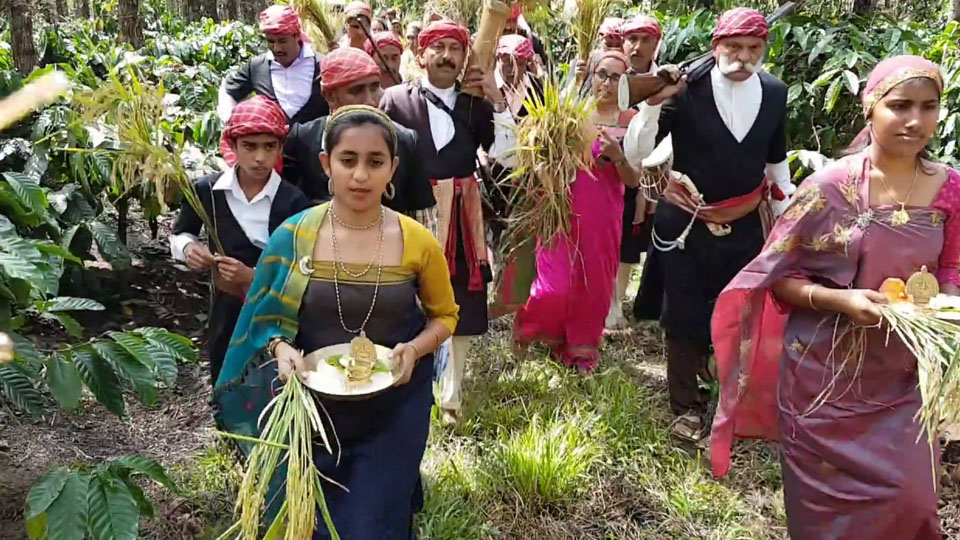
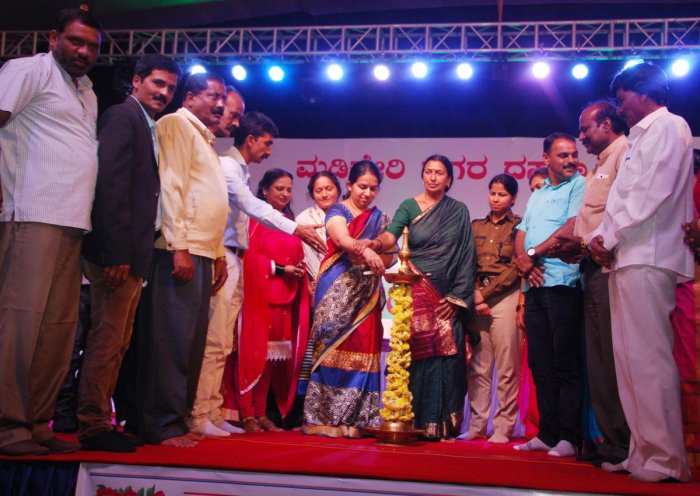
The State Government has declared a holiday to Kodagu district on Nov.24 on account of Huthri Festival.
The holiday will be applicable only to Kodagu district and has been granted by Dr. B.S. Manjunath, Under Secretary, Department of Personnel and Administrative Reforms.
source: http://www.starofmysore.com / Star of Mysore / Home> News / November 05th, 2018
Coffee is indisputably one of the most favourite and widely consumed beverages in the world. It is estimated that more than 200 crore cups of coffee are consumed by people around the globe on a daily basis. The coffee plants originated in the African continent, and Arabica and Robusta are the most commonly grown varieties.
The tale of coffee
There are many legendary accounts related to the origin of the coffee. The most popular among them is the tale of Kaldi, the Ethiopian shepherd, who noted how his goats have become excited and active after eating the leaves of a plant which bore red shiny seeds. He took the leaves and seeds of this plant to the nearby monastery to know more about it. It is said that the monk at the monastery brewed a special drink using the seeds brought by the shepherd. After drinking the concoction, the monk discovered that he could indulge in his works with renewed energy and remain wake at night to offer prayers. So many believe that the first cup of coffee was brewed in an Ethiopian monastery by a monk.
It was in a 9th century document that coffee was mentioned for the first time. Crassus, a Persian apothecary has written about a drink called bunchum. It was noted that bunchum was brewed from a fruit called bun, which means coffee beans in the Ethiopian language. Historians thus surmise that Craussus had mentioned about coffee brewed from coffee beans. In the meantime, Arab merchants had begun cultivating coffee plants in Yemen, which were brought from Ethiopia. Their coffee cultivation was based on the hilly areas in the south western parts of Yemen. This coffee variant, known as Arabica, had reached almost all the Arab countries as well.
Turkish brew
Ozdemir Pasha, the Turkish Ottoman governor of Yemen had taken tons of coffee to Istanbul. He, in fact, is credited for introducing coffee to Turkey. It was the Turkish people who brewed the coffee, for the first time, in the way in which it is consumed today. They roasted the coffee seeds, ground it to fine powder and then mixed in hot water to make the beverage. As per the historical records, the Ottoman emperor Suleiman had created a special title called the ‘chief coffee maker,’ and the person who bore that title enjoyed a special position in his royal court as well. It was during the reign of the Ottoman Empire that coffee reached various parts of the world and became one of the most prominent drinks.
Unique flavour
In this image taken on May 13, 2013, glasses of cold-brewed iced coffee for summer are shown served on a tray in Concord, N.H. (AP Photo/Matthew Mead)
By the 17th century, coffee had become popular in Europe and North America. When Britain imposed tea tax in America in 1773, the Americans resorted to coffee. The Arab merchants tried to retain their dominance in coffee export when the demand increased significantly in Europe and America. They had exported only roasted coffee beans or the seeds which were boiled in water, to prevent the cultivation of coffee in other parts of the world.
However, the Dutch, French, and the Portuguese had begun coffee cultivation at their various colonies around the globe. The Dutch had cultivated coffee in South East Asia, while the French had coffee plantations in the Caribbean islands. The Portuguese, too, had large plantations in their South American colony, Brazil. By the 1830’s Brazil became the largest exporter of coffee in the world, and still continues its leading position in coffee export followed by Vietnam and Colombia. Robusta coffee which originated in the central and western Africa is largely grown in Vietnam.
Coffee in India
It was Baba Budan, a Sufi monk who is believed to have smuggled coffee out of the Yemenese harbour town Mocha to India, while returned from a pilgrimage to Mecca. There are many portraits of Baba Budan in which he is portrayed as smuggling 7 coffee seeds by hiding them under his long beard or strapping them onto his chest. It is said that Baba Budan, who was a resident of the Chandragiri hills in Chikmanglur, Karnataka, had grown those coffee seeds here in 1670. Today, these hills are known as the Baba Budan hills. In 1870, the first first coffee plantation in India was set up near the Baba Budan hills. J H Jolly, who was the manager of the Parry and Company, had requested the king of Mysore to allot 40 acres of land for coffee cultivation. Later, the coffee reached other places in south India like Wayanadunand Nilgiri.
Indian special
Though the British had tried to cultivate coffee in India, it wasn’t as successful in the beginning.They had faced a backlash when the Arabica variety was affected by the coffee rust disease. However, in the 19th century the British had managed to grow coffee in more than 3 lakh hectares of land. In the initial stages, the coffee plantations were opened mainly in places like Mysore and Coorg, and the Robusta variety was grown here. Later they began to cultivate S795 variety of the Arabica coffee which was immune to the coffee rust disease.
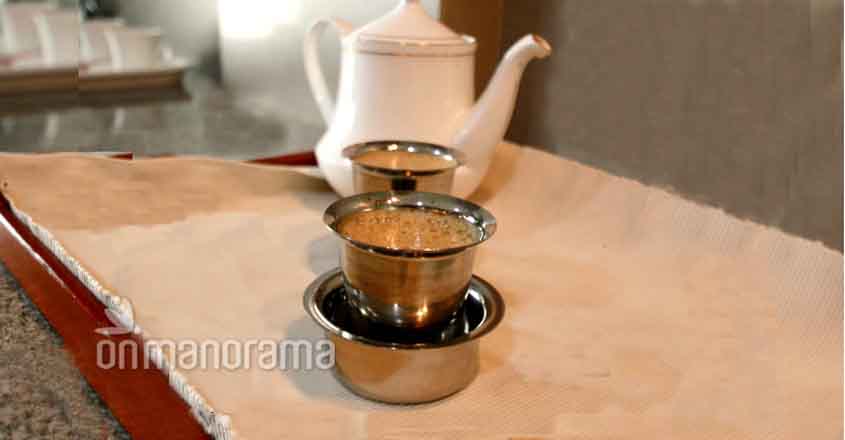
In the mid 19th century, India emerged as a leading exporter of coffee. But the market crashed due to the severe financial constraints which arose during the world wars. To effectively tackle this a coffee cess committee was formed in 1935. As per their recommendations, Indian coffee house outlets were opened in 1940. It was during this time that the renowned Indian filter coffee emerged.The filter coffee prepared by mixing roasted coffee beans, chicory, milk, and sugar became instantly in popular in South India. The Coffee Board of India was formed in 1945 to regulate the coffee exports exports and to aid the small scale coffee cultivators.
The Indian Coffee House
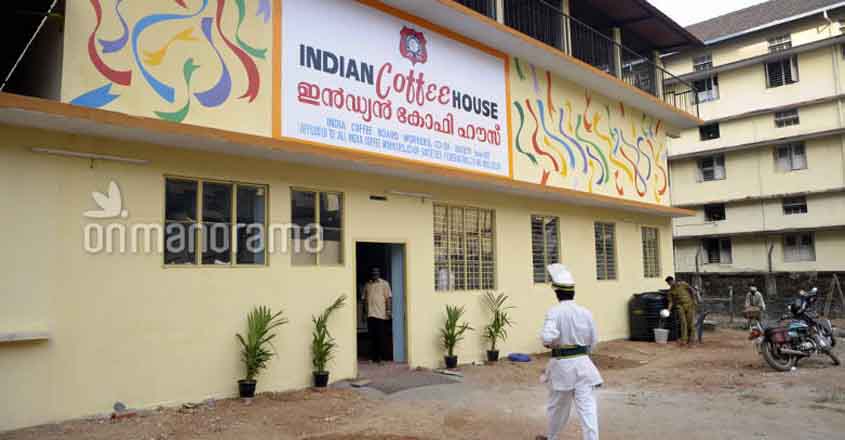
In the 1950’s, the Coffee Board of India decided to shut down the India coffee house outlets opened during the British era, and to terminate the labourers who worked at these outlets. However, the labourers, led by the charismatic communist leader A K Gopalan, formed the India Coffee Board Workers’ Cooperative Society on 19 August 1957 at Bangalore. The first outlet of the Indian Coffee House was thus opened, in the same year, in Delhi. The next year, the Indian Coffee House was opened in Thrissur, making it the first outlet in Kerala. More outlets of the iconic Indian Coffee House were opened at various places like Thalassery, Lucknow, Nagpur, Jabalpur, Mumbai, Calcutta, Pune, and Tamil Nadu.
Expensive brew
It is in the south Indian states that coffee is cultivated in abundance. Karnataka produces 71% of the total coffee production while Kerala has 21% and Tamil Nadu produces 5%. The Indian coffee is in great demand around the globe as coffee here is mostly grown in mixed farming, getting ample shade under the cardamom, clove, nutmeg, and cinnamon crops. The Indian Monsoon coffee has a distinct flavour and aroma. There are coffee plantations in states like Andhra Pradesh, Odisha, and many north eastern states as well.
The unique coffee produced by the tribal people of the Araku valley in Andhra Pradesh is one of the most famous organic coffee brands in the world. The Araku brand of coffee has achieved an international honour by winning the Prix Epicerie Award 2018. It is for the first time that an Indian coffee brand has won this prestigious award. The brand which sells 100% authentic Arabica coffee now has an outlet in Paris as well. Five different varieties of Araku coffee are sold at this outlet, and the premium coffee variant costs up to Rs 7000 per kilogram.
source: http://www.food.manoramaonline.com / OnManorama / Home> Food> Foodie / by M Muhammmad Shafi / November 02nd, 2018
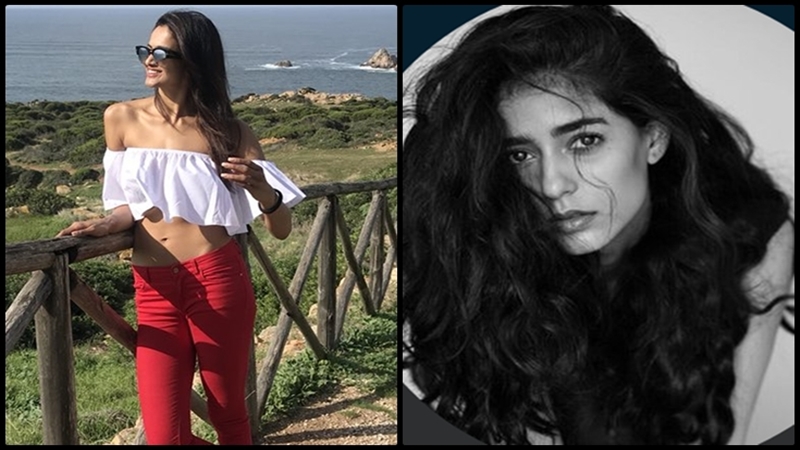
Actress-models Shubra Aiyappa and Diva Dhawan, who will be featured in Kingfisher Calendar 2019, say that shooting for it was a truly memorable experience. Commenting on her experience shooting for the Kingfisher calendar, Shubra said, “Being a part of this year’s Kingfisher calendar campaign was indeed a one of a kind experience. I was quite nervous in the beginning as this is my first swimsuit shoot, however the whole journey was a lot of fun. Working with a crew, who have been shooting the Kingfisher calendar for more than a decade was truly an unforgettable moment.
“The calendar has been shot in some stunning locations across the globe, but this year’s destination Sardinia was indeed a wanderlust paradise. We shot some stunning swimwear in some gorgeous locations and are still recovering from the Sardinian after-effect. There was never a dull moment or a time where I didn’t feel comfortable, only vibes I felt were the Good Times. Looking forward to the years Kingfisher Calendar.”
Diva Dhawan also shared her thoughts on being part of this year’s calendar shoot. “Being a part of the Kingfisher calendar was truly a great experience indeed, as it celebrates Indian women and beauty in all forms. I think it’s nice to be part of something that has been around for so long because everyone in the team has been working together for years. The Kingfisher calendar truly was a memorable experience,” she said.
Kingfisher, The King of Good Times, has the calendar featuring four top models shot by ace photographer Atul Kasbekar.
The other two ladies who will be part of the calendar are beauty queen from Orissa Sushrii Mishraa and Hayley Parr from the United Kingdom. Sardinia, a gem of an island in the Mediterranean Sea, will form the breathtaking backdrop for the Kingfisher calendar 2019.
The Kingfisher calendar has featured stars like Deepika Padukone, Katrina Kaif, Nargis Fakhri, Liza Hayden over the years.
source: http://www.freepressjournal.com / Free Press Journal / Home / by IANS / October 31st, 2018
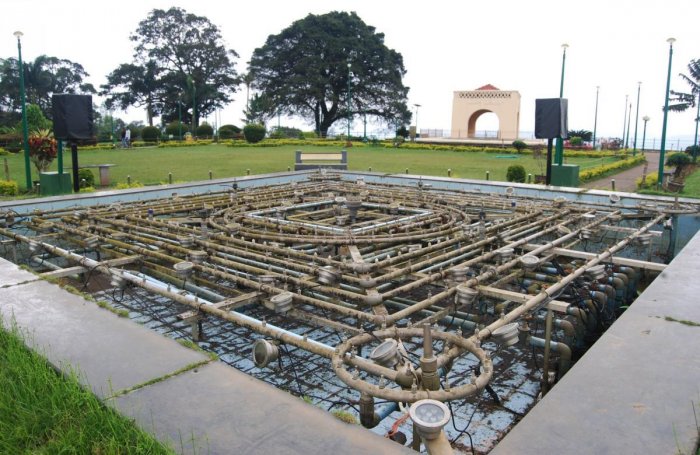
A view of the defunct musical fountain at Raja Seat.
Deputy Commissioner P I Sreevidya directed officials from Horticulture department to organise the flower and fruit show at Raja Seat in Madikeri in the first week of January.
Speaking at a meeting on the development of Raja Seat and Gadduge park on Monday, she said that flower show will be organised to attract tourists to the district. The repair of musical fountain and toy train at Raja Seat will also take place, at the at the earliest.
She said that staff should be deployed for the maintenance of Raja Seat and Gadduge, and emphasis should be laid on its cleanliness.
Stating that there are several parks in the district, she said she had been receiving complaints on lack of maintenance of parks. The parks should have enough lights and CCTV cameras must be installed, during the event.
Horticulture department Deputy Director Chandrashekar, Senior Assistant Director Devaki, CMC Commissioner M L Ramesh and others were present.
source: http://www.deccanherald.com / Deccan Herald / Home> State> Mangaluru / by Naina JA / DH News Service, Madikeri / October 31st, 2018
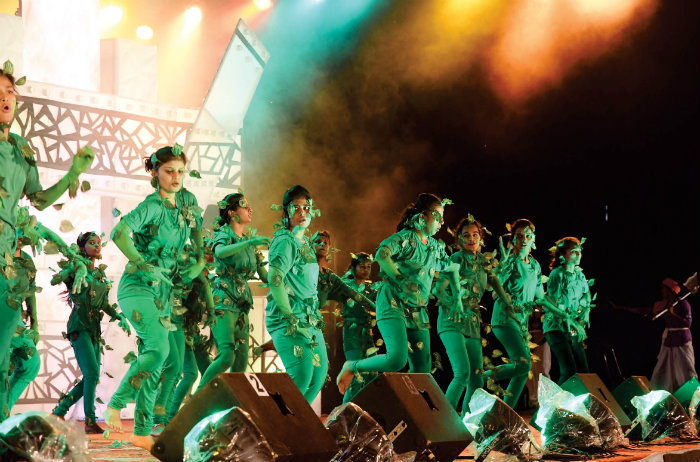
The seventh day of Dasara Yuva Sambhrama held at the Open Air Theatre in Manasagangothri here last evening saw the participating students sending out messages on Water Conservation, Save Kodagu and Swachh Bharat through their songs and dance.
While the students of Government Arts, Commerce and PG College, Hassan, gave a message on conservation of environment and water, the students of Virajpet First Grade College presented a dance drama for the song ‘Janana-Janana Yarado Papa, Marana-Marana Yarado Shaapa.’ The students later highlighted the devastation caused by floods and landslides in Kodagu and gave messages on the importance of forest conservation.
The students of Jnanadeepa First Grade College danced to the song ‘Mysuru Dasara Yeshtondu Sundara’ which received appreciation from the audience. JSS Women’s College students of Chamarajanagar, all dressed in green, walked up on the stage and highlighted the importance of conserving, protecting and planting trees besides sending out messages on conservation of forests.
Messages such as women empowerment by students of Devaraja Girls Government PU College, Indira Gandhi Government FGC, Sagar, on Kannada and Culture, Madikeri’s Field Marshal K.M. Cariappa College students on Freedom Struggle and Mangaluru’s Dr. P. Dayananda Pai-Dr. P. Satish Pai FGC students sent out a message on Swachh Bharat through their dance.
source: http://www.starofmysore.com / Star of Mysore / Home> News / October 07th, 2018
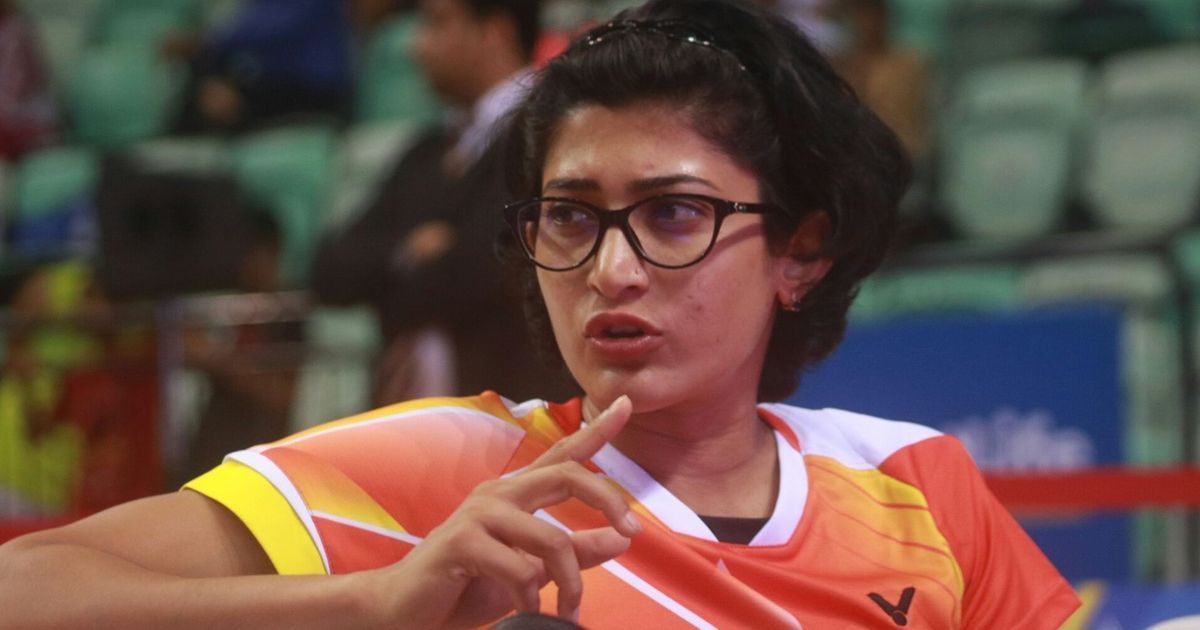
The ace Indian shuttler said she felt ‘lucky and blessed’ that she had not faced any sort of sexual harassment in her career.
Ace Indian shuttler Ashwini Ponnappa on Monday backed the country’s #MeToo movement against sexual harassment, saying it’s important to stand by the women who are sharing their experiences.
Since October 5, several women have used social media to make allegations of sexual harassment and misconduct against several journalists, media professionals, actors, writers and others.
“In a nation like India, you need to be tough and careful as well,” Ashwini said. “It’s important to stand by them, listen to them and give them strength and courage. It’s not easy to speak up and voice your opinion.”
Ashwini said she was “lucky and blessed” that she had not faced any sort of sexual harassment in her career. “It’s quite unfortunate with all the things I have read and that’s happened,” she said. “But all I can say is that I am fortunate in that respect that I don’t have much to complain about or say. I am grateful for that.”
Ashwini was speaking to reporters in Kolkata while promoting the inaugural Badminton Express League. The all-amateur meet will have six teams with 14 players each, who will compete for top honours at the Ordnance Club from November 28 to December 2.
Ashwini and her current partner N Sikki Reddy caused a massive upset at the recent Denmark Open, ousting seventh seeds Lee So Hee and Shin Seung Chan of South Korea to make the quarter-finals. Their fine run came to an end against top seeds Yuki Fukushima and Sayaka Hirota in the quarter-finals.
“It’s important to understand that when you play doubles, you win and lose together,” Ashwini said. “Sikki and I had a great quarters match and that has given me a lot of confidence that we are going in the right direction.”
She added, “In the quarters [of the Denmark Open] against the Japanese, we tried doing the same as we did against the Koreans. It did not work. We cannot have the same game style against everyone. We need to get better in a few tactical areas too. It’s important to have something special so that we work it towards the end.”
With the Olympics in two years time, Ashwini said she and Sikki are hopeful and working extremely hard to get better. “We are stretching the top players and it’s about time we start winning,” she said.
“Satwik [Rankireddy] and Chirag [Shetty] have had a great run. Sikki and I have had great matches, Satwik and I have had great matches. We are going to do everything we can to qualify and win a medal.”
With inputs from Scroll Staff
source: http://www.scroll.in / Scroll.in / Home> Field> Badminton / Press Trust of India / October 30th, 2018
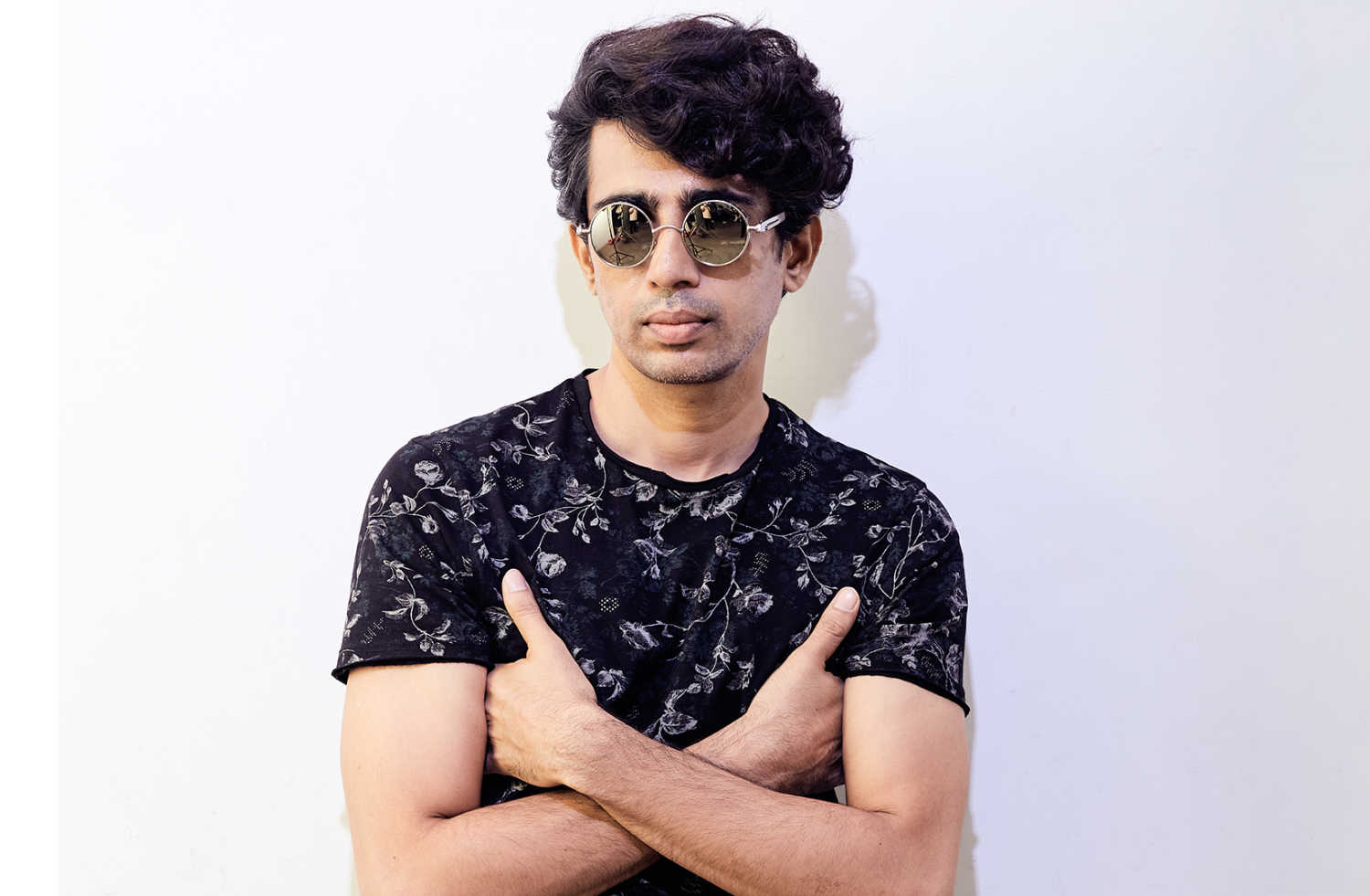
The Mard Ko Dard Nahin Hota (2018) actor speaks about his upcoming roles in Eros Now’s Smoke and Commando 3.
More and more actors and actresses are being drawn to web-series these days. From Amazon’s Inside Edge to Netflix’s Sacred Games, all have boasted of versatile ensemble casts. Now it is the turn of Eros Now to unveil its latest online series, Smoke.
The show, which take a look at the drug mafia in Goa, stars Jim Sarbh, Kalki Koechlin, Mandira Bedi, Gulshan Devaiah, Amit Sial, Satyadeep Mishra, Neil Bhoopalam, Prakash Belawadi, and the late Tom Alter.
Actor Gulshan Devaiah spoke to Cinestaan.com about why he took on the role of gangster Jairam Jha in the web-series.
“When the producers came to me, they offered me the character of Jairam Jha who is from Bihar. Being a proper South Indian, I thought it was pretty gutsy of them to offer me a role of a Bihari,” he recalled.
He told the producers he would need time to prepare. But he later agreed to the part, saying, “I take a lot of confidence in people having a lot of confidence in me.” That person was producer Faisal Malik, who had faith in Gulshan Devaiah’s abilities.
“I don’t buckle under such pressure, I thrive,” the actor continued. “I want to try and I do believe that I am a versatile and diverse artiste. These are opportunities that I jump upon when they come to me. This is an opportunity where I can actually put my money where my mouth is. So I was really happy. That’s one of the main reasons why I wanted to do this.”
Further, he believed in the producers and directors on the web-series who wanted to raise the digital content being produced in India.
“I think we suffer from not paying enough attention to quality,” he said. “These people that I was working with, they seemed like they had their hearts and minds in the place where they would say that we want to make something entertaining, that people will like, but we want to make a good product at the end of the day which will take this genre forward in a positive direction. I was in agreement with that.”
source: http://www.youtube.com
SMOKE Trailer | An Eros Now Original Series | All Episodes Streaming Now
Smoke’s impressive cast was another strong selling point. Asked if he knew who was working on the project before he signed up for it, the actor replied in the affirmative.
“I knew everybody that I was working with,” he said. “I didn’t know them personally. It was the first time I was working with Mr Tom Alter, who was such a fine actor and a thespian. We will surely miss him. Mandira Bedi is also a proven actor and it was fantastic to work with her. Kalki and Neil are friends, so it was easy with them.
“Amit Sial, whom I have always admired, he is a fabulous actor and it was a great opportunity for me to work with him and another gentleman from Bangalore called Prakash Belawadi who is a very prominent theatre person,” he continued. “They put together an interesting and diverse cast so that was also an incentive to see how it would be.”
The web-series, directed by Neel Guha, examines characters through the lens of greed and power.
“It looks at greed and power from different perspectives, of all these characters. They are all after the same thing. Everything is in grey and there are different shades of grey depending on the situation and on who they are and what they want. So it looks at that, which is an advantage in the case of Smoke, because in a film it would be a much more narrowed down point of view, and greed and power are things which are very common and we are suffering the effects of that as we speak.”
Besides Smoke and his double role in Vasan Bala’s Mard Ko Dard Nahin Hota (2018), Gulshan Devaiah has also signed on to play the antagonist to Vidyut Jammwal’s lead character for the third Commando film, for which shooting has begun. The actor joked that he did not require any training for the film as he already knows karate after training for Mard Ko Dard Nahin Hota.
“My attempt is always to try and do something different, try and see how I can create and contribute,” he said. “This, to put it simply, would be an out-and-out commercial film. I also feel that I don’t restrict my sensibilities as an artiste to certain kinds of films. Sometimes, you have to do as many films as possible.”
He sat down with the film’s producer and director to work out how his character would take shape.
“We play villains like villains. That’s exactly what I’m not trying to do. For the sake of everybody understanding how exactly I fit in, it’s the antagonist, but from my point of view, I’m not playing it as the antagonist. I would completely disagree and say I’m not the antagonist, I am the protagonist,” he said.
With his approach he hopes to give fans of the Commando franchise something exciting to look forward to. The third Commando film is scheduled for release in 2019 while the 11-episode web-series Smoke was made available for streaming on Eros Now on 26 October.
source: http://www.cinestaan.com / Cinestaan / Home> Interview> Hindi / by Sonal Pandya / Mumbai – October 28th, 2018
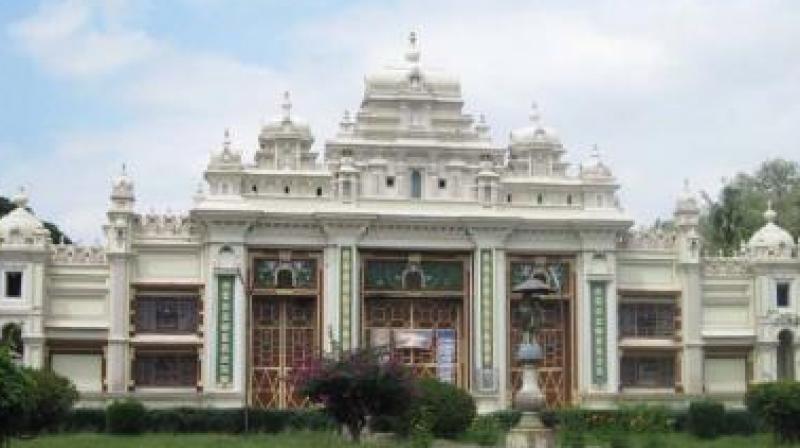
As many 25 poets read out their works in Kannada and five others read out theirs in Sanskrit, Hindi, Tulu, Kodava and Konkani. Main section of the three- day poets meet held at the Jaganmohan Palace on Monday
Mysuru:
The Kodagu disaster and the environment concerns that it has thrown up seemed to be on the minds of several poets at the “Dasara Pradhaana Kavighoshti,” the main section of the three- day poets meet held at the Jaganmohan Palace on Monday.
As many 25 poets read out their works in Kannada and five others read out theirs in Sanskrit, Hindi, Tulu, Kodava and Konkani.
Both 71- year- old, Dr T Govindaraju, who recited his poem in Kannada and Cauvery Udayam, a poet from Kodagu, who recited hers in Kodava , focused on the recent floods and landslides in Kodagu. Dr H S Rudresh, meanwhile, read out his poem on the late former Prime Minister, Atal Bihari Vajpayee.
Thirty two children recited their poems at the first day of the poets’ meet, “Chiguru Kavighoshti” which was held on October 12 and 31 more the next day.
source: http://www.deccanchronicle.com / Deccan Chronicle / Home> Nation> Current Affairs / by Shilpa P, Deccan Chronicle / October 16th, 2018
We head to where the beans grow in India to discover the country’s nuanced flavours.
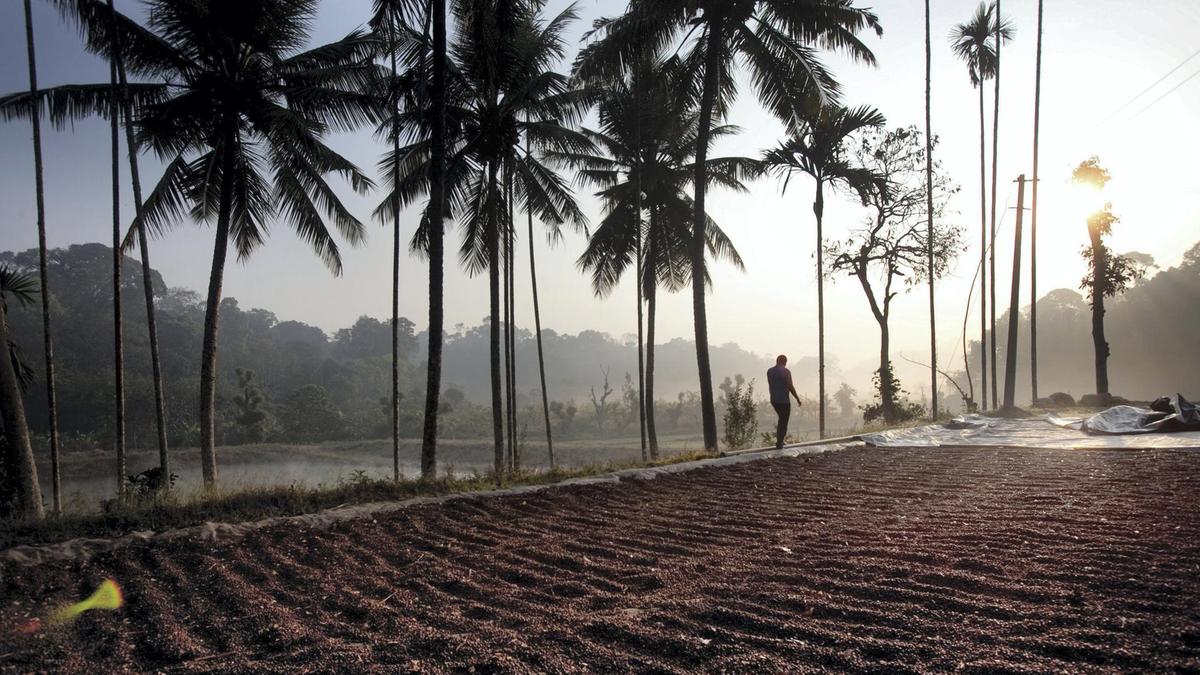
Coffee berries left out for dry processing on a farm in Coorg, India. Bloomberg
It is still early in the evening, with a few hours to go before sunset, but all I can see outside is the swirling mist. When I had checked into at my resort a few hours earlier, the view from the balcony of my room was a lush carpet of green. Now, it’s white blanket. But I am not surprised. After all, this is Coorg, in south India, and I’m visiting during monsoon months, when the fog sweeps over as soon as there’s a break in the rain.
The scenery on my way from Bangalore changed dramatically once I entered the area; crowded highways turning into narrow lanes and commercial activity making way first for emerald paddy fields and then undulating hills dotted with seasonal waterfalls and sprawling plantations. It is obvious that Coorg is a blessed land; a variety of spices growing with abandon across this tiny region – pepper, cardamom, nutmeg, clove and even honey. The undisputed star of Coorg, though, is coffee.
Known in the local language as Kodagu, Coorg is part of the region in south India where coffee first arrived in the country. Legend has it that Sufi saint Baba Budan was delighted when he discovered coffee during a pilgrimage to Makkah, sometime in the 17th century. And on his way back, via the port of Yemen, he hid a few beans in the folds of his robes. As celebrated novelist R K Narayan wrote in his book A Storyteller’s World, “The origin of Indian coffee, thus, is saintly. It was not an empire builder or a buccaneer who brought coffee to India but a saint, one who knew what was good for humanity.”
“Indeed, he did,” I think, as I sip on the frothy brew at the coffee shop of The Tamara resort the next morning. Located within a functioning organic coffee plantation, the property is proof of how easily coffee travelled from Baba Budan’s base in the town of Chikmagalur to nearby Coorg, and how well it flourished in the wet, hilly landscapes there. The Coffee Board of India estimates that more than 70 per cent of the country’s beans are grown in Karnataka, almost entirely in Chikmagalur and Coorg, and are used for both domestic consumption and exports to Europe.
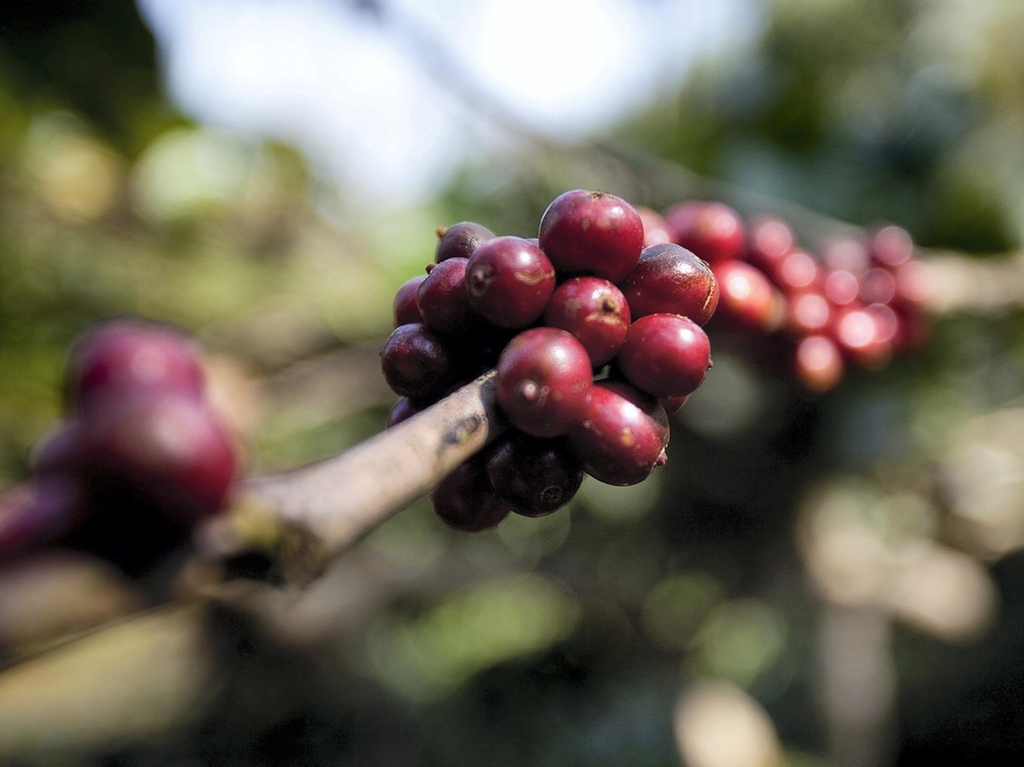
he fresh fruit that bears the beans. Bloomberg
The cup is my reward at the end of a two-hour walk through the coffee estate with Sareesh Kumar, the resident naturalist who seems to know the names and qualities of practically every plant on the trail. The rain has let up for the morning, and I am exhilarated by the hike through a thick canopy of silveroak and rosewood trees with pepper vines snaking around their tall trunks. Sunlight barely filters into the Arabica and Robusta shrubs all along the path, and the air is crisp and refreshing.
Kumar extols the moody nature of the coffee plant that demands great care and attention along with shade, and describes the taste differences between a brew made from Arabica and Robusta beans. I listen to him with half an ear as I lean towards the plump fruit in the vain hope of smelling coffee. He smiles at my enthusiasm, saying the berry has a long way to go before it reveals its true colours, or in this case, aromas and flavours.
And then it’s quiz time: “What does the coffee flower smell like?” he asks me. I know enough by now not to say “coffee” but I take a lame stab at the response anyway. It turns out, it’s jasmine. That’s what the sneaky coffee flower smells and even looks like.
It is an easy walk, with caterpillars and leeches, parakeets and hornbills, waterfalls and streams for company all the way. Before we know it, we fetch up in front of the small cafe that doubles as souvenir shop. It’s time for the “Blossom to brew” lesson. I learn to select, roast and powder my own coffee beans. Ah, finally, that aroma I have been dreaming of. And then I get to make my own drink. The south Indian in me can allow nothing other than local filter kaapi (a strong drip decoction lightened with hot milk and sugar) and I sit back to enjoy what I consider my personal blend.
On my way back home, I take a detour for a slice of Tibet. Bylakuppe is the second-largest hub – after Dharamshala – for Tibetan monks in India who followed in the footsteps of their spiritual leader, the Dalai Lama, some 60 years ago.
The cluster of monasteries, stupas and residential areas (divided into old and new Camp) was built in the early 1970s on land given as a gift to the community by the king of Mysore. The most famous of these temples is the Namdroling Monastery with its golden roof (it’s also known as the Golden Temple), that beckons to visitors from a great distance. Turning off the main road, we drive through dusty lanes where the only colour is that of prayer flags fluttering in the morning breeze and the maroon and yellow robes of monks walking in small groups or riding their motorbikes with great style.
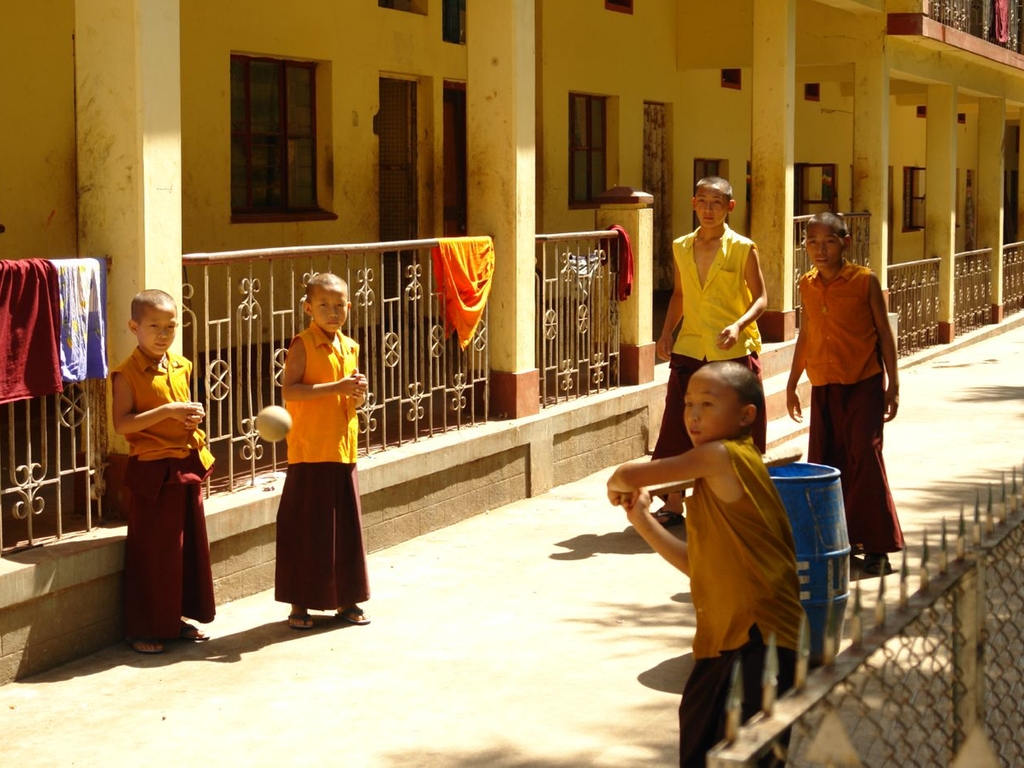
A monastery in Bylakuppe, a hub for Tibetan monks in India. Charukesi Ramadurai
While the tourist crowds throng the premises of the temple, taking photographs from all angles, bargaining raucously with local vendors and arguing over where to find the best thukpa and momos in the neighbourhood, it is a completely silent tableau inside. There are three gigantic gilded statues of Buddha, in his states as Shakyamuni, Padmasambhava and Amitayus. On one side of the room, I spot a row of monks poring over their scripture books and chanting in low tones. On my walk around the monastery, I come across another group of monks – young, barely in their teens – engaged in a boisterous game of cricket. I realise then that this Tibetan community here is much like coffee itself: both are settlers from another country who have made Coorg home.
Of course, there is more to Coorg than coffee. History residing in the old temples and ruined forts near the town of Madikeri and adventure that ranges from easy treks to canoe rides all over the region. Then there are the popular picnic spots like the perennial Abbey Falls, the Dubare Elephant Camp and the Talacauvery shrine, from where the River Cauvery (held sacred by locals) originates.
But I ignore all these attractions to stay put in my room, watching the clouds play hide and seek with the green hills.
source: http://www.thenational.ae / The National / Home> Lifestyle> Travel / by Charukesi Ramadurai / October 18th, 2018
Deputy Commissioner P I Sreevidya inaugurates cultural programmes at Gandhi Maidan in Madikeri on account of Dasara celebrations on Friday night.
Heavy music, youth dancing to the tunes of the music, Dashamantapas depicting mythological themes, bhajan, dance, and Kodava traditional music along with a large number of spectators were the highlight of Dasara Shobhayatre which continued till the early hours of Saturday.
After the landslides and flood that ravaged the district in August, organisers of Dasara in Maikeri and Gonikoppa were doubtful of the celebrations.
However, with the efforts of the committees, Dasara was celebrated in a simple manner at Madikeri and Gonikoppa.
Cultural programmes were held in Gonikoppa for few days while in Madikeri, cultural programmes was restricted to Vijayadashami day.
The welcome dance by Kings of Coorg, a bhajan by Ramanjaneya Bhajana Mandali, Kodava dance by Kanoorina Sullimada Gowramma and team, a dance ballet reflecting the culture of Arebhashe language speaking people by Kudekal Santhosh, Kodava dance by Kanoorina Gejjetanda, Ganasude by Samveditha, folk dance by Gandharva in Somwarpet, and Thiruvathira by Malayali Sangha unfolded the cultural diversity of the state.
This year, prizes were not announced for the Dashamantapas (10 tableaux).
Each mantapa was given a sum of Rs 2 lakh. A few mantapas had also given priority to simplicity.
A large number of visitors lined up on the either side of the main streets of the town where the tableaux passed to get a glimpse of the Madikeri Dasara.
Compared to previous years, the number of visitors were less. All the tableaux were disciplined in their performance.
The visitors who had come to take part in Shobhayatre were tired of searching for wine shops as the district administration had prohibited the sale of liquor in a 10-km radius of the town.
A few miscreants who were creating public nuisance before the commencement of the procession of tableaux had to face lathis.
‘Rebuild Kodagu’
Deputy Commissioner P I Sreevidya called upon the people to join hands with the district administration in rebuilding Kodagu district.
Speaking after flagging of cultural programmes organised by Dasara Samithi and the Kannada and Culture Department on Friday, she said, “Dasara was celebrated traditionally in a simple manner.”
SP Suman D Pennekar said, “Dasara represents victory against evil forces. Similarly, we have to keep away bad forces and work towards leading a peaceful life.”
Dasara Samithi President Kaveramma Somanna said, “In the backdrop of the natural calamity, a few programmes were cancelled during Dasara celebrations. Let us pray for the Shakthi Devathas to protect the district in the coming days.”
source: http://www.deccanherald.com / Deccan Herald / Home> State> Districts / by Adithya KA / DH News Service, Madikeri / October 20th, 2018
WELCOME. If you like what you see "SUBSCRIBE via EMAIL" to receive FREE regular UPDATES.
Read More »