Category Archives: Arts, Culture & Entertainment

From forest to plate in Coorg

Foraging has long been a way of life for wild-food loving Coorg
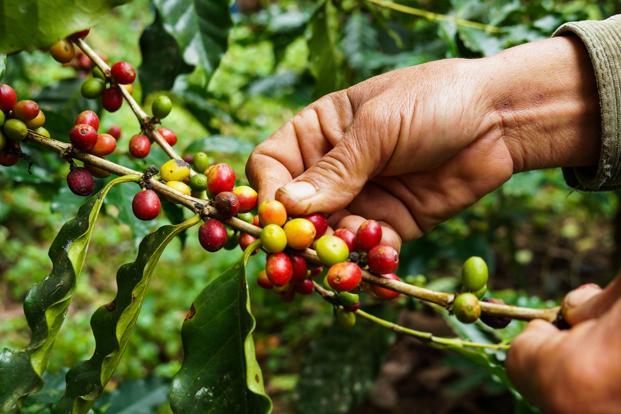
Coffee-picking at an estate in Coorg. Photo: iStock

René Redzepi, the foraging genius who stormed the culinary world with his New Nordic cuisine, would have a lot to smile about in Coorg. Here foraged ingredients don’t just put in an occasional appearance but are the main attraction, making Coorg an interesting region for true-blue wild-food pioneers. The eastern declivities of the Western Ghats that make up Coorg are extensively clothed in forests. Shade-grown coffee plantations offer the ideal habitat for rare flora and fauna to thrive as do sacred groves or devakads, designated as protected forests under the Indian Forest Act.

Against this backdrop is a staggering bounty of indigenous greens, weeds, flowers, fruits, berries, nuts, mushrooms and shoots, many of which play a starring role in the local cuisine.

Gazetteer Of Coorg, first published in 1870, devotes reams to Coorg’s jungle bounty: wild pepper, wild ginger, wild cloves, bitter local oranges known as kaipuli, rose apples, jungle mangoes, bastard sago—esteemed for its toddy—hog plums, several kinds of bamboo shoots, and an alphabetical list of over 60 ferns.

Locals keep their eyes open to what’s growing around them, constantly sizing up culinary possibilities. Freshly plucked cape gooseberries go into jams, a tangle of greens are added to stir-fries, and fronds of tender bracken ferns get pickled and ground into chutneys.

Kaveri Ponnapa, author of The Vanishing Kodavas, says in one of her earlier articles on Coorg: “Most women of my mother-in- law’s generation who lived on coffee plantations never set out on a stroll without the equivalent of the Russian avoska, the ‘maybe’ or ‘perhaps’ mesh bag—you never knew what surprise the season would throw your way.”

Several ingredients are unique to these parts. Like kachampuli, the dark vinegar made from the concentrated juice of the garcinia gummi-gutta fruit (called panapuli locally), which adds a sour kick to pork and fish dishes. And the famous Coorg honey, made from wild roses and forest blooms, which locals drizzle on akki ottis or rice rotis, and eat with ghee for breakfast.

Naveen Alvares, executive chef at Evolve Back Chikkana Halli estate, attributes this love of indigenous ingredients to Coorg’s unique geography and culture. “Kodavas, who make up most of the population, are ancestor worshippers and eat what is available off the land. Most have a plantation background or a sacred forest, so the connect with the land is very strong,” he says.

Walking through the resort’s lush plantations, among the oldest in Coorg, I see the coffee-forest symbiosis in full bloom. Coffee bushes sit beneath a canopy of silver oak trees that support festoons of black pepper. Ginger and turmeric, planted for intercropping, dot the forest floor. Jackfruits hang from trees. You can hear red-whiskered bulbuls chirruping.

Several exotic edibles are to be seen, many of them unconventional in the Indian context. As I stop to admire the bizarre artistry of a passionflower, Alvares smiles, “This is what makes Coorg special. It’s wildness.”

Dinner is a knockout pandi curry. The dark colour and complexity of this most iconic of Coorg pork dishes derives from dark roasted spices and kachampuli, a souring agent Alvares clearly loves.

I drive down from Siddapur to Madikeri the next day. The hour-long journey is jawdroppingly scenic. Acre after acre of coffee plantation presents itself, occasionally punctuated by the whoosh of a waterfall or the brilliant blue of a kingfisher.

A treasure trove of mushroom diversity, the Western Ghats are home to 750 species. Edible fungi known as kummu grow wild on Coorg’s hills and are highly prized for their exotic flavour. Vancouver-based blogger Shalini Nanda Nagappa mentions several varieties in her blog, A Cookery Year In Coorg—“feathery, delicate nucchi kummu and kokkalé kummu, succulent aal kummu, the giant nethalé kummu,..and the decidedly meaty pandi kummu.”

Only locals who carry with them an intimate knowledge of when, where and how to harvest the edible varieties can procure them, Nagappa points out. As a result, these treasures rarely make it to local markets and remain confined to the kitchens of plantation owners and local villagers.
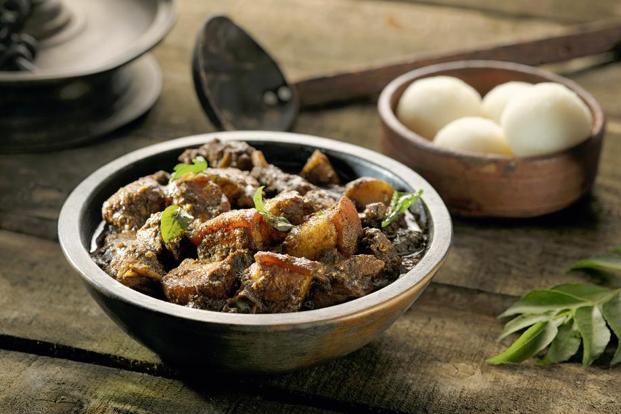
'Pandi curry' at the Evovle Back resort.
‘Pandi curry’ at the Evovle Back resort.

The pleasures of kummu elude me during this visit, but I do feast on other Kodagu treats at Coorg Cuisine, a popular local restaurant in Madikeri. My lunch companion is M.B. Kumar, a Madikeri-based Kodava agriculturist and plantation owner. The wild mango curry, made with small jungle mangoes or kaad maange and black jaggery, is by turns sweet, sour and peppery. It’s unlike anything I’ve ever tasted. Chewing on a mango kernel, it is love at first bite.

The smoked pork, known as chillkana pandi, packs a meaty savouriness, while the freshness of the forest pervades a bowl of lightly fermented and sauteed baimbale or bamboo shoots. There’s pandi curry, of course, intensely flavoured and addictive as always. And akki ottis and kadumbuttus (rice balls) to mop it all up with.

To put pork’s near sacred place in Coorg’s cuisine in context, Kumar narrates a colourful legend. When Parvati expressed a desire to see Arjuna’s back (the great warrior never showed his back—a sign of weakness—during war), Shiva disguised himself as a hunter and shot a wild boar that Arjuna’s arrow had pierced. An altercation followed. As Arjuna fell over his opponent, his back was revealed, granting Parvati’s wish. A shower of flowers fell from the heavens and the pork was distributed as prasad to the hunting party.

The yarn illustrates the extent to which Coorg’s geographical seclusion has shaped its unique cuisine. “While we Coorgs (Kodavas) treat pork as prasad and offer it to our ancestors during rituals, it would be considered blasphemous to go anywhere near pork in neighbouring Mysuru,” Kumar laughs.

As we eat, Kumar draws my attention to the age-old tradition of foraging for monsoon greens, known as thoppus in Coorg’s interiors. The repertoire of seasonal weeds is dazzling. Thatte thoppu has a slightly bitter taste but tastes delicious with akki ottis and a little ghee; kakke thoppu with its purplish-black fruit is effective in deworming; therme thoppu or bracken ferns taste good simply sautéed with onions and pair divinely with eggs.

During mid-monsoon, on the 18th day of a period known as kakkada, Kodavas pick the leaves of a wild plant called madd thoppu and extract its juice to make a payasam.

The bustling Friday market in Madikeri is chock-full of these supergreens and more. Kembe (colocasia leaves) and kaipuli are up for grabs as are spices and meat. Walking around, it becomes abundantly clear that Kodavas are not just master harvesters, they’re also skilled at altering foodstuffs for preservation by yeast and bacteria. A huge assortment of jams and pickles made from the spoils of the land lines the local stores. Everything is home-made and unbranded.

On my last morning in Coorg, I drop in at Coorg’s Progressive Beekeepers Co-op Society store and pick up a bottle of wild honey to take back home. As I make my way to Bengaluru to catch my flight, the resinous, sour-sweet taste of kaad maange lingers on my tongue.

Wild foods, which grow in their natural habitat without fertilizers or pesticides, don’t deplete the earth’s resources. And they taste incredible. What if we, like Kodavas, thought of the forest as our pantry? Let’s tap into our vast underutilized permacultures and support the foragers who gather these ingredients. Let’s showcase our native treasures at the finest restaurants through dishes that startle with their newness and intensity.

Let’s go wild.

source: http://www.livemint.com / Live Mint / Home> Leisure / by Sona Bahadur / October 21st, 2018
Madikeri Dasara begins with Karaga procession

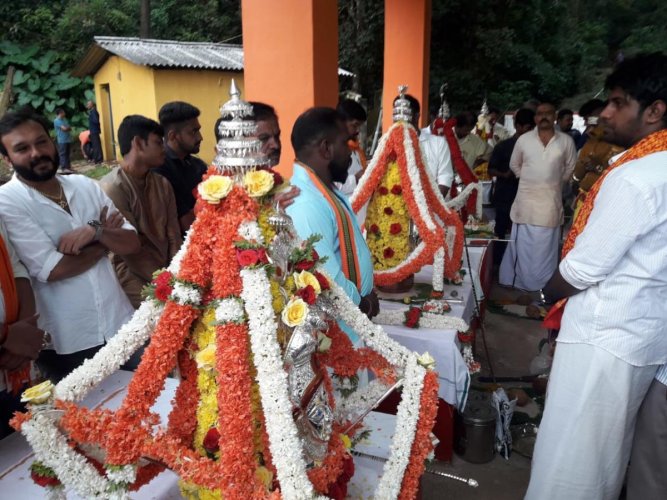
‘Karagas’ of ‘Shaktidevata’, the four goddesses, being offered a puja at Pampinakere in Madikeri, as a mark of the commencement of Dasara celebrations on Wednesday.

The traditional Madikeri Dasara kickstarted, though in a sober way, on Wednesday.

As per the age old custom, Madikeri Dasara celebrations commenced by offering puja to the decked up ‘Karagas’ of four ‘Shaktidevata’ Goddesses – ‘Kanchi Kamakshiyamma’, ‘Kote Mariyamma’, ‘Kunduru Chowti Mariyamma’ and ‘Dandina Mariyamma’ at Pampinakere, in the presence of Dasara committee members, elected representatives and devotees.

Special prayers were offered to the deities, seeking protection from natural calamities.

After Karagotsava, a procession was taken out from Pampinakere to Chowdeshwari Temple, through A V School and Mahdevpet Road.

Hundreds of devotees stood beside the road to have a glimpse of the Karagas.

From Thursday, all the four Karagas will visit houses and the devotees will welcome the Goddesses by washing the feet of the persons who carry the Karaga, along with fulfilling their vows, as per the age old custom.

History of Karagotsava

Karagotsava, observed as a part of Navarathri celebrations in Madikeri, has an interesting background.

The religious leaders had sought a divine intervention when the whole district was affected with an epidemic. As per the suggestion of the priests, it was decided to carry out ‘Karaga puja’ to appease the four ‘Shaktidevata’ and accordingly, the spread of epidemic was contained. The tradition has been continuing ever since then.

However, Madikeri Dasara is being observed in a simple way, owing to the massive floods in the district.

No rejoicing

Though the state government has released a grant of Rs 50 lakh, people are in no mood to rejoice. No festivity is in the air, except the flexes and banners wishing people for Navarathri festivity.

As the fear of floods and landslides still haunts tourists, the district is likely to see poor footfall during the Madikeri Dasara celebrations.

The resort and homestay owners have been campaigning to promote tourism, after the recent floods had a cascading impact on the tourism sector.

source: http://www.deccanherald.com / Deccan Herald / Home> State> Districts / by Ashwani Kumar NKR, DH News Service, Madikeri / October 10th, 2018

Bengaluru handbag brand looks to Karnataka’s Kodagu district for inspiration

Inspiration drawn from fashion capitals like Paris or Japan in the business of design is routine. However, when you hear of a handbag collection that is inspired by the Kodagu district of Karnataka, the offbeat element is intriguing. Bengaluru-based luxury handbag label, Aranyani, has launched a line of totes, hobos and clutches that narrate design influenced by Kodagu’s landscape and culture.

“This collection tells the story of Kodagu, its flora and fauna, and culture seen through the eyes of its princess Victoria Gowramma, the first Indian royal to have landed in Britain in 1952. The bags are made with goat’s leather and handloom from Salem,” said CEO Haresh Mirpuri, who launched the label a year ago.

“Kodagu is known for its 250 species of birds like peacocks and birds of paradise that have translated into our design story in the form of motifs and colour schemes. The waterfalls of the mountain province, the nari-mangala or tiger wedding culture and medallions worn by brides at their wedding have been woven into the collection story,” he explained.

Interestingly, Mirpuri was stranded in flood-stricken Kodagu while working on this collection. “My brand draws inspiration from nature for all our lines. Stranded in Kodagu during its recent heavy monsoon and witnessing the devastation first-hand made me realize that we need to be serious and champion the cause of nature,” he said.

The Bengaluru brand has a celebrity client list that includes names like Hollywood singer Vanessa Williams and Bollywood actor Chitrangada Singh and comes in the price range of Rs 8000-75000.

Currently, it is retailed at flagship stores in Bengaluru, Surat and New York. Soon, they will expand to Delhi and Bali.

source: http://www.economictimes.indiatimes.com / The Economic Times / Home> Panache / by Smita Balram, Economic Times Bureau / October 11th, 2018

Up for challenges

Gulshan Devaiah, who is set to experiment with a Bihari avatar in the web series Smoke, says he prefers challenging roles over those he can do easily. “Challenges attract me.

Roles that are difficult and that need work are ones that interest me. Roles I feel I can sleepwalk in don’t attract me. I give these roles everything I possibly can and then it’s for the audience to enjoy it or not,” Gulshan said.

Be it the Maharashtrian Mandar Ponkshe in Hunterrr or Kutchi Bhavani in Ram-Leela, Chittappa Gowda from That Girl in Yellow Boots or the Goan Ricky in Dum Maaro Dum, Gulshan has displayed his versatility in his projects.

Smoke is being touted as a gritty and dark crime drama set in the underbelly of Goa. It will premiere at the global entertainment content market MIPCOM 2018 in Cannes under the ‘Made in India Originals’ category on October 15.

According to a source, Gulshan kept his Bihari accent on and off the set throughout the duration of the shoot of Smoke, which will release digitally on October 26.

He will also be seen in a double role in Mard Ko Dard Nahi Hota and as a parallel lead with Vidyut Jammwal in Commando 3.

source: http://www.ahmedabadmirror.indiatimes.com / Ahmedabad Mirror / Home> Entertainment> Bollywood / IANS / October 11th, 2018

Dasara gift for Kodagu

The inauguration of Mysuru Dasara on Wednesday came with a special gift for the people of Kodagu, who were hit by floods and landslips recently. Infosys Foundation has announced a grant of Rs. 25 crore for construction of houses in the district.

Foundation chairperson Sudha Murty, who inaugurated the festivities, made the announcement in the presence of Chief Minister H.D. Kumaraswamy. In her address, Ms. Murty said her foundation would build houses for the distressed people of flood-ravaged Kodagu if the government came forward with land for it.

She also promised to contribute more for restoring the Hebbal lake in Mysuru, on whose rejuvenation the foundation is spending Rs. 35 crore. Ms. Murty is the first woman to inaugurate the Mysuru Dasara festivities in decades

source: http://www.thehindu.com / The Hindu / Home> National> Karnataka / by Special Correspondent / Mysuru – October 11th, 2018

Minister promises Rs 50 lakh for Madikeri Dasara

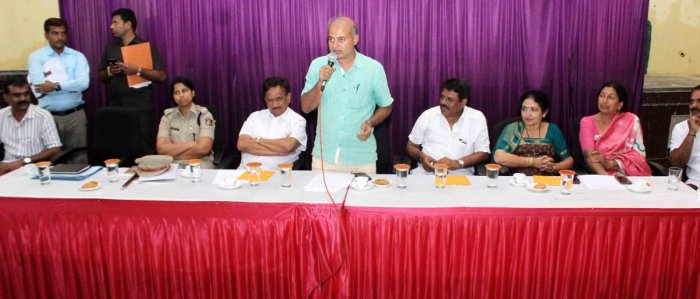
District In-charge Minister Sa Ra Mahesh speaks during a preparatory meeting on Madikeri Dasara on Monday

Simplicity and tradition will mark this year’s Madikeri Dasara, said District-In-charge Minister Sa Ra Mahesh.

Chairing a preparatory meeting on Madikeri Dasara here on Monday, he said that a grant of Rs 50 lakh will be sanctioned for Madikeri Dasara and Rs 25 lakh for Gonikoppa Dasara celebrations.

The chief minister had earlier decided to celebrate Dasara in Mysuru and Kodagu in a grand way. But after the floods in Kodagu, it was decided to observe it in a simple and traditional manner.

“Villages in eight gram panchayats are in distress. Tourism of the district has seen a fall. Therefore, raising funds from people is not advisable. The government will provide all assistance towards simple Dasara celebrations,” said Sa Ra Mahesh.

Resort and Homestay association district advisor Chidvilas said that the preparatory meeting should have been conducted 15 days earlier. Madikeri Dasara is not all about Dashamantapa procession. Around 1 lakh tourists visit the city, he said and suggested conducting cultural programmes.

Dashamantapa committee chairman Ravikumar said that during epidemics in Madikeri, the committee had made a pledge before the four Shakti Devata Goddesses to offer a worship through Karaga procession. Shelving Dasara is not prudent. Dashamantapa procession should be taken out as per the tradition.

MLA K G Bopaiah, M P Appacchu Ranja, MLC Veena Acchaiah, CMC president Kaveramma Somanna, district Superintendent of Police Sumana D Pannekara were present.

source: http://www.deccanherald.com / Deccan Herald / Home> State> Districts / by DH News Service – Madikeri / October 08th, 2018

Jyothy Institute of Tech holds ‘Run for Coorg’

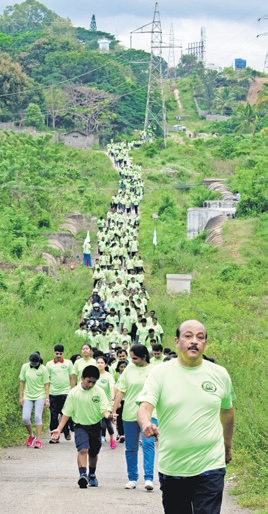
Jyothy Institute of Technology organised ‘Run for Coorg’, a 5K run, near its college campus at Thataguni in Bengaluru on Saturday.

RunforCoorgKF08oct2018

Bengaluru :

Jyothy Institute of Technology organised ‘Run for Coorg’, a 5K run, near its college campus at Thataguni in Bengaluru on Saturday. More than 2,000 people, including music director Gurukiran and actor Aniruddha Jatkar, participated.

People from various parts of the state, including Mysuru, Davangere, Dakshina Kannada and Uttara Kannada, participated. They have decided to rebuild a village in Kodagu that was devastated by the recent floods. The event was flagged off by Gurukiran and Aniruddha Jatkar.

The Institute along with Rotaract organised the event with an aim to reconstruct Kodagu and rehabilitate the affected people. They have planned to reconstruct a village in Kodagu and help people who lost their houses and other properties, said Rajesh K of the Institute.

source: http://www.newindianexpress.com / The New Indian Express / Home> States> Karnataka / by Express News Service / October 08th, 2018

Weather, elevation decides taste

The Flying Squirrel
The Flying Squirrel

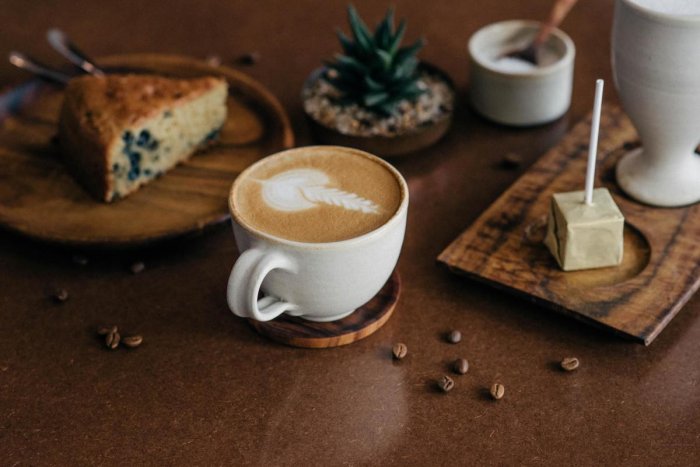
Coffee lovers in the city must be a happy lot. There many options in places to have a hot cuppa and newer varieties and blends are being discovered regularly.

Metrolife spoke to owners of some of the popular cafes in the city who brew their own coffee, farm to cup style.

The Flying Squirrel

Starting off as a purely coffee making business, owners Ashish Dabreo and Tej later decided to open a cafe in Koramangala a couple of years ago. They have an estate in Coorg.

The cafe offers about eight varieties of coffee. The bean and powder are also retailed online and at the cafe.

Ashish says, “We follow the artisanal method to create our coffee. Depending on the type of coffee we are using, the process also varies according.”

One of their products, Sunkissed Coffee, is made with pulped sundried robusta bean. “There are two ways in which you can roast coffee — you either remove the skin and pulp and then dry it, or leave some of the pulp when drying. We follow the latter for Sunkissed coffee. The bean is fermented and then left to dry for 12 days. In this case, the fruitiness in the pulp gets absorbed into the bean, giving the coffee a distinct flavour.”

Each of the varieties offered here goes through various experimentations like pulping, drying, smoking and roasting before it goes on the shelf.

“Sometimes, cross plantation with citrus and vanilla gives different outputs too. And when that’s done, the storing process also needs to be monitored so that we get the consistency required,” adds Ashish.

He says that they are able to experiment with each harvest as the city is open to newer blends.

Coffee Mechanics

Ganga Prabhakar, co-founder, explains that their motto is to educate coffee lovers about the varieties they offer.

“We have three estates in Srilakshmi, Bhadrapura and Kuttinkhan, each of which give us different outputs as they are micro-farmed in different soils. With the difference in elevation at which the beans are grown, the flavour differs too. Depending on the roasting technique, the shade changes from light roasted to darker,” she explains.

The more you roast it, the more caramelised it becomes. However, if almost burnt, it becomes ashy which ruins the taste. The lightly roasted ones give a tangier taste which the brewers call ‘acidity’. “The higher you roast, the lesser the acidity. And then it can become caramelised or chocolatey — depends on what you prefer.”


Third Wave Coffee Roasters

Unlike other brewers, Third Wave Coffee Roasters don’t have their own plantation. They get samples from various farms between the months of March to May which they use to roast, cup and sample before they decide which coffee they want to buy for the year.

Co-founder Ayush Bathwal says, “Most of our coffees come from Yercaud and Kerala. We work with single origin farms so that we can maintain the authenticity of the beans available. We mix the beans only if we are experimenting with certain blends.” So how does their blending and brewing process work? “We buy close to 1,000 kg of green beans which we roast according to need. Once roasted, we store them in airtight containers. Each blend last two to four weeks.

They follow the Specialty Coffee Association of America meter. They finalise the product only if the bean scores more than 80 points.

source: http://www.deccanherald.com / Deccan Herald / Home> Metrolife> Metrolife on the Move / by Anila Kurien, DH News Service, Bengaluru / September 30th, 2018

Now serving: Coffee with olive oil

ChefKF30sept2018

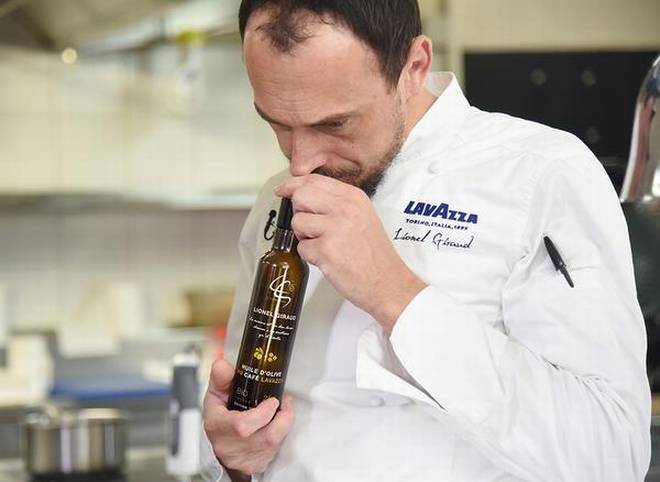
Chef Lionel Giraud on the gourmet product which was created along with Alexis Muñoz
Chef Lionel Giraud became a Lavazza Chef Ambassador in 2016, and, since then, has taken great pleasure in exploiting all its facets. However, after two years as a Chef Ambassador, Lionel decided to infuse two most essential elements of Italian cooking — coffee and organic olive oil. Lionel Giraud chose to work alongside Alexis Muñoz, a famous olive oil producer. Alexis Muñoz rose to the challenge and created high quality oil, which is completely organic.

Lavazza’s coffee with olive oil is produced in a limited edition and sold in 25cl bottles. Excerpts from an interview:

How would you describe the aromatic notes that emerge from the combination of coffee and olive oil?
After weeks of research and testing, we finally found the perfect match: an amazing olive oil both subtle and spicy with a fruity taste, combined with a Lavazza coffee with a strong and delicate flavour.

The feedback from the restaurant’s customers is positive. They are very surprised to see how different the perception can be, depending on the way you try the oil. For instance, on a slice of toast, it is the fruity taste that stands out, while on other foods, it is the coffee note which will first be perceived.

Coffee is now used to give flavour especially to soups. Do you think that coffee oil could further improve these tastes?
Of course the addition of some qualitative fat always improves the taste and brings stronger flavours to the dish.

What have you learned from your years of experience with a clientèle with diverse profiles?
Today, customers want a light coffee with 50% Arabica and 50% Robusta. The restaurant’s customers are very keen on the Tierra coffee.

How would you assess how your customers enjoy their coffee?
Today, customers have a better knowledge of coffee, its production method and the different ways of preparing it. It is all about a product that has to be enjoyed and that arouses curiosity and discussion. As a result, it is more appreciated than it used to be.

What would be the best way to introduce someone to coffee?
I personally like to include roasted grains in my preparations. For example, I introduced my children to coffee by adding grated roasted coffee beans to a silky mashed potato. It removes the bitterness from the coffee.

source: http://www.thehindu.com / The Hindu / Home> Life & Style> Food / by Prabalika M. Borah / September 28th, 2018

Get-Together Of Igguthappa Kodava Association

The annual get-together of Sri Igguthappa Kodava Association, Vivekanandanagar, will be held on Sept. 30 (Sunday) at Kodagu Sahakara Sangha in Jayalakshmipuram from 9.30 am onwards.

Kalapanda B. Vishwanath, President, Sri Sri Shivabalayogi Maharaja, Mysuru Division, will be chief guest.

Sangha President Moodera B. Belliappa will preside.

The day-long event includes presentation of Scholarships to meritorious students, sports and games, lucky-draw.

For details contact Mob: 99013-92444.

source: http://www.starofmysore.com / Star of Mysore / Home> In Briefs / September 28th, 2018