The elected representatives directed the officials to make necessary arrangements for Cauvery Theerthodbhava, scheduled to be held on October 17, at Talacauvery.
Speaking at a meeting convened to discuss preparations for the annual programme on Saturday, MLA K G Bopaiah said that the Theerthodbhava will occur at 12.33 pm.
He said a large number of devotees are likely to attend it. Hence, additional bus facility should be made. The pothole-filled road from Madikeri to Talacauvery should be repaired. Also, suitable arrangements should be made for the parking of vehicles. The district administration should ensure that no inconvenience is met by the devotees, he added.
Bopaiah said temporary toilets should be constructed. Arrangements should be made for the supply of drinking water too, he added.
Congress leader Biddatanda S Thammaiah said that a bridge near Thavoor on Madikeri-Bhagamandala has collapsed a few years ago and it has not been repaired so far.
Hosooru Ramesh Joyappa said the density of vehicles to Talacauvery and Bhagamandala is on the rise. There is a need to check the density of vehicles, he added.
Pushkara ritual
Some people in the meeting opposed Pushkara ritual at Talacauvery and Bhagamandala stating that it is against the sanctity of the place.
MLA K G Bopaiah, MLC Sunil Subramani and Veena Achaiah questioned the ritual, where the Theertha kundike is made impure by taking bath.
source: http://www.deccanherald.com / Deccan Herald / Home> District / DH News Service, Madikeri / October 07th, 2017
Standing tall: Government Archaeology Museum in Madikeri.
Two doormen, embellished with silver jewellery and adorning red dhotis welcome visitors while standing guard at the entrance of the Government Archaeology Museum in Madikeri. The museum has been set-up inside a 150-year-old intrinsic church, which is located at the southeast entrance of Madikeri Fort. With Roman Gothic architecture, the 19th century church invites the art connoisseurs into the world of forepassed artefacts. As one crosses the glass-painted windows, sky-reaching arch, limestoned blue walls, and the dwarapalakas at the entrance, one is introduced to Kubera, the Lord of Wealth, revived from the ruins of a temple in Bettageri.
Artefacts from every era
While statues of folk deities stand firm on wooden stands, two horns pop out from behind the 18th century Ganesha statue. And they are the horns of a 1922 aurochs, which is now preserved to perfection. Adjacent to the aurochs stands a stuffed life-size leopard, “given to the museum by Mysore Archaeological Society,” explains, Renuka, the curator.
Inscriptions from the Ganga dynasty, seals from the Lingayat kingdom of Haleri, statues of Jain tirthankaras, 3D paintings of the kings and queens of Kodagu, terracotta and brass kitchenware from 12 century, and beautiful lintel that has been carved from limestone are a few objects that decorate the inner linings of the museum. However, it is the cultural folk deities and the traditional weapons that steal the show here. “People want to see and learn more about the uniqueness of the culture of Kodagu. And they ask for cultural, tale-telling artefacts of the district,” explains Renuka.
The 18th century swords and daggers from the historical reminiscence of British rule are arranged neatly in a glass case. “The collection also includes the swords used by King Veera Rajendra,” she explains. The cult weapons — odi kathi, peechakathi — synonymous with dagger and sheath knives, tell the tales of the warrior clans of Kodagu. There is also a section of armouries that bring light to the heroic deeds of Kodavas in the army. One of the highlights among these armouries is a heavy bronze cannon of the 17th century.
The Kodavas also hold special reverence to cult deities that were worshipped in the then extensive, now diminishing, devara kadus or the sacred groves. And the museum is home for many such cult deities revived from 11th and 12th century. Naga idols, masks of boar headed folk gods, idols of the Sun God, Goddess Kali, Shiva-Parvathi idol and Uma Maheshwari idol are just a few to mention among the immense bronze idol collection.
“Most of them are harake shilpas (ex-voto offerings), which were recovered from the ruins of many temples, and some gifted by the temples for preservation,” she confirms. The museum sheds light on the Jain heritage in the region too. Stone and pot inscriptions and intricately carved statues of Jain tirthankaras — they take one back to between the 11th and 14th century, when the Kongalvas (subordinates of Cholas) were the prominent rulers in the district.
There is also a section in the museum dedicated to Field Marshall KM Cariappa, who donated many worthy artefacts of the past. While an ornamental chair of the Field Marshall sits at the centre of this section, it is surrounded by various mementos won by him and a few other age-old statues collected by him as an art connoisseur. “They have been exhibited in the gallery in memory of his parents,” Renuka explains.
The art of preserving
While the staff of the museum is actively involved in reviving historical artefacts, they have also faced hurdles in preserving some historical objects. Renuka explains, “We make sure that none of the ruins of historical idols are immersed in the rivers and immediately fall into action in collecting them. However, sometimes the beliefs of people work against our actions. One such incident took place in Bhagamandala, where the locals refused to hand over the ruins of elephant sculptures in the area due to religious beliefs. However, learning its importance, they are now preserving the sculptures.” Renuka, as a curator of this museum, has revived over 250 artefacts; the recent one being the painting of King Chikka Veera Rajendra, the last ruler of the kingdom of Kodagu.
A State-funded museum, the museum attracts a lot tourists during the weekends who also tour the historic fort located in the area. “We are looking at further improving the museum by including a detailed story of the heritage value and revival process of these historical objects,” concludes Renuka. The museum is open to visitors from 09.00 am to 5.00 pm except on Mondays and general holidays.
source: http://www.deccanherald.com / Deccan Herald / Home> Supplements> Spectrum / by Prajna G R / October 03rd, 2017
With hardly two days left for the Madikeri Dasara celebrations, the untimely rain could play havoc with the preparation. Mantap celebrations are on with 10 temple committees engaged in giving decorating mantaps with flowers and glowing lights. Committee members are worried that rain could hinder the preparation of figures and fixing of lights.
Each mantap is prepared at a minimum cost of Rs 10lakh, and a maximum of Rs 25lakh, depending on the enthusiasm to compete for the three prizes — Devendra garva bhanga by Dechuru Ramamandira, Ananthpadmanbha Darshana by Pete Rama Mandira, Narakasura Vadhe by Kundurumotte, Hiranyaksha Vadhe by Kote Mariamma, Lalithambika killing Bhandasura by Chawdeshwari, Bhoodevi killing Narakasura by Karavale Bhagavathi, Chamundeshwari killing Mahishasura by Dandina Mariamma, Vinayaka killing Thalasura by Kote Ganapathi, Kolluru Mookambika killing Mookasura by Kodandarama, and Ramanjaneya killing Ravanasura by Kanchi Kamakshi are the 10 mantaps getting prepared to enthral thousands of enthusiasts.
The procession of the figures will be exhibited at three shows during the Shobha Yatra in the town on Dasara night, with one show exclusively for the judges. The show will take a minimum of 20 minutes climaxing in a fight between gods, goddesses and demons, ultimately ending in the killing of demons with audio effects, conversations, glowing lights etc.
The Dasara committee will distribute Rs 2lakh each for mantaps and Rs 1lakh each for karagas out of the government-sanctioned amount of Rs 50lakh for Madikeri Dasara. With Rs 20lakh collected by donors the total budget is Rs 70lakh, Dasara committee and city municipal council president Kaveramma Somanna said.
For Ayudha Puja, decoration competitions for various type of vehicles will be organized. Decoration contests for shops and establishments are already announced. Cultural programmes, which started on September 22, will end on Friday evening and a night orchestra will play through Saturday night into the early hours of Sunday.
source: http://www.timesofindia.indiatimes.com / The Times of India / News> City News> Bangalore News / Times News Network / September 29th, 2017
The enjoyment was clearly written on their faces at the end of the day as they had seen nothing like this before.
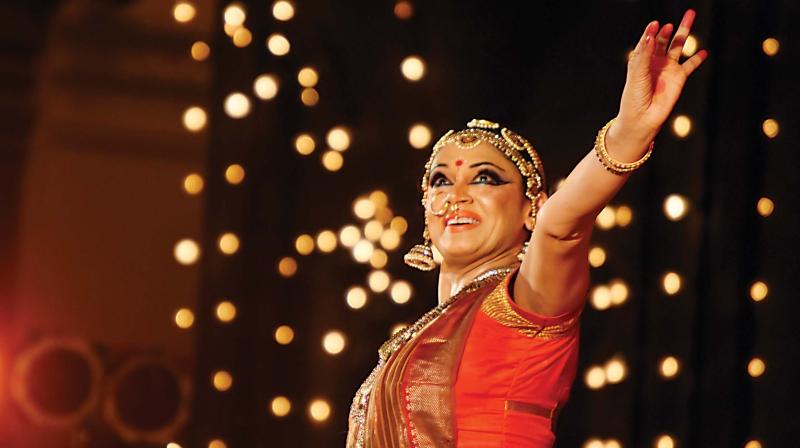
Actor Shobhana performs in front of Mysuru Palace on Friday as part of Dasara celebrations (Photo: KPN)
Mysuru:
Planters from Virajpet in Kodagu, Juthika Bopanna, Suman Chengappa and Divya Madaiah, had come all the way to Mysuru for the “Palace on wheels” trip offered to tourists this Dasara.
“We have seen Mysuru Palace in the past, but not the other palaces. And lunch at the Lalitmahal Palace was the icing on the cake,” they said, happier for the experience.
Picked up near Mysuru Palace, they were introduced to Jaganmohan Palace, given lunch at the Lalitmahal Palace, shown the Cheluvarajammanni Mansion, the Jyalakshmi Mansion at the University of Mysuru which houses the folklore museum , the Regional Museum of Natural History, the Indira Gandhi Museum and Railway Museum and then dropped back near Mysuru Palace. The enjoyment was clearly written on their faces at the end of the day as they had seen nothing like this before.
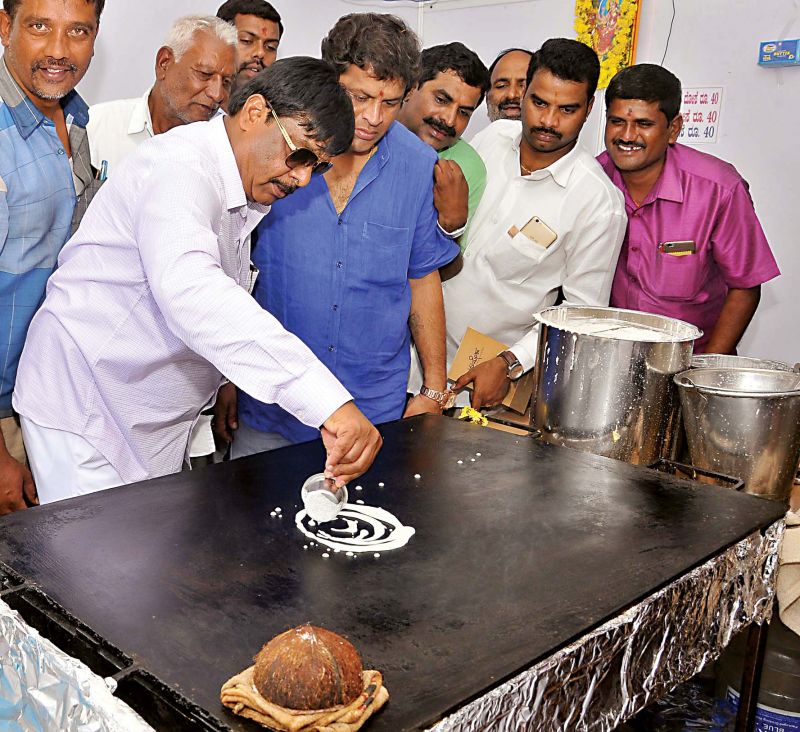
Mysuru district in-charge minister H.C. Mahadevappa launches ‘Food Dasara’ (Photo: KPN)
Twenty –year- old Manjula, a farmer’s wife from Maleyuru village in T Narsipur taluk, confessed it was her first Dasara in Mysuru. “I had only seen Dasara on television before,” she admitted. Manjula was one of 5,400 farmers brought in 108 KSRTC buses from 18 taluks of Mysuru, Mandya and Chamarajnagar taluks for the “Dasara darshan” organised by the district administration for villagers, who have never seen it before. As many as 3300 more farmers from 11 taluks of Kodagu and Hassan will be brought in the second batch to enjoy the Dasara.
The farmers were on Friday taken from T Narsipur taluk to the Mysuru Palace, Chamundi hills, the zoo, and to enjoy the events of the Women’s Dasara and Raitha Dasara. Transport minister H M Revanna said the district administration had given the KSRTC Rs 20 lakh to organise the trip.
Children’s Dasara
Tarunya, daughter of the mahout of Dasara elephant Abhimanyu from Thithimathi and the youngest among 35 kids of mahouts and kavadis, made her parents proud by performing at the Children’s Dasara which began on Friday at Jaganmohan Palace. The kids who were trained by music and drama teachers from government and private schools, staged Kindara Jogi play.
All 15 Dasara elephants were familiarised with the booming sound of nine cannon fire shots fired from 150 year old brass cannon barrels, on Friday. raditionally, 21 cannon shots will be fired in 90 seconds during the Jumbo Savari procession after the Chief Minister offers floral tributes to the idol of Goddess Chamundeswari placed in the Golden Howdah.
source: http://www.deccanchronicle.com / Deccan Chronicle / Home> Nation,Current Affairs / Deccan Chronicle, by Shilpa P / September 23rd, 2017
Kannada TV actor and anchor Shwetha Chengappa talks about her favourite serials on television and the childhood memories associated with them.
Earliest memories of watching television
For the longest time even after the introduction of television, my parents never bought a TV set as they were quite strict with our
studies. I remember going to our neighbour’s house to watch it. One fine day, while I was in third grade, my parents finally bought a TV. Jungle Book and Shaktiman were a hot favourite back then. I also remember telling my parents back then that one day I would also be on TV. It has been a 13-year journey on the small screen now.
All-time favourite sitcom/serial
Small Wonder. It was about a boy and his little sister who was a robot. It was the cutest thing I ever watched on TV back then. I also loved watching serials like Chandrika on DD. Pallavi Joshi was my favourite and I loved a navy-based serial, in which she played the protagonist. The Coorg in me was probably the reason I adored it so much. Kahin Toh Hoga on a private channel was another favourite. I later acted in its remake in Kannada, which was titled Kadambari. It was a huge hit.
One advice to small screen newbies
Don’t get carried away by the fame which has come to you in an instant. Don’t also be dejected by downfall. Both are part of this small screen world.
source: http://www.timesofindia.indiatimes.com / The Times of India / News> TV> News> Kannada / by Madhu Daithota / TNN / September 25th, 2017
As many as 40 poets recited their poems at the Madikeri Dasara Kavi Goshti (poets’ meet) held at the Kaveri Kalakshetra here on Monday.
The poems on water, corruption, humanity, relationship, love tried to open the eyes of the society to the burning issues.
Additional DC M Sathish Kumar inaugurated the meet by writing “Idu bahubhasha kavighosti, egagale agide kavanagala srishti…” on a board. He said that poets play a vital role in transforming the society. The poems should make people introspect, Kumar felt.
Dasara Samithi president Kaveramma Somanna and others were present. Rekha Prakash, Leela Dayanand and Nagesh Kaloor were the invited poets.
Poets’ meet committee president Aithichanda Ramesh Uthappa said, “The committee had planned to hold the meet in a unique manner. However, due to the paucity of funds, we had to organise poets meet with limited resources. About 201 poems were received by the committee for the meet. The committee selected 40 poems for the meet.”
K P Sudarshan, Divya Mandeera, Krithajnana Besooru, Asha Prabhu, B R Ramachandra Rao, Asha Prabhu, Kasturi Govindammayya, Ranjitha Cariappa, A S Kavya, S A Anagha, Aparna, A B Manjunath, U R Akram, Sabalam, Bhojanna Reddy, Kadlera Jayalakshmi, Mohan Kumar, S K Ishwari, Shailaja Dinesh Barike, M K Nalinakshi, M S Inchara, Revathi Poovaiah, Kayapanda B Tata Changappa, Ranju Nanaiah, Mulivanda Nalini Bindu, Sunitha Vishwanath, M A Manoj, Kiggalu Girish, and Preetham recited poems.
Writer Kodagi B Appanna presided over the programme.
Today’s programme
Makkala Dasara, Makkala Santhe, Makkala Mantala, fancy dress, clay modelling, science modelling, Chennamane, Kallata and others will be held at Gandhi Maidan in Madikeri from 9 am onwards.
General Thimmaiah Public School, children from Kid Paradise will present dance, Ramayana dance ballet by Little Flower team and dance extravaganza by Bhargavi and team will be held as a part of cultural programmes at 6 pm.
source: http://www.deccanherald.com / Deccan Herald / Home> District / DH News Service, Madikeri / September 26th, 2017
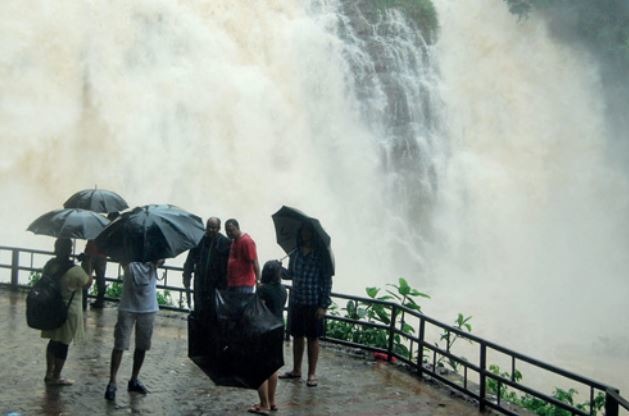
Tourists at Abbey Falls near T Shettigeri, with rain catching up by monsoon end, all falls in the State are putting up their best show
Madikeri :
City dwellers might hate rain with its attendant problems but when they flock to Kodagu, the rain is an added attraction. Tourist inflow has gone up in the rainy months which were once considered off-season.As many as 91,619 visitors came to Kodagu in July, a jump over the figures for 2016.
Between January and July this year, 6.9 lakh people visited Kodagu, of whom 91,619 people visited in July. This is a jump of 21% over last year, when just 75,492 tourists came. In 2015, only 74,798 tourists visited in the month of July. But even these are conservative numbers, say officials, since it only accounts for guests at registered homestays. The number could be almost double if the other homestays, not on paper, are factored in as well.
What helped probably was that the rain wasn’t as heavy as expected. The district as a whole received 51cm of rain in the month against a normal of 90cm, allowing tourists to enjoy the showers while finding time to move around as well. The tourist count estimate for this August had crossed 50,000 by the middle of the month.
While most tourists visit the staples in Kodagu -Talacauvery, Cauvery Nisargadhama in Kushalnagar, the Nalaknad palace in Kakkabe and Raja’s Seat – some also make their way to Irupu falls near Shrimangala, Mallalli falls off Somwarpet, Abbey falls near Madikeri, the golden temple at Kushalnagar, Dubare elephant camp, Ha rangi and Mandalapatti near Madikeri.
Shobha Shetty , a retired bank employee from Mangaluru, says she had a magical experience visiting Talacauvery in the morning hours. “The mist-covered slopes, the moving fog and the gathering dark in daylight made me forget everything else. This can happen only during monsoon,” she says. Around 45,616 tourists visited Talacauvery between January and May this year.
Shashi Monnappa, who runs Mythili homestay at Madikeri, said many tourists preferred to visit during monsoon and opted to go to waterfalls, for river rafting and on safari in Nagarahole.
Boosting the tourist inflow, homestays drop rates during the rainy off-season. Coravanda Madan Somanna, who runs a homestay in BB estate at Kadagadal near Madikeri, said the discounts ranged between 25% and 30% on the room tariff.
Kushalnagar assistant conservator of forests Chinnappa said an average of 3 lakh tourists visit the Dubare elephant camp every year.And around two lakh tourists visit Irupu falls in south Kodagu every year, says Kodagu DFO Jaya.
Given the surge, the tourism department has taken up some development projects. It is building a Kodava heritage centre at Madikeri at a cost of Rs 2.6 crore, a pathway for tourists at Mallalli falls at Rs 1.4 crore and providing a chain barricade at Abbey falls for Rs 86 lakh.
The district administration has sent proposals for another 12 projects which include road development in Mandalapatti, Talacauvery and Dubare; building a hanging bridge to Irupu falls and setting up a garden at the Nalaknadu palace. It has also proposed building a concrete road from Nanjarayapatna to Dubare to reach the elephant camp. These proposed projects will need nearly Rs 17 crore from the government.
source: http://www.timesofindia.indiatimes.com / News> City News> Bangalore News / TNN / September 25th, 2017
Children’s Dasara wins hearts at Madikeri Dasara Janotsava
‘Makkala Dasara’, the children’s Dasara, doubled the joy of Dasara Janotsava at Gandhi Maidan in Madikeri on Tuesday.
The youngsters kept themselves as busy as bumble bees, sold various items including vegetables and fruits at ‘Makkala Santhe,’ the children’s shandy market.
There was a competition between the ‘vendors’ in attracting more customers and selling the items, using their communication skills. Buyers were offered discounts on the purchase of vegetables and other items. The traditional attire of some of the vendors added to the spirit of the shandy market.
Altogether, there were 100 tiny stalls featuring coconuts, ‘Chur Muri,’ bangles, fancy items and game shows. The low-priced coconuts were sold briskly, even before the formal inauguration of the programme. A stall put up by ‘Shanti Niketana Raita Bandhu’ too made a swift business.
Customers thronged the stall of Keerthan and Aneesh from St Micheal’s School, to grab the tasty lemon juice. Likhitha and Roshni from St Joseph School sold buttermilk. Packaged water bottles with the brand name ‘Coorg’ were sold by Shrinidhi and Hitesh of St Joseph School at 50% discount rates. Items such as bags, watches and flags prepared by Government Girls Balamandira, gathered appreciation from people.
A canine show organised by children at the venue drew the attention of onlookers. One could take selfies with dogs by paying a fee of Rs 5 to its owner.
The ‘Mantapa’ tableaux decorated by children were colourful. Children who took part in the fancy dress competitions seemed to be the live miniatures of historic heroes, social reformers and national leaders. An exhibition of clay models and science models created by the tender hands was also an added feature of the Children’s Dasara.
On the other hand, the children were engaged in playing rural games of ‘Goliyata’, ‘Lagori’, ‘Chowka Bara’ and ‘Baleyata.’
Inaugurating Children’s Dasara, City Municipal Council (CMC) president Kaveramma Somanna said the programme provides a good platform to showcase the talents of children.
Dasara Committee Working president Mahesh Jaini, general secretary A C Devaiah, treasurer Sangeetha, District Janapada Parishat president B G Anantashayana, Chummi Devaiah, CMC commissioner B Shubha, Dasara Cultural Committee president H T Anil and Rotary Misty Hills representative Sandeep were present.
The programme was organised in association with Rotary Misty Hills.
source: http://www.deccanherald.com / Deccan Herald / Home> District / DH News Service, Madikeri / September 27th, 2017
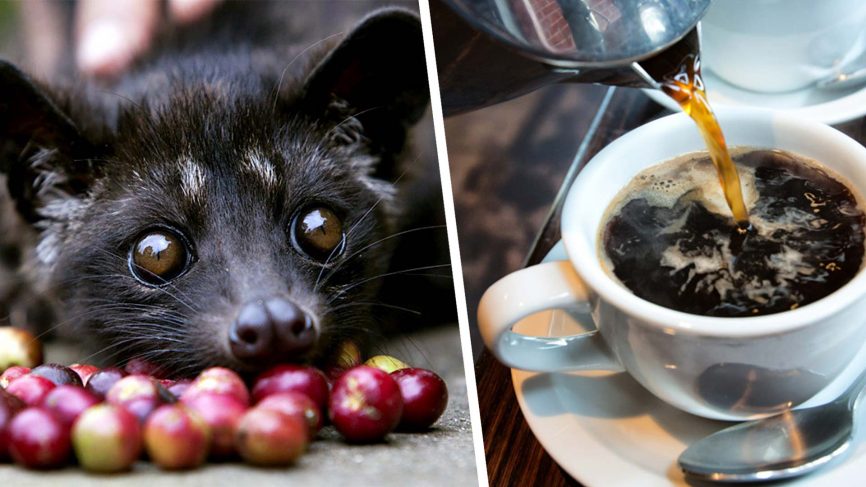
Before you take a sip of Civet coffee, the world’s most expensive coffee, there are two things you should know: 1) A single kilo of it costs between ₹20,000 to ₹25,000; for those who don’t buy their own groceries – that’s approximately 25 times (2500% more) of what your everyday brew retails at, and 2) It is made from the droppings of the Civet cat.
That’s right, droppings as in that smiley brown emoji you love sending your sibling.
Though it is a common drink of the elite in both the richest parts of the Middle East and Europe, you won’t have to go too far to take a sip. Civet coffee is made right here in India, in Karnataka’s Coorg and Chamarajnagar districts. Its high price comes from the uncommon (to say the least) method that is involved in its production.
There’s a reason why the most expensive coffee in the world derives it’s name from the civet cat, a largely nocturnal creature that resembles any child a raccoon and a cat may have some day. The end of the civet’s digestive process is the beginning of the coffee’s life cycle.
When the civet eats the flesh of the coffee cherries, the natural enzymes in the animal’s stomach enhances the flavour of the eaten bean within those cherries. The bean is then found in the poop of the civet, processed and, after a routine check, packaged. The fact that it has been through the civet’s digest tract is what apparently makes it nutritious and its steep price tag attributed to the high cost that goes into sourcing the animal and quality certification.
However, unlike other countries where civets are caged and fed forcefully, India uses a more natural method: the waste of wild civets is collected from coffee plantations that stand at the edge of the forests in Coorg and Chamarajnagar. That’s great news for farmers too because though we’re no coffee experts ourselves, we’re going to guess that locally sourced organic coffee bean-laden poop fetches a better price than the cage manufactured variety.
source: http://www.gqindia.com / GQ / Home> Live Well> Drink / by Tracy Ann / September 20th, 2017
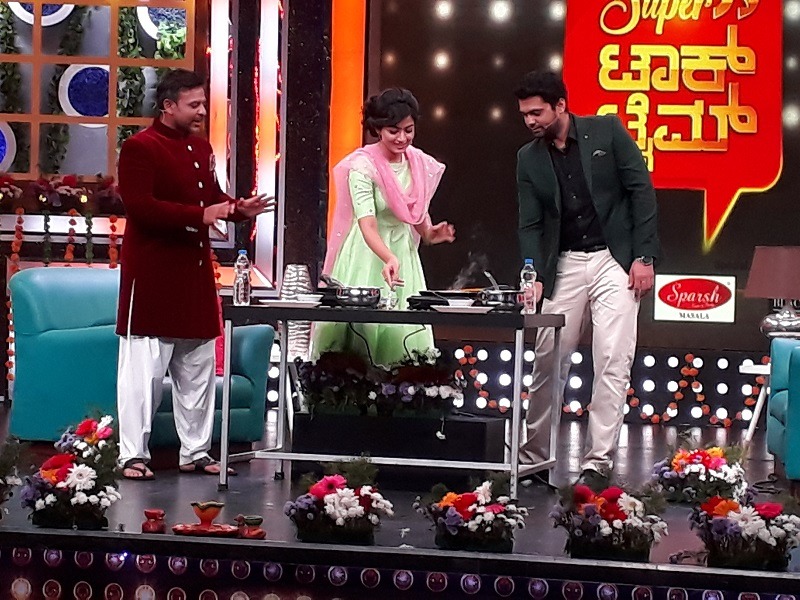
They may be the latest couple on the Sandalwood block, but have been known to maintain a low profile when it comes to their relationship. Which is why, it came as a huge surprise when the recently-engaged pair Rakshit Shetty and Rashmika Mandanna agreed to come on the celeb chat show — Super Talk Time.
What’s more, the two even took a shot at domesticity — they were asked to make dosas by host Akul Balaji. The challenge? To make them heart shaped. While Rashmika managed to make a semblance of a heart, Rakshit’s according to Akul looked like a kidney. “Now every time dosas are made at my house, I’ll think of Rashmika,” said Rakshit.
Did you know:
In order to make it to the show. Rashmika had to juggle quite a bit with her schedule. She was shooting in Hyderabad the previous day, after which she shot for Anjaniputra until late night. In five hours after she wrapped up with Anjaniputra, she reported on the sets of the chat show. Having wrapped up the chat show, she left for another event out of town. Phew!
source: http://www.timesofindia.indiatimes.com / The Times of India / News> TV> News> Kannada / by Madhu Daithota / TNN / September 18th, 2017
WELCOME. If you like what you see "SUBSCRIBE via EMAIL" to receive FREE regular UPDATES.
Read More »