Category Archives: Arts, Culture & Entertainment

Dasara cultural extravaganza in Madikeri

Cultural programmes for Dasara at Madikeri will be organised from September 22 to 30 and renowned musicians and artistes will regale the public on the occasion.

Dasara Cultural Committee president H.T. Anil stated in a release that the audience will be treated to a variety of programmes daily at Gandhi Maidan. The inaugural day events feature a saxophone recital, a dance by students of Saandipany School, Rasamanjari by Vikas Janaseva Trust group, fusion dance and music, folk art performances and more from 6.30 p.m.

On September 23, there will be a comedy programme by members of Bhagamandala Abhinaya Kalamilana Charitable Trust followed by a dance by artistes from Sandalwood. Mahila Dasara programmes will be held on September 24 and will commence from 10 a.m. They will include ethnic dressing, garland making contests and more. At 6.30 p.m, renowned artiste Dr. Shamala Malnad and her team will present a concert that will be followed by dance programmes by various groups from Madikeri and other areas.

On September 25, the public will be treated to Bollywood hip hop dance programmes besides a whistling concert featuring C.N. Madhav Bhat. On September 26, there will be a Children’s Day and rural sports events followed by cultural presentations in the evening.

A concert by Bollywood singer Sangeetha Rajeev is the main feature for September 27 while on September 28, there will be a Yuva Dasara programme including dance and music from various groups.

On September 30, to mark Vijayadashmi, the organisers have arranged a Karnataka Darshana laser show, Dollu Kunitha, Kamsale and other folk art programmes among others, Mr. Anil said.

source: http://www.thehindu.com / The Hindu / Home> News> States> Karnataka / by Staff Reporter / Mysuru – September 18th, 2017

‘The journey of Evolve Back will be the same mystical trip down the roads of history and culture’

The House of Ramapuram, promoters of The Orange County Resorts, as part of taking their eco-friendly and community based resorts concept beyond the borders of Karnataka in India and also beyond India, has taken a new brand name, Evolve Back. Notwithstanding the renaming, the promoters assert that they will continue to uphold the time tested ethos and philosophy embedded in the ‘spirit of the land’. Jose Ramapuram, Director-Marketing, Evolve Back Luxury Resorts in an interaction with P Krishna Kumar elucidate the reasons behind the renaming, future expansion, investment challenges in the eco-resort space, etc.

OrangeCounty01KF15sept2017

Q What made you rebrand Orange County, a well-established resort brand, as Evolve Back Luxury Resorts? What is the significance of this rebranding in the future journey of the company?
We, The House of Ramapuram, are planters by tradition, diversified into the hospitality business in 1994 by setting up a small resort in their 100-year-old, 300-acre ChikkanaHalli Estate in Coorg. What came naturally to us was to share our way of life and warm hospitality with our primarily urban guests. As we are prepared to expand the locational footprint of our resorts to other parts of India, Africa and Asia, we felt we need a universal name that was inspired by our ‘Spirit of the land’ philosophy.

The Orange County name was chosen for our first resort at Coorg, in memory of the captivating fragrance and flavour of this wonderful fruit which was, not long ago, part of the spirit of Coorg.

OrangeCounty02KF15sept2017

Being crafted specifically for our resort in Coorg, it was not conveying the ‘Spirit of the land’ character of our new resorts – Kuruba Tribal Village themed resort at Kabini and the Vijayanagara Palace themed resort at Hampi.

Moreover, we found that in the global tourism markets, the brand name ‘Orange County’ had a very strong association with a county in California, USA.

Today, as we prepare to expand the locational footprint further in India, and to Africa and Asia, we realised the need to rename the brand to reflect our ‘Spirit of the land’ spirit but with a universal appeal. That’s how we arrived at a more appropriate name ‘Evolve Back’.

Q The core of Orange County has been your commitment to sustainable and responsible luxury. What significant changes the rebranding would bring to that core or what additional aspect you would stress upon in Evolve Back?
‘Evolve Back’ is the new brand name given to the same ‘Spirit of the land’ experience which we strive to immerse all of our guests in. It is inspired by the past when the air, land and all of nature was pure, hospitality was from the heart, life was simple, nice and peaceful, culture was of the land and food was from the goodness of nature. Evolve Back is the signature style of delivering all these with the best in comforts and luxuries.

In short, nothing has changed besides, just the name. The journey with Evolve Back will be the same mystical trip down the roads of history and culture. Despite the name change, the ownership, management, and operations or the company are still under the ownership of Orange County Resorts & Hotels Ltd.

OrangeCounty03KF15sept2017

Q Since the rebranding coincides with the launch of your new property in Hampi, how would the brand ethos be reflecting in that property? How your latest resort in Hampi is different from the other two resorts?
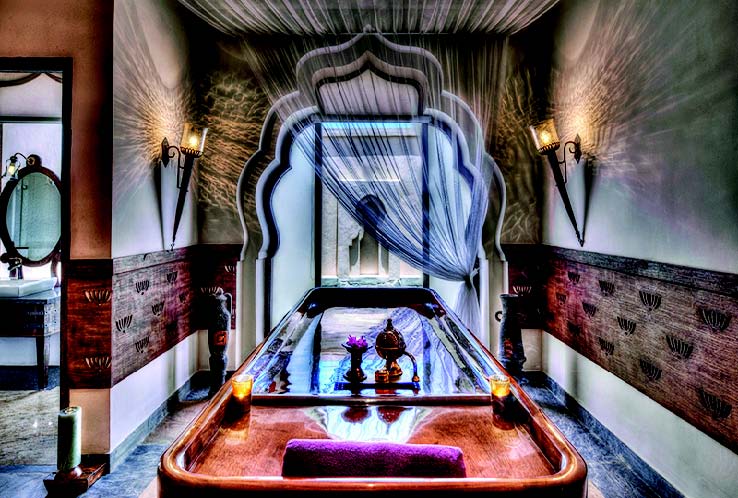
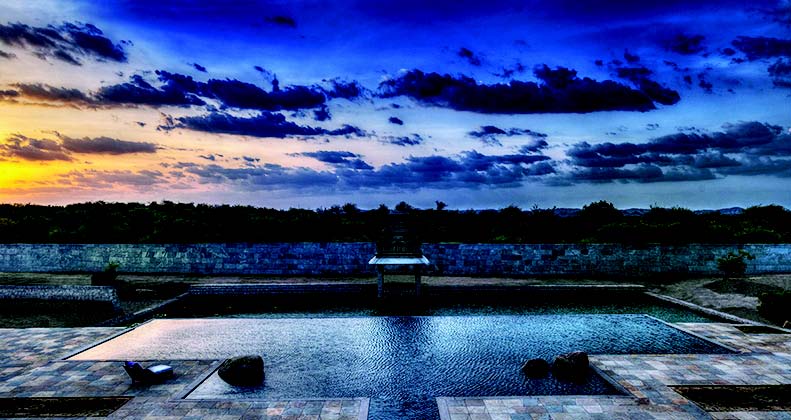
Evolve Back Kamalapura Palace in Hampi is inspired by the grandeur and magnificence of the 14th Century Vijayanagara Empire and is located 4 kilometres from the historic ruins of Hampi. Kamalapura Palace complements its surrounding by adding to its beauty and splendour, while enthralling its guests with its luxurious offerings.

The Evolve Back property in all its resplendence is a glorious tribute to the hey days of the Vijayanagara empire. The entire project has been designed after spending many months with the locals and in studying the history of the region. Special care has been taken to weave in the cultural and traditional aspects of Hampi into the architecture, the theme, the interiors and other aspects of Evolve Back Kamalapura Palace. Visitors to the property will get to soak in a slice of history though the myriad elements that make a play for one’s senses during their stay.

Q You have recently announced your plans to go scouting for properties outside Karnataka in India as well as to overseas destinations in Asia and Africa. Could you share your future investment plans and timelines for these developments?
Evolve Back is looking to expand over the next three years, during which we expect to open four new properties across India and abroad. The investment for the expansion is estimated to be around INR 112 crore. This entire investment amount is planned to be raised with a mix of internal accruals and debt.

We are looking to tap the new-found interest among people for experiential travel, especially at untapped destinations. We usually avoid overcrowded destinations, and scout for those un-spoilt markets where we sense the potential to grow — not just for us, but also for the destination.

We will be developing a resort at Kumta in North Karnataka district over an area of 30 acres with an investment of INR 50 crore. This resort is planned to be themed on a local fishing village. We are also looking at a palace-themed resort at the medieval town of Mandu in Madhya Pradesh. This property is expected to see an investment of INR 35 crore.

In the interim, a property each in African and an Asian country are being planned.

OrangeCounty04KF15sept2017

Q What are the challenges investors in eco-resorts face in India considering it requires comparatively large land area at ecologically sensitive and fragile locations?
The biggest challenge we face is in acquiring land in these locations. Land in many parts of India is largely fragmented and furthermore we will need to acquire the land from multiple individuals. The next challenge is in getting the required clearances for the project from multiple departments and signatories. Environmental laws are typically very rigid and hence take a lot of time and effort to comply with all the requirements.

In addition to this, because of the vast distances between locations, basic services such as electricity and water are typically hard to come by. In fact, most of the basic infrastructure that we take for granted, is missing or inadequate and needs to be developed from scratch. All this is not only extremely time consuming causing unnecessary delays but also ends up escalating costs as a result.

krishna.kumar@saffronsynergies.in

source: http://www.hospitalitybizindia.com / Hospitality Biz India.com / Home> Interview / Friday – September 15th, 2017

Rashmika Mandanna to star opposite Vijay Sai Deverakonda

RashmikaKF08sept2017

Rashmika Mandanna is all set to star in Telugu film starring Tollywood latest sensation Vijay Sai Deverakonda, who is making waves with his trend setting film “Arjun Reddy”.

While she has committed to a Telugu project with Naga Shourya and to another project with Ram, her third Tollywood outing is bigger as Rashmika is paired opposite none other than Vijay Sai Deverakonda of “Arjun Reddy” fame.

An elated Rashmika tweeted: “Happy to sign the film with Vijay Devarakonda in Parasuram’s direction. Thanks to producers Allu Aravind and Bunny Vas.”

Originally, Lavanya Tripathi was signed for the project. For reasons unknown, she walked out of the film even before it went on the floors.

In Sandalwood, Rashmika is working in “Anjaniputra” opposite Puneeth Rajkumar and “Chamak” opposite Ganesh.

source: http://www.vimocafe.com / VimoCafe / Home> Entertainment> Sandalwood / by Rohit Kumar / September 08th, 2017

Madikeri Dasara grants increased to Rs 60 lakh

Dasara Committee convinces CM to release more funds.

The Rs 30 lakh grant released by the state government towards Madikeri Dasara was the reason of disappointment for the Dasara Committee this year. However, after pressuring the government, the committee has been successful in convincing the chief minister to release an additional grant of Rs 30 lakh.

On Wednesday, a team comprising District In-charge Minister M R Seetharam, MLA
M P Appacchu Ranjan, MLC Veena Acchaiah and Karnataka Kodava Sahitya Academy former president Biddatanda S Thammaiah met Chief Minister Siddaramaiah and requested for more grants, to which the chief minister has agreed.

There was a demand to earmark a fund of Rs 1 crore towards Madikeri Dasara. The committee members expected the government to release at least Rs 60 lakh. But, the calculations went wrong when the grants were restricted to only Rs 30 lakh by the government. The assurance by the chief minister to release additional funds has been a relief for the committee members.

The Madikeri Dasara will be flagged-off with the Karagotsava on September 21. The last day of Dasara will be marked by the extravagant ‘Dasamantapa’ procession, the major attraction of Madikeri Dasara. This apart, there will be Dasara sports tournament, Youth Dasara, Children’s Dasara, cultural programmes, rural games, women’s Dasara and poets’ meet. Therefore, the committee members were expecting a grant of Rs 80 lakh to Rs 1 crore.

In 2015, a grant of Rs 50 lakh was released by the state government in the wake of drought situation in the state. In 2016, though Rs 75 lakh was assured, only Rs 60 lakh was released.

The previous Madikeri Dasara was a bundle of chaos as several artists did not receive payments and some even received bounced cheques. District In-charge Minister M R Seetharam had taken the committee members to task in this connection.

Preparations yet to begin

Even as there is only a week left for Dasara, no preparations have begun at Gandhi Maidan, except for the makeover of the Gandhi Mantapa. The deputy commissioner has not convened any preparatory meet. The patchwork of roads too has not been taken care of. However, people said the office-bearers of Madikeri Dasara Committee have been raising funds from the public.

The dates of Children’s Dasara, ‘Makkala Santhe’ and rural games have been finalised. But, the schedule of the cultural programmes is not out yet.

DH News Service

source: http://www.deccanherald.com / Deccan Herald / Home> District / by Aditya K A, Madikeri / DH News Service / September 14th, 2017

Trails in Coorg

An inside view of the Golden Temple. (Below) The author.

One Friday evening, I was all set with a cup of coffee to finish my leftover work when I got calls from my friends asking me to join them for a Coorg wedding. The decision wasn’t a tough one at all. So without a clear plan, we were ready for it.

We set out 6 am the next day to avoid the heavy traffic. We had breakfast on the way. This was going to be my first time in Coorg and I couldn’t wait to see the ‘Scotland of India’.

Soon the city slowly drifted away and greenery and tobacco farms started unveiling before us. Our first visit was to the Golden Temple, the beautiful Buddhist monastery in Bylakuppe. It was about fours hours since we started our journey.

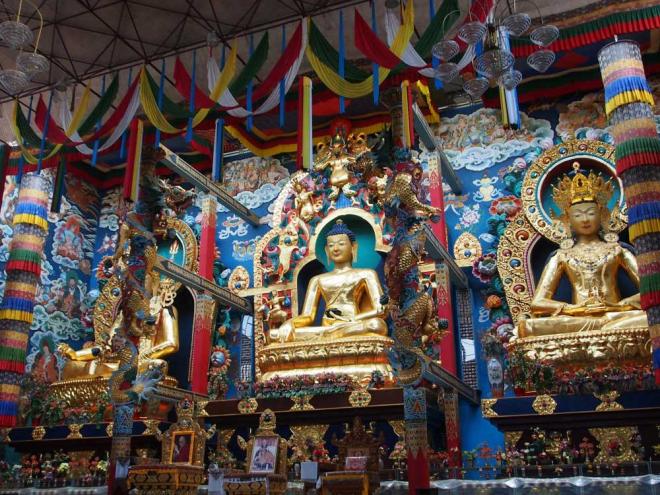
We suddenly were amidst a sea of young Tibetan monks and tourists. The Namdroling Monastery is a world in itself, rich in history. The highly ornate temple tower is certainly worth a visit.

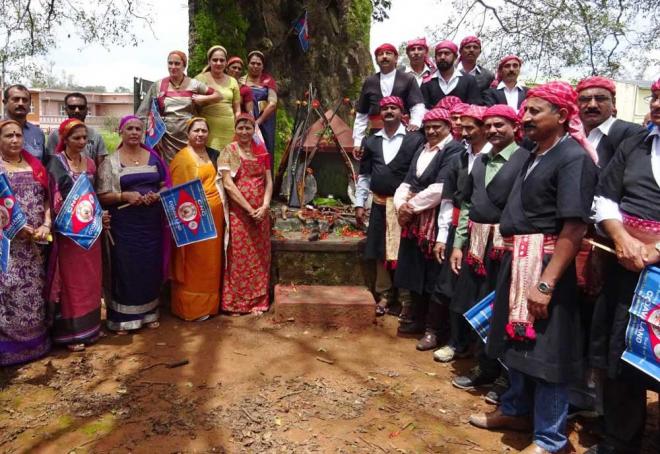
Our next stop was where the Coorg wedding was happening. The wedding is called ‘Mangala’ in Kodava language and the wedding is indeed a fun-filled cultural feast. The men wore the traditional black ‘Kupya’, secured with a red ‘Chele’ on their waists and a turban, while the women wore traditional Coorg saris. Unlike the usual Hindu wedding customs, a Coorg wedding is short, simple and filled with an evening of guests letting their hair down, dancing to tribal drums and relishing the customary dishes.

We spend that night in a hotel near Madikeri. Next morning, we woke up early and saw the hills sprawling across the stretch of settlement and streets. It was cloudy, so a hot breakfast at the nearby Shanthi Sagar restaurant was a great start to the day.

Dawn had just broken when we set out to visit MugiluPete (Mandalapatti) on a solitary road with lush greenery and winding vales, often on both sides. The climb to the top was rough and unsafe for cars, hence we had to book a jeep. The narrow roads that take you to the top are pretty scary.

The climb to the top brought us almost into the middle of the clouds. This fog-shrouded breathtaking mound of earth is surrounded by mountains on all sides. The Pushpagiri range made for a magnificent view. We also visited the place considered as the source of river Cauvery – the Talacauvery and the temple there. The legends were good to hear over ‘pakodas’, hot Maggi and a cup of ‘gullak’ tea served near the temple. Coorg was a great experience, perfect for travellers exploring new areas.

(Simon can be contacted at simn.stephns@gmail.com)

source: http://www.deccanherald.com / Deccan Herald / Home> Supplements> Metrolife / by Simon Ghosh / September 15th, 2017

Serving a legacy

IndiaCoffeeHouseKF15sept2017

At the pinnacle of the co-operative movement, Delhi’s Indian Coffee House brims with a rich history of common tastes

Today, coffee shop chains are the order of the day. Long before these became a fad, home-grown coffee shops established themselves as ‘by the common man, for the common man’, although there was nothing common about it. Patronised by the who’s who of Delhi, be it politicians, journalists, economists, thinkers, activists (perhaps they considered themselves as common then!), the joint was run purely on a cooperative basis and soon established itself as a hub for excellent coffee and snacks.

That’s the legacy of the Indian Coffee House in Delhi — the country’s first home-grown chain of coffee houses that turns 60 this year.

The outlets served no lunch or breakfast routines, but served tiffin or snacks throughout the day. There was excellent South Indian coffee with a couple of variations, as well as idli, dosa, vada, sandwiches and toast. The word spread and it soon became a popular ‘adda’ for anyone and everyone. The hallmark of cooperative movement, there were no workers or managers — everyone worked shoulder to shoulder.

How it all began

The year was 1957. The place — 10, UB Bungalow Road, Jawahar Nagar. Following its success, a branch was opened at Janpath in 1964. Soon, it was allotted space by NDMC at the Central Portion, where Palika Bazaar stands today. Here it soared, given the ideal location.

In Delhi, the Indian Coffee Houses tasted success and started operating canteens in various Government offices. It also opened branches across North India, and currently has around 10 outlets in the North. The canteen was frequented by Raj Narayan and Ram Manohar Lohia among others.

There are stories of how in the early 70s before Emergency, a van from Indira Gandhi’s residence would come to pick up idli, vada, sambar and coffee for visitors and functions regularly. Then for a rupee, one could get vadas, idlis and coffee to boot!

Turn of events

When the Connaught Place outlet was demolished without advance notice, it was forced to shift the entire operation to its current place, Mohan Singh Place, where it has been in operation since 1969. Most regulars swear that after this, it could never regain its erstwhile glory. A little sign on the outside of Mohan Singh Place proclaims, Indian Coffee House. Mohan Singh Place is known for its excellent economical denim jeans made within a few hours. The Indian Coffee House is located on the top floor of the building with a lift. The space is clean and quite nice, almost like a canteen.

Joining hands

So what started this cooperative chain of coffee houses? One can go back to the heady days of the cooperative movement, when this venture was thought of as a measure for retrenched workers to find employment.

As Narayanan Kutty, an old member of the Indian Coffee Workers Cooperative, says, “In the year 1957, the Coffee Board decided to close down its propaganda department and down the shutters on its Coffee Houses as well. The Communist leader AK Gopalan, leader of the Coffee Board Labour Union, Subhadra Joshi, MP, and Pt Jawaharlal Nehru, then Prime Minister of India — advised the retrenched employees of the Coffee Board to form their own co-operative societies. The employees welcomed this idea and formed their own cooperative societies, known as Indian Coffee Workers Cooperative Society. The first was formed in Delhi.”

PD Pradeep, Manager, who has climbed up the ranks, says, “Anyone who joins the establishment as a worker has to go through the rank and file, starting from the lowest. This ensures no one is a boss, but everyone is a worker. So when there is a shortage of hands, it is not uncommon to see managers chip in, shoulder-to-shoulder.”

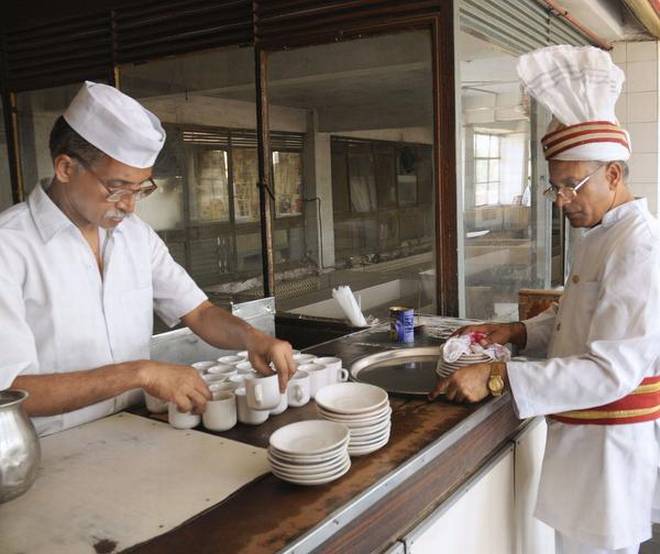
The liveried bearers remind one of railway dining halls. Pradeep says, “Everything is made fresh. We do not buy off-the-shelf masalas. We make everything from scratch.” The coffee powder is procured from the neighbouring India Coffee Board.

In other parts though, the chain procures beans from Wayanad. This is roasted and powdered in-house for use. Filter coffee decoction is brewed in a huge steel coffee filter. For sambar, the spices are roasted and ground and no sambar powder is used. Coconut chutney is made using fresh grated coconut with roasted chana dal, ginger and green chilli. As Pradeep speaks, there is a sense of pride in being a part of such a cooperative-spirited venture.

Recipe for success

Pradeep says an interesting formula has been worked out by the establishment. “One kilo of rice and 250 grams of urad dal without husk gives 35 dosas. Similarly, one kilogram of potato with half a kilogram of onion gives masala for 18 dosas. One kilogram of rice and half a kilogram of urad dal makes 50 idlis, and one kilogram of urad dal gives around 50 to 55 vadas.” Any variation and the cook is taken to task. The reason — if it is more, that means the quantity is wasted; if lower, then the customer is short-changed.” Amul butter is used for butter dosa and Amul cheese for the sandwich. The prices are still common man-like.

The Indian Coffee House reflects another era, where the unity of the people under the cooperative banner to build businesses and the country was paramount. They are still relevant in today’s world, where Amul gives the best of MNCs a run for their money. A little more effort, a little more care, more vision and the Indian Coffee House could be pioneering coffee chains not only in India but even abroad!

In this weekly column, we take a peek at some of the most iconic restaurants

source: http://www.thehindu.com / The Hindu / Home> Life & Style> Food / by Chitra Balasubramaniam / September 14th, 2017
Sun TV’s Kalanithi Maran and wife take total remuneration of Rs 155.86 cr in FY17

Mumbai :

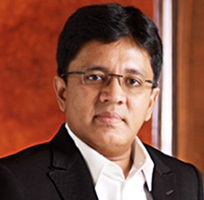
Sun TV Network founder-promoter Kalanithi Maran and his wife Kavery have taken home a combined remuneration of Rs 155.86 crore in FY17, making them one of the highest-paid corporate executives in the country.

The Marans were paid Rs 77.93 crore each as salary plus bonus in FY17, an increase of 9.04% from the earlier year. In FY16, each enjoyed a remuneration of Rs 71.47 crore.
KalanithiMaranKF07sept2017

While the salary remained the same, the increase in remuneration was mainly due to an increase in ex-gratia/bonus. The bonus component rose by over 11%.

Sun TV Network founder and executive chairman Kalanithi and his wife Kavery, who is an executive director, received Rs 13.14 crore each as salary, the same as in the year-ago period. However, the ex-gratia/bonus income rose to Rs 64.79 crore each from Rs 58.33 crore a year ago.

Maran received a dividend of Rs 295.56 crore in FY17 compared to Rs 458.12 crore in the prior year.

Meanwhile, Sun TV MD and CEO K Vijay Kumar drew a salary plus bonus of Rs 1.17 crore in FY17 compared to Rs 1.08 crore in the earlier year. Vijay Kumar’s salary grew to Rs 97 lakh from Rs 82 lakh in FY16.

Sun TV Network’s total income for the year ended 31 March 2017 was up 8.03% at Rs 2,703.80 crore, as against Rs 2, 502.75 crore a year ago. Profit before tax stood at Rs 1,490.35 crore against Rs 1,334.24 crore a year ago.

Profit after tax was Rs 979.41 crore as against Rs 869.69 crore in the previous year.

source: http://www.televisionpost.com / Television Post / Home> Television / by Television Post Team / September 04th, 2017

SIIMA awards ceremony to be aired on Sunday

SIIMAawardsKF05sept2017

The awards ceremony of the sixth edition of South Indian International Movie Awards, which was held at Dubai, will go on air on Sunday on Udaya tv at 6pm.

Sandalwood actresses Shubra Aiyappa and Shraddha Srinath, have performed in the glittering ceremony.

Actors Shivarajkumar, Rakshit Shetty, Nikhil Kumaraswamy, Chandan Achar, Radhika Chetan. Vasishta Simha, Rashmika Mandanna and Samyukth Hornad have graced the occasion.

The awards are given in different categories like best actor, best director, best singer, best debutant actor, best supporting actor and in several other category.

source: http://www.timesofindia.indiatimes.com / The Times of India / News> TV> News> Kannada / TNN / September 01st, 2017

Annual Kail Pold celebrations in Kodagu

Codava National Council members celebrate 'Kail Pold' festival, near Madikeri Junior College on Friday. dh photo
Codava National Council members celebrate ‘Kail Pold’ festival, near Madikeri Junior College on Friday. dh photo

The annual Kail Pold festival was celebrated in different parts of Kodagu with traditional fervour and gaiety on Friday.

The Codava National Council (CNC) members observed Kail Pold in the city. The festival will also be celebrated in a few parts of the district on Saturday and Sunday.

As part of its 22nd year of celebrations, the CNC organised a vehicle rally, held prayers for agricultural implements and firearms and also shooting at coconut competitions.

Agricultural equipment like plough, yoke, ‘Tami Taave,’ ‘Bollangi,’ burnished firearms, ‘Odi Kathi,’ ‘Peeche Kathi,’ were worshipped at a mand near Junior College in Madikeri.

Speaking on the occasion, CNC president N U Nachappa said, “Kodavas should be accorded tribal status. The district is known for its rich legacy. By celebrating the folk games and festivals in Kodagu, we have to pass on the tradition to the future generation.”

source: http://www.deccanherald.com / Deccan Herald / Home> District / by DH News Service, Madikeri / September 01st, 2017

Definitely Coorg!

Tucked in the western ghats in Karnataka, Coorg is best known for its coffee and people. There is something for everyone in this picturesque locale

BylekuppeKF05sept2017

Last week a friend asked me for travel advice on Coorg — when to go, what to see and buy and so on. It triggered many memories of the place and of the many trips I had made to it over the years.

Coorg’s lesser-known name is Kodagu. A rural district in Karnataka. It has been a popular holiday destination for long and especially for people of the state and surrounding ones. There are many things that draw people to Coorg – coffee plantations, homestays, which offer a slice of local life, an exotic Tibetan settlement, the wild western ghats, scrumptious local delicacies and wildlife sighting too.

The picturesque coffee plantations of Coorg are great to drive around. They are a photographer’s delight and are nowadays featuring in many south Indian films too. It is not only their scenic beauty which fascinates; Many plantations offer guided tours so you can see the various stages of coffee-making from the seeds to the powder and you can see carpets of coffee seeds laid out to dry in the sun as also piles of soap nut before houses.

Among the best trekking options in south India are contained in the Western Ghats which are now part of the UNESCO World Heritage List for their rich biodiversity. Waterfalls add to the scenic beauty. Some treks require permission from the forest department. Given its location on the eastern slopes of the Western Ghats. Coorg is a paradise for naturalists and even the lay nature lover will discern a vast range of flowers, birds and butterflies.

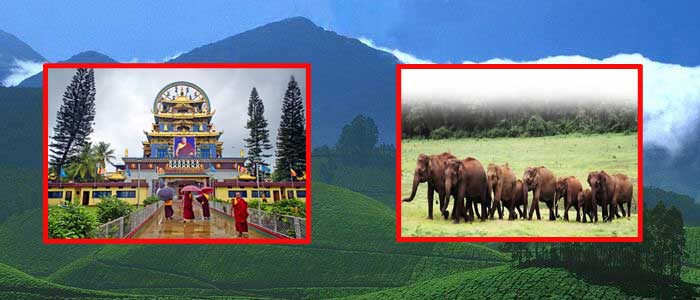
About 40 km south of Madikeri, is the Tibetan settlement at Bylakuppe built on land donated to Tibetan refugees by the Union Government. Here is the beautiful Namdroling monastery—once I entered, it felt like I was in Bhutan or Thailand’s monasteries; so authentically have the Tibetans recreated the Buddhist ethos. Stores here sell authentic handicrafts and hand-woven items though they are relatively expensive.

You can get up close and personal with elephants at the Dubare Elephant camp at the Cauvery river. Watching them bathe in the river and even helping in their scrubbing is a special delight for visiting urbanites and children particularly.

For sighting wildlife in more natural habitats, you can visit the Nagarhole National Park. A wide variety of safaris are on offer here. The tiger is a big draw—this park was part of Project Tiger. Bison, bear, leopards, reptiles, and hundreds of species of birds, etc are the other inhabitants.

Homestays have caught on in a great way in Coorg. I had never experienced a homestay in this area but had a close look at a few. Provided you find a really good one they are a great way to enjoy a slice of local life. From their food and architecture to their songs, marriage customs and attire including the way they drape their sarees. there is a fascinating Kodava culture to discover.

Coorg is a foodie’s delight too with its varied cuisine. Being a vegetarian, I have never tasted its most famous dish–Pandi Curry but have heard my carnivore friends rave about it. This is pork in a sour and spicy gravy made from Kachampuli, a black vinegar made from black kokum fruit. My favourites are the bamboo-shoot curry, Puttu or steamed rice dishes like Nooputtu which is a bit like Kerala’s idiyappam, Paaputtu and Akki roti with pumpkin curry or Kaad mango curry made from wild mangoes which give it a delightful tartness.

Rice and coconut are integral to the local cuisine and non-vegetarian dishes like mutton and chicken are popular. You will also find on the table local honey, chutneys of smoked or dried meat and fish, and pickles of mushroom, gooseberries and tender bamboo.

For my friend’s shopping list, I recommended the local wines (made from local fruits) knowing she and her husband were wine connoisseurs. The gooseberry wine generally tops that list of wines for such people. The honey is among the best in the country and coffee seeds and powder are favourite purchases of visitors. You can carry back spices and locally made jams and pickles. The artefacts at Bylakuppe and items from discarded wood from plantations are other options.

source: http://www.thehansindia.com / The Hans India / Home> Sunday Herald / September 02nd, 2017