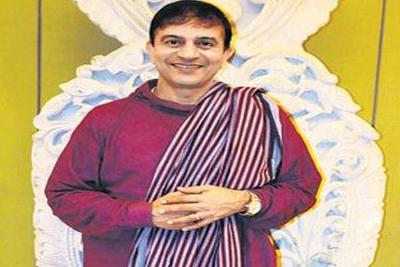
Prasad Bidapa is doing a fashion show. What’s new, you might ask. Well this one is in Pakistan.
And naturally, Bidapa is thrilled.`Shaan-e-Pakistan: Kya Dilli Kya Lahore’, organised by Huma Nassr, is an annual three-day event in Lahore intended as a plat form for the singers, dancers and designers of both nations.
And Bidapa has company not just from the fashion industry but from the music industry as well, such as popular singer Atif Aslam.
Now this is a cross-border collaboration worth strutting his stuff for.
source: http://www.timesofindia.indiatimes.com / The Times of India / News Home> Entertainment> Kannada / Bangalore Mirror Bureau / March 23rd, 2016
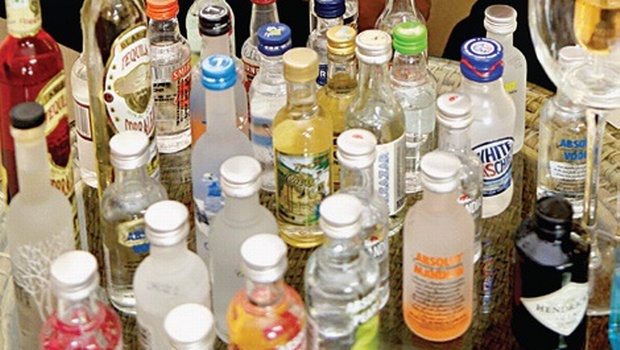
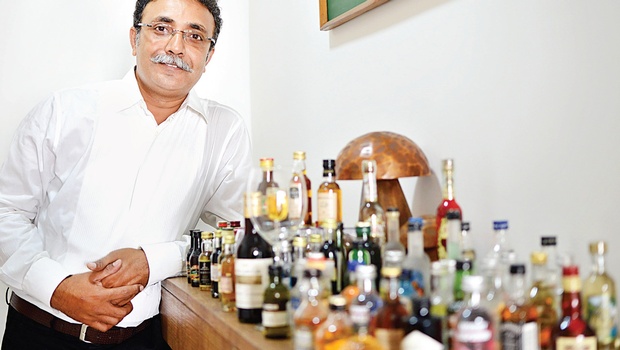
Hailing from Kodagu — where no feast or ceremony is complete unless liquor is served — Kishoo Uthappa, a civil contractor, has a large collection of miniature liquor bottles.
He saw his uncle’s collection when he was in high school in 1985, and got an empty mini bottle from him. That was the start of his own collection of liquor and cologne bottles. However, he stopped adding cologne bottles to the stash about three years ago as the content evaporates quickly.
Kishoo says, “I pick up a bottle or two when I see them at stores. They are pretty expensive. I pick up some from the airport where they are easily available. I now have a collection of 200 full bottles of scotch and vodka, especially Absolut — which has come up with its own collection of different kinds of bottles. ”
He has a mini bar at home with all kinds of bottles for his guests. “I relish every flavour of alcohol now. I used to drink one or two brands before. But now I find everything enjoyable,” he says with a laugh.
His family is proud of his collection. “I was talking to one of my friends about Absinthe, a drink with 75 per cent alcohol content. It is banned in most countries. I was telling him how I would love to own a bottle and my son reminded me that I already do have a miniature from Germany,” he recalls.
Kishoo buys and exchanges bottles with people on his Facebook page Pushkar V
On some Sundays, they take the collection out, clean the bottles and rearrange them.
Peg bottles are new in India, he says. “The smallest bottles otherwise are of 250 ml here. But in Europe, peg bottles are very common.”
Kishoo started a Facebook page a year ago that now has about 200 followers. While he has bought bottles from some, he has found some fraudsters too. “I had once transferred money to a guy who promised me some mini bottles but I never received them,” he says.
Kishoo has also reported fake profiles, owners of which download pictures of bottles from the Internet and portray them as their collection.
He never sells anything from his collection but is ready to exchange. He says, “It is my hobby and I don’t intend to make any money out of it.”
source: http://www.newindianexpress.com / The New Indian Express / Home> Cities> Bengaluru / by Akhila Damodaran / March 21st, 2016
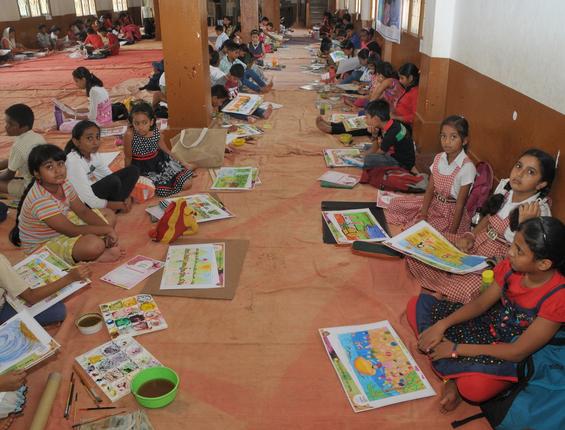
Winners of the The Hindu Young World Painting Competition at St. Rita’s English Medium School, Jeppu, in Mangaluru on Sunday.— PHOTO: H.S. MANJUNATH
Mokshit Suresh, fourth standard student from Delhi Public School, Mangaluru, and Gauravdev H.B, eighth standard student from St. Aloysius High School, Kodialbail, were adjudged as the winners in the junior and senior categories, respectively, at The Hindu Young World Painting Competition here on Sunday.
Arya P.R. and and M.K. Saham, sixth standard students from Bharatiya Vidya Bhavan, Madikeri, were chosen the first and second runners-up in the junior category. Raeesha, ninth standard student from Madava Kripa School, Manipal, and M. Siri Subash, seventh standard student from St. Aloysius English Medium School, Urwa, were chosen as the first and second runners-up in the senior category.
The consolation prize winners in the junior category are Sinchana Subhash from St. Aloysius English Medium School, Urwa, Havyas K.K. from Bharatiya Vidya Bhavan, Madikeri, Prajwal P. from RMSM School, Mulki, Aditi P. Pai from Canara CBSE School, Mangaluru, Ananya Y.M. from Canara Higher Primary School, Urwa, Suvidha S. from Sri Venkataramana School, Kundapura, and Himani from St. Cecily’s Higher Primary School, Udupi.
The consolation prize winners in the senior category are Atul Shet from Canara High School, Mangaluru, Rahul N. Naik from Little Rock Indian School, Brahmavar, Ashika Naidu from St. Gerosa School, Mangaluru, S. Sanjeev Bhagath from Bharatiya Vidya Bhavan, Madikeri, Malaika J. Sequeira from St. Agnes High School, Mangaluru, Shreyas Achar from Vivekananda School, Puttur, and G. Varun Raj from St. Rita School, Mangaluru.
Senior artists of Mangaluru Rajendra Kedige and Harish Kodialbail were the judges.
source: http://www.thehindu.com / The Hindu / Home> Karnataka / by Staff Correspondent / Mangaluru – March 21st, 2016
Students from Mangaluru topped in the junior and senior category in the Young World Painting competition held at the St. Rita School here on Sunday.
As many as 250 students from Mangaluru, Udupi, Madikeri and Chikkamagaluru took part in the competition held separately for junior and senior categories.
Over 250 students participated in this year’s Young World Painting competition that was held at the St. Rita School at Mangaluru on Sunday. Photo: H.S. Manjunath
The topic for the juniors (students from 4th to 6th standards) was “Fun in Sun” and “Outside the window”, while for the senior category (students from 7th to 9th standards), the topic was “Emotions”, “A scene in kitchen” and “My home town railway station”.
Mokshit Suresh, a 4th standard student form Delhi Public School, was adjudged the winner in the junior category. Arya P.R and M.K. Saham, both 6th standard students of Bharatiya Vidya Bhavan of Madikeri, were adjudged as first and second runners-up.
Sinchana Subhash from St. Aloysius English Medium School Urva, Havyas K.K. from Bharatiya Vidya Bhavan, Madikeri, Prajwal P form RMSM School, Mulki, Aditi P. Pai from Canara CBSE School, Ananya Y.M. from Canara Higher Primary School Urwa, Suvidha S from Sri Venkataramana School, Kundapura, and Himani from St. Cecily’s Higher Primary School, Udupi, bagged consolation prizes in the junior category.
In the senior category, Gauravdev H.R From St. Aloysius High School, Kodialbail, was adjudged as the winner. Raeesa from Madhava Kripa School, Manipal, and M. Siri Subash from St. Aloysius English Medium School, Urwa, were adjudged as first and second runners-up.
Atul Shet from Canara High School, Rahul N Naik from Little Rock Indian School, Brahmavar, Ashika Naidiu from St. Gerosa School, Mangaluru, S. Sanjeev Bhagath from Bharatiya Vidya Bhavan, Madikeri, Malaika J Sequeira from St. Agens High School, Shreyas Achar from Vivekanananda School, Puttur, and G. Varun Raj from St. Rita’s School won consolation prizes.
Managing Trustee of Alvas Education Foundation Vivek Alwa presented the prizes and urged parents to encourage their children in drawing and other creative art.
This year, the event was presented by Thyrocare, while the St. Rita school was the venue partner. The Learining Centre (TLC) was the associate sponsor, while the Hangyo Ice creams Pvt. Ltd was the beverage partner.
source: http://www.thehindu.com / The Hindu / Home> National> Karnataka / by Raghava M / Mangaluru – March 20th, 2016
Plastic was banned in the town way back in 2010-11 during P D Ponappa’s tenure as president of the City Municipal Council.
The town is also called Nirmala Nagara.
Ponappa said he was happy that the concept was well received by the people of Madikeri.
People carrying cloth bags for shopping is a common sight in Madikeri. Even on shandy days, they bring bags from home.
Harish, proprietor of Hotel Omkar, said they have started giving parcels in plastic boxes that are permitted and and carrybags made of cloth. City Municipal Council Commissioner Pusphavathy said, “We have taken up awareness programmes like door-to-door campaigning. We have been penalising people who violate the rules, and we destroy plastic bags that are banned.” She appreciated the cooperation from shopkeepers as well as the public.
“But tourists who visit Madikeri during weekends and holidays pollute the town by using plastic bottles and bags,” she rued.
source: http://www.newindianexpress.com / The New Indian Express / Home> Cities> Bengaluru / by B C Dinesh / March 12th, 2016
Don’t restrict the mela to yourself; invite people from other communities so that they can come to know more about Kodavas, said MLC R Dharmasena.
During the valedictory function of the two-day state-level Kodava Sahitya Samskruthika Mela organized by the Karnataka Kodava Sahitya Academy, Madikeri in association with Kodava Samaja, Mysuru, at the Scouts and Guides grounds here on Sunday he appreciated the academy for conducting the mela outside Madikeri.
Regarding a request by PG Chengappa, former vice-chancellor, UAS, Bengaluru, Dharmasena said, “The academy requested enhancing the annual grant from Rs 65 lakh to Rs 1 crore, but I requested the government to enhance it Rs 2 crore.”
Chengappa called upon the community to come together to conduct various programmes under the Karnataka Kodava Sahitya Academy so that the purpose of setting academy by government will be realized. During the event, various cultural and awareness programmes, including poets’ meet, were conducted. Due to the demise of two community persons and the ongoing exams, the turnout was not on expected lines.
Biddatanda S Thammaiah, chairman, Karnataka Kodava Sahitya Academy was also present.
The first book on the Mahabharata written in the Kodava language released
The first concise book on the Mahabharata written in the Kodava language by Kanathanda S Muthappa was brought out by the Karnataka Kodava Sahitya Academy. It was released by PG Chengappa, former VC, UAS, Bengaluru at the valedictory of the mela.
Muthappa, who hails from Thithimathi of Virajpet taluk in Kodagu district, is the elder brother of late superintendent of police K S Thammaiah, who had distinguished himself as chief of the anti-rowdy squad in Mysuru in the mid-1990s.
The KKSA took a year to complete the compilation of the book with Kannada as the script. The 300-page book will enable Kodavas and lovers of the language to read the epic in their mother tongue and comprehend the epic quickly.
source: http://www.timesofindia.indiatimes.com / The Times of India / News Home> City> Mysore / March 13th, 2016
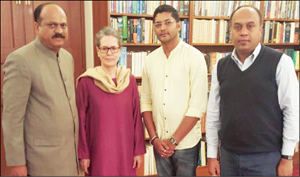
Kodava Sahitya Academy Chairman (extreme left) Biddatanda S. Thammaiah, Legal Advisor to Karnataka CM Palachanda Brijesh Kalappa (extreme right) and artiste Chekkera Pancham Thyagaraj seen with AICC President Sonia Gandhi at her 10 Janpath residence in Delhi.
New Delhi :
The Kodava Sahitya Academy has demanded an exclusive Rajya Sabha (RS) seat for Kodavas on the lines of Anglo-Indian community and conferment of Bharat Ratna posthumously on the country’s first Field Marshal, Gen.K.M. Cariappa.
A delegation of Kodava Sahitya Academy, comprising its Chairman Biddatanda S. Thammaiah, Legal Advisor to Karnataka Chief Minister Palachanda Brijesh Kalappa and artiste Chekkera Pancham Thyagaraj, which met AICC President Sonia Gandhi at her 10 Janpath residence here recently, apprised her of the current status of Kodavas.
Responding to the delegation’s plea, Sonia Gandhi said that she was aware of Kodagu district’s unique geographical features, Kodava culture and traditions.
Recalling that Gen. K.S. Thimmaya’s sister Ammi was a Personal Secretary of late Prime Minister Indira Gandhi, Sonia Gandhi reminded that it was Rajiv Gandhi’s Government which bestowed the ‘Field Marshal’ title on Gen. K.M. Cariappa on Jan. 14, 1986.
Sonia also assured that she would look into the demands of Kodavas and respond appropriately, said Brijesh Kalappa.
source: http://www.starofmysore.com / Star of Mysore / Home> General News / March 10th, 2016
Kodavas seek Bharat Ratna award for Field Marshall K.M. Cariappa
Mysuru :
“It is not just a spur of the moment to seek benefits, but the culture and tradition practiced by Kodavas are akin to tribals in the State, hence Kodavas need to be accorded the status of tribals”, urged Chief Minister Siddharamaiah’s Legal Advisor Palachanda Brijesh Kalappa, who is also the spokesman of All India Congress Committee (AICC), here yesterday.
Addressing a huge gathering at the two-day Kodava Literary and Cultural Festival at the Scouts and Guides Grounds organised by Karnataka Kodava Sahitya Akademy, he said “Earlier, especially post-independence, Kodava IPS officers were in large numbers. Now, the number of such officers in civil services has dwindled, as Kodavas are not eligible to get their due share in top service-oriented jobs owing to lack of reservations”.
Claiming that Kodava language has a rich history of over 1,000 years and is older than Malayalam, he added that there is a need to preserve the language for posterity, besides carving a niche in defence services, the community members should also achieve in other fields, thus spreading the innate Kodava culture among all.
Regional Commissioner A.M. Kunjappa, speaking on the occasion said that there are many possibilities of Kodava culture and tradition facing threat as the people of the land are migrating to other places and added that instead, Kodavas should spread the essence of their land among their off-springs.
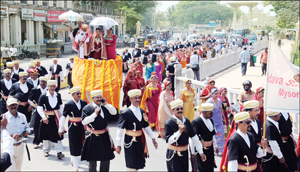
Earlier, inaugurating the grand cultural procession at the North Gate of Mysore Palace, Kunjappa said ‘One or two-day cultural programmes is not enough to spread the Kodava culture. It should be taught to the younger generations on a daily basis’.
Kodavas seek Bharat Ratna to K.M. Cariappa: Karnataka Kodava Sahitya Akademy Chairman Biddatanda S. Thammaiah yesterday urged the Central Government to confer the Country’s highest Civilian Award “Bharat Ratna” posthumously on Field Marshall K.M. Cariappa during the on-going two-day State-level Kodava Sahitya Samskruthika Mela in city.
Stating that Kodava Culture, tradition and practices have been widely appreciated, he rued ”Unfortunately successive governments have failed to make serious attempts to bring Kodavas into the mainstream.”
He added that there are no able leaders to raise the problems and issues of Kodavas in the Parliament or in the Legislative Assembly.
Book Release: Meanwhile, Assistant Professor Dr. Kaveri Prakash, whose book titled ‘Kodavara Samskaragalu’ in Kannada highlighting traditions of Kodava Culture was released on the occasion, pointed out that all cultures and traditions are fast vanishing due to modernisation and stressed the need to protect them
Karnataka Kodava Sahitya Akademy Chairman Biddatanda S. Thammaiah, State Handicrafts Development Corporation Chairperson Shantheyanda Veena Achhaiah, Mysuru Kodava Samaja President Moovera Kuttappa, Balyamanda M. Nanaiah and others were among those present.
source: http://www.starofmysore.com / Star of Mysore / Home> General News / March 13th, 2016
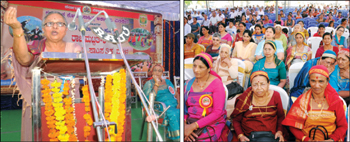
Poetess Kasthuri Govindammayya is seen addressing the gathering during the Kavigoshti at Scouts and Guides Grounds here this morning. Picture rights shows a section of audience.
Mysuru :
The second and concluding day of the two-day State-level Kodava Sahitya Samskruthika Mela organised by Karnataka Kodava Sahitya Academy, Madikeri, in association with Kodava Samaja, Mysuru, at the Scouts and Guides Grounds behind the Deputy Commissioner’s (DC) office here, began with Kavigoshti (poets meet) this morning.
Poet Kiriyamada Raj Kushalappa of Hudikeri recited poems on ‘Kodava land’, while poetess Mukkatira Akkamma Nanjappa from Ammatti recited poems with the theme ‘Mother’ and poetess Maluvanda Nalini Bindu from Arameri, recited poems on ‘Selfless service’.
Senior writer and poetess Badakadamanda Kasthuri Govindammayya, chaired the Kavigoshti session. Commenting on the recited poems, Kasthuri Govindammayya said that Raj Kushalappa’s poems highlighted the sacred relationship between the mother and land.
Observing that it was fortunate to be born in Kodagu, which is a rich mix of nature and unique culture, she regretted the migration of Kodavas to far off places.
Noting that Akkamma Nanjappa’s poems were based on the theme ‘Mother’ and focussed on the hardships faced by a mother in bringing up her children, she lamented the growing tendency of children sending their aged parents to old age homes, with least regard for them.
Bemoaning the declining interest among Kodavas, especially the younger generation, for Kodava Sahitya, Govindammayya cautioned that Kodava Sahitya would lose its identity if immediate measures were not taken for attracting the youth towards Kodava Literature and Culture.
The Kavigoshti was followed by a seminar in which senior advocate Pandanda D. Medappa presented a paper titled ‘Varthamanathara Kodag’, while Ponjanda Lovely Appaiah presented a paper titled ‘Kodavada Samskruthi.’
Star of Mysore Editor-in-Chief Kaliyantanda B. Ganapathy, who presided over the seminar, said that Kodagu has unique geographical features, which needs to be preserved at any cost. He was summing up the talks given by P.D. Medappa and Lovely Appaiah.
Regretting that not much was being done for retaining Kodagu’s unique identity and culture, which he said was fast changing, Ganapathy called for serious thoughts over the issue at least in the future.
Highlighting the need for the involvement of more youths in politics in order to fight for the geographical identity of Kodagu district and for protecting the political rights of the Kodavas and other 18 Kodava language speaking people in Kodagu, Ganapathy urged the youngsters to be politically conscious. He called upon the youth to join any political party and strive to identify themselves in politics. The valedictory of the two-day event will take place later this evening.
source: http://www.starofmysore.com / Star of Mysore / Home> General News / March 13th, 2016
Mysuru-Kodagu MP Pratap Simha is seen lighting the traditional lamp to inaugurate the two-day State-level Kodava Literary and Cultural Fest at Scouts and Guides Ground in city this morning. Others seen are (from left) former President of Mysuru Kodava Samaja Dr. A.A. Kuttappa, Samaja President M.K. Kuttappa, Regional Commissioner A.M. Kunjappa, Karnataka State Handicrafts Development Corporation Ltd., Chairperson Veena Achaiah, Karnataka Kodava Sahitya Academy Chairman B.S. Thammaiah, Legal Advisor to Karnataka Chief Minister Brijesh Kalappa, former VC of Hampi University Prof. H.J. Lakkappa Gowda, Folklore University VC Prof. Ambalike Hiriyanna, Joint Director of Kannada and Culture Balwant Rao Patil, In-charge Assistant Director of Kannada and Culture Department (Kodagu) S.I. Bhavikatti and Academy Registrar Umarabba.
Mysuru:
Observing that Kodava culture and traditions can be likened to that of Parsi community, which is known for its unity, entrepreneurship and large heartedness, Mysuru-Kodagu MP Pratap Simha said that patriotism runs in the blood of every Kodava.
He was speaking after inaugurating the two-day State-level Kodava Sahitya-Samskruthika Mela at Haradasa Appaneravanda Appachha Kavi Vedike at the Scouts and Guides ground near the Deputy Commissioner’s office here this morning.
Stating that he had great affection for Kodavas, Simha said that however, he has a little grouse against Kodavas for migrating to other places in search of work and other profession, after leaving their homeland Kodagu.
Pointing out that Kodavas celebrate three major festivals in a year — Huthri, Kail Poldh and Cauvery Sankramana — the MP wondered how many Kodavas were really interested in farming and cultivating paddy and other crops.
Noting that Kodava community had given great warriors like Field Marshal K.M. Cariappa and General K.S. Thimayya to the nation, Simha lamented the declining number of Kodavas joining the armed forces of late.
Expressing concern over the sharply declining Kodava influence in the armed forces, Simha warned that one day a gallery of Kodava Army Officers has to be set up for the future generation as reminiscence of the past, if the trend continued.
Expressing disappointment over declining cultural values, traditions and unity among Kodavas, Simha said this can be seen in the lack of development of Kodava Samaja buildings across Kodagu district.
Suggesting creating of an exclusive space at the newly-constructed Kodagu DC Office building at Madikeri for displaying the rich Kodava culture, heritage and traditions to future generation, the MP stressed on the need for inculcating Kodava culture among younger generations of the community.
Highlighting the need for maintaining unity and affection among Kodavas, Simha called for appropriate measures for further strengthening of Kodava culture and traditions.
Earlier, the Reception Committee Chairman Dr. Adengada A. Kuttappa hoisted the flag. Kodava Sahitya Academy Registrar Umarabba welcomed. Academy Chairman Biddatanda S. Thammaiah presided.
Mysuru Kodava Samaja President Moovera K. Kuttappa, Regional Commissioner Appachettolanda M. Kunjappa, Karnataka State Handicrafts Development Corporation Chairman Shantheyanda Veena Achaiah, Legal Advisor to the Chief Minister Palachanda Brijesh Kalappa, former Hampi Kannada University VC Prof. H.J. Lakkappa Gowda, Karnataka Folklore University VC Prof. Ambalike Hiriyanna, Joint Director of Kannada and Culture Balwant Rao Patil, Department of Kannada and Culture Assistant Director (Kodagu) S.I. Bhavikatti and others were present.
The two-day event features a book exhibition, an informative expo on Kodava land, literature, culture and geographical features, Kodava Folk art contests followed by a host of cultural programmes. Tomorrow, the second and concluding day of the Mela, will feature kavighosti at 11 am followed by a seminar at 12 noon.
The valedictory will take place at 4 pm with former Agriculture University VC Prof. P.G. Chengappa delivering the valedictory address.
source: http://www.starofmysore.com / Star of Mysore / Home> General News / March 12th, 2016
WELCOME. If you like what you see "SUBSCRIBE via EMAIL" to receive FREE regular UPDATES.
Read More »