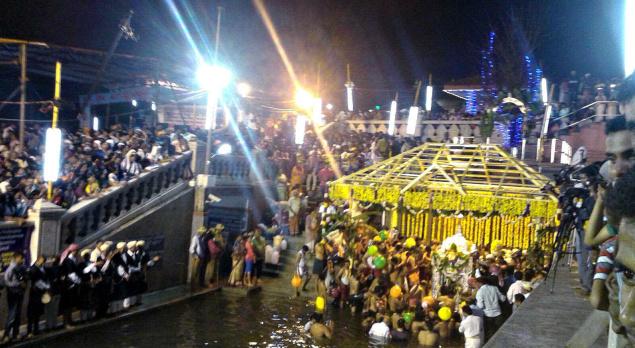
Devotees thronged to collect teertha after the Teertodbhava at Talacauvery in Kodagu on Sunday.
Several devotees reached Talacauvery ahead of the scheduled event
The annual spectacle of ‘Teertodbhava’, symbolising the emerging of holy water from the ‘Brahmakundike’, a tiny niche at the foothills of the Brahmagiri Hills at Talacauvery in Kodagu, occurred at 12.15 a.m. amidst the chanting of Vedic hymns by priests on Sunday. The Cauvery originates from Talacauvery.
Thousands thronged the spot to catch a glimpse of the occurrence. Many devotees had reached Talacauvery much ahead of the scheduled event. “Everything went off well,” Manu Muthappa, president of the Bhagandeshwara-Talacauvery Temple Management Committee, said.
Devotees streamed into Bhagamandala to take a holy dip at the Triveni Sangama, offer prayers and proceed towards Talacauvery, located about eight km away. The district police had a tough time controlling devotees. Priests sprinkled ‘teertha’ on the devotees as soon as it emerged from the Brahmakundike.
The water is not allowed to overflow from the niche, since it is considered inauspicious.
Distribution of teertha will take place on Sunday evening and Monday morning. The entire area had a festive appearance with people scrambling to carry ‘teertha’ from the birthplace of the river.
There is also a tradition of the devout performing rites in memory of the deceased and adequate arrangements were in place to cater to the devotees. Public representatives, administration and police officers were present.
source: http://www.thehindu.com / The Hindu / Home> National> Karnataka / by V. Paneesha And / Madikeri – Mysuru, October 19th, 2015
Talacauvery, the birth place of River Cauvery in Kodagu district, is all set for Cauvery Theerthodbhava to occur at 12.15 am (Sunday).
Inspecting the preparations, Kodagu DC Meer Anis Ahmed and Additional DC Satish Kumar yesterday visited the pilgrim towns of Bhagamandala and Talacauvery.
DC Ahmed, speaking to media persons, said that about 700 cops and 47 officers, 42 women constables and 150 Home Guards would be posted on security duty during the Theerthodbhava in which thousands of devotees from the State and neighbouring States will take part.
Kodagu Ekikarana Ranga will serve breakfast to the devotees, he said and added that temporary toilets had been built for the convenience of visitors at both Talacauvery and Bhagamandala.
This apart, the KSRTC will run special bus services from Madikeri to Talacauvery today.
Traffic regulation:
In an effort to avoid congestion of traffic on the occasion of the Theerthodbhava, the district administration has regulated movement of vehicles towards Talacauvery and Bhagamandala on NH-275 by imposing one-way rule.
All vehicles traveling towards Talacauvery and Bhagamandala on Mysuru-Bantwal NH-275 have been asked to take a right turn near Thalathamane and pass through Appangala-Bettageri.
Likewise vehicles returning from Talacauvery and Bhagamandala have been instructed to pass through Bettageri-Appangala-Katakeri road to join Mysuru-Bantawal Highway and the restrictions would be in force till 6 pm on Sunday.
source: http://www.starofmysore.com / Star of Mysore / Home> General News / October 17th, 2015
The Kodava Sahitya Academy and Arebhashe Samskriti Mathu Sahitya Academy will urge the Ministry of Home Affairs to continue the exemption to possess firearms under Section 3 and 4 of the Indian Arms Act.
At a meeting convened on Wednesday, to collect public opinion on the issue, the Kodava Sahitya Academy president B S Thammaiah said that a delegation under the leadership of MP Prathap Simha would be taken to Delhi to impress upon the Home Ministry.
“The public should give their opinion on exemption to possess firearms in writing. All the written opinions will be compiled and submitted to the Central government,” he said.
Arebhashe Samskriti Haagu Sahitya Academy President Kolyada Girish said, “There are several burning issues in Kodagu. Now, the issue of exemption to possess firearms has appeared. We are not ready to lose the exemption given to us.”
Napoklu Kodava Samaja President Uthappa demanded, “Exemption to possess firearms by every person of Coorg race and every Jamma holder should be continued.”
P J Ayyappa said the circular issued by the British rules mentions the term ‘Coorg race.’ There is a need to define the term ‘race’ to make the officials and the government understand, he insisted.
Kudukuli Bharath said, “All the traditional dwellers of Kodagu come under Coorg by race. I had availed exemption to possess firearms way back in 1976.
“The exemption is not restricted to Kodavas alone. It is related to all the traditional dwellers of Kodagu. We have to protect our rights.”
Kodagu Gowda Vidya Sangha member and Advocate Dayanand concurred, “The exemption to possess firearms has been given to ‘gallant people of Coorg’, according to a circular issued by the British Commissioner Cubbon in 1861. The circular does not mention one community alone.
“The ‘Coorg race’ is not restricted to one caste or creed alone. The circular on Coorg race has been misunderstood by the officials. The exemption enjoyed by the traditional dwellers of Kodagu prior to 1976 should be continued.”
Codava Makkada Coota President Bolajjeera Ayyappa said, “Coorg, by race, is only Kodava community. There is no need to create confusion in this regard.”
List of communities
Kodava Bhashikara Sangha District President Sara Changappa said, “When K G Bopaiah was the Speaker of the Assembly, the State government had submitted a list of communities that come under ‘Coorg by race’ to the Kodagu deputy commissioner. The list includes all the traditional dwellers of Kodagu.”
Advocate Yaladaalu Manoj Bopaiah said, “The exemption given by the British regime is continued by the Central government through a circular. The exemption is not a legislation passed in the Parliament. In case the government feels that the exemption will create discrimination among communities, then it will be withdrawn. The right is not bestowed on a particular community. Instead, it is given to the residents of a geographical area. There is a need to convince the government that the exemption has been availed by the Codavas, Arebhashe Gowdas and other community members in the district.”
Legislators K G Bopaiah and Appachu Ranjan should impress upon the Home Ministry through Union Minister for Law Sadananda Gowda, he said and added, “As we do not have time, we have to act swiftly.
source: http://www.deccanherald.com / Deccan Herald / Home> District / DHNS, Madideri – October 15th, 2015
In her few years as an actress, Harshika Poonacha has been a part of Kannada, Kodava and Konkani films and won a state award for her work in Thamasu. Now, with a Telugu film in the offing and with her currently shooting for an untitled multi-lingual thriller, she is set to make her Tamil debut too. Harshika tells us about the challenges the film industry has put forth before she could make headway.
Is branching out of the Kannada film industry to work on films in other languages the only way for a south actress to make a mark today? I don’t think actresses here can be blamed if they work towards making a mark elsewhere. We move out because, at times, filmmakers here fail to see the potential in local, Kannadiga actresses. See the number of films that are being made here each year — most of them have heroines from various other states. This, even when there are so many talented local actresses right here. I have often heard people say that heroines from here are not on par with, say, heroines from Bollywood or other south industries. They say we don’t look glamourous enough or are not bold enough. But that is not true. Actresses here can transform to play any role and I am not speaking for myself when I say that. Take a look at the many actresses from here that have gone on to make a mark in other languages. It is unfortunate that makers tend to notice potential only when an actress has ventured out and proven herself.
Tell us about the multi-lingual thriller you are shooting for… I have been shooting right through the nights for this film at a huge house on the outskirts of Bengaluru for the last one month. It is a thriller, directed by Venugopal,which is being made in four south languages simultaneously. So the cast for all are on the set together as we are required to shoot our scenes one after the other. While it is being made in Kannada too, I am not part of the Kannada version. This will mark my Tamil debut instead, in which I star opposite Mahat Raghavendra.
Do you find yourself facing language issues when it comes to such projects? Going to a school where you have friends who speak so many different languages is a huge advantage. I can speak most south Indian language fluently. While I dub for all my Kannada films, it is up to the director to decide if my Tamil is fluent enough for me to dub. Though, dubbing for your own films does give you an advantage, in terms of portraying your character to the fullest, as well as when you are being considered for State awards. There are not many actresses in the Kannada film industry who can dub for themselves. I am part of three Kannada films that are being shot in the coming year, and I will, of course, dub for all these films myself.
source: http://www.timesofindia.indiatimes.com / The Times of India / Home> Entertainment> Kannada> Movies / by Kavya Christopher, TNN / October 11th, 2015
What do pretty words do? A lyrical line, a clever turn of phrase, a poetic piece of prose in a book, a page, a passage: what it does is that it gives you a line to note down in a journal of favourite such lines from there and elsewhere. What these words and phrases do is make you remark privately on the poetry in the writer’s prose, applaud her imagination in stringing smart metaphors together, the sorts that make you pause your reading and say ‘ah’. But there is something like too much of a good thing. We have known that for long. And it is this too much of a good thing that threatens to tarnish the gleam in Sarita Mandanna’s Good Hope Road.
Mandanna is a good writer, undoubtedly. Some of her metaphors are very well thought of indeed. “…petrol-over-water colours”, “the sheen of a fin upstream” and suchlike draw a picturesque scene in the readers’ minds, like something at the edges of a detailed postcard. They lend themselves delightfully to a reading aloud, the lyricism as pleasing to the ears as to the mind that recreates every scene in a story as you go along. But the pitfall—and I imagine it is a hard one to avoid falling into—is that the story itself gets clouded by the pretty décor that is sprinkled on every page like sparkly confetti. Which is too often the case with Good Hope Road.
The story’s scope is ambitious and is spread over many decades and a couple of generations, spanning the First World War and ending just at the beginning of the Second. The narrative goes back and forth, shifting between the years and stories and incidents, jerky in some places, but mostly retaining a decent pace. There is Major James Stonebridge, a Yankee from New England, and Obadaiah Nelson, a Louisiana native, who find themselves at the warfront in Paris. Idealistic, brave, loyal and hungry for adventure, as most young men were, they form a deep, and unlikely, friendship. A decade and half later, Stonebridge is a recluse, back home, but lost somewhere still in France’s old war zones. A mirror that he is content to stare into stares back at him an image of a man broken and burdened by a war that changed his generation and the histories of many nations. His anger, his moods are most felt by his son Jim, whose first understanding of his father’s life comes when pretty and privileged Madeleine enters their lives. She won’t let the Major stew in his black mood, drawing him slowly out of his shell.
Then there is the Bonus March that is sweeping the nation… a reference uncannily, similar to the protests sweeping this nation, for pensions and dues. Mandanna picks up on a little known protest by veterans demanding that the US government give them the bonuses due to them and explores poignantly the way nations ignore their returning soldiers. It is in that sense a story of every nation that has ever been at war. While young men are sent off to the front with fanfare and hailed as heroes, or martyrs, the ones that return are often ignored. Their assimilation into a society that has never seen bombs or been in trenches is an exercise undertaken only reluctantly, half-heartedly, if at all. The book addresses this theme with sensitivity, highlighting the trauma, the depression and lack of a sense of purpose that plagues war heroes. It is not limb or life alone that is affected, but the hidden scars that run dark and deep that Mandanna seeks to shine a torch on. And for all the gloss, the book does do that rather well.
Her attention to detail makes for fascinating reading as well. Skimming over the technical details of war strategies, Mandanna cuts right through to the lives of the soldiers, strangers thrown together by patriotism, adventure or something else. Their camaraderie, the little sharing of a song or a letter, small conversations, these are places where the book offers lovely insight into the human-ness of those that fight a nation’s wars.
source: http://www.newindianexpress.com / The New Indian Express / Home> LifeStyle> Books / by Deepa Bhasthi / October 10th, 2015
Centuries-old custom of Kodavas and Jamma land tenure holders in Kodagu
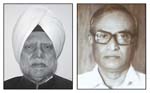
Buta Singh & C. G. Somiah
The issue of Kodavas (a native community belonging to Kodagu district in Karnataka) enjoying the concession to hold guns under the Indian Arms Act without licence along with a few other communities like Amma Kodavas, Kodagu Gowdas, Mapillas also known as Moplah in english, enjoying the special and unique land holding called Jamma tenure, has once again come into public discussion following a PIL filed by one Y.K. Chetan.
Since I had written about it a couple of times in this column, I thought I would ignore it this time but after seeing a letter to the editor written by a Kodava senior advocate of Mysuru, P.D. Medappa, I decided to add my bit to the “gun question” raised frequently by those who are jealous of Kodavas per se and others enjoying the concession in Kodagu. Those who question this privilege bring in such irrational arguments like that this privilege is discriminative in nature in a democracy, it is ultra-virus to the Constitution, it is dangerous to other citizens who do not have the privilege etc.
This privilege issue became so serious about a decade ago when a communal clash in Kodagu resulted in the death of two persons belonging to the Moplah (Malabar Muslim) community. A month after this, Union Home Ministry received a letter from Kerala Chief Minister mentioning the incident and demanding withdrawal of the concession under the Indian Arms Act.
This development at the highest political level had almost led to the withdrawal of the concession but for the intervention of the then Home Secretary C. G. Somiah (who later became the Comptroller and Auditor General of India). C.G. Somiah has written about it in detail in his book titled ‘The Honest Always Stand Alone.’ Let me quote the relevant part from the book:
There was a stray incident of communal disharmony in my home district, Kodagu. It started as a case of eve teasing of a Coorg girl by the youth belonging to the Moplah community, which led to violence and arson in the market area of Virajpet.
The next day a wayside temple was found desecrated and the clashes continued between the two communities resulting in the death of two Moplahs, one of them having suffered gunshot wounds. With a massive show of force, the district administration brought the situation under control and peace returned to the area.
The Moplahs of Malabar in Kerala have lived in peace for centuries in Coorg and they were the main traders of the produce of Coorg — coffee, oranges and spices. They also traded in fish, bringing fish to Coorg from the nearby seaports of Kerala. I was happy that peace had returned to Coorg by the deft handling of the situation by the local administration. A month later we were surprised to receive a letter from the Chief Minister, Kerala, addressed to the Home Minister about the incident and suggesting that gun culture in Coorg had to be curbed. This was to be done by withdrawing the concession under the Indian Arms Act granted to the Kodavas, which permitted them to own guns without a licence under the Arms Act.
The section dealing with the Arms Act was in charge of a Malayali Section Officer and he gleefully supported the proposal, with endorsements from the senior officers, when the file landed on my desk. In the Arms Act enacted by the British Government in India, the Indian Princes and the Kodavas of Coorg owning Jamma land were both exempted from the provisions of the Arms Act. Indira Gandhi, while abolishing the payment of Privy Purses to the Princes whose territories were ceded to India at the time of Independence, got the concession of exemption under the Arms Act enjoyed by them also abolished. This fact was also mentioned in the letter of the Chief Minister of Kerala, who wanted the similar exemption granted to the Kodavas abolished.
I recorded an appropriate note in the file explaining the rationale why this concession was granted to the Kodavas in the first place and also the fact that possession of a gun (which is worshipped) is as sacred to the Kodava inhabitants of Coorg, as it was sacred for a Sikh to possess a kirpan (sword). Buta Singh, Home Minister, readily agreed with me and a suitable reply was sent to the Chief Minister of Kerala. The age-old custom and right of the Kodavas was thus safeguarded.”
Before I revert to the ‘gun question,’ let me allude to the casual, even callous manner the IAS, IPS, KAS and other higher officers work, blindly following the note their subordinates write on the case file. That’s why a citizen fails to get justice and is driven to law courts where many times getting justice is rather dicey!
Here in this gun case, just because C.G. Somiah, as the Home Secretary, took special interest, may be himself as a son of Kodagu, justice was done. Otherwise, one Malayali (Keralite) Section Officer would have succeeded in getting the gun privilege abolished.
Nearer home, let me narrate one instance where injustice was done to Bharatiya Vidya Bhavan (BVB). To cut a long story short, the High Court ordered that BVB should not construct the school building on land granted for playground. But BVB’s school building plan was approved by MCC after collecting about Rs. 8 lakh as fee. Following High Court order, BVB asked for refund of Rs. 8 lakh since it was not going to construct the building as per High Court order. Three successive MCC Commissioners went by the all important ‘note’ written on the file by the Joint Director, Town Planning and wrote back saying no refund is possible.
BVB, a Charitable Organisation, sought legal opinion paying a heavy fee. The legal opinion, running to a few pages clearly said that BVB is entitled for refund since it was the High Court that barred BVB from constructing the MCC approved building. The legal opinion also quoted some High Court decisions in support of its opinion.
The BVB for the nth time approached the MCC with this legal opinion through its advocate. Now, BVB is waiting for a decision after over two years…
Anyway, I have heard that sometimes dog wags the tail but many times it is the tail that wags the dog! Amen.
To revert to the ‘gun question,’ I entirely agree with advocate P.D. Medappa, who has mocked at the PIL and explained the reason that entitled the Kodavas by race and other Jamma land tenure holders to get this concession — religious tradition and the need to protect themselves and their crops from the wild animals that filled the thick, rain forests of the early centuries.
Tailpiece: The truth is that it was neither the 1857 Arms Act by the British nor the 1959 Arms Act of Independent India that should be discussed here. Both these Acts relate only to Kodavas and other Jamma land tenure holders getting concession. The core issue, according to advocate P.D. Medappa is that the Kodavas possessed their own brand of gun known as ‘Tharikal Thok,’ apparently a country-made weapon, which they worshipped along with other traditional weapons like the sword, dagger, bow and arrow, shields and spears even before the Lingayat Rajas came to Kodagu. The Britishers in their fair sense of justice merely respected the sentiments of Kodavas. Hence, it has been part of their religious practice for centuries and now, a right under the Constitution.
e-mail: kbg@starofmysore.com
source: http://www.starofmysore.com / Star of Mysore / Home> Abracadabra…Abracadabra / by K.B. Ganapathy / Saturday – October 10th, 2015
Decides to submit memorandum to the Centre to retain the status.
A resolution was passed to submit a memorandum to the Centre, seeking to maintain the existing status on firearm rights enjoyed by Kodavas and Jamma land holders at the zilla panchayat general meeting convened by Zilla Panchayat president Chodumada Sharine Subbaiah at Old Fort Hall in Madikeri on Thursday.
Raising the issue, member Shanteyanda Ravi Kushalappa said that the Kodavas and Jamma land holders have been using rifles from generations. But, an appeal filed in the court, against the exemption rights has hurt the sentiments of people, she said.
Zilla Pancahayat president said that a report will be submitted to the Union Home Ministry, seeking the retention.
ZP former president B Shivappa said, the ration cards are being cancelled in many villages in Somvarpet expressing discontent over the move.
World Food Day
Sharine Subbaiah said that all department officials strive towards the meaningful observation of ‘World Food Day’ and towards creating awareness against the wastage of food, especially in the hostels in the districts.
Member Kaddi Sundar pointed out that the roofs of anganwadi buildings in Moornadu are leaking and demanded that the buildings A child has succumbed to death recently , due to a road accident and road widening is the need of the hour in the area, he said.
Zilla Pancahyat vice president Beena Bollamma said that the protective walls along Madikeri-Bhagamandala road are on the verge of collapse and directed the Public Works Department officials to take immediate measures, in the wake of upcoming Tula Sankramana at Talacauvery.
DCF Yedakundulu said that the government has released Rs 5.5 crore towards the control of wild elephant menace and elephant trenches have been dug and solar fences have been erected in the reserve forest.
The meet decided to form three teams in three taluks to inspect the afforestation work by the Forest Department. Meanwhile, Kodandera Bond Ganapathy urged the Forest Department to provide the names of the locations where saplings have been planted.
The DCF replied that the information will be provided according to the New Forest Act.
Bond Ganapathu also told the members to provide information on the work of drinking water projects worth Rs 25 lakh in each ZP limits. The list of works should be submitted by the respective zilla panchayat members, towards the action plan.
Members Biddanda Usha Devamma, Indira, Babbira Saraswathi, M S Venkatesh, Boppanda Bollamma Nanaiah, Venkappa Poojary, Geeta and Mani Nanjappa were present.
source: http://www.deccanherald.com / Deccan Herald / Home> District / Madikeri – DHNS, October 09th, 2015
Raj Chengappa, Group Editorial Director of India Today was today elected the President of Editors Guild of India while chief editor of online daily ‘The Citizen’, Seema Mustafa was elected as the treasurer.
Prakash Dube, Group Editor, Dainik Bhaskar was elected as the General Secretary.
The new office bearers were elected at the general body meeting today, a statement by the Guild said.
source: http://www.ptinews.com / Press Trust of India / Home> National / New Delhi – September 26th, 2015
Deputy Commissioner Meer Anees Ahmmed directed the officials to gear up for the upcoming Tula Sankramana event at Talacauvery scheduled to be held on October 17.
Chairing a preparatory meeting on Tuesday, he asked officials to ensure drinking water supply and construct temporary toilets and maintain cleanliness at Talacauvery where thousands of devotees are expected to take part.
The DC also asked officials to make lighting arrangements at the site as the event will be held at midnight and to clear the weed grown on either side of Madikeri-Bhagamandala-Talacauvery, Napoklu-Bhagamandala road and to ensure cleanliness placing waste bins at various locations in Talacauvery.
He directed the revenue officials to conduct revenue and pension adalats and respond to the grievances of the public. “There are complaints about delay in the issuance of income and caste certificates. The issue needs to be rectified at the earliest. The applications received under the old age pension, Sandhya Suraksha yojana, widow pension, Manaswini, Maitri and other schemes should be cleared at the earliest,” he added. Additional DC M Sathish Kumar said there is a need to dispose of the applications filed seeking voter IDs within a short time frame.
source: http://www.deccanherald.com / Deccan Herald / Home> District / DHNS – Madikeri, October 07th, 2015
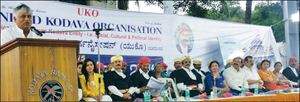
Mandya MP C.S. Puttaraju is seen addressing the gathering at the valedictory of ‘Jabhoomi Baalo-2015’ padayatra at Kodava Samaja in Bengaluru yesterday.
Bengaluru :
Rajya Sabha member from Bengaluru, Kupendra Reddy, has promised Rs. 10 lakh for conservation of Kodagu mandhs and revival of paddy cultivation across Kodagu district, said Mandya MP C.S. Puttaraju at the valedictory of ‘Jabhoomi Baalo-2015’ padayatra at Kodava Samaja in Vasanthnagar here yesterday.
Puttaraju said that he was authorised to announce this by MP Kupendra Reddy, who is currently in USA, on his behalf.
Stating that Reddy has announced Rs. 10 lakh for UKO’s cause as the first instalment, Puttaraju said Reddy has promised more funds for UKO’s various plans.
Stating that the people of Mandya were always indebted to river Cauvery, which originates in Kodagu, Puttaraju assured of extending all support for the protection of Kodava land, culture and its environment.
UKO Convenor Kokkalemada Manju Chinnappa, in his address, said that the funds provided by Kupendra Reddy will be utilised for conservation of Kodagu mandhs and other programmes. He also said that Puttaraju has handed over Rs. 10 lakh grant to UKO as the first instalment as promised by Reddy.
Karnataka State Handicrafts Development Corporation Chairperson Shantheyanda Veena Achaiah, former MLC Cheppudira Arun Machaiah, Kodagu District Congress President Biddatanda T. Pradeep, former Kodagu District BJP President Machimada M. Ravindra, Federation of Kodava Samajas President Mallengada Dada Belliappa, Bengaluru Kodava Samaja President Mandeda Ravi Uthappa, Vice-President Mukkatira Vani Nanaiah, Secretary Chennapanda Subbaiah, actress Prajwal Poovaiah, Madikeri Kodava Samaja President Moovera Shambu Pemmaiah, Ponnampet Kodava Samaja Secretary Chottekmada Rajiv Bopaiah, Kodava Sahitya Academy President Biddatanda S. Thammaiah, UKO office-bearers and others were present.
source: http://www.starofmysore.com / Star of Mysore / Home> Generla News / Monday – October 05th, 2015
WELCOME. If you like what you see "SUBSCRIBE via EMAIL" to receive FREE regular UPDATES.
Read More »