Category Archives: Arts, Culture & Entertainment

The pulse of Pollibetta

PollibettaKF12nov2014

The most conspicuous thing to note about Pollibetta, deep in the heart of Coorg, South-West of Bangalore, is that there is absolutely nothing to do in this town.

Ask any inhabitant or a visitor and you see him struggle to list out the usual touristy stuff and happening places that are there to see. This was precisely the reason why this town had been highly recommended and also why we had motored down all the way from Bangalore, 250 km away.

We wanted to relish the mountain fresh air, inhale the invigorating aroma of coffee and pepper, and to be amidst misty hills, sprawling coffee plantations and breathtaking landscapes. This was the way to experience Coorg without the crowds.

It was dark by the time we took the curved road through the Tithimathi forests to arrive at the centre of the town. After a six-hour drive from Bangalore, past the Mysore Highway, through bamboo forests, silver oak trees interspersed with teak trees and the ubiquitous coffee plantations, we reached Pollibetta’s main road.

A few shops were still open on (what, in the usual hill-station jargon, would be termed the Mall Road) the main road where all tourists and town folk converge for their evening stroll. Only on this road there were hardly any folks but we did manage to find somebody to guide us to our destination – the Bamboo Club.

This southern part of Coorg was known earlier as the Bamboo District, and so, the club started by coffee planters in keeping with the British tradition of establishing a club wherever they resided, became the Bamboo Club, a ‘Little England’ where they could meet, play games, dance and party to overcome their nostalgia for home.

The club, which continues to be a home-away-from-home for today’s members was to be our abode for the duration of our stay at Pollibetta. True to club traditions, we were handed a strict dress code, after conforming to which, we made our way to the club dining room.

A three-course dinner served by uniformed attendants later, we turned in for a restful sleep, tired after our journey through the plantations and forest trails that were waiting to be discovered at break of day. We woke the next morning to the chatter of birds and to see through the windows, acres and acres of coffee plantations interspersed with tall gigantic silver oak trees. From the beautiful balcony, meant to sit at and soak in the ambience, we could see several varieties of bamboo forests with myriad butterflies of striking colours darting here and there.

We had to choose from a number of recreational activities that included a safari through coffee plantations, nature walks, bird watching and trekking. Instead, we chose to visit a temple. One of the several dotting the cultural landscape, this was devoted to Lord Ganapathy. We had to drive through a lush coffee plantation, as the temple was situated inside the forest.

The architecture and layout were relatively modern, except for the sanctum sanctorum which was laid out in traditional temple style. The gopuram was positioned with sculptures culled from mythology.

There was not a soul around, and it was peaceful to just listen to the sounds of the forest. As typical city dwellers used to the din of the metro living, we could not
immediately adjust to the pace of Polli-betta life and so, as to do something, we decided to go on a tour of the Raj-era estate bungalows that dot the plantations.

Once occupied by British coffee planters, the bungalows are more than 100 years old. Every bungalow was built on an elevation, overlooking the mountains and the
plantations so that the British planters could lead lives of perfect tranquillity
waited upon by butlers, cooks and gardeners. Later, managers of the Tata group occupied these heritage bungalows for a while, till the management came up with the idea of homestays. Talk about the perks of a job!

We first visited the Woshully Estate Bungalow where the European planters had first met in the 1880s to establish the Bamboo Club. The view of plantations, from here, was so spectacular that we were not surprised the bollywood film Saat Khoon Maaf starring Neil Nitin Mukesh, Priyanka Chopra and John Abraham was shot here.

Another heritage bungalow we visited was the Thaneerhulla Bungalow, so known because of the beautiful water pond that’s just a short walk away. We could imagine the bullock carts and the horse-drawn carriages emptying the planters onto the bungalow’s patio in a bygone era. With antiquated wooden floors and a cosy fire place, this bungalow had an old world charm about it.

There were several others we could see, but we decided to visit only the Cottabetta Bungalow. The freshness of the crisp air caressed our faces picture-postcard
greenery filled our sight. The majestic mountains seemed to open up from the bungalow’s veranda — on the south was Kerala and to the North, Kushal Nagar and the Madikeri hills.

There was a hill we wanted to climb where porcupines inhabited the area
earlier. The driveway was quite challenging. The slope was so steep that our car’s engine roared, coughed and spluttered in protest, but it was worth it.

Back at the club, biting into crisp, hot onion pakoras, sipping coffee and
viewing the mist-capped hills was just the perfect way to end a beautiful outing in the forests, while narbets, drongos, parakeets, bulbuls, flower peckers and sunbirds flurried by. It seemed like there was not much to do apart from lounging around in the bungalow, and yet, there was so much to soak in.

source: http://www.deccanherald.com / Deccan Herald / Home> Supplements> Spectrum / by Dipika Priyan Naik, Bangalore / DHNS – November 11th, 2014

Like Ganga, like Cauvery: Chief Minister Siddaramaiah

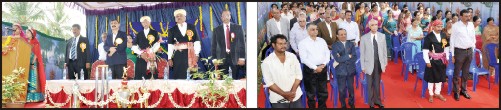
Chief Minister Siddaramaiah being greeted in traditional style on his arrival in Kodagu to launch developmental projects on Monday

Mysuru:

The State will soon evolve a plan of action on the model of that for River Ganga, to purify Cauvery river water which is getting polluted with every passing day, said Chief Minister, Siddaramaiah at Madikeri, here on Monday.

Speaking to press persons, Mr Siddaramaiah, said, Cauvery is not just the source of drinking water for Bengaluru and other cities in Karnataka but the lifeline for neighboring States like Kerala, Tamil Nadu and Puducherry. ‘Hence the State will take necessary action to ensure its cleanliness,” he said.

He reiterated that the State has already opposed the Union government’s proposal to include the eco sensitive Western Ghats in the UNESCO’s list of World Heritage sites.

The State Government is very much committed to honor local sentiments in this regard, he said.

The Chief Minister also said that, the State government is evolving a permanent solution for the elephant attacks, for which the government has allocated 212 Crores in the current budget. The State has already released 58 crores for the purpose.

Barricades will be built alongside railway tracks across the forests to prevent elephant deaths, he said.

Mr Siddaramaiah also said, that among 22,000 vacant posts in the state police department, his government is committed to fill 11,000 posts in phases in the coming years.

Speaking after inaugurating the District Administration Complex in Kodagu worth Rs 14.44 Crores and laying foundation stones for various developmental projects at Gandhi Maidaan (Grounds) at Madikeri, Mr Siddaramaiah said, “Accepting a bribe to do the government’s work by government officials by itself is not corruption, but creating undue delay to get bribes amounts to corruption which every government servant should remember. Government’s work is God’s work’” he reminded.

source: http://www.deccanchronicle.com / Deccan Chronicle / Home> Nation> Current Affairs / DC / Shilpa P / November 04th, 2014

Testing new waters

Nishan Nanaiah in a promotion still of Badlapur Boys / by Special Arrangement

Actor Nishan Nanaiah talks to about his upcoming Hindi flick Badlapur Boys.

“We have gone to six cities in a week and another 10 have to be covered over the next two weeks. I don’t know how I am going to make it,” Nishan Nanaiah says with a chuckle over the phone. The back-breaking trips are for promoting his new Hindi movie, Badlapur Boys, slated to be released on November 7.

“In the Hindi industry, when you sign up for a movie, along with shooting dates, you also have to give dates for promotions,” he adds.

Badlapur Boys is a remake of Susindran’s hit Tamil flick Vennila Kabaddi Kuzhu, which tells the story of a group of kabaddi players in rural Tamil Nadu, who have never won a game but triumph in the end under the guidance of an astute coach. However, the Hindi version has been tweaked to a great extent even as kabaddi remains the core factor.

Nishan says. “My character, Vijay has to tackle certain personal issues and has a goal that he dreams to attain through kabaddi,” he says. The movie, shot in Mammana village near Jaipur, is directed by debutant Shailendra Varma, who wrote Salman Khan’s Veer and has done television shows as well.

Badlapur Boys is Nishan’s third Hindi film after Cycle Kick, directed by Subhash Ghai, which “came and went unnoticed” and David.

According to him, there couldn’t have been a better time for Badlapur Boys to be released, since the game of kabaddi has touched new heights, thanks to the recently concluded Pro Kabaddi League and India’s golden run at the Asian Games. “The best part about the movie is that what you see on screen is the real game. Except for a handful of actors, the rest of the players you see in the film are actual kabaddi players. When you do a sports film, you have to look authentic on screen. Our director was very particular about this and all of us practised hard before shooting the game sequences. I enjoyed sweating it out, having played the sportsperson in real and reel lives. I was a state-level tennis player before entering films. I acted as a football player in Cycle Kick and now in Badlapur Boys, I am playing kabaddi,” he says.

With just days left for the release of the movie, he can’t hide his nervousness. He is worried about how the audience would accept a sports movie with many new faces. “If a movie with newcomers becomes a hit, many similar movies are made and released. But the moment one such movie flops, a dozen other films with newcomers that are in various production stages get shelved. It is a huge risk but we have done our best,” he says.

Meanwhile, he is doing another Hindi movie, Chai Shai Biscuit, a satire on arranged marriages, directed by debutant Himanshu Bhatnagar. An untitled Malayalam movie is also in the pipeline.

Before signing off, this alumnus of the Film and Television Institute of India admits that he is not happy with the way his career is shaping up in Malayalam cinema. “I am doing my best, but I am not flooded with roles. Perhaps, being a non-Malayali (he hails from Coorg, Karnataka) is a problem. As far as I know, I have never been the first choice for many of the roles I did. Nevertheless, I hope things will change. After all, I have worked with some of the best directors, a bonanza I never expected,” he says.

Badlapur Boys has Saranya Mohan, Pooja Gupta and Annu Kapoor in the cast.

source: http://www.thehindu.com / The Hindu / Home> Features> Friday Review / by Athira M / Thiruvananthapuram – October 30th, 2014

A Chef Charts the City’s Changing Foodscape

ChefNarenKF310ct2014

Bangalore :

Chef Naren Thimmaiah, executive chef at the Gateway Hotel Residency Road, has been associated with the iconic Karavalli Restaurant in Bangalore since its inception 24 years ago. This multiple award-winning restaurant with its very unique ethos and focus on authentic regional cuisine has won the chef many accolades.

Hailing from a traditional Coorgi family, this chef believes in the lasting power of recipes handed down through mothers and grandmothers and replicating them perfectly even in a restaurant set up. It has been his aim to offer the guests a taste of home and comfort food even while they are travelling. It is in keeping with this idea which combines fresh ingredients, seasonal produce and traditional recipes that he creates dishes which are both healthy as well as delicious like the Maddur Vade (deep-fried patties of rice flour, semolina, maida, sliced onion, curry leaves, grated coconut and asafoetida)

Chef Thimmaiah has been well aware of Bangalore’s changing foodscape over the last two and half decades and in a special menu celebrating 25 years of the hotel (which will be available till Nov 10), he has crafted a menu which will pay tribute to iconic dishes from the city, recreated in his own kitchens.

This spread will include everything from a simple yet special Lassi from a popular roadside eatery to the succulent Midnight Chicken Kebabs from a well-loved joint, from the familiar Commercial street-style Gulab Jamuns and sinful Death by Chocolate to the unforgettable lamb burgers with sweet mayo.

Bangaloreans will immediately be able to identify these age-old city favourites from well-known eating joints around the city. This apart, the chef will also reintroduce hit dishes from his own menu over the ages and recall dishes that are representative of different cuisines and true to their indigenous roots in different parts of the country depending on availability of produce. These include the typically Amritsari Pindi Chole, the Awadhi Kakori kababs and the Coorgi Akki Roti Soppina Saaru (rice flour roti with a broth made of lentils and edible greens).

source: http://www.newindianexpress.com / The New Indian Express / Home> Cities> Bangalore / by Diya Kohli / October 27th, 2014

Trekking alongside clouds

TadiyandomolKF30oct2014

If you are looking for a getaway that takes you through green hills, misty clouds and silent paths, Tadiyandamol is for you, says Maya B.

Imagine walking through the clouds, running your fingers across cold ice crystals, and watching the rains from above the clouds. These are a few soothing moments one can experience from standing at the summit of Tadiyandamol, the second highest peak in Karnataka. Situated in the hilly district of Kodagu, Tadiyandamol is the tallest mountain in the district, with its highest point being 1,748 metres above sea level.

It is a lesser-known trekkers’ paradise that has fortunately not been commercialised yet.
The mountain is wide and gigantic, with two peaks, and lies on the Kerala border. Tadiyandamol in Malayalam or Kodava loosely translates to tall hills with a broad base. The best time to start the trek would be early in the morning, around 6 am. It is approximately an eight-km trek, which could be mildly strenuous.

Adventure enthusiasts can begin the trek at a small waterfall, about half a km from the foothills. A tarmac road leads to the waterfall, and further up, there are no motorable roads. A safer option to park vehicles would be at the Nalaknad Palace.

“A stream is a nice place to begin and end the trek as the cold water is invigorating,” says Aalok Gokhale, a regular trekker who has scaled Tadiyandamol twice. Trekkers first traverse through a dirt-road, which leads to a fork. Take the road sloping upwards as it passes through a forest area and a couple of streams. On the downside, the stretch is infested with leeches during monsoons.

Dreamy routes
And then there is a winding route that leads you into the open. That’s when you get the first glimpse of the mountain you will be climbing, and a complete view of the hills you are surrounded by. The trick is to simply walk in the direction of the peaks. You will come across a huge boulder on the way which is an ideal spot for a break and has the perfect viewpoint.

Here, the trekkers can choose one peak out of the two. The one on the left is higher than the one on the right. “When hiking to the peak on the right, you can take the route less travelled on, through the grass, or the man-made path. Once you reach the peak, you can see that the path continues to two more viewpoints, and the best view awaits at the end of the range, and it is tranquil,” shares Aalok.

“When it starts raining, a dreamy mist sets in. You can see clouds moving up the mountain side, towards you, and then finally, you walk through the clouds,” he adds.
The route to the peak on the left, that is the highest point of the mountain, leads you to a false summit at first and then,unexpectedly, opens up into a dense forest area.

The path leading to the forested area could be barren or grassy, depending upon the season. There is a natural stair-like formation throughout the mini-jungle which could be very steep at times. Once this tedious journey ends, you are out in the open yet again and the majestic mountain rises in front of you. The ground up the mountain is full of gravel and slippery, so be careful while trekking.

The summit of the mountain is a wide area which slopes down slightly to culminate in a cliff, and it is breathtaking view from the top. The boulders around could be great for picnics.

All in all, Tadiyandamol is a wonderful weekend getaway and takes you away from the hectic urban life.

Single peaks can be covered on the same day, and both the peaks can be trekked in a single day or over a course of two days by camping on the mountain overnight. But trekkers must be wary of elephants, as their dung can be spotted at certain places.

Ankith Joshi, founder of the travel agency ‘Time to Trawel’, who regularly sends troupes to Tadiyandamol for camping says, “There are several points across the hills where you can pitch tents. But the best would be at the peak as it has a wide base and the experience is thrilling. You can’t enjoy the beauty of the place if you camp elsewhere.”

Those who prefer warmer accommodation can choose homestays in Kakkabe and Virajpet. The best seasons to visit Tadiyandamol would be mid-monsoon and winter (August-January). During these seasons, the atmosphere is cool and misty, which feels heavenly.

source: http://www.deccanherald.com / Deccan Herald / Home> Supplements> Spectrum / Maya B / DHNS, October 28th, 2014

Children’s Dasara wins people’s hearts

For children it was a new experience of celebrating Dasara at Madikeri on Thursday. It was on the occasion of children’s Dasara, being organised by Madikeri Dasara cultural committee, for the third year.

Children themselves inaugurated the Children’s Dasara at Gandhi Maidan at 11 am. Besides participating in various competitions and cultural programmes, children honed their marketing skills too, by selling various items in the children’s market.

The market offered a wide range of items from vegetables to snacks.Fancy dress, makkala mantapa, children’s shandy market, quiz, drawing and various other competitions were conducted on the occasion.In Makkala Mantapa, the tableau competition, a group of recreated ‘Dasha Mantapa’s, which is a prominent feature of Madikeri Dasara.

Also, recreation of mythological scenes was part of the competition.

The children’s shandy market drew an overwhelming response with customers purchasing variety of items such as fruits, vegetables, snacks, coffee, juice, flower vases and so on.

Results

Children’s shandy market: Vinith Lobo and team – I, Hrithvik Anwekar and team – II and Samarth – IIIMantapa competition: Vidyavinayaka Makkala Sangha – I, Shivoham team – II, Bharath and team – IIIDrawing competition (5 to 8 years category): Rishika M A – I, Rakshith M B – II and U M Jeevith – III (9 to 12 years category): P R Arya – I, Shreyas – II and Havyas – III. Consolation prize – Dilan (13 to 16 years category): Shreyas S – I, Nuthan P N – II and Pritham H M – IIIQuiz on Indian Heritage and Culture: (2 to 7th standard category):G R Ashutosh – I, N M Dillan – II and I B Dinal – III (8 to 10th standard category): S S Gautham – I, H U Gurugovind – II and K M Karthik – IIIFancy dress competition (Below 5 years category): Dhruva Nanjappa – I, Anushka – II, G R Anuhya – III and Diya Vasanth – Consolation(6 to 8 years category): Brihat Bopaiah – I, Anchal Joshi – II, Shahnavi – III and Abhinaya Krishna – consolation(9 to 12 years category): Yavani – I, Vakya Dinesh – II, Victor Lobo – III and Apeksha Rai – consolation.DH News Service

source: http://www.deccanherald.com / Deccan Herald / Home> District / DHNS, Madikeri – October 05th, 2014

Dashamantapa procession enthrals devotees

The procession of Dashamantapas marked the conclusion of Madikeri Dasara celebrations on Saturday.

Thousands, including a large number of tourists from outside the district, lined up on either side of the main roads in Madikeri where the tableaux passed through— to get a glimpse of the Madikeri Dasara procession. The city was decked up with lightings.

As per the tradition, the procession was led by Pete Srirama Mandira mantapa. The tableaux on the theme of Mahishasura Mardhini attracted the spectators. The sound and light special effect was centre of attraction. After offering pooja at the temple, the Mantapa passed through College Road, Chowki, private bus stand, Town Hall to reach Gandhi Maidan.

Kundurumotte Sri Chowtti Mariyamma, Dandina Mariyamma, Kote Mariyamma, Kanchi Kamakshi, Kote Ganapathi, Chowdeshwari, Kodandarama Temple, Dechur Rama Mandir and Karavale Bhagavathi Temple tableaux also passed through streets of Madikeri. The procession that started on Saturday night went on till wee hours of Sunday.

A large number of people from outside the district had arrived Madikeri on Friday itself. All the hotels, home stays and resorts were full in Madikeri. After visiting tourist spots in Madikeri on Saturday morning, they arrived the city in the evening. Gandhi Maidan had turned into a mini bazar with eateries, stalls selling clothes. The stalls made brisk business during the night.

Traffic jam

The police had banned the entry of vehicles inside Madikeri town to check traffic congestion. The movement of vehicles on the streets where Dasha Mantapas passed through were banned. It had caused inconvenience to the vehicle users. The police had arranged parking of vehicles at APMC and Dairy.

Parking of vehicles in a haphazard manner caused inconvenience. To prevent the entry of additional vehicles inside the city, more than 100 buses from Mysore and other districts had to park their vehicles in Kushalnagar. The passengers from Kushalnagar were ferried to Madikeri in special buses. DH News Service
source: http://www.deccanherald.com / Deccan Herald / Home> District / DHNS, Madikeri – October 05th, 2014

It’s booze time for Bhuvan Ponnanna, Andrea

Kannada actors Bhuvan Ponnanna and Andrea were caught sharing a light moment at The Boozy Griffin on Wednesday night. Andrea kept disappearing from the do.

So Ponnanna asked her in a light vein who she was hiding. He was a tad suspicious about the puffiness on her lips when she returned.

BhuvanKF29oct2014

Andrea responded by hitting him lightly, telling him not to joke.

source: http://www.timesofindia.indiatimes.com / The Times of India / Home> Entertainment> Kannada> Movies / by Bangalore Mirror Bureau / July 11th, 2014

Queen, The Godmother

Victoria: A Life by AN Wilson is a book that chronicles Queen Victoria’s life. An excerpt from the book essays her role as a godmother of an Indian princess named Gouramma

Ten days after they heard the news of the Charge of the Light Brigade, it was the Princess Royal’s fourteenth birthday….The Queen spent the day quietly with the children and’sketched Gouramma’. This was her god-daughter, the Princess Gouramma, now Victoria Gouramma, of Coorg. Her father, the deposed rajah, driven from his lands in Southern India, had for a while resided at Benares. In 1852, the rajah brought Gouramma, then aged eleven, to London and offered her to the Queen for adoption if the Queen would take charge of my daughter & treating her with honour and kindness grant her an education complete in every respect & suitable to her rank, and bring her up according to English customs in the Christian faith’. It was a tall order, but the Queen always felt sheepish about the deposed Indian maharajahs whose wealth had been seized by the East India Company. At first she replied to the rajah that ‘it would not be in accordance with the usages of this Country that Her Majesty should take the charge of his daughter’. The India Board offered to pay for the upbringing of the child and to pay him a stipend while she was in England. Prince Albert suggested giving the rajah £40 per month for the child, and the rajah’s response was that ‘your Majesty has been graciously pleased to grant me much more than I prayed for with regard to my little daughter’. It was suggested that the child be made a ward in chancery of Sir James West Hogg, baronet, chairman of the East India Company. This was not quite what the rajah had in mind. He felt that a ‘lady of rank’ should be found to look after the child. Moreover, the little girl was staying with her father in an hotel. The culture shock was mighty. He complained of’people lurking in the passages to see her’, and threatened that if she were further humiliated’, he would have no alternative but to put her to death.

The background was as painful as any colonial story could be. On the one hand, the Rajah of Coorg was getting a very poor deal from the East India Company. He had provided the British with’many thousands’ of his own subjects, to act as coolies for the Bombay army; he had supplied ‘upwards of 3,000 pack bullocks… 40,000 bottles of rice, 5 elephants, and 3,000 sheep. For all these supplies the Raja received no pecuniary indemnification.’

There could be no doubt that the rajah had been swindled by the Company. On the other hand, he was no saint. Evidence had been collected of atrocities perpetrated under his regime. Lord William Bentinck had decided, as far back as 1834, that’the interests of humanity’would be served by removing a man who, though open and friendly in his manner and a skilled horseman, performed such cruelties as forcing his subjects to act as human stockades around wild elephants during his hunting expeditions. Any who let the elephants escape were put to death….

The Queen agreed to stand godmother to the child, who was baptized by Sumner, the Crumpet, in the chapel at Buckingham Palace on 1 July 1852. It was no hole-in-corner affair. Lord John Russell’s clergyman half-brother, Lord Wriothsley Russell, and Dean Gerald Wellesley, the nephew of the Duke of Wellington, assisted. The princess was, in effect, adopted by an Indian army couple, Major and Mrs Drummond, who took her riding, read her Gulliver’s Travels and tried to make her have the enthusiasms of an upper-class Scottish aristocrat. To some extent they succeeded, but Princess Victoria Gouramma was neither a demure nor a healthy person. Coquettish from the moment of her arrival in Britain, by the time she was sixteen the Drummonds found her as interested in stable boys as in ponies, more than once finding her wrapped in the arms of a groom. At the Juvenile Ball held at Buckingham Palace in April 1856, Gouramma danced merrily with the boys, and clearly attracted the Prince of Wales, but this was the first time she began to cough blood.

The Queen…never lost her affection for the Indian princess, however much of a scamp she was. For a confirmation present, she gave her a coral and diamond necklace, hoping ‘that these ornaments, instead of gratifying the vanity of the young Princess, may serve, when she looks at them, to remind her of the high duties and responsibilities which she has taken upon her’. The hope was a little optimistic. Some time in 1859, her father gave her a bag of jewels, before expiring and being buried in Kensal Green. The Drummonds, slightly unable to cope with the princess’s latest attachment (to an under-butler), applied to the Queen, who was entirely unshocked by the girl’s amorous propensities and merely recommended that they take her on a continental tour.

Gouramma was not the only Indian child in whom the Queen took an interest. In 1854, the Maharajah Duleep Singh, the Lion of Punjab, had arrived in England. He was a charming boy, as Hardinge had observed when bringing the Kingdom of the Punjab to an end, at the close of the last Sikh wars in 1850, and appropriating Duleep Singh’s greatest treasure, the Koh-i-Noor, which means ‘Mountain of Light’….

The Queen’s hope was that Gouramma would marry her new protege?, but Duleep, at this stage at any rate, was too strait- laced for her, and when the pair were introduced, at Lord Normanby’s seat of Mulgrave Castle, it was not a success. At that house party, however, Singh introduced her to a Thackeravian roue?called Colonel John Campbell. Meanwhile, the diligent Drummonds pursued an unsuccessful legal case against the East India Company to restore the maharajah’s appropriated property. A child was born to the marriage, but it was not a happy union. Princess Gouramma died of consumption, in not very salubrious lodgings in Jermyn Street.

Colonel Campbell was seen slipping out of the house carrying a bag, presumably of the maharajah’s jewels. The Queen kept up with the daughter, whose name was Edith.
(Published with permission from the publishers)

source: http://www.dnaindia.com / DNA / Home> Lifestyle / Agency:DNA, Place:Mumbai / Sunday, October 19th, 2014

Gram Panchayat least bothered about basic facilities near Abbey falls

Abbey waterfalls in Kodagu district is one of the itinerary included in the list of tourists who visit the district.

Breathtaking waterfalls, its roaring sound and beautiful cascades spring back to life with the monsoon. A large number of tourists visit the waterfalls during weekends. Inspite of the fetching income from tourism, the gram panchayat has failed to provide basic facilities for the tourists near the waterfalls.

Abbey waterfalls is situated amidst coffee plantation. It cascades down 30 to 40 feet from a hillock. The land where Abbey falls is situated belongs to a private individual.

The land belongs to Neravanda Indira. To ensure that tourists are not disappointed, she has allowed them to walk in between her estate. However, the gram panchayats have not taken any measures to ensure that no harm is done to the estate.
Those who visit the waterfalls pluck coffee plants, throw plastic carry bags, cigarettes, beedi, gutka packets and liquor bottles, she said.

Indira said “the gram panchayat had promised to lay grills to the foot road that passes through estate. However, the promises have remained only on paper. The tourists damage the plants.”

“In protest against apathy of the gram panchayat, I had even locked the main gate. To ensure that no inconvenience is met to the tourists, I started opening the small gate to allow the tourists to enjoy the beauty of nature,” she said.

“The gram panchayat fetches income by collecting parking fee. However, they are least bothered to provide toilets, drinking water and cleanliness in the region,” said tourist Subrahmanya from Shimoga.

source: http://www.deccanherald.com / Deccan Herald / Home> District / by Srikanth Kallammanavar / DHNS, Madikeri – October 19th, 2014