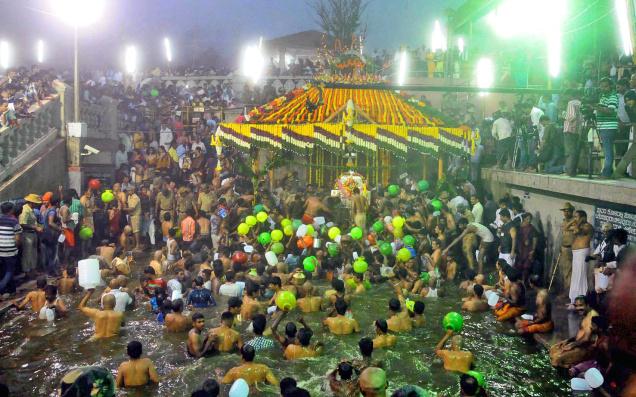
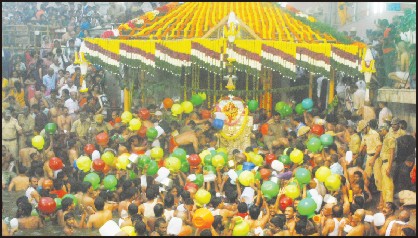
With the arrival of Dashamantapas and Karagas of four temples to Banni Mantapa in the wee hours of Sunday, curtains were down for the vibrant Madikeri Dasara.
Thousands of people viewed Dashamantapa procession which passed through the main streets of Madikeri on Saturday night and culminated on Sunday morning. Ten tableauxs of Pete Sriram Mandira, Kundurumotte Sri Chowtti Mariyamma, Dandina Mariyamma, Kote Mariyamma, Kanchi Kamakshi, Kote Ganapathi, Chowdeshwari, Kodandarama Temple, Dechur Rama Mandir and Karavale Bhagavathi Temple were taken in a majestic procession.
Main temples, government offices, private buildings, main streets of the city were lit with colourful lights. The procession of Dashamantapas started after 11 pm. Each temple tableaux depicted different story based on mythology. Kote Mariyamma temple Mantapa won the first place in the contest, followed by Chowdeshwari temple (II) and Kodanda Ram temple (III).
Valedictory
Madikeri Dasara is organised in an equivalent manner to that of Mysore Dasara. It has been organised with more grandeur by every passing year, said Home Minister and Kodagu District-in-Charge Minister K J George.
source: http://www.deccanherald.com / Deccan Herald / Home> District / DHNS – Madikeri, October 05th, 2014
He was speaking at the valedictory of Dasara cultural programme at Gandhi Maidan on Saturday. “Madikeri Dasara is not just limited to Kodagu district, but also it has been drawing people from neighbouring districts and states. It is a challenging job for the district administration and the police to controlling a large gathering in Madikeri during procession. Yet, all have done a commendable job, he said.
MLA Appachu Ranjan congratulated the State government for granting Rs one crore for the purpose.
source: http://www.deccanherald.com / Deccan Herald / Home> District / DHNS – Madikeri, October 05th, 2014
The procession of Dashamantapas marked the conclusion of Madikeri Dasara celebrations on Saturday.
Thousands, including a large number of tourists from outside the district, lined up on either side of the main roads in Madikeri where the tableaux passed through— to get a glimpse of the Madikeri Dasara procession. The city was decked up with lightings.
As per the tradition, the procession was led by Pete Srirama Mandira mantapa. The tableaux on the theme of Mahishasura Mardhini attracted the spectators. The sound and light special effect was centre of attraction. After offering pooja at the temple, the Mantapa passed through College Road, Chowki, private bus stand, Town Hall to reach Gandhi Maidan.
Kundurumotte Sri Chowtti Mariyamma, Dandina Mariyamma, Kote Mariyamma, Kanchi Kamakshi, Kote Ganapathi, Chowdeshwari, Kodandarama Temple, Dechur Rama Mandir and Karavale Bhagavathi Temple tableaux also passed through streets of Madikeri. The procession that started on Saturday night went on till wee hours of Sunday.
A large number of people from outside the district had arrived Madikeri on Friday itself. All the hotels, home stays and resorts were full in Madikeri. After visiting tourist spots in Madikeri on Saturday morning, they arrived the city in the evening. Gandhi Maidan had turned into a mini bazar with eateries, stalls selling clothes. The stalls made brisk business during the night.
Traffic jam
The police had banned the entry of vehicles inside Madikeri town to check traffic congestion. The movement of vehicles on the streets where Dasha Mantapas passed through were banned. It had caused inconvenience to the vehicle users. The police had arranged parking of vehicles at APMC and Dairy.
Parking of vehicles in a haphazard manner caused inconvenience. To prevent the entry of additional vehicles inside the city, more than 100 buses from Mysore and other districts had to park their vehicles in Kushalnagar. The passengers from Kushalnagar were ferried to Madikeri in special buses. DH News Service
source: http://www.deccanherald.com / Deccan Herald / Home> District / Madikeri – DHNS, October 05th, 2014
The district police have banned the entry of vehicles to Madikeri and Abbi Falls from Saturday 2 pm to regulate traffic in view of the Dasara procession.
“Dashamantapa” procession (a procession of the mantapas made by 10 major temples of Madikeri) is a major attraction of the Dasara festivities in Kodagu.
People who witness Jamboo Savari at Mysore travel to Madikeri to take part in the procession leading to traffic congestion. “The entry of vehicles and visitors to Abbi Falls and Golf course has been prohibited after 2 pm on Saturday.
One-way rule has been imposed on several roads in the town. The restrictions will be in place till 10 am on October 5 (Sunday),” Deputy Superintendent of Police Prasanna V Raju said. Security has been beefed up by setting up a checkpost at the town entrance, he added.
source: http://www.deccanherald.com / Deccan Herald / Home> State / DHNS – Madikeri, October 02nd, 2014
Director Santosh Kondanker’s upcoming trilingual, Home Stay, which stars Shruthi, Ravi Kaale, Sayali Bhagat and Shirin is inspired by the mushrooming of homestays in holiday spots like Coorg. The film will be made in Kannada, Tamil and Hindi and will mark the debut of Shruthi in Bollywood.
Sayali will be playing the female lead in the Kannada and Hindi version, while Shirin will play the lead in the Tamil version of the film. Shruthi, who will feature in all three languages, is reportedly excited as her role has two very different shades — her character is a simple homestay owner who traumatizes the very guests she has been hospitable to earlier in the day.
Shruthi debuted as a supporting actress and acted in the Shivarajkumar-starrer Aasegobba Meesegobba. Her first film as a lead actress was the 1990 film Shruti. The movie was a hit and she hasn’t looked back since.
source: http://www.timesofindia.indiatimes.com / The Times of India / Home> Entertainment> Kannada> Movies / by Dhwani Desai, TNN / February 05th, 2014
Regional favourites: Akki ooti and molai kuru./ Photo: V. Ganesan / The Hindu
At the Kodava food festival, Susanna Myrtle Lazarus learns that there’s more to the cuisine than pork
“Pandi (pork) curry does not define Coorg cuisine even though it is what we’re most famous for,” says Smitha Kuttayya, a native of Coorg. The statement is a little hard to believe, but the spread at Clubhouse, the all-day diner at Taj Club House, makes it clear that she isn’t far off the mark.
A collection of signature Kodava recipes curated by Chef Naresh from Vivanta by Taj – Madikeri, includes koli chuttadh (chicken marinated with spices and griddled), kummu (mushroom)soup, toppu palaya (traditional curry with fresh double beans) and akki (rice) payasam among other regional favourites. Being from the region, Smitha has partnered with the hotel to consult on the food and interact with diners about Kodava cuisine.
Smitha says that the food is influenced heavily by Kerala cuisine: “We also use a lot of coconut and rice in our food. It’s basically a farmers’ mentality to use everything we grow in the food we eat. And so we have varying degrees of rice – the fine, broken grains that are found after the dehulling process is used to make dumplings called kadumbuttu, the medium-sized grains are used to make paputtu.”
Kodava cuisine is also very seasonal, says Smitha, who has draped her sari in the very elegant Coorgi way. “During Aadi — we call it kakada — the rains are the heaviest. There is a particular plant that is normally considered a weed; it grows all over the place throughout the year. The 18th day of this heavy rain is the only day when that plant has a particular taste and it is gathered and made into dark, almost blackish syrup called madhu thoppu,” she says. This plant is believed to have 18 medicinal properties and is incorporated into payasams or puttus.
As we speak, steaming hot attukal soup (peppered lamb shank) is brought to the table along with kadumbuttu seasoned with spices. Smitha says that the kadumbuttu should be had with ellu kanji, which is a sort of chutney made with roasted sesame seeds. The steamed dumplings are addictive. “No Kodava wedding will take place without this dish being served. The women of the house sit together the day before the wedding and roll out the balls to be steamed. If they’re not of the right consistency, they will become a congealed mass of boiled and steamed rice,” she says, adding that they are served plain at weddings.
Going beyond pork curries, Kodava cuisine uses vegetables and fruits like pumpkin and raw banana. The kari bale cutlets are roasted raw banana patties that are crisp on the outside and soft inside. Mushrooms are plentiful and each distinctive kind is used in different ways; the small ones are usually pickled or made into a curry, and each type is cooked separately. Smitha also talks about a certain type of grapefruit called kaipuli which can’t be found anywhere else. Apparently it is not sour as the name suggests, but can be made into jam, marmalade, juice and it can be burnt to make chutney as well.
For the main course, Tarkari pulao (bright yellow rice with vegetables) and akki ooti (rice roti) are served with koli curry that has a distinct, yet not unpleasant, taste of coconut oil and molai kuru that is mixed sprouts curry.
The picturesque hill district is known for its spice plantations and according to Chef Naresh, it is this that gives the Kodava cuisine its distinct flavour. “I used a special blend of spices — coriander seeds, cinnamon, and cloves — all from Coorg. These are used in all the dishes. Slow roasting for a long period of time gives the dishes like pandi curry their distinct colour — they are dark, but not burnt. The flavours come through more strongly without the spiciness,” he says.
Incorporating cardamom into caramel custard gives the soft dessert a lovely scent and the subtle flavour brings to mind the hills on which the spices were grown. The traditional akki payasam is not overly sweet but is a satisfying end to the meal.
The Kodava food festival is on at Club House in Taj Club House till September 28. A meal for two costs Rs. 2,000 upwards
Kadumbuttu
Ingredients
1 cup raw rice (washed and dried), 2 cups water, 2 tbsp butter, Salt to taste
Method
Lightly pulse the dried rice in a dry grinder or mixer. Put in very small quantities at a time so that the broken rice you get is small and even in size. The grains have to be powdered to “rava” size. In a thick bottomed vessel, boil the water with salt and a tsp of butter. Slowly add the broken rice, stirring all the time so that no lumps form. Close and allow to cook.
When still hot, take small portions and roll into balls. Your dumplings are now ready to go for steaming. Heat water in a double boiler. Line a vessel with a damp, white muslin cloth and put the dumplings in. Cover with the edges of the cloth and put in the double boiler and steam for about 15 minutes.
Serve with Pork curry, chutney or any side dish of your choice.
source: http://www.thehindu.com / The Hindu / Home> Features> MetroPlus> Food / by Susanna Myrtle Lazarus / September 25th, 2014
Domestic tourist arrivals may go up this festive season if the inquiries and bookings for touring Mysore and Kodagu are any indication.
Surprisingly, there have been bulk bookings from non-traditional markets. Travellers hailing from Telangana and Andhra Pradesh have planned their itinerary this Dasara, according to travel and tour operators. Like every Dasara, tourist arrivals from Tamil Nadu and Kerala are expected to be on the higher side.
“Generally, tourists from some parts of south India tour up north. But with the floods recently, tourists were perhaps looking for alternative tourist spots like Mysore. The inquiries and bookings have picked up,” explains B.S. Prashanth, president, Mysore Tour and Travel Operators’ Association. He told The Hindu that tourists were planning combined trips to Mysore and Kodagu. Home-stays in Kodagu were reaching full occupancy, he said. Tourists prefer Mysore and Kodagu packages as they get the best of holiday over there, Mr. Prashanth said. “We have confirmed bookings from foreign tourists, who had booked six months in advance,” he said.
Some tour operators in Mysore were promising to facilitate watching of the Jamboo Savari. “This way, the operators were attracting tourists,” a tour operator told The Hindu. Deputy Director of Tourism Husseni told The Hindu his department had been getting calls from inter-State travellers to know more about the festivities. “Besides explaining the events, we also guide them to visit websites to know more about the events,” he added.
The Karnataka State Tourism Development Corporation and the Karnataka State Road Transport Corporation will launch tour packages.
KSTDC Managing Director Harsha said tourists booking at the KSTDC’s properties in Mysore, KRS, Madikeri and Srirangapatna can avail themselves of packages. KSRTC Divisional Controller (Urban) Mahesh said the corporation was launching special package tours called ‘Darshini’, with packages like Giri Darshini, Jala Darshini, Deva Darshini, and Nagara Darshini. The tickets are available on the corporation’s website or at the reservation counter in the mofussil bus-stand here, he said.
source: http://www.thehindu.com / The Hindu / Home> National> Karnataka / by Shankar Bennur / Mysore – September 24th, 2014
While she was still studying surgery at the University of Liverpool in England, Kavery Nambisan was informed by her friend that a mission hospital in Bihar was in desperate need of a surgeon, and asked if she would be interested in the offer. She took it up as a challenge and landed in the town of Mokama, a dacoit infested area, where she went on to treat patients who had faced several degrees of violence.
After Mokama, she worked at rural hospitals in Uttar Pradesh, Tamil Nadu and Karnataka, where she presently works in the Coorg district. But in the meanwhile, Kavery found time to write seven novels in the last two decades.
Her last book, The Story That Must Not Be Told was shortlisted for the DSC Prize for South Asian Literature as well as the Man Asian Literary Prize. “I started writing once I had become a doctor; initially it was few flippant pieces here and there, and then I ended up writing two children’s novels. It was a revelation for me, because I don’t have a literary background,” she says.
Kavery soon ventured into writing adult novels because she felt there was more to her imagination that she could put down on paper. Her recently released seventh book A Town Like Ours, chronicles the growth of Pingakshipura, a village that has now become a town. It is a place where the water runs a poisonous black and the hair on every child’s head is white. And all of this is through the eyes of an ageing prostitute who resides at a temple premises.
The central character is borrowed from one of Kavery’s childhood memories. “When my father was transferred to Delhi, there was a temple we used to visit often. Right next to the temple, in a room, I found this scantily clad elderly lady who was smoking a hookah and had several men huddled around her. She had a loud voice, and as a young girl, I was mystified and yet disgusted by her appearance,” she adds. But do most of her memories, or her medical experience find place in her books?
“Not constantly, but since I am a writer, I do observe. I listen to my patients intently when they confide in me about their family problems. Any inclusion is not always intentional but I guess once you have the seed of something, you can always create,” she says.
Kavery, who writes early in the mornings and during weekends, says that she never had a problem juggling her professional expertise with her passion for writing. “Since I have always had it this way, I never have really seen it as a problem. Apart from medicine and writing, I don’t feel the need to socialise because I meet so many people anyway. However, I have discovered that I can write an awful lot in hotel rooms when I am travelling, because there I have no other responsibilities,” she adds.
In the present times, when bookstores are stocked with new authors writing about college romances and urban life, there are barely a handful of voices which document the rural facets of our country. The author adds, “It’s not their fault that most of these young authors did not have any rural experience to write about. On my part, I am deeply saddened by injustice which plagues our society. When I have the opportunity of education and upbringing, someone else is continuously being denied it. I constantly think of it, but I haven’t been able to come up with an answer. But instead of feeling helpless, we must realise that we can’t do everything to resolve the situation, but can continue to do what we do best.”
And Kavery’s decision to spend her life writing about and aiding the rural folk in villages, where healthcare is deemed a luxury, is a clear example of that. “It was partly the influence of my father and my teachers, who instilled in me the sense of purpose, of why you do something. And being born and brought up in a village, I realised this is what I should do, because this is what I do best,” she says.
source: http://www.deccanchronicle.com / Deccan Chronicle / Home> LifeStyle> Books/Art / DC / Amrita Paul / August 30th, 2014
Author Kaveri Ponnapa stresses how we’re all becoming a monoculture. Photo: V. Sreenivasa Murthy / The Hindu
Kaveri Ponnapa worries that her small community of Kodavas are slowly getting dissolved in the monoculture that the world is morphing into. She tells her book The Vanishing Kodavas could be the starting point to explore the people from the hills of Kodagu
So we sing.
Singing this song/ What do we gain?
If we sing with faith…
Planted vegetables will thrive/
And the baby in the cradle will live
This excerpt from a song of the Kodavas exemplifies the simplicity and beauty of the life of the Kodava community. It offers a whiff of the essence of the community — establishing its agrarian roots, its oral tradition, the questioning of what one gains in continuing a tradition, of the hope that its warrior people will flourish…
The song is one of the many lesser-known aspects of the Kodava people, that author Kaveri Ponnapa has recorded in her book, The Vanishing Kodavas. In popular culture, knowledge of the community is limited to facts such as they are good-looking people, valiant warriors with a phenomenal presence in the country’s armed forces and the place is home to beautiful hill stations, is where pandhi curry and bamboo-shoot pickle comes from.
Born and brought up outside Coorg, and having lived a large part of her life overseas, Kaveri was mesmerised by how “the presence of Coorg within me has been a constant part of my interior landscape”. That presence drew her back to her homeland, where right through childhood, she spent two months a year during summer vacation. “We all shift cities, countries, continents. We should look at ways to internalise culture and pass it on, carrying it within us,” is Kaveri’s hope for her people. Painstakingly researched over 15 years, the book goes deep into the community’s history, its grand houses, laws of the land, customs, worship, songs of the warriors, the forests and sacred landscapes, coffee, stories of its people.
Kaveri holds a masters in social anthropology from the School of Oriental and African Studies (SOAS) London. Even her thesis was on the culture of the Kodavas.
“After I shifted to Bangalore 16 years ago, I started visiting Coorg more often. It was a search to find what hold this place had on me. It became a quest for identity, exploring the unarticulated parts of you.” Slowly she started documenting festivals, ancestor propitiation ceremonies, whatever she witnessed in the villages of Coorg, and what came out of conversations with people on the rural areas. “I became conscious that the culture was vanishing and dwindling away.”
As she kept going back year after year, fewer people were attending annual celebrations with each passing year, older people in the community pointed out how youngsters weren’t learning their songs; how young men don’t know the ritual dances. “When I titled the book as ‘vanishing’, people from within the community too questioned me. It’s such irony that though numerically we are larger than we ever were, we are becoming like everybody else. Monoculture is a global problem. Just as there is a need for biodiversity for survival, so is it with people. Now with borders being porous, how are we going to continue looking at ourselves in new circumstances…that is the question,” she elaborates. The culture, which has been maintained in the living culture of the villages of Coorg, says Kaveri — “even there an erosion has taken place, with economics in play, and people moving away…”.
“Small cultures are well balanced with the environment. The link to land and agriculture anchored us to our culture. Now you have a dominance of the economy and tourism. While we were the prominent community in Coorg, we maintained equilibrium with other communities. There was great foresight among our forefathers to acknowledge that we can’t survive on our own,” says a passionate Kaveri.
The research that went into the book took Kaveri on a search for records. Official records, correspondence, colonial accounts, recorded history of the Rajahs of Kodagu… she sifted through them all. The book also has a detailed account of the Lingayat Rajahs and their council of Kodava chieftains and the role they played in the rise of the East India company in south India.
Finding archives was not easy, she admits. There were a few books from the early 20th century and gazetteers written by Missionaries from the then Britishadministered Coorg.
“The thing that really struck me is that the history of my people from manuals and gazetteers spans about the last 200 years, but we’ve been around 2,000 years. But the people had a definite sense of history that comes out in folk histories. I’ve interwoven these micro-histories into the book. Just because it wasn’t in a book doesn’t mean those events didn’t happen.”
She travelled alone into the villages, introduced herself, having the advantage of being an ‘insider’ to participate in ceremonies, got invited into ain manes (ancestral homes).
Some events, she went back to every year, sometimes seven years running! “It possessed me and sucked me in…I was no longer the writer,” observes Kaveri, who, incidentally chronicles oracles and spirit mediums in the Kodava community. At the end of it all, she had developed a great network.
Elders were forthcoming and gave permission to photograph intimate ceremonies related to everything from birth to death.
“Despite the photography being intrusive, I’m grateful to my community that they placed trust. Not one door was closed on me…so in that sense it’s not my book really.” So when the book was published in September this year, she launched it in Madikeri, Coorg, where 250 people from the villages turned up to look at the book they had made together. “What struck me was the great sense of dignity in their lives, the beauty of their lives and how they balanced between the hard times they have had. Despite being a warlike people, there was a tremendous sense of justice and fairness.”
“The book was a personal journey; despite both our families (hers and husband’s) being rooted in Coorg, we knew very few people in the villages…with education and going away, you tend to lose links,” she points out.
You definitely can’t dismiss it as a coffee table book laden with fantabulous pictures, though it can also be seen that way. “For the non-reader who would want to just look at the pictures, we put in detailed captions that should make you go back to the text. This is to bring in the younger generation, yet retain the depth of the work.”
You can find details on the book, of more than 350 pages and 300 images, and place orders from www.thevanishingkodavas. com or www.coorg.com.
Proceeds from the sale of the book, priced at Rs. 7,500 will be donated to the Coorg Education Fund.
source: http://www.thehindu.com / The Hindu / Home> Books> Authors / by Bhumika K / December 19th, 2014
Kodagu district witnessed a series of incidents in the year 2013 that has bygone. The year brought joy and sorrow to the district, however a keen look into the year reveals that the district witnessed more negative events than the positive ones.
From the heavy rainfall that proved disasterous to the district, to the reports under the guise of conservation of environment creating ripple in the society, the district has seen it all. It was also a year of protest, as there were repeated protests opposing Madhav Gadgil report and Kasturirangan report on conservation of Western Ghats, demand for title deeds to tribal, demand for relaxing the law on possession of weapons, protest seeking autonomy status to Kodagu.
Of all the events, the rain fury leading to major damage across the district, occupies the first place in the list of events. Coffee growers and agriculturists incurred crores of rupees loss due to rain. Six persons and 30 cattle lost their lives. The district administration had submitted a report to a study team from the Central government estimating the rain loss at Rs 86 crore.
The district witnessed a success in the form of amendment to the Land Revenue Act, 1964, scrapping the tax imposed on Jumma Bane land. Unfortunately, despite the amendment, people complain that the revenue department officials have failed to implement the Act effectively.
The presence of Maoist activities which was felt in the end of 2012, continued even in 2013. Maoist activities were noticed in Madikeri, Virajpet and Somwarpet taluks. In this backdrop, the government has decided to set up an Anti Naxal Force camp in Kutta.
For the first time in the history, Talacauvery – Bhangadeshwara temple management committee offered ‘Annadana’ for a period of one month from October 17 to November 16 as a part of Tulasankramana.
Despite the disputes that prevailed in offering ‘Annadana’ right to private organisation, ‘Annadana’ was offered, thanks to the efforts by Deputy Commissioner Anurag Tiwari who strove hard to co-ordinate between the temple committee and Kodagu Ekikarana Ranga.
source: http://www.deccanherald.com / Deccan Herald / Home> District / by Shrikanth Kallammanavar / Madikeri, DHNS – December 31st, 2013
WELCOME. If you like what you see "SUBSCRIBE via EMAIL" to receive FREE regular UPDATES.
Read More »