Category Archives: Arts, Culture & Entertainment

‘Manam’ To Shoot In Coorg From The 1st December

ManamKF26nov2013
Manam’, the first 3G (three generation) film in Telugu casting the legendary actor Dr. ANR, his son Nagarjuna and grandson Naga Chaitanya will resume shoot from the 1st December in Coorg, a hill station in Karnataka.

Director Vikram Kumar said ‘The schedule will be on for 15 days in which we will film some key sequences between Nagarjuna, Sriya, Naga Chaitanya and Samantha. I wish our hero Chaitanya a happy birthday’

Chaitanya said ‘This will forever be the most memorable film in my career coz it has the thrilling experience of acting alongside Dad and Granddad. Vikram is carving a beautiful family entertainer and this will be my third with Samantha after YMC and ANS’

ANR, Nagarjuna and Naga Chaitanya are the male leads in the film with Samantha and Sriya as the female leads. Brahmanandam, Tanikella Bharani, MS Narayana, Jaya Prakash Reddy, Posani, Nagineedu, Saranya, Kasi Vishwanath, Ravi Babu, Vennela Kishore and Melkote are playing the other key roles.

The crew: Dialogues: Harsha Vardhan; Lyrics: Chandra Bose, Vanamali; Dance: Brinda; Fights: Vijay; Costumes: Nalini Sriram; Cinematography: PS Vinod; Music: Anup Rubens; Art: Rajivan; Editing: Praveen Pudi; Executive Producer: Y Supriya; Presented By: Akkineni Annapurna; Produced By: Akkineni Nagarjuna; Story, Screenplay & Direction: Vikram K Kumar

source: http://www.indiaglitz.com / IndiaGlitz / Home> IndiaGlitz Telugu / Saturday – November 23rd, 2013

Judges for The Hindu Prize 2013

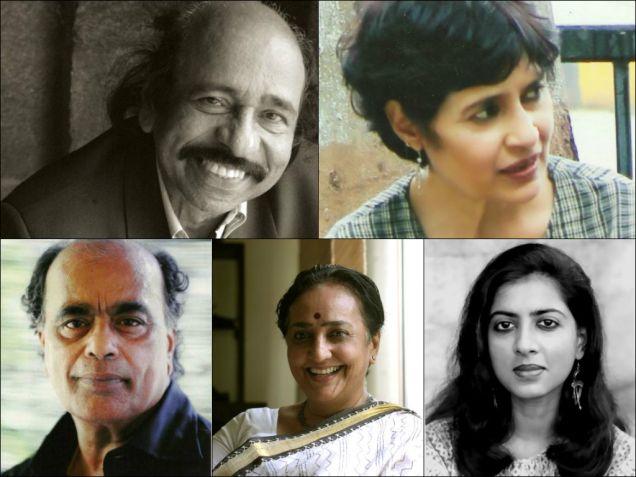
Clockwise from top: K. Satchidanandan, Kavery Nambisan, Arundhathi Subramaniam, Geeta Doctor and Timeri N. Murari. / The Hindu

Meet the panel of distinguished judges has selected the five books from which the winner of The Hindu Prize for Best Fiction 2013 will finally be chosen.

The panel comprised Malayalam poet, author and critic K. Satchidanandan, poet and writer Arundhathi Subramaniam, author Timeri N. Murari, surgeon and novelist Kavery Nambisan and writer and critic Geeta Doctor.

K. Satchidanandan is perhaps the most translated of contemporary Indian poets, having 23 collections of translation in 19 languages. He writes poetry in Malayalam and prose in Malayalam and English. His book While I Write: New and Selected Poems (Harper Collins) came out in 2011. He has lectured and read his poetry across the world. He was a professor of English, and later the chief executive of the Indian National Academy of Literature (Sahitya Akademi) and the Director of the School of Translation Studies, IGNOU, Delhi. He has won 27 literary awards including the Sahitya Akademi, Kerala Sahitya Akademi award (five times), Kusumagraj National Award, NTR National award, Bharateey Bhasha Parishad Award, Knighthood of the Order of Merit from the Government of Italy and India-Poland Friendship Medal from the Government of Poland.

Arundhathi Subramaniam is a poet and writer who has worked as curator, critic and poetry editor. As poet, she is the author of three books of poetry, most recently Where I Live: New and Selected Poems. As editor, her books include Another Country: An Anthology of Post-Independence Indian Poetry in English; an anthology on sacred journeys, Pilgrim’s India; and a co-edited anthology on contemporary love poems, Confronting Love. As prose writer, her books include the bestselling biography of a contemporary mystic, Sadhguru: More Than A Life and The Book of Buddha.

She is the recipient of the Raza Award for Poetry, the Homi Bhabha fellowship, the Charles Wallace Fellowship and the Visiting Arts Fellowship. She has been Editor of the India domain of the Poetry international Web for several years, as well as Head of Chauraha (an interactive arts forum) and Indian Dance at the NCPA, Bombay.

Timeri N. Murari was for many years a journalist writing for The Guardian, The Sunday Times and Observer in London before he moved to New York, where he made documentary films for British television. He has written 18 books of fiction and non-fiction. His bestselling Taj: A Story of Mughal India has been translated into 25 languages. He is also the writer and producer of The Square Circle one of Time’s “ten best films of the year” in 1997. He adapted it for the stage and directed it as the Leicester Haymarket theatre with Parminder Nagra in the lead role. In 2002, he was presented with the R.K.Narayanan Award for his his contributions to writing, cinema and theatre. Aleph will publish his new novel, Chanakya Returns, later this year.

Kavery Nambisan is a surgeon and novelist. She has spent most of her professional life in rural areas and her fiction is strongly coloured by this experience. Currently, she runs a rural hospital in Kodagu district in Karnataka. She has written six novels, all of which are published by Penguin India. Her last novel, The Story That Must Not Be Told, was shortlisted for the Man Asian Literary Prize and the DSC South Asian Literary Prize. Her next novel, A Town Like Ours, will be published in April 2014 by Aleph Publications.

Geeta Doctor is a journalist and writer. She is also a noted reviewer of literature. She has written extensively on art and architecture; on food and travel; as well as children’s stories. She describes herself as a journalist whose commentaries on life, literature and society have always sought to be incisive and insightful. She received the Angarag lifetime achievement award 2008 for her contribution to journalism. She published a volume of poems in 2013 entitled What We Leave Behind. Geeta lives in Chennai.

Visit the new website: www.thehindulfl.com
Like us on Facebook: www.facebook.com/TheHinduLitForLife
Follow us on Twitter @hindulitforlife
YouTube: www.thne.ws/playlist-lfl

source: http://www.thehindu.com / The Hindu / Home> Books / Chennai – November 21st, 2013

Hearty, meaty meal

FoodKF24nov2013
Coorg is the smallest district of Karnataka but the cuisine is considered to be one of the most delicious among the South Indian ones and the Kodavas (natives of the area), who claim to be descendants of Alexander the Great, are pure non-vegetarians. No wonder then that the cuisine is heavily dependent on pork, lamb and fish. The change in palate has also brought in chicken variations.

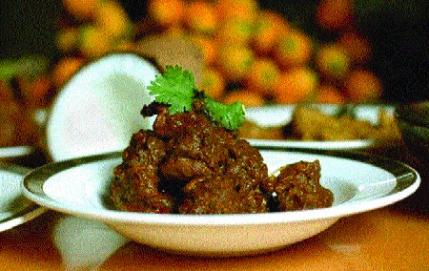
“Coorgi pork curry (pandi curry) is one of the most famous dishes from the area. The people there are a proud race and believe that nobody apart from them can make a good pork curry in the country,” says chef Prem Kumar of The Imperial that recently concluded a week-long Coorgi food festival at their restaurant, Daniell’s Tavern. Although, there aren’t many restaurants in the capital that serve it as a part of their standard menu, there are festivals organised from time to time.

Coorgi food is entirely different in taste, flavour and texture. Chef Velu Murugan P of Dakshin, WelcomHotel Sheraton says, “An elaborate dinner on Puththari (the harvest festival) is celebrated with pandi curry eaten with akki ooti (rice roti) or kadambuttu (rice dumplings). Another popular pork dish is chilkana pandi and is prepared using pork marinated in local spices, vinegar and tossed with onion and green chillies.”

For vegetarians, dishes are prepared using yam, pinto beans and even mushrooms. “Though not many people there like eating vegetarian food, they do cook yam, potato, beans and mushrooms. Yam fry with curry leaves and loads of pepper, red chilli and coriander tastes outstanding,” says chef Kumar. To this chef Murugan adds, “Koombu kanni is an interesting option for mushroom-lovers. The dish is prepared using mushroom infused with coconut milk and a tinge of spices. Koomu barthad is prepared using stir-fried whole mushrooms with finely chopped onions and loads of masala.”

Among spices cloves, mace and chillies in all forms are heavily used to induce heat since Coorg is relatively colder than other parts of South India. “A special souring agent called kachampuli, a local vinegar extracted from fruit is extensively used in Coorgi cooking. Tamarind is used in other parts of south as it is a cooling agent. But since Coorg is cold, people like eating hot and spicy food,” says chef KP Shivam of Kaustubh, DLF Place Saket, that soon plans to introduce the cuisine in their menu.

“Khaima unde or minced mutton balls cooked in spices, mutton chops marinated in coriander-chilli paste and freshly ground pepper, prawn curry in coconut milk and red hot chicken fry served with ghee bhaat (rice) are my other favourites from the region,” puts forth chef Kumar.

Although Coorgis do not like having desserts, they have options like mangai rasayana. “Mangai rasayana is like a mango kheer with freshly chopped mangoes and a big bang of cardamom. Dumroot halwa is also mouth-watering halwa prepared using white pumpkin simmered in pure ghee and milk,” says chef Murugan P.

The Coorgis’ fondness for good food (kadi) and liquor (kudi) is legendary. Go to their festivals and their weddings to see them enjoy their kadi and kudi while they regale themselves with their dance and songs. “For non-vegetarians, it is a cuisine not to be missed!” concludes chef Shivam.

source: http://www.asianage.com / The Asian Age / Home> Life and Style> Dining / by Papia Lahiri and Aditi Pancholi, Age Correspondent / November 21st, 2013

Amid the glitz, a glaring disparity among artistes

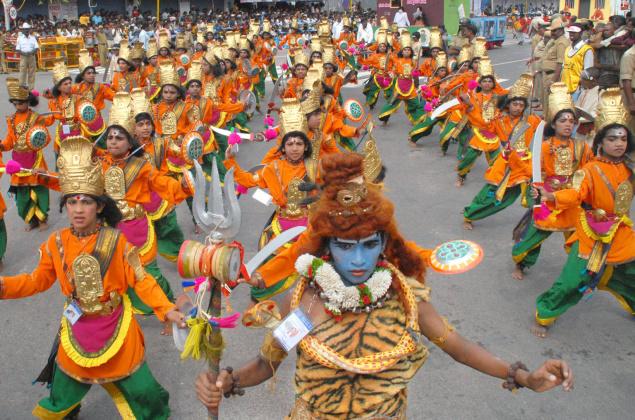
Dance and bear it: Dancers, percussionists and flautists who perform at the Dasara finale have traditionally got a raw deal in terms of the daily wage they receive. / File Photo: M.A. Sriram / The Hindu

Mysore’s folk artistes lament the ‘ínsulting’ wages they earn when compared to Bollywood stars
Behind the very luminous facade of Mysore’s glitzy cultural extravaganza is a disparity that is as old as it is stark. Every other artiste you meet will tell you they are forced to grin and bear it because an opportunity to perform at the prestigious Naada Habba (State festival) cannot be missed. But how long do they expect us to come and perform for this pittance, asks Siddappa, a percussion folk artiste from Madikeri.

He says dancers, percussionists and flautists who perform at the Dasara finale have traditionally got a raw deal. “It almost feels like on the festival day, we are being reminded that we are lesser mortals,” says Siddaraju. The daily wage of Rs. 750, hiked from Rs. 500 last year, is an “insult” to the very art and culture that this festival claims to celebrate and promote, artistes say. “They say Dasara is the most well-preserved tradition we have. What they have also managed to preserve is the disregard shown historically to us, mainly because we don’t belong to the privileged castes.”

Another dancer, who has been performing for 14 years in a row, pointed out that while their ancestors may have performed for free, the State cannot expect them to claim anything less than a fair wage for the work they put in. “What bothers me is that big artistes are brought to perform from around the world. We know they are paid in lakhs of rupees some times; can they not spare us a few thousands? This is not private money to be spent without a sense of right and wrong,” the 45-year-old dancer says. Earlier this month, a group of folk musicians and artistes had publicly threatened to boycott the Jamboo Savari, and walk backwards from Banimantap if their wages were not revised.

Other artistes too

Similar disparities exist also in the remuneration given to other artistes who perform at the cultural programmes held across the city for 10 days in the run-up to Dasara. While they get better accommodation and are given travel money, they feel there is clearly some sort of a ‘two-tumbler’ rule in place. While they are okay with ‘A-category’ performers being paid more, they say that the process of fixing pay is arbitrary and it is as if performing here itself is a reward.

Adivappa Kariyawar (63), a Janapada artiste from Haveri, says that the government must actively try to promote lesser-known artistes and art forms that are dying due to lack of exposure. “We are performing at a park here; so yes, naturally, the ones performing on the bigger stages will get better audience. While it is natural to categorise artistes, the larger picture, which is to promote lesser-known arts, must not be forgotten.”

Another Janapada artiste, who did not wish to be named, said that the government has no business spending money to bring Bollywood stars to perform, alluding to the concert by pop music artiste Mika Singh here. “We say that the real arts don’t have a young audience. But they are never going to see our performances because all the attention and money is where these big performers are.”

source: http://www.thehindu.com / The Hindu / Home> News> National> Karnataka / by Deepa Kurup / Mysore – October 13th, 2013

Fashion stakes differ for men

Where often battles must be waged to ensure better life opportunities for women, in the world of glamour, the high heels seem to be winning. Male models in Bangalore must often contend with fewer assignments and lower pays.

Fashion guru Prasad Bidapa who has groomed many a model’s career says, the inequality in the industry is known and accepted. “It’s just the way the market works. Only 10 per cent of designers work on men’s clothing, the rest focus on women as their target clientele. It’s only natural that female models will be in greater demand,” he says.

Where estimates place the remuneration for top female models at ` 20 to 25,000 per fashion show, the figures hinge at ` 15 to 18,000 for their male counterparts.

“Efforts put in by male and female models may be the same, but there’s a lot more that female models have to do during a show, starting from the long make-up sessions. They have about five changes (of clothes) but men average one or two. It’s only logical then that they are paid more,” says Zoheb Yusuf who started modelling in 2003 and now heads Prasad Bidapa Model Management.

Yusuf’s standing advise to aspiring male models has been to always keep another profession going. “Modelling has to be a hobby. Of course, there are those who made it bigger going on from their modelling days like Arjun Rampal, Dino Morea and John Abraham. But if you want to make it big just as a model, then it requires moving to Mumbai or working through an agency that pushes you ahead to bigger assignments even abroad. Even then it’s best to have something else to back you up, ” he says.

Bangalore boasts of more than 50 top women models, some full-time, but nearly all 35 to 40 top male models are either students or working.

That’s not to say the industry is all unforgiving to men. “Male models have a lot of work to look forward to in television and print ad campaigns and for well-established models the pay is on par,” says Roshan Issac who has been modelling for ten years now and works as a techie at Bosch.

Things are changing. Bidapa points to designers like Sanchita who give equal importance to their menswear line. Isaac feels there’s a lot to explore as actors for male models. He says, “Chennai offers a lot of work in TV for male models, especially with the rising number of grooming products aimed at men, there’s increasing scope there. There are movies that one can graduate to, a place where we know that the (fee) scale instantly reverses.”

source: http://www.newindianexpress.com / The New Indian Express / Home> Cities> Bangalore / by Aparna Chandra – Bangalore / October 15th, 2013

Grey Matter

Five years ago, Gulshan Devaiah quit a successful fashion business to become an actor. Today, he awaits the release of Ram-Leela, which can be a game changer for him

ALAKA SAHANI

Some years ago when Gulshan Devaiah was walking towards his Andheri pad after a particularly bad day, he got a call from Kalki Koechlin. She was having dinner with Anurag Kashyap in the vicinity and wanted him to join them. Devaiah headed there. However, there was more in store for him. Kashyap and Koechlin narrated some scenes from That Girl in Yellow Boots to him and asked him to play the role of Chittiappa.

The character of this ruthless gangster was not fully fleshed out at that time. Drawing from his experience of devised theatre where the cast improvises together and develops a script, Devaiah started working on it. “We did not want Chittiappa to be a typical gangster. Apart from theatre, what helped me was the experience of living on the outskirts of Bangalore. People I had encountered there as well as the hoodlums in my college came handy in giving shape to the character,” he says.

With this, Devaiah got his first break on the big screen that kind of justified this National Institute of Fashion Technology, Bangalore, graduate’s decision to give up a fairly successful career in fashion at the age of 30 and shift to Mumbai. Five years since, he has acted in seven films and is awaiting the release of the most commercial of them all — Sanjay Leela Bhansali’s Ram-Leela, where he is cast as Deepika Padukone’s cousin Bhavani. Most of his characters, including the one in this movie, where his villainy is unveiled gradually, are marked by dark shades. “Yet with each of these roles — be it KC of Shaitan or Siddharth Dhanrajgir of Hate Story — I have attempted to do something out of the box. I don’t have a straightforward approach; I like to deviate a bit,” says Devaiah, who has done English theatre in Bangalore and Mumbai. He featured in acclaimed plays such as Butter and Mashed Banana, Hamlet: The Clown Prince and Project STRIP.

source: http://www.indianexpress.com / The Indian Express / Home / by Alaka Sahani / Thursday – November 14th, 2013

Harshika Poonacha’s Lip-Lock In B3

Coorg girl Harshika Poonacha, who recently won Karnataka State Award for the Best Supporting Actor (female), has done three seconds lip-lock in her forthcoming movie B3. It is reported that the actress has done the lip-lock in a song sequence, which is featured on her and lead actor Shrikanth.

Harshika, who confirmed the news to a regional daily has said that the song of the B3 has a lip-lock scene, which features her and Sriknath. “Actually, it is a song, which has the intimate scene for ten seconds, including three seconds of lip-lock,” Harshika added.

Harshika has also said that B3 is a women centric movie and she has got an opportunity to show her talent as an actor. Talking about her role, Harshika said, “I am sure, I will get a big break with the movie. I will also make few boys to remember their girlfriends after they watch me on-screen.”

Defending the lip-lock scene, Harshika said, “Actress Sridevi was also seen in wet dress in the movie Mr India. I don’t see any vulgarity in that. We should change our mind set.” B3 reads the tagline – Love U, and it is directed Ghanshyaam.

source: http://www.entertainment.oneindia.in / OneIndia Entertainment / Home> oneindia> Entertainment> Kannada> News / by Sandesh / Wednesday – November 13th, 2013

When Ram-Leela’s costume gave Gulshan Devaiah trouble

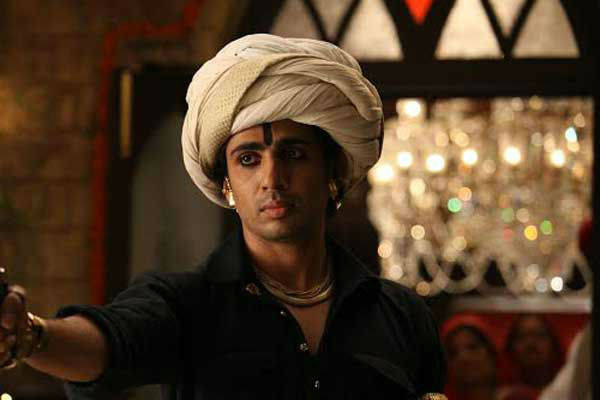
Not everything went well for Gulshan Devaiah, who plays the chief antagonist in Sanjay Leela Bhansali’s ‘Ram-Leela’. Since the movie is based in Gujarat, the actor had to wear traditional costumes and jewellery for the film. A key element of that look is the earrings he is wearing.

(Gulshan Devaiah )
(Gulshan Devaiah )

Gulshan was initially excited with the idea of wearing the heavy earrings as the script, the look and the director demanded it. He, however, realised that they were pressing against his ear lobes and as a result gave him headaches and radiating pain down his neck & shoulders. “I spent hours and days trying to manipulate the shape of the earrings to fit my ears comfortably but it just didn’t work. They were really painful. I just had to put up with the pain as the earrings were such an integral part of the brilliantly designed look .”

Gulshan plays the character of Bhavani . The movie is slated to release on 15th November, 2013.

source: http://www.articles.timesofindia.indiatimes.com / The Times of India / Home> Entertainment> Bollywood> News & Interviews> Costume / by Tanvi Trivedi / November 13th, 2013

Coorg: A Green Escape in Karnataka

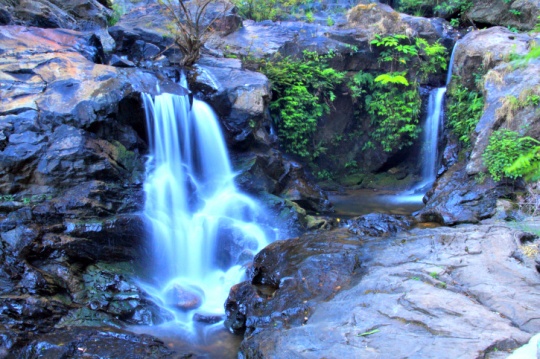
If you find Ooty, Kodaikanal or Munnar a bit too touristy and crowded a destination in southern India, Coorg is that perfect holiday spot in Karnataka that is sure to please toddlers, youth and the old alike.
CoorgKF16nov2013
Not that this hill station needs to be chosen for a sojourn by eliminating other similar destinations in the vicinity. Just a three-hour drive from Mysore, 150 km away, Coorg district on its own has much to offer, beyond its coffee, cardamom, pepper and beetelnut estates.

There is much to see, admire and soak in at this hill station, which the locals call Kodagu, on the slopes of the Western Ghats, what with some pristine trekking trails, picnic spots, waterfalls, wildlife, woods, forests, valleys and some mouth-watering cuisine. Situated at a height of 1,525 metres, Madikeri or Mercara is the capital of Coorg, with a nice bazaar, quaint houses with red-roofs and liberal use of teakwood reapers for doors and furniture, so common among homes and clubhouses in Indian hill stations.

It may come as a surprise to some that Coorg has one of the largest settlements of Buddhists in India, just about 30 km away from Madikeri, with their own Namdroling Monastery built in 1963, which the locals call the Golden Temple. Once you enter the monastery, you feel transported into some other world in the Orient, packed as it is with some 5,000 monks in bright yellow and red robes, with some soothing Buddhist chants, smell of incense and breathtaking sights of pagodas.

After seeing those large golden statues of the Buddha and Tara, the intricate murals and Tangkha paintings, don’t forget to taste some authentic Tibetan food here, especially the delectable momos and the subtle thugkpa, their noodle soup. One is told it is the largest teaching centre of Nyingmapa – a major lineage of Tibetan Buddhism in the world – and the present Dalai Lama gave its shorter name, as opposed to Thegchog Namdrol Shedrub Dargyeling that this mesmerising place was called originally.

Before dwelling further, where to stay is a question that is bound to crop up. While there are plenty of hotels and resorts, including the Orange County, that can even set you back by as much as Rs.25,000 per day, it is best to opt for a home stay. There are some 35 of them in and around Medikeri in a range of Rs.1,000 to Rs.5,000 per day where one gets not just to retire but also taste authentic Coorgi food and take some refreshing strolls on their plantations that grow coffee and other cash crops.

As far as the season goes, October to March — like most places in India — are the best months. The weather is pleasant with that welcome nip in the air. But Coorg during monsoons can be equally mesmerising and enchanting. There are also plenty of places one can go to. There is Abbey Falls, not far, where one has to make his or her way through some dense woods, dotted with coffee bushes, trees and creepers, to suddenly find a cascading gush of water.

Then about 80 km away is the Iruppu Falls, right next to the Rajiv Gandhi National Park, also called Nagarhole, which is famous for its elephants, with a lot of other game and some 50 species of birds. Children, especially, are certain to enjoy a visit to Dubare Forest, around an hour and a half from Medikeri. A ferry there takes you across to an elephant camp where one can see the pachyderms being bathed and fed, after which they are ready for a joy ride.

Talacauvery, around an hour away, is the source of the river Cauvery, with a temple to pay homage to this main source of water for some parts of Karnataka and Tamil Nadu. Not far is Bhagamandala, the confluence of three rivers: Cauvery, Kanika, and Sujyothi.

Another must-see is Tadiyendamol, which is the tallest peak in Kodagu and gives a breathtaking view of the entire Coorg, apart from the distant Arabian Sea. There is also the Naalkunaadu Palace built by Kodagu king Dodda Raja Veerendra in 1792. After all this exploring, a bungalow at the plantation is perhaps the best place to retire. Toddlers can chase butterflies, and a hammock and freshly brewed coffee are sure to be at hand!

How far: Around 150 km from Mysore and 260 km from Bangalore

How to reach: By bus or car from Mysore. Closest airport is in Bangalore; the airport in Coimbatore in neighbouring Tamil Nadu is another alternative.

Cost: Around 35-40 home stays in Coorg ranging Rs.1,000 to Rs.5,000 per day.

source: http://www.indiatimes.com / India Times / Home> Lifestyle> Travel / November 11th, 2013

Tea Board of India Extends Support to “World Tea & Coffee Expo” 2014, India’s Only International Trade Show Dedicated to the Tea & Coffee Sectors

As a part of its commitment to promote the Tea sector, the Tea Board of India, set up under Ministry of Commerce & Industry has extended its support to the 2nd Edition of “World Tea & Coffee Expo”™ (www.worldteacoffeeexpo.com), India’s only International trade fair dedicated to the Tea & Coffee sectors. The event is to be held at Bombay Exhibition Centre, Mumbai, India from Thursday 6th Feb 2014 to Saturday 8th Feb 2014. Tea Board of India has always been at the forefront of promoting Tea and has always taken proactive steps to address issues related to the Hot Drinks sector in India. The Tea Board of India decided to support this trade event since it shares a common goal with the show viz. promoting Hot Drinks in India. This niche expo is organized by the Mumbai headquartered Sentinel Exhibitions Asia P Ltd, a company engaged in managing and organizing trade events.

Says Mitesh M Kapadia, Director, Sentinel Exhibitions Asia P Ltd, “Hot drinks are witnessing positive growth since the last few years thanks to intensive marketing campaigns by players, launch of innovative products, the emergence of upscale Cafes offering both convenience, affordability and quality and the trend of these cafes becoming a meeting ground for young consumers.”

In addition to showcasing brands, products, machinery, retail Chains, accessories & technologies, WTCE 2014 will have Dedicated Innovations Display Zone, Interactive Demo areas (featuring Exotic Tea Tasting / Brewing sessions, Latte Art championships, Recipes and a lot more) as also Seminars & Conferences by Global Industry leaders & Policy makers to determine future trends in the Hot Beverage segment. The seminars will analyse prime factors influencing the sector and identify the sectors driving growth.

With an anticipated turnout of over 6000 Business Visitors including International buying delegations, WTCE 2014 promises to offer huge potential for franchising, marketing alliances, appointing Distributors, bulk orders, joint ventures and overall branding.

WTCE 2014 is also endorsed by a number of National & International Trade Bodies and visitors to the event will get exposure to national and international Brands, manufacturing and packaging technology, storage technology, Flavored Beverages, hi-tech vending machines, retails chains as well as a variety of products from importers and exporters of Tea & Coffee. For further details log onto www.worldteacoffeeexpo.com or contact Mr Mitesh, Director on +91 22 28625131 / +91 98205 03876 or on mitesh@sentinelexhibitionsasia.com

source: http://www.teanewsdirect.com / Tea News Direct / by K. Priti, Sentinel Public Relations P Ltd / November 06th, 2013