Category Archives: Arts, Culture & Entertainment

Honoris Causa for Dr Kambara, Subbaiah, Kadri Gopalnath

Dr T Ramasami will deliver the convocation address
Former national coach of Indian men’s hockey team and social worker A B Subbaiah, Saxophone player Kadri Gopalnath and litterateur Dr Chandrashekhara Kambara will be conferred honorary doctorate degrees at the 31st annual convocation of Mangalore University, on February 23.

Speaking to presspersons here on Thursday, Mangalore University Vice-Chancellor Prof T C Shivashankaramurthy said that Secretary to Government of India, Department of Science and Technology Dr T Ramasami will deliver the convocation address. Minister for Higher Education C T Ravi will grace the occasion. Chancellor H R Bharadwaj will preside over the programme.

The VC said that Anjaparavanda Bopaiah Subbaiah is a hockey player who had represented Indian team for 11 years and is presently serving as Secretary of Hockey Karnataka and has been mentoring youth to perform at higher level at the international arena. He has been into hockey for the last 30 years. He had represented Indian team in Barcelona Olympic Games, Atlanta Olympic Games, 8th World Cup at Sydney, 11th Asian Games, Beijing, 12th Asian Games, South Asian Federation Games and so on.

Subbaiah was the national coach of the Indian Men’s Hockey team for two years in 2003-04.

Kadri Gopalnath is an Indian Saxophonist and one of the pioneers of Carnatic music on saxophone. He was awarded Padma Shri in 2004. He has the distinction of being the first Carnatic Musician to be invited to perform in the BBC promenade concert in 1994 at London. He has participated in the Jazz festival in Prague, Berlin. He has won ‘Saxophone Chakravarthy,’ ‘Saxophone Samrat,’ ‘Ganakala Shree,’ ‘Nadopasana Brahma’ ‘Kalaimamani’ and other awards.

Dr Chandrashekhara Kambara is one of the leading dramatists of the country and is a poet, folklorist, novelist and a researcher. After a brief stint in teaching in the University of Chicago, he has taught in Bangalore University for over two decades and was a Fulbright Scholar.

He was the founder Vice-Chancellor of Kannada University, Hampi. He has won prestigious Jnanpith award in 2011. Some of his work are ‘Anna tangi,’ ‘Karimaayi,’ Singarevva mattu aramane,’ ‘Shikhara Soorya,’ and others.

Degrees

The VC said that Mangalore University will award 84 Doctor of Philosophy degrees, which includes Arts—15, Science—59, Commerce—8, Education—2, seven Master of Philosophy degrees (science—6 and commerce—1).

There will be 36 gold medals and 55 cash prizes. About 60 ranks (PG—44, UG—16: Arts—12, science and technology—30, commerce—10, law—1, education—4 and PG diploma—3) will be given to the students.

A total of 1,406 students will receive the degree in person. The Syndicate of the University has decided to use university’s own funds to present gold medals to toppers in the university because the money deposited by donors of various gold medals is insufficient as the gold prices have skyrocketed in the past few years.

A sum of Rs 2,36,880 will be required for 36 gold medals. There was shortage of Rs 43,607, which will be borne by the university itself.

Years ago, donors instituted gold medals to encourage bright students. The interest from the fixed deposits was used to give the medals. Now, gold prices have shot up and the amount is not enough to finance the medals, said the VC.

The gold medal has 25 gram silver with 1.200 gram gold plated on it.

Degree for MCMS

The Mangalore University will award degree to students of 2009-10, 2010-11 and 2011-12 batch students of Master of Communication and Media Studies (MCMS) of St Aloysius College. Accordingly, 36 students will get the degree from the university.
Registrar Prof P S Yadapadithaya, Registrar (evaluation) Prof B Narayana was present.

source: http://www.DeccanHerald.com / Home> District / Mangalore, DHNS / February 21st, 2013

Nalknadu Aramane – Coorg’s Forgotten Palace

In the midst of blossoming coffee bushes in interior Coorg lies a forgotten temple, the erstwhile capital of the Haleri kings.

Lakshmi Sharath –
The Nalknadu Aramane, the palace of the erstwhile Haleri dynasty of Coorg, now wears a forlorn look.

If stone walls do not a prison make, they do not make a palace either. However, in Coorg, you can find one such monument. Shrouded by dense coffee plantations, it hides behind its walls the secrets of the Haleri Dynasty that ruled the coffee country for more than 200 years from the 17th to the 19th centuries. I am on my way to discover this lost piece of history. Our journey takes us through mists and mountains as we drive through interior Coorg, looking for this historic monument that traces the origins and the end of this dynasty.

The mist plays with the mountains. The hills come alive. As we drive up the Western Ghats, the slopes are carpeted by coffee and cardamom plantations. It had rained just then and the coffee plantations are brimming with snowy-white blossoms sparkling like gems – a blend of diamonds and emeralds in a jeweled setting.

We drive through Virajpet and enter the Nalknadu region at Kakkabe. After paying our respects to the powerful deity Iguthuppa, we walk around the plantations and learn that Coorg’s tryst with coffee started right here in Nalknadu more than a couple of centuries ago. It is believed that the coffee seeds were planted right here by the Mopla community from Kerala who traded with the Arabs. The local people cultivated “wild coffee” here as small holdings came up on the fertile slopes of the Western Ghats that were too steep to grow rice.

We are not in Nalknadu for coffee. We are in search of a small palace hidden somewhere in the hills that had been witness to some events in the lives of the Haleri kings. The origin of the Haleri dynasty is traced to Veeraraja, a nephew of Sadashiva Nayaka of the Ikkeri dynasty who overthrew the local Nayaks, including the chieftains of Bhagamandala and Talacauvery, and went on to become the king of Kodagu with Haleri as its capital. His grandson, Mudduraja, later changed the capital to Madikeri. But our interest is in king Doddaveerarajendra who ruled in the 18th century and was constantly engaged in wars with Tipu Sultan. And that is where our search leads us.

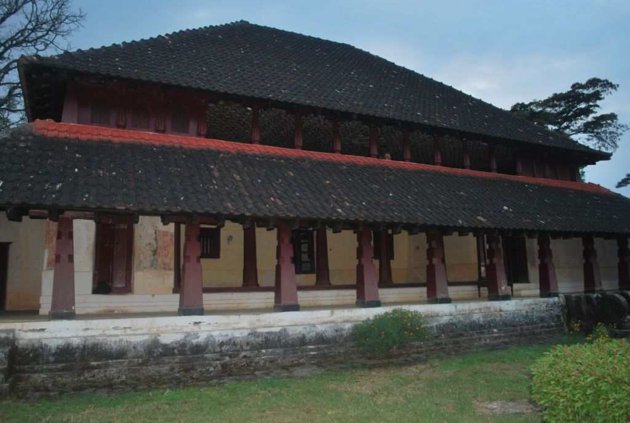
We enter a small hamlet called Yavakapadi in Kakkabe, where the Nalknad Aramane built by Dodda Veerarajendra in the 18th century awaits us. There are coffee plantations all around. A small mud road appears out of nowhere. A beautiful two-storey structure painted in red with a tiled roof, old wall paintings and pillars, gazes at us as we open the portals of the palace. A small mandapa in white is located close by. A drizzle starts as we hear a sound behind us. A caretaker silently opens the main door for us. We are the only visitors. As we soak in the moment, we are given a capsule of history.

Hyder Ali captured Coorg when Lingaraja I died in 1780 and took the young princes, Dodda Veerarajendra and Linga Rajendra, captive. They were sent to a fort in Gorur and a minister ruled over Coorg. While Hyder Ali fought the British, the locals rebelled and overthrew the minister. Tipu Sultan recaptured Coorg, but Dodda Veerrajendra escaped. He fought relentlessly against Tipu Sultan and during one of the wars he retreated into a dense forest in Nalknad. He built a palace here and made it into his operation base and also got married to Mahadevammaji.

The caretaker shows us around. We climb a small ladder and shows us to a hidden chamber in the roof. We are also taken to the torture room, the royal bedrooms, and the main durbar.
The palace, which had seen happier times, was also witness to the end of the dynasty. It was the final refuge of the last king, Chikkaveerarajendra, who spent his last few days hiding from the British who eventually deposed him. In many ways it is the only living symbol of the beginning and the end of the Haleri dynasty.

We head downstairs and sit by the pillars. A government school has now been built adjoining the palace. A bunch of schoolchildren are playing about. I wonder if they realize that their childhood playground was once a battlefield. As I sit there pondering, the rain tumbles down, refreshing the mood and the atmosphere.

source: http://www.in.lifestyle.yahoo.com / Home> Travels / by Lakshmi Sarath / Monday, February 18th, 2013

The right blend of coffee and tourism

Fascinating trails

Coffee lovers and those with wanderlust have something to rejoice over. Bangalore International Airport Limited (BIAL), in collaboration with the Ministry of Karnataka Tourism and Thomas Cook (India) Ltd, recently launched the Kaapi Trail, a tourism product which allows one to experience coffee in its homeland with a single click.

The trails will cover coffee regions like Coorg, Chikmagalur, BR Hills and Araku Valley and offer three types of tourism packages – heritage trail, wild trail and leisure trail.
Depending on the package chosen, travellers will visit coffee plantations, stay in carefully handpicked homestays, go for jeep safaris in the wild and on cycling tours and more importantly, experience the local culture, traditions and cuisine.

Interestingly, this project had its beginnings place last year itself, when the City airport was full of little kiosks selling different varieties of coffee for domestic and foreigners to get a taste of the South.

“Last year, the promotion began as a way of introducing people to the pleasures of coffee drinking and to strengthen the diversity of tourism attractions of the state. Trails like this have been successful world over. The Scotch trails, for example, combine scotch whiskey with the wonderful landscape of Scotland. This is our version of it with the common thread of coffee,” says Hari Marar, President, operations, BIAL.

For Jawaid Akhtar, chairman, Coffee Board, this move will make Bangalore the gateway to South India.

He points out the benefits of this trail – “This will not only increase the coffee grower’s income and the occupancy of the homestays in the coffee regions. But the microclimate in which Indian coffee is grown will be exposed to tourists,” he shares.

“We need to take this product to tour operators around the world and get it incorporated into brochures. This will ensure that tourists see it as a part of the Indian offering,” informs Madhavan Menon, managing director, Thomas Cook (India) Ltd. He adds, “We’re not trying to create a new genre of products but a new destination.”

In fact, this is the first time that tourism and coffee are coming together, and the convenience aspect of having a readymade travel plan is truly a big step forward.

“It’s great that this concept has germinated into a product. This is chance for Karnataka to show that coffee’s a way of life in this part of the world; it’s integrated in our culture. We live coffee, drink coffee and dream coffee,” wraps up Arvind Jadhav, additional chief secretary, Karnataka State Tourism.

source: http://www.DeccanHerald.com / Home> Supplements> Metrolife / DHNS / January 15th, 2013

Roopashree begins work on her next film

Actress Roopashree seems to be having a great run lately. The Kannada starlet, who manages to have multi-projects in her kitty all the time, has recently begun work on a new project titled Janma Nakshatra, where she is going to be paired opposite young actor Nagakiran. The film also stars Disha Poovaiah.

Roopashree recently finished work on her other Kannada film Jatayu, which has been directed by PC Sekhar, who last made the Ganesh-Bhavana starrer Romeo. This film is supposed to be a total entertainer, with a lot of comic elements to keep the masses happy.

Roopshree meanwhile has also been busy working on her newest Tamil film, Onbadhula Guru, which is also nearing its release. The actress was in Chennai recently to dub for her portions. This film is a comedy multi-starrer and has Bangalore boy Vinay Rai, Premgi Amaren and Lakshmi Rai among others as her co-stars in the film.

source: http://www.articles.timesofindia.indiatimes.com / Home> Regional> Entertainment> Kannada / by Sunayana Suresh, TNN / January 22nd, 2013

They sing among us


Musician Biddu

CHAT Musician Biddu speaks of how his iconic hit Aao Na, Pyaar Karen features in Luke Kenny’s Rise of the Zombie

They just seem to be everywhere—the undead that is. In graphic novels, books and now with Luke Kenny’s Rise of the Zombie, they have stepped into Bollywood as well. Slated for release in February, musician Kenny’s apocalyptic vision is the result of a collaboration with partner Devaki Singh. Apart from bloodthirsty grisly ghouls, ROTZ also features the hit ‘Aao Na, Pyaar Karen’ composed by Biddu and with Nazia Hassan’s vocals. “Last year Luke got in touch with me saying he wanted to use the song,” Biddu says. “I like dealing with young people.”

The composer of the famous ‘Kung Fu Fighting’ says: “Unlike ‘Disco Deewane’ in Student of the Year, this will be a reworked version of ‘Aao Na.’ I haven’t heard the final version. Luke sent me two adaptations — one is trancy techno and the other has David Guetta groove to it. I don’t know which one they will finally use. If I remember right the song is being used during a rave party. Good luck to them.”

Biddu who mostly stays abroad, spends December to February in India. “Mainly in Goa, but I come to Bangalore to meet family,” says Biddu who says he is not doing any music now. “I am finishing a book which is funny and sad. It is about the sexual awakening of a boy in Mumbai.”

Biddu has written his autobiography and the simultaeneously gripping and mystical whodunit, The Curse of the Godman says his next book will be set abroad. “There is only so much you can do in India,” he says signing off with a laugh.

source: http://www.TheHindu.com / Home> Features> MetroPlus / by Mini Anthikad – Chibber / Bangalore, January 31st, 2013

Reservations declared for town panchayat polls

Patterns of 2007 for centres continued

The State Election Commission has decided to continue the reservation pattern of 2007 for Virajpet, Somwarpet and Kushalnagar Town Panchayats for the forthcoming elections.

Ward-wise quota:
Virajpet town panchayat: 1. Church Road – General, 2. Devanga Beedi- SC (woman), 3.Arasu Nagara- backward class (A), 4.Telugara Beedi- general, 5.Mogaragalli- general (woman), 6.Harikere- general, 7.Nehru Nagar 1- backward class (A), 8.Nehru Nagar 2- backward class (woman) (A), 9.Subhash Nagar- backward class (A), 10.Panjarapet- general, 11.Meenupet 1- ST (woman), 12.Meenupet 2- general (woman), 13.Gowrikere- general (woman), 14.Gandhinagar- backward class(B) (woman), 15.Chikpet- general, 16.Shivkeri- SC.

Somwarpet town panchayat:
1.Basavewshwar block-backward class (A), 2.Powerhouse block- backward class (A), 3.Venkateshwar block- SC (woman), 4.Tyagaraj block- ST (woman), 5.Visveswaraya block- general, 6.C K Subbaiah block- general (woman), 7.Janatha Colony- ST (A) (woman), 8.Ranger block 1st level- backward class- backward class (B) (woman), 9.Ranger block 2nd level- general, 10.Siddalingeshwara block- general, 11.Mahadeswara block- general.

Kushalnagar town panchayat:

1.R Gundurao extension, Baichanahalli (North)- backward class (B)(woman), 2.Dr B R Ambedkar ext, Nijamuddin ext- SC(woman), 3.Cauvery ext, Indira ext, Ayyappa Swami temple road(right side)- general, 4.Dandinapet main road, Ayyappa temple road (left side)- backward class(A), 5.Dandinapet, Avabhi ext, Shantimarga- backward class(A) (woman), 6.Bapooji ext- Town colony, Car street- general, 7.Aadhi Shankaracharya ext, Vivekananda ext, Russell ext- general, 8.Kalamma colony, Aadarsha, Dravida colony- SC, 9.Nethaji ext, Shailaja ext, Shringaramma ext- general(woman),10.Avadhani ext, Basappa ext- general, 11.Dr S Radhakrishna ext, Someshwar ext (East), Industrial ext- backward class(a), 12.Dr Shivrama Karantha ext, KHB Colony, Gowda Samaja Road- general, 13.Nehru ext, Siddaiah Puranik ext, H R P ext- ST(woman).

source: http://www.DeccanHerald.com / Home> District / by DH News Service / Madikeri, February 11th, 2013

Review: Storm Festival, Coorg

Now in its second year, the camping festival still has to overcome many teething issues.

The Raghu Dixit Project. Photo: Imran Ahamed/ Storm Festival

February 1 and 2, Madikeri:
The first thing you should know about Storm Festival is that you don’t just wake up and attend the festival. It requires meticulous planning and packing. The eight hour journey from Bengaluru to Coorg was exhausting to say the least and there’s little one could have done to avoid squabbling with the security once we landed there.

We went through rigorous checking for this drug-free festival. Considering most festivalgoers were camping on site, they arrived with a bag of clothes, toiletries, a camera, but except for clothes, little else was allowed in. “Do they expect us to toss our cameras in the river?” ranted a festivalgoer, who was pulled up at the security. The scene repeated itself on multiple occasions during day one, with bags being ransacked, clothes tossed around, water bottles, perfumes and toothpastes confiscated and teabags taken out for further inspection. Instead of metal detectors, the second level of security meant an encounter with sniffer dogs before festivalgoers could step foot into Storm Fields, the camping site at the festival. Not the best start.

The venue for the festival, a sprawling tea estate, bore semblance to a theme park, almost like the fantasy world of Takeshi’s Castle with life-size installations including a mermaid in red bikini. Maybe a case of misplaced geography… Hills missing the beach? With the sun at its harshest, the concert space lay in comatose, while Stormers were seen paintballing, rock climbing, riding bronco bulls and ATVs, sliding on ziplines and leaving no time to wrestle one another in chicken-like outfits.

A visit to the camping site, with oven hot tents, ensured we got to the performance area as quickly as possible. The stages were named Paddy [acoustic sets], Spice [EDM], Coffee [folk] and Honey [midnight jam space], with the EDM and the folk stage serving as the bigger venues. Bengaluru band Agam worked hard at attempting to get their audience, who were comfortably nestled under the trees for shade, up closer to the stage, without much success. Like Agam, most opening acts at this day-long, open-air festival, such as Astitva and Lagori on day two, too received a lukewarm response from the audience. In spite of the sparse mid-afternoon turnout [there were barely 400 people] Agam continued to power through a setlist of songs such as the “Boat Song” and prog rock-style bhajan “Rudra” from their debut album The Inner Self Awakens. But Solder’s uninspiring acoustic set featuring old-school rock songs found favor with the audience.

Delhi’s Advaita up next on the mainstage performed concert favorites like “Ghir Ghir” and “Mo Funk” from their second album The Silent Sea but also barely succeeded in getting the audience up on its feet. However, when Nikhil Chinappa took to the decks at the EDM stage, followed by his brother Vachan, the party began to take off at Storm. With the folk and EDM stage located not too far apart from one another, there was no time wasted while stage hopping, though the sound did leak into the other stage occasionally. But if it weren’t for the proximity of the singer-songwriter stage and the folk stage, the festival would have lost the bonhomie of off-the-cuff moments like the time when Raghu Dixit, while soundchecking on the folk stage, joined in on Sidd Coutto’s set closer, the comic doomsday song “The Mayans Know” on the acoustic stage from across the other side.

For the first time that we’ve seen him perform perhaps, Dixit was baffled by how long it took for the crowd to warm up. The adrenaline levels of his audience seemed to pick up only when Dixit picked an audience member up on stage to sing a line from his Kannada tongue twister “Lokada Kalaji,” a track, like most shiny, happy songs by Dixit and his band, talks about letting go of worldly concerns and celebrating life. Karsh Kale Collectiv that included artists such as Warren Mendonsa, Benny Dayal, Monali Thakur and Shilpa Rao managed to keep the audience engaged through the hour-long set and was the highlight of day one of the festival. While the day’s gigs ended at 10pm, the party at the EDM stage carried on as Russian DJ Bobina produced some heady mix for trance fans.
The camping festival had more in store afterhours, as the temperatures dipped. Artists such as Dayal, Alisha Pais and Coutto joined campers for a bonfire jam late into the night. One thing that most festivals in India can’t compete with is Storm’s ability to make Stormers curl up into their sleeping bags to the sound of a cheery jam and wakeup to soundchecks. “It was great waking up to Papon singing,” said Vasantha Prakash, a Storm first-timer from Bengaluru.

The collaborations at the fest also set it apart. At their mid-afternoon slot, Lagori frontman Tejas “Boom” Shankar tried every crowd-rousing antic in the book to coax people to “get tanned” (he even took off from stage, with mic in hand, to pull crowds seated in the far-off corners). Cajoling audiences to singalong to his band’s music that adds funk-rock influences to Hindustani classical alaaps, Shankar found company in Indian Ocean’s Rahul Ram, spotted amidst his listeners, and thereby invited Ram to join him on their stoner hit “Boom Shanker”.

Unfortunately, management hassles seem to return at morning break with stranded campers waiting to be let in. Mahesh Dinkar, booked the camp for two days and arrived at 7am on day two to find out that he could enter the site only post 10am. Swati Dighe from Mumbai was also full of complaints. “We wanted to take a stroll outside, since the festival doesn’t start till 2pm, but we were told we can’t step out once we are in. It’s like school. You can’t smoke outside of a tiny entrapment, have to choose between watching a gig or getting a drink…There’s no festival vibe, just a straight-up check that kills all the excitement as soon as you step in,” she said.
But with over 300 campers on site, the festival organizers managed to keep up their claim of being the cleanest music festival. While the turnout doubled on day two with about 1,500 people spread across the two stages, the festival ran way behind schedule on Saturday, with soundchecks taking up most of the afternoon. Slated to begin at 1pm, it was past three when Delhi’s Hindi fusion rock band Astitva took over from festival headliners Indian Ocean, who had spent over an hour soundchecking. Astitva debuted new songs such as “Hum Dono” and “Meri Kahani,” though their performance didn’t make it into our list of standout gigs at the fest.

The high point of the festival came minutes later when Tamil folk artist Anthony Daasan (ex-La Pongal) stepped in, introducing himself as a funeral singer. An unlikely party starter, Daasan appeared in an electric blue kurta, sporting his characteristic bandana and urumi (a traditional double headed folk drum from Tamil Nadu) on a sling and took no time to prove that he was the man of the show. His dance-music performance, cheeky onstage banter and infallible energy managed to draw the EDM crowd as well. Daasan’s vocals matched the nadaswaram wails, the beats of the urumi and the thunderous thappattam drums note for note. Daasan’s band, Anthony Daasan- In Party, a vibrant eight-member ensemble, which made its stage debut at Storm also featured Junkyard Groove bassist Sajith Sathya and a motley of dancers, who moved to the nadaswaram and clarinet, kickstarting the festival’s first dust storm of sorts. The adrenalin peaked when Benny Dayal stepped in to guest on the harvest song “Vandiyila Nellu Varum.”

Next up, Swarathma, in their lively Topiwalleh regalia minus the ghodi, called upon Daasan to guest on “Mukhote.” The band, which returned to the festival for the second year, remained crowdpullers. Barring a few sound glitches, the band seemed to be in form with drum duties shared between Karthik Mani and Sachin Banandur (Parvaaz), stepping in for Montry Manuel. At the EDM stage, there were a few surprises with high-quality performances by DJ Swing, Brute Force and headliner Dash Berlin. While Tuhin Mehta laid the hammer down with his percussion-heavy techno mix, Dash Berlin showcased that he was a likely candidate for a bigger stage.

Although the much-awaited collaboration at the festival, featuring Shankar Mahadevan and Indian Ocean, failed to live up to the hype. The Delhi folk rockers took to stage soon after Papon won over the audience with the often-requested “Banaao Banaao” and the upbeat boat race song “Boitha Maro Re.” While Indian Ocean kicked off their set with “Bandeh,” one of their biggest hits, their performance hit a bump once Mahadevan stepped in to give his “Kal Ho Na Ho” touch to the protest anthem “Ma Reva.” However, Mahadevan redeemed himself as quickly, when he performed “Breathless.” On “Tandanu”, part-gibberish, part-Kannada folk, the powerhouse artists collaborated, bringing Mahadevan’s vocal elasticity to the fore.

Sticking to the 10pm deadline, calls for an encore went unheard and festivalgoers were seen grabbing whatever they could lay their hands on at the food stalls. The pork Pandi curry and sannas disappeared quickly. Close to midnight, the music returned to the hills once again, with the day’s star, Dasaan, bringing his staccato beats to the jam-friendly camps and ensuring that the festivities at the camp were far from over.

source: http://www.rollingstoneindia.com / Home> Gig Reviews / by Megha Malhotra / February 13th, 2013

Coffee grower to exhibit his 85 cars

Madikeri:

Ahmad Kutti, a resident of Nellihudikeri, has organized an exhibition of 85 different cars, some vintage, on February 13 and 14.

Entrance to the exhibition is free for students from Siddapur, Abhyathmangala, Nellihudikeri and other surrounding villages. In addition to the cars, Kutti, a coffee grower, also owns 20 two-wheelers, seven jeeps and seven lorries.

Among the cars Kutti owns is a 1951-model Moris minor,1953-Hill man,1976-Moris-8, 1943 Ford jeep,1928 Ford tower, 1948 Ford perfect, 1946-Ford Myangilo, 1948-Austin-A-50, 1968-Hill man super mix and 1956-Austin-A-50.

Kutti has a separate garage for these cars inside his estate. The cars are not merely showpieces, but are in working condition, he says proudly. His son Ashraf, who studies in Bangalore, informs his father immediately when there is a vintage car for sale. Kutti has even bought a vintage car from senior politician K H Patil for just Rs 3,500.

After purchasing the car, some of which have to be brought to his garage in a lorry, Kutti gets them repaired spending more than its worth to bring them back to running condition. Kutti even brought a car from Pune.

He brought one car from Pune. He is also a member of the Karnataka Vintage Cars Association and participates in every vintage car rally.

Initially, his family members were worried, but about his peculiar taste, later they adjusted and enjoying moveding in those cars. The records of all the cars are perfectly maintained.

source: http://www.articles.timesofindia.indiatimes.com / Home> City> Bangalore / TNN / February 11th, 2013

Bidappa to celebrate ‘Karnataka Day’ at Surajkund Mela

Karnataka has been selected as the theme state for the ongoing International Crafts Mela, Surajkund and ace designer Prasad Bidappa will choreograph a fashion show Saturday to celebrate ‘Karnataka Day’.

From colours, ethnicity, traditions to hospitality, the best of Karnataka is showcased at the 27th edition of the crafts mela started Feb 1.

Karnataka’s main event will take place Saturday with a fashion show and a bouquet of cultural programmes. The day will be observed as ‘Karnataka Day’, reads a statement.

“Our main intention this year is to portray the grandeur of the many worlds of Karnataka that many people don’t know about,” Arvind Jadhav, IAS, Additional Chief Secretary (Tourism), Government of Karnataka, said in a statement.

“We now want to bring to centre stage little known but highly intriguing facts about our silks and sarees, the Dharwad gharana and its contribution to hindustani music, the colourful patterns of Navalgund and Kasuti, the national flag manufacturing that is unique to our khadi units in Dharwad and many such lesser known stories,” he added.

As many as 400 artistes and artisans from across the state of Karnataka are participating at the mela and are presenting various forms of art, folk, music, dance and theatre shows.

Also the venue has been transformed into some of the popular monuments of the state including Tulabara from Hampi, Bara Kaman from Bijapur, Belur Chennakeshava Temple, Mysore Palace, Dasara Dolls, Jain Basadi, Pattadakal Temple Complex, Vijayanagara Empire and Hoysala Pillars.

There are a total of 75 stalls from Karnataka presenting their wares at the 15-day craft mela.

source: http://www.DeccanHerald.com / Home / by IANS / New Delhi – February 08th, 2013