Category Archives: Arts, Culture & Entertainment

‘CM promises ` 50 lakh for Madikeri Dasara’

Utsava Committee members meet Shettar for funds

City Municipal Council President H M Nanda Kumar informed that Chief Minister Jagadish Shettar has assured of releasing Rs 50 lakh for Madikeri Dasara Janotsava.

Speaking to Deccan Herald, he said that a delegation of Madikeri Dasara Utsava Committee members led by their President Nanda Kumar and Working President Robin Devaiah had met the chief minister recently seeking funds for Dasara celebrations. The State government had released Rs 50 lakh last year and the members have requested for releasing the same amount this year too.

Responding to the request, the CM has said that the government can not release more amount this year as the state is facing drought. However, he has assured of releasing the amount in line with the previous year, said Nanda Kumar.

The delegation also met Kodagu District-in-Charge Minister M P Appachu Ranjan prior to meeting the CM.

source: http://www.DeccanHerald.com / Home> District / Madikeri, September 09th, 2012 / DH News Service

The vanished Haleri dynasty of Coorg

Give the homestay lounging and pandi-curry hogging a miss and stretch those itchy feet. Let’s go explore the relics of Coorg’s long-departed Haleri kings

I am always in a fix when I visit Coorg. While my mind wishes to linger in the verdant greenery around me, my feet get all itchy and demand that I explore the heritage and historic sites that nestle in the luxurious landscape.

So when I revisited the coffee country last time, I decided to soak in a bit of history. We started with Madikeri and ended in Kakkabe where we heard stories that traced the beginning and the end of the Haleri dynasty that ruled Coorg for more than 200 years from the 17th to 19th centuries.

We were in Madikeri when we first heard this story. A Haleri king was on a hunting expedition when he suddenly saw his wild dogs chased by a hare in a small hillock. He felt that a powerful energy must vibrate in the village which could turn a meek hare into a courageous beast. The king built a fort there and set up a mud wall garrison. The hamlet, which became the capital of the dynasty, was named after the king, Mudduraja. His dynasty was Haleri and the capital was called Muddu Raja Keri or Muddurakayray. Today, we know it as Madikeri.

The origin of the Haleri dynasty is traced to Veeraraja, a nephew of Sadashiva Nayaka of the Ikkeri Dynasty. As the Vijaynagar Empire crumbled, Veeraraja, who dreamt of establishing his own dynasty, was looking to exploit the weakness of local kingdoms. His ambition took him to Kodagu, which was then ruled by various Nayaks.

Disguised as a “jangama” or a priest with healing powers, he established a small group of followers in Haleri. He overthrew the local Nayaks, including the chieftains of Bhagamandala and Talacauvery, and went on to become the lord of Kodugu with Haleri as his capital. His grandson, Mudduraja, later changed the capital to Madikeri.

Madikeri Fort is today one of the few remnant symbols of this powerful dynasty. It was eventually rebuilt in granite by Tipu Sultan who named the site Jaffarabad. It was recaptured by the Haleri ruler Doddaveer Rajendra in the 18th century and it later fell into the hands of the British who renamed it as Mercara. Today the fort houses a palace, a temple, a chapel, a prison and a museum where you can see hero stones or virakkals among other artifacts.

We embarked on the trail of this dynasty. Further away from the city is Gaddige or the Raja’s samadhis, which are the tombs of the kings Doddaveerarajendra and Lingarajendra. A solemn air hung around the deserted tombs. The tombs of the diwans and army commanders were also placed here. We passed a few boys who were playing cricket as we took in the domes and minarets touching the evening sky.
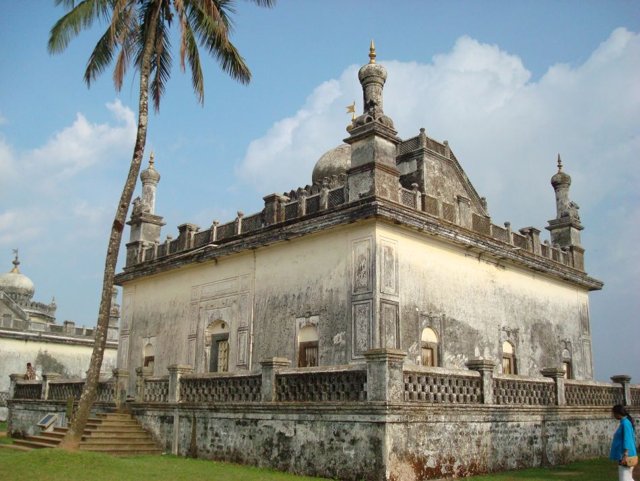
A visit to Madikeri is never complete without a visit to the 19th century Omkareshwar temple built by Lingarajendra II. Dedicated to Shiva and built in the Indo-Saracenic style, it has elements of Gothic and Islamic architecture as well. It is said there could have been a secret passage below that led to the palace of the king.

I heard that the temple resonated with the tale of a king haunted by a ghost. Our story starts one summer morning when a poor Brahmin comes to Madikeri with the intention of giving his daughter away to the Raja’s harem as he was unable to take care of her. He, however, changed his mind and left Madikeri after listening to stories about the king from Subarasaiah, another Brahmin who lived in the town. When the king heard about the incident, he mercilessly beheaded Subarasaiah’s sons, besides slaughtering the Brahmin as well.

Lingarajendra went to sleep that night only to be woken up by Subarasaiah staring at him. The visits continued. The king became distraught as the spirit hovered around him. The dead Brahmin had become a demon or a Brahma Rakshasa. Tantriks advised the king to build a Shiva temple and bring a linga from Varanasi to appease the demon. The king, however, did not recover fully and died within a year.

A light, it is said, perpetually glows from the sanctum. Even today, I hear, the spirit of the demon roams freely in the sacred grove within the temple premises where the Brahma Rakshasa resides.

Our next stop was Virajpet – one of the key towns and erstwhile capital named after Virarajendra, the Haleri king. It is said that Dodda Veerarajendra established the town in the 18th century to commemorate his meeting with the British General Abercrombie during their joint war against Tipu Sultan.

We then went in search of a small palace where the Haleri Dyansty came to an end. Our trail ended in a small hamlet called Yavakapadi in Kakkabe where Nalknad Aramane, built by Dodda Veerarajendra in the 18th century, awaited us.

There were coffee plantations all around. A small mud road appeared out of nowhere. A beautiful two-storey structure painted in red with a tiled roof, old wall paintings and pillars gazed at us as we opened the portals of the palace. A small mandapa in white was located close by. A drizzle started as we heard a sound behind us. A caretaker had silently moved in and was opening the main door for us. We were the only visitors. As we soaked in the moment, we were given a capsule of history.

During one of the wars with Tipu Sultan, Dodda Veerarajendra had to retreat and he came to this dense forest. He converted it into an operations base and built a palace and even got married here. This palace was the final refuge of the last king, Chikkaveerarajendra before he was deposed by the British and it symbolised the end of the Haleri dynasty. The caretaker showed us around as we climbed a small ladder, saw the hidden chamber in the roof, the torture room, the royal bedrooms, and the main.durbar.

It was ironic that the Haleri kings, who had befriended the British to fight Tipu Sultan, were finally deposed by the Europeans. As we walked back, we saw a few tourists who had just returned from their trek to Thadiyandamol, the highest peak in Coorg. The sun had set as we walked back to our homestay, wondering how this silent monument would have once been a scene of battles fought and won.

source:http://in.lifestyle.yahoo.com/the-vanished-haleri-dynasty-of-coorg.html
By Lakshmi Sharath / Wednesday, September 12th, 2012

I’m thrilled: Ashwini Ponnappa

Did you expect the Arjuna award this year?
Honestly, I didn’t think about it. I’ve been training extremely hard and trying to do my best in the game. I think my hard work paid off when Jwala and I won gold during the Commonwealth Games and then the bronze at the World Championship. My aim was to win a medal for the country during the London Olympics, but unfortunately that could not happen…

When Jwala and you missed out on the quarterfinal berth by a difference of just one point despite winning the match, it seemed as though the two of you had no clue as to what happened?
Yes, Jwala and I were unaware that we failed to make it to the quarterfinals despite winning the match. We knew we had to win by a certain margin, but the exact number eluded us. It was much after the match that we got to know of our fate. Plus, there was so much drama happening around that time…

Drama?
To be honest, a few countries did not play fair and we had to bear the consequences. The Chinese and Indonesians have always ruled the roost in badminton. Post our ouster, we lodged a formal protest, but it fell on deaf ears. Of course, the complaint was lodged a little late in the day. Gopi sir (Pullela Gopichand) too was very vocal about the issue. However, the decision was completely unfair. We have to work so hard to book a berth for ourselves at the Olympics. But there are countries like Australia, South Africa, Canada and others, who don’t really have to qualify as they get in through the Continental spot.

Heard that you won’t be teaming up with Jwala in the future?

That story is completely wrong. I’m not planning on changing my doubles partner. It’s just that Jwala is taking a break now and since I’ll be playing, I have to pair up with other players. We’ll be back soon.

What about playing singles?
It’s not easy to shift gears from doubles to singles and vice versa in a blink of an eye. Both formats need a lot of training and different sets of disciplines. I’m happy playing
doubles for now.

Saina, Jwala and you are credited with making the sport glamourous.
I’m flattered when people call me glamourous. When Saina broke into the scene, she brought along a lot of new fans of the sport. Ditto with Jwala and me. One has to be a good performer to get people into watching a sport which is not cricket. It’s nice to be well-dressed on court. Of course, people have loved watching us play and that’s a great thing.

source: http://www.articles.timesofindia.indiatimes.com / Home> Sports> More Sports / by Sarah Salvadore, TNN / August 30th, 2012

Security: GPS fitted on two elephants in Kodagu

Tracking pachyderms

In an unique attempt, Global Positioning System (GPS) devices have been installed on the collars of two tamed elephants at Dubare elephant camp in Kushalnagar. It is for the first time that GPS has been installed on elephants.

Two elephants that have got the privilege of GPS are Ranjan (4) and Shivagange (11). With the installation of GPS on Saturday, the path on which the elephants walk could be traced through the internet enabled system.

The elephants at Dubare are left to roam around in the forest after bathing them in Cauvery river and providing them with food. These elephants roam around in the forest in search of food and return to the camp in the evening by 4.30 pm.

The elephants that are left to the forest are tied with iron chains with links. These chain links leave mark on the road on which the elephant walks, thus enabling mahouts to find the route on which the elephant has traveled.

However, mahouts find it challenging to trace elephants during heavy rain as the mark created by chain links are usually washed out. It is at this juncture, that the GPS comes to the rescue of mahouts. The radiation emerging out of the GPS will help to find the exact location of the elephant with the help of internet.

Inspired by Prajna

Animal lover and elephant expert Prajna Chowta is the inspiration behind introducing GPS devices in Dubare. Prajna Chowta, who is looking after four elephants in Dubare camp has installed GPS devices on two of her elephants.

Speaking to Deccan Herald, Dubare range forest officer Appaswamy said that Prajna had brought the matter of installing GPS devices on two of her elephants in the camp, to the notice of the higher officials. Hence, the department decided to install devices on the elephants, he said.

A GPS-enabled device normally records and stores location data at a pre-determined interval or on interruption by an environmental sensor.

source: http://www.DeccanHerald.com / Home> District / by Shrikanth Kallammanavara, Madikeri / September 03rd, 2012

Women & Guns

Mysore, Sept. 8:

The Week magazine dated September 16, 2012, has a surprise for Kodavas particularly as it carries on its cover the gun-toting, trigger-happy Kodava woman who lives in city, Mrs. Tiny Biddapa.

The 66-year-old Kodavathi, Madrira Tiny Biddapa, is also featured on the inside-spread of the magazine with her 12-bore gun resting on her shoulder inside her coconut-garden in the outskirts of the city adjacent to the Police Layout in Mysore East.

The article says that many women see guns as a force equaliser in this unfair world, well, dominated by men of lust and greed.—KBG

source: http://www.StarofMysore.com / General News / September 08th, 2012

Talacauvery temple panel to enforce dress code

Irked by tourists who wear skimpy dress while visiting the Bhagandeshwara temple in Talacauvery, the management committee of the shrine has decided to impose a dress code for visitors.

“We have not finalised the dress but any dress that covers women and men adequately would suffice. This is not an ordinary tourist centre but is a shrine of Cauvery river which feeds lakhs of people in Mysore and Bangalore and in Tamil Nadu and also irrigates several thousand hectares of agricultural land in South Karnataka and Tamil Nadu. So we should show some respect to the shrine by being presentable at the shrine,” said the committee president AK Manu Muthappa.

The committee is also wary of the litterbugs. “They throw all sorts of trash including empty food packets, water bottles, polythene bags in the temple premises. The committee has taken a serious view of this and has decided to start a campaign against littering” Muthappa said.

The committee member TS Narayanachar said: “The dress code will come into force immediately and those who wish to visit the temple should be prepared to wear the prescribed dress.”

The festivities (Sankramana Jathre) at the shrine will begin on October 17 when lakhs of pilgrims are expected to visit the temple.

source: http://www.dnaindia.com / Daily News & Analysis / Home> Bangalore> Report / by DNA Correspondent, Place: Madikeri, Agency: DNA / Tuesday, September 04th, 2012

Pandi curry

The pandi curry at Coorg is one of the top dishes of Bangalore

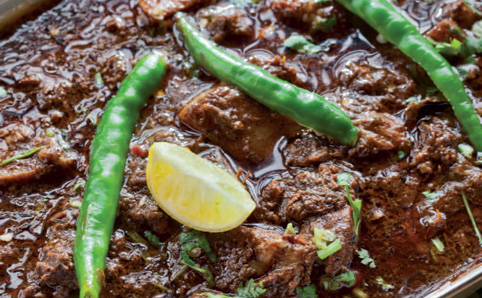
The pandi curry at this quaint home-turned-restaurant (on weekends) is the highlight of the buffet; invariably, it has patrons lining up for seconds, and even thirds. Coorg’s owner, KC Aiyappa, pointed out that “it’s a compulsory fixture at all Kodava feasts and functions too”. A meal in which this slow-cooked pork preparation is the star dish certainly does take on a celebratory tone, if only to applaud the time, precision and care that goes into achieving this wondrous amalgamation of fatty meat and many, many spices.

Aiyappa leaves the cooking in the able hands of his wife, Priya, who first treats the pork with rock salt, pepper, turmeric and a hint of chilli, then bastes it with masala before setting it on the flame. The meat cooks in its own oil and fat for nearly an hour before she adds another mix of spices, this time fragrant plantation produce from Coorg, such as cardamom, cinnamon, cumin and cloves. Much later, only when the dish has simmered and thickened, does it get flavoured with kochampuli, an ingredient that’s also brought from the coffee-growing regions of the state, which lends the curry its dark colour and sour, woody taste. The Aiyappas insist that for the pulp to be made correctly, it must “be left on firewood and most importantly, watched over.”

Not differing from tradition, the folks at the restaurant don’t refrigerate the rich curry. Instead, it is heated over and over till it is lapped up by customers, most commonly with several akki ottis, or soft, porous rotis made from cooked rice.

Coorg 477, Krishna Temple Road, 1st Stage, Indira Nagar (+91 98454 93688). Fri 8.00pm-11.00pm, Sat, Sun 12.00pm-3.30pm, 8.00pm-11.00pm. No cards. R180.

source: http://www.timeoutbengaluru.net / Home> Restaurants & Cafes> Features / by Ria Basu / Photos by Selvaprakash L / August 31st, 2012

Fishing for compliments

At the Coorg table, you can immerse your tastebuds into a dark, tangy fish curry, with spice tones reminiscent of the famous pandi curry, but thinner and sharper. No coconut here — just ground onions, garlic and a few grains of raw rice as a thickener, a faint, pleasing bitterness from fenugreek seeds, dark roasted spices. Sharp, clear flavours emerge from the earthenware cooking pots. For a land locked, hill people, we eat a lot of fish in Coorg. The streams and rivers offered a generous supply of fresh water crabs and fish, like the sweet-fleshed bare meen.

Fishing trips had a touch of the theatrical — fire-lit or lamp-lit men, balancing along the mud embankments of the fields, or river-banks, to spear or trap fish. Bamboo traps were laid in cold, swift flowing streams. In season, the flooded paddy fields were full of crab and the prized, tiny koile meen.Fresh catch from the sea was just a day -trip away and, centuries of trade with the Malabar coast established a tradition of fresh and dried fish finding their way into Coorg homes, in sawdust-lined tin boxes, carried by Mapilah traders, to be haggled over in backyards. Salted fish was set aside for the monsoon months, or pickled in a thick layer of spices, immersed in baranis (earthenware jars).

To the fish and crustaceans of the sea and their own highland streams, the Coorgs brought their typical spice mixtures that added beguiling flavours. Whole mackerel, sardines, or slices of sweet-tasting river fish were lightly marinated in red chilli powder, turmeric and the indispensible kachampuli (Coorg vinegar), dipped in rice powder, and fried crisp on cast iron tawas. The contrast of the crunch of crisped exteriors, the lingering levels of spice in the firm flesh and a squeeze of lime was always perfect. There were plump morsels of pickled fish, and curries and pickles of prawns. Some days, an estate worker would come by with a catch of slender, flashing fish, a couple inches long, from the paddy fields. Fiddly to clean of the grit and mud, we spent ages rubbing slippery mounds with ash or salt for curry, or my favourite — clusters of koile meen, mixed with spices, for ‘cutlets.’

Fresh crab, caught in streams or fields were quick fried, or curried with finely ground coconut into a sour-spicy curry. Served with hot akki ottis and melted ghee. As we sat around a small, dining table, crunching crab claws and sucking out tender meat, my mother-in-law would explain which phases of the moon brought the crabs heavy with meat and, the knack of catching live crabs without receiving a painful pinch. I would nod enthusiastically, but left that particular task to the experts.

RECIPE
Coorg Fish Curry
Ingredients
* 1kg fish (seer works very well) cut into ½ inch thick steaks
Grind together to a fine paste
* 4 large onions
* 1 inch ginger
* 8 pods of garlic, peeled
* 1 ½ tsp jeera
Dry spices
* Red chilli powder to taste
* 2 tsp coriander powder
* 1 level tsp turmeric

For seasoning
* 1 tsp mustard seeds
* 2 green chillies
* 2 onions, sliced thin
* 8-10 curry leaves

For the roasted masala
* 1 tsp whole cumin (jeera)
* 1 tsp mustard seeds (rye)
* ¼ tsp fenugreek seeds
* ¼ tsp raw rice
* ½ tsp black peppercorns kachampuli, or malt vinegar

Slow roast the above spices separately on a hot tawa until they release their aromas and change colour. Allow them to cool, and crush to a powder, separately, and then mix.
* Salt to taste
* ½ cup oil
* 2 cups hot water

Method
Wash and dry the fish fillets or steaks.
Mix the kachampuli (or malt vinegar), the turmeric, chilli powder, salt into the fish, and set aside.
Heat the oil in a deep pan, or kadai, add the mustard seeds. When they begin to splutter, add the curry leaves, the sliced onions and the green chillies, and fry gently until softened.
Add the coriander powder, chilli powder, and ground paste of onions. Cook slowly, until the raw smell disappears.
Add 2 cups hot water, or more according to gravy required, and when simmering add the fish, and cook uncovered, until almost done.
Add the dry roasted, powdered spices, and simmer until done.
Optional — you can thicken the curry with a small amount of tamarind paste too.

– The writer is an anthropologist and independent author based in the city, who delves in to food, wine, travel and heritage. She is also behind A Gourmet’s Table In Coorg (http://coorg.com), a blog exploring the fascinating traditions of Coorg cuisine, food lore and special meals.

source: http://www.DeccanChronicle.com / Home> Channels> LifeStyle> Dine o Mite / by Kaveri Ponnapa, DC / September 06th, 2012

‘Kail Pold’ festival celebrated in Kodagu

“Kail Pold”, one of the main festivals of Kodagu, was celebrated with traditional gaiety across Kodagu on Monday.

The festival symbolises “Ayudha Puja” for the people of Kodagu, mainly Kodavas. It also marks the culmination of paddy transplantation throughout the district and waning of monsoon. Firearms, weapons of all sorts, including “odikathi’ (curved dagger), are burnished, plough used to till paddy field, yoke and old Kodava artefacts are placed at the “Nellakki” (place where Kodavas offer prayers in their houses) and worshipped. Kodavas of Nalknad area celebrated the festival on August 28.

The eldest person in a family dressed in traditional attire would offer puja to the items placed at the “Nellakki”. Bacharaniyanda P. Appanna, former president of the Karnataka Kodava Sahitya Academy, arranged artefacts of the yore to worship, symbolising the festival at his residence in Kushalnagar on Monday. The objects included “ambkathi”, “pillkathi”, “koykathi”, “balkathi”, “maradudi”, “tarikutt”, “vannali”, “mora”, “morkuthi”, plough, and yoke used in households in Kodagu in the past.

Pall of gloom

However, a pall of gloom descended on the district when two persons, who were returing home after celebrating the festival in the district, died on Monday.

Avin Ponnanna (30), who was crossing the old bridge across the Cauvery at Balamuri near Murnad on his motorcycle, was washed away. He was returning home after taking part in the Kail Pold sports events organised at Hoddur village, reports received here said. Kodagu in-charge Minister M.P. Appachu Ranjan and Capt. Ganesh Karnik, MLC, visited the spot.

H.B. Gopal, who took part in the festivities at Mutharmudi near Murnad, fell into a stream and drowned at Tobattumane area while returning home.

source: http://www.TheHindu.com / Home> National> Karnataka / by Special Correspondent / Mysore, September 05th, 2012

First batch of dasara jumbos reach Mysore

Mysore:

The first batch of six elephants including howdah elephant Balarama on Friday ambled from the woods marking the beginning of the Dasara-2012.

The elephants will be in Mysore for nearly two months and will participate in the Vijayadashami procession on the last day of Dasara festival celebrations, which is scheduled to commence from October 16.

A traditional pooja was performed before they moved out of woods at Nagarpura, a territorial forest area in Hunsur. Earlier, ‘Gajapayana’ (the ritual of brining elephants from forest for the celebrations) was being conducted at Veeranahosahalli, a tiger reserve in Nagarahole National Park but this time authorities changed the venue for ‘Gajapayana’ following supreme court direction to ban activities in tiger reserve area.

On the occasion, the students of a tribal school and Tibetans presented a cultural performance at the venue, some 60 kms away from Mysore.

Wildlife division DCF S N Devaraja told TOI that four elephants from Nagapura – Balarama, Abhimanyu, Arujuna and Vijaya and two from K Gudi – Srirama and Gajendra have reached Mysore safely. They were transported in separate trucks from forest areas. They will traditionally welcomed inside Mysore Palace where they will stay put till Dasara concludes on September 10.

The second batch of six elephants will arrived three weeks before the celebrations.

Siddeshwara Swamiji to inaugurate Dasara

District minister S A Ramdas who inaugurated the traditional ceremony at Nagapura announced that this year Sri Siddeshwara Swamiji of Jnanayogashrama Mutt, Bijapur, will inaugurate the Dasara celebrations atop the Chamundi Hills on October 16. The minister said earlier they had selected litterateur S L Byrappa to open the celebrations but as Byrappa will be busy attending a literary meet in Japan during the time he will be not available for the inauguration.

On the occasion, district minister presented title deeds to five families who were relocated from reserved forest areas under central government rehabilitation scheme. Each family received ownership documents of five acre land outside the protected forest area and soon the district administration will offer possession certificate to other members of tribal community.

Meet the jumbos

Balarama: He was trapped in Kattepura village forest in Kodagu district in 1987. Balarama, aged 54 years, has been participating in Dasara since 16 years and carrying golden howdah since 12 years. He hails from Thithimathi elephant camp and weighs 4950 kilos.

Abhimanyu:He was caught at Hebballa forest in Kodagu district in 1977. Abhimanyu, 46 years, is being used in operations to tame other wild elephants and he has been participating in Dasara since 13 years. He weighs nearly 4320 kilos.

Arjuna:The 52-year-old tusker was caught in Kheda operation at Kakanakote forest in 1968. He has carried golden howdah once. He comes from Balle elephant camp and weighs 4820 kilos.

Gajendra (57):This elephant was caught during an operation at Kattepura in Kodagu in 1987. Gajendra, the ‘Pattada ane’ has been participating in Dasara procession since 15 years. He is around 4560 kilos

Srirama :He was caught from Thithimathi forest in Kodagu in 1969. He is strong and courageous. Srirama, 55 years, is used in pooja at Mysore Palace. This is his 16 thparticipation in dasara. He weighs nearly 4450 kilos

Vijaya:She was caught in Dubare forest in 1963. The 54-year-old is mild in nature and she is taking part in Dasara since 7 years. She weighs nearly 3250 kilos.

source: http://www.timesofindia.indiatimes.com / Home> City> Mysore / by Lawrence Milton, TNN / September 07th, 2012