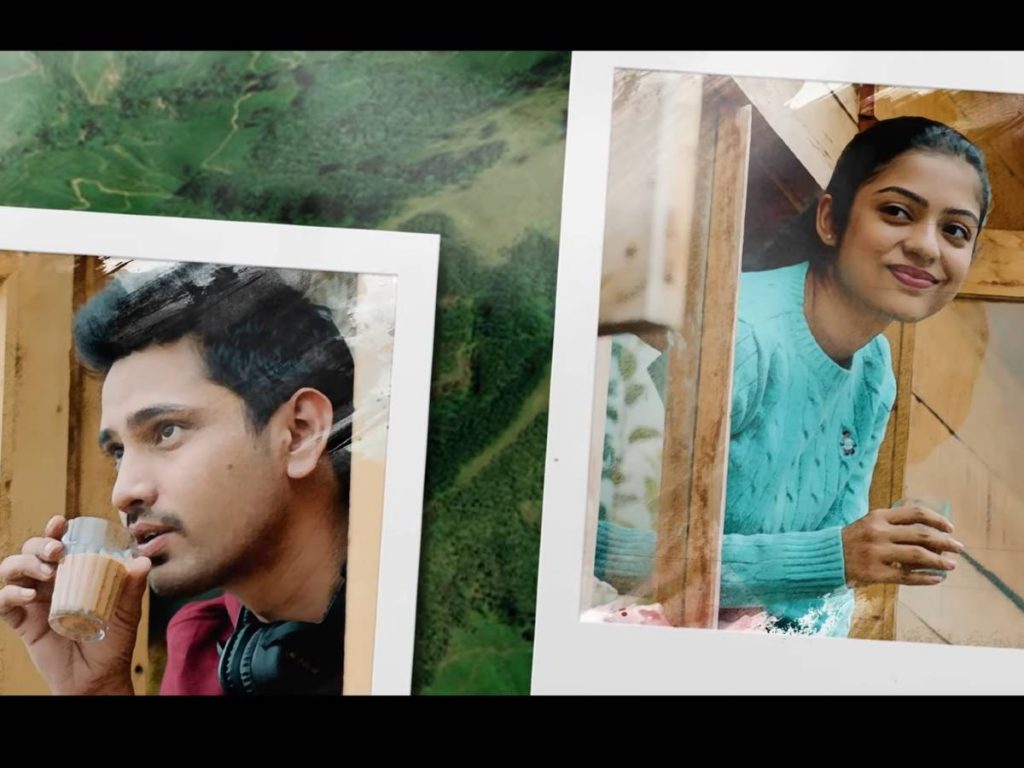
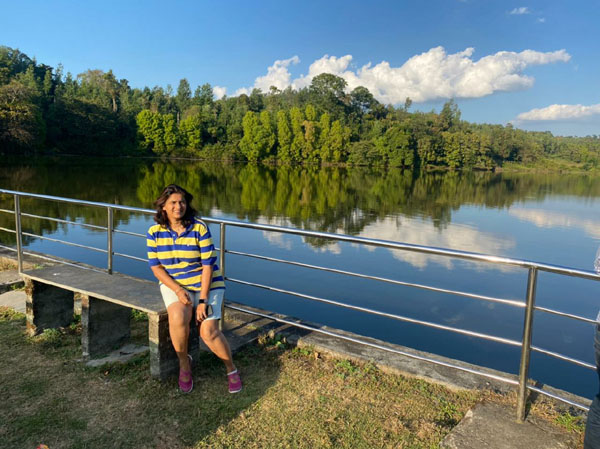
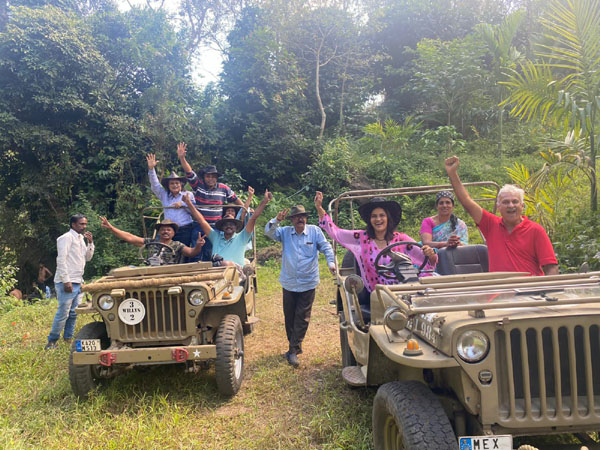
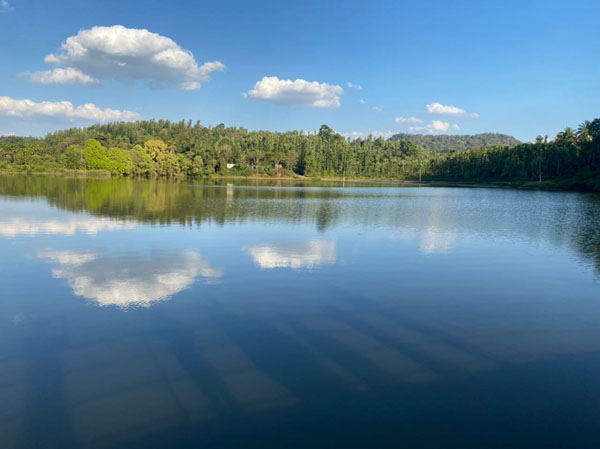
Actress Nidhi Subbaiah enjoyed a quick getaway to Coorg last weekend with her family, saying it was the perfect soul rejuvenation as she got to indulge in her favourite activities and spend time with her loved ones.
“It was my mother’s birthday weekend, so it made this trip all the more special. I decided to drive down from Bengaluru, pick my mother up and head to Coorg.
We went to my aunt’s place, where I spent much of my childhood. So, it was a whole lot of nostalgia. My cousins and I had a good time reminiscing our favourite things. My cousin, who lives in Australia, was back for the first time after the pandemic, so I got to spend time with my niece and nephew too,” she adds.
The outing involved barbeques, hikes, visits to favourite spaces and family bonding. “I had a great time with the kids, as we went around the area. We even spent time recreating old pictures. One of the best things was when the kids and I had a ride on a burrow, which was a lot of fun. I am glad that I could have such a good trip with my family,” shares Nidhi.
source: http://www.timesofindia.indiatimes.com / The Times of India / Home> News> Entertainment> Kannada> Movies / by Sunayana Suresh, TNN / January 24th, 2022
Actress and model Shubra Aiyappa recently got engaged to beau Vishal Sivappa.
The star said ‘Yes’ after a dream proposal in Maldives. Sharing the engagement news with the fans, Shubra Aiyappa shared a cosy picture with her fiancé. The lovebirds are seen sharing some romantic moments in the pool. She captioned the picture, “I said yes to my panda @vishalsivappa.”
Shubra is said to have been dating the Bengaluru-based businessman for some time now and the two have finally taken their relationship to the next level.
Talking about her engagement to The Times of India, the actor revealed, “I am still taking it all in. I cannot believe that we are engaged. Vishal went above and beyond to make it a magical moment that was so special, giving me no clue about what was in store. All I knew was that I was going to the Maldives for a trip. All I knew was that we had a dinner reservation. I wore my favorite outfit, thankfully. He had set up this place on a private beach with candles and a gazebo, where he went down on his knees and asked me if I would marry him. It was beautifully curated and it was an emotional moment for both of us.”
Meanwhile, Shubra Aiyappa will next star alongside Anant Nag in Sanjay Sharma maidan project Thimayya & Thimayya. Produced by Rajesh Sharma, the film went on the floor last October. Thimayya & Thimayya will also have Aindrita Ray featuring alongside Diganth.
source: http://www.pinkvilla.com / Pink Villa / Home> Entertainment> South / by Pinkvilla Desk / January 25th, 2022
The Saudi pavilion at Dubai’s Expo 2020 Dubai on Tuesday launched Saudi Coffee Week, a five-day event to celebrate the country’s coffee culture.
Running until Jan. 29 from 3:00 to 9:00 p.m., the series features daily activities to inspire and educate visitors on the Kingdom’s coffee traditions that form an essential part of its culture.
The event will also host two workshops at Sard Café to help guests learn the art of making Saudi coffee. (Supplied)
This includes showing casing a variety of coffee-making and brewing techniques, as well as tasting experiences.
The event will also host two workshops at Sard Café to help guests learn the art of making Saudi coffee.
The pavilion also features booths from Ethiopia, Colombia, Honduras, Panama, and Australia at the Open Square to familiarize visitors with traditions of other countries.
source: http://www.arabnews.com / Arab News / Home> Lifestyle / January 26th, 2022
“This edifice is believed to be the house of Hombale Nayaka, a close aide of King Dodda Veera Rajendra who once ruled Kodagu kingdom,” said Nagesh Kaluru, a writer.
The outside view of the 18th century edifice near Murnad.
Madikeri :
Three stone pillars with Nandi sculptures on them. This is what is first seen of an age-old edifice in Kathuru village limits in Murnad of Madikeri taluk. Over three centuries old, the building is now covered with scribbles carelessly left by people who did not know better. However, if revived, this edifice will narrate the iconic history of Kodagu and its renowned kings.
The Archaeological Department is currently involved in village surveys across Kodagu to identify and revive historical places. During one such survey in Murnad limits, the 18th-century edifice was located amidst the bountiful coffee estates in the area.
“During the village survey, we were told about this place by the locals,” explained Rekha, curator of Kodagu District Museum. The department with support from the NSS students of Murnad PU College and professor Harish Kiggal cleared the area of dense growing weed and the edifice glowed under the sun.
“This edifice is believed to be the house of Hombale Nayaka, a close aide of King Dodda Veera Rajendra who once ruled Kodagu kingdom,” said Nagesh Kaluru, a writer.
According to historical findings, Homabale Nayaka stayed here during the 18th century along with his family. A close aide of the royal family, he was one of the people who helped the king escape from Tipu Sultan’s prisons in 1788.
The historical edifice was under the care of the Kere Mane family settled in Kathuru. The family has an ancestral connection with Homable Nayaka and the building had been home to many other ancestors from the family.
However, the archeological department has now discovered the historical importance of the edifice. There is though no confirmation from the department about plans to revive it. Other historical monuments in the district including the Madikeri Fort and the Nalknad Palace are already awaiting funds for maintenance.
source: http://www.newindianexpress.com / The New Indian Express / Home> States> Karnataka / by Pragna GR, Express News Service / January 25th, 2022
Actor Raghavendra Rajkumar’s next Sthabda was launched on Monday, and the team has commenced shooting in Bengaluru
Raghavendra Rajkumar, Harshika Poonacha and Prathap Simha.
Actor Raghavendra Rajkumar’s next ‘Sthabda’ was launched on Monday, and the team has commenced shooting in Bengaluru. Laali Raghav, who has previously helmed the Tamil film, Ariyamai, forays into Kannada with ‘Sthabda’.
The film starring Prathap Simha in the lead also marks the first collaboration of Raghavendra Rajkumar and Harshika Poonacha.
“Sthabda is a psychological thriller and deals with illusions,” says Laali.Sthabda, backed by Vidyasagar, has music by Arav Rishi and PVR Swamy for the camerawork.
Veteran music director Hamsalekha will be penning the lyrics for the songs.
Sthabda will also feature Prashant Siddi and Shruti Raj in pivotal roles .
source: http://www.newindianexpress.com / The New Indian Express / Home> Entertainment> Kannada / by Express News Service / January 26th, 2022
Two inscriptions, previously assumed to be in mixed language, contain a unique character set
by Mookonda Nitin Kushalappa, Engineer, Historian, Author and Researcher
In his 1914 revised Coorg Inscriptions volume of the Epigraphy Carnatica book series, B.L. Rice has listed two peculiar 14th century inscriptions. These were deciphered for Rice by Narasimhachar and Krishna Shastri. Many have dismissed the inscriptions to be a mixture of scripts and languages. It beats logic for an inscription to use a mixture of languages rather than a single language itself.
I have managed to separate the characters in the inscription and group them into an alphabet. The alphabet is midway between an intermediate transitional ‘Grantha’ script and the ‘Tulu-Tigalari’ script. It is related to the 14th century Tamil letters. Since the two inscriptions were found in two prominent temples of Kodagu, I would prefer to call the script ‘Thirke’, after the Kodava word for a temple. An online organisation called ‘Indian Roots Polyglots’ calls this “old Kodava script.”
Narasimhachar had noted in the ‘Coorg Inscriptions’ that the 14th century inscriptions’ “characters are a jumble of Grantha, Malayalam, Tamil and a few Vatteluttu. There is no doubt about portions being in Tamil, but other portions are in a language that is neither Malayalam nor Tulu but is related to them. I think the inscriptions are older than 1400 AD. Some of the characters appear to go back to the 11th century.”
Inscription word examples.
Tamil-Kodagu, Tamil-Malayalam
The Kodava language is the descendant of the Tamil-Kodagu branch of the Dravidian language family. Tamil-Kodagu is older than Tamil-Malayalam, the parent of the Malayalam language.
The ‘Brahmi’ script was used all over ancient India. Variants of it were used in South India. There were the ‘Kadamba’ and the ‘Pallava’ scripts, named after ruling dynasties of their ages. The Kadamba script gave rise to the Kannada and the Telugu scripts. The Pallava script gave rise to Tamil and Grantha. These in turn were related to the ‘Vatteluttu’ and the ‘Tulu-Tigalari’ scripts. The ‘Tulu-Tigalari’ script itself is a descendant of the ‘Grantha’ script.
However, neither is the ‘Thirke’ (or old Kodava) script itself modern ‘Tulu-Tigalari’ nor is the language used modern Kodava. The Kodava and the Tamil languages don’t have long consonants, unlike most other Indian languages. But the old Kodava script itself has a few long consonants. We can safely say that the language used is a lost language that was an ancestor of or at least related to the modern Kodava language.
Like in the ‘Tulu-Tigalari’ and other related scripts, some letters in this ‘Thirke’ (old Kodava) alphabet (such as ‘cha’, ‘pa’ and ‘va’) are like each other and may be mistaken for each other. ‘Ta’ and ‘da’ are interchangeable in this script, like in old Malayalam. Hence, ‘Nadu’ is sometimes called ‘Natu’ in the two inscriptions.
Inscription found in Vitla Palace Garden.
Evidence found at Vitla
Meanwhile, in the Palace Garden of the Heggade rulers of Vitla is a stone pot with an inscription. P. Gururaj Bhat had claimed that the script was Tulu and the language Kodava. The script used is not the same as the one used in the two 14th inscriptions of Kodagu. Recently, it has been found that the Vitla Palace inscription actually uses the Malayalam script and language.
The earliest inscriptions found in Kodagu date back to the 9th and 10th centuries and are in Kannada. An 888 AD stone inscription found in Biliyur village mentions a ‘Kadanga’, a defensive earthwork barricade against enemy soldiers and elephants unique to Kodagu and made by the Kodavas.
Thirke alphabet.
Eight householder families
The same inscription, along with a few later ones, mentions the ‘Entu Okkal’ or the eight householder families, who held some power in the region. An ‘Okkal’ is a land-owning agriculturist family. It corresponds to the Kodava word ‘Okka.’ These eight families could correspond to the eight ‘seeme thakkas’ (regional chieftain families) of Kodagu — eight hereditary chieftain families (Kallera, Bollera, Pardanda, Pandira, Mathanda, Buduvanda, Porera and Paruvanda).
The two 14th century inscriptions of Kodagu are dated around 1370-1371 AD. Both state that the king or overlord is ‘Bodharoopa Bhagavar’ who issued the two edicts. The Bhagamandala inscription mentions that the ruler of that ‘nad’ (region) is Melpundi Kunniyarasa. The name Kunniyarasa means ‘little ruler.’
The two inscriptions were found in the Bhagandeshwara Temple of Bhagamandala and the Mahalingeshwara Temple of Palur. Both temples are Shaiva temples. Both the inscriptions begin with the Sanskrit words ‘Svasti Sri’, which mean ‘Be it well’. This is similar in meaning to the term ‘Baalo’ with which most Kodava folk songs begin.
Combination syllables.
Edicts of Bhagamandala and Palur
The Bhagamandala edict goes as follows. On a Friday, when Jupiter was in Virgo, during the month of Scorpio, the Bhagamandala inscription is created. A penalty is stated for stopping the daily expenses. Even the ruler Kunniyarasa is not spared of this penalty. Curses are placed upon those who don’t pay for the daily expenses of the temple. Even if the king doesn’t punish one who doesn’t pay, he is to be cursed by the people. The ‘arm-bearing thousands’ (soldiers) of the 18 regions and merchants are to protect the temple. Blessings are pronounced upon the ascetics and the king. A mention of a copper plate and a treasury register (both of which went missing over the centuries) is also made.
The Palur edict begins with a prayer to Vinayaka (Ganesh) and Saraswathi.
‘Bodharoopa’ is mentioned to be the disciple of a particular guru and to have made the stone inscription to the Mahadeva (Shiva) of Palayur. A curse is pronounced upon those who don’t pay for the daily expenses. The edict is made for the Srivaishnava, the merchants, the arm-bearing thousands, and the Brahmans of the 18 regions who may see and maintain it. The merchants will read out loudly the daily expenses once a year and check the temple accounts. This edict is unsigned, unlike the Bhagamandala one.
Srivaishnava was a general South Indian term for people who rendered services to a temple, such as guarding it, being the torchbearer (like the Mukkati families in Kodagu), managing its festive activities (like the ‘deva thakka’ families in Kodagu), etc.
Palayur and Vaganda
Palur is called ‘Palayur’ while Bhagamandala is also called ‘Bhaganda Ashrama’ and ‘Vaganda’ in the two inscriptions. The Bhagamandala inscription has been signed as ‘Pakandala Ayari elattu’ (the writing of the Bhagandalaya Achari). ‘Pakandala’ and ‘Bhagandalaya’ are other names for Bhagamandala. The modern Kodava word for writing is ‘elt’, which could have arisen from the word ‘elattu.’
‘Achari’ is a name used by priests and members of the Vishwakarma community. People of the Vishwakarma community served as metal, stone and woodworkers such as carpenters, smiths and stonemasons. Usually, a carpenter or a foreman was called an Achari.
It is interesting to note that Kodagu has a community of Kodava speaking smiths called the ‘Airi.’ The word ‘Ayari’ seems to indicate that the word ‘Airi’ arose from the term ‘Achari.’ Hence, the title ‘Pakandala Ayari’ could simply mean, the ‘Airi from Bhagamandala.’
[mookonda.kushalappa@gmail.com]
source: http://www.starofmysore.com / Star of Mysore / Home> Feature Articles / January 24th, 2022
There are two basic forms of writing. One is prose and another verse. Prose is used in speaking and writing, distinct from verse. Prose follows a basic grammatical structure. In verse, poetry, there is compromise on grammar and even use of words and phrases. It is called poetic liberty. It follows a metrical structure.
With this, brief, succinct introduction to prose and verse, let me take on a book that landed on my desk for review and critique. The title of the book ‘A Place Apart – Poems From Kodagu,’ is alluring. It is originally written in Kodava language, a dialect, using Kannada script. The author, a junior college lecturer in Kodagu and a Kodava by race.
Much thought and labour seem to have gone into the writing and production of this book which carries both translation from Kodava language (written in Kannada script) into English and a transliteration where Roman script (english alphabets) is used to write the original poem, just as Kannada is used in the first part of the book that contains 21 poems.
The translation and transliteration are by Kaveri Ponnapa, the famous author of the book ‘The Vanishing Kodavas,’ a magnum opus of a pictorial, research-based book on Kodava people, their heritage, culture and a dismal future. She has a Master’s Degree in Social Anthropology from London. Naturally, the book acquires its importance because of the quality of the translation and transliteration that enables the reader to understand the sound and pronunciation of the spoken Kodava language.
She has indeed played the role of James Boswell to Dr. Samuel Johnson, the english lexicographer, so to say. Of course, Boswell made Johnson more famous by writing a masterpiece of a biography of the latter. Let it be. But here, the book of 21 selected Kodava poems written by B.P. Appanna and rendered into english by Kaveri Ponnapa, seems like serendipity for B.P. Appanna in getting a scholar of Kaveri Ponnapa’s stature to select his works for this book in english. For me those poems, described elsewhere as ‘deceptively simple poems’ did not seem to portray, as claimed, ‘the sense of dislocation and erosion of identity’ of Kodava people at all. This was the subject of Kaveri Ponnapa’s book ‘The Vanishing Kodavas.’ Here it is a poetic narration of Kodagu’s natural beauty — the deep verdant valley, the cloud kissing peaks of mountain ranges, dark forests, wildlife — almost like a prose sans soul, emotion, without igniting imagination in the reader.
Even so, this book will surely expose the author and the translator to the world outside Kodagu ignorant of Kodagu and Kodavas, a land and its people with distinctive geography and culture.
Kodava language, the dialect, has its vocabulary limited to that of the hunter-gatherer of the early ages related to agriculture, hunting and skirmishes. Naturally, a Kodava writer or a poet has to express himself using these limited vocabulary only. To overcome this handicap, perforce he has to borrow words from another language, here Kannada. Which is why, for example, in one poem where he should have used the pure Kodava word ‘Batte’ for road, he has used the word ‘Marga’, road in Kannada. May be for the purpose of alliteration in the stanza.
The transliteration section of the book is a testimony to Kaveri Ponnapa’s patience, tenacity and dedication to her work. It is a transliteration of the Kodava poems (written in Kannada script) using Roman, with a Kodava-english key to reading them. It offers an opportunity to those who do not know Kannada but know english to approach the sound and sense of Kodava language.
According to Kaveri Ponnapa, Romanisation like this will offer a practical opportunity to keep the language alive by reaching out to maximum number of speakers. Indeed, very true. As she further avers, “If we are looking at a way to taking endangered languages into the future, we need more speakers (and also readers).”
Here is her final word to those who tried to develop a new script for Kodava language, including the well-known Kodava author I.M. Muthanna. She says: “Languages like Kodava Takk do not need new scripts, they need more accessible scripts that open them up to a greater number of speakers or readers.”
We read in ‘Alice in Wonderland’, ‘What is a book without pictures’ and ‘A picture is worth a thousand words.’ Fortunately, for the reader of this book, there is much consolation and compensation when he sees those water-colour illustrations of people, places and artefacts of Kodagu the land, by artist Rupesh Nanaiah. Wish they were in colour. They speak about the subject of the book more eloquently than all those words.
I also wish Kaveri Ponnapa had chosen for this book some poems from other Kodava poets also.
There are some brilliant poems written by non-Kodavas about Kodagu and Kodavas like Panje Mangesh Rao, for example. A Kodava Sanyasi of Ramakrishna Ashram Swami Shambhavananda, I.M. Muthanna and others too have written about the people, flora and fauna of Kodagu that evoke nostalgia among the old and the diaspora.
Anyway, A Place Apart is a significant contribution to the Kodava community and its literature. The book must adorn every Kodava household and also the libraries of every Kodava Samaja. To purchase the book, contact: Dushyant on WhatsApp 99009-99994 or place your order at: https://www.coorg.com/kaveri.
e-mail: voice@starofmysore.com
source: http://www.starofmysore.com / Star of Mysore / Home> Columns> abracadabra / by K.B. Ganapathy / January 08th, 2022
Varsha Acharya with versatile talent is making her big career in both acting and fashion designing industry at the same time.
Coastal region always known for producing talents and Varsha Acharya is one who manages both professions with ease. In her short span of career, Varsha has grown exponentially with managing multiple roles that can set example for young generations.
Varsha Acharya hails from Kodagu, has done her pre-university at Canara College and fashion designing at Karavali College. Varsha is the daughter of Venkataramana Acharya and Vidyalatha Acharya and has a sibling Vrushab Acharya. Varsha was titled ‘Princess of Malnad’ in a beauty pageant in 2016.
During her fashion designing course at Karavali College, Varsha used to do lots of shoots, designing where the opportunity popped out for Varsha four years ago through Hombanna.
Varsha Acharya was always passionate about designing, illustrations, paintings. Apart from acting Varsha has shown interest towards fashion designing for several occasions. Kannada movie Padavipoorva was the first breakthrough for Varsha to showcase her creativity in fashion designing. Apart from fashion designing, Varsha is playing a key role in the movie Padavipoorva.
Varsha has also designed a main sequence in the movie Abracadabra directed By Shishir in the banner of Paramvah Studios. She is also the designer for an album song as well in a movie starring Pruthvi Ambar And Kushee Ravi, while two projects as an actor is on card. Varsha is delighted to pull of both the professions equally by being an actress and a designer.
Speaking to daijiworld.com about her dual job Varsha Acharya said, “Although they are two different professions, there is quite a bit of overlap but it all comes under how passionate I am about the work I do to manage both the professions equally. Being an actor was always my passion, as I have done my Fashion Designing i love to carry forward that in the industry too as if feel I can put both under the same roof.”
She also says, “Acting is all about fitting into the character and requires more of homework, practice and so on. Perhaps in Fashion Designing we have lot of groundworks, pre-production, try to figure out different looks of the character, fitting them in , figuring out the exact time scales per project for the preparations of the attire, time management, sudden schedule changes, being active, involvement, interest. I love to take challenges. It’s a whole different feeling being in both the professions.
“I will have a clear idea about the costumes once the script is narrated. I always have a word with my directors if they have any particular visually planned ideas, so that I can get an actual output as per the director’s plan, she says.
When asked about managing tight deadlines, Varsha says, “Tight deadlines have always made me feel good, that makes me happy knowing that I am doing good at it. However tight the schedule is, I keep my charm and smile on my face that makes my work even easier.”
source: http://www.daijiworld.com / DaijiWorld.com / Home> Coastal> Cine World / by Daijiworld Media Network – Mangaluru (ANK) / January 05th, 2022
Olympian M.P. Ganesh, who captained the Indian hockey team and was honoured with the Padma Shri by President Ram Nath Kovind, is Coorg Person of the Year-2021.
Mollera Poovaiah Ganesh, hailing from Suntikoppa in Kodagu district, was selected ‘Coorg Person of the Year’ in a poll conducted by www.coorgtourisminfo.com, Kodagu’s first news portal, promoted by journalist and author P.T. Bopanna.
There may not be many such extraordinary instances of a person running away from home to join the Army ending up at the Rashtrapati Bhavan to receive the coveted Padma Shri. Ganesh was also conferred the Arjuna award in 1973.
Ganesh, born on July 8, 1946, was an achiever both on and off the field. Though he ran away from home without informing his parents to join the Army after writing his matriculation examination, Ganesh managed to complete his MA in English, diploma in sports coaching from the National Institute of Sports, Patiala and Ph.D in Physical Education.
Although Ganesh joined the Army to fulfil his childhood dream of becoming a football player, he failed to make it to the football team. Then he went for the hockey selection where he was successful. This goes to prove the adage that “hockey is in the blood of the Kodavas.”
Ganesh represented the Services (Defence Services) in the National Hockey Championships from 1966 to 1973.
After he found a place in the Indian hockey team in 1970, Ganesh played for India at the 1972 Olympic Games in Munich, finishing third. He was one of the coaches of the Indian team that won a gold medal at the 1980 Olympic Games in Moscow.
Ganesh, a right winger, twice represented the country in the Asian Games, first in 1970 in Bangkok and then in 1974 in Tehran. He was in the Indian team that won Bronze at the first World Cup in Barcelona in 1971 and captained the team that won Silver at the next World Cup in Amsterdam in 1973. He also played for World XI in 1972. Ganesh last played for India in 1974, as his career was cut short following a knee injury.
His most disappointing moment probably was during the finals of the World Cup in Amsterdam when India lost to Netherlands in the finals, after missing a penalty stroke.
Ganesh had a long reign as a sports administrator. He served as Director of Sports Authority of India (South) and in 2017 took charge as the High Performance Director and CEO of the National Hockey Academy in Delhi.
He is married to Keethiyanda Prema and their only son Ayyappa passed away when he was 20 years old due to a rare medical condition.
P. Shrividya Somanna, who helped Ganesh to put together his autobiography ‘Living The Dream: My Autobiography’ told this reporter that Ganesh’s wife Prema was instrumental in motivating him to pursue his higher education.
source: http://www.starofmysore.com / Star of Mysore / Home> News / January 01st, 2022
‘A Luxury Called Health’, written by a doctor who is also a novelist, needs to be not only read but also discussed.
Kavery Nambisan. / Modified from screenshot via YouTube / Author TV
What do you get as a reader when a writer of fiction, and also a surgeon who has worked closely in both the public as well as private health sector, picks up her pen to write on the state of the health system in the country?
The answer is easy: you get a book that lays bare the fact that the health of the citizens of a nation is an investment, that the health system is a part of nation building and effective governance and that it is time to learn from mistakes that have been made and continue to be made.
You get a book that comes from years of working amidst the dust and the grime of government health care set-ups, from having observed the profit-oriented approach of the private sector. A book that offers quiet hope that things can, and must, improve.
What’s wrong…
Kavery Nambisan’s first work of non fiction, A Luxury Called Health: A Doctor’s Journey Through the Art, the Science and the Trickery of Medicine, is exactly what its title says, with little drama or exaggeration. It is an honest examination of this thing called healthcare, of the systems that are working and not working, of the people who are its faces and, at times, because of whom, healthcare turns into what it should be: effective, affordable and something that can be trusted by everyone.
A passage from Fyodor Dostoevsky’s The Brothers Karamazov, where a doctor examines a terminally ill patient in a very poor home, that features in the introduction is an apt reminder of what happens when the poor try to access healthcare: the hope and despair felt by the patient’s loved ones and the disdain that the doctor projects. It sets the tone for what follows in the subsequent chapters.
Later, Nambisan conveys how patients and their families often put doctors and healthcare staff on the pedestal of demigods and do not try to find out about the nitty gritty of how illnesses are treated. This makes them resort to threats and abuse when things do not go as they should.
From the early traditional medical practices to the first steps taken in India to institute a medical institution to train and educate health-workers and medical staff, the author puts the focus on how the poor health of individuals affects the overall well-being of a nation. She takes readers into the time the seeds of a new nation were being sown and, along with them, the hopes and aspirations that went to building the health care system. It was a task made more difficult by entrenched caste practices, such as those of not even touching corpses, leave alone dissecting them as medical students.
Nambisan’s note of appreciation for the first wave coming from Kerala when it was still a profession that had few takers soon after Independence is a reminder of how far the health care system has come. But, as she shows with anecdotes and analysis, with this has come disparities between the public and the private sphere when it comes to health.
… And what’s right
What works for this book is that it stays clear of rhetoric or the blame game. Instead, it injects humaneness through personal insights while making a point on how the health system is interconnected to nutrition, poverty, hygiene, water, and sanitation. Nambisan makes the point that urban development ends with more buildings but little attention to, among other things, waste and rainwater management and water resources, which in turn, affects the health system. She emphasises that treating medical situations on a case by case basis, without a holistic strategy for improving health, leads to little progress.
Thankfully, none of these heavy-duty issues weigh down the book and for that we have the quality of her writing to be thankful to. Perhaps only a writer of fiction used to the economy of words would have been able to cover such complex matters in a little over 300 pages. There are no appendices with tables and data, for the author speaks from her own long years of practice, with quiet, unwavering authority.
The use of anecdotes from the history of medical practices across the world and in India, peppered with the author’s own experiences, makes the book come alive in a way that is informative as well as thought-provoking. In one chapter that details the list of medical procedures in a health set-up, Nambisan admits how easy it is to treat patients as mere technicalities, and that it takes a lot to probe further or ask questions of a supervisor or senior colleague.
There is little of handwringing or giving into hopelessness, even when the book details corruption and political apathy, as well as greed. In a chapter titled “Doctoring Reality”, the author highlights rural initiatives started by medical practitioners who have given up lucrative placements to set up affordable and accessible services. It makes you wonder why we don’t see many of these inspiring stories in the mainstream media.
Towards the end the author takes readers into her personal space, as a spouse having to play part- bystander and caregiver when her husband, the acclaimed poet Vijay Nambisan, is diagnosed with cancer.
Kavery Nambisan’s voice is gentle but firm, with words of caution about how critical it is to listen to the voices on the ground, the doctors who work in remote areas with poor resources. For they are the ones whose intervention saves lives, instead of following protocols laid down by international organisations like the WHO, especially in the wake of the Covid-19 pandemic.
A Luxury Called Health is an important book, one that needs to be read and discussed. It exposes the failings of the medical system in the country over the years, but it also shines a light on the people who mend worn-out bodies and organs, bringing hope and succour.
Chitra Ahanthem is former editor of Imphal Free Press, a newspaper published in Manipur. She is also a Manipuri-to-English translator.
A Luxury Called Health: A Doctor’s Journey Through the Art, the Science and the Trickery of Medicine, Kavery Nambisan, Speaking Tiger Books.
source: http://www.scroll.in / Scroll.in / Home> Book Review / by Chitra Ahanthem / December 19th, 2021
WELCOME. If you like what you see "SUBSCRIBE via EMAIL" to receive FREE regular UPDATES.
Read More »