Dubare Elephant Camp to open from Sept. 15 with restrictions
Kushalnagar:
Many tourist destinations in Kodagu were thrown open on Sept. 1 after months of COVID-induced closure but the public response remained tepid. The District Administration is preparing to open all tourist spots from Sept. 15 and stakeholders are expecting a surge in the number of visitors.
Although most of the tourist spots in the lush green and hilly district of Kodagu, which were shut down due to the outbreak of COVID-19 pandemic in March, reopened on Sept. 1 after the State Government announced new relaxations a day earlier, some of the tourist spots coming under the control of Forest Department have remained closed.
These tourist spots included Dubare Elephant Camp, Mallalli Falls in Somwarpet taluk, Irupu Falls in Virajpet taluk, trekking and expedition spots including Thadiyandamol and the famed Mandalpatti have not reopened as a precautionary and safety measure. These spots are most likely to open on Sept. 15.
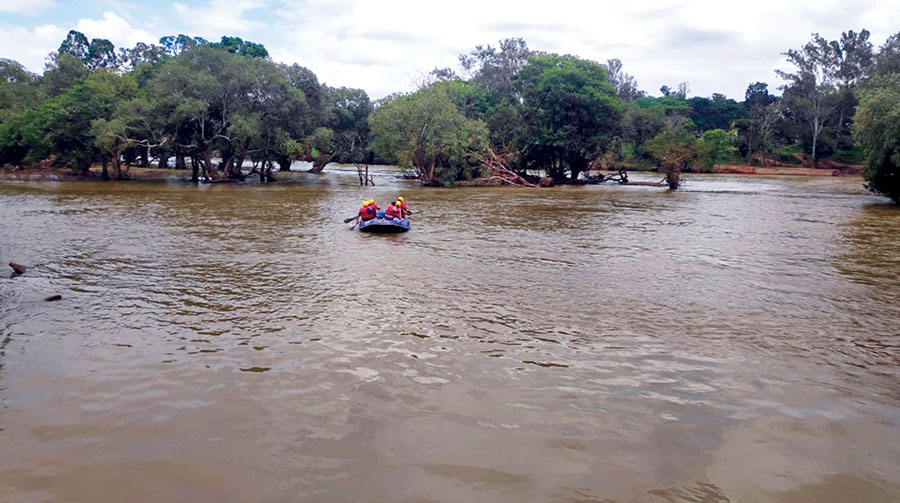
Rafting at Dubare will not be permitted as of now.
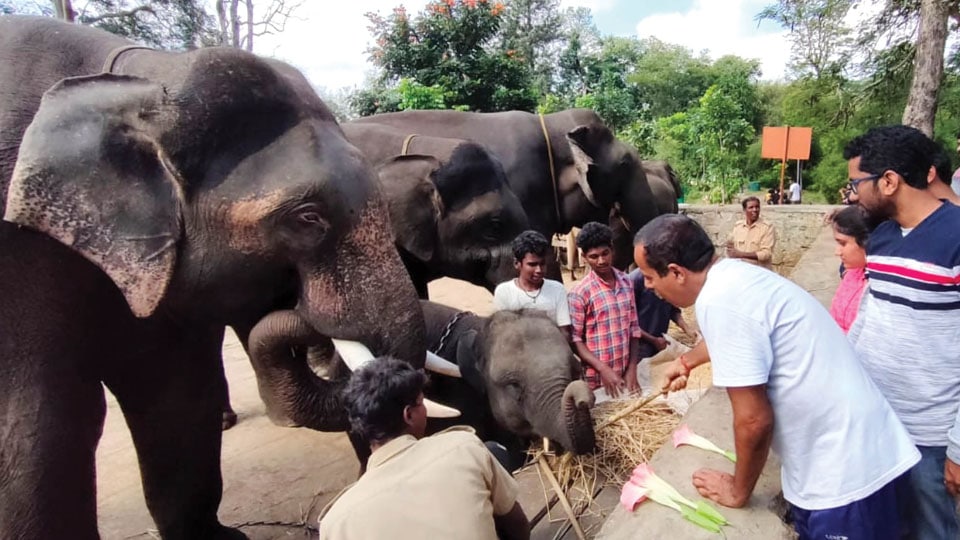
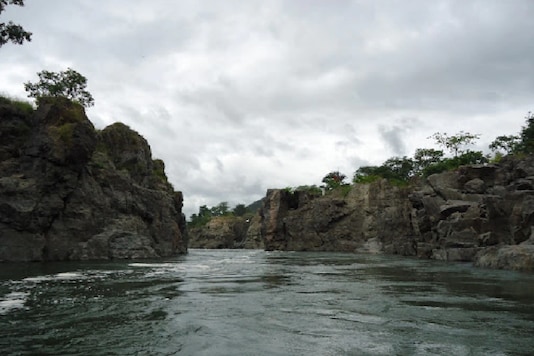
Among the places that are popular is Dubare Elephant Camp where tourists can see and experience tamed elephants in close quarters and take a look at the life of an elephant and its mahout and kavadi in a day. Also, the place is famous for White Water River Rafting. The Forest Department, however, is now constructing barricades in the wake of COVID pandemic to separate elephant enclosures from the tourists.
Earlier at Dubare, one could touch and feed the elephants and this was a popular activity for almost all the tourists, especially children. But henceforth, this activity will not be allowed and there will be a six-foot distance between elephants and tourists.
Rafting at Dubare has not been permitted along with boating activities at Cauvery Nisargadhama in Kushalnagar as at present, the water currents are strong and it is dangerous to raft or pedal a boat. These activities are likely to be open from November, said Forest Department officials. At present, barricading works are being undertaken at Dubare.
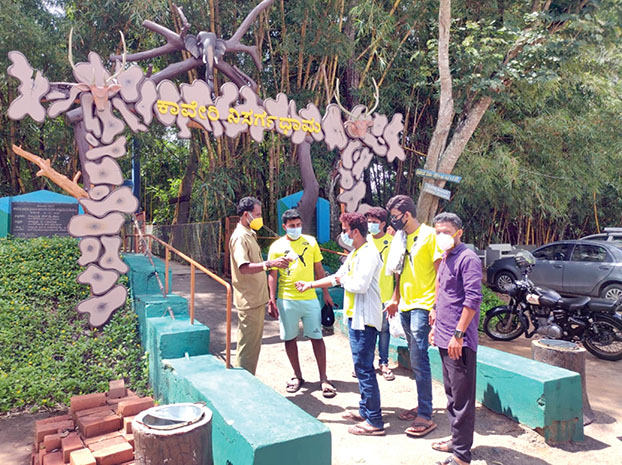
Visitors being thermal-screened before they enter Cauvery Nisargadhama at Kushalnagar
The tourist spots which opened on Sept. 1 included Abbe Falls, Raja’s Seat, Chikklihole Dam, Kanive Aqueduct and Cauvery Nisargadhama.
Nisargadhama, a beautiful 64-acre island near Kushalnagar on the Mysuru-Madikeri Highway, has been renovated and beautified by the Forest Department. The nature park, surrounded by River Cauvery, is an ideal weekend getaway for those who yearn to be amidst nature, far from the madding crowd.
However, visitors are not allowed to touch any animal at the Deer Park which has been completely fenced as a COVID-19 safety measure.
Nisargadhama recorded a footfall of 150 visitors on the first day of reopening on Sept.1 with all COVID-19 safety measures such as thermal screening, wearing of facemask and use of hand sanitisers. Besides, all sit outs and other seating spots are sanitised every day in accordance with the protocol.
Kushalnagar Range Deputy Range Forest Officer Vilas told Star of Mysore that they were expecting an increase in the number of tourists in the coming days. This apart, the tourist destination is likely to witness a good number of visitors on weekends and the Forest Department, which manages the tourist spot, is mulling on allowing visitors in batches if the crowd gets bigger. However, pedal boating is disallowed for now and the Department may allow its resumption only in November after getting permission from the Government, he added.
Raghavendra, Assistant Director of Tourism, Kodagu, said that all tourist spots, including the ones controlled by the Forest and Tourism Departments, will re-open from Sept. 15.
The Department has put all COVID-19 precautions in place at all tourist spots and centres, he said.
However, there will be no rafting for now at Dubare Elephant Camp and the visitors have to maintain a safe distance from the pachyderms, he added.
Golden Temple at Bylakuppeto remain closed till Oct. 26
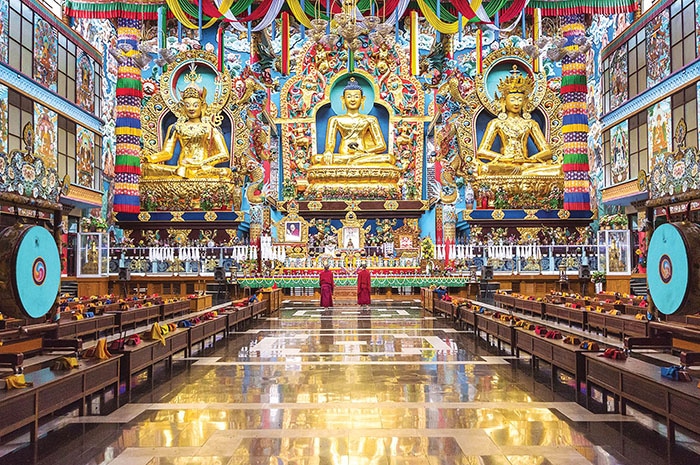
The famous Namdroling Monastery — commonly called the Golden Temple — located inside Tibetan Camp at Bylakuppe on Mysuru-Madikeri Highway will remain shut for visitors till Oct. 26.
The Temple, a popular tourist spot close to the border of Mysuru-Kodagu district near Kushalnagar, was closed for visitors following the nationwide COVID-19-induced lockdown in March.
The temple will remain closed till Oct. 26 as a precautionary measure and no outsiders will be allowed entry into the Temple, according to Lobon, General Secretary of Namdroling Monastery, who manages the Buddhist Temple.
source: http://www.starofmysore.com / Star of Mysore / Home> Coronavirus Update, News / September 07th, 2020
Ex-Sergeant Deranna Gowda, who handed over a pistol to A.B. Devayya, shares his experience
Madikeri:
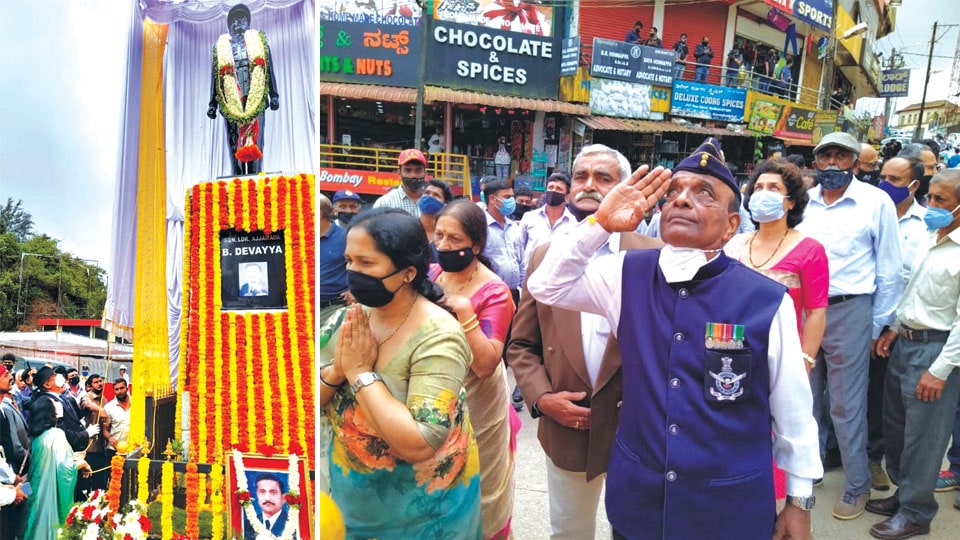
The bronze statue of Squadron Leader Ajjamada Bopayya Devayya was unveiled at Madikeri in Kodagu district this morning. The 6-feet-9-inch statue has been installed at the Old Private Bus Stand Circle and was unveiled by Air Marshal (Retd.) Kodandera C. Nanda Cariappa today, the day Devayya was martyred 55 years ago. The Circle will henceforth be officially called Squadron Leader Ajjamada B. Devayya Circle.
Squadron Leader A.B. Devayya is the only Indian Air Force (IAF) Officer to be posthumously awarded the Maha Vir Chakra (MVC). During the 1965 India-Pakistan War, Devayya (called ‘Wings of Fire’) was part of a strike mission (on the Pakistani Airbase Sargodha). During the war, Devayya shot down a US-made PAF (Pakistan Air Force) F-104 Starfighter on Sept. 7, 1965 while flying an inferior Mystere of French make.
The bronze statue weighs 600 kg and Rs. 20 lakh has been spent on getting the statue carved at Kengeri near Bengaluru. Devayya’s wife Sundari and daughter Preeth were present during the statue inauguration this morning. Also, ex-Sergeant Deranna Gowda from Sullia, a retired Non-Commissioned Officer, who was present when Devayya was seen off on Sept. 7, 1965 before Devayya took off to the skies, was among the dignitaries.
Sharing his experiences, ex-Sergeant Deranna Gowda said, “When Fourth Pakistani Air Force started bombarding the Jalandhar Air Base, Devayya came to the Armoury to collect his weapons to fight the enemy, I handed him a pistol and strapped the weapon around him. Kudupaje Bhojappa was also present. Later, Devayya sat on Mystere aircraft and took off to the skies.”
Addressing the gathering, Air Marshal Nanda Cariappa, who himself is a war veteran and son of Field Marshal K. M. Cariappa, said that it was a matter of pride for Kodagu as Squadron Leader A.B. Devayya and Major Puttichanda Somaiah Ganapathy (later promoted as Lieutenant Colonel) received the honour of Maha Vir Chakra, next only to the supreme Defence award Param Vir Chakra.
While Devayya received the honour for shooting down a Pakistani plane and martyring for the cause of the Nation, Puttichanda Ganapathy was awarded Maha Vir Chakra for his combat role in 1987 Operation Pawan in Sri Lanka (launched by Indian Peace Keeping Force) against the LTTE.
MLC Veena Achaiah, Kodagu Deputy Commissioner Annies Kanmani Joy, Superintendent of Police Kshama Mishra, Field Marshal K.M. Cariappa and General Thimayya Forum President Col. (Retd.) Kandrathanda Subbaiah, Convener Major (Retd.) Biddanda Nanjappa, Kodava Makkada Koota President Bollajira Aiyappa, Ajjamada family President Ajjamada Lava Kushalappa, Squadron Leader Ajjamada Devayya Memorial Trust members and President of Mysuru-based VeKare Ex-Servicemen Trust Mandetira N. Subramani were present on the occasion.
source: http://www.starofmysore.com / Star of Mysore / Home> News / September 07th, 2020
Frayed Lines, directed by Kannada film director, Priya Belliappa, won the best short film award in the Karnataka competition section of the 10th edition of the Bengaluru International Short Film Festival (BISFF).
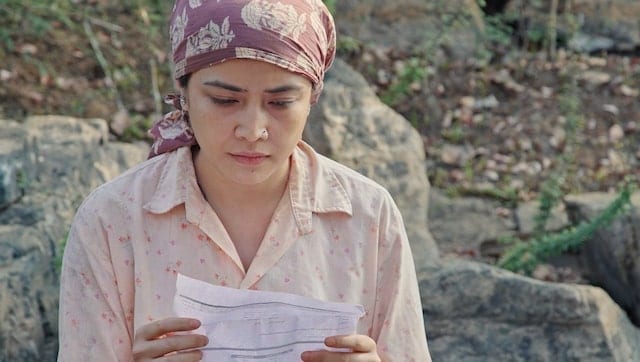
Tabu, an Assamese migrant worker, who has journeyed 2,000 km to work on a Coorg coffee plantation, frets that she has no documents to prove her citizenship back home. “I don’t even know the identity of my parents, where will I get a birth certificate?” she asks herself bitterly, worried that she may be forced to leave her country.
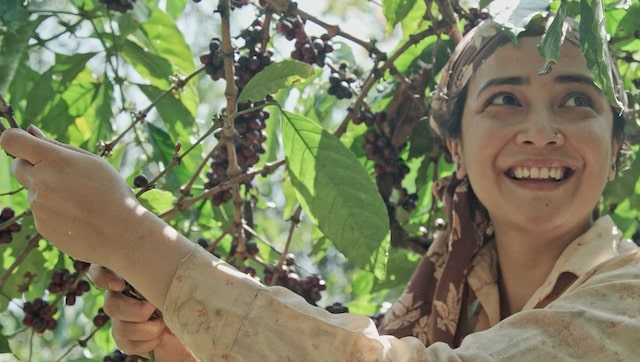
A young Kadappa, who has a PhD and comes from a poor Kodava (as people from Coorg are known) family, prefers to work on a coffee plantation plucking coffee seeds, earning Rs 700 a day rather than getting a job in the big city.
These two characters who don’t speak a common language strike up a silent ‘connection’ and set off on a journey to migrate to the city. This is the crux of the multi-layered, nuanced short film, Frayed Lines, directed by Kannada film director, Priya Belliappa that won the best short film award in the Karnataka competition section of the 10th edition of the Bengaluru International Short Film Festival (BISFF). “It was an obvious choice,” said Anand Varadaraj, festival director, who adds that the festival entries got more traction this year.
This Oscar Academy accredited film fest, held completely online for the first time, had nearly 6,500 viewers who had logged in to watch the 150 films streaming on their website. (as compared to the 1,000 registrations for their offline event last year).
In a conversation with Firstpost, Frayed Lines director, Priya Belliappa too admits that she was surprised by the ‘amazing response’ she had received from the four-day online fest as opposed to a theatre screening, which would be limited to a geographical location.
“It is also not a straight-forward narrative but still people understood the film’s premise, the silences and spaces and connected with it,” remarks the director, who made her debut in Kannada cinema with a commercial movie, Ring Road, based on a high-profile crime involving a young law student, Shubha Shankarnarayan, who was found guilty of masterminding the murder of her fiancée.
Frayed Lines, which is a slice-of-life movie, was shot in early 2019 much before the contentious National Register of Citizens (NRC) had become a national conversation. While researching for her film, Beliappa had met Assamese migrants who felt helpless without proper documents and she wanted to capture that ‘helplessness’.
The character of the troubled Assamese migrant worker, portrayed brilliantly by talented actress Gitanjali Thapa, reflects on her surreal situation with these words: ‘In these uncertain times of blurred and broken lines, strange is the land that you don’t belong. Stranger that I have lived within these boundaries all my life.’
Gitanjali Thapa in a still from Frayed Lines
According to Belliappa, her film however is not a direct comment on the ‘complex’ issue of the NRC. “I just wanted to tell the story of people who don’t have official documents for various reasons. I wanted to explore their emotional state of mind as they grapple with being suddenly told they don’t belong in their own country.”
Belliappa had stumbled upon the subject when she was exploring the coffee estates on a visit to her hometown Coorg, after she had completed her first feature film. She had built up a visual diary of people working on a coffee plantation and found enough material to make a film. The film also draws attention to the language dilemma migrant workers face in the coffee plantations, where people largely converse in Kodava takk.
The short film effectively captures the local flavor of a Coorg coffee plantation with real labourers working beside the two protagonists, which includes Kannada actor, Avinash Mudappa. For that reason, it is a ‘fiction immersed in reality’, explains Belliappa, who expects to take the story of the same couple in Frayed Lines forward when she makes her feature film.
The short film gave her the opportunity to explore the subject in all its dimensions. “Shorts give you creative freedom but unfortunately are not recognised in India like in Europe. Slowly, however that is changing with more festivals and more experimentation in the digital medium,” says Belliappa, who is comfortable in any format as long as she is wielding the camera.
Belliappa, who has a background in design and has beenan art director for O&M in Sri Lanka made a career switch mid-way after enrolling herself in FTII in Pune in 2003. Incidentally, Belliappa’s diploma film, Hazy Grey Skies, which has been screened in international fests, including the Karlovy Vary, featured actors like Nawazuddin Siddiqui and Pataal Lok protagonist Jaideep Ahlawat. The film is about a monsoon-drenched day in the life of a Mumbai taxi driver, played by Siddiqui.
Belliappa is a film-maker who loves to challenge convention and age-old prejudices. She is an admirer of British comic actress Phoebe Waller-Bridge and her series Fleabag. “I love the way she is able to say the unpleasant without squirming. Her characters are flawed but she shows them for who they are. I want to be able to break down my prejudices and freely explore negative dimensions of a person without restraint,” says Belliappa, who is further inspired by Waller-Bridge’s brilliant writing and for breaking the glass ceiling barriers in Hollywood. She is one of the co-writers for the latest James Bond film, No Time to Die. (Waller was brought in by actor Daniel Craig to liven up the script) “Women in Hollywood too are fighting for their space in a male-dominated industry,” she points out wryly.
Back in 2015, Belliappa too defied convention in south Indian cinema and roped in an all-women crew to make her film, Ring Road. It didn’t take her long to realise that she was the only woman on set while working as an associate director in a Kannada film, I am Sorry Mathe Banni Preethisona, which went on to win state awards.
“This effort started a conversation in a male-dominated industry. Many people would drop by our set to comment on how well the crew was managing the set,” she says, adding the rider that it is however talent and hard work that matters and not gender.
source: http://www.firstpost.com / FirstPost.com / Home> Entertainment News / by Kavitha Shanmugam / September 06th, 2020
An outburst of saxophone flurries sits you straight up in your chair. The tone is rich but with a cutting edge.
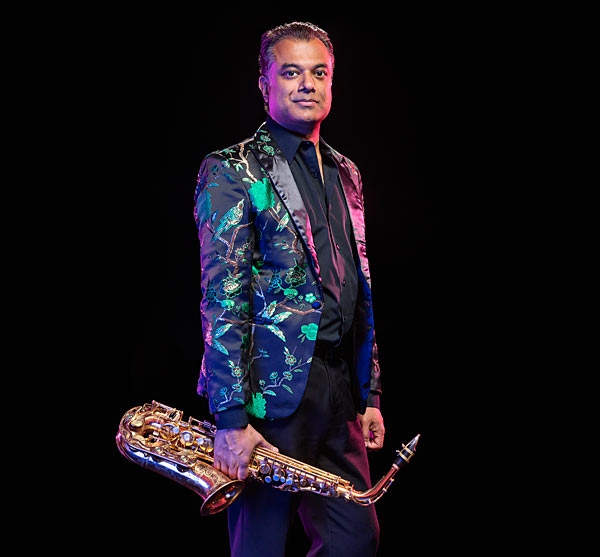
It has to be Rudresh Mahanthappa. The riveting cry of his alto saxophone is one of the most recognizable sounds in jazz.
But those darting runs coalesce into Charlie Parker’s “Red Cross.” So it can’t be Mahanthappa, can it? He has made 15 straight albums of original music. He doesn’t do covers, right?
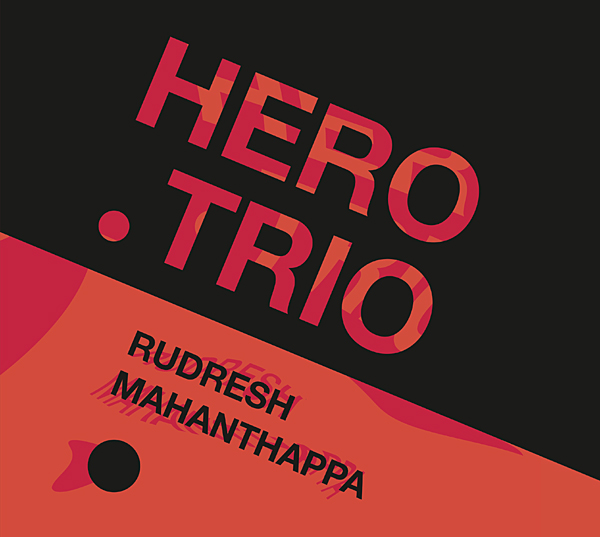
On his 16th recording, Hero Trio, Mahanthappa breaks through to the past—his and ours. He proudly proclaims Parker’s bebop—but then “Red Cross” flies apart, into free showers of 16th notes. It is startling to hear Mahanthappa playing songs you know, even lilting ones like Stevie Wonder’s “Overjoyed” and time-honored standards like “I Can’t Get Started.” Of course, his versions do not stay lilting or standard for long. By the sixth track, you’re ready for anything—except “Ring of Fire.” Rudresh Mahanthappa doing a Johnny Cash song? There must be a story there.
The story begins in Colorado—specifically, Boulder. Mahanthappa’s father is a noted theoretical physicist who came to the United States from India to get a Ph.D. at Harvard and stayed in the American academic world, settling at the University of Colorado. The school’s website says that K. T. Mahanthappa is “interested in grand unification theories, fermion mixing and masses including charge fermions and neutrinos.” His son Rudresh shares a proclivity for the intellectually challenging and the arcane, but in 16th notes, not neutrinos. (There are two more sons in this high-achieving family, both with Ph.D.s in the sciences.)
Mahanthappa grew up in Boulder, listening to people like Stevie Wonder. He started on alto saxophone in the fourth grade. He matriculated at the University of North Texas in 1988, right after it changed its name from North Texas State. The school had a reputation for turning out notable jazz musicians. Billy Harper, Lyle Mays, Bob Belden, and David Weiss went there. So did Norah Jones, briefly. (So did Meat Loaf, briefly, though presumably not in the jazz program.) Snarky Puppy started there.
Mahanthappa was not happy at North Texas. He says, “For me it was an uncreative place. There was kind of one way of doing things. And as a brown person in Texas, I never felt comfortable.” After two years, he transferred to Berklee College of Music in Boston, a school even better known for turning out notable jazz musicians. “I had always wanted to study with Joe Viola, who was one of the great American master teachers of the saxophone. Berklee was more the vibe I needed.”
When he took his degree in 1992, he did not, like so many Berklee graduates, relocate immediately to New York City. “I wanted to go to a big city that wasn’t New York, and Chicago was a place you could play a lot.” He entered a master’s program at DePaul University. By 1997, he was ready to make the move. “I always said I wanted to play with Dave Holland and Jack DeJohnette someday, and that was never going to happen if I stayed in Chicago. In the mid-’90s, you had to be in New York.”
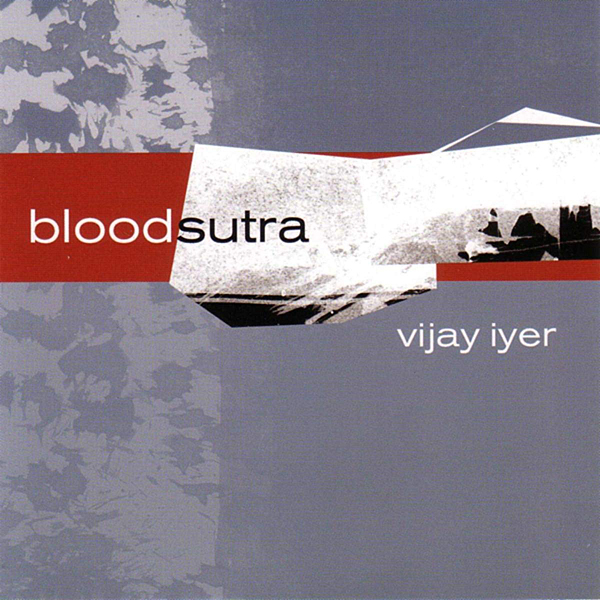
Mahanthappa hit the jazz radar not long after arriving in town, when he joined forces with pianist Vijay Iyer. They began gigging and making records, some led by Iyer (Blood Sutra on Pi Recordings; Panoptic Modes, reissued on Pi), some led by Mahanthappa (Mother Tongue, Pi), some co-led (Raw Materials, Savoy). Today, Mahanthappa and Iyer are two of the most respected, most decorated musicians in jazz.
They dominate the critics’ polls in the alto saxophone and piano categories, respectively, and most years appear at or near the top of categories like “musician of the year” and “album of the year.”
Back at the turn of the millennium, though, they were up-and-coming players who were unusual for two reasons: There were few Indian-American jazz musicians, and they played strange stuff. Iyer is an autodidact who has always had his own percussive, polyrhythmic piano language. As for Mahanthappa, when you listen to his early recordings now, he already sounds like no one else. He already has that sublime alto saxophone shriek. His art is already dizzying in its diversity, juxtaposing melodicism and dissonance, formal focus and freedom. In his playing, you hear intimations of many moments in saxophone history, from primary sources (Coltrane, Coleman), to footnotes (Jimmy Lyons, Sonny Simmons). You also hear lyricism in beautiful new jagged shapes.
All the unfamiliar sonorities led many listeners, including critics, to assume that Mahanthappa and Iyer were bringing Indian influences into their jazz. “Not so much,” Mahanthappa says. “I knew very little about Indian music at that time. When I was a kid, my mother sometimes played bhajans on Sunday mornings. They were like Hindu hymns. She had this stack of 45s. But that was it. When I became a musician, I mostly ran the other way. I got tired of people expecting me to be an expert on Indian music.”
But a revelation occurred while he was at Berklee. He went to India to play with a Berklee student band at Jazz Yatra, a festival that no longer exists. “It was my first time in India in over 10 years, my first time going as an adult, without my parents. And I was going there to play music. It was a lot to deal with. I was terrified. I was confronting head-on all these questions: ‘How Indian are you? How American are you?’ It was a mindfuck. Then I went to an all-night event in Bangalore. There is a tradition in India of concerts that go all night, ’til dawn. What I heard blew me away. It was unbelievable. I found out later that some of the greats of Indian classical music had performed that night, both Hindustani and Carnatic. I went to record stores the next day and bought as many cassettes and CDs as I could carry. And that’s about all I listened to for a couple of years.”
When Mahanthappa made the recordings with Iyer in the early 2000s, he was not yet ready to incorporate Indian elements into his work: “I kept thinking, ‘How do you put these things together and still maintain reverence and integrity?’ Because I knew that Indian symbolism and iconography had mostly been engaged very superficially in jazz. For a jazz group to bring in a tabla player did not automatically result in a cross-cultural collaboration. I knew I wanted to create something that didn’t sound like cut-and-paste. If I was going to deal with Indian rhythms or Indian melodic content, it had to be integrated.”
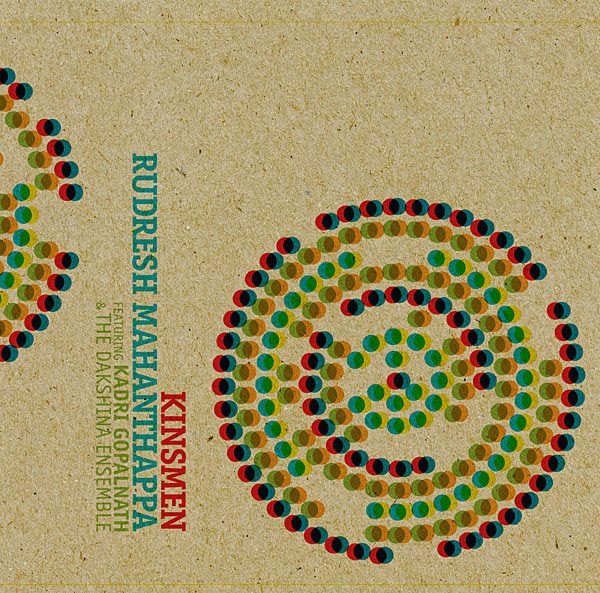
The turning point came in 2005, when he again traveled to India, this time to Chennai, on a commission. He spent time with Kadri Gopalnath, who played Mahanthappa’s instrument, the alto saxophone, but in a style that was decidedly non-Western. Gopalnath employed microtones derived from the Carnatic music of southern India. After Mahanthappa made another trip to India on a Guggenheim grant, he felt ready to record with Indian musicians. The result was Kinsmen, his collaboration with Gopalnath, released on Pi in 2008 to widespread astonishment and praise. Two dissimilar musical cultures, both prioritizing improvisation and energy, meet and commingle organically. Mahanthappa visits ragas and quarter tones, and Gopalnath visits bebop and the blues. They whip all these ingredients into wild eight- and four-bar exchanges and wailing, extended joint ventures.
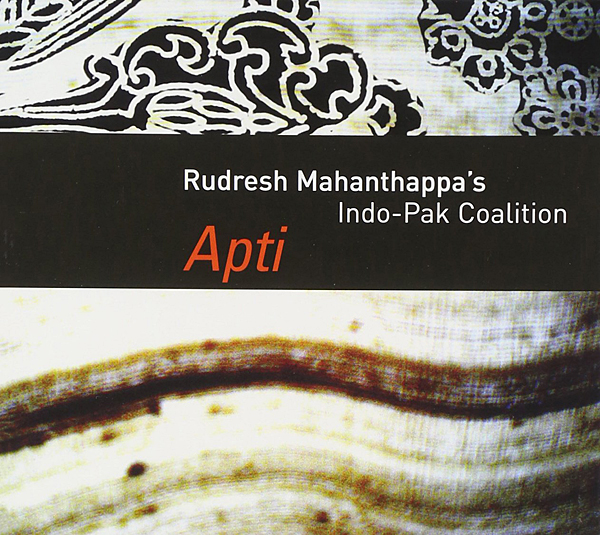
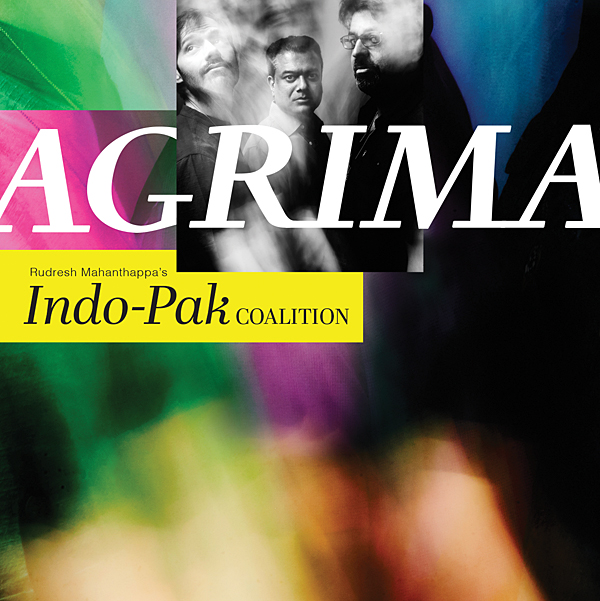
Kinsmen was important, but it was a one-off project. Around the same time, Mahanthappa formed another ensemble that drew deeply on his Indian heritage, a trio that continues to the present day. Indo-Pak Coalition is two Americans with roots in the Indian subcontinent (Mahanthappa and guitarist Rez Abbasi, born in Pakistan), and a third American, Dan Weiss, who studied for 20 years with tabla master Pandit Samir Chatterjee. Their album Apti (Innova, 2009) expanded upon the cross-cultural explorations of Kinsmen. (They released a second album, Agrima, in 2017, available as a digital download or double LP from Mahanthappa’s website (rudreshm.com) and from HDtracks.com.)
was American Songbook standards and the pop music of his youth. He says, “There was a part of me that always wanted to record standards. But when I was younger, I guess I had a certain agenda, certain ideas and energies that I wanted to get out there in the world. I didn’t want to be just one more saxophone player doing ‘Now’s the Time’ [Charlie Parker’s bebop classic]. I felt like I had a perspective that would not come across effectively if I played ‘I’ll Remember April.'”
It took Mahanthappa a long time to record with Indian musicians, and it took him even longer to record “I’ll Remember April.” But there it is, the seventh track on Hero Trio. When you hear it now, it is unclear why he had once feared that such a song would not allow his “perspective” to “come across effectively.” The perspective on “I’ll Remember April” is radical and personal. It opens with a commanding bass announcement from Franáois Moutin and violent drum detonations from Rudy Royston. Then Mahanthappa fires quick blasts that soon run together into long spilling arcs. It is a rush when Gene de Paul’s time-honored melody clarifies out of abstraction. Mahanthappa hits “I’ll Remember April” hard then spins off it for free, blistering runs, then returns to the song with fervent embellishments.
In our present jazz era, it is common for albums, especially those by younger musicians, to contain all or mostly all originals. But skilled players far outnumber gifted composers. Mahanthappa analyzes the problem this way: “A lot of new players today are coming out of academic settings. There is a kind of unspoken checklist of things you’re supposed to do. One is compose. Everyone puts ‘composer’ in their title now.” Mahanthappa’s exclusive preference for recording original music was understandable in his first 15 albums. He was defending a unique aesthetic position, and he was an accomplished composer. But Hero Trio opens new vistas. It turns out that “I’ll Remember April” does not limit jazz creativity. The opposite is true: The song provides a base pattern embedded within Mahanthappa’s own vast design. He can glance off the form, using it as a touchpoint, a known frame of reference, one resonant with historical associations.
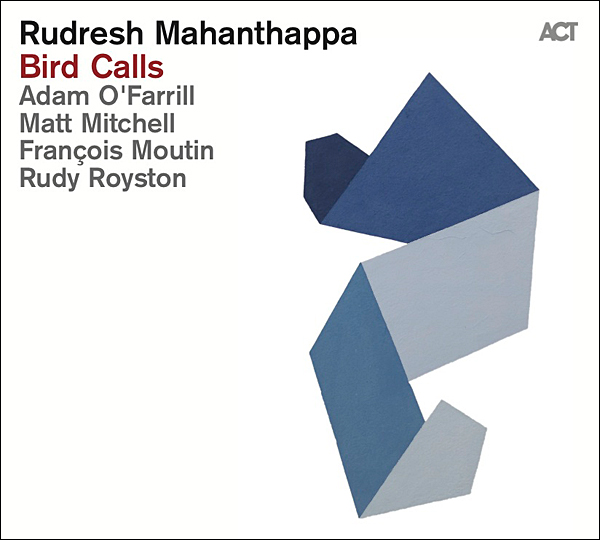
The other covers (if “covers” is the term for such unbridled acts) also lead to inspirations of memory. “Ring of Fire,” with a new beat in the third measure, is the most surprising choice, but Mahanthappa says Johnny Cash was vital to his childhood. Charlie Parker was vital from his adolescence onward. He made a widely praised Parker tribute in 2015, Bird Calls, on the ACT label, but at that time he was still committed to recording his own material. Bird Calls has music motivated by, not composed by, Parker. The decision to record three Bird tunes on Hero Trio is significant. (Besides “Red Cross,” the others are “Barbados” and “Dewey Square.”) Mahanthappa burns these iconic themes into the air then repurposes them in his own vivid timbre and energy. Perhaps the piece that is most literally a cover is Ornette Coleman’s great lament, “Sadness.” Mahanthappa’s version is faithful, concise, and passionate.
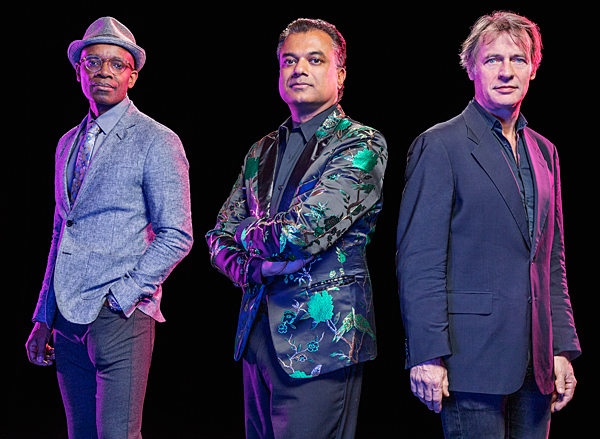
Mahanthappa has played with Moutin in various settings for more than 20 years. His association with Royston goes back to 1991, in Colorado. But until the new album, they had never played together as a trio. The saxophone trio with bass and drums is one of the foundational formats in jazz. Trios led by Sonny Rollins, Ornette Coleman, Joe Henderson, Joe Lovano (and, more recently, J.D. Allen) are important examples. Mahanthappa, with a few brief, minor exceptions, has bypassed the format—until now.
Moutin and Royston are extraordinary on Hero Trio. Their aggression establishes drama, even before Mahanthappa enters. Moutin reminds you of David Izenzon with Ornette Coleman. Izenzon was the first bassist who proved that it was not only okay, it was levitational, for a bassist to play so many notes, to become a semi-autonomous whirlwind of energy within a jazz ensemble. Mahanthappa says, “I always wanted to make a classic saxophone trio record. And I always wanted to make an album of music that was not my own. I realized that now was the time, for both. François and Rudy and I are so connected. Anything you play with them sounds fresh.”
He explains how, in live performance, the three of them developed a system of cues: “I play a melodic figure that cues a particular bass line, a certain groove. And the idea is that we can vibe on that for a while and then I’ll start playing a tune, a standard, and everybody will kind of fall in. Then I’ll cue another bass line. Let’s say I have six or seven of these cues. You can play a whole set of standards that are bridged together by these grooves. It works really well live. It’s very organized but it sounds sort of stream-of-consciousness. It puts an original light on standards. The challenge with this album was, ‘How do you capture that spontaneous thing that happens live on a studio recording, a five-minute track?'”
“I Can’t Get Started” shows how the trio meets this challenge. A quick melodic flourish from Mahanthappa, repeated twice, indeed cues a groove, an ominous, slow ostinato from Moutin. Then Mahanthappa floats in over the groove. He is playing the alto saxophone, but the sound comes from so far east of Boulder that he might be playing the double-reed shehnai of India. His wavering, hypnotic lines suggest distant ancient ceremonies and processionals. A song by Ira Gershwin and Vernon Duke is transformed. The transformation could only be imagined by someone who grew up in the presence of the American Songbook, was sent on a mission by Charlie Parker, ventured outside of Parker, then returned to where he started, on a passage that included a stop at an all-night concert in Bangalore.
“I Can’t Get Started” is the closing of a circle. Ideally, it would have been a live album. (Surprisingly, Mahanthappa has never made one.) He says, “The original plan was to play a club somewhere for maybe four nights and record everything and then figure out what the record should be.” For various practical and logistical reasons, the plan was abandoned. Hero Trio was recorded by engineer David Amlen at Sound on Sound Studios in Montclair, New Jersey, within long walking distance of Mahanthappa’s home. The upside (as is often the case when weighing the pros and cons of live vs studio recordings) is the sound. Sonically, the album is dynamic and visceral. You are close enough to Mahanthappa’s alto saxophone to reach out and touch it. The mix by Liberty Ellman brings the bass and drums far forward—appropriate given the centrality of Moutin and Royston to this trio’s impact.
You can’t talk to a jazz musician in mid-2020 without inquiring about how the global pandemic has affected their life and work. Mahanthappa says, “This was supposed to be a big touring year for me. I had some major stuff lined up, including a long tour with a project for the Charlie Parker centennial.” (It involved an all-star band co-led with Terri Lyne Carrington and was called “Fly Higher: Charlie Parker @ 100.”) “Of course, everything got cancelled. But I’m doing okay. I’ve been teaching at Princeton for four years now, so I’m less dependent on income from touring. My wife is a therapist, and she has been able to do that from home, by Zoom or whatever. Her field is actually one that ramps up in times like these. I’m more concerned for all my good friends and colleagues who rely mostly on performing. I’m glad that a lot of organizations have mobilized to help.”
When told that many musicians report an unprecedented availability of practice time while sheltering in place, he speculates, “They must not have young children.” (He has a son and a daughter, ages 7 and 4.)
“I imagine the trio will probably do a bunch of touring to support the new album in 2021.” We can only hope.
source: http://www.stereophile.com / Stereophile / Home> Music and Recording Features / by Thomas Conrad / September 04th, 2020
Tasked with curating the India episode of ‘Gordon Ramsay: Uncharted’, Anurag Mallick & Priya Ganapathy wondered what food adventures could they dish out to a
Gordon Ramsay is no stranger to India. In his 2010 series Gordon’s Great Escape, he learnt Lucknowi biryani, Rajasthani khud gosht, Bastar’s chapda chutney to blood sausages in Nagaland. In South India, he tried sattvik fare and cooked on a houseboat in Kumarakom. For Uncharted, Gordon would undertake a culinary adventure in remote parts of the world learning food secrets from emerging chefs and locals, ending in a Big Cook with his take on the region’s cuisine.
The Season 2 of the series would take him to Tasmania, South Africa, Louisiana, Guyana, West Sumatra, Norway and one wondered how India would match up. We drove via Coorg to Kannur in mid-October last year on a weeklong recce. The Mapilas, Kerala’s second-largest community, are known for their unique cuisine. But Uncharted went beyond the food to the source with emphasis on foraging.
Though kakka irachi (fried clams) is a kallu shaap (toddy shop) favourite, Valiyaparamba backwaters where women dove in shallow riverbeds for the elambakka (clams) was too far north. Kannur’s legendary thattukadas (food stalls) serve typical Malabari snacks like pazham pori (banana fritters) and ari kaduka — green mussels stuffed with rice dough. At Ezhara Beach, local fishermen rued the late monsoon’s effect on the sea’s salinity and the reduced spawning of the kallumakai (green mussels).They ventured on a two-hour boat ride to rocks mid-sea for a sizeable catch, holding their breaths for 4-5 minutes in each dive. Too dangerous and time-consuming!
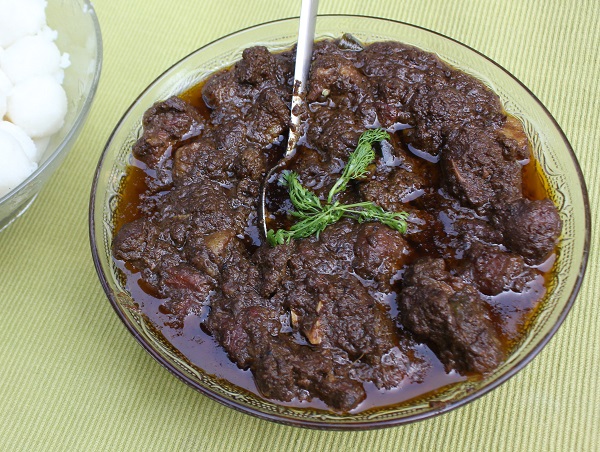
Coorg Pandi curry
Our friends Nasir and Rosie acquainted us with some local fishermen. The best kallumakai came from Thottada and none knew these waters better than 70-year-old Moiuddin or Moidu ka. His group used the caravela or dragnet technique — two men waded in to spread out a wide net that the crew dragged in an arc to dredge the catch ashore. Moidu ran an eatery in Bengaluru before he settled for a quiet life by the sea. “Those were wild days when he was “Yeshwantpur ka Don,” his vivacious wife Shakila teased the mellowed Moidu, clearly showing who was boss now! He humoured her by baring his battle-scarred body — reminders of drunken brawls at his eatery. We told them about a crazy British chef who would learn the ropes from him —perhaps Shakila could teach him a fish curry? On the itinerary was a kachhkada serving fruit pickled in brine and chilli. Just the spice test Gordon needed (though he never made it to the kachh, a fiery red tamarind chutney used as a topping.)
In Coorg, we were early to harvest honey with the Jenu Kurubas. Monsoon-centric activities like hunting for bemble (bamboo shoot), kumme (mushrooms), kembu (colocasia) and termay (fiddlehead fern) or collecting ripe Garcinia fruits to make kachampuli, Coorg’s signature black vinegar, was out. Seasonality dictated our choices and we couldn’t ask Gordon to come back in the rains! Coorg’s legendary pandi (pork) curry was on the menu but didn’t really have a foraging or adventure angle. Besides coffee, bitter limes would be in season, so we opted for chutta kaipuli pajji — the smoky flavoured chutney made with roasted bitter lime and Kodagu’s delicious kumbla (pumpkin) curry.
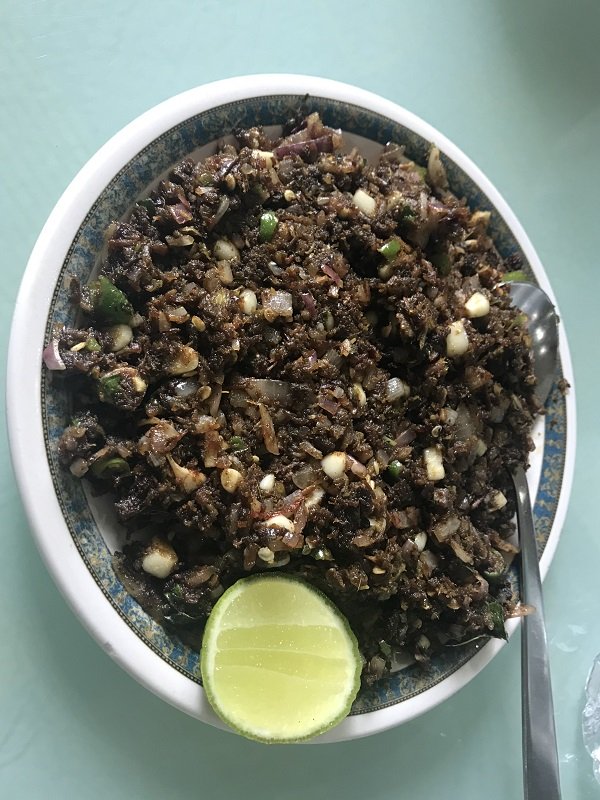
Vonekk Yerchi or smoked pork
On the pre-shoot scout in mid-November, the production team unanimously chose Coorg as the Big Cook locale. The network zeroed in on Chef Sri Bala from Chennai, an authority on ancient Chola cuisine and Kerala local Harish. The India shoot was sandwiched between Indonesia and Guyana.
Come coffee picking season, estate workers are beset by ant nests. Enter chigli (Weaver Ant) chutney, a dish not native to the Kodavas but consumed by the Gowda community from neighbouring Malnad. He dubbed his attempt to catch the ant nest ‘the funniest TikTok dance ever’. Pavithra from Mudigere helped us make the chutney in a grindstone. Eventually, chigli chutney was the ace up Gordon’s sleeve though he didn’t bargain for the ants in his pants! At the Big Cook, the graceful Kodava ladies fearlessly critiqued his pandi curry. “Less kachampuli, more spice… ’cos we are all spicy ladies,” they chimed in. Ramsay promised to return with his mum. The latest in the grapevine is that he plans to open a restaurant in Kerala! Wouldn’t that be a coup?
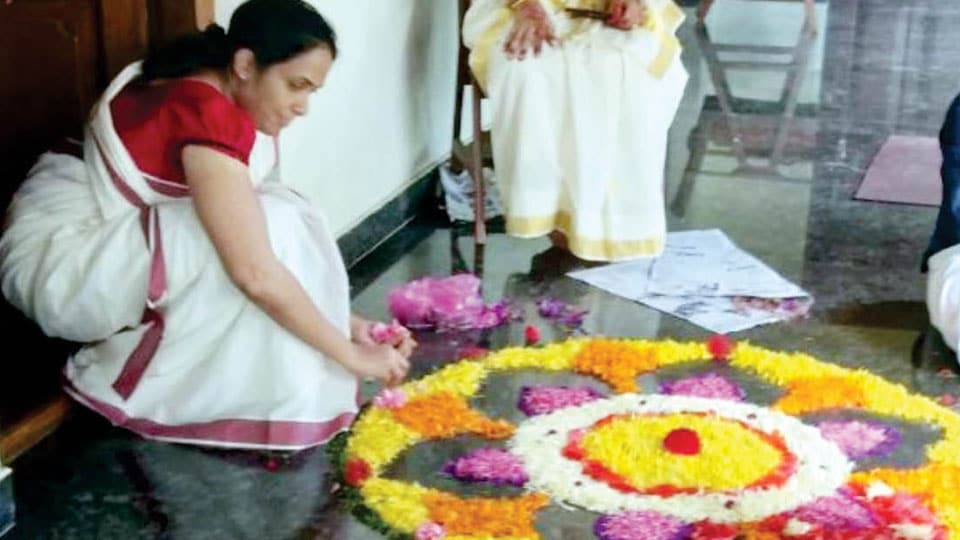
IAS Officer Annies Kanmani Joy, a native of Kerala, who is serving as the Deputy Commissioner (DC) of Kodagu district in Karnataka for the past two years, celebrated Onam, the harvest festival of her native State, at the DC Bungalow in Madikeri, Kodagu.
The DC, attired in traditional costume, is seen making Pookalam (‘poov’ meaning flower and ‘kalam’ means colour sketches — floral rangoli) in the portico of her house this morning as part of the celebrations.
source: http://www.starofmysore.com / Star of Mysore / Home> Photo News / August 31st, 2020
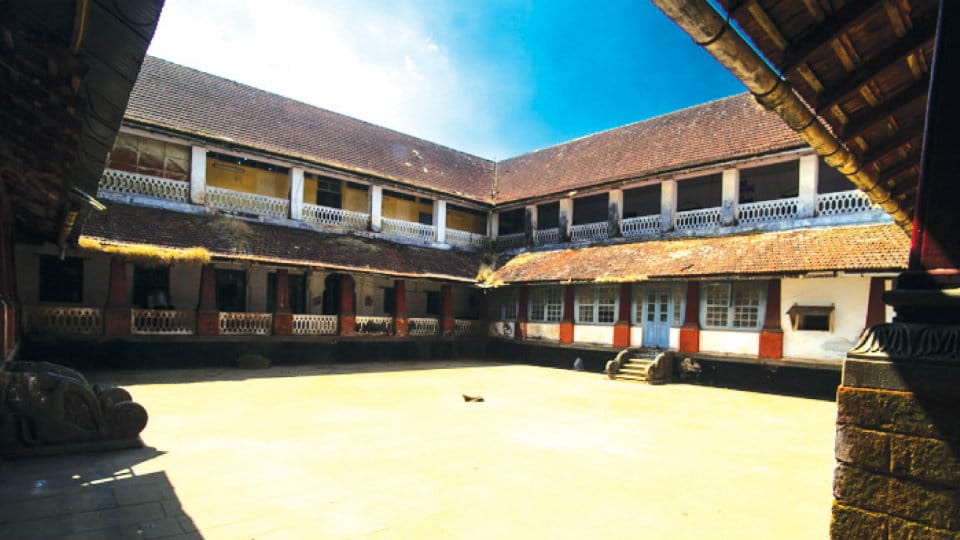
In a significant judgement regarding restoration work of monuments at Madikeri in Kodagu district, the Karnataka High Court on Monday directed the Archaeological Survey of India (ASI) to take up permanent restoration work of the ancient Fort, Palace premises and tombs (Gadduge) of Kodagu Kings at Madikeri town, the district headquarters of Kodagu, while also asking it not to levy service charge to the State Government for carrying out the work.
A Division Bench of the High Court, comprising Chief Justice Abhay Shreeniwas Oka and Justice Ashok S. Kinagi, which heard a PIL filed by J.S. Virupakshaiah, a retired IAS Officer and a resident of Kodlipet in Somwarpet taluk in Kodagu district in 2017, directed the Kodagu Deputy Commissioner to nominate an officer not below the rank of Assistant Commissioner to frequently visit the site of the monuments.
Instructing the officer to be designated to take up the issue with ASI if he/ she finds that the work is not carried out as per the DPR (Detailed Project Report), the bench also directed that the Assistant Commissioner shall submit a report as regards the status of the emergency work and also the status of major restoration or repair works.
Observing that it is a great deal of importance that the said work is carried out efficiently, properly and expeditiously as it is the duty of the ASI to ensure that the protected monuments are restored and maintained, the HC Bench directed the ASI to complete all emergency works within Oct. 14, 2020.
On the service charge issue, the Court directed the ASI, which had contemplated a 23.7 percent service charge on the State Government, not to levy the service charge for carrying out the restoration or repair work.
Noting that there is no justification at all for the ASI to levy service charge to the State Government, the Bench held that the ASI is not empowered and also not entitled to collect service charge from the State Govt.
The petitioner J.S. Virupakshaiah, in his PIL (Public Interest Litigation), had contended that instead of preserving the protected monuments, the State Government had been running its offices on the Palace premises.
However, during the course of the PIL hearing, the District Administration vacated the offices of Social Welfare Department, Land Records Department and District Library from the ancient Palace premises and had handed over the premises to ASI.
Also, following directions of the Court from time to time, the State Government has released Rs.10.76 crore for permanent works as per the DPR.
source: http://www.starofmysore.com / Star of Mysore / Home> News / August 26th, 2020
The management of Kodava Samaja, Mysuru, has decided not to hold the annual get-together function of Kailpoldh Festival-2020 in view of COVID-19 pandemic and has decided to convene the Annual General Body Meeting (AGM) of 2019-20 on Dec. 20, 2020, according to a press release from the Kodava Samaja Hon. Secretary M.M. Ponnappa.
source: http://www.starofmysore.com / Star of Mysore / Home> In Briefs / August 28th, 2020
Every year, lakhs of devotees visit Talacauvery and Bhagamandala to offer prayers to goddess Cauvery. (News18 Kannada)
The Deputy Commissioner of Kodagu, Anees Kanmani Joy has informed the Kodavas that she would discuss their demand at the highest level and would try to find a solution at the earliest.
The recent torrential rains and landslide resulted in the deaths of the chief priest and his family members at Talacauvery, the birthplace of river Cauvery. The Brahmin priest Narayana Achar, his wife and three other family members perished in a huge landslide, last week.
Now, the Kodava community, the natives of the hilly district, have demanded that the state government should return priestly duties to them from the Brahmins. Locals fear that if this issue is not dealt with carefully, it might lead to a legal battle which could take on a political colour.
Every year, lakhs of devotees visit Talacauvery and Bhagamandala to offer prayers to goddess Cauvery. Amma Kodavas, a priestly class among the Kodavas have made an official request to the Deputy Commissioner of the district in this regard.
According to them, the pooja and all other associated rituals at Talacauvery were handled by Amma Kodavas for centuries and the Brahmins had no role in Kodava religious traditions and rituals. About 150 years ago, after the annexation of princely state of Kodagu or Coorg by the British in mid-19th century, the priestly jobs were transferred to the Brahmins from the neighbouring Mysore kingdom.
Since then, the Brahmins have been conducting all religious activities at Talacauvery, which is a holy place for the Kodavas and other communities. According to Amma Kodava community leader Bananda N Prathyu, their community had transferred the rights of worship to Brahmins due to certain reasons. However, they argue that there are hundreds of historical records to prove their claims that Amma Kodavas have an ancient connection with river Cauvery and its origins.
“We are the original inhabitants of Kodagu district. We are nature worshippers. Cauvery is our goddess. We have the first right to worship at Talacauvery and Igguthappa temple”, he said.
After the tragic death of priest Narayana Achar and his wife, their two daughters who live in Australia, rushed back home to perform their parents’ last rites.
According to a report in the Kannada daily Vijayavani, when the local government officials issued a compensation in their names, they informed them that they are no longer Hindus and have converted to Christianity. This revelation has now created a furore among the devotees of Cauvery. Since the deceased priest was a leader of the Vishwa Hindu Parishat (VHP), this has now taken a political colour with opposition parties questioning BJP’s commitment to Hinduism.
The priest’s daughters have declined to comment on the conversion and have gone incommunicado. Local Tahasildar has confirmed that their given names and names on record don’t match.
The Deputy Commissioner of Kodagu, Anees Kanmani Joy has informed the Kodavas that she would discuss their demand at the highest level and would try to find a solution at the earliest.
However, some fringe groups are opposing the handing over of the temple to Kodavas, by calling it a violation of old tradition. Kodagu, Karnataka’s tiny district is known as the coffee bowl of India. With its deep forests, rivers, waterfalls and hills, Kodagu is also known as the Scotland of Karnataka.
It was ruled by the Lingayat Kings from the Haleri dynasty till 1830s. The last King Chikka Veera Rajendra was a despot and the British exploited the resentment among his subjects to annex Kodagu with British India. The deposed King was sent to Vellore in Tamil Nadu and later Benares, now Varanasi, to keep him away from his subjects.
Hoping to get his Kingdom back, Chikka Veera Rajendra travelled to England to lobby with Queen Victoria and the British Parliament. After his efforts to secure the Kingdom failed, a dejected King died in London and was buried there. His granddaughter Victoria Gowramma, whose only son died in the First World War, breathed her last in London in 1930s ending the line of succession.
The British ruled Coorg/Kodagu as a separate state for over a century till 1947. It was a separate state with an Assembly till 1956. In 1956, Kodagu was merged with Karnataka State. The martial race of Kodavas have produced two of India’s best Army Chiefs Field Marshal KM Cariappa and General KS Thimmaya. They have their own language Kodava Thakk.
source: http://www.news18.com / News18 India / Home> News18> India / by DP Satish / August 26th, 2020
Berera Shambhu Aiyanna (73), former President of Bengaluru Kodava Samaja, a social worker and a resident of Vidyranyapura in Bengaluru, passed away early this morning at his residence.
He leaves behind his wife and two sons. Cremation was held this afternoon at Bengaluru.
source: http://www.starofmysore.com / Star of Mysore / Home> Obituary / August 18th, 2020
WELCOME. If you like what you see "SUBSCRIBE via EMAIL" to receive FREE regular UPDATES.
Read More »