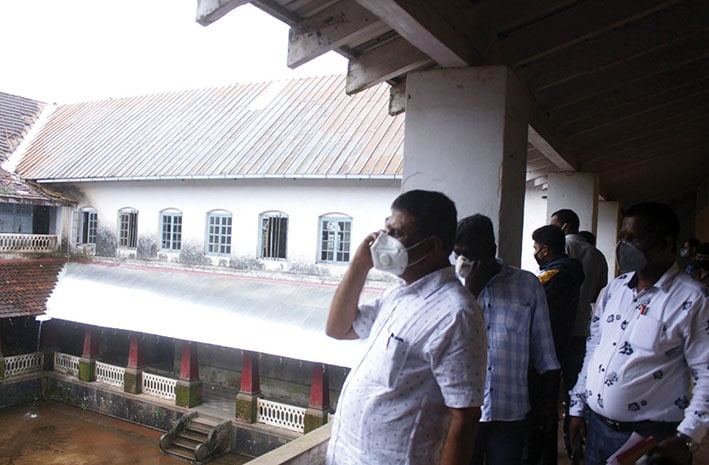
Madikeri Akashavani in its ‘Krishi Ranga’ programme on July 15 at 6.55 pm, will feature ‘Pondman’ Kamegowda, who recently hit the headlines after PM Narendra Modi made a reference to him in his monthly ‘Mann Ki Baat’ programme on All India Radio (AIR) last month.
source: http://www.starofmysore.com / Star of Mysore / Home> In Briefs / July 14th, 2020
Theatre personality Prakash Belawadi to direct the play based on acclaimed author’s popular novel
Mysore/Mysuru:
Saraswathi Samman recipient and acclaimed Kannada novelist Dr. S.L. Bhyrappa will soon catch the imagination of theatre lovers as his novels will be adapted into plays at theatre repertoire Rangayana.
Though the novelist’s works have been translated into English and many regional languages, Rangayana had not so far experimented on them as there was a prejudice that Bhyrappa is a right-wing writer. Though art and literature transcends the boundaries of caste, creed, sex, personal prejudices and religion and one cannot brand a writer as right wing, left wing or neutral, Dr. Bhyrappa was an anathema to many theatre activists, artistes and people who were in the forefront of theatre in Mysuru.
Dr. Bhyrappa hails from Mysuru and despite this, Mysuru’s Rangayana never thought of adapting his novels as plays to reach the mass audience. Now with Addanda C. Cariappa as the Rangayana Director, things are moving in the right direction without any bias, vested interests or prejudice. Bhyrappa’s novel ‘Parva’ will be adapted into a play and work has begun in this regard.
Rangayana has the distinction of bringing Kuvempu’s ‘Sri Ramayana Darshanam’ and ‘Malegalalli Madumagalu’ into theatre and both the plays received tremendous response. Rangayana artistes said that this ‘Parva’ adaptation is an ambitious project and the nitty-gritty of the project has begun with the artistes examining the finer details in the novel.
After the first show at Rangayana, ‘Parva’ will be staged across the State including places like Shivamogga, Dharwad, Kalaburagi, Chikkamagalur, Hubballi, Udupi, Chitradurga, Davanagere and other places.
Considering Dr. Bhyrappa’s popularity and a wide reach – thanks to the universal appeal of his novels – artistes are sure that the ‘Parva’ play will be well-received.
Actor Prakash Belawadi, a multi-faceted personality who has created a niche in theatre, will direct the play. If COVID pandemic eases, the play will be ready to be staged during Navaratri. “It is an ambitious project and as promised to the audience during last Bahuroopi, we will adapt Bhyrappa’s novel into a play. We will meet Bhyrappa and Prakash Belawadi soon and discuss the plans, chapters to be adapted, theme, overarching message and finer details,” Rangayana Director Cariappa told Star of Mysore.
Dr. Bhyrappa’s ‘Parva’ was written in 1979 and has entered 41st year. It has seen many reprints and is among the popular works of the acclaimed novelist. Recently, Kannada and Culture Minister C.T. Ravi had discussed about adapting ‘Parva’ into a play at a meeting of Ranga Samajas.
Booker Prize Winner Aravind Adiga on ‘Parva’ plot
Aravind Adiga, an Indo-Australian writer and journalist whose debut novel, ‘The White Tiger’, won the 2008 Man Booker Prize, describes ‘Parva’ in the following words:
“By the mid-1970s, the novelist’s genius for detail — the smell of sandalwood soap on a lover’s body, the toothache that distracts the hero, the tiger’s skin against which the scholar rests to study the Vedas — and his ability to create memorable voices, especially for his women, were strengthened by a new interest in formal experimentation. In 1979, after having won the Sahitya Akademi award for ‘Daatu’, his novel about caste, Bhyrappa published the work that defines him for many readers: Parva.”
“On the surface, it is an anthropological retelling of the Mahabharata, in which the Kurukshetra war is freed from mythology and magic and presented as an actual historical event, the novel is really a study of human character under extreme stress. Innovative in structure, ‘Parva’ is built around long interior monologues that are like arias; one by one, Bhyrappa enters into the minds of the major players, Pandava and Kaurava alike, to create complex, almost Cubist, character portraits,” Adiga says.
“First we see Karna being stupid and lustful, goading the Kauravas on to rape Draupadi; then, we see him about to bathe in the Ganga, thoughtful and insecure, having just discovered that he is the illegitimate son of Kunti; now we see him in battle, a cold-blooded killer; and finally, as a man torn between his loyalties, who lets himself be killed rather than betray either side. Melancholic in tone — the world of the Mahabharata is coming to an end in every page — ‘Parva’ reads like a Hindu Gotterdammerung. Though Bhyrappa’s characteristic failings are present here — repetitiousness and occasional verbosity — it is one of the most breathtaking of 20th-century Indian novels,” Adiga adds.
source: http://www.starofmysore.com / Star of Mysore / Home> News / July 10th, 2020
Congress leaders and workers watched the installation ceremony of D K Shivakumar as Karnataka Pradesh Congress Committee (KPCC) president, through a live session on zoom application, at Coorg Community Hall in Madikeri and various other places in the district on Thursday.
The programme was aired live at the gram panchayat levels as well.
Congress leaders and workers took oath on the occasion, towards strengthening the party further.
In the leadership of Congress leader Nandakumar, ration kits were distributed to 200 families on the occasion. Senior leader Chandramouli said that everyone should lend a helping hand to the needy.
The programme at the Coorg Community Hall was inaugurated by Kodagu District Congress Committee President K K Manjunath Kumar. MLC Veena Acchaiah, leaders Appu Ravindra, Kolyada Girish and K P Chandrakala were present.
source: http://www.deccanherald.com / Deccan Herald / Home> State> Top Karnataka Stories / DHNS, July 03rd, 2020
Actor Gulshan Devaiah says the untimely demise of Sushant Singh Rajput has served as a wake-up call for the Hindi film industry, which otherwise functions on the basis of popular opinion.
The 42-year-old actor, who moved to Mumbai from Bengaluru almost a decade ago to pursue a career in cinema, believes Rajput’s death has pushed many people in the showbiz to assess their ambition and reason for joining the profession.
“There are certain approaches that I need to reassess after this terrible tragedy. I am in the process of figuring it out, I am introspecting, self-reflecting, understanding the work we do, why we do and whether it is okay to fail,” Devaiah told PTI in an interview.
Best known for his performance in films “Shaitan”, “Goliyon Ki Raasleela Ram-Leela”, “A Death in the Gunj” and “Mard Ko Dard Nahin Hota”, the actor said now when he looks back at his journey in movies, there is both a “sense of pride and disappointment”.
Devaiah said in this business-driven industry, merit doesn’t count and success is measured on the basis of box office or popularity.
“It is a tough business and everyone comes here with a lot of ambition and aspirations. Some people achieve it, some don’t… All we want is more and more people to like us and want to work with us.
“But the way success is perceived popularly is by films making money (at box office) and having ‘x’ number of followers or likes on social media. It is not based on merit. The entire entertainment business is a game of perception.”
Rajput, 34, was found dead at his Mumbai residence on June 14. His death has reignited discussions around the struggle of survival for outsiders.
Devaiah said while there is a lot of “toxicity” in the showbiz because of the power structure, actors need to safeguard themselves from getting into a position where they can “lose control”.
“People try to wield a certain power from casting companies to producers. There is abuse of power. If we can rein it a little bit and be less judgmental and be more responsible, we all can be nice.
“For actors like me, who have ambition and expectations, it is ok to have it but you have to prepare yourself to fail. If it doesn’t matter to you then no matter what people say and look and snigger at, it won’t affect you.”
He believes Rajput was in a pretty sound position professionally, and rather than putting out theories on the reasons for his decision, the need of the hour is to do some self-analysis.
“Sushant was doing incredibly well for himself, his death is unfathomable. He worked in TV for 10 years, he came into films that made money. In reality, only he knows why he did it or maybe he didn’t…
“I don’t have a popular opinion. I take this tragedy to self-reflect and assess and understand the world we live in,” he said.
Devaiah said going forward he plans to be more accepting of the nature of the film business and manage his expectations.
“A lot of people come here with dreams and aspirations and dreams are shattered everyday one can see that. A lot of this pain can be avoided if we look inwards and set our perceptions.”
source: http://www.deccanherald.com / Deccan Herald / Home> Entertainment / by PTI, Mumbai / June 21st, 2020
Rashmika Mandanna has surprised Mahesh Babu and family by sending them a special gift hamper. Rashmika has sent a basket full of delicious goodies including Avocados, Mango pickle and other organically grown foods. Along with the gift hamper, Rashmika has sent a hand-written note to the Superstar couple. This act of Rashmika is winning praise from Superstar’s fans.
None other than Mahesh Babu’s wife and former actress Namrata Shirodkar took to social media and revealed Rashmika’s gift hamper to Mahesh. Namrata has thanked Rashmika for sending such a beautiful gift all the way from Coorg where Rashmika is staying with her family. Namrata said this is the first gift hamper Mahesh Babu has received in Covid times. She also said she got such a lovely gift in this monsoon. Acknowledging the gift received, Namrata Shirodkar wrote, “Thankyou for all the delicious goodies rashmika !! all the way from Coorg #monsoonseason #mangopickle our first gift hamper in covid times happy monsoons !! #stayhomestaysafe”
It can be noted that Mahesh Babu is the first big star hero with whom Rashmika has acted. Rashmika got a big break after working with Mahesh Babu in Sarileru Neekevvaru. Rashmika is now paired up with Allu Arjun in Sukumar’s directorial Pushpa.Rashmika is pinning high hopes on Tollywood and is expecting to pair up with all the big stars in Telugu. Recently, she has turned down a movie alongside Nani as she didn’t want to play second fiddle to Sai Pallavi. Looks like Rashmika is making her moves well.
source: http://www.gulte.com / Gulte.com / Home> Movie News / by Gulte Desk / June 29th, 2020
On a pre-scout exploring Coorg’s dramatic landscape
It all started with an email out of the blue. A world-class chef was shooting a food/adventure show in India in 2020 and was looking for ideas.
Only later, we learnt it was none other than ‘GR’ — the crew’s codename. ‘Gordon Ramsay’ was as unmentionable in public as the expletives he spews. The horror stories of chefs facing him in Hell’s Kitchen outdid the B-grade Bollywood horror flicks made by the Ramsay brothers back home whom we were more familiar with.
This was the second season of Gordon Ramsay: Uncharted. Ramsay gets out of the studio and into the wild outdoors to explore remote places and learn local food secrets with a dose of heart-pumping adventure. The emphasis lay in foraging and going back to the source. He would meet rising star chefs and embark on a culinary adventure that ended in a big cook-off. Locals would critique his take on the region’s cuisine, albeit with none of GR’s trademark vitriol with which he roasts amateur chefs on Twitter. He has likened someone’s poached egg in noodle soup to ‘toxic scum on a stagnant pool’, another’s Scottish breakfast as ‘heart attack on a plate’, a poor bloke’s rice as ‘older than me’, an attempt at empanadas as ‘camel hoofs’ and somebody’s overdone steak as ‘Gandy’s flip flops’.
Gordon with Priya and Anurag
What could we suggest to an ill-tempered firebrand Michelin-starred chef who seemed to have done it all?
Season 1 saw Gordon rappel down a waterfall in Morocco to hunt for the perfect mushroom and go spearfishing in Hawaii. In New Zealand, he waded in a stream to catch an eel with his bare hands, tasted grubs from a rotten tree trunk, and dived for paua shells and sea urchins, braving strong currents and sharks. He jumped into the Mekong River in Laos to catch snails and learnt how to cook a giant water bug called ‘toe biter’. In Peru, he dangled perilously from a cliff edge to harvest a plant for insect larvae while in Alaska, he scaled the 60-ft Chimney Rock to make tea from ‘old man’s beard’.
Season 2 upped the ante with bigger, bolder and better stuff, injected with a healthy dose of jeopardy to the food.
From snuba diving (a mix of snorkeling/scuba) in Tasmania for rock lobster, jumping off a helicopter into Durban’s shark-infested waters and using rhino poop to catch tilapia in South Africa, trying swamp rat and Cajun cuisine in Louisiana’s Bayou, hunting Arowana fish with bow and arrow and roasting the Goliath birdeater (one of the largest spiders in the world) in Guyana’s remote rainforests, fishing for freshwater prawns in a flood-prone cave in West Sumatra, to scuba diving for scallops in the frigid fjords of Norway and making reindeer blood pancakes. So what challenges could India offer?
Hunting crabs in Malabar
Gordon was no stranger to India. His 2010 series for Channel 4’s Gordon’s Great Escape, took a deep dive into our culinary traditions and his quest for curry. He rode in a dodgy pantry car of the rattling Mangla Express, slicing onions and cooking veg curry for 400 diners, before playing apprentice to biryani masterchef and ‘King Qorma’ Imtiaz Qureishi for a wedding feast in Lucknow. He described Qureishi as the “Dog’s bollocks in the region” (No 1). Gordon’s glossary is colourful — ‘Bloody Hell’ could mean ‘Absolutely Delicious’ and **** could be anything. He rode a Royal Enfield, jumped onto a running train, cooked khud gosht in a desert pit he dug, sampled mahua and chapda chutney in Bastar, hunted with the Konyak tribe in Nagaland, tasted blood sausages and the world’s hottest chili bhoot jolokia in the North East, and cooked with ‘Sambar’ Mani in Dharavi, while trying everything from bullock cart racing and climbing a coconut tree to vegetarianism at Sadhguru’s ashram, besides grabbing karimeen (pearl spot) out of Kumarakom’s backwaters.
This was his second trip to Kerala and South India, but to a different part — the historic northern nook of Malabar. From Greek and Roman times to the European Age of Discovery, Kerala’s Spice Coast lured traders and travelers alike. For centuries, Arab seafarers controlled the lucrative global spice trade and often anchored in Kerala to tide the monsoon. Intermingling with the local populace resulted in a Malayalam-speaking community of Muslims called Mapila — derived from ‘Maha-pillai’, an honorific term for the new groom or son-in-law. As Kerala’s second-largest community, Mapilas are known for their distinct cuisine. In 1498, ambitious Portuguese explorers found a direct trade route to India to bypass Arab middlemen. Propelled by monsoon winds, they sailed across the Indian Ocean to reach Malabar, paving way for the Dutch, French and British. The English established a fort at Thalassery to protect their trade in ‘Tellicherry’ Pepper, prized as ‘Black Gold.’ It was befitting that a British chef was seeking culinary inspiration here. We were keen to get GR to try local fare like ari kaduka (rice stuffed fried mussels), kakka erachi (clam fry) and tackle audacious challenges.
Seafood in Kannur
Gordon is no pushover — a 6’2” tough-as-nails Scotsman, footballer, swimmer, karate black belt and Kona Ironman finisher. Yet, for all the potentially dangerous activities, we had to keep the host unharmed. We didn’t want to go down in history as the couple that got the world’s most renowned celebrity chef maimed! We vetoed the arduous boat ride on the high seas to dive for kallumakai (green mussels) around rocky islets due to the time crunch. On our recce in October, our old friends Nasir and Rosie of Kannur Beach House put us onto local fishermen. The late monsoon washed in surplus freshwater into the sea, thereby reducing its salinity, which resulted in lesser vitt (eggs) spawning on the rocks. So the spectacular beaches around Kannur had to suffice. The big question was where next?
The pristine backwater of Valiyaparamba for clam diving was too north. The Empress of Mapila cuisine Abida Rashid was far south in Kozhikode. An extension to Wayanad would make the show too Kerala-centric, a destination that features extensively in international shows.
So we suggested Kodagu (Coorg) — a region GR hadn’t visited before. After the unending stretches of human habitation in Kerala (India’s third most densely populated state), Coorg would be the perfect antidote. As Karnataka’s most forested district, its rolling hills and wild vistas were ideal for a show like Uncharted. It lay in the Western Ghats, one of the world’s eight hottest biodiversity hotspots, the fountainhead of South India’s most important river Cauvery, a record producer of honey, cardamom and coffee (80 per cent of India’s coffee comes from the area) with the highest concentration of sacred groves in the world.
Ari kaduka (green mussels)
Though Coorg and Wayanad are adjacent districts with similar topography — hills, coffee and spices common to both — the difference lay in the cultural/culinary uniqueness. Coorg is home to the Kodavas, a fascinating martial community who lived off the land while preserving their unique culture, cuisine and traditional attire. Unlike Wayanad, Coorg has a well-defined cuisine with charming homestays run by hospitable Kodavas. The new Kannur International Airport at Mattanur was strategically located at an hour’s drive from Kannur and two hours from Virajpet. It was no surprise that the production team was bowled over by Coorg’s beauty on the pre-shoot scout and unanimously chose it as the locale for the ‘Big Cook’. For us, the great clincher was getting a Scottish chef to a region dubbed ‘The Scotland of India’.
The shoot was scheduled for late January this year. So monsoon-centric activities like foraging for termay (fiddlehead fern), kemb (colocasia), bemble (bamboo shoot) and kumme (wild mushrooms) was out. Nor could one collect ripe garcinia fruits to make kachampuli, the dark vinegar that’s integral to Kodava cuisine. We were too early to harvest honey with the Jenu Kuruba tribe. Seasonality dictated our choices. Trekking to hills and waterfalls for vistas that were dramatic yet accessible, we scouted streams for crab hunting spots. Catching crabs traditionally involved baiting them with a gutted rotting toad wedged in split bamboo. The smell was enough to entice crabs from their rocky lairs, though we weren’t sure if a TV audience could stomach Kodagu’s wild old ways. We kayaked in hidden rivers for fishing options and hunted out two old wizened men of the Meda tribe, experts in mat and basket weaving to make fish baskets for us — a dying tradition. Signature dishes, rare treats, interesting locals and adrenalin-tinged tasks for GR — our job was to supply the ingredients — the world’s best chef and his team had to make a delectable episode out of it.
Coorg oranges
Production was shouldered by Adarsh NC of Felis Creations, with over a dozen blue-chip documentaries for Nat Geo, BBC and Animal Planet. Their recent three-part home-production Wild Cats of India was filmed by Sandesh Kadur and the third part India’s Wild Leopards is currently on Disney Hotstar. Adarsh says, “Primarily, we are into nature/wildlife and are happy filming tigers, leopards and counting scat on the field. We have covered the Western Ghats extensively and there was an adventure quotient to the program. But handling an international show with a star chef like Gordon was a dream come true. They were several challenges — two locations, multi-cam set up, high profile celeb, large crew, time crunch, permissions, travel, logistics… We were on the threshold of Corona with India’s first COVID cases reported in Kerala, so sending them back safely without harm or any adventure was nerve-wracking!” “It’s location, not a vacation”, was the oft-repeated mantra of Director Neil DeGroot. Executive Producer Jon Kroll admits, “The weakest episode this season is stronger than the strongest episode from last season!”
Gordon Ramsay: Uncharted Season 2 premiered on National Geographic in the USA at 10 pm on June 7, and Disney Hotstar, with the India episode slated for release in July.
source: http://www.indulgexpress.com / The New Indian Express – Indulge Express / Home / by Anurag Mallick an Priya Ganapathy /June 26th, 2020
People watch solar eclipse using goggles in government high school in Soorlabbi near Madapura on Sunday. DH Photo
The first ‘ring of fire’ annular solar eclipse of the year 2020 could not be witnessed in Kodagu, as the sky remained overcast disappointing a majority of eclipse watchers.
In Madikeri, the eclipse was witnessed between 11 am and 12 noon, amidst clouds. People preferred to remain inside their houses. The astronomical incident had its impact on commercial activities too.
The previous solar eclipse to be seen in Kodagu was on December 26.
Talacauvery, Bhagamandala, Omkareshwara and Igguthappa temples remained closed after offering prayers in the morning. Entry of devotees to the temples were restricted during the solar eclipse. The temples were reopened after 5 pm for cleansing.
source: http://www.deccanherald.com / Deccan Herald / Home> State> Karnataka Districts / by DHNS, Madikeri / June 21s, 2020
When Rudresh Mahanthappa recorded Bird Calls, the alto saxophonist wanted to pay tribute to one of his heroes who was probably the greatest alto saxophonist of all time, but he didn’t want to make a straight-up Charlie Parker covers record. Instead, he re-cast Parker tunes to the extent that they became Mahanthappa originals. Five years later, he crosses completely over into playing covers of Parker and other sources for his inspiration.
Hero Trio is that ‘all-covers’ record, which is about the only thing this boundary-pushing composer, bandleader and ace reedman hadn’t yet attempted in one of the most creative jazz careers since the turn of the 21st century. And far from being just an exercise in his interpretive skills (which are unique and stimulating), here is a large window into what makes Rudresh Mahanthappa tick, what lights his fire, what shaped him into the artist he is today. It reaches across generations and genres, but ‘Bird’ still looms large.
The Hero Trio band is a pared down version of the quintet that made Bird Calls. Drummer Rudy Royston and Mahanthappa’s longtime acoustic bassist François Moutin are all who’s needed for Mahanthappa to flesh out these songs in meaningful ways because the saxophonist is so good at fully sketching out the melody and harmony of a song without chordal support and his rhythm section is so good at taking these songs into fresh new places.
“Red Cross” is what I’d call the track that perfectly bridges us from Bird Calls to Hero Trio, mainly because it’s a Charlie Parker song. The trio puts its own stamp on the tune, never fully playing out the head before diving into improv and there’s even a new bridge. “Barbados/26-2” has a funky interlude tacked on front and only after that is done we hear Parker’s 12-bar blues. Moutin gets first dibs on soloing, and when Rudresh Mahanthappa does his thing next, he stretches bebop out to its logical limits. From there, the trio transitions into John Coltrane’s “26-2”, where Trane did what Mahanthappa did on Bird Calls and built a song around the chord changes of Parker’s “Confirmation,” but that, too, is puckish and livelier than the original.
There are other vintage jazz standards on Hero Trio and none of these are treated in ways they’ve been treated ever before. For instance, Mahanthappa chose “I’ll Remember April” because he was thinking about Sonny Rollins’ performance of it on Live at the Village Vanguard from 1957 as well as Lee Konitz’s 1961 rendition. But it’s hard not to notice the crazy, contemporary rhythm Moutin and Royston keeps slipping underneath it and at one point they spill over into the leader’s space. It sounds like irresistible fun, and they do it again for yet one more Parker classic, “Dewey Square.” For an anguished take on “I Can’t Get Started,” Moutin devises a bass line that matches Mahanthappa’s sentiment instead of Vernon Duke’s melody and Royston plays to the mood as well.
A couple of jazz songs from the post-bop era show up in creative renderings. For Keith Jarrett’s 70s tune “The Windup,” Moutin undertakes Jarrett’s role in the song while Mahanthappa is playing Jan Garbarek. Moutin later is fast, dexterous and lyrical for his aside. Moutin saws with sorrow just as David Izenzon did on Ornette Coleman’s “Sadness”, and Mahanthappa wavers his notes perfectly just as Coleman did but still within his own language.
The Hero Trio finds ways to liven up old and familiar songs outside the realm of jazz, too. Rudresh Mahanthappa covers all the harmonic touch points of Stevie Wonder’s “Overjoyed” so that there’s no mistaken what song this is, but judiciously avoids adding unnecessary notes that would clutter it up. Mahanthappa exploits the phrasing irregularities in the Johnny Cash hit “Ring of Fire” as a springboard for freedom. Plus, it’s a great melody, a common trait of all of the songs chosen for this album.
Just because Rudresh Mahanthappa took a break from composing for this project doesn’t mean he took a break from creating. Hero Trio has just as many delightful surprises and audacious musicianship as any other Mahanthappa record.
Hero Trio will release on June 19, 2020 from Whirlwind Recordings.
source: http://www.somethingelsereview.com / Some Thing Else ‘ / by S Victor Aaron / June 11th, 2020
Friends is undoubtedly one of the most popular sitcoms with fans globally watching it multiple times and referencing in their daily lives. Meanwhile, the much-anticipated Friends reunion special, which had been suspended indefinitely due to the coronavirus-led production shutdown, is expected to be completed by the end of the summer.
But did you know, the iconic show was once adapted in Hindi and aired on Zee TV as Hello Friends. It starred former MTV VJ’s Cyrus Broacha, Maria Goretti, Nikhil Chinapa alongside Simone Singh, Anil Dimri, and Aparna Bannerjee. However, Hello Friends failed at recreating the magic of the original show and was pulled off the air by the network after only 26 episodes.
The show premiered on September 6, 1999, and concluded on February 20, 2000, while the original show went on to rule hearts and the rating charts for many more years to come. In an old interview, Hello Friends creator Ajit Pal had stated, “They are the idols of the youth who are a readymade audience for the show. The jokes are very Indian.” For the unversed, the Hindi show ended up being a poor attempt at emulating the success of its American counterpart and was also a scene-to-scene replica of the original.
Hello Friends had Cyrus play Chandler Bing, Maria as Phoebe Buffay, Nikhil as Ross Geller, Simone as Monica Geller, Anil as Joey Tribbiani, and Aparna as Rachel Green who would all hang out at a café named Uncle Sam’s similar to Central Perk. The episodes of the Hindi show are now available to view on YouTube.
source: http://www.filmibeat.com / FilmiBeat / Home> Television> News / by Waiz Ahmed / June 11th, 2020
WELCOME. If you like what you see "SUBSCRIBE via EMAIL" to receive FREE regular UPDATES.
Read More »