Category Archives: Arts, Culture & Entertainment

School Annual Day

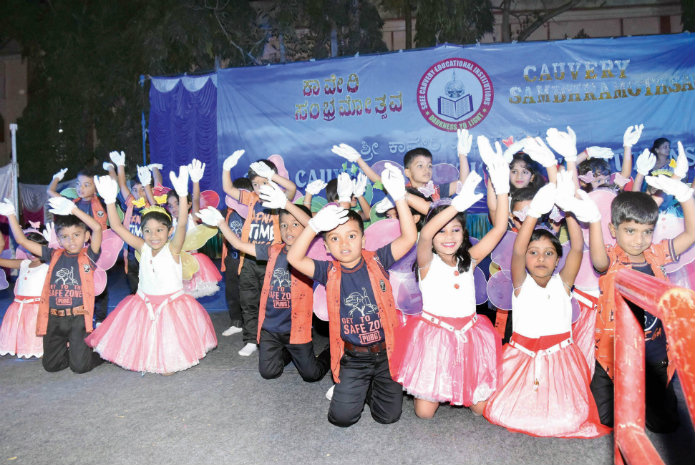
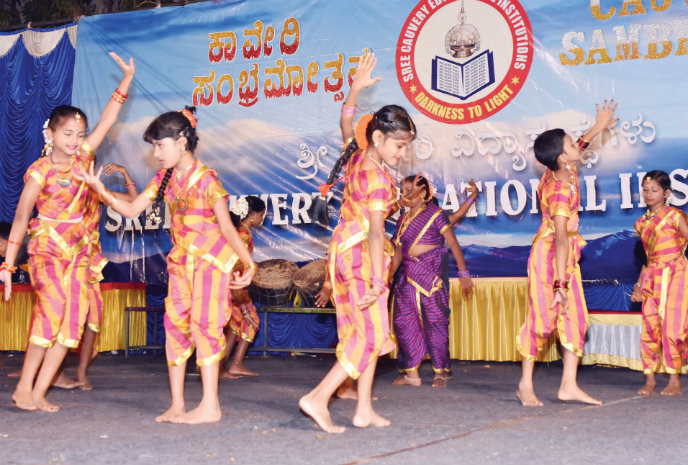
The 37th Annual Day of Sree Cauvery School, Indiranagar, Bengaluru, will be held at its premises on Dec.20 at 4.30 pm.

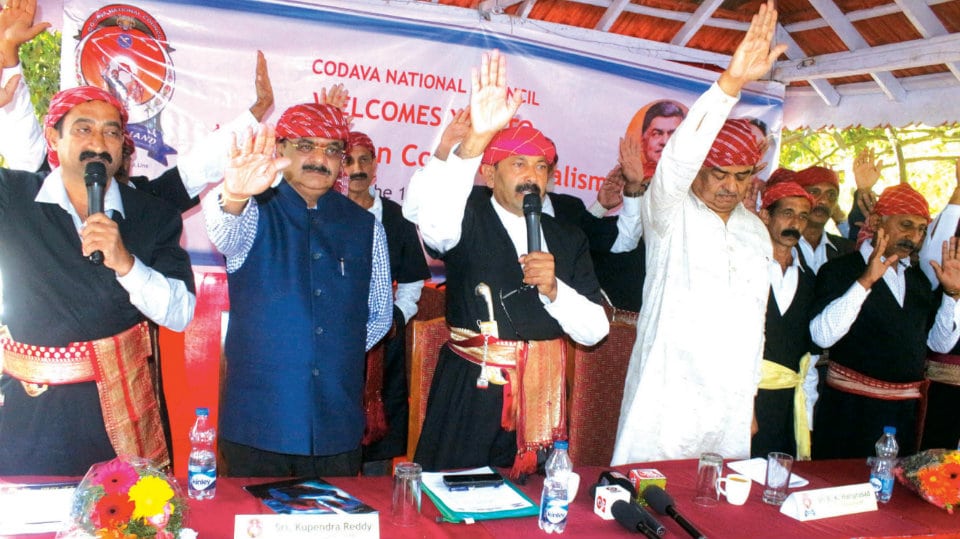
Kodava Samaja-Bengaluru President and senior advocate Muckatira T. Nanaiah will be the chief guest.

Kodava Samaja Education Council Chairperson Dr. K.K. Seethamma will preside.

source: http://www.starofmysore.com / Star of Mysore / Home> In Briefs / December 19th, 2019

Where Devotees Offer Clay Dog Idols To Deity

ClayDogs01KF19dec2019

Napoklu:

Have you heard of a Temple where figurines of dogs are offered as a vow (harake) to appease Gods? There is a unique Temple at the remote village of Bethu near Napoklu in Kodagu District where visitors are greeted with thousands of dog idols that look like they are howling.

The historical Makki Shasthavu Temple at Bethu draws thousands of devotees to its Jathra Mahotsava where the figurines of dogs are offered. It has been a practice for devotees to offer clay dogs to the deity in fulfilment of the vow they made. Devotees visit the Temple in large numbers and offer such clay dogs, during the annual fair of the Temple. This year, the fair is being held from Dec. 16 (today) to Dec. 19.

Centre for Truth: The Makki Shasthavu Temple is otherwise known as the “Centre for Truth” and every year, two fairs are held. While the first main fair is held during December, the second main fair is held during May. The Temple fair is marked by pomp in the region. The Temple is surrounded by thick forest and as the number of devotes is usually large, the entire campus of the Temple is filled with clay dogs.

ClayDogs02KF19dec2019

On Dec. 16, clay dogs are offered as it is the day of ‘Dhanu Sankramana.’ Devotees climb the steps to have a glimpse of the stone idol of the presiding deity, ‘Shasthavu Devaru’, placed on a pedestal under a jackfruit tree and characterised by the trident (trishula). The circular pedestal is five feet in height.

The clay dogs are offered to the deity during the festival in December, on the day of ‘Dhanu Sankramana.’ The clay dogs, however, are prepared in the ‘Vruschika Masa’, a month before the festival. The order can be placed by paying Rs. 350 for a pair of dogs. The fairs are celebrated with rituals like Deeparadhane, Ajjappa Kola and Vishnumoorthy Kola.

Secret transportation: Once the clay dog idols are prepared, the idols are transported to the Temple during wee hours and they are carried in such a way that no one sees the transportation process. First, the idols are taken to the ‘Karpathachan Nade’ near the ‘Bethu Mandh.’ Here, the idols are worshipped with flowers, kumkum and sandalwood paste. Later, they are carried and deposited inside the Makki Shasthavu Temple around the pedestal that has the tridents (trishulas).

ClayDogs03KF19dec2019

Interestingly, so secretive is the movement of the clay dogs that villagers do not venture on that road before the idols are shifted. There is a strictly followed belief that no one must cross the way of the idols. As such, people desist from walking on that road during the festival season.

Rotis for dogs: There is a tradition of preparing rice rotis to be given as offerings to the clay dogs as Naivedya. Men from the families that take the vow of offering clay dogs prepare a fireplace near the Temple with stones and they collect firewood and deposit them near the fireplace. The women from the family stay overnight at a designated place near Temple and bathe in cold water early in the morning.

They later powder the rice to prepare rotis and bake them on the fireplace that their men had prepared. Once the rotis are baked they place them on plantain leaves all along the route through which the men transport the clay idols of dogs.

Why the vow?: The vow of offering a clay dog is taken to protect the dogs of households from external attacks. If the dogs in the house are safe, the properties owned by the families like land, crops and wealth too will be safe from thieves and other threats. This is the firm belief the villagers of surrounding areas have.

Of late, there is a scarcity of fine clay. Realising this, the Temple Management Committee said that the clay dogs meant for the offerings were brought to the Temple from Dharmasthala at a cost of Rs. 1.20 lakh two years ago. Clay idols submitted by devotees in the previous years are replaced during the Temple fair.

ClayDogs04KF19dec2019

The legend of the Temple

There are several legends associated with the Makki Shasthavu Temple. Many years ago, at the Temple, there was a ‘Thirula’ (a man who is possessed with a divine spirit). This Thirula was once imprisoned for some reason. During one of the festivals, there was a loud sound of drum beats at the Temple and this Thirula, under divine possession, broke the shackles of the prison and came before the Temple pedestal. Under divine influence, the Thirula was able to break the prison shackles and also free himself from the handcuffs by vigorously shaking his hands before the Makki Shasthavu deity. Due to sheer force, a broken piece of the handcuff flew and got etched to the bark of the jackfruit tree (see pic.). This metal piece can be seen even now. The clay used to prepare the idols is sourced from Balamuri village nearby. This has been the practice for the past 30 years. After preparing the idols, they have to be dried in shade. As per tradition, members belonging to 12 families of the village compulsorily bring 12 pairs of clay dogs and submit it at the Temple.

source: http://www.starofmysore.com / Star of Mysore / Home> News / December 16th, 2019

For the love of ‘magical’ beans

The book constantly reminds you why we need coffee in our lives

Harish Bhat’s new book takes readers on an adventurous journey from the coffee plantations of Coorg to graveyards in Japan—to remind them of the joy a hot cuppa brings.

An Extreme Love Of Coffee is an adventure story running on a caffeine kick. It’s simple, fast paced and constantly reminds you why we need coffee in our lives, every day, maybe even every hour.

It’s also a tribute to Indian coffee blends.

After writing two books on business, marketing and consumer behaviour—The Curious Marketer: Expeditions In Branding And Consumer Behaviour and Tatalog: Eight Modern Stories From A Timeless Institution—Harish Bhat, the brand custodian of Tata Sons Pvt. Ltd and a Mint columnist, has published his first novel that blends coffee and magic, with enough servings of adventure and travel.

It follows a young couple, Rahul and Neha, who, after drinking a cup of “magic” coffee, are entrusted with a quest that promises to end in treasure. As they race from the lush green coffee plantations of Coorg to strange graveyards in coffee-loving Japan in search of the prize, they find Japanese assailants trailing them with swords, a friendly ghost and their passion for warm frothy concoctions and each other. A part of a poem by Neha sums up the spirit of the book: “Coffee love, do you rise like steam. Warm aromas that make my dream? With delicious magic by your side. On what carpet am I astride?”

The book reminds coffee-drinkers why they love the drink and gives non-drinkers enough reason to give it a try.

Write to us at businessoflife@livemint.compooja singh

source: http://www.livemint.com / LiveMint / Home> Explore / by Pooja Singh / December 17th, 2019

‘Kolata’, sports mark Huthari celebrations

Kodava men perform ‘Huthari Kolata’ on the premises of the Old Fort in Madikeri on Thursday.

Celebrations of Huthari continued with ‘Kolata’ and various sports events on the very next day of Huthari festival in the district on Thursday.

The Pandira family and the management committee of the Omkareshwara Temple organised the ‘Huthari Kolata’ on the premises of the Old Fort in Madikeri.

‘Ummattat’, ‘Bolakkat’, ‘Kolat’, ‘Pariya Kali’, ‘Chowli Aat’ and ‘Kattiyat’ were performed by teams from the Kodava Samaja, the Pandira family and the Pommakkada Koota.

Children added sheen to the Kolata by tapping their feet to the music of the traditional Kodava Valaga, which came as the icing on the cake.

Speaking on the occasion, MLA K G Bopaiah said that Kolata is celebrated soon after Huthari festival in Kodagu. Kolata was performed on the premises of Old Fort since generations, he said.

Stating that a week-long Huthari Kolata will be celebrated in ‘Uru Mand’ and ‘Naad Mand’, the MLA stressed on the need to cherish and preserve the tradition.

Since 2008, Kodagu has been enjoying holiday for Huthari and Kaveri Sankramana, after the government recognised the festivals, he added.

History

The Pandira family members of Hebbettageri village have been performing ‘Huthari Kolata’ or Puttari Kolata, on the premises of Old Fort, since the time of the reign of royal kingdoms in Kodagu.

The paddy is harvested during the festival and brought to homes.

The Puttari Aramane Kolu was held in high regard in the palace in older days and the same is continued today.

‘Will accept minister’s post if offered’

Speaking to reporters, Bopaiah said that he is not in the race for a minister’s position. However, if offered, he will accept the same with humility and work with conviction and handle with responsibility.

He meanwhile stated that he is an honest member of the party and does not believe in lobbying. He denied pressuring any leader to give him the minister’s post. “I have fetched a lot of grants to Kodagu and will continue to strive to solve people’s problems,” Bopaiah added.

source: http://www.deccanherald.com / Deccan Herald / Home> State> Mangaluru / by DH News Service, Madikeri / December 12th, 2019

Portable Memorials: Portrait Miniatures

Attributed to Ozias Humphry (British, 1742–1810), Dodda Vira Raja (or, Vira Rajendra Wodeyar), Ruler of Coorg 1780-1809, c. 1787. Watercolor on ivory. Gift of Shirley Latter Kaufmann in memory of Harry and Anna Latter, 74.649.

New Orleans, LA :

The New Orleans Museum of Art (NOMA) presents the museum’s Latter-Schlesinger Collection of Portrait Miniatures. Cradled in the palm of the hand or worn close to the heart, portrait miniatures were never intended for public consumption, but rather, functioned as personal tokens of affection, love, or memorial. Drawing from NOMA’s permanent collection, the installation of more than 100 portrait miniatures is now on view in the Lupin Foundation Decorative Arts Galleries on the museum’s second floor.

“NOMA’s Latter-Schlesinger Collection of Portrait Miniatures, given in 1974 by Shirley Latter Kaufmann in honor of her parents, Harry and Anna Latter, is one of the singularly important collections at this museum,” said Susan Taylor, NOMA’s Montine McDaniel Freeman Director. “Ranging from the court of Henry VIII to Napoleonic France, the collection includes masterful examples of the important artists and techniques used in the art of miniature portraits.”

Andrew Plimer (British, 1763–1837), Henrietta Ponsonby, Countess of Bessborough, c. 1795. Watercolor on ivory, frame with pearls. Gift of Shirley Latter Kaufmann in memory of Harry and Anna Latter, 74.654.

Portrait miniatures were the passion of New Orleans collectors Harry and Anna Latter. In 1957, the Latters traveled to London to oversee a government project and dedicated the trip to the pursuit of English portrait miniatures. After her parent’s passing, Kaufmann gifted the comprehensive collection to NOMA, where she was a trustee for more than twenty years and board president in 1978. The family continues Kaufmann’s tradition of supporting the museum through the Milton H. Latter Educational and Charitable Foundation, which sponsored the design and fabrication of a custom cabinet for the magnificent collection.

Nicholas Hilliard (English, 1547–1619), Portrait of an Elizabethan Court Lady, c. 1590. Watercolor on parchment. Gift of Shirley Latter Kaufmann in memory of Harry and Anna Latter, 74.337.

Portrait miniatures feature details of historic lace, jewelry, ornate hairstyles, royal adornments and military regalia, all executed by the artist sometimes using a single hair as a brush. The earliest 16th-century miniatures were painted with watercolor onto vellum (animal skin) or cardstock, but by the 18th-century heyday of portrait miniatures, artists painted on thin sheets of ivory for a natural luminescence to the watercolor portraits. NOMA’s collection includes master miniature artists Nicholas Hilliard (English, 1547-1619), John Hoskins the Elder (English, c.1590-1665), Samuel Cooper (English, 1609-1672), Richard Cosway (British, 1742-1821), and George Engleheart (British, 1752-1829). On view are examples of portraits framed with the sitter’s hair, intricately arranged and braided, and two “lover’s eye” miniatures, capturing just an intimate close-up of the sitter’s eye, recognizable only to her dearest confidants.

A tablet produced by NOMA details the stories behind these portrait miniatures, with the stories of royalty and historic celebrities, the highly-skilled craft of miniature painting, and the Latter family collection.

NOMA’s installation was made possible with the support of the Milton H. Latter Educational and Charitable Foundation.

source: http://www.artandobject.com / Art & Object / Home> Museum / December 11th, 2019

Mysuru Kodava Samaja Keeping Tradition Alive By Hosting ‘Puthari’ Get-Together

Puthari01KF13dec2019

Mysuru:

Huthri or Puthari festival was celebrated with grandeur and traditional fervour in Mysuru and Kodagu districts yesterday. It is a festival of harvest and getting the harvested paddy crop home.

Kodavas and members of Kodagu Gowda community visited paddy fields in their traditional attire and harvested the new crop after offering prayers.

The festival is observed either in the month of November or December on full moon day of Rohini Nakshatra. Before harvesting, they chanted ‘Poli Poli Deva,’ fired three times in the air and burst crackers.

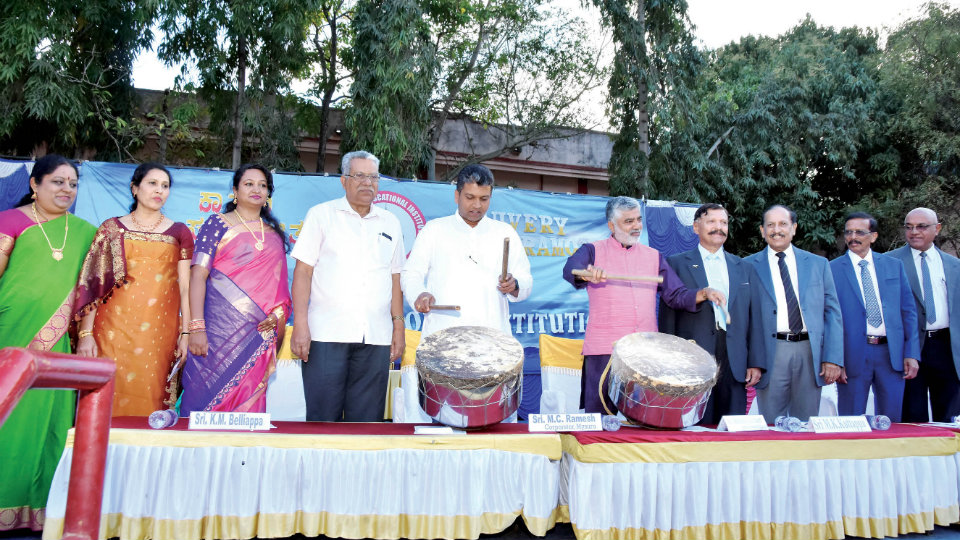
In Mysuru, the celebrations were organised by Mysuru Kodava Samaja at Sree Cauvery Educational Institutions premises in Kuvempunagar while members of Kodagu Gowda community celebrated the fest at their Samaja premises in Vijayanagar.

Kodagu Gowda Samaja members after harvesting the new paddy

The celebrations started at Cauvery School at 5.30 pm with performance of traditional Kodava dances by both men and women including small children.

‘Nere kattuva’ ritual was held at 7.35 pm followed by reaping of new paddy crop at 8.35 pm and distribution of thambutt prasada (a unique pudding made of ripe banana, coconut, jaggery/sugar, sesame, cardamom, ghee and roasted boiled rice flour) at 9.35 pm.

Puthari03KF13dec2019

The menfolk, wearing their traditional attire complete with Kuppiya – Chele, Mande Thuni and Peeche Kathi and the saree-clad women accompanied by girl children holding Thaliathakki Bolcha (a bronze tray with rice, betel leaves, arecanut and a lamp) marched to the nearby fields to reap the paddy crop. The festival marks bringing home the new paddy crop from the fields, symbolic of welcome to Goddess Lakshmi, who is the presiding deity of wealth.

A festival primarily confined to Kodagu in the past is now being celebrated in cities too where there is a considerable population of Kodavas. And Mysuru Kodava Samaja has been striving to keep the tradition alive by hosting the Puthari Eedu and Festival get-together annually.

Puthari Eedu was held for five days from Dec.6 to Dec.10 daily at 6 pm at the Kodava Samaja premises in Vijayanagar where traditional Kodava dances are practiced with the cultural troupe members and new-comers, according to Kekada M. Belliappa, President and Malachira M. Ponnappa, Hon. Secretary of Kodava Samaja, Mysuru. Hundreds of Kodavas attended the celebrations in city last evening. On the occasion, the Samaja felicitated the men’s cultural troupe that won prize in the competition held at Balugodu Samaja recently.

source: http://www.starofmysore.com / Star of Mysore / Home> News / December 12th, 2019

Merging border with dance

New Delhi, (IANS) :

Rasaja Foundation, in collaboration with Business & Community Foundation (BCF) will organise a discussion ”Merging Border” with artists Lata Pada (Sampradaya Dance Creations, Canada), Dr I Wayan Dibia (scholar, author and dance choreographer, Indonesia), Shila Mehta (Nupur Zankar Academy of Performing Arts, New Jersey, Belgium and Mumbai) and Hema Rajagopalan (Natya Dance Theatre, Chicago) followed by ”Nimitta” a solo kathak performance by Shila Mehta, portraying “Shikhandi” from Mahabharat on December 12 at Sri Aurobindo Society in New Delhi.

”PRALAYA”, a collaboration in Bharatanatyam and Baliness dance by Sampradaya Dance Creations, Canada, a modern retelling of the Mahabharata with special focus on the game of dice between the Pandavas and the Kauravas will be staged on December 13 at Kamani Auditorium in the capital.

The presentation, conceptulised and directed by Lata Pada, includes choreography by Lata Pada & I Wayan Dibia, music by Praveen D. Rao, costume Design by Sandhya Raman, visual Design by Jacques Collin and lighting design by Deepa Dharmadhikari.

Their Indo–Balinese collaboration that premiered in Toronto in November 2016 and went on to do an eight-city tour in Canada, has now begun its international tour across seven cities in India and a stint in South East Asia-Indonesia.

–IANS / Sukant/prs
source: http://www.outlookindia.com / Outlook / Home> The News Scroll / December 10th, 2019

Kodava Samaja, Mysuru

Huthri celebrations, 5.30 pm onwards;

traditional Kodava dances by the Samaja members and their children,

‘Nere kattuva’ ritual, 7.35 pm;

Reaping new paddy crop (Kadiru), 8.35 pm;

Distribution of thambutt prasada, Sree Cauvery College Grounds, Kuvempunagar, 9.35 pm.

source: http://www.starofmysore.com / Star of Mysore / Home> Events / December 10th, 2019

Kaveri Kalakshetra hall to get facelift soon

The present condition of Kaveri Kalakshetra hall in Madikeri.

Kaveri Kalakshetra hall in Madikeri will finally get a facelift. An action plan has been prepared at an estimated cost of Rs 1 crore under a special grant of the state government to take up development work.

The Kaveri Kalakshetra hall building will be repaired and the roof and floor of the hall will be renovated, said CMC Commissioner M L Ramesh.

The hall was constructed at the district headquarters even before Independence and it provided a platform for various cultural programmes.

Owing to the deplorable condition of the building, there was fear among the organisers to host programmes in the hall.

The cracked walls, broken window and doors, pathetic condition of the roof were attracting negative opinion of the visitors.

Though CMC had earmarked funds in its annual budget for the construction of Kaveri Kalakshetra two years ago, it has not materialised so far. The members had expressed displeasure at the failure of the government to release the grants in spite of submitting memorandum several times in the past.

The commissioner said, “Technical inputs from PWD have been sought for the renovation of the Kaveri Kalakshetra hall. An action plan has been prepared and the tender will be floated for the work shortly. The hall will also have new seating arrangements after the renovation work.”

Nagara Hitharakshana Vedike President Ravi Gowda said, “Kaveri Kalakshetra hall was crying for attention without any maintenance. A suitable platform should be provided for young talents and artistes after the renovation of Kaveri Kalakshetra.”

The local residents have urged the authorities to rent out Kaveri Kalakshetra hall for marriage functions to increase the income of the CMC.

Artist Raju from Kushalnagar said, “There is no dearth of artistes in Kodagu district. However, there are no platforms for the artistes to showcase their talent. The demand for Ranga Mandira and theatres in the district has not been fulfilled.”

source: http://www.deccanherald.com / Deccan Herald / Home> State> Mangaluru / by Adithya K A / DH News Service , Madikeri / December 09th, 2019

Crop to Cup 2019 – Coffee Workshop with Marc Tormo at Old Kent Estates Coorg

Coffee lovers are discovering new coffee destinations from within the cities all the way to the countryside, including the heartland of coffee in India – Coorg. This workshop provides an excellent opportunity to learn from a certified Q-Grader & connoisseur Marc Tormo, Roastmaster from Barcelona, who has more than 20 years of experience in the international coffee movement.

Harvest with the locals, learn about how coffee is sustainably cultivated in India while gaining a deeper appreciation of roasting techniques and experience the subtle notes hidden in the beans. Learn exciting brewing techniques and impress your friends with your barista skills creating art from the rich froth of your latte.

So, don’t miss the change to grab this opportunity with both hands! Because, this is a unique platform for all coffee lovers, coffee enthusiasts, those trying to make an entry into the coffee world, or simply those trying to impress their guests!

Date: 06th-09th December 2019

Venue: Old Kents Estate, Coorg

Price: Rs 30,000 ++ (all-inclusive stay in a spacious English cottage with a private garden)

For Reservations: Call 9789896454

source: http://www.hungryforever.com / Hungry Forever / Home> Events / by Christina George / November 29th, 2019