Category Archives: Business & Economy

‘Use Indian coffee products to promote local growers’

The Indian coffee would get a better price if we stop depending on foreign countries and start using more coffee products of Indian origin, said Central Coffee Research Centre Director Dr Y Raghuramulu.

He was speaking at a programme organised at the Navodaya Vidyalaya in town as part of the International Coffee Day celebrations on Thursday.

“In America, the average consumption of coffee by a person is four to five kg a year. In India, however, it is barely 100 gm. The consumption is increasing by six per cent every year,” he said and added that Brazil had created awareness among children about use of coffee about 10 years ago. “As a result, Brazil stands second in the list of countries that are the highest consumers of coffee in the world,” he said.

The International Coffee Organisation (ICO) has called upon all coffee-growing nations to celebrate Coffee Day on October 1 every year, to protect the interest of coffee growers and nations. “From next year onwards, the day would be celebrated with road shows and various other programmes,” he said.

‘Chicory is good’
Dr Raghuramulu claimed that chicory is good for health and a maximum of 49 per cent of chicory can be added to the coffee powder.

“The carbohydrate content of chicory makes the coffee a bit thicker. Chicory is usually grown in some parts of Andhra Pradesh, Kerala and few other states. It is also used in the production of biscuits,” he said.

In his inaugural speech, Sahyadri Coffee Growers’ Association President M S Sundaresh Gowda said that the imagination behind Coffee Day would help the growers. The market for coffee can be extended by creating awareness about the drink in North India, he added.

Meanwhile, ‘Coffee Karma’, a 20-minute documentary on the birth of coffee was screened at Navodaya Vidyalaya hall. An exhibition was held as a part of Coffee Day on different coffee species, possible diseases, pesticides and other things. More than 1,500 people watched the documentary and free coffee was served to all.

Balehonnur JCI President Dayakar N Suvarna, Navodaya Vidyalaya Principal K Rameereddy, Coffee Board scientists were present.

source: http://www.deccanherald.com / Deccan Herald / Home> District / Balehonnur / DHNS – October 02nd, 2015

From Assam to Hassan in search of work

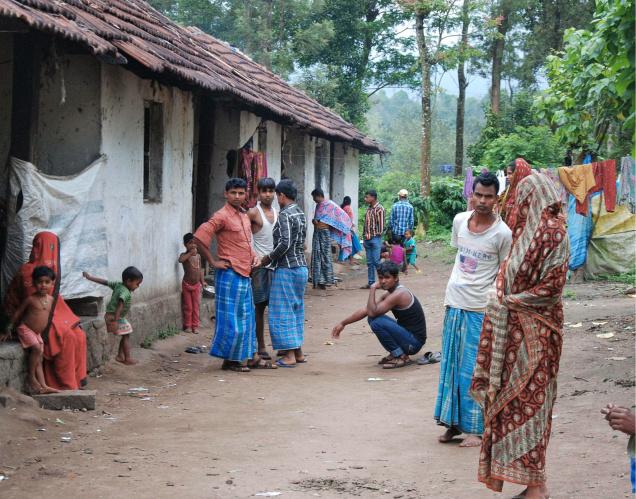
More than 5,000 people from Darang and neighbouring districts of Assam have found work in plantations of Belur and Sakleshpur taluks.— Photo: Prakash Hassan

Assam may be famous for its tea gardens, but a good number of Assamese workers have found employment in the coffee estates of Chikkamagaluru and Kodagu.

More than 5,000 people from Darang and neighbouring districts of Assam have come to work in plantations of Belur and Sakleshpur taluks. Many more work in estates spread over Chikkamagaluru and Kodagu districts.

“We hardly find jobs in our hometown. If we get work for a week, we remain jobless for next few weeks,” said Habizur Rahman (25), who has been working in Hasurugudda Estate of IBC company near Arehalli in Belur taluk for the last four years. Both men and women are enrolled as contract workers in estates for a daily wage of Rs. 228. In Assam, women hardly get the opportunity to earn in fields, he said.

The wave of migration started five years ago, when a manager of an estate in Belur taluk came in contact with planters in Kodagu, where workers from Assam had begun to arrive. “Those days we were struggling to get local people to work. We were looking for people who could work. The first batch of 25 people came from Assam five years ago. As they got work for the entire year and wages were better than what they got in their homeland, they brought more people from their State,” said Fazlur Rahman, manager with IBC estate.

Election trips

The manager pointed out that many planters have employed Assamese as they are hard workers, though they are not well-versed in the skill of maintaining coffee. These workers have brought their family and all of them make a trip to their homeland during elections. “Voting is significant as there is a serious issue of illegal migrant voters from Bangladesh,” said Shwahidul Islam, who always keeps his voter’s identity card in his pocket.

However, the workers are unhappy with the poor facilities provided in the estates. Around two or three families are forced to settle in one house with plastic sheets to separate them. For over 80 families there is only one toilet, in one of the estates visited by The Hindu .

“We repeatedly demand for proper facilities, but our cry does not reach the people concerned. If anyone falls sick, we neither get paid holiday nor medical expenses reimbursed,” said Habizur Rahman.

The district administration has set up a tent school for children of migrant workers, but they find this of no use. “We need a proper school where our children can get education from teachers who know Hindi,” said Marina Khatun, one among the women workers in the estate.

source: http://www.thehindu.com / The Hindu / Home> National> Karnataka / by Sathish G.T. / Hassan – September 27th, 2015

Power line through Kodagu is ready

Madikeri :

The Power Grid Corporation of India (PGCI) has completed the project to supply power from Kaiga to Kozhikode in Kerala amid protests. The 400kV transmission line was opposed in Kodagu on grounds that it would damage forest cover. Due to opposition from environmental organizations and farmers’ association and court cases, work had been halted for some time in Kodagu.

While the line was in place in Kerala, the missing link has now been completed. PGCI warned people that it’ll charge the line and residents of the area should be careful.

The 120-km high-tension wire from Mysuru to Kozhikode passes through 55km in Kodagu. Of this, 4.45km is forest land, while the remaining is private land and plantations. The lines in Mysuru and in the opposite direction between Manandavadi and Kozhikode were completed two years ago.

Workers on coffee plantations and school children would face the maximum threat. Following protests, the Kodagu district administration distributed compensation to land owners where power lines passed. The PGCI completed the project with police protection and many cases were booked against agitators.

The corporation said the wire through Kodagu was laid 15 metres above the ground and would not harm elephants.

source: http://www.timesofindia.indiatimes.com / The Times of India / News Home> City> Bengaluru / TNN / September 29th, 2015

New team for United Planters’ Association of Southern India

N. Dharmaraj, President and D.Vinod Sivappa, Vice - President
N. Dharmaraj, President and D.Vinod Sivappa, Vice – President

Mysuru :

N. Dharmaraj was elected as the President and D.Vinod Sivappa as Vice- President of United Planters’ Association of Southern India (UPASI) for the year 2015-16 at the Annual General Meeting of UPASI held on Sept.24 at Coonoor, Tamil Nadu.

Dharmaraj has over 41 years of experience in plantation business, working with companies like Brooke Bond, Unilever etc. He is currently the Chief Executive and Whole-time Director of Harrisons Malayalam Ltd.

Dharmaraj was Chairman of the UPASI Tea Committee and Chairman of the UPASI Commodities Exchange Limited. He was a member of the Tea Board of India and Founder-Convener of the Golden Leaf India Awards (TGLIA). He is currently a Member of Tea Council of South India constituted by the Tea Board as also a Member of the Core Committee of the Tea Board of India.

Vinod Sivappa, son of former President of UPASI (late) D. Sivappa in the year 1970-71, hails from a coffee growing family for more than 160 years. Vinod Sivappa was on the Committees of Codagu Planters’ Association and also was the Chairman of the Karnataka Planters’ Association. He is involved in many sporting activities. He is a Director of many organisations and various companies, according to a press release from Ullas Menon, Secretary General, UPASI.

source: http://www.starofmysore.com / Star of Mysore / Home> General News / September 27th, 2015

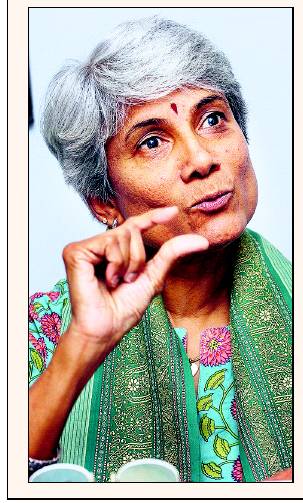
She sips, swirls and spits: Meet Asia’s only woman coffee taster

What would life be without spicy food, ice-creams, perfumes, fragrant flowers, late-night parties and alcohol? Ask Sunalini Menon, who swears by this regimen.

No, she’s not a health freak or someone prone to allergies. She’s been practising abstinence for the sake of her passion, which is also her profession.

Asia’s first and only woman professional in the field of coffee cupping (tasting), Sunalini has experienced the aroma of several thousands of coffee types and spent a considerable time in the fields. “I love ice-creams and soft drinks but they affect my taste buds. My profession requires them to be extremely sensitive. So, I steer clear of cold food items or beverages,” she said. The chief executive of Coffeelab, one of India’s largest coffee exporters, Sunalini spoke to TOI on the ocassion of Coffee Santhe, a three-day carnival hosted by Karnataka Chitrakala Parishath.

Restraint and discipline are core attributes of a good coffee cupper. “It is essential to preserve the palate, the instrument vital for coffee tasting. We’re advised to avoid spicy food. Alcohol and smoking are a strict no no. Late nights and poor health can be a hindrance to the job,” she explained.

Coffee cuppers have to perform regular tongue exercises not only to keep their taste buds active but also to pick up foreign flavours. “Cupping with experts from other parts of the world helps calibrate one’s potential and understand the coffee produce of other countries. One also needs to perceive through the eyes, nose and palate of other cuppers,” she said.

SunaliniMenonKF26sept2015

Habituated to taking a sip and playfully swirling the liquid in her mouth before spitting, Sunalini said her job doesn’t allow her to swallow the coffee, however aromatic and delicious it be. “Coffee can have the distinct enzymatic flavours of apples, apricots, peaches and berries; sugar-browning flavours of chocolate, caramel, honey or those of spices like clove and pepper. It is an inborn acuity of taste, knowledge, experience, memory and good communication skills which help the cupper differentiate one flavour from another,” she said.

Sunalini, who entered the male bastion decades ago, said her journey hasn’t been easy. “I wasn’t lucky enough to be handheld when learning the tricks of the trade. I had to learn on my own, especially the chemistry of the coffee bean. It took a long time for me to be accepted into the fold, but once there, you are in,” she said.

Cupping as a Career

There are certifications for coffee tasters issued by the Specialty Coffee Association of America (SCAA) and Specialty Coffee Association of Europe (SCAE). The SCAA issues two types of certificates. One is called the Licensed ‘Q’ grader and the other, the Licensed ‘R’ grader. The ‘Q’ grader licence is a certificate for proficiency in evaluating arabica coffees and the ‘R’ grader for proficiency in evaluating robusta coffees,” said Sunalini.

She admitted that coffee tasting as a career could have some limitations.

“To overcome them, one needs to perhaps complement tasting with other jobs such growing, roasting or marketing coffee,” she said.Coffee tasting is more of a passion; it may not help you financially, especially in the first 10 or 12 years. Credibility comes only through knowledge and experience,” Sunalini signed off.

source: http://www.timesofindia.indiatimes.com / The Times of India / News Home> City> Bengaluru / by Sreemoyee Chatterjee, TNN / September 26th, 2015

Newly elected corporators learn lessons in Madikeri

The corporators-elect of Congress,who are camping at two resorts in Madikeri, were on Wednesday given a special lecture on the rights and responsibilities of the corporators.

Yeshwantpur legislator S T Somashekhar, Tarikere MLA Srinivas and senior corporator Gunashekhar delivered lectures for two hours at Vivanta By Taj hotel.

Senior corporator Padmavathi said that the elected members should understand the stand of their party on a particular issue. She said that they should support their party colleagues in meetings and should launch an attack to counter the Opposition parties. She said that the mayor should allot the funds available at his/her disposal equitably. The members elected for the first time heard the lectures attentively.

Some members expressed the opinion that the poor and the downtrodden had overwhelmingly voted for them. Hence, special programmes should be launched for their welfare. The corporators-elect cancelled their plan to visit the Dubare elephant camp in order. According to sources, the plan was dropped as otherwise it would convey a wrong message to people.

source: http://www.deccanherald.com / Deccan Herald / Home> City / Madikeri (Kodagu Dist) / DHNS – September 10th, 2015

Mysore Coffee Curing Co-op. Society (MCCCS) : General body held in city

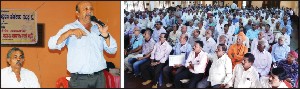
MCCCS Convenor Mookonda Bose Devaiah is seen addressing the Society’s General Body meeting at CITB choultry in Hebbal this morning as Society’s Liquidator C. Girish looks on. Picture right shows a section of members who attended the meeting.

Mysuru :

The General Body Meeting of Mysore Coffee Curing Co-operative Society (MCCCS), KRS Road, was held at CITB Choultry in Hebbal here this morning after a gap of 17 years.

The meeting began in the presence of Liquidator C. Girish, with 223 members of the MCCCS attending the General Body, much more than the 115 members required for the quorum.

As soon as the meeting began, the members alleged that the six Liquidators appointed by the Government since 1999, following the ceasing of functioning of the Society in 1998, worked for the downfall of the Society rather than working for reviving it by taking appropriate measures.

The members unanimously demanded the government to recall the Liquidator and restore the composition of the Society which was in place between 1953 and 1998 when it functioned.

Liquidator Girish, who is currently in charge, recorded the proceedings of the General Body and said that the same will be sent to the Registrar of Co-operative Societies for due consideration. It is upto the Government to take further decision on the revival of the Society, he added.

The MCCCS Members Welfare Committee Convenor Mookonda Bose Devaiah, Co-convenors Kolathanda Subramani, K.B. Hemachandra, Alamengada Bose Mandanna, s.p. prasanna, Mathanda c. poovaiah, Kolera Jaya Chengappa, Mahesh, Thirumallesh, Nandu Subbaiah, Arun Machaiah and others were present.

A total of 223 members of the Society from Hassan, Kodagu, Chikkamagalur and Mysuru districts attended the meeting.

Society’s history: Coffee growers of Kodagu, Hassan, Mysuru and Chikkamagalur districts got together in 1953 to establish the MCCCS by procuring 10 acres and 23 guntas of land along KRS road in Mysuru.

The Society, with 1,159 members, functioned normally for many years and had also constructed several godowns. However, when the sale of coffee was freed from restriction and free market was allowed, the Society began to incur loss and gradually ceased functioning in 1998, following which the State Government appointed a Liquidator.

Later on, subsequent Liquidators auctioned 5 acre, 23 guntas of land, besides bringing down the 9 godowns built in the premises, in order to clear the Society’s debts and for various other reasons.

Despite having cleared the Society’s debts and meeting other obligations, the Liquidators tried to dispose off the remaining 5 acres of landed property belonging to the Society, through a public auction, when the members moved the High Court seeking a stay.

The High Court, which heard the Society’s plea, granted a stay on July 9, 2015 against the auction of the remaining landed property which is estimated at more than Rs. 20 crore.

source: http://www.starofmysore.com / Star of Mysore / Home> General News / September 01st, 2015

Assamese Workers Fill Labour Shortage in Kodagu Estates

Madikeri :

They have worked in the tea gardens of Assam but in Madikeri they are tending the Coffee plants. Labourers from Assam working in coffee plantations in Kodagu have become a common sight since the past two years.

It is in south Kodagu that more number of Assamese labourers find work in houses and estates.

A few days ago, nearly 200 people arrived from Assam and were divided in teams to meet the demands of the local agents.

According to the labour department officials, there are seven labour camps in and around Kodagu where these people stay.

A few big planters will host some of the Assamese labourers in their own camps in the estates.

In Kodagu, over the years, shortage of labourers have been very severe and existing workers have been demanding more salary and benefits. In 2011, the acute shortage of labour and the high demands of local labourers had put the planters in a spot.

Earlier, the planters were getting labourers from Sullia in Dakshina Kannada and Arasikere in Hassan district, but the Assamese labour comes much cheaper than the usual lot, the officials added.

A labour contractor from Dakshina Kannada, Rajappa Gowda, who takes labourers from Sullia and Puttur every week, says Kodagu has a heavy demand for labourers.

Many escape the labour work in the estates and get into more cozier jobs as servants at home-stays.

But the migrants tend to stay for longer as they get all the benefits, from schooling for their children and higher social security.

Former vice-chairman of Coffee Board of India, Bose Mandanna, told Express that though Assamese workers do not know the scientific work of coffee cultivation, those who settle here learn how to spray, borer tracing and other works. Since all migrants show records like BPL cards, voter IDs and other records, it is the responsibility of the officials to trace fake cards, he says.

However, according to Codava National Council president N U Nachappa, these workers are all Bangaldeshis possessing fake documents. He recalled the protests held early this year urging officials to verify the labourers’ antecedents.

A coffee planter from Gonikoppa told Express, “Since we are getting Assamese labour, demand for more salary from workers who come from far away places cease.”

Another planter from Suntikoppa in Somwarpet taluk said many estates would run into trouble if the Assamese labour did not flow into Kodagu.

The police department have asked all coffee growers to check the documents and collect photos of workers and their family members and submit copies to them without fail.

source: http://www.newindianexpress.com / The New Indian Express / Home> States> Karnataka / by Express News Service / August 24th, 2015

Tourist spots in Kodagu need basic facilities, says officer

TourismKodaguKF31aug2015

Tourism Department Assistant Director V Phanish has said that there is a need for better facilities at tourist spots all over the district.

“About 30 lakh tourists visit Kodagu district every year and business transactions of Rs 700 crore take place in the district due to tourism related activities. With the completion of work on the Kannur international airport, the inflow of tourists to the district is only expected to increase,” he said.

The official was speaking after inaugurating the Kodagu District Tourist Vehicle Owners’ and Drivers’ Association.

Listing out the tourism-related work carried out in Kodagu, Phanish said, “In the last two years, works worth Rs 12.29 crore have been taken up in the district to support tourism. A proposal of Rs 5.19 crore has been submitted to develop the road leading to Mallalli waterfalls in Somwarpet. The work on the concrete road worth Rs 3.19 crore has also been taken up. A sum of Rs 40 lakh has been released to provide basic facilities at Mallalli waterfalls. In addition, Rs 60 lakh has been released to develop the road leading to Makkala Gudi Betta at Kiragandoor, while Rs 1.53 crore has been released to develop Kodava Heritage to introduce culture and tradition of the Kodagu people.”

Development work on the road and footpath on the Abbey Falls stretch will be taken up at a cost of Rs 20. Senior Motor Vehicle Inspector B S Rajashekar said that an insurance scheme for drivers of private commercial vehicles has been launched by the government.

source: http://www.deccanherald.com / Deccan Herald / Home> District / DHNS – Madikeri, August 23rd, 2015

Indian coffee stall an eye-catcher at Int’l trade fair

Varanasi :

The week-long international trade fair organised in the heart of the city at Beniabagh is all about ‘Make in India’ offering a variety of products ranging from handloom to handicrafts and others from different state pavilions. But the main attraction of the event was the exclusive stall put up by the Coffee Board of Government of India offering the taste of palatable Indian coffee varieties.

Intrigued buyers were seen congregating at the coffee stall, seeking details of preparation of filtered south Indian coffee from the staff and also savouring a cuppa of ‘filtered’ coffee. Some were even seen grabbing free samples available at the stall.

“Several local buyers thronged the trade fair and ensured to give us a visit and inquire about the specialty of coffee, its distinct method of preparation and how it sets itself apart from the packaged coffee of various brands,” assistant secretary of Indian Coffee House, South Black, Coffee Board of India, HM Nagraj told TOI on Saturday. “We are aware that Indian coffee is not as much popular in Northern India, hence our main purpose is to promote the Indian filtered coffee among North Indians,” he added.

Explaining about the kinds of coffee and the method of preparation, Nagraj said, “There are two kinds of coffee beans, arabica and robusta, grown in hills of Karnataka, Tamil Nadu, Kerala and Andhra Pradesh. The coffee beans processed after curing works are available in various grades and the method of preparation is simple and one-of-its-kind.” The coffee is brewed in two cylindrical cups of a metal device, one of which that rests at the vertex is loaded with freshly ground coffee with small outlets at the bottom to filter the brewed coffee. Boiling water is then added to grounded coffee and after compression, the decoction is mixed with sugar and boiling milk, he explained.

At this stall the Indian coffee packets are available in 100g, 200g and 500g and are priced at Rs 400 per kg. “Our stall has become more of an eye-catcher at the fair and we are getting suggestions from the buyers and visitors to open an outlet here in the city,” said Nagraj.

Suyash Bajpayee, a visitor at the stall said, “The coffee tantalized my taste buds and I am glad to have visited the stall where I got to learn so much about the varieties of Indian coffee beans.” Another visitor Abhishek Mishra said, “This coffee is a perfect example of the ‘Taste in India’, ‘Made in India’.” A local resident, Brihaspati Bhattacharya, was pleased by the hospitality at the stall and thanked the staff for giving detailed information about coffee.

source: http://www.timesofindia.indiatimes.com / The Times of India / News Home> City> Varanasi / by Punkhuri Kapoor, TNN / August 23rd, 2015