Kodagu Zilla Panchayat is all set to begin “Namma Yojane, Namma Chinthane” (Our projects, our thoughts) programme on All India Radio (Akashvani) to create awareness among people about the development schemes of the government as well as to get feedback from them.
Addressing mediapersons here on Saturday, Zilla Panchayat Chief Executive Officer M Koorma Rao said that it has been thought to get public feedback about Swacch Bharath campaign, Mahatma Gandhi National Rural Employment Guarantee Act (MGNREGA), housing projects, Rajiv Gandhi Chaitanya Yojana, collection of revenue in Gram Panchayats and few other issues.
Public opinion would be collected through Akashvani on Swacch Bharath campaign on August 26, about MGNREGA on August 27, housing projects (August 28), self-employment and Rajiv Gandhi Chaitanya Yojana (Aug 31), revenue collection in GPs (September 1) and on Panchayat Raj Act and Gram Sabha on September 2, she added.
Zilla Panchayat Deputy Secretary Vishwanath Poojary, Chief Project Officer Takat Rao, Chief Project Officer Takat Rao and Project Director Narendra Hittalamakki were present.
source: http://www.deccanherald.com / Deccan Herald / Home> District / DHNS – Madikeri, August 23rd, 2015
Will improve basic infrastructure to attract tourists in large numbers
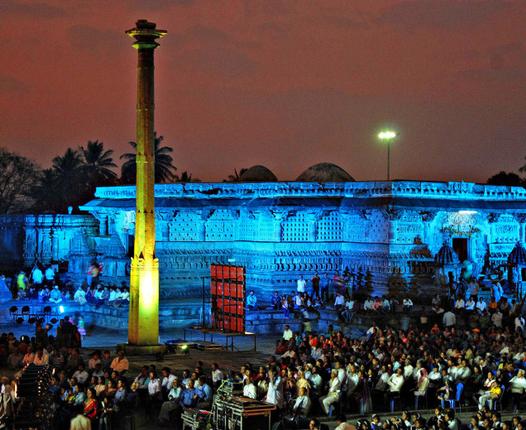
Belur and Halebid, two major tourism destinations in Hassan district, are expected to get a facelift following the Tourism Department’s initiative to involve non-governmental organisations in driving tourists to the State.
Coffee Day Enterprises Ltd. (CDEL) has shown interest to adopt the two tourism destinations, known for the Hoysala period temples, to improve basic infrastructure so as to attract tourists in big numbers.
The department launched the Adopt Tourist Destination programme in 2014. M.R. Prakash, Assistant Director of the department, told The Hindu on Tuesday that CDEL had shown interest to adopt Belur and Halebid.
“The company’s proposal is being examined by the department. The objective is to provide basic amenities such as drinking water, washrooms and toilets, and improve connectivity to the destinations,” said the officer.
When The Hindu contacted Devahuti, in-charge of media relations in CDEL, she said the company had shown interest to adopt the two places.
Details of the mode of developing these destinations will be made public later, she said.
“The CDEL has entered into an understanding with the Archaeological Survey of India and the Department of Tourism for infrastructure development in Belur and Halebid. The company is hoping to help in development work by building drinking water facilities, washrooms and toilets for tourists along with soft skill training programmes for tourist guides,” a note issued by the company said.
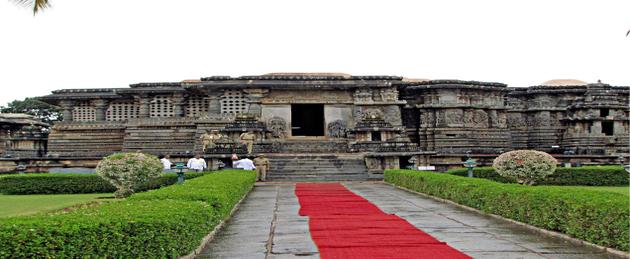
Belur and Halebid are widely known for the Hoysala sculptures. The Channakeshava temple in Belur (left) and the Hoysaleshwara temple in Halebidare famous tourist destinations.— File Photos: Prakash Hassan
However, the places lack basic amenities for tourists. The State government is making efforts to develop the place around Channakeshava Temple in Belur by acquiring private properties.
Similarly, in Halebid, tourists encounter problems of finding decent hotels.
“We can develop these centres with the help of private companies. Then, the number of those visiting these destinations will also increase,” Mr. Prakash added.
source: http://www.thehindu.com / The Hindu / Home> National> Karnataka / by Staff Correspondent / Hassan – August 26th, 2015
The General Body Meeting of Mysore Coffee Curing Co-operative Society (MCCCS) will be held in Mysuru on Sept.1.
Announcing this at a press meet at Virajpet Press Club on Thursday, the Society’s former President Karnanda Raghu Somaiah called upon all members of the Society to attend the meeting.
Pointing out that the general body meeting of MCCCS, which is one of the most prestigious Co-operative Societies in Mysuru region, has not been called for years, Somaiah said that he had brought a stay from the High Court on July 9, 2015 on the moves to publicly auction the Society’s landed property estimated at about Rs. 200 crore. Earlier, the Court of the Registrar of Co-operative Societies at Bengaluru had dismissed a petition in respect of the appointment of Liquidator and not convening the general body meeting, he said.
Continuing he said that the Liquidator has asked all the members to attend the Sept.1 meeting at Mysuru while setting some conditions. The Liquidator has also asked the members to produce the original copy of share certificates held by them, he said.
Stating that a few members of the Society have died between 1998 and 2014, he demanded the Liquidator to allow all those having ID cards to attend the meeting and to ensure that the meeting is conducted as per the procedures.
Stressing on the need for an united and organised fight for the revival of the society, Somaiah said that the list of Kodagu members of the MCCCS was available at Virajpet Town Bank. The members from Kodagu can visit the Bank during working hours and check the list for their names, he added.
Coffee planter and MCCCS office-bearer Kolathanda W. Bopaiah, in his address, sought co-operation of all the members for the survival of the Society.
Kodagu Central Co-operative Bank former President Mathanda A. Ramesh, K.W. Ganapathy, K.M. Charmana, C.K. Ganapathy, K.P. Nagaraj and others were present at the press meet.
source: http://www.starofmysore.com / Star of Mysore /Home> General News / August 23rd, 2015
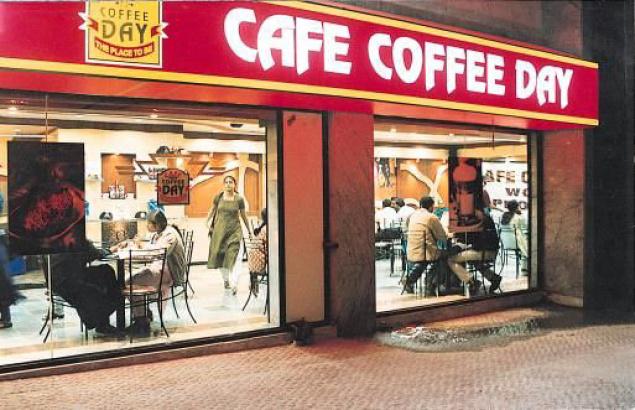
Coffee Day Enterprises, which runs the country’s biggest coffee chain Cafe Coffee Day, has received markets regulator SEBI’s go—ahead to raise Rs. 1,150 crore through initial public offering (IPO).
The firm had filed its draft red herring prospectus (DRHP) with SEBI through its lead merchant banker Kotak Mahindra Capital Company Limited on June 26 this year.
Securities and Exchange Board of India (SEBI) issued its final observations on the draft offer documents on August 14, which is necessary for companies to launch any public offer.
As per the draft paper, the company intends to raise an estimated Rs. 1,150 crore to aid its expansion plans and pay off debt.
The company, which has got private equity giants like KKR, Stanchart PE and New Silk Route as its investors, has reserved Rs. 15—crore worth shares for staff.
The company proposes to list its shares on the BSE and the NSE.
Coffee Day Enterprises is the parent company of the Coffee Day Group and operates coffee business through a subsidiary, Coffee Day Global Limited (earlier known as Amalgamated Bean Coffee Trading Company Limited), and its subsidiaries.
Coffee Day Global Limited had a total income of Rs. 1,154 crore and operating profit of Rs. 189 crore in 2013—14 fiscal.
Out of the capital raised through the issue, the parent company plans to utilise nearly Rs. 632 crore to pay off debt and the remaining to open new stores, set up coffee bean roasting plants and make vending machines, the proposal said.
In the next two financial years, the company plans to open over 215 outlets and set up 105 kiosks.
source: http://www.thehindubusinessline.com / Business Line / Home> Markets / PTI / August 17th, 2015
Shipments rise for first time this year; drop in Arabicas offset by robusta and soluble varieties
Bengaluru :
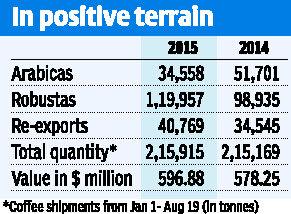
The Indian coffee exports, for the current calendar year, have registered a marginal growth for the first time, on increase in shipments of robustas and the soluble or instant variety.
According to provisional numbers, total export permits issued by the State-run Coffee Board have exceeded the last year’s levels for the first time and were pegged at 2.159 lakh tonnes (lt) for the January 1 to August 19 period against 2.151 lt in the corresponding period last year.
However, the green bean coffee exports continue to trail the last year’s levels largely on account of a 33 per cent drop in Arabica shipments, despite the robustas registering a 21 per cent growth.
Green coffee trails
Also, the soluble coffee shipments measured in green bean equivalent stood at 60,842 tonnes, including the re-exports that grew 18 per cent for the period.
“We expect the shipments to maintain a small growth for the rest of the year,” said Ramesh Rajah, President of Coffee Exporters Association.
“The coffee held back by the growers anticipating better prices, would come out into the market over the next couple of months before the arrival of new crop,” he added.
Currency volatility
Rajah attributed the trailing trend in green coffee shipments to the declining production of the Arabicas.
Also, the Indian exporters are facing challenge from the devaluation of currencies by the top two coffee producing nations – Brazil and Vietnam, which has made their exports competitive.
The Brazilian Real and Vietnamese Dong have weakened by around 15 per cent against the dollar over the past year, while the Rupee has fallen by over 8 per cent.
Crop estimates
The Arabica harvest this year is likely to be advanced by a couple of weeks to September as the early rains have boosted the prospects for coffee.
The Board, in its initial estimates, pegged the crop size for 2015-16 crop year starting October at 3.55 lt – a growth of 8.75 per cent over previous year’s 3.27 lt.
Arabica crop size for 2015-16 is pegged at 1.10 lt – up 12.55 per cent over 2014-15’s final estimate of 97,700 tonnes.
Robusta crop size is estimated to expand to 2.45 lt, a growth of 7 per cent over previous year.
Export markets
C Rajendra Prasad, Chairman and Managing Director of CCL Products Ltd, the country’s largest instant coffee exporter said demand continues to be strong both from traditional markets such as Russia and Europe and even from the new geographies such as the United States.
CCL Products, which exports to about 56 countries, has so far shipped about 24,741 tonnes of instant coffees in the current calendar year. Tata Coffee has exported about 10,207 tonnes, while Nestle with 8895 tonnes were the other large instant coffee exporters.
Italy has been the largest buyer of Indian coffee at 55,378 tonnes, so far, followed by Germany at 20,537 tonnes and Russian Federation at 14,526 tonnes.
source: http://www.thehindubusinessline.com / Business Line / Home> Agri-Biz / by Vishwanath Kulkarni / August 20th, 2015
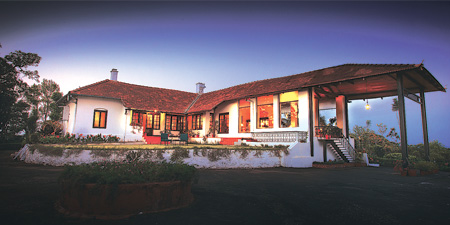
Located amidst coffee and tea estates, Plantation Trails by Tata Coffee enables its guests to enjoy the life of a planter while staying in heritage bungalows. Currently, Plantation Trails by Tata Coffee offers seven unique heritage colonial-style bungalows across Coorg and Chikmagalur. “The concept has been evolving over time and is slowly yet steadily becoming popular amongst discerning travellers.
Gautam Prakash
We notice immense scope for Plantation Trails as it opens an all new category of tourism for families looking to indulge in tranquility and lesser known activities,” said Gautam Prakash, head, Plantation Trails.
Pointing out that occupancies have grown despite the increased competitive intensity in the marketplace, Prakash mentioned that all their properties seek to recreate the authentic plantation experience, including a luxurious stay in a planter’s bungalow and a coffee or tea plantation visit where one gets to experience the bean-to-cup journey in the truest sense.
With more people travelling and looking for authentic experiences that a place has to offer, there have been interesting trends in terms of visitor profile and preferences. “Of late, we have observed that the number of women travelling alone or in groups has risen over the years. Now we see more independent women in their 30s – 40s travelling without their family. It’s a growing trend and a welcome change.
Along with this, we have seen an upward trend among couples who take a vacation to catch up on their ‘we time’,” said Prakash.
Cottabetta and Thaneerhulla Bungalows are the flagship projects of Plantation Trails by Tata Coffee. Both were recently restored. “The plan is to focus on premiumisation and restoration of other bungalows.
These bungalows are unique colonial heritage properties, combining the grace and grandeur of a bygone era with contemporary comforts and warm service. The recent restoration has added the luxury elements to the old colonial charm,” he said.
The spacious and quaint bungalows offer a personalised cook and butler service to guests who are also treated with authentic Coorg delicacies from home-styled kitchens. In terms of activities there are many options for guests – trekking, boating, white water rafting during monsoon season, and sports like badminton, table tennis and golf. Nature lovers can go for a guided bird watching tour in the plantations.
source: http://www.financialexpress.com / Express Travel World / Home> Market / by Sudipta Dev – Mumbai / August 12th, 2015
Mysuru-Kodagu MP Pratap Simha and others are seen presenting the memorandum to Union Commerce Minister Nirmala Seetharaman in New Delhi recently.
New Delhi :
A delegation of Kodagu Coffee Growers Federation, led by Mysuru-Kodagu MP Pratap Simha, met Union Commerce Minister Nirmala Seetharaman in New Delhi recently and presented a memorandum, demanding announcement of permanent solution for the problems being faced by coffee growers.
Speaking on the occasion, Nirmala Seetharaman said she would take appropriate action on loan waiver, package announcement besides addressing other related issues, after going through the facts and figures presented by the Coffee Board.
The delegation also met the Minister’s Secretary Rajani Ranjan Rashmi and discussed with her the losses faced by the coffee growers on account of the vagaries of nature.
Earlier, the delegation met former Karnataka Chief Minister and MP B.S. Yeddyurappa, during which he assured that he would raise the issue of problems of coffee planters along with that of the difficulties faced by growers of horticultural crops such as grapes, pomegranate etc., in the Parliament.
The delegation also met Rajya Sabha MP from Karnataka Kupendra Reddy and discussed with him the issues concerning coffee planters.
The MP said that all MPs representing coffee growing regions should come together in bringing pressure on the Govt. for addressing their issues and added that he would make all efforts to draw the attention of the Government towards the problems being faced by the coffee planters.
Federation President Ajjamada Shankaru Nachappa, Secretary Annira Harish Madappa, Treasurer Maanira Vijaya Nanjappa, Director Kaibulira M. Harish, officer-bearers Jammada Mohan Madappa, Maanira Muthappa, Ajjamada Chengappa and Machamada Sumanth, ZP President Chodumada Sharin Subbaiah, Coffee Board member Adengada Tara Ayyamma and others were part of the delegation.
source: http://www.starofmysore.com / Star of Mysore / Home> General News / Thursday – August 13th, 2015
The 69th Independence Day was observed with patriotic spirit on the Fort premises in Madikeri on Saturday.
The marchpast by police, Scouts and Guides, NCC, NSS, and students and cultural programmes by the schoolchildren added colours to the celebrations.
Speaking on the occasion, District In-charge Minister K J George said the State government is ready to respond to the woes of the farmers. The farmers should not take extreme steps to end lives. Freedom should not be misused. It should be used for the welfare of all, he added.
St Joseph High School student Sreeja and Dechamma were felicitated for securing highest marks in SSLC examination. The highest scorers in second PUC examination — Ahalya Appacchu, B M Neelamma, Amrita Girish, Preethi Riya Pinto and Uthappa — were also felicitated.
The schoolchildren danced to patriotic songs on the occasion. In the cultural programmes, General Thimmaiah Public School team won first place while St Michael High School and Rajarajeshwari School teams stood second and third.
Guides team of St Joseph High School, Sevadala of St Michael School and Scouts of Rajarajeswari School won first, second and third place respectively in the marchpast category. Hoovaiah Gowda, who had entered into the Ginnessh Book of World Records for growing 41-feet tall sugarcane, was also felicitated. Valley Dew team presented traditional Kodava dance. Rajesh and team from Mandya presented Dollu Kunitha on the occasion.
source: http://www.deccanherald.com / Deccan Herald / Home> District / Madikeri / DHNS – August 15th, 2015
Home and District Incharge Minister K J George offered ‘baagina’ to River Cauvery at Harangi dam near the town on Saturday.
Speaking to reporters on the occasion, the minister said that the government had sanctioned a rural police station to Kushalnagar. Senior police officials have been asked to start the station in a temporary building. The Finance Department has to give nod for appointing the staff, he added.
No comments
The minister refused to speak on Mahadayi issue. “The State government is with the farmers. The farmers should not take extreme step to end their lives,” he said.
source: http://www.deccanherald.com / Deccan Herald / Home> District / Kushalnagar / DHNS – August 16th, 2015
ANUBHUTI KRISHNA grudgingly climbs through slippery rocks and hills, but the heady aroma of coffee keeps her going
The woods are lovely, dark and deep, but I have promises to keep, and miles to go before I sleep. The closing verse from Robert Frost’s famous poem, Stopping by Woods on a Snowy Evening, reverberates in my mind as I pant my way along the muddy path, evading grasshoppers, beetles, bugs and an occasional salamander. Even though these are no woods, and I have had a good night’s sleep, this is the closest I have been to the woods in years, and I am on the verge of giving up. The lines, therefore, make perfect sense.
Remembering and playing the verse in my head repeatedly could also be my way of shutting out the nasal voice of Arun, my guide for the morning. He is the owner of the coffee plantation I am staying at and a compulsive talker too. He insisted that I come for the early morning trek with him (he also arranged for a pair of gum boots for me and helped me put them on – much to my embarrassment) and has been talking non-stop right from the time we left the cottage.
A visit to Coorg had been on my mind for years. I had been to the Himalayas, I had been to the Nilgiris, I lived not far off from the Aravallis, but I had yet to set foot on the Western Ghats. So when my friend suggested that I come with her to the plantations, I jumped at the opportunity. There was something else that she had told me: the coffee plants bloom in the middle of summer and that was the best time to be in Coorg, among low and dense foliage bursting with delicate white flowers which look and smell just like jasmine. It was only after we had reached our home stay, a neat set of cottages built alongside Arun and his wife Kaveri’s residence, that we realised the coffee flowers had already bloomed in spring. But by then, I was so absorbed in the shades of green that surrounded us that the lack of white hardly mattered.
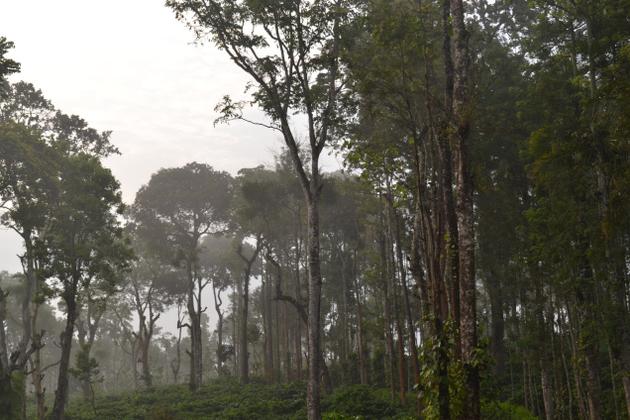
Located at an hour’s drive from Madikeri, the estate is as green as green can possibly be. We had reached there driving through narrow winding hill roads lined with tall oaks and shrubs and had almost missed the elusive turn to the estate. Far removed from habitation, our place of stay is a true example of the back of beyond. The cottages – there are only two of them, since the owners do not want to overcrowd the place – stand bang in the middle of the plantation. The day was bright and sunny when we had arrived in the afternoon; by early evening, however, the sky had already turned a shade of charcoal, and soon rains were lashing at the tiled roof of the cottages: what else could a parched soul from a concrete jungle ask for?
We spent the evening sitting on the cemented ledge of the long verandah, savouring strong coffee and munching on crunchy onion and potato bhajjis made by Lakshmi, the doe-eyed housekeeper of the home stay. It was here, with the coffee and the bhajjis that I met Arun: he had come to say hello and had hung around through the evening, talking animatedly about coffee, climate and Coorg; he had left only after I had agreed to go out with him around the estate in the morning.
In the middle of a thicket now, drenched in sweat, with a steady stream of water dripping from millions of thick, broad coffee leaves on my arms and legs, struggling to climb the slippery hill, and surrounded by unruly branches and the abundant insect life, I curse myself for having agreed to the trek: how nice it would have been to just sit in the verandah and write!
My chain of thoughts is broken by Arun’s voice. He is as energetic as ever, and busy explaining to me why he has brought me here. “I want you to remember Coorg for a long time,” he says, while offering me his hand. I reluctantly take it and climb another tricky rock. He keeps talking and offering me his hand, even as I gasp for breath and almost slip over a pile of soggy leaves, wondering if the climb will ever end.
I am close to tears of frustration and exasperation when I finally see the rays of the early morning sun streaming in through the canopy of leaves. In another few minutes, the dense shrubs magically disappear and we are standing on a large rocky clearing atop a hill that has no road or walkway.
As I look down at the sea of fluorescent paddy fields sprinkled with tiny ponds formed by last night’s rain, the thick forest along the horizon with trees that touch the clouds, the silver mist rising from the earth and mingling with the golden rays of the sun midway, and the height of the hill I have just climbed, my heart fills with gratitude for Arun. I now know what he meant when he said that he wanted me to remember Coorg for a long time. Thanks to him, I will never forget it.
source: http://www.thehindu.com / The Hindu / Home> Features> MetroPlus / by Anubhuti Krishnan / Chennai – August 07th, 2015
WELCOME. If you like what you see "SUBSCRIBE via EMAIL" to receive FREE regular UPDATES.
Read More »