Category Archives: Business & Economy

71.94 voter turnout in Kodagu

The voting was peaceful in Madikeri and Virajpet Assembly constituencies which come under Mysore Lok Sabha constituency. While Madikeri recorded 73.84 per cent voter turn out, Virajpet recorded 70.04 per cent thus registering a total voting percentage of 71.94.
VotingKF23apr2014
The voting was peaceful without any untoward incidents. The voters have decided the fate of the 15 candidates including H Vishwanath of Congress, Prathap Simha of BJP and Chandrashekaraiah of JDS. The counting is scheduled for May 16, at Mysore District Centre.

The voting was brisk in almost all polling booths at morning and in some booths voters turned out afternoon. Madikeri observed drizzling at 2 pm, but it stopped soon after 20 minutes without disturbing the polling process.

Voters stood in long queue to excersice their franchise at Madikeri, Onachalu, Moornadu, Virajpet, Arji, Ammatti-Kaarmaadu, Siddapur, Nelmahudikeri, Vaalnuru, Nanjarayapattana, Kushalanagar, Somwarpet, Guddehosur, Suntikoppa, Kambibaane, Chettalli and other areas. Senior citizens took help from others to cast their vote.

First time voters were happy after exercising their franchise. They showed their fingers marked with ink to media persons.

In Dabbadka polling booth, the voting was delayed by one and half hours because of some problem in Electronic Voting Machine (EVM). The staff had to change the EVM to start the polling.

In Madikeri, the stores and complexes were closed and the city wore a deserted look. One of the resident of city said that because of awareness programmes, the turnout was good.

As it was government holiday and some private companies also declared holiday, the voters’ turnout was good. People came from far away places to exercise their franchise, he said.

source: http://www.deccanherald.com / Deccan Herald / Home> District / Madikeri – DHNS, April 17th, 2014

The Tamara Coorg wins ‘Best Luxury Resort In South India’ award

The Tamara Coorg won the ‘Best Luxury Resort in South India’ award at the South India Travel Awards held in Hyderabad on March 27, 2014. DDP Publications gave away the award at Radisson Blu Hotel at Banjara Hills in Hyderabad.

This exclusive event is presented in four regional editions, with South India as the first event. The award recognises the ‘best of the best’ in travel and tourism in the country. The winners from each zone will now participate in Pan-India awards to be held later in the year.

Senthil Kumar N, Director and CEO, The Tamara Coorg said, “We are really pleased to win this prestigious award. This is a wonderful confirmation of our exclusive service in the luxury segment & our offering to discerning travellers seeking elevated experiences.”

source: http://www.hospitalitybizindia.com / HospitalityBizIndia.com / Home> NewsTrack / by HBI Staff – Mumbai / Monday – April 07th, 2014

Starbucks Says India Operations Fastest Growing in its History

Tata Starbucks currently has presence in Mumbai, Delhi, Pune and Bangalore and has its coffee plantations in the Coorg area of Karnataka. | AP

With 40 stores in 17 months of its operations, India is the fastest growing market in the history of the Seattle-based iconic American coffee chain Starbucks, according to a company statement.

The US-based coffee chain, which had sewed up an equal joint venture with Tata Global Beverages, opened its first outlet in Mumbai in October 2012.

“With 40 stores in four cities (in 17 months) and nearly 1,000 partners, India is the fastest growing market in Starbucks history,” Tata-Starbucks chief executive Avani Davda was quoted as telling Starbucks annual shareholders meet.

Tata Starbucks currently has presence in Mumbai, Delhi, Pune and Bangalore and has its coffee plantations in the Coorg area of Karnataka.

Starbucks globally operates over 20,000 stores across 64 countries, serving over 70 million customers per week.

Starbucks chairman, president and chief executive Howard Schultz told shareholders that the company would continue to reinforce the ongoing investments in 200,000 Starbucks partners (employees), including USD 250 million in their healthcare benefits and USD 234 million in bean stock in fiscal 2013.

He said the company recorded record revenue of USD 14.9 billion, up 12 per cent and record earnings per share of USD 2.261, up 26 per cent, taking its net profit to USD 2.5 billion, a rise of 23 per cent in fiscal 2013.

source: http://www.newindianexpress.com / The New Indian Express / Home> Business> News / by PTI – Mumbai / March 20th, 2014

Media Academy awardees felicitated

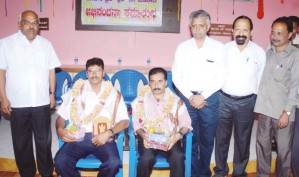
KodaguKF23mar2014Winners of Media Academy awards — K. Jeevan Chinnappa (Karnataka Bureau Chief of The Hindu) and M.S. Rajendra Kumar (Mysore Bureau Chief for Prajavani) — and who had served in Madikeri for several years, being felicitated by the Kodagu District Journalists’ Association in Madikeri yesterday.

Former Assembly Speaker and MLA Ramesh Kumar, senior journalist Ravindra Bhat, Kodagu Press Club President U.M. Poovaiah and Kodagu Patrika Bhavan Trust General Secretary K.B. Mahantesh are seen.

source: http://www.starofmysore.com / Star of Mysore / Home> General News / March 18th, 2014

Actress Shubra Aiyappa launches Pochampally ‘IKAT art mela’

Mela 2014, at Sree Chowdeshwari Kalyana Mantapa ,West of chord Road ,Rajaji Nagar,Bangalore.In this Mela, renowned Textile designers and Weavers of Pochampally , presenting their designer and appearls, handicrafted designer sarees, dress materials, hand bags many more. The exposition will be on till 23 rd March 2014.
ShubraKF20mar2014
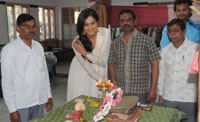
Sandalwood upcoming and Tollywood Actress Shubra Aiyappa inaugurated the Mela by lighting the lamp. “It’s glad to see various apparel, particularly designer Fabrics, silk and cotton sarees, to be showcased for the Fashion Connoisseurs” said Shubra .”Platforms such as this are required to reach out women looking for well-designed hand made handloom cotton, exclusive home textile. Which can see the blend of different style and concept of handloom creations coming together under one roof? she added.

‘Weavers exhibiting their creations of different genres of handloom products in vibrant colours and textures in wide variety and styles” Krishna- Ex -Chairman pochampally Handloom park, said. on display colour ful range of fabrics like home textile to apparel fabrics, stoles , scraves, and sarees in silk & Cotton, duppatas, table mats, covers, cotton shirts & Kurtis, Hand bags’ he added.

source: http://www.newstrackindia.com / NewsTrack / Home> Life Style / by NI Wire / Bangalore – Saturday, March 15th, 2014

Smell the oranges (and the coffee!)

Summary

The famous loose-jacketed mandarin orange was as much a part of the fabric of Coorg as the coffee alongside which it was planted
_______________________________________________________________
Owned and managed by the Ramapuram family of Kerala, Orange County Resorts and Hotels is based on the ‘Spirit of the land’ philosophy that showcases the nature and culture of the regions where it is operational. The first Orange County Resort that opened at Coorg in 1994 was built on the theme of coffee, spice and plantation life to reflect the true spirit of Coorg, and is situated amidst 300 acres of coffee and spice plantations. It is flanked on one side by the Dubare Reserve Forest and the river Cauvery on the other.

Link to the land
Reminiscing on the days of old, Cherian Ramapuram, director, Orange County Resorts and Hotels says, “The Orange County – Coorg resort was built on the plantation owned by our family from 1926. In the 90s, Coorg was not known outside Karnataka. The location was extremely beautiful, packed with history and culture. Orange trees are usually inter-planted along with shade trees for cultivating coffee. So like coffee, Coorg produced the best oranges in the country, till a virus attacked them about 18 years ago. The huge, sweet, loose jacket oranges turned into small tight skinned sour ones. The resort was christened when the oranges were good.”

The brand opened its second resort at Kabini in 2007. Inspired by the local ‘Kadukuruba Hadis’, the architecture of this tribal themed resort was crafted to transport its guests into a tribal setting from which they can enjoy the spectacle of Asia’s largest biosphere.

Cherian Ramapuram adds, “With location and luxury coming together in such a happy union, Orange County Resorts offers guests a true ‘Spirit of the land’ experience. Plantation stays are unique because they are a combination of an exclusive lifestyle, while touching the soul of the land. It also gives one an opportunity to see how the precious commodities that they buy or use in the day-to-day life are cultivated. We give the guest a very unique experience of living like a ‘Planter’ for the stay. They get to go for a signature tour of the plantation, plantation trail, nature walk, etc., which are unique to this part of Coorg.”

The resort’s main target is the discerning traveller. Cherain Ramapuram feels that the guest profile shows a continuous evolution. Today’s guest is more educated tastes become more refined as they travel around the world. While there is no specific special interest groups in this segment, the discerning traveller looks for experiences like this. He says, “We do not promote stays or even holidays. We promote Exclusive Local Experiences.”

Community is core

Orange County’s Kabini property has been selected by National Geographic Traveller among the top 25 Eco Lodges in the world. The company takes guest feedback and suggestions very seriously. “This is evident from the feedback that you can see on sites like Tripadvisor. All these comes wrapped in highest standards of responsibility in tourism,” says the proud hotelier.

His brother Thomas Ramapuram, joint director, Orange County Resorts and Hotels elucidates on the sustainable hospitality measures the company has initiated. “The concept of responsible tourism comes naturally to Orange County Resorts. It is, after all, an extension of the vision and philosophy of the House of Ramapuram whose values are broad, contemporary and inclusive.”

The government has now made CSR mandatory part of a company’s revenues. But Orange County has long supported community development. “Over 60 per cent of our staff at both resorts are from the surrounding local areas. We constantly strive to engage with local village heads in community development programmes. We also conduct Structured Community Development Programmes on an annual basis like for example, scholarships, toilets in villages, road work, etc,” says Thomas Ramapuram.

He adds, “We believe that education is the most powerful weapon which you can use to change the world. So we have formally adopted the local school at Coorg in Karadigod Village. We are also in the process of adopting the school in Kabini (H.D.Kote Village), however we have not received a formal government approval for the same. Through adoption we have implemented various initiatives like computer facilities, better play grounds, hiring quality teachers etc. This is an ongoing continuous process and our vision is to develop these schools into world class institutions of learning.”

The brand has also adopted technological innovations to make the guest experience a seamless one. “Our indigenously developed central reservation systems compares with the best in the industry. It allows for easy storage, access and transmission of information. Our systems allow us to have an intimate knowledge of each of our guests even before they step into our properties.”

It is rare to find a two resort brand in the world today that has 60 per cent of their clients booking directly with us (as opposed to booking through a OTAs or a tour operator). We are able to achieve this through our powerful database management systems and processes.”

Being a traditional brand with a strong focus on ethics, values and other old fashioned ideas, has not stopped the brand from embracing technology and leveraging its tremendous power to deliver a superior guest experience. “Technological innovation is a core value at Orange County Resorts,” reiterates Thomas Ramapuram.

As for the brand’s foray outside Karanataka, Cherian Ramapuram says that it has not been easy to build and run resorts in the state itself. “While we have not yet looked seriously outside, we are keeping our eyes open for opportunities. We have two more locations where we have land in Karnataka. We are looking out for options outside the state and the country too,” he optimistically sums up.

source: http://www.financialexpress.com / The Financial Express / Home> Travel & Tourism / by Steena Joy / Mumbai – March 11th, 2014

Tata Coffee sees huge margin upside in instant coffee biz

Tata Coffee expects markets of West Asia, Turkey and Iran to open up and becoming new buyers. It is also witnessing shift in dynamics of its US market business. “We are shifting much of our business from bulk to packaging currently,” said Huq.

Hameed Huq, MD of Tata Coffee said the rally in coffee prices is based on the severe drought in Brazil, the world’s biggest coffee producer.

The prices of Arabica coffee have gone up by 60 percent in the last 6-8 weeks, and this rise is here to stay, says Huq. “While Robusta coffee prices have gone up, they have not moved up as dramatically as Arabica coffee prices,” said Huq. Tata Coffee expects markets of West Asia, Turkey and Iran to open up and becoming new buyers. It is also witnessing shift in dynamics of its US market business.

In an interview with CNBC-TV18’s Reema Tendulkar and Ekta Batra, Huq said, “We are shifting much of our business from bulk to packaging currently.”.

Tata Coffee garners 50 percent of its revenue from instant coffee business. Huq says the company plans to focus more its coffee business and sees no new additions in its tea business. “We are seeing huge upside in margins for our instant coffee business,” he told the channel.

Below is the verbatim transcript of the interview:

Q: We have witnessed sharp increase in coffee prices across 2014, how much does Tata Coffee stand to gain since the company exports a considerable proportion of the produce?
A: The coffee prices in the terminals are determined by two factors. One is a fundamental factor, the other is the funds, etc playing. This rally is based on a very severe drought in Brazil, so this is a rally and Arabica prices have gone up by 60 percent. However, along with anticipated shortfall in Brazil the Robusta prices have also moved up. It has not gone up to the same extent whereas Arabica has moved up by 60 percent; this has moved up by 30 percent odd. So, what does it do for Tata Coffee – essentially we have just completed our harvest. We finished Arabica, we got good crop. Robusta, the crop was marginally lower. We have got all this coffee now to sell in financial year ’14-15. So, to that extent price increase will translate back into the bottom line and the various quarters coming forward.

Q: Analyst views are suggesting fall in coffee prices globally, what is your view?
A: We have to look at what has caused it because a lot of people are analyzing it. Essentially, we were looking at a carry forward, a surplus stock at the end of the next coffee year, about five-six million bags. The crop has come down by 10 million bags. So, from a surplus situation this has gone into a deficit situation on the closing stock. The other thing to understand is what has caused this. If it was simple lack of rainfall, definitely rains would come and things would correct itself but in Brazil what has happened, it was not only lack of precipitation rainfall, it was compounded with very high temperatures which depleted the soil moisture with the result certain amount of damage has been done not only to this year’s crop, people are talking for next year’s crop also being affected. So, if we come out with a deficit situation or a breakeven situation and then come into not a big crop next year; with steady 2 percent rise in consumption, these prices – our understanding will remain whether it will remain at USD 2 or come down, nobody can say but gone are the days what we saw second half of last year of dollar end 5 and dollar end 10 cents to the pound, which is below the cost of production of many producers in the world and everybody will have views on this. Our views are that because this is by fundamental, the retraction will not go back to the levels we saw six months ago.

Q: The fall in coffee prices during 2013 or last year did hit your performance. So, in that sense, can you give us a sense, number wise that if in case there is an improvement in coffee prices, what would be the impact number wise on the profit and loss (P&L) front for Tata Coffee?
A: We generally do not give guidance on principal. There is a normal escalation in cost with the wages and everything else and take the percentage increase because we generally do not give guidance on percentage on improvement on margins. Q: Your Company exported nearly 40 percent in January on stronger prices but how are you seeing the current situation pan out? A: The maximum benefit will come into the next financial year largely on account of – although we are a plantation company, 50 percent of our revenue comes from instant coffee. If you look at it, the Arabica prices have hardened substantially but the Robusta prices have not got up to the extent. Our major competition with low Arabica prices came from the South American producers who use a lot of Arabica in instant coffee. To that extent, we will be much more competitive with higher percentage of Robusta and also having covered our coffee fairly well. In instant coffee business also we are seeing an uptick after this. Last year there was acute competition from producers in Brazil but to that extent Arabica prices have gone up substantially and our competitive pressure also comes down in instant coffee which is significant for our business now almost 50-55 percent of income comes from instant coffee.

Q: During 2013 we did see you enter into the south East Asian markets. What is on the anvil for the international markets at this moment or perhaps in the near future, anything that you have slated in 2014-2015?
A: We have been able to consolidate our position in Japan which is a very difficult market but a remunerative market. Russia, which has given us problem, last year on account of dumping from Ecuador and Brazil is again opening up in spite of the internal problems. However, what is very interesting is that Middle East, Turkey, Iran, they have become new buyers. These are economies that are opening up. So, this is our new thrust. We will consolidate our position in West Africa; we are also entering into Eastern Europe which is roasted ground coffee but instance coffee is there. So, these are the new markets, the new initiatives we have taken on. We have commissioned a very modern packaging unit at our Theni plant. So, we are moving our business more from bulk to the packing. So, these are the two significant steps we have taken and should start seeing the result in the next financial year.

Q: What about the Eight O’ Clock business because it saw a fall close to about 12.5 percent in Q3. Has there been any recovery and would be the expectations be how Eight O’ Clock will perform going ahead?
A: There has been a little change in the market dynamics in the US coffee market. Large reason the shift from black coffee to single serve is very rapid but Eight O’ Clock is in both the segments. So, you may see some volume issues, topline issues but if you look at the overall profitability, the business is very sound. So, we are adjusting to the market dynamics, we have had a major relaunch of our Eight O’ Clock coffee and this way, we started seeing the volumes coming in there but we are fully attune to changing the dynamics from black coffee to single serve but fortunately we are in both the segments so I see the businesses should not be under any pressure in the coming year.

Q: What about your tea business. It contributes to around 5 percent of your revenues at this point. How do you expect to scale it up if in case that is the plan for Tata Coffee going ahead?
A: Not really because we have a tea business, it’s a very small part of the business. Our focus has been on coffee. If you look at margins that we get out of coffee and tea in plantation – it is much easier to add value to coffee. In our Arabica – when the prices were down last year, we had a substantial value by producing very high quality specialty coffee – that protected our bottom line in spite of a difficult year the results that you are seeing are not to that extent. Second, we are committed on going into instant coffee, the soluble coffee business where also we see huge upside on the margins going forward and new markets coming in. Tea is there, we have the estate but we dot not have any vigorous growth plant on tea as we have in coffee.

Tata Coffee stock price

On February 24, 2014, Tata Coffee closed at Rs 916.95, up Rs 1.90, or 0.21 percent. The 52-week high of the share was Rs 1675.00 and the 52-week low was Rs 869.90.

The company’s trailing 12-month (TTM) EPS was at Rs 56.40 per share as per the quarter ended December 2013. The stock’s price-to-earnings (P/E) ratio was 16.26. The latest book value of the company is Rs 280.80 per share. At current value, the price-to-book value of the company is 3.27.

source: http://www.moneycontrol.com / MoneyControl.com / Home> News> Business / Source: CNBC-TV18 / March 10th, 2014


Mysore-Madikeri rail line project ‘being revived’

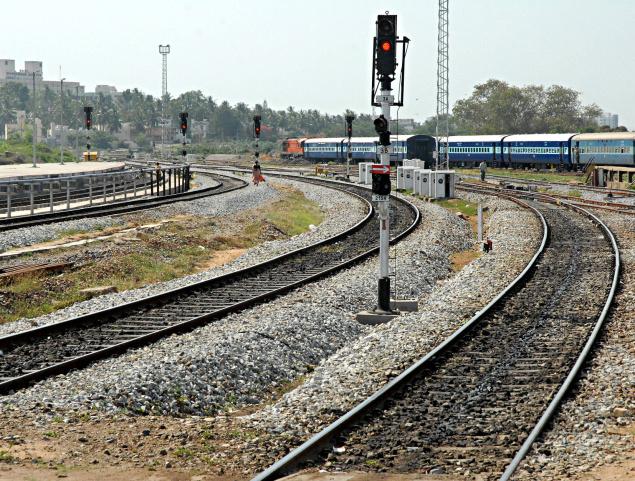
The 100-km rail line is expected to connect Mysore with Hunsur, Periyapatna and Kushalnagar in the first phase./  File Photo: M.A. Sriram / The Hindu
The 100-km rail line is expected to connect Mysore with Hunsur, Periyapatna and Kushalnagar in the first phase./ File Photo: M.A. Sriram / The Hindu

Earlier, it was perceived to be economically unviable and shelved

A question mark hovers over the future of the Mysore-Kushalnagar-Madikeri rail line project, for which there was a considerable push from a section of stakeholders in the region.

Although the preliminary engineering-cum-traffic survey for the new rail line was launched more than two years ago (in December 2011) and completed four months later, there has been no further progress. However, according to a railways document on the status of various projects and new lines coming under the South Western Railway, the 100-km line project seems to have been “shelved” by the Railway Board.

This was confirmed by a senior official of the construction wing of the Indian Railways. The official added that the board had shelved the project because it was perceived to be “economically unviable,” but clarified that it was being “revived” again.

“The State government has come forward to fund 50 per cent of the cost and provide land free, following which the project was sent to the Railway Board for a review. But we have not heard anything from the board so far, and will have to wait for the full-fledged budget after the new government comes into power at the Centre, to see if the project gets any financial allocation this year,” the official added.

When the survey was launched, the cost of the new rail line — expected to connect Mysore with Hunsur, Periyapatna and Kushalnagar in the first phase — was pegged at around Rs. 600 crore.

The then Railway Minister K.H. Muniyappa had averred that work on the new line would start “within a year” after the survey’s completion; however, the project did not receive any allocations in the two budgets that followed. The Railway Budget 2010–11 included the line under ‘socially desirable rail connectivity proposals’. However, given the pace of construction and the gestation period of the projects, it is anybody’s guess as to when the rail line will materialise, the official said.

Incidentally, the Mysore-Madikeri line was first mooted around 1881-82, according to the Mysore Gazetteer published by the State government. It also notes that two alternative routes connecting Mysore and Madikeri were suggested, but never took wing.

The first route was a branch line to Bettadapura and Kushalnagar, from the Mysore-K.R. Nagar main line.The second connected Mysore and Hunsur, linked with Kushalnagar. It was for this route that the survey was conducted two years ago.

source: http://www.thehindu.com / The Hindu / Home> News> National> Karnataka / by R. Krishna Kumar / Mysore – March 04th, 2014

PGCIL keen on completing Mysore-Kerala project

KodaguMapkf08mar2014
Power Grid Corporation of India Ltd., a Government of India enterprise, which is drawing the 400 KV D/C transmission line from Mysore to Kozhikode in Kerala via Kodagu district, has blamed certain non-governmental organisations of placing hurdles to the implementation of the project citing environmental reasons.

Of the 210-km transmission line, work has been completed in a stretch of 155-km (92 km in Kerala and 63 km in Karnataka). The balance 54.5-km line needs to be drawn in Kodagu, through 38 km of paddy fields and across 12 km of coffee plantations. Works covering a distance of 4.5 km in reserve forests in Kodagu has been completed. The Coorg Wildlife Society and Cauvery Sene have been opposing the project.

The apprehension created by the NGOs among the people over the project is unfounded, says S. Ravindar Kumar, Additional General Manager, PGCIL, who is in charge of the Karnataka projects. He told The Hindu that the project was entrusted to the PGCIL to evacuate power from Kaiga 3 and 4 nuclear plants, with the prior approval of the Union government. The Union Ministry of Environment and Forests had given clearance for the lines in Kodagu.

As many as 2,450 trees were cut in Kodagu to draw the line across a stretch of 4.5 km reserve forests. An estimated 6,000 trees would have to be cut in the 12-km stretch of coffee plantations and about 300 in the 38-km stretch of paddy fields. However, the contention of the NGOs that over 50,000 trees would be felled to draw the line via Kodagu was far from the truth, Mr. Kumar said.

The PGCIL had commenced the Mysore-Kozhikode line works in December 2005, which was to have been completed in 2007. But, the Kodagu stretch has remained a bone of contention. It has also planned to earmark Rs. 60 crore for payment of compensation to farmers and has already deposited Rs. 10 crore in the Kodagu district treasury. Farmers could be paid Rs. 15 to Rs.18 lakh per acre as compensation in coffee plantations and Rs. 2 lakh per acre of paddy field, Mr. Kumar said.

The alternative routes suggested by the NGOs: utilising the 220 kV Kadakola-Kaniyampetta corridor (through the Bandipur National Park) would not be possible as it is the only inter-State feeder and de-energising it cannot be done since it is critical to meet the demands of north Kerala. The second alternative, that the existing D-line could be made use of (via Nagarahole National Park) was rejected by the State and Union governments.

source: http://www.thehindu.com / The Hindu / Home> News> National> Karnataka / by K. Jeevan Chinnappa / Bangalore – March 05th, 2014

Karnataka Fashion Week pays tribute to Coorg

Tribute to Coorg at Karnataka Fashion Week — the three-day event put together by fashion guru Prasad Bidapa. Entrepreneur Ashok Kheny inaugurated the second day of the fashion week, where Prasad, who was dressed in a traditional Coorg Kupiya, paid a tribute to Coorg and the book, The Vanishing Kodavas.

Fashion was of course in focus at the event, and the second day saw collections from Roopam Silks, Nimirta Lalvani, Abrar Ali, Ritu Pandey, Tahera Peeran, Manish Saksena, Anjali Sharma and a finale by Jamila and Seema Malhotra.

Also present the occasion were Charu Sharma and Nooraine Fazal from B.PAC.

source: http://www.timesofindia.indiatimes.com / The Times of India / Home> Entertainment> Events> Bangalore / TNNn/ January 25th, 2014