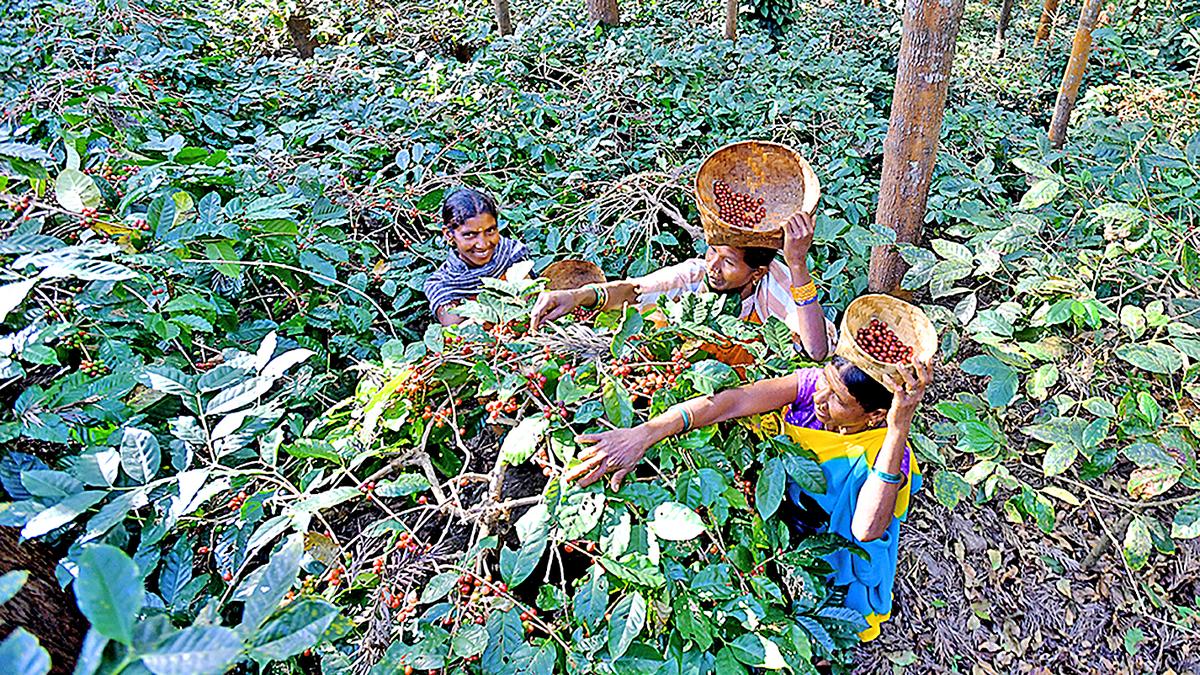
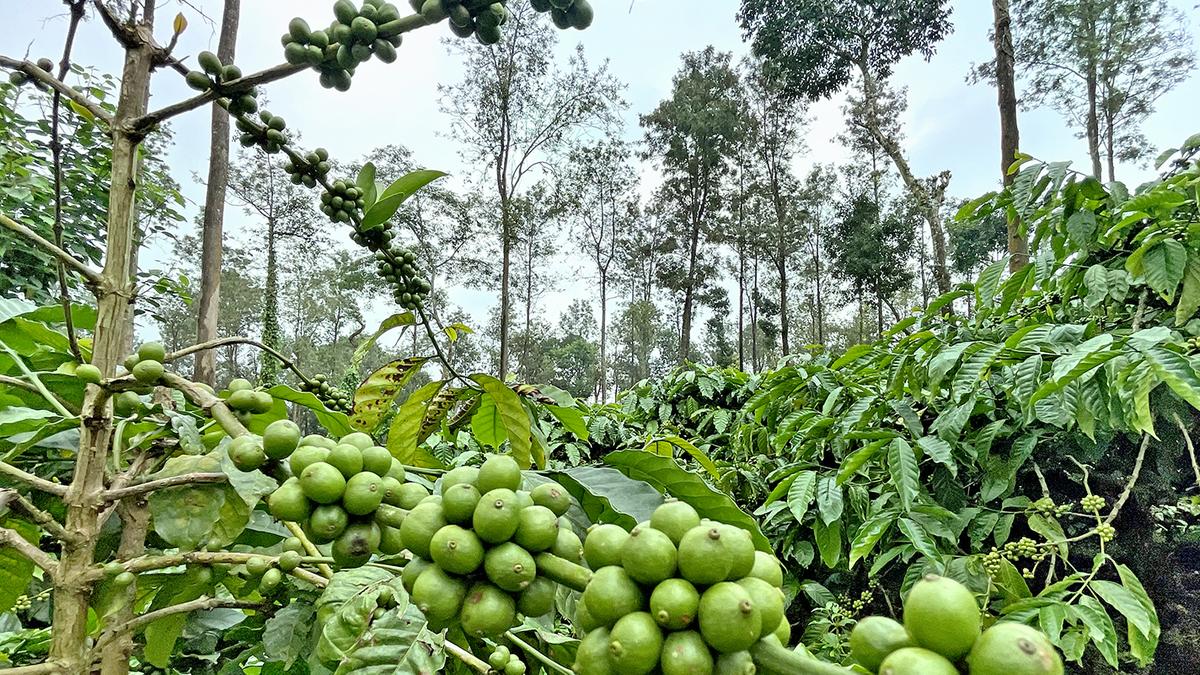
The initiative aims to establish 2,500 coffee kiosks and train women from self-help groups to become successful coffee entrepreneurs.
Women harvesting coffee beans. Initially, 400 women will be trained to become master trainers at the coffee board’s head office in Bengaluru. | Photo Credit: K.R. Deepak
The Coffee Board of India, in partnership with the National Livelihood Mission in Karnataka, has initiated a project to empower 1,00,000 women members of National Livelihood Mission Self-Help Groups (SHGs) across the State on coffee brewing techniques and rural cafe management.
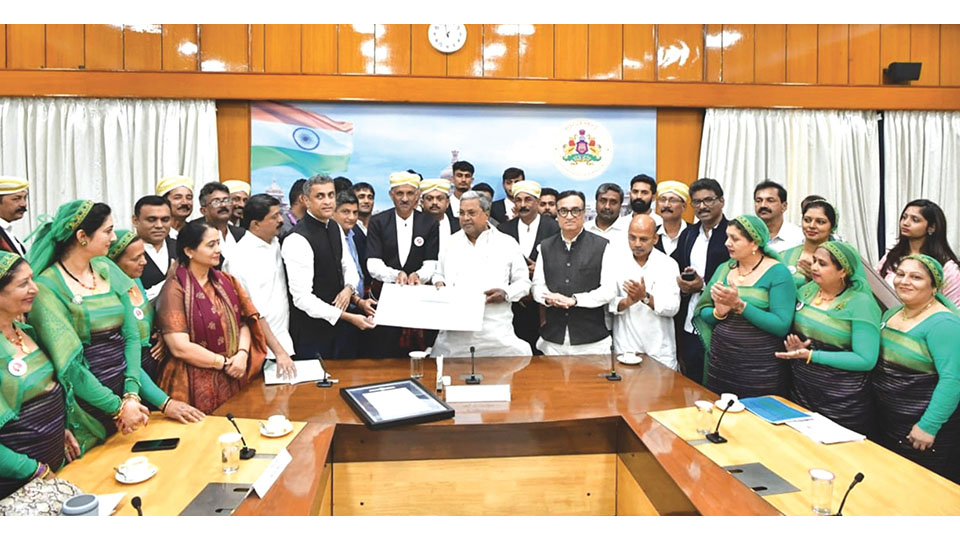
To execute the programme, an MoU was signed between K.G. Jagadeesha, CEO and Secretary, Coffee Board, and P.I. Sreevidya, Mission Director of National Livelihood Mission. This was mainly aimed to facilitate the establishment of rural and urban cafes dedicated to offering an authentic filter coffee experience, said the coffee board on Wednesday.
“The coffee board, in collaboration with subject matter experts and in-house specialists, will work along with the Atal Incubation Centre of Coffee Board, the implementing and monitoring partner, to ensure impactful outcomes,’‘ said Mr. Jagadeesha. Ms. Sreevidya added: “This coffee micro entrepreneurial project will provide a new window of opportunities to women empowerment.”
According to the coffee board, the project will be implemented in two phases. Initially, 400 women identified by NLM will be trained to become master trainers at the coffee board’s head office in Bengaluru, who in the second phase will subsequently upskill other women at taluk and hobli levels. The initiative aims to establish 2,500 coffee kiosks and train one lakh women from SHGs to become successful coffee entrepreneurs.
The State government allocated ₹25 crore in its 2024-25 State budget to train one lakh women from NLM SHGs as coffee entrepreneurs. ‘’By supporting potential and existing entrepreneurs, it promotes gender equality, reduces poverty, and fosters opportunities for marginalised women,” Mr. Jagadeesha said.
source: http://www.thehindu.com / The Hindu / Home> News> India> Karnataka / by The Hindu Bureau / January 23rd, 2025
India’s relationship with coffee dates back centuries. The story begins in the 1600s when Baba Budan, a revered holy saint, brought seven Mocha seeds to the hills of Karnataka. This simple act of planting seeds in his hermitage courtyard in Baba Budan Giri marked the beginning of India’s rise as a significant coffee producer. Over the years, coffee cultivation has transformed from a modest practice into a booming industry. Today, India stands as the seventh-largest coffee producer in the world, with exports reaching an impressive $1.29 billion in the fiscal year 2023-24. This figure is nearly double the $719.42 million recorded in 2020-21.
Growing Global Demand for Indian Coffee
The surge in India’s coffee exports can be attributed to the increasing global demand for its rich and unique flavors. In January 2025 alone, India exported over 9,300 tonnes of coffee, with major buyers including Italy, Belgium, and Russia. Approximately 75% of India’s coffee production consists of Arabica and Robusta beans, primarily exported as unroasted beans. However, there is a notable shift towards value-added products, such as roasted and instant coffee, which is further driving the export boom.
The rise of café culture, coupled with higher disposable incomes, has led to a growing preference for coffee over tea among Indian consumers. This trend is evident in both urban and rural areas. Domestic coffee consumption has increased from 84,000 tonnes in 2012 to 91,000 tonnes in 2023. This shift reflects a broader change in drinking habits, as coffee becomes a staple in daily life for many Indians.
Coffee Cultivation in India: A Rich Heritage
India’s coffee is primarily cultivated in the ecologically rich Western and Eastern Ghats, known for their biodiversity. Karnataka leads the nation in coffee production, contributing 248,020 metric tonnes in 2022-23, followed closely by Kerala and Tamil Nadu. These regions are home to shaded plantations that not only support the coffee industry but also play a crucial role in preserving the natural environment. They help maintain the ecological balance of these biodiversity hotspots.
The Coffee Board of India has launched several initiatives to enhance coffee production and meet the growing domestic and international demand. The Integrated Coffee Development Project (ICDP) focuses on improving yields, expanding cultivation in non-traditional regions, and ensuring the sustainability of coffee farming. These measures are part of a comprehensive strategy to strengthen India’s coffee industry, increase productivity, and enhance its global competitiveness.
Empowering Communities Through Coffee Farming
A prime example of successful coffee farming is found in Araku Valley. Here, nearly 150,000 tribal families have collaborated with the Coffee Board and the Integrated Tribal Development Agency (ITDA) to increase coffee production by 20%. This achievement is supported by loans from the Girijan Co-Operative Corporation (GCC). It demonstrates how coffee farming empowers communities and aligns with the vision of Aatmanirbhar Bharat, or self-reliant India.
These initiatives, along with export incentives and logistical support, play a vital role in expanding India’s coffee industry. They not only improve domestic production but also enhance global competitiveness. As India continues to establish itself as a leading player in the global coffee market, the future looks bright for this beloved beverage.
source: http://www.observervoice.in / Observer Voice / Home> News> National / by Shalini Singh / January 21t, 2025
Timbertales Luxury Resort, nestled amidst the luah forests of Coorg, is delighted to announce its grand opening this January. This much-anticipated retreat with 71 villas, spread across 100 acres , is designed to pamper, soothe, and offer an oasis of serenity for those who seek an escape.
Timbertales is more than a resort. It is an experience where every leaf tells a tale. Designed by a noted architect Mr. Abdul Manan, the resort’s global architecture seamlessly blends eco-luxury with traditional local craftsmanship. All villas on the property are made with Laterite stone, with the structures blending harmoniously with the lush greenery, exuding an air of understated luxury.
The true essence of Timbertales comes alive with the extensive use of Balinese bamboo that reflects limitlessness. The design features open spaces and abundant natural light, making you feel part of the forest and seamlessly blending architecture with nature, creating a tranquil and immersive retreat.
Mr Prasad G P, Joint Managing Director and the visionary behind Timbertales, says, “Timbertales is not just a place to stay, it’s an experience that embodies the charm of Coorg while redefining luxury tourism in India. Our goal is to create a retreat where guests can reconnect with nature, immerse themselves in local culture, and indulge in personalized luxury”.
Wellness in Nature
Embrace wellness and tranquillity at Viyoma, where nature and tradition unite to rejuvenate your mind and body. The 27,000 sq. ft. centre, spread across three levels, has 25 therapy rooms offering Swedish, Balinese, Aromatherapy, and Ayurvedic treatments. Viyoma also offers the only Turkish Hammam in the region.
Guests can also relax in the panoramic sauna, which creates a calm environment with beautiful views of the surrounding landscape. Additionally, Viyoma includes specialized skin and hair care treatments designed to enhance natural beauty and rejuvenation. Understanding that wellness is a necessity in today’s fast-paced world, Viyoma expands its services to include wellness for kids, thoughtfully crafted to nurture their well-being and promote holistic growth.
Offering guided yoga and meditation sessions, the Vinyasa Yoga Deck is an atmosphere that offers calmness and vitality. Set against the backdrop of a vast 7-acre lake, it transports you into the embrace of nature and fosters an unmatched sense of tranquillity.
The Villas
Each of the 71 villas at Timbertales is designed with luxury and comfort in mind.
Windchimes Duplex Villa – This cozy yet luxurious duplex villa offers a unique experience where you descend to a beautifully designed room and wake up to an amazing nature view. Ideal for couples with distinct personas.
Riverstone Family Villa – Designed for families seeking togetherness and personal space, the villa has interconnected staircases that balance privacy and connection. The large balconies, invite you to spend time outdoors, offering a seamless connection with nature.
Mistwood Pool Villa – This villa is designed as a serene retreat, where the mist whispers ancient woodland stories to those who listen, offering a breathtaking view from its infinity pool, perfect for a young family.
Forestlight Luxury Villa – This villa is a world in itself, covering 3200 sq. ft. of luxurious space. It offers a truly unique experience, featuring an open living area, an in-house therapy space, an open-air shower, a jacuzzi, and an infinity pool overlooking the lake.
Timbertales offers luxury experiences priced between INR 40,000 and INR 1,00,000, where everything from meals to curated experiences is thoughtfully managed, embodying the essence of stress-free getaways.
The Dining Experience
Food is at the heart of any holiday memory. In line with this philosophy, the resort’s restaurant “Bamboo Buzz” offers over 250 curated dishes, lakefront views, and a unique ‘pan-to-plate’ experience. The ‘pan-to-plate’ concept emphasizes a fresh, immersive dining experience where guests can witness and ensure that each dish is as authentic and flavorful as it can be. “The Cellar Lounge Bar” awaits, where Winchester-style seating and an exquisitely appointed bar offer a perfect backdrop making it a must-visit destination.
“Twisted Basil” a plant-based culinary haven, features a dedicated vegetarian kitchen, private dining pods on a water body, and tropical surroundings with stunning panoramic views. Each of the curated set menus offer a luxurious 7-course meal, crafted to soothe any palate.
The Experience
At Timbertales, there is never a moment to get bored. Nature walks, aided by expert naturalists, wellness therapies, curated yoga sessions around the lake, kayaking, the infinity pool ‘Ripples’ overlooking the lake and equipped with a bar, and a lot more.
For children, the exclusive play area ‘Funky Turtle’ provides engaging activities that encourage them to step away from screens and enjoy interactive play. ‘The Modur Kaapi’: A Coffee Experience Centre offers guests a glimpse of the coffee-making process, as well as delightful choices in local brews. Guests can explore the entire process, from bean selection to brewing techniques, as part of the resort’s unique Bean to Brew concept.
Timbertales is situated 7 km away from the main city of Madikeri and can be accessed by road or nearby aerodromes. The resort offers one of the few helipads in Coorg for direct and convenient access.
About Timbertales Luxury Resort
Timbertales Luxury Resort, located in the lush landscapes of Coorg, is founded on the belief that nature is a storyteller. Here, luxury and the wild coexist in perfect harmony, offering guests an unparalleled opportunity to immerse themselves in the tales of the natural world. Designed with eco-consciousness at its core, Timbertales seamlessly integrates sustainability with opulence, allowing visitors to experience the soul of the forest while enjoying unmatched comfort.
source: http://www.msn.com / MSN / Home / by ANI news www.aninews.in / via PRNewswire / January 22nd, 2025
For the past five years, coffee plantations in Kodagu, Chikkamagaluru, and Hassan districts have grappled with a labour crisis during the crucial November-to-March harvest period.
While harvesting requires manual labour, small planters are proposing mechanisation of processes like drying beans and irrigation, which will help reduce dependency on labourers. | Photo Credit: File photo
Karnataka’s big coffee planters, reeling under years of labour shortage, are enjoying a welcome respite this harvest season as migrant workers arrived in sufficient numbers to meet the demand even as coffee prices have hit a record high this year, offering a financial cushion to growers after years of challenges.
For the past five years, coffee plantations in Kodagu, Chikkamagaluru, and Hassan districts have grappled with a labour crisis during the crucial November-to-March harvest period. Planters heavily rely on migrant workers, primarily from Assam and West Bengal, with smaller contingents from Tamil Nadu, Kerala and north Karnataka. However, the COVID-19 pandemic, lockdowns, and state and general elections in those States disrupted the arrival of these workers, exacerbating the shortage.
“We’ve seen a good inflow of labourers from Assam and West Bengal, unlike in recent years,” said Kaibulira Harish Appaiah, former president of the Kodagu Growers’ Association and executive committee member of the Kodagu Planters’ Association.
“All the elections in these States are over. There is no pandemic. This has ensured that workers can travel to Karnataka without disruptions. Coupled with record-high coffee prices, growers are hopeful that this will help recover from the losses incurred over the last 15 years, and help them reinvest in their estates,” he added.
However, workers from Tamil Nadu and north Karnataka have dwindled, opting for construction jobs in urban areas, such as Bengaluru. “These sectors offer regular work and comparable wages, pulling workers away from coffee estates,” said Mr Appaiah.
Kiran Hegde, a planter from Sakleshpur in Hassan, said, “Coffee harvesting is physically demanding and requires precision, which is why we rely on trained workers. The return of migrant workers has brought some relief, but it’s been a tough few years for all of us. If these high prices sustain, it might just give us the breathing room we desperately need.”
Varun Raj, a coffee grower from Mudigere in Chikkamagaluru, said, “We’re finally seeing hope. With global prices rising and labourers returning, it feels like we’re catching a break. However, this is just the beginning — we need sustained efforts to address these challenges for the future. Again next year we don’t know whether the labourers will come and if the price of the coffee will be high.”
Struggle for small growers
While large coffee estates have sufficient labour, small growers are still struggling.
“It usually takes a month to harvest my five-acre plantation with adequate workers. This year, we’ve only managed to cover 30% so far. Despite the high prices, small growers like me cannot afford the increased wages being offered by the larger estates. If we don’t harvest soon, the overripe cherries will drop, causing significant losses,” said Ramesh Uthappa, a planter from Birunani village in Kodagu.
Labour-intensive harvesting requires skilled hands, as the delicate process involves picking ripe cherries without damaging the plant. Workers, often earning double their usual wages, are incentivised to make the long journey to Karnataka.
Planters urge support for coffee mechanisation
Coffee growers rued the lack of support from the State and Central governments as well as the Coffee Board.
M.T. Poovaiah, a coffee planter from South Kodagu, said, “Labour shortages have become a major challenge. Local labourers are no longer available, and we have to rely on workers from Kerala, who come here, work for the day, and return home. We bear their transportation costs and hefty labour charges, which result in significant losses. Around 80% of the profit we earn from coffee goes back into maintaining our estates throughout the year. This includes expenses for harvesting, fertilizers, irrigation, and other essential work.”
Small coffee planters are urging the government to support mechanisation and automation to address labour shortages.
Highlighting this need, Mr Poovaiah added, “To tackle labour shortage problems, mechanisation and automation must be adopted in coffee plantations, and the government, especially the Coffee Board, should assist us. While harvesting still requires manual labour, mechanisation can be applied to processes like drying beans and irrigation, which will help reduce dependency on workers in these areas.”
source: http://www.thehindu.com / The Hindu / Home> Business> Agri-Business / by Darshan Devaiah B.P. / January 17th, 2025
Chief Minister Siddaramaiah handed over a cheque for Rs. 1 crore to the Kundyolanda family, organisers of the 2024 Kodava Hockey Festival, during a ceremony held here on Thursday.
The funds, allocated from the Department of Youth Empowerment and Sports, underscore the government’s commitment to promoting the unique sporting tradition of the Kodava community in Kodagu.
The event was attended by Virajpet MLA and Chief Minister’s Legal Advisor Ajjikuttira S. Ponnanna, MP Ajay Maken, Medical Education Minister Dr. Sharanprakash Patil, Urban Development Minister Byrathi Suresh, Chief Secretary to the Government Shalini Rajneesh, and Additional Chief Secretary to the CM and Additional Chief Secretary, Finance L.K. Atheeq.
Highlighting the cultural and sporting significance of the festival, CM Siddaramaiah praised the Kodava hockey tournament, which entered the Guinness World Record last year as the largest field hockey event.
The 2024 edition saw participation from 360 teams and 4,800 players, showcasing the unmatched passion of the Kodava community for hockey.
“Hockey is deeply rooted in Kodava culture, and it is a matter of pride that the tournament has gained global recognition. As the birthplace of hockey legends like Dhyan Chand, India must nurture this sport alongside cricket. The State Government remains steadfast in its support for elevating the Kodava Hockey Festival to greater heights,” Siddaramaiah stated.
The Kodava family hockey tournament, a hallmark of the Kodagu district, has been organised annually for over two decades. It began in 1997 with just 60 teams and has grown into a mega-event with international attention.
Many Kodavas have gone on to represent India in national hockey teams, further cementing the community’s association with the sport. CM Siddaramaiah expressed his hope for the tradition to flourish and promised continued support to sustain the festival’s legacy.
It may be recalled in Aug. 2024, Congress Rajya Sabha MP from Karnataka, Ajay Maken, speaking in the Rajya Sabha, had highlighted that the Kodava Family Hockey Tournament 2024 had earned a place in the Guinness Book of World Records — a remarkable achievement accomplished without any support from the Union Government, though the State Government had fully backed the event. This, he had argued, underscores the urgent need for the Centre’s involvement in such significant sporting events.
He had also called upon the Centre to provide financial assistance for the Annual Kodava Family Hockey Tournament.
source: http://www.starofmysore.com / Star of Mysore / Home> Sports News / January 13th, 2025
Justice Suraj Govindaraj ruled that the state cannot exploit a mistake made by a citizen in categorising the land as ‘sagu bane land’ when it was, in fact, alienated ‘sagu bane land’, and retain the deposited amount.
Representative image showing a forest./ Credit: DH Photo
Bengaluru:
The Karnataka High Court has directed the Forest Department to refund Rs 4.33 lakh, along with 6 per cent interest, to the legal heirs of a Kodagu landowner, Mahabaleshwar Bhat, who had deposited the amount in 1982.
Justice Suraj Govindaraj ruled that the state cannot exploit a mistake made by a citizen in categorising the land as ‘sagu bane land’ when it was, in fact, alienated ‘sagu bane land’, and retain the deposited amount.
Bhat, who owned 38.5 acres in Biligeri Village, Madikeri taluk, Kodagu district, had received permission on February 1, 1983, to cut 349 trees on the property. He subsequently paid Rs 4,33,082, the assessed value of the trees. However, he later realised that the land had been classified as alienated ‘sagu bane land’ since 1897, making the payment unnecessary.
Bhat requested a refund from the authorities, but his plea was rejected by the Forest Department on April 25, 2012, citing the Karnataka Land Revenue Act, 1964, as grounds for denial. After the department’s appellate authority also dismissed his appeal, Bhat moved the high court.
During the pendency of the case, Bhat passed away and his legal representatives were substituted as petitioners in 2023. The court found that the Forest Department failed in its duty to verify the land’s classification.
“In fact, it was for the assistant and chief conservator of forest to verify these from the records concerned and not go by the statement made by the petitioner himself. Whenever any application is filed by any person claiming permission to cut trees, there is a duty imposed on the authority granting such permission to verify the details. If at all the details had been verified, it would have been clear that the land in question is alienated ‘sagu bane land’ and not un-alienated ‘sagu bane land’.
This aspect has been made clear by the deputy commissioner in his order dated March 29, 2010,” Justice Suraj Govindaraj said.
source: http://www.deccanherald.com / Deccan Herald / Home> India> Karnataka / by Subarna Mukherjee , DH Web Desk / January 03rd, 2025
A new book says innovative thinking-on-demand is possible, if executives are given the right challenges.
Stimulating the mind
Pathbreaking “innovation happens when an area that needs transformation meets an innovator with the will and the desire to create, not follow, history”, write Rajiv Narang and Devika Devaiah in their new book, Orbit-Shifting Innovation: The Dynamics of Ideas that Create History. Narang is the founder of consultancy Erehwon Consulting Pvt. Ltd, and Devaiah is director at the firm.
The book makes a case for devising new innovation strategies that are not based on precedent or projections tied to past performance. In a chapter on “Take on an Orbit-shifting Challenge and Burn the Bridge”, the authors explain that sometimes asking a different or a broader question can lead to more efficient and interesting solutions. Edited excerpt:
All excitement around innovation is centred on getting the bigidea. Thinking out of the box is talked about with obsession. The world of innovation is full of stories of how a leader got to an out-of-the-box idea that created a transformative impact.
Nearly all of these stories are really about incidental and accidental innovation. The core question is: How do we make orbit-shifting innovation happen by design?
The reality for most organizations is that layers and layers of gravity can make it very difficult to come up with an out-of-the-box idea. Come to think of it, out of which box is the real question. For there is the organizational gravity box, the industry gravity box, the country gravity box, and the cultural gravity box. The deeper you go, the more invisible the box becomes.
Most orbit-shifting innovations did not start with an out-of-the-box idea, but with an out-of-the-box challenge, an orbit-shifting challenge.
It takes an orbit-shifting challenge to create the escape velocity needed to break through gravity. An out-of-the-box idea is a consequence. An orbit-shifting challenge leads to an orbit-shifting idea and not the other way round.
Redefine Goal Setting
To trigger orbit-shifting innovation by design, organizations need to start by going beyond performance goals. They need to redefine goal setting into a twin-track exercise: orbit-maintaining PLUS orbit-shifting goals. A powerful principle is: for every three orbit-maintaining (performance) goals, a leader needs to take on at least one orbit-shifting challenge. Adopting and institutionalizing the 3+1 twin-track goal-setting construct will unleash orbit-shifting innovation by design.
Going further, by ensuring orbit-shifting challenges are not skewed, but straddle across process, product, and business models and at all orbit-shift levels, a leader will ensure a powerful orbit-shifting portfolio: to not just build competitive advantage but sustain and grow future advantage. Twin-track goal setting is a powerful way to embed strategic flexibility into the organization’s DNA.
Triggering the Orbit-shifting Challenge
How does a leader or an organization go about uncovering and identifying orbit-shifting challenges? What are the new reference points? What triggers the identification of an orbit-shifting challenge as against a traditional performance goal?
Most traditional goal-setting exercises get rooted into the reference points of the current orbit. Last year’s achievements and industry projections become the first reference point for next year’s goals. Orbit-shifters, unlike followers, don’t reference last year and create stretch goals. They trigger orbit-shifting challenges.
Making an Exception the New Reference Point
Some followers look at the average and create stretch goals, others benchmark with the industry best practices and create catch-up goals. Orbit-shifters search for the exception, across industries and domains, and make the exception the reference point for an orbit-shifting challenge.
The Most-Watched Show
The KBC (Kaun Banega Crorepati) orbit-shifting challenge came to life when Rupert Murdoch and Peter Mukerjea asked ‘what is the most-watched TV programme in India’ and ‘not what is most-watched game show in India’. They made the exception across all TV formats as the reference point, and this went on to trigger the orbit-shifting challenge—make the Indian version of Who Wants to be a Millionaire as big as an India-Pakistan cricket match on a Sunday.
As a CEO, think about this:
Traditionalists focus on the average; they treat exceptional events/occurrences as abnormalities to be ignored. For orbit-shifters, what is an exception today could be the norm tomorrow. Acting like an orbit-shifter, look for: the absolute exceptions in your industry. What is an exception across industries? For each reference point defining the current orbit, look for an abnormality, look for an exception—within the industry and across industries.
Make the exception the new reference point of the next orbitshifting challenge.
source: http://www.livemint.com / Mint / Home / by Rajiv Narang & Devika Devaiah / February 23rd, 2014
Many planters are seeing uneven ripening because of multiple rains and multiple blossoms.
A file photo of coffee beans in an estate in Kodagu district (Coorg) of Karnataka. | Photo Credit: MURALI KUMAR K
Coffee planters are a confused lot this year. On the one hand, coffee prices have hit a record high. On the other, vagaries of the weather through 2023 and 2024 have resulted in erratic ripening and a dip in yield this season. The Coffee Board is estimating an average 15% loss this season due to this.
Coffee is harvested between December and February.
Rain pattern
“We are estimating more than 15% loss in yield, mostly in Karnataka, because in other coffee growing regions such as Andhra Pradesh and the North East, they receive the northeast monsoon. This time, the southwest monsoon, which covers Karnataka, was heavier and not uniform,” said K.G. Jagadeesha, CEO and Secretary, Coffee Board, adding that the exact figures will be clearer after the post blossom survey in March-April.
The heavy rain was localised. Some regions received rain well into November. Yield is expected to be hit in the three main coffee districts — Kodagu, Chikkamagaluru and Hassan.
Explaining further, he said, “Last year, there was rain during November-December. Then this year again in January there was rain. Blossom showers during February-March is ideal. If it rains earlier, then uneven berry formation and ripening are observed. We expect a modest production of 3.5 lakh metric tonnes compared to 3.6 lakh metric tonnes last year.”
Naj Chengappa, a planter from Devarapura, south Kodagu, said, “Many planters are seeing uneven ripening because of multiple rains and multiple blossoms. In one coffee tree, we are seeing ripe, green and dried ones. Droppings (of berries) were also observed in high rainfall areas.”
This comes as bad news for planters as coffee prices have hit record highs owing to supply side disruptions in Brazil and Vietnam. “We get no clear information from them on restoration. So, the price may be high till that is restored,” Mr. Jagadeesha said.
Climate resilience
The Coffee Board has urged planters to adhere to best practices to shield themselves from weather variations.
“This year, there was heavy rain. Those who have invested in water conservation will have stored this water and used it for better yield. We have also started the research on climate resilient varieties. We recommend maintaining high carbon content, organic mulching, mixing organic and chemical fertilisers, good shade management and water conservation,” Mr. Jagadeesha said.
source: http://www.thehindu.com / The Hindu / Home> Sci-Tech> Agriculture / by K C Deepika / December 25th, 2024
Coorg’s lush landscapes are evolving, with century-old coffee plantations now sharing space with thriving rows of avocado trees, writes GYANESHWAR DAYAL
As I pack my bags in Delhi the AQI is reading staggering 430, the smog has dawned on the city and there is heaviness in the air, eyes burning, breathing is an effort to be undertaken. The touchdown in Kempegowda International Airport Bengaluru is smooth the temperature is almost at par with Delhi but air is breathable. The five hours journey to Coorg is tiring but relaxing scenery changes from rocky to green to lush green, on the way you get to see the Gabbar Singh’s den, the place where Sholay film was shot some 40 years back. On the way we have elephant family waiting for us by the roadside and snake crosses the road as drives pushes the brakes. Yes, all of us have right to live, even snakes!
It is night already and the day is done without much fuss as we retire in 140-year-old property a British bungalow now a tata property -Taneerhulla in ama coffee trail. The morning view from the window is fascinating, Delhi smog has given way to Coorg fog, and AQI has dropped to 43! I take a deep breath, as if to store this purity and carry it back home.
Coorg, or Kodagu as it is known in Kannad is nestled in the heart of the Western Ghats, has a fascinating history shaped by its strategic location, natural resources, and the allure of its spices. This region has been a magnet for traders, rulers, and explorers, each drawn by its bounty and beauty.
The history of Coorg dates back to ancient times, with its mention in early Indian texts like the Sangam literature. The region was originally home to indigenous tribes like the Kodavas, who developed a rich culture centered around nature and agriculture. Kodavas are known for their martial traditions, unique customs, and close-knit community life, which continue to define Coorg’s identity today. Over centuries, Coorg saw the rise and fall of several South Indian dynasties, including the Cholas, Gangas, Hoysalas, and Kadambas. These rulers left their imprint through temples and forts, which stand as silent witnesses to the region’s historical significance.
By the 15th and 16th centuries, the fame of the Western Ghats and their riches spread beyond India’s borders. The spice trade was the primary lure, as Coorg, along with other parts of the Western Ghats, became a significant source of black pepper, cardamom, and other exotic spices. The Portuguese were among the first Europeans to set sail for India, with Vasco da Gama’s arrival in 1498 marking a new era of trade and conquest. Soon, Dutch, French, and British traders followed, vying for control of spice routes. Coorg, though a landlocked region, became an integral part of these trade networks due to its fertile hills and spice plantations.
In the early 19th century, the British annexed Coorg after defeating the local ruler, Chikka Veerarajendra, in 1834. Recognising Coorg’s agricultural potential, the British transformed its economy by introducing coffee cultivation alongside spices. This was the beginning of coffee plantation on commercial scale in Coorg and has stayed that way since. Coffee thrived in the region’s climate, and Coorg became one of India’s premier coffee-producing areas. The planters were of course the British who lived near their plantations. Their Bungalows dot the place and the one we stayed was of course belonged to a British. The British also admired Coorg’s natural beauty. Coorg is often referred to as the “Scotland of India” for its rolling hills, misty valleys, and temperate weather. Under British influence, the Kodavas were granted special privileges, including exemption from the Arms Act, which allowed them to retain their traditional firearms-a legacy still continues.
The Western Ghats, a UNESCO World Heritage Site, are among the most biodiverse regions on the planet. Stretching over 1,600 kilometers from Gujarat to Kerala, these ancient mountains are home to an astonishing variety of flora and fauna.
In Coorg, the Western Ghats reveal their most enchanting side. Dense forests, gurgling streams, and cascading waterfalls dominate the landscape, making it a paradise for nature enthusiasts. The forests host an incredible range of plant species, from ancient trees to medicinal herbs. They are especially known for sandalwood, teak, and bamboo. The Western Ghats are a haven for wildlife, including tigers, elephants, gaurs, and numerous endemic species like the Lion-tailed Macaque and Malabar Civet. The Ghats are also critical for the region’s agriculture, providing a fertile environment for growing coffee, spices, and now avocados.
Coorg’s history is a blend of ancient traditions and modern influences. Its spice heritage continues to thrive alongside its renowned coffee plantations. Now, with the introduction of avocado cultivation by Westfalia Fruit, Coorg is stepping into a new chapter of agricultural innovation.
Tourists visiting Coorg can trace its history through ancient temples, forts, and colonial-era bungalows, all while enjoying its natural beauty and rich culinary traditions. The intertwining of the Western Ghats’ biodiversity with the cultural tapestry of Coorg makes it one of India’s most enchanting destinations.
Coorg’s identity is deeply intertwined with its coffee plantations, which have been the backbone of its economy for decades. Introduced by Baba Budan in the 17th century, coffee found an ideal home in Coorg’s rich soil and temperate climate. Today, the district is one of India’s leading coffee-producing regions, renowned for its Arabica and Robusta beans.
The plantations, often set against misty hillsides, not only produce world-class coffee but also create picturesque landscapes that attract tourists. Coffee estate tours allow visitors to learn about the journey of coffee beans from farm to cup, making them an integral part of the Coorg experience.
Located in southwestern Karnataka, Coorg is a verdant hill station known for its cool climate, scenic views, and pristine environment. It is part of the UNESCO -listed Western Ghats, one of the world’s biodiversity hotspots. The region’s dense forests, cascading waterfalls and diverse wildlife make it a haven for eco-tourism and outdoor activities such as trekking, birdwatching, and nature photography.
Some must-visit spots include the Abbey Falls, Raja’s Seat, Dubare Elephant Camp, and the Brahmagiri Wildlife Sanctuary. The Kaveri River, originating from Talakaveri in Coorg, adds to the district’s charm, serving as a lifeline for the southern states of India.
While coffee remains Coorg’s hallmark, the region is now witnessing a burgeoning avocado revolution, led by Westfalia Fruit, a global leader in avocado production. Recognising Coorg’s favourable climate for cultivation, Westfalia has established a state-of-the-art avocado nursery in collaboration with Sam Agri and Dvori-Or Nursery. The initiative focuses on growing high-quality Hass and other commercial avocado varieties.
The saying, “Where tea and coffee grow, avocados can grow better,” perfectly describes Coorg’s potential. Its tropical climate, high elevation, and fertile soil make it an excellent location for avocado farming. Westfalia’s meticulous approach to planting, nurturing, and harvesting ensures that the avocados meet global quality standards.
Westfalia has already contributed to planting over 500 acres of avocado farms across India, with a target to exceed 1,000 acres by 2026. The Coorg nursery plays a critical role in supplying premium rootstock and planting material, ensuring sustainable practices and high yields. For coffee farmers, avocados offer a promising diversification crop, creating additional income streams and contributing to rural development.
Westfalia, in partnership with the World Avocado Organisation (WAO), is driving efforts to educate Indian consumers about the health benefits and culinary versatility of avocados.
Campaigns like “Avocado Ki Paatshaala,” led by celebrity chef Sanjeev Kapoor, have been instrumental in popularising the fruit.
We get hands on lessons on avocado grafting and cloning the techniques Westfalia is introducing in Coorg for avocado plantation sooner than later Coorg avocados would be available across the country. Avocados is one of the healthy diet options which can served in several avatars from avocado-on-toast to guacamole and even avocado shake and ice cream. This is going to benefit the local farmers as well as they can four to five times the amount they make on coffee.
Coorg’s transformation from a coffee giant to a hub for avocados signifies its adaptability and progressive approach to agriculture. Visitors to Coorg can now enjoy not only a cup of freshly brewed coffee but also a taste of locally grown avocados, blending wellness with indulgence.
Whether you’re exploring its lush landscapes, learning about coffee cultivation, or witnessing the avocado revolution, Coorg offers a unique journey through nature and innovation. This jewel of Karnataka remains a must-visit destination for travellers and a shining example of India’s agricultural potential.
As the time to leave draws near, I find myself reflecting on the air of Delhi and take one last, deep breath of Coorg’s pure, refreshing atmosphere. The aroma of spices beckons us to the local market, where we gather handfuls of fragrant treasures and, naturally, Coorg’s signature Arabica and Robusta coffee. With our bags filled with spices, coffee, and the newfound delight of avocados, we bid farewell to this enchanting land and set out on the highway to Bengaluru. As we journey home, our hearts are brimming with memories that promise to call us back. Coorg is a place one longs to return to-sooner rather than later.
source: http://www.dailypioneer.com / The Pioneer / Home> Sunday Edition> Agenda> Travel / by Gyaneshwar Dayal / December 01st, 2024
Dr. M. Senthilkumar, Director of Research, Coffee Board of India, says that India need not worry too much about losing coffee by 2050.
“Of course, climate change is happening not only in India, but around the world but this is not going to make much impact on Indian coffee, when compared with other countries like Brazil and Vietnam. We are a country that does not grow coffee in an open condition. Most of the coffee in India grows in a shaded condition. We are pushing our farmers to grow more traditional and conventional shade trees at the coffee estates – that is deciduous and evergreen trees, which will help create a microclimate that will facilitate comfortable growing of coffee,” Dr. Senthilkumar explained.
India has rainfall from June to September usually, followed by a drought period of 70 days. “Due to climate change, there is a possibility of drought period being extended. If it extends farmers will have to use methods of artificial irrigation encoring more expenditure,” he added.
“By 50-100 years from now, climate change can cause problems at any given point as the temperature is increasing by 1.5 degrees centigrade every year. But again, not for Indian coffee. Indian coffee may benefit because of climate change, as other countries will stop producing coffee. But that does not mean we should stop worrying about climate change,” Dr. Senthilkumar said.
source: http://www.thehindu.com / The Hindu / Home> News> Cities> Bengaluru / by Yemen S / November 29th, 2024
WELCOME. If you like what you see "SUBSCRIBE via EMAIL" to receive FREE regular UPDATES.
Read More »