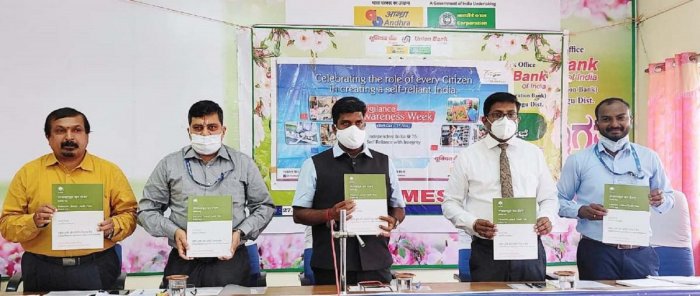
Deputy Commissioner Dr B C Sateesha and others release a credit plan prepared by Nabard in Madikeri.
Deputy Commissioner Dr B C Sateesha released a credit plan of Rs 6,205.84 crore prepared by the National Bank for Agriculture and Rural Development (NABARD) for 2022-23 on Wednesday.
He reviewed the progress of the banks after releasing the credit plan at the Lead bank hall in Madikeri.
The credit plan has given emphasis to priority sectors of agriculture, small industries, education and housing. The loans should reach the eligible beneficiaries, said NABARD district manager V Ramesh Babu.
More emphasis has been given to agriculture, dairy farming, fisheries, horticulture and small industries. The credit plan has also given the emphasis on basic facilities in agriculture markets, he added.
More loan facilities will be available for self-help groups under the Pradhan Mantri Formalisation of Micro food processing Enterprises (PMFME) scheme, he said.
Even schemes under Atmanirbhar Bharat are also being implemented. Priority has also been given for skill development, he added.
Venkatesh Gopal representing the RBI said that the banks should work towards the welfare of the farmers.
Union Bank regional manager Jyothi Krishnan said that the government has implemented several programmes for the welfare of the farmers.
Funds allocated
Of the total credit, an outlay of Rs 3,794.29 crore has been earmarked for the agriculture sector, while Rs 154.63 crore for agriculture-related basic facilities, Rs 801 crore for medium and small enterprises, Rs 409.60 crore for the export sector, Rs 121.50 crore for education, Rs 676.80 crore for housing, Rs 9.17 crore for alternative energy and Rs 27.70 crore for basic facilities.
Zilla Panchayat project director Srikanta Murthy and others were present on the occasion.
source: http://www.deccanherald.com / Deccan Herald / Home> State> Mangaluru / by DHNS, Madikeri / October 27th, 2021
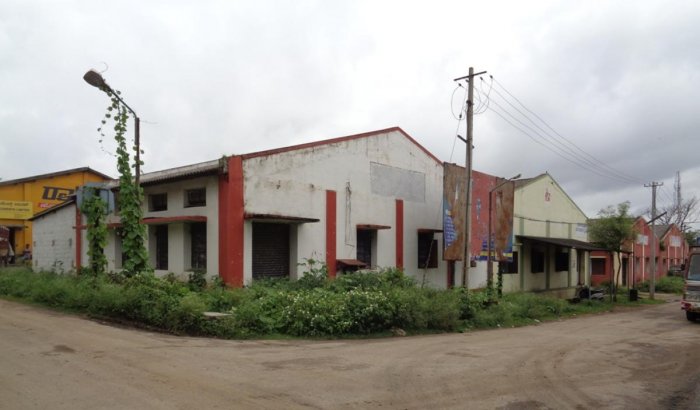
The industrial area in Kudloor. The first and the only KIADB industrial area in Kudloor in Kushalnagar is facing a lack of basic facilities. The layout is devoid of facilities and people are eagerly waiting for its upliftment.
Owing to the efforts of then chief minister Gundurao, the industrial area had come up at Kudloor in 1984.
There are more than 60 industrial units related to coffee, pepper and others that have come up in the industrial area. About 40% of them are related to coffee and its processing. Some of the food industries including ice cream, hollow bricks, iron and other industries are functioning. The annual turn out from coffee-related industries is Rs 4,000 crore, said Kudloor Kaigarikodyamigala Sangha president A N Praveen.
The industrial area has been completely neglected over the years. Owing to the pressure from the industrialists, pothole-ridden roads have been developed in the area.
According to KIADB officials, the government had sanctioned Rs 10 crore for the development of the industrial area. All the roads leading to various industrial layouts in the vicinity have been developed. The basic facilities will be improved in a phased manner.
Though 250 acres of land was acquired for industrial area, the khata of only 100 acres has been handed over. The remaining 150 acres has no khata. It is not even registered in the name of KIADB. As a result, several industrialists are denied facilities from the government, said, industrialists.
The industrial area has a lack of streetlights. As a result, people are scared to move around at night. Even drains are not constructed by the side of the road. Weeds have grown on either side of the roads.
There is an allegation that only coffee-related industries are set up in the industrial area. As a result, the employment generation is restricted and youth have been migrating to cities in search of greener pastures, said local residents.
There is even a lack of security in the industrial area. Theft cases too have been reported in the nights.
Department of Handlooms and Textiles assistant director Guruswamy said the department had submitted a proposal on setting up a mini power loom park at the industrial area in Kudloor. The deputy commissioner has given approval for the same.
Beeralingeshwara power loom will be set up in the future which will provide employment to women and men, he added.
Industries centre joint director Shankaranarayana said that a meeting to discuss the problems faced at the industrial area will be convened shortly at Koodumangalore Gram Panchayat hall. The officials from KIADB and others will attend the meeting.
Meanwhile, MP Pratap Simha has submitted a proposal to set up an ESI Hospital in Kodagu. Even land has also been identified for the hospital at Kudloor.
However, the process for the setting up of the hospital has not been initiated so far.
Vanijyodyamigala Sangha, Kodagu, president M B Devaiah said, “We have appealed to Union Minister Rajeev Chandrashekar to help in the generation of employment in the district.
source: http://www.deccanherald.com / Deccan Herald / Home> State> Mangaluru / b y DHNS, Kushalnagar / September 30th, 2021
The joint study found bird species richness to be higher in shade coffee plantations that had 78 species than in open coffee plantations that had 55 species
‘Alteration of canopy, woody plant composition can influence pattern of functional composition of resident birds’
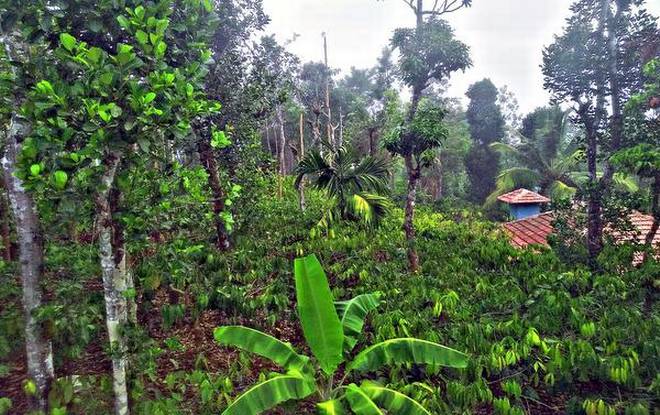
Verdant coffee and tea plantations are more than an ideal backdrop for photos; they support a thriving avian population. In a study that underscores the need to understand the patterns and drivers of bird species composition and diversity outside Protected Area (PA) networks to develop landscape-level conservation strategies, researchers found that they varied in differently-managed plantations.
The findings were the result of collaborative work by Kannur University, Kerala, Salim Ali Centre for Ornithology and Natural History, Coimbatore, Ashoka Trust for Research in Ecology and the Environment (ATREE), Bengaluru, and Ferns Nature Conservation Society, Wayanad. It was published in July 2021.
Focussing on the coffee plantations in the Western Ghats, which are an important agro-ecosystem and help maintain a significant portion of regional avian diversity, the researchers compared the composition and functional diversity of resident birds between shade and open coffee plantations.
They counted 3,846 birds of 87 species, and found species richness to be higher in shade (78 species) than in open coffee plantations (55 species). “Interestingly, 32 species were unique to shade and nine were unique to open coffee plantations, with 46 species found in both types of plantation. Species richness and abundance were higher in shade coffee,” the study says, adding that the results reveal that different farm management practices can affect functional bird richness and its abundance in coffee plantations. They have made a case for retaining shade-trees of native varieties in coffee plantations to support high functional diversity, richness, and abundance of birds in the coffee plantation of the Western Ghats.
The study, ‘Resident birds show different patterns in species composition and functional diversity in differently managed coffee plantations in the Western Ghats, India’, was published by the Ornithological Science journal in July 2021.
Speaking to The Hindu, Santhanakrishnan Babu, one of the authors, said the study was conducted between May and August, 2016, in the northern part of Wayanad district. “Wayanad is a major coffee producer, producing 90% of the Kerala’s coffee. Our study aimed to understand how resident birds respond to differently-managed coffee plantations – shade and open,” he said.
The Kerala government recently passed an order to chop all resident trees on private land except sandalwood. This will lead to extensive chopping of resident trees from the coffee plantations which will affect biodiversity, he added.
Another author Athira S. Variar and Mr. Babu said retaining shade trees of native varieties in coffee plantations is important for supporting high functional diversity, richness, and abundance of birds. “Shade plantations support several habitat specialists and range-restricted birds, and alteration of the canopy and woody plant composition can influence the pattern of the functional composition of resident birds. Since our study covered only one season, year-round study in these plantations may shed more light on the composition of resident, breeding and migratory bird species,” they said.
Conservation strategies
They have called for landscape-level conservation strategies. Author Anoop N.R. pointed out that the Forest Department has little authority over the plantations located outside forest areas, and trees in these plantations are increasingly being replaced with exotic trees such as Grevillea robusta. “To promote the protection of large native trees in coffee plantations, we recommend initiating programmes to provide financial incentives to private landowners. Education programmes will also help to improve community support for retaining texisting indigenous tree varieties and promote planting more of the same,” he recommended, adding that a framework needs to be developed with regard to which species can be planted and which must be maintained, or removed, from the plantations.
source: http://www.thehindu.com / The Hindu / Home> News> States> Karnataka / by K C Deepika / Bengaluru, October 04th, 2021
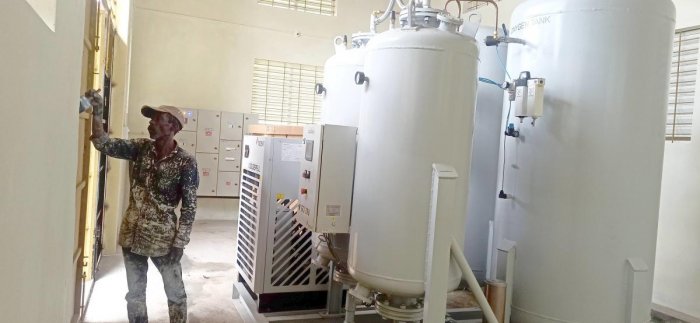
The work on an oxygen generation unit built at a cost of Rs 1 crore at Somwarpet government hospital has been completed. The required machines and generation unit have been installed.
The plant can generate 390 litres of oxygen per minute, which will be a boon for the patients.
After facing a shortage of oxygen during the second wave of Covid-19, the government had planned to set up oxygen plants in the government-run hospitals.
Pipelines have been laid to supply oxygen to 50 beds for Covid infected and non-Covid infected patients in the government hospital.
Without the unit, the oxygen cylinders had to be refilled in Mysuru in the past.
With the unit capable of generating 390 litres of oxygen per minute, the need for oxygen from Mysuru will not arise, said officials.
The compressor, ventilator and oxygen concentrators have already been procured, said Pushpak of the contracted firm.
People from rural areas in Somwarpet taluk are dependent on the government hospital for treatment. In case of emergency oxygen requirements, the patients had to be rushed to Madikeri, Mysuru and Hassan for treatment in the past.
Dr Shivaprasad, who works at the hospital said, “Compared to the first wave, more people had succumbed to Covid-19 during the second wave. The experts have already warned of a possible third wave. Already, 15 to 20 Covid infected people are undergoing treatment in the hospital. The plant will help in the use of oxygen as per the requirement.”
MLA M P Appachu Ranjan said that the work on the generation plant has been completed. With the help of Rs 1 crore from Mobius Foundation, the work on an oxygen generation unit at Kushalanagr has also been completed.
Both the units will be inaugurated next week, he added.
source: http://www.deccanherald.com / Deccan Herald / Home> State> Mangaluru / by DHNS, Somwarpet / October 05th, 2021
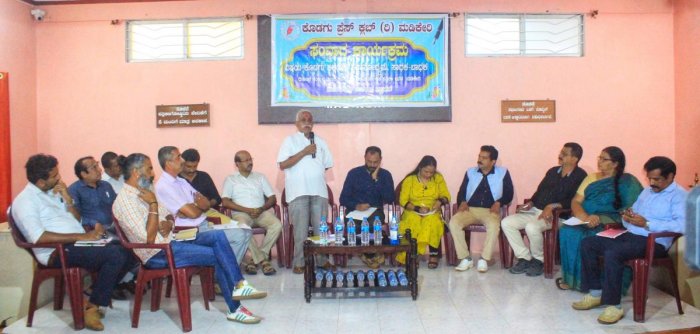
Chamber of Commerce president M B Devaiah speaks during a discussion on the pros and cons of tourism in the district, held at Kodagu Press Club, Madikeri, on Tuesday.
Various stakeholders in the tourism sector gave their suggestions towards developing sustainable and eco-friendly tourism in Kodagu, during a discussion on the pros and cons of tourism in the district, held at Kodagu Press Club, Madikeri, on Tuesday.
Chamber of Commerce president M B Devaiah said that it is the foremost duty of the people of Kodagu to preserve the environment of the district. Businesses can be carried out while maintaining ethics. Money is not everything.
“Nature-friendly industries should be set up in the district to provide jobs for people,” he added.
Pravasodyama Avalambitara Okkoota president K K Manjunath Kumar said that tourism contributes immensely to the development of a country.
Tourism in Kodagu has been generating good revenue, he said and pointed out that the countries which are backward in tourism are backward in development as well.
Resort and Hotel Owners’ Association president Nagendra Prasad said that there has been a significant rise in investment in the tourism sector in the district after the market for coffee fell. There are 1.50 lakh people in the district who are depending on tourism activities for their livelihood.
Kodagu Press Club president Ajjamada Ramesh Kuttappa in his introductory remarks, said, “Every citizen of the nation has a right to carry out legal work in any part of the country to make a living. No restrictions can be imposed on him or her in carrying out a job. A forum has been formed to discuss the problems of people working in the tourism sector and to find possible solutions.
Hotel, Lodges and Restaurants’ Association advisor Chidvilas said that coffee growers switched to homestay and hotel industry after they suffered losses in the coffee industry. He also advised imposing a total ban on plastic at tourist destinations in the district.
Kodagu Samrakshana Vedike convener Chammatira Pravin Uttappa said that there is a need to curb illegal activities which are carried out in the name of tourism.
“Insulting the traditional Kodava attire in some resorts should stop immediately. Tourism activities should stop during the Cauvery fair,” he added.
District Working Journalists’ Association president Savitha Rai, writer Bharadwaj K Anandateertha, Kodagu Hitarakshana Samiti president Rajiv Bopaiah, Travel Association president Cheyyanda Satya Ganapathy, Kodagu Tourism Association president Madetira Timmaiah and others were present.
source: http://www.deccanherald.com / Deccan Herald / Home> State> Mangaluru / b y DHNS, Madikeri / October 05th, 2021
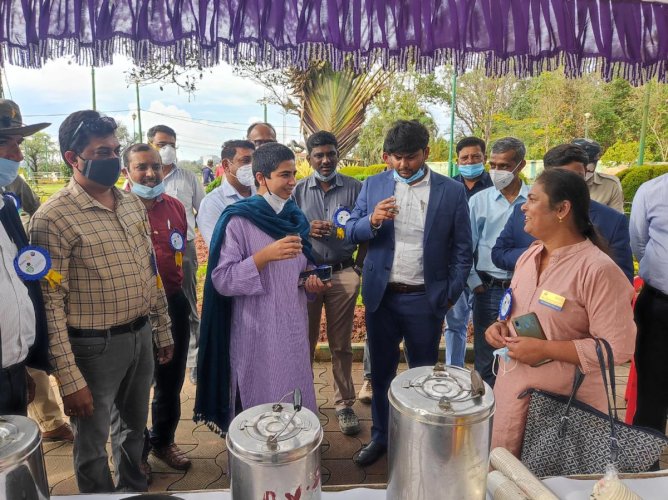
Deputy Commissioner Charulata Somal sips coffee at Raja Seat on Friday, on the occasion of International Coffee Day
Deputy Commissioner Charulata Somal said that the International Coffee Day celebrated in Kodagu, highlights the hard work of coffee growers, which is behind the taste of coffee.
She was speaking during the International Coffee Day programme observed by Rotary Misty Hills, at Raja Seat, on Friday.
The deputy commissioner added, “I got to know about every detail of coffee cultivation after I was posted to Kodagu. The dedication and effort by coffee growers in producing the best quality of coffee is commendable.”
Rotary Misty Hills president Anitha Poovaiah said that more than 1,500 visitors at Raja Seat were served coffee on account of International Coffee Day.
Rotary Deputy Governor H T Anil said that the quantity of coffee powder used by a person in India is 4 to 5 kg per year whereas, in a foreign country, a person uses 15 kg of coffee powder annually.
Therefore, there is a need to increase the usage of coffee in India, he added.
Misty Hills project director Devanira Tilak also spoke on the occasion.
Madikeri CMC commissioner Ramdas, horticulture department deputy director Sridhar, senior assistant director Pramod, Coffee Board deputy director Shivakumar Swamy and others were present.
‘Coffee export’
Kodagu Mahila Coffee Jagruthi Sangha distributed free coffee at various places in Madikeri on account of International Coffee Day.
The Coffee Day observed at Tadka House on Raja Seat Road was inaugurated by Kodava Samaja president K S Devaiah.
When the coffee industry was in distress women had started a unit to instil confidence in coffee growers in the district. The sangha has been promoting coffee consumption, said K S Devaiah.
Women have been actively engaged in managing coffee plantations and the industry. Kodagu’s coffee is known for its taste, he said.
Kodagu Coffee Growers’ Cooperative Society president M B Devaiah said the society is the largest coffee cooperative in Asia.
It is now mulling about exporting coffee and requires financial assistance from the government for exports, he added.
Advocate Pasura Preetham said the International Coffee Day is being observed since 2015.
Dr Mohan Appaji said that the consumption of coffee by those above 40 years is good for health.
Kodagu Mahila Coffee Jagruthi Sangha president Chitra Subbaiah, general secretary Anitha Nanda and others were present.
source: http://www.deccanherald.com / Deccan Herald / Home> State> Mangaluru / by DHNS, Madikeri / October 01st, 2021
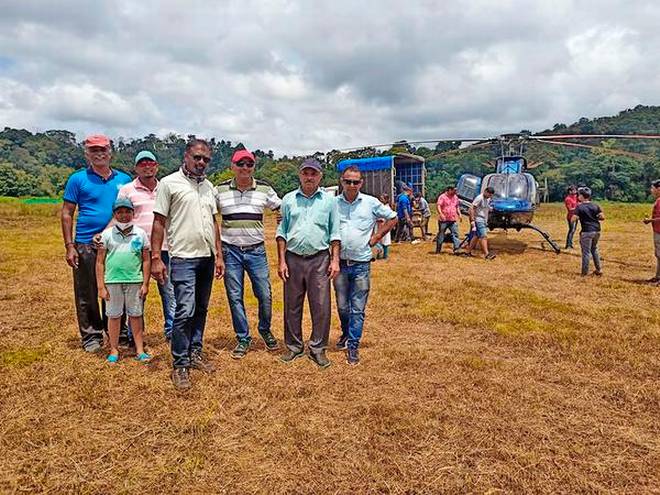
Locals gather to witness the heli-tourism initiative taking off, at Kakkabe in Kodagu. The chopper of a private operator that landed with three tourists can be seen in the backdrop.
A private operator flies in tourists from Bengaluru to a village resort close to Tadiandamol
Even as successive governments continue to dilly-dally over launching heli-tourism for high-end tourists despite umpteen promises, Kodagu has taken the first step towards giving a start to the initiative post-pandemic with local stakeholders taking the lead and kick starting the much-talked-about initiative.
A group of tourists from Bengaluru landed in a chopper at a village to explore Coorg’s splendour, staying in a resort located close to one of the highest points in Kodagu – Tadiandamol. These tourists, instead of taking the 6-hour drive to Madikeri from the IT Hub, chose to fly by a chopper owned and run by a private operator to reach the hill station.
In fact, Kodagu was also identified along with Mysuru for developing heli-ports by the Tourism Department which did not take off. However, an entrepreneur in the hospitality sector in Kodagu, Apparanda Sagar Ganapathy, who runs a resort at Kakkabe, coordinated with the chopper operator to ferry guests to his property where a helicopter landing facility was established recently at the resort to facilitate heli-tourism.
Mr. Ganapathy, who is also the president of Association for Rural Tourism (ART), says the potential of rural tourism remains unexplored as corporates and well-heeled tourists are keen to explore the life and lifestyles in villages. Heli-tourism can bring tourists who can afford chopper rides to the remotest corners of Kodagu to experience the coffee land’s unmatched beauty and the Coorg villages.
Villagers turned up in large numbers to witness the heli-tourism initiative. Kakkabe Panchayat president Kaliyanda Sampan and other locals were present to greet tourists.
Corporate executives can have their meetings amidst nature instead of in multi-storied structures. They can fly in by chopper, have a meeting, spend some valuable time and head back to their destinations. Infrastructure can help promote such kinds of tourism, the stakeholders believe.
The stakeholders in the hotel and hospitality sector in Kodagu, including ART and Kodagu Tourism Association, are also in the process of identifying infrastructure where choppers could land, bringing tourists, and promoting heli-tourism in a big way. Another resort is also in the process establishing the chopper landing space, foreseeing its potential, he said.
Kodagu has many luxury resorts, which, according to the stakeholders, are getting back their clients with the opening of tourism post-pandemic. But the mid-range resorts are lacking clientele with corporates, particularly those from the IT industry, are yet to return to their offices and continue to work from their homes.
“Before COVID-19, we used to get groups of 25-30 coming and staying in resorts during weekends or holidays. Such trips have stopped for one and half years due to the pandemic. Until the offices start working like before and schools and colleges function normally, tourism recovery may prolong,” Mr. Sagar said.
Unlike other places, Kodagu is predominantly covered by undulating hills with thick forest cover. There is a need to establish a safe environment for the landing and taking off of the choppers. “If we provide infrastructure like heli ports or helipads, more operators can show interest in bringing tourists by choppers, thus driving the tourist economy and helping revive the sector,” the travel operators said.
source: http://www.thehindu.com / The Hindu / Home> News> States> Karnataka / by Shankar Bennur / Mysuru – September 29th, 2021
The villagers were mostly agriculturists, but with their farmlands and estates buried under debris, their future appeared grim.
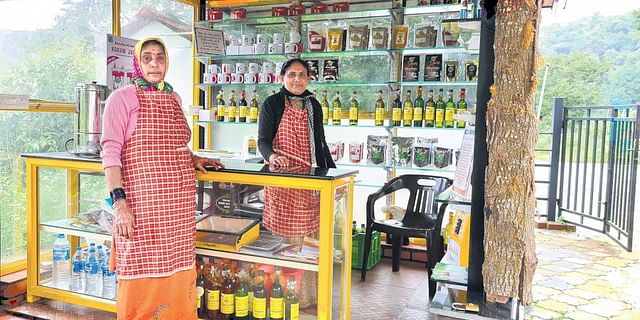
The Forest Cafe at Kaluru
Madikeri :
In August 2018, when the skies opened up with a vengeance, and flash floods and landslides left a trail of destruction, Kaluru was one of the worst-hit villages in Kodagu district. People lost their livestock, houses, farmlands and estates overnight.
“Over 200 families moved to relief centres in August and we returned to our village only in October. Estates, farmlands, cattle – everything was lost,” recalls Dechavva, who was left to pick up the pieces after the disaster.
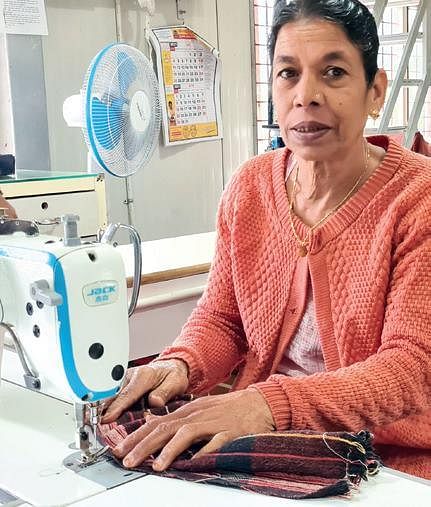
The villagers were mostly agriculturists, but with their farmlands and estates buried under debris, their future appeared grim. If was the women who rose from the ruins to crossed all hurdles to turn around their lives. Their grit and determination earned them the title of ‘Kaluru women’. They are now entrepreneurs and sole breadwinners, thanks to Project Coorg, a rehabilitation initiative.
Narrating how they started getting back on their feet, Dechavva, who became a master tailor at the age of 65, says the village temple priest, Nagesh Kaluru, approached Bharatiya Vidya Bhavan, seeking support to rebuild the life of the villagers.
Dechavva, who learnt tailoring at the age of 65
Under Project Coorg, the trust started organising skill development programmes for the women of the village. They were also joined by a few affected women from Devasthuru village. Soon, tailoring and food processing training programmes took shape.
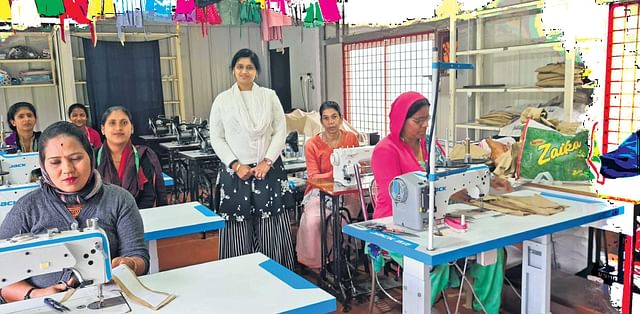
The tailoring unit was headed by Ashrafunissa. “I didn’t know much about Kaluru village till the disaster. I stay in Madikeri and my house also suffered severe damage due to landslides. During this time, I was approached by Balaji Kashyap – who heads Project Coorg. I was asked to train women in tailoring,” she says. A total of 30 women were trained for six months.
However, not all the women wanted to take up needle and thread. The older ones opted for food processing, and 30 women were trained in manufacturing masala, pickle, chocolates, chips, rice flour and other food items by Neena Shetty, award-winning chef from Udupi.
“We wanted to create a continuous revenue generating model for the women. We didn’t take the CSR approach as it is not suitable for the situation here. However, sponsors and partners came in to support the initiative after seeing our work,” says Kashyap of Project Coorg.
The women were also taught soft skills and other business know-how by Kashyap and the initiative launched ‘Yashaswi’ – a self-help group to empower the Kaluru women. The villagers’ struggle didn’t go unnoticed. Many sponsors came forward to support the group, and the land for the Yashaswi factory was donated by the Karera family of the village. The factory building was sponsored by the Kodava Koota of North America. With equipment donated by various companies, including Bosch India, the women of Kaluru soon became entrepreneurs.
“I only worked in farmlands all my life. I did not know how to even hold a needle. But our trainer, Ashrafunissa, taught me like I was a child and now I stitch bags for several companies; I continue to earn my own living,” adds Dechavva. Ashraf explains that the women get orders from various schools to stitch uniforms and other products. “Our business is expanding as we are getting orders from colleges outside Kodagu too,” she says. Many other women in the village now have the skill of working with factory jack machines installed at the unit.
Ashrafunissa (standing) and her team at Yashasvi Tailoring Unit | EXPRESS
Muthamma, an entrepreneur under the Yashaswi group, opted for training in food processing as her eyesight was not good enough for stitching. Along with other elder women, she grinds rice and flour, prepares various masala powders and tries her hand at chocolate making. “Apart from the regular salary, we are paid incentives when sales increase,” she said.
A rustic eatery, called Forest Cafe, was also set up next to the factory, and tourists often visit it. “We serve local delicacies and also sell food products which we make,” says Jamuna. The flood victims have now become an inspiration for many, and skill development training is being extended to many other women across the district. “Post the pandemic, the Project Coorg initiative has expanded from being a rehabilitation initiative to a women empowerment initiative,” says Balaji.
30 women trained in manufacturing masala, pickle, chocolates, chips, rice flour and other food items
source: http://www.newindianexpress.com / The New Indian Express / Home> Good News / by Prajna GR, Express News Service / September 26th, 2021
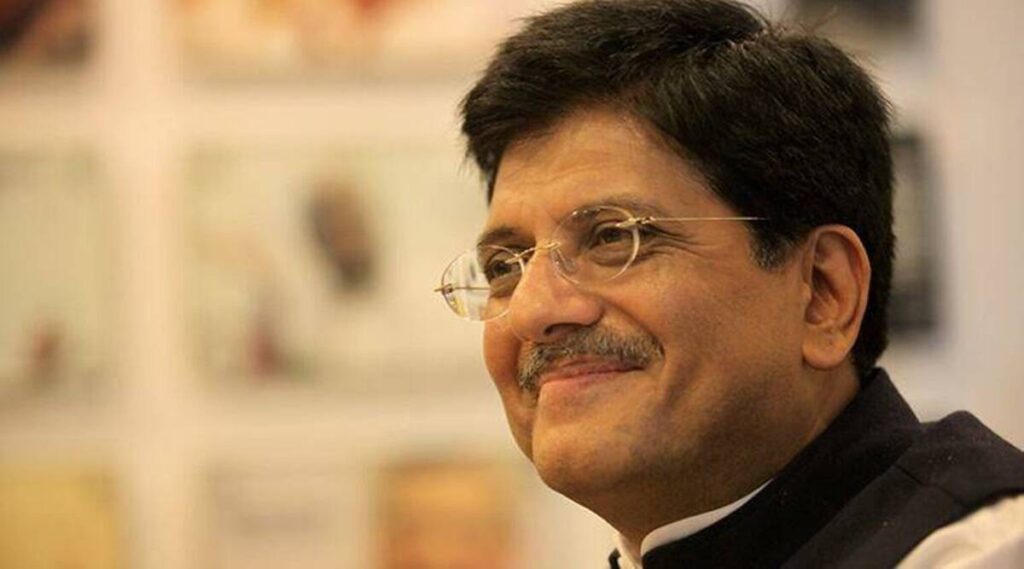
The issue was discussed, among other things, in an interaction of Commerce Minister Piyush Goyal with coffee growers, roasters, exporters and other stakeholders at Coffee Board Head Office, Bengaluru.
Commerce Minister Piyush Goyal. (File)
The government will relook at the coffee law to make it suitable as per the present needs of the sector and facilitate its growth, the commerce ministry said on Saturday.
The issue was discussed, among other things, in an interaction of Commerce Minister Piyush Goyal with coffee growers, roasters, exporters and other stakeholders at Coffee Board Head Office, Bengaluru.
Coffee growers expressed concerns over losing their lands in view of the notices issued by banks under the Securitisation and Reconstruction of Financial Assets and Enforcement of Security Interest (SARFAESI) Act.
source: http://www.indianexpress.com / The Indian Express / Home> India / by ENS, Economic Bureau, New Delhi / September 19th, 2021
Aurika, Coorg, is a pet friendly resort with 55 aesthetically designed rooms and suites, new-age dining and extensive banqueting options, and innovative high-tech entertainment facilities.
Lemon Tree Hotels Ltd., through its management subsidiary Carnation Hotels Pvt. Ltd., enters in Coorg, with its new upscale resort – Aurika, Coorg. This is the second property under the brand Aurika Hotels & Resorts – Luxury by Lemon Tree Hotels, with the first having launched in Udaipur in 2019.
The 45 acre landscaped resort is located amidst the coffee gardens of Coorg, with panoramic views of the rainforest. From undulating coffee plantations to the black treasures of pepper vines, from the ancient Kodavas culture to their authentic cuisine, one can explore the unique and unexplored world in the Western ghats of Southern India with Aurika, Coorg.
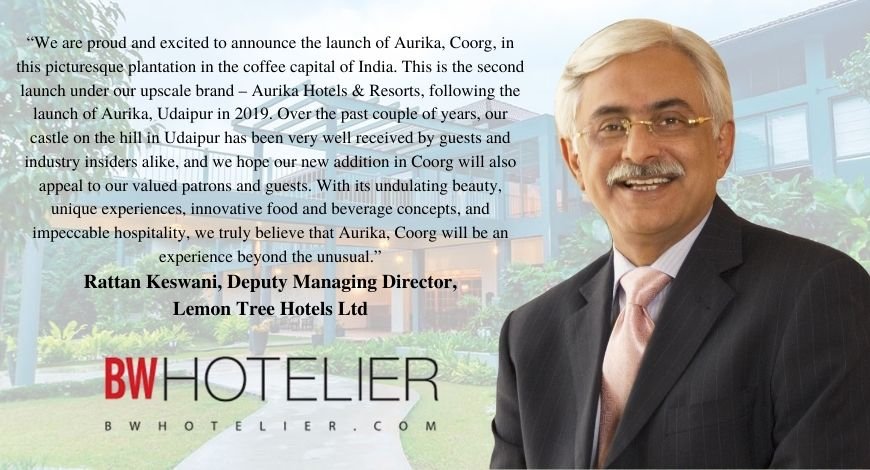
“We are proud and excited to announce the launch of Aurika, Coorg, in this picturesque plantation in the coffee capital of India. This is the second launch under our upscale brand – Aurika Hotels & Resorts, following the launch of Aurika, Udaipur in 2019. Over the past couple of years, our castle on the hill in Udaipur has been very well received by guests and industry insiders alike, and we hope our new addition in Coorg will also appeal to our valued patrons and guests. With its undulating beauty, unique experiences, innovative food and beverage concepts, and impeccable hospitality, we truly believe that Aurika, Coorg will be an experience beyond the unusual,” said Rattan Keswani, Deputy Managing Director, Lemon Tree Hotels Ltd.
The resort features Mirasa* – the all-day dining restaurant, Ariva* – the bar, Roast & Red* – the coffee lounge, Aura* – the private cabana deck, and extensive banquet facilities including the ballroom*, the boardroom* and multiple outdoor terraces* and eclectic venues* for private events and exclusive experiences.
Recreational facilities include Araya* – the spa, a well-equipped fitness center*, the outdoor swimming pool* and bar*, the Rumpus Room* for children, Check & Mate* – the chess garden, Au.rion* – the star gazing terrace and outdoor activities*, including a putting green and croquet lawn.
The 55 elegantly designed rooms and suite showcase glimpses of the heritage, culture, flora and fauna of Coorg, while imbibing upscale décor elements that reflect the Aurika brand. Each room features an alfresco sit out area, from which to admire the lush green plantations. The relaxed atmosphere, inspired design and luxury amenities are accompanied by hi-tech facilities one cannot do without, even on a holiday.
As a pet friendly resort, Aurika, Coorg offers a comfortable and luxurious stay for your furry four-legged companions as well. The pet friendly rooms are located close to the specially demarcated open play area and are equipped with dog beds, bowls and toys for use by your beloved pups during your stay. Our culinary experts and resident dog lovers have also designed a canine menu, with wholesome gourmet meals to suit each pup’s palate and appetite. Pet pawrents can also dine with their pups at the designated cabanas at Aura.
*Due to the ongoing COVID 19 circumstances, certain services and facilities will be limited or unavailable, in keeping with our house rules and the prevailing government regulations.
source: http://www.bwhotelier.businessworld.in / BW Hotelier.com / Home> News / by BW Online Bureau / September 16th, 2021
WELCOME. If you like what you see "SUBSCRIBE via EMAIL" to receive FREE regular UPDATES.
Read More »