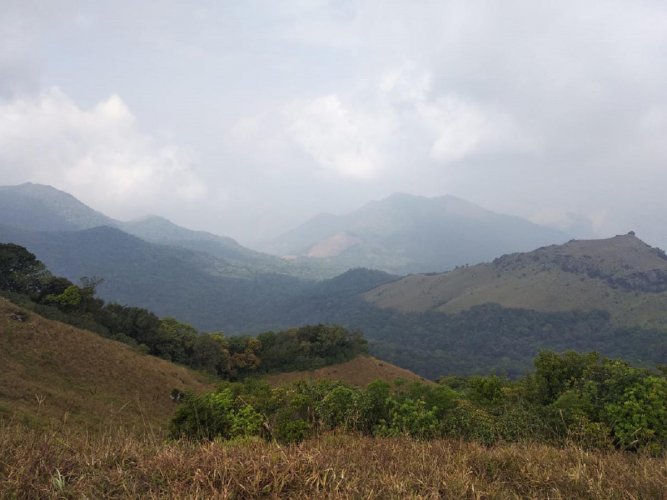
A view from the top of Tadiyandamol Hill in Kodagu.
Tadiyandamol, the highest cliff of Kodagu, is known for nature’s bounty and attracts trekkers. Tadiyandamol roughly translates to ‘tall, broad hill’ in the local dialect.
It is the highest peak in the Kodagu district and the third highest in Karnataka after Mullayyanagiri and Kudremukh.
To embark on the trekking adventure, trekkers have to trail through lush green plantations and here and there water bodies cross the path. The path does not make one feel tired as one looks at the beauty of the surroundings.
Owing to the Covid-19 pandemic, the trekking activities were suspended for a few months.
Trekking activities resumed
When the trekking activities resuming, people from all age groups have started their trekking adventure.
The number of people during the weekends and holidays is on the rise.
Trekkers from not only Karnataka but also from outside the state and country visit Tadiyandamol.
With verdant valleys in all directions, the views all around from the top mesmerise the trekkers.
The trekkers enjoy a whiff of cool breeze at the top with the clouds playing hide and seek. Trekkers visit the spot even during winter and summer.
Distance and height
Tadiyandamol cliff is 48 km away from Madikeri. The height of the cliff is 1,717 metres and one has to cover 10 km to reach the cliff via Nalkunadu palace in Yavakapadi.
One can enjoy the beauty of nature while traversing the trekking trial via Kabbinakadu.
After reaching Kakkabbe via Napoklu, one must locate Yavakapadi village. Jeeps are also available for rent from Kakkabbe. After driving for six to seven kilometres, the rest of the way can be covered on foot.
Panoramic view
The panoramic view of Tadiyandamol during monsoon is totally different. One come across several waterfalls cascading down the hillock en route.
Several researchers also visit the cliff to study biodiversity.
To check the pollution, the forest department has laid down a few restrictions on the trekkers.
The trekkers have to pay Rs 100 and ensure that they do not dump plastic and other waste en route.
“Tadiyandamol is a paradise for the trekkers,” said Prof Pattabi of Mangalore University, who had trekked along with a team recently.
source: http://www.deccanherald.com / Deccan Herald / Home> State> Mangaluru / by DHNS, Napoklu / February 27th, 2021
Their daily grind is to evaluate and certify the bean
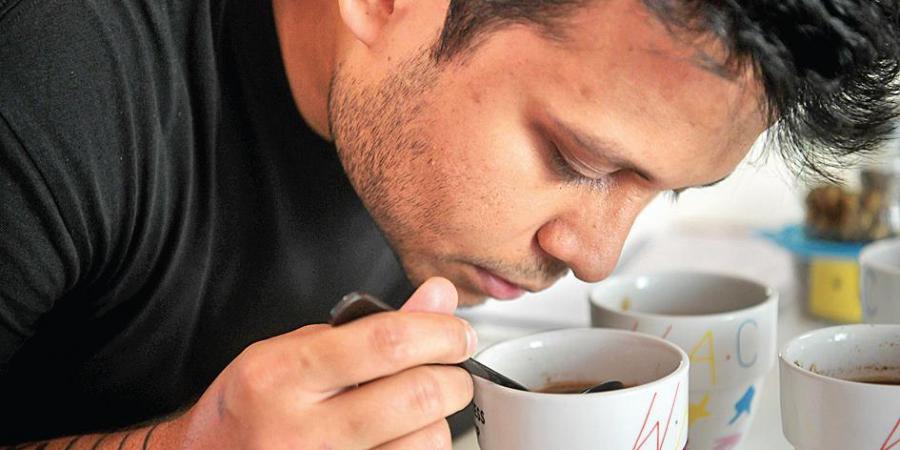
Suhas Dwarkanath slurps coffee
Bengaluru :
Imagine having coffee breaks throughout the day! And imagine your boss insisting that you take these coffee breaks! Well, coffee tasting or cupping is not as simple as that. There is a science and a philosophy behind that hot cuppa you consume daily.
Coffee goes through a process – from beans to brew. From planting the seed to picking the fruits, to curing it, roasting it and finally grinding it – making it ready for consumption. In between the planter and the consumer, is a very important person called the taster who not only certifies that the coffee is good for consumption but also grades it, helping planters fix a price.
This profession started when consumers were able to recognise the difference in the coffees, and roasters started tasting every batch of coffee, and preparing a cupping report to ensure consistency. This report quantifies all the sensory attributes to coffee which are fragrance (dry coffee), aroma (wet coffee) and taste. Tasting evaluates coffee on flavour, body, acidity and after taste. The coffee industry took cues from the beer, wine and scotch industries as they have been doing it for much longer.
Ideally, a coffee taster should be on a bland diet for a week before tasting. However, when it becomes a regular job and tasting happens a lot more frequently, a taster shouldn’t eat for a minimum of two hours before tasting. Most of them do it first thing in the morning on an empty stomach or after a minimum of a two-hour gap.
Tasting starts with roasting and one such taster Suhas Dwarkanath (32) is a Bengaluru boy, who fell in love with coffee as a child. He used to walk past Coffee Day every day on his way to school and the aroma that wafted through made him decide that he wanted to work with coffee when he grew up. After completing MBA, he went to Dubai to pursue a job and it was then that he found out that there’s more to coffee than filter coffee. He studied at ‘Specialty Coffee Association’ and became a certified taster.
He decided to return home and opened a business called ‘Benki Brewing Tools’ making his childhood dreams a reality. The tasting room is a sacred place and is kept free of any outside smell so as to not interfere with the aroma. He says, “All your senses are working when you are tasting the coffee.” The tasting room has a red light as the human eye cannot differentiate between different shades of brown under this light making the process unbiased.
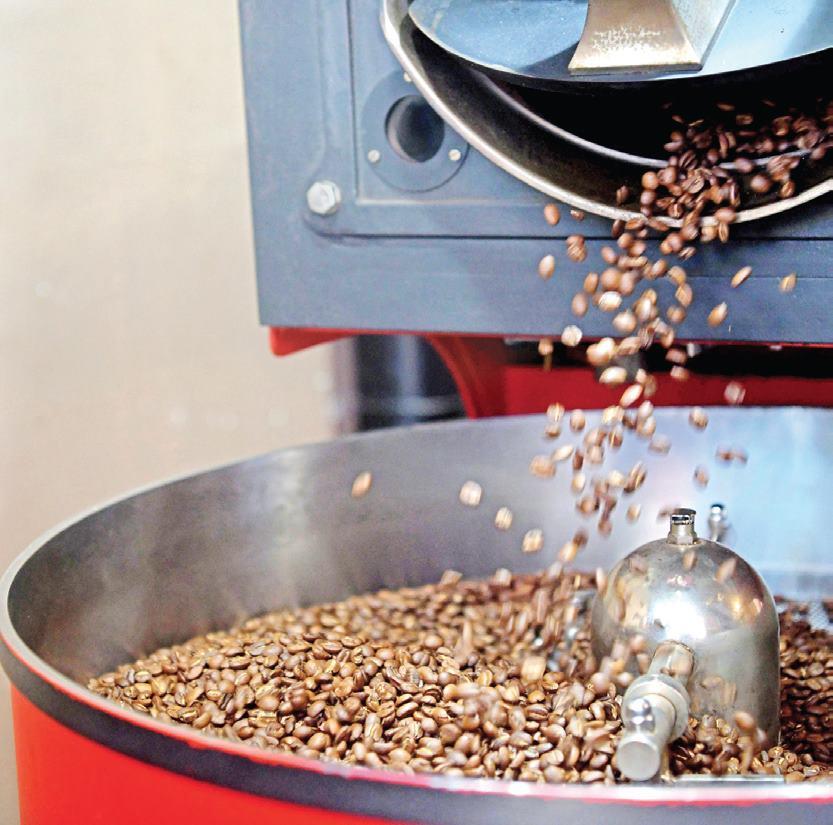
The temperature is between 22 and 26 degrees Celsius because it influences taste and anyone tasting a batch of coffee anywhere in the world should get the same result. The process is quite elaborate. A taster needs to roast the beans first as roasting is transforming the green bean to something that’s consumable and soluble in water. Tasters must have knowledge of roasting but don’t need to be roasters.
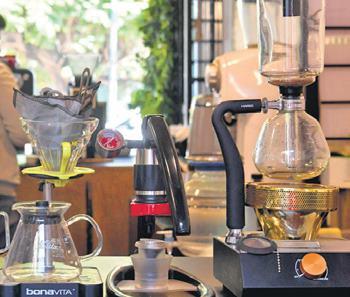
Tools of the coffee taster’s trade
Roasting the beans caramelises the sugars, increases the size, changes colour and makes the flavours pop. The taste of the coffee depends on the soil, weather conditions and the microorganisms that migrate as these factors determine how the plant matures. For instance, if a farmer is growing pepper in the same estate, the microorganism that feeds on pepper will sit on a coffee cherry and influence the taste of the coffee.
After analysing and roasting the beans, it rests for 8-24 hours after which it is ground (coarse grind). A taster takes 8.5gm of coffee in a cup, evaluates the fragrance, then introduces 150gm of water at 92 degrees Celsius which rests for 4 minutes. The taster then breaks the crust to evaluate the aroma and slurps the coffee and evaluates the taste.
While tasting multiple cups, a taster cleanses the palate using unsweetened/unsalted crackers or just rinses mouth with plain room temperature milk. The nasal cavity is neutralised by smelling one’s skin.
Suhas also trains people and one such person is Sandesh. A computer engineer, Sandesh is married to a coffee lover. While sourcing coffee for his wife from across the globe, he decided to open a roastery. He learnt the art of tasting as every roaster needs to understand it so as to sell the right product to the right customer. He calls his business ‘Kohi Roasters’. He says, “I have found the love of my life.”
Once you fall in love with coffee you carry it everywhere you go. One such coffee taster is Ajay from Maharashtra, who, tired of being cooped during the lockdown, visited coffee estates in Chikkamagaluru and Kodagu. En route home, he stopped in Bengaluru to meet his coffee buddies and share his experiences. He has a small brewing kit and carries it wherever he goes. He says, “I can brew my coffee in a moving bus.”
COURSE CUP To become a coffee taster, one needs to study cupping. It is available as an independent course as well as a part of other coffee courses. Specialty Coffee Association is the only one that has international recognition. It was first formed in Europe with its headquarters in Essex, UK (SCAE), and later in the USA with its headquarters in Santa Ana, California (SCAA).
WHERE THEY TEACH Coffee Board of India Central Coffee Research Institute, Chikkamagaluru Benki Brewing Tools, Bengaluru Araku, Hyderabad
POPULAR COFFEES IN INDIA
Arabica: Flavourful, aromatic, acidic (needs shade). Arabica comes from Robusta
Robusta: Bold, double the amount of caffeine, strong. Mother plant
Liberica: Mix of Arabica and Robusta (not very commercial, gets mixed in Robusta here in India)
Excelsa: Delicate and difficult to grow in all kinds of topography (not very commercial, gets mixed in Robusta here in India)
source: http://www.newindianexpress.com / The New Indian Express / Home> Cities> Bengaluru / by Meghana Sastry, Emirates News Service / February 28th, 2021
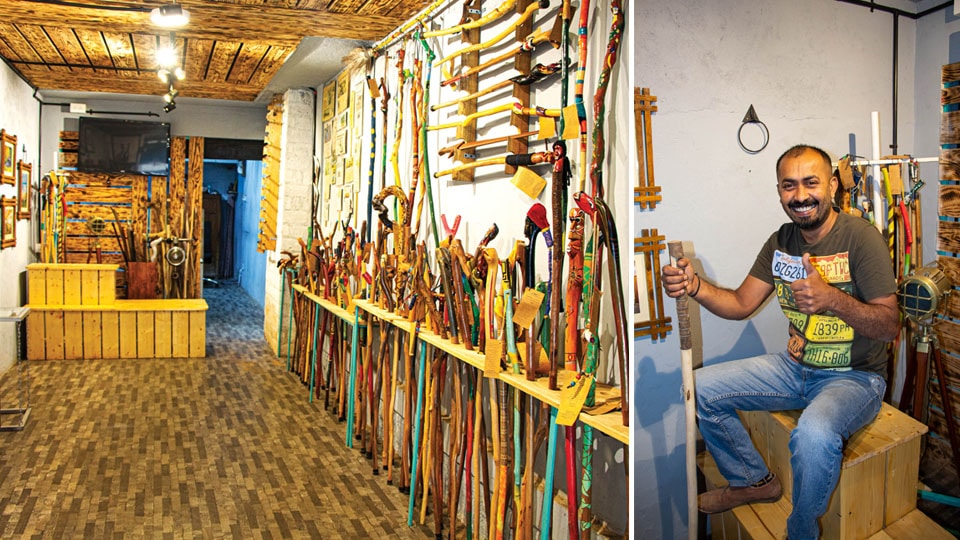
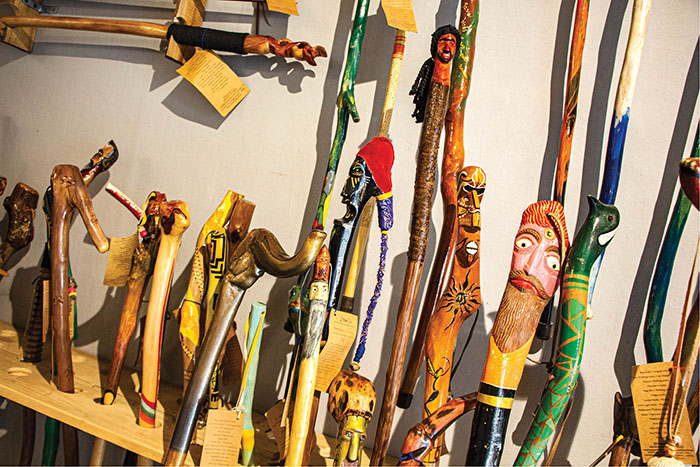
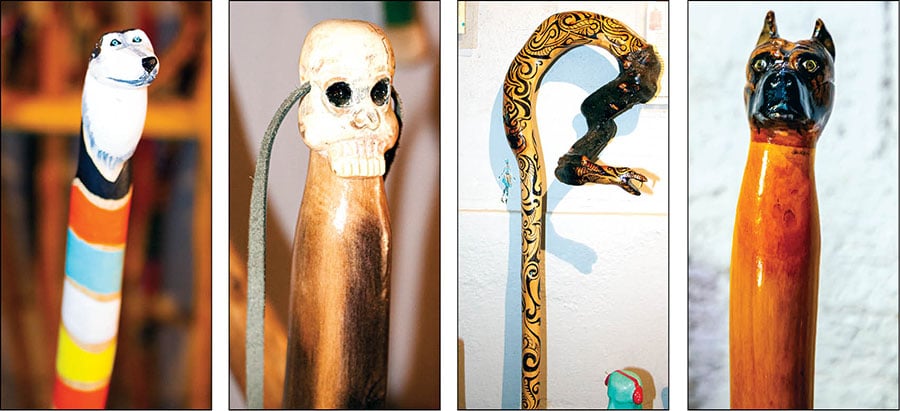
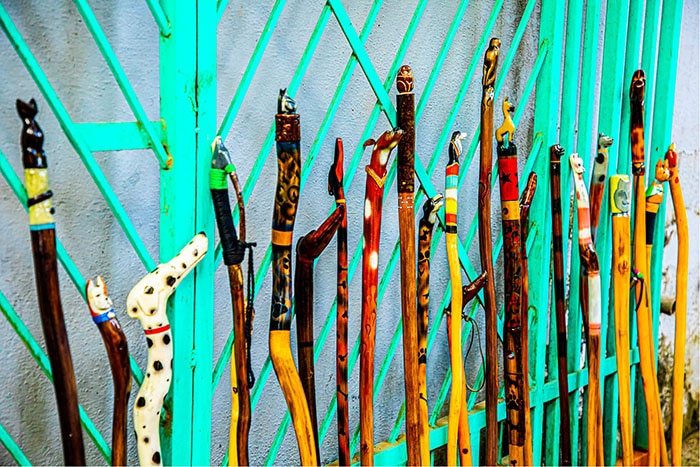
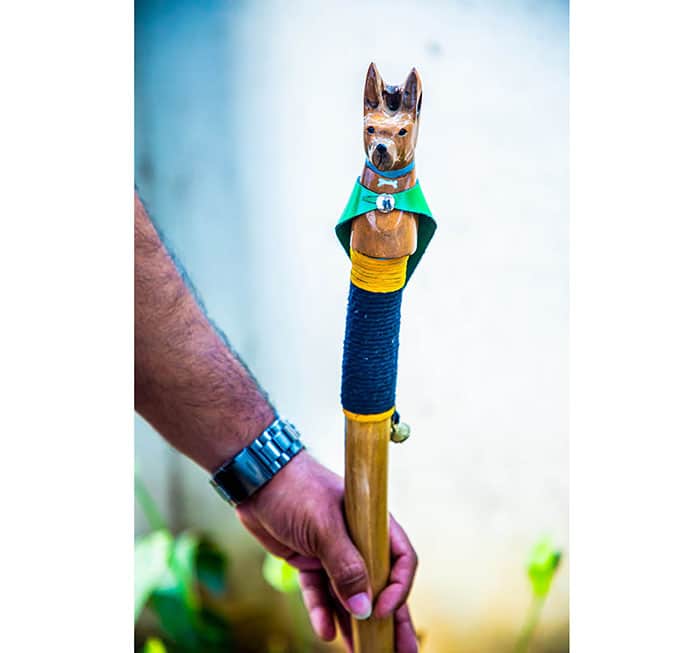
Have you ever been to a shop dedicated to just walking sticks? Yes, you read it right — walking sticks. In all shapes and sizes, in cane, dead hard-wood, sticks with carved animals, with dog faces, thumb sticks, deep river walking sticks, country walking sticks, home decor sticks, decorative sticks, fashion sticks, bell sticks, hook sticks, gadget sticks, city walking sticks, catapult sticks, lawn light sticks, bug sticks, rattan vine sticks, antique sticks, muscle loader sticks, whip sticks, spirit face sticks, garden sticks, broom sticks, professional walking sticks, shirt hanger sticks, key chains, wind chimes… the list goes on.
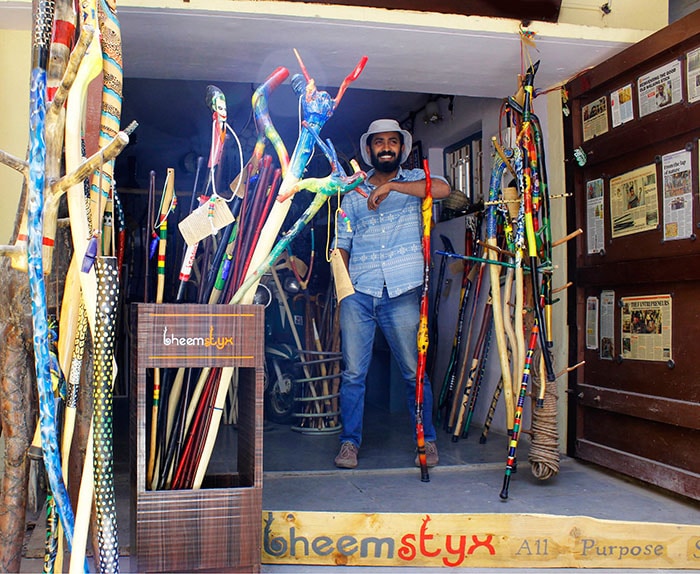
While some handle heads are brightly painted, some are shaped as horse hooves, shoes and the various inmates of an animal farm. Walk into ‘Bheemstyx’ in Indiranagar Seventh Main, Bengaluru and be prepared to be boggled by its collections. ‘Bheemstyx’ offers a range of natural sticks that are ideal for walkers, walking stick collectors, and hikers and even can be used as home decor.
Meet Kullodanda Kuttappa Bheemaiah aka K.K. Bheemaiah from Kaloor village near Madapura in Kodagu district, who has created a brand ‘Bheemstyx’. After dabbling with various professions including event management in Mysuru and Bengaluru, Bheemaiah has forayed into the business of walking sticks — he breathes life into dead wood to create unique works of art.
Born to a family of coffee planters, Bheemaiah has innate knowledge about native trees, the sturdiness of wood and how they can be shaped into trendy walking sticks. He does not cut any tree but spends most of his time in Kodagu visiting estates scouting for fallen trees and branches.
“I had a penchant to collect souvenirs and a friend got me a beautiful rattan vine stick in the year 2000. I first thought how I could further ornament the stick and began smoothening, seasoning, and painting it. Ultimately, the walking stick looked like a piece of art. That was when the idea of creating trendy walking sticks germinated,” Bheemaiah told Star of Mysore.
Business acumen
He did not stop there and pursued the idea and expanded his collection and began shaping them into different designs. His aim was to combine utility and art and his sticks. “My friends initially laughed at the idea and there were many who belittled my work. No one saw the business potential and only I saw. We have brands for everything these days but there was no brand for walking sticks and now we have ‘Bheemstyx’ and ‘Bheemstyx’ means strong sticks,” he says with a smile.
Flea markets gave a push
Though the work on walking sticks was started in 2000, the brand ‘Bheemstyx’ was launched in 2014. When Bheemaiah had a good collection of 50 to 80 sticks, he sold them at flea markets that provided him a good platform. He used to carry stick bundles to almost all flea markets and craft bazaars in South India and along the beach festivals and created a niche and name for himself.
“At the craft bazaars and flea markets, I saw an array of handmade, handcrafted items and I realised that the market is growing for such products in Bengaluru where people loved unique designs, especially if eco-friendly. I was quite well-known in event management in Bengaluru and Mysuru and the name ‘Bheemstyx’ was a conscious decision to leverage my popularity to kick-start the business,” he said.
Bheemaiah personally handpicks each stick from forests and plantations. “I never cut any trees or branches and only collect fallen twigs and dead wood. The landslides of 2018 and 2019 in Kodagu yielded good raw materials for my business. I use natural jungle hardwood to make the sticks and once the sticks are stored, they are cleaned, treated, smoothened, exposed to smoke to make them dry out and later hand-carved,” he explained.
One-of-a-kind pieces
Each stick has a uniqueness that only nature can design and so every customer receives a one-of-a-kind design. “Nature gives each stick a shape and you cannot copy or create the design. I take natural pieces of sticks and create a functional piece. There is no similarity between one stick and another and each one is unique in shape and paint. The sticks can last up to 200 years,” he said.
The entire process of making walking sticks can take either a month or over a year depending on how fresh the stick is. Bheemaiah himself hand-carves sticks into different shapes and sizes and polishes them before being given to artists who bring the sticks to life. He has a huge network of friends who double up as artists.
Artists are compensated taking into consideration their efforts and the detail of their work — the result is exquisite walking sticks with curved handles or decorative sticks with animal heads or abstract art. Despite all painting and polishing, all the sticks uniquely manage to retain their natural feel and this according to Bheemaiah is his USP.
Useless to useful
“My father has been a great support and he has taught me to find the right kind of wood and passed on the knowledge of hardwood trees which grow in rainforests of Western Ghats. When I decided to make a business out of sticks, I had decided that my sticks should not only be aesthetically appealing but also be put to practical use — they are for stability in each step, protection or simply as a fashion accessory,” he said.
The price of walking sticks at ‘Bheemstyx’ ranges between Rs. 500 and Rs. 15,000. “I am giving something old, destroyed and useless wood a new lease of life and new meaning and people must appreciate the value and real efforts that go behind breathing life into dead wood. No one values a thing that is fallen down. But if the same piece is turned into art, they are well-received,” he added.
source: http://www.starofmysore.com / Star of Mysore / Home> Feature Articles / by B.C. Thimmaiah / February 16th, 2021
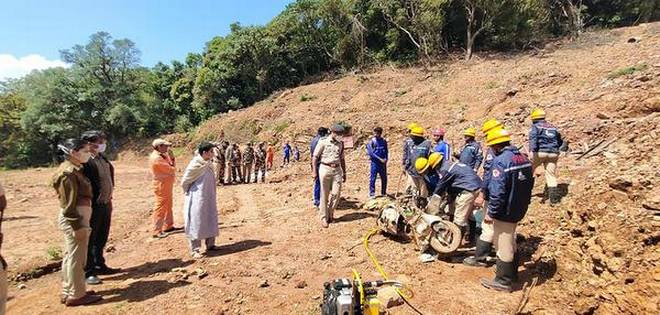
Deputy Commissioner Charulatha Somal watching the drill at Talacauvery in Kodagu on Tuesday.
A drill was staged at Gajagiri hills in Talacauvery in Kodagu on Tuesday to demonstrate the steps taken for rescue during landslips and floods. The demonstration displayed the preparedness of the forces in case of emergencies.
An effort of the Kodagu district administration and the State Disaster Response Force (SDRF), the drill was conducted in the presence of Deputy Commissioner Charulatha Somal, Superintendent of Police Kshama Mishra and other senior officers.
The personnel of the NDRF, the Fire Department, Home Guards, the police and other agencies aiding rescue operations jointly carried out the exercise on how rescue efforts have to be carried by the teams amidst the calamities. Various types of rescue operations were demonstrated mocking a situation of landslips at the hills. The demonstration was carried out at the same site where a major landslip had occurred at Talacauvery last year.
Ms. Somal said the district administration was preparing itself for handling emergencies in the wake of three successive floods and landslips since 2018. The rescue teams were staging the drills at vulnerable sites, demonstrating the preparedness.
Ms. Mishra said the police would extend all support to the NDRF, SDRF and other rescue teams and coordinate with them on handling emergencies.
Importantly, the district administration has prepared the District Disaster Management Plan for bringing into effect preventive and mitigation measures whenever necessary, and chalked out an action plan for the reconstruction and rebuilding of Kodagu.
The ‘template’ of handling disasters and lessons learnt from the experience came in handy for also handling the pandemic in the district, with the district administration working and coordinating with the police, and other key departments during floods for reaching out rescue and relief to the affected.
The coordination that was displayed in handling the crisis last year was notable with the elected representatives, elected bodies and the officials working together as teams to manage the disasters. The administration, in 2019, had estimated ₹1,700-crore for rebuilding Kodagu after the calamities. The loss suffered by the coffee industry was over ₹53-crore while the black pepper industry’s losses had been pegged at ₹83 crore.
Minister in-charge of Kodagu district V. Somanna had said last year that a loss of ₹415 crore had been estimated based on the damage caused to roads, bridges, and other infrastructure facilities across Kodagu during floods and landslides in 2020. As many as 91 villages bore the brunt of floods and nearly 28 villages witnessed landslides.
source: http://www.thehindu.com / The Hindu / Home> News> States> Karnataka / by Special Correspondent / Mysuru – February 24th, 2021
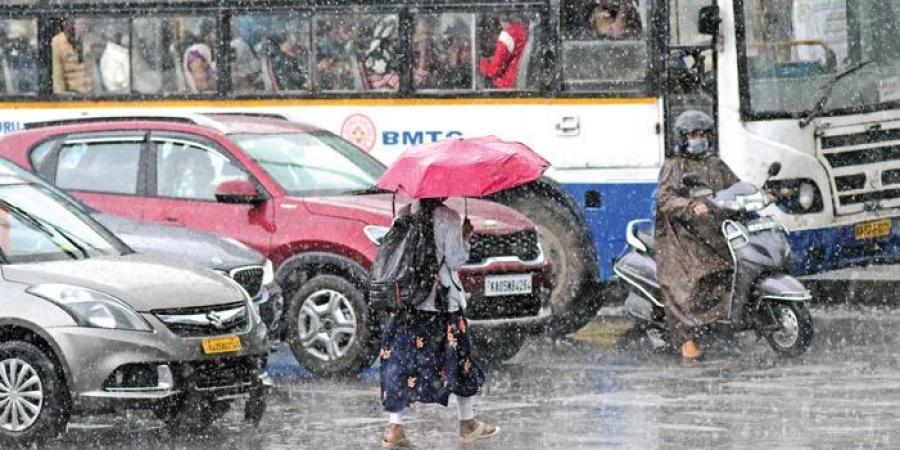
A woman crosses the road through the pouring rain, in Bengaluru on Friday. Many parts of the city received unseasonal showers | AshishKrishna H P
Meanwhile, the India Meteorological Department (IMD) officials in Bengaluru were surprised on learning about hailstorms in Kodagu and Chikkamagaluru during this time of the year.
Madikeri :
It was a surreal experience for many in parts of Kodagu district on Friday.
A sudden, heavy hailstorm, lasting over half an hour, left several villages across Shanivarsanthe wearing a snow-capped look.
While youngsters in the villages frolicked with chunks of ice, the farmers were worried about crop losses.Villages including Nidtha, Mulluru, Gudugalale, Ankanahalli and Dundalli in Shanivarsanthe hobli were swathed in about 1.5 inches of white.
Many students of Mulluru Government Primary School had their first experience with a hailstorm. “Hail stones had collected on a tarpaulin we had put up outside the classrooms for conducting classes. All the students brought buckets and collected ice chunks. It was a unique experience for them,” explained Satish, a teacher at the school.
“I have not witnessed such a hailstorm in the last 45 years of stay at Shanivarsanthe,” said M P Mohanraj, an agriculturalist. He grows pepper, coffee, orange and lemon and expressed concern that this was not good news. “Such rains are always disastrous for farmers and growers. Following the coffee picking season, the coffee plants have to dry till March. On March 31, the farmer’s much sought-after rain – the ‘rathi’ rain – enables blossoming of the crops. This hailstorm will damage the crops and will affect the next year’s crop,” he felt.
Meanwhile, the India Meteorological Department (IMD) officials in Bengaluru were surprised on learning about hailstorms in Kodagu and Chikkamagaluru during this time of the year. The IMD-Bengaluru, Director in-charge, Geeta Agnihotri, told TNIE that thunder and lightning, coupled with light rainfall, was the forecast following the formation of the easterly system.
“There was no forecast of a hailstorm. It has come as a shock. The conditions were also not favourable for it to occur as there was no rise in temperature and sufficient moisture in the air,” she explained. She added that they have been getting inputs from across districts about hailstones and damage that have occurred. The IMD has forecast rainfall and thunder showers for the next three days.
As per the IMD, Bengaluru received 5.7 mm rainfall and HAL airport recorded 5.8 mm rainfall till 8.30 pm on Friday. Most parts of Karnataka received rainfall because of a trough over north Kerala to south Gujarat coast. The rainfall and dip in temperature is also because of easterly winds, explained an official.
Heavy rains lashed Chitradurga district on Thursday and Friday, inundating low-lying areas. Several parts of Chikkamagaluru district also received moderate rainfall on Friday. A 20-year-old youth died after he was struck by lightning at Nidgal village in Khanapur talluk on Wednesday evening.
source: http://www.newindianexpress.com / The New Indian Express / Home> States> Karnataka / by Express News Service / February 20th, 2021
With the Zilla Panchayat (ZP) and Taluk Panchayat (TP) polls scheduled to take place this year, the State Election Commission (SEC) has set in motion the process of delimitation of ZP and TP Constituencies in all districts of the State. The SEC, which has fixed the number of ZP and TP Constituencies in all districts, has directed the Deputy Commissioners to depute election Tahsildars and other concerned staff in their respective district to appear before the Commission on specified dates, along with maps of Constituencies and other corresponding details.
Accordingly, the election Tahsildars of Mysuru, Kodagu, Hassan, Mandya, Chamarajanagar, Chikkaballapur, Kolar, Chitradurga, Ramanagara and Bengaluru Rural districts are required to appear before the SEC at Bengaluru on Feb. 22.
After delimitation, Mysuru ZP will have 53 Constituencies from eight taluks and the district will have 144 TP Constituencies collectively. Of the 53 ZP seats, Mysuru, T. Narasipur, Hunsur, K.R. Nagar and Periyapatna taluks will have seven seats each, while Nanjangud taluk will have 10, H.D. Kote 5 and Saragur 3 seats.
As far as the Taluk Panchayat is concerned, Mysuru, T. Narasipur and Hunsur Taluks will have 19 seats each, K.R. Nagar and Periyapatna 18 seats each, Nanjangud 27, H.D. Kote 13 and Saragur 11.
Kodagu District with 5 taluks, will have 29 ZP seats and 52 TP seats collectively.
Regarding ZP seats, Madikeri taluk will have 7 seats, Kushalnagar and Virajpet five seats each and Somwarpet and Ponnampet six seats each.
In respect of Taluk Panchayat, Somwarpet, Kushalnagar and Virajpet taluks will have 11 seats each, while Madikeri taluk will have 10 and Ponnampet 9 seats.
Mandya ZP will have 46 ZP Constituencies from seven taluks and 124 TP Constituencies collectively.
Regarding ZP seats, Mandya, Maddur and Malavalli taluks will have 8 seats each, while Pandavapura, Srirangapatna and Nagamangala will have 5 seats each and K.R. Pet taluk 7 seats.
In respect of Taluk Panchayat, Mandya Taluk will have 23 seats, Maddur 22, Malavalli 20, Pandavapura 14, Srirangapatna and Nagamangala 13 seats each and K.R. Pet 19 seats.
Chamarajanagar ZP will have 27 seats from five taluks and 75 TP Constituencies collectively .
Regarding ZP seats, Chamarajanagar taluk will have 9 seats, while Kollegal will have 4, Hanur 5, Gundlupet 6 and Yelandur 3.
In respect of Taluk Panchayat, Chamarajanagar taluk will have 24 seats, Kollegal 10, Hanur 14, Gundlupet 16 and Yelandur 11.
source: http://www.starofmysore.com / Star of Mysore / Home> News / February 14th, 2021
The beekeepers and producers of ‘Coorg Honey’ said they want the authorities concerned to take their brand across the country and beyond and bring back the halcyon days when the hill district used to be the country’s top honey producer.
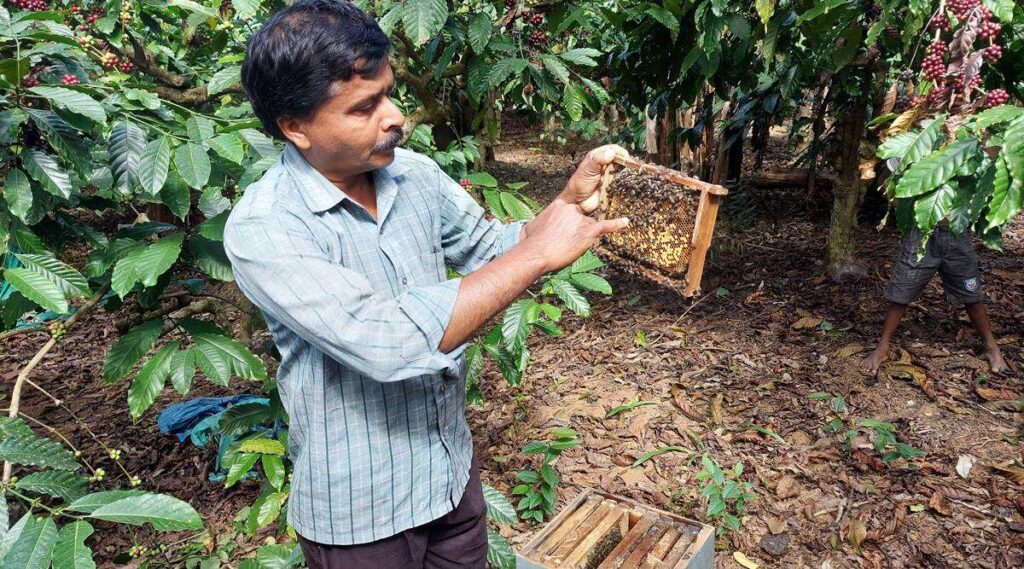
Nagesh, an apiarist in Bittangala village in South Coorg. (Express Photo by Darshan Devaiah)
Be sweet with Coorg Honey. Those were the words of Sri Shambhavananda Swamiji from Sri Ramakrishna Mission who developed a unique method of bee-keeping known as ‘Coorg Standard Hive’ in the hilly district of south Karnataka-Coorg (Kodagu). Now, the beekeepers want the state government to not only make the practice sustainable but also go big on promoting brand ‘Coorg Honey’.
Citing a recent investigation by the Centre for Science and Environment (CSE), which found that honey sold by major brands in India was laced with modified sugar syrup, the beekeepers and producers of ‘Coorg Honey’ said they want the authorities concerned to take their brand across the country and beyond and bring back the halcyon days when the hill district used to be the country’s top honey producer.
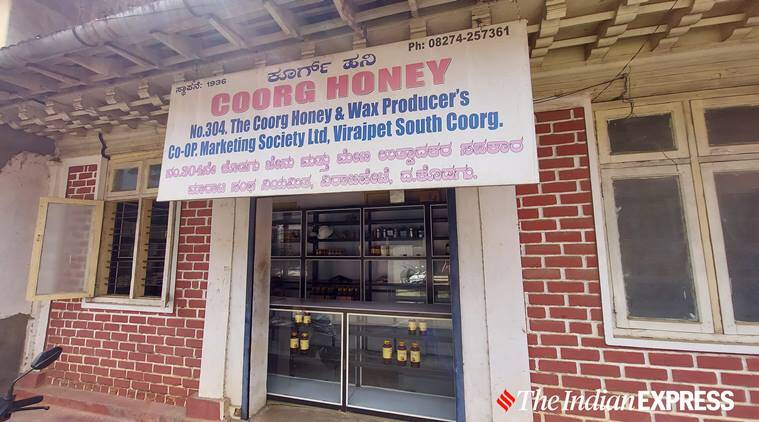
After becoming the first president of Sri Ramakrishna Saradashrama in Coorg way back in 1928, Swami Shambhavananda initiated a bee-keeping project in the district knowing that the lush, hilly terrain presented an ideal setting for the practice which could also contribute to the local economy. In 1936, Swamiji set up the ‘Coorg Honey and Wax Producers Co-operative Society Ltd’, which, in time, became the first honey producers’ co-operative in the country.
Coorg Honey society building in Virajpet. (Express Photo by Darshan Devaiah BP)
Over the last few years, the practice of bee-keeping and honey collection in the district has declined, to the extent that the Coorg Honey and Wax Producers Co-operative Society Ltd is now forced to procure honey from North Indian states just to keep their brand alive.
Speaking to indianexpress.com , Kodira Praveen Chengappa, former president of Coorg Honey and Wax Producers Co-operative Society Ltd, said, “Everyone who comes to Coorg, which is one of the country’s top tourist destinations, wants to take home a pot of ‘Coorg Honey’. However, the beekeepers in the district are not producing honey now like they used to. Since the production has reduced, our society has little option but to buy honey from beekeepers in Chikamagaluru, Karnataka, Bihar, Punjab and other places, who collect pure and original honey. We do a strict quality check then if the honey meets our standards, we sell it under the ‘Coorg Honey’ brand name.”
Kodira Praveen Chengappa taking honey from his honey bee box. (Express Photo Darshan Devaiah BP)
Apis Cerana bees, known as the honey bees of Coorg, still flock around the colourful indigenous flowers, lining the Western Ghats, drawing nectar. However, the practice of beekeeping has been severely hit.
“Earlier, many trees were planted and wildflowers, including coffee blossoms, paddy, ragi, were cultivated, drawing bees by the droves. However, honey collection has been severely dented as the use of pesticides these days is killing the bees,” Chengappa said.
Apiculture or beekeeping used to be one of the important farming activities in Coorg and contributed substantially to the income of local farmers. “In 1936, Shambhavananda Swamiji started the first honey producers’ co-operative in India at Virajpet in Coorg district. Later, in 1938, he founded the Ramakrishna Ashram and started to impart beekeeping lessons to local youth, who took an interest in the practice, at his office and a honey processing unit. He also sent local enthusiasts to beekeeping training centres in Pune and Coimbatore. He also marketed ‘Coorg Honey’ in Mumbai and other cities,” Chengappa said.
Though the production of ‘Coorg Honey’ has declined drastically, the former boss of the co-operative said the demand for the brand remains undiminished and with a bit of hand-holding from the government and other authorities concerned, the district could return to its glory days of honey making.
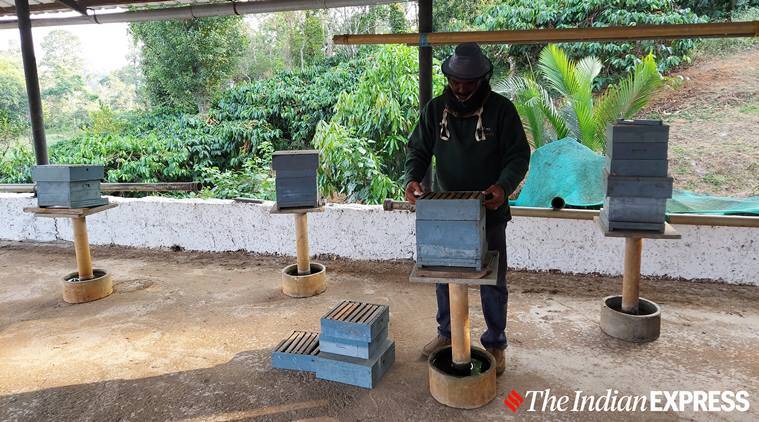
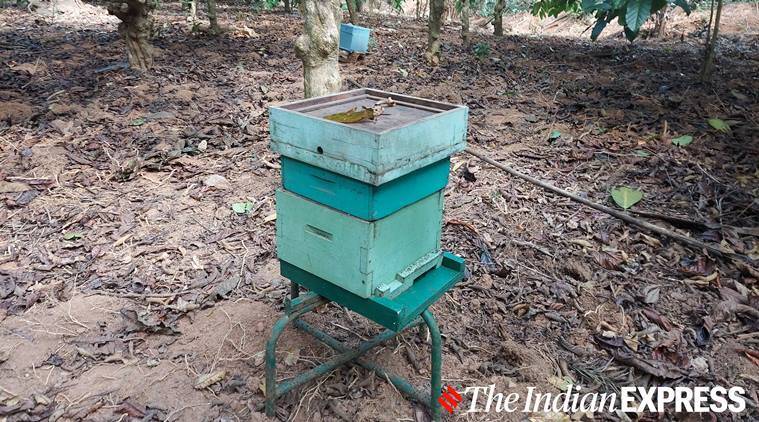
Bee hive boxes kept inside a coffee estate in Coorg. (Express Photo by Darshan Devaiah BP)
Traditional beekeepers, who have been harvesting honey since ages, are struggling these days as the honey bees of Coorg are declining in number, largely because of the use of pesticides. They said that radiations from mobile towers in the district are proving fatal for the bees.
Nagesh, an apiarist at Bittangala village in South Coorg who has been into beekeeping for three decades, told indianexpress.com, “I request our farmers not to use pesticides as it is because of these chemicals that the honey bees are dying. I have also seen the bees dying because of radiation from mobile towers. As much as 30 to 50 per cent of bees are dying due to mobile tower radiation and another 80 per cent because of the use of pesticides.”
Nestled in the midst of rolling hills and dense forests, Coorg experiences periodic shifts in climate and temperature, making it a favourable haunt for four major species of honey bees. According to Nagesh, a Coorgi, the honey tastes different as seasons roll and also at time of crop cultivation. “During the harvesting of coffee beans, the honey tastes very different compared to the season when paddy is cultivated,” Nagesh said, adding that the main four species of honey bees found in Coorg are Ponn thene (Apis dorsate) in forest areas, Potti thene (Apis cerena), Kaddi thene (Apis floria) and M ooli thene(Apis trigona), which are domesticated.
Beekeepers in Coorg keep around 30 to 50 bee boxes within an area of one to one-and-a-half kilometres, depending on the source of bee forage, in their coffee estate or areca nut farms. Nagesh said bee colonies, these days, is very hard to find as they are facing the risk of a colony collapse disorder where the majority of worker bees in a colony disappear.
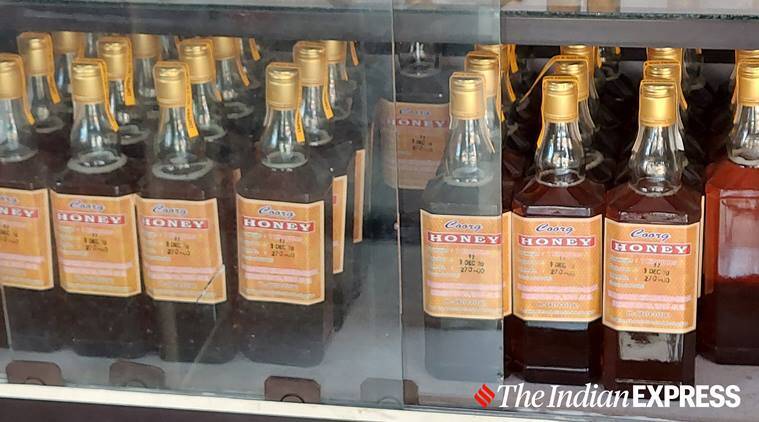
Coorg honey. (Express Photo Darshan Devaiah BP)
A beekeeper in Coorg can harvest 2-3 kgs of honey from one box. “Earlier we used to harvest 10 to 20 kgs of honey from one box. During the peak time, honey can be extracted once in 15 days from one box if there are strengthened colonies. However, that is not possible now,” Nagesh said.
The horticulture department has started providing Bee Hive Boxes and training to interested people at the beekeeping training centre in Bhagamandala, North Coorg. Founded in 1953, the centre provides three months of training, where students are taken through the basics of bee collecting, bee hiving and honey collecting or extraction, among other practices.
Prakash Mandanna, a beekeeper who took his lessons in the practice at Bhagamandala training centre, said, “After enrolling for a training course 10 years ago, I started beekeeping. However, six years later, the bees were afflicted with diseases such as Thai sac brood. Planting of exotic trees such as Silver Oak, Eucalyptus and Acacia Auriculiformis in the coffee estates affected pollinators and altered the native flora of Coorg.”
“The loss of forest cover and native trees is also an important reason for less honey bee production in Coorg. The government should focus on revival of bee production through the expansion of forest cover and forage plants in the district,” Mandanna told indianexpress.com.
He said the need of the hour is for the state horticulture department to promote beekeeping among the youth in the district. “Our government has undertaken various initiatives to promote beekeeping but the problem is that people are losing interest in the practice as the bees are not available in plantations and forests now. The horticulture department should come forward and support beekeeping in Coorg,” he said.
Officials in the horticulture department said various initiatives have been taken up in recent years to increase production of honey and provide subsidy to farmers interested in Apiculture.
Speaking to indianexpress.com, Dr Hemalatha, senior assistant director, Horticulture (Apiculture), said, “We have three different schemes at central, state and district levels to help farmers who are interested in apiculture. As part of the state sector, we are giving a budget for beekeeping development and under the central sector scheme, we are providing pollination support. We are also giving residential beekeeping training at the Bhagamandala centre in Coorg where approximately 15 to 20 interested farmers can take a training in beekeeping every year and earn a stipend.”
She said the horticulture department is also reaching out to farmers across the state, who are interested in beekeeping. “Our schemes are aimed at helping farmers interested in Apiculture and we are spreading the word through local newspapers and grama sabha meetings. Honey Mela is also organised every year in Bengaluru to promote Apiculture,” Hemalatha said.
source: http://www.indianexpress.com / The Indian Express / Home> Cities> Bangalore / by Darshan Devaiah BP, Coorg, Madikeri / February 15th, 2021
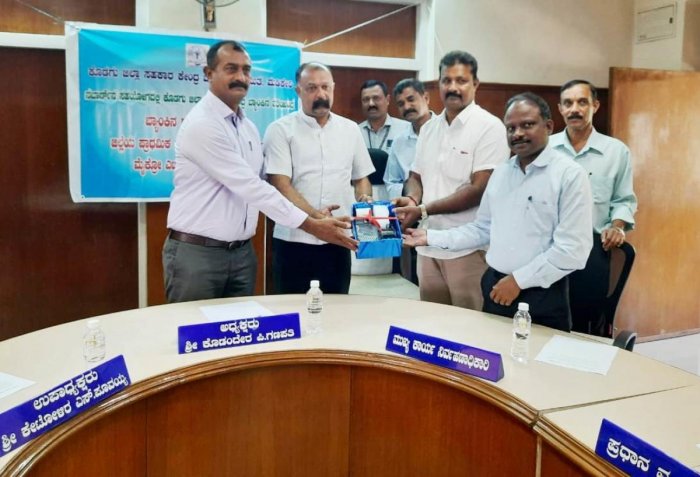
Micro ATMs were distributed to Primary Agriculture Credit Cooperative Societies at DCC Bank hall in Madikeri.
Micro ATMs are being distributed to all the Primary Agriculture Credit Cooperative Societies (PACCS) in the district in a phased manner. The farmers should make use of the facilities, said Kodagu District Cooperative Central Bank president Kodandera P Ganapathi.
He was speaking after distributing micro ATMs in the DCC Bank hall on Tuesday.
The government has directed to implement digitalisation in cooperative banks on the lines of nationalised banks. In this regard, micro ATMs are being distributed to 21 Primary Agriculture Credit Cooperative Societies in the district, he added.
For the benefit of the customers of the bank and cooperative societies, micro ATMs are being given. The micro ATMs are being implemented in association with Nabard. All the branches of DCC Bank will be installed with micro ATMs, he said.
“Farmers find it difficult to reach the DCC Banks, situated far away from villages. Instead, using the micro ATMs at primary credit cooperative societies, they can complete their financial activities,” he said.
The district has 73 Primary Agriculture Credit Cooperative Societies. The micro ATMs are helpful in carrying out financial transactions. The micro ATMs are installed with 90% funds from Nabard and 10% from the DCC Bank, said Kodandera Ganapathi.
The micro ATMs will be installed at Bhagamandala, Karike, Maragodu, Made, Payaswini, Hathoor, Hudikeri, Rudraguppe, Thithimathi, Srimangala, Kanooru, Devanageri, Birunani, Bairambada, Mayamudi, Rameshwara Koodumangaluru, Nanjarayapattana, Chettalli, Handli, Aluru Siddapura and Torenoor societies, he added.
DCC Bank CEO Salim said that measures will be initiated to extend all the facilities from the cooperative banks to the farmers.
RuPay card is being distributed to all the farmers, he added.
Sampaje Payaswini Agriculture Credit Cooperative Society president Anantha said micro ATMs will benefit farmers from rural areas.
DCC Bank vice president Ketolira Harish Poovaiah and others were present.
www.deccanherald.com / Deccan Herald / Home / DHNS, Madikeri / February 10th, 2021
Ex-banker Soomanna Mandepanda and his wife, Puja Soomanna set up their startup Humblebean in 2017 to ensure better prices and reach for small coffee farmers and improve every part of the value chain.
For former banker Soomanna Mandepanda, the motivation for setting up Humblebean was not just to sell the best coffees, but more importantly, uplift the small and medium Indian farmers who grow them.
In the process, he is trying to bring about changes at almost each stage of the business — from cultivation and supply chain to research and education.
Founded in 2017 by Soomanna and his wife and former Yahoo executive Puja Soomanna, Bengaluru-based Humblebean works on an omnichannel model: It ties up with small coffee farmers in south India, roasts and grounds supply, provides the beans to roasters, exports its products, operates brew bars, and has an online presence.
A responsible way to grow coffee
The coffee drinking experience has been gaining traction in India, with the market for the brew expected to record a compound annual growth rate of 7.2 percent during 2021-25, according to a January 2021 Statista report.
Startups including Sleepy Owl, The Flying Squirrel, and Coffeeza, as well as shops such as Third Wave Coffee Roasters are making their presence felt in the market.
India is the world’s sixth-largest producer of coffee and fifth in terms of exports; in fact, 70 percent of its production is exported, says a January 2021 report by the India Brand Equity Foundation. Yet, Soomanna says, “a lot of small and medium farmers and farms aren’t getting the kind of business and reach they should” .
Soomanna would know: he spent most of his childhood on the coffee estates of Coorg and was a small farmer before moving to the world of finance and banking for 13 years. One way to correct the imbalance, he says, is by “making great biodiverse coffee that farms in India are already poised to do”.
According to him, 80-90 percent of coffee farms in India are held by small and medium farmers, whose secondary income comes from crops such as jackfruit, avocado, pepper, and orange that are part of the same farms.
Cultivating other crops alongside coffee “ensures automatic carbon sequestration, top soil replenishment, and lesser need to feed chemicals unlike commercial crops grown in other countries”, says Soomanna. “The mining of the minerals is automatic and you become carbon neutral.”
Puja Soomanna
Advocating farmer-friendly norms
Increasingly popular among young consumers are organic, speciality, and Rainforest Alliance coffees that respectively employ natural methods of cultivation dispensing with harmful chemicals, are of the highest grade being derived from a single origin or single estate and protect the environment as well as worker rights.
However, in India these certified varieties are grown largely on rich estates; most small and medium farmers cannot afford the costly certifications and grades.
Coffee cultivation and the business are still quite unorganised in India, the certifications cost a lot of money, and need constant follow-ups, says Soomanna. “The norms are difficult to adhere to for most small farmers. It is a replication of an American model.”
___________________
He says most large corporations in India export to Europe. “The small companies in Hassan, Chikmagalur, etc. certify about 150 estates and add the tags. But the farmer doesn’t get the price because the better prices are still being fetched with the local trader. The local traders are important, but the real traceability is lost.”
As farmers don’t get better prices, there is little driving them to improve their produce, he says. “Speciality coffee is something few farmers can afford to grow.”
Hence, the need to bring in farmer-friendly rules, he says.
The Humblebean coffee
Promoting social value investing
Given the largely unorganised state of affairs, Humblebean focused on getting farmers on board. The team collected random samples, tasted them, and guided farmers on growing the beans in a better way.
By 2018, the team had got 50-60 farmers on board and given them assessment reports free of cost. Until then, the startup was in its pre-revenue stages, bootstrapped with funds from family and friends.
The team then focused on getting roasters to directly buy from farmers. For this, it adopted the idea of social value investing, in which everyone who is part of the value chain comes together to solve a problem and there is money in it for all.
__________________
“Once we got the farmers on board, we decided to tie up with brands and introduce them to the new portfolios of coffees,” says Soomanna. “We incubated close to four different brands in India from scratch to start a unique brand with a different blend. The idea was to bring in multiple partnerships and inclusiveness in the farming community on one platform.”
Most of the speciality coffee firms have restricted names and types of beans grown on particular estates. “The idea is to bring in more brands that can access different estates, work with them, and encourage the farmers,” says Soomanna.
Humblebean also fulfils the complete roast and ground process for such brands and even gives them a credit facility, he says.
Quality comes with education
Towards the end of 2018 and early 2019, the Humblebean team found that coffees served at most star hotels weren’t up to the mark.
One of the reasons for this, Soomanna says, is that coffee as education is lacking in hotel management schools: one has to go to Italy to learn more about its nuances. The Coffee Board of India mostly takes care of the functionality, he says.
_________________
“We met a few management schools and after some discussions it was decided that the colleges would look at it as part of the curriculum,” says Soomanna.
Brewing innovative Indian blends
Even as Humblebean works to improve every part of the value chain, it is trying to offer consumers a very Indian coffee drinking experience.
To that end, the startup opened its first Brew Bar in the food experience section of a workspace on Bengaluru’s Residency Road in 2019. Humblebean was one of the early members of that workspace set up by a Singapore-based company.
Puja, who conceptualised Brew Bar, spent time innovating the blends with the use of Indian robustas.
“We don’t serve a single cup of speciality coffee; we wanted to make sure through the brewing methods can small and medium farmers come into mainstream brewing?” says Soomanna.
______________
He says these Indian blends “aren’t being used by a single new-age speciality coffee company” as they are considered “harsh and used as a filler across the world. But they are unique and you need great expertise and experience to make a robusta out of them”.
Following research and development, the startup has also come up with its own set of products. Together with B2B partners, it has launched these products online and will soon sell them at other marketplaces. The range is priced at Rs 220-350 for 250 gm for limited editions and depending on the roast.
“Indian coffees can have a global impact,” says Soomanna. “The idea is to be farmer-friendly and also not cause too much environmental damage. We want to bring an amazing cup of coffee from the farms the way it should be drunk.”
Edited by Lena Saha
source: http://www.yourstory.com / YourStory / Home> Start Up / by Sindhu Kashyap / February 07th, 2021
The best thing about the Budget is that it’s citizen-centric and investment-based, a national Budget for Indians, says Bidapa.
Does the Budget address the distress caused by the pandemic?
I hope the new health care package will help control the Covid-19 pandemic better and speed up the vaccination process. Efforts to tackle the crisis and vaccinate people have to be implemented better across the country.
Will this Budget help the economy and create jobs?
I should hope so. The stimulus packages featured in the Budget are good. It’s people-friendly and an overall good Budget that should drive the economic recovery.
What is the best thing about the Budget? And the worst?
The best thing about the Budget is that it’s citizen-centric and investment-based, a national Budget for Indians.
It’s a great relief for taxpayers that rates on the direct tax front have not been increased.
Senior citizens, however, could have been given relief from the age of 65 years instead of 75 given the health challenges in the post-Covid-19 scenario.
The worst thing in the Budget is the agriculture infrastructure cess that will be imposed on petrol and diesel. It is not good and will further jack up inflation.
If you were the Finance Minister, what would you have done with the Budget?
On the specific opening and promotion of textile parks, I would have reserved at least 20 per cent for the handloom and khadi sector, which have enormous export potential, especially in the luxury sector. We need to incentivise the handmade and craft sectors of India, which are unique to us.
WELCOME. If you like what you see "SUBSCRIBE via EMAIL" to receive FREE regular UPDATES.
Read More »