Category Archives: Business & Economy

Micro ATMs distributed to 21 PACCS in Kodagu

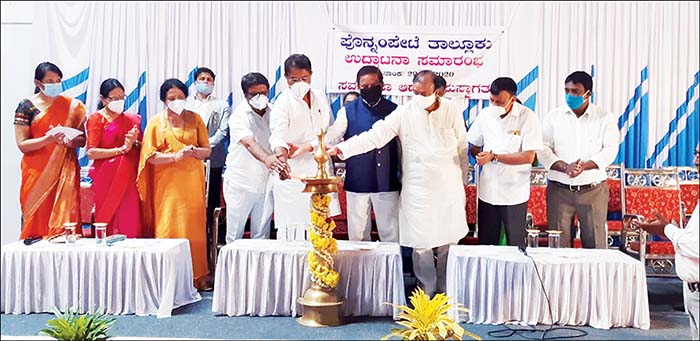
Micro ATMs were distributed to Primary Agriculture Credit Cooperative Societies at DCC Bank hall in Madikeri.

Micro ATMs are being distributed to all the Primary Agriculture Credit Cooperative Societies (PACCS) in the district in a phased manner. The farmers should make use of the facilities, said Kodagu District Cooperative Central Bank president Kodandera P Ganapathi. 

He was speaking after distributing micro ATMs in the DCC Bank hall on Tuesday. 

The government has directed to implement digitalisation in cooperative banks on the lines of nationalised banks. In this regard, micro ATMs are being distributed to 21 Primary Agriculture Credit Cooperative Societies in the district, he added.

For the benefit of the customers of the bank and cooperative societies, micro ATMs are being given. The micro ATMs are being implemented in association with Nabard. All the branches of DCC Bank will be installed with micro ATMs, he said. 

“Farmers find it difficult to reach the DCC Banks, situated far away from villages. Instead, using the micro ATMs at primary credit cooperative societies, they can complete their financial activities,” he said. 

The district has 73 Primary Agriculture Credit Cooperative Societies. The micro ATMs are helpful in carrying out financial transactions. The micro ATMs are installed with 90% funds from Nabard and 10% from the DCC Bank, said Kodandera Ganapathi. 

The micro ATMs will be installed at Bhagamandala, Karike, Maragodu, Made, Payaswini, Hathoor, Hudikeri, Rudraguppe, Thithimathi, Srimangala, Kanooru, Devanageri, Birunani, Bairambada, Mayamudi, Rameshwara Koodumangaluru, Nanjarayapattana, Chettalli, Handli, Aluru Siddapura and Torenoor societies, he added. 

DCC Bank CEO Salim said that measures will be initiated to extend all the facilities from the cooperative banks to the farmers.

RuPay card is being distributed to all the farmers, he added. 

Sampaje Payaswini Agriculture Credit Cooperative Society president Anantha said micro ATMs will benefit farmers from rural areas. 

DCC Bank vice president Ketolira Harish Poovaiah and others were present.

www.deccanherald.com / Deccan Herald / Home / DHNS, Madikeri / February 10th, 2021

Uplift of small farmers drives this Bengaluru coffee startup

Ex-banker Soomanna Mandepanda and his wife, Puja Soomanna set up their startup Humblebean in 2017 to ensure better prices and reach for small coffee farmers and improve every part of the value chain.

For former banker Soomanna Mandepanda, the motivation for setting up Humblebean was not just to sell the best coffees, but more importantly, uplift the small and medium Indian farmers who grow them. 

In the process, he is trying to bring about changes at almost each stage of the business — from cultivation and supply chain to research and education. 

Founded in 2017 by Soomanna and his wife and former Yahoo executive Puja Soomanna, Bengaluru-based Humblebean works on an omnichannel model: It ties up with small coffee farmers in south India, roasts and grounds supply, provides the beans to roasters, exports its products, operates brew bars, and has an online presence. 

A responsible way to grow coffee 

The coffee drinking experience has been gaining traction in India, with the market for the brew expected to record a compound annual growth rate of 7.2 percent during 2021-25, according to a January 2021 Statista report. 

Startups including Sleepy Owl, The Flying Squirrel, and Coffeeza, as well as shops such as Third Wave Coffee Roasters are making their presence felt in the market. 

India is the world’s sixth-largest producer of coffee and fifth in terms of exports; in fact, 70 percent of its production is exported, says a January 2021 report by the India Brand Equity Foundation. Yet, Soomanna says, “a lot of small and medium farmers and farms aren’t getting the kind of business and reach they should” .

Soomanna would know: he spent most of his childhood on the coffee estates of Coorg and was a small farmer before moving to the world of finance and banking for 13 years. One way to correct the imbalance, he says, is by “making great biodiverse coffee that farms in India are already poised to do”.  

According to him, 80-90 percent of coffee farms in India are held by small and medium farmers, whose secondary income comes from crops such as jackfruit, avocado, pepper, and orange that are part of the same farms. 

Cultivating other crops alongside coffee “ensures automatic carbon sequestration, top soil replenishment, and lesser need to feed chemicals unlike commercial crops grown in other countries”, says Soomanna. “The mining of the minerals is automatic and you become carbon neutral.” 

Puja Soomanna

Advocating farmer-friendly norms 

Increasingly popular among young consumers are organic, speciality, and Rainforest Alliance coffees that respectively employ natural methods of cultivation dispensing with harmful chemicals, are of the highest grade being derived from a single origin or single estate and protect the environment as well as worker rights. 

However, in India these certified varieties are grown largely on rich estates; most small and medium farmers cannot afford the costly certifications and grades.   

Coffee cultivation and the business are still quite unorganised in India, the certifications cost a lot of money, and need constant follow-ups, says Soomanna.  “The norms are difficult to adhere to for most small farmers. It is a replication of an American model.”

___________________

He says most large corporations in India export to Europe. “The small companies in Hassan, Chikmagalur, etc. certify about 150 estates and add the tags. But the farmer doesn’t get the price because the better prices are still being fetched with the local trader. The local traders are important, but the real traceability is lost.” 

As farmers don’t get better prices, there is little driving them to improve their produce, he says. “Speciality coffee is something few farmers can afford to grow.” 

Hence, the need to bring in farmer-friendly rules, he says.

The Humblebean coffee

Promoting social value investing

Given the largely unorganised state of affairs, Humblebean focused on getting farmers on board. The team collected random samples, tasted them, and guided farmers on growing the beans in a better way. 

By 2018, the team had got 50-60 farmers on board and given them assessment reports free of cost. Until then, the startup was in its pre-revenue stages, bootstrapped with funds from family and friends. 

The team then focused on getting roasters to directly buy from farmers. For this, it adopted the idea of social value investing, in which everyone who is part of the value chain comes together to solve a problem and there is money in it for all. 

__________________

“Once we got the farmers on board, we decided to tie up with brands and introduce them to the new portfolios of coffees,” says Soomanna. “We incubated close to four different brands in India from scratch to start a unique brand with a different blend. The idea was to bring in multiple partnerships and inclusiveness in the farming community on one platform.” 

Most of the speciality coffee firms have restricted names and types of beans grown on particular estates. “The idea is to bring in more brands that can access different estates, work with them, and encourage the farmers,” says Soomanna. 

Humblebean also fulfils the complete roast and ground process for such brands and even gives them a credit facility, he says. 

Quality comes with education 

Towards the end of 2018 and early 2019, the Humblebean team found that coffees served at most star hotels weren’t up to the mark. 

One of the reasons for this, Soomanna says, is that coffee as education is lacking in hotel management schools: one has to go to Italy to learn more about its nuances. The Coffee Board of India mostly takes care of the functionality, he says. 

_________________

“We met a few management schools and after some discussions it was decided that the colleges would look at it as part of the curriculum,” says Soomanna. 

Brewing innovative Indian blends

Even as Humblebean works to improve every part of the value chain, it is trying to offer consumers a very Indian coffee drinking experience.

To that end, the startup opened its first Brew Bar in the food experience section of a workspace on Bengaluru’s Residency Road in 2019. Humblebean was one of the early members of that workspace set up by a Singapore-based company. 

Puja, who conceptualised Brew Bar, spent time innovating the blends with the use of Indian robustas.  

“We don’t serve a single cup of speciality coffee; we wanted to make sure through the brewing methods can small and medium farmers come into mainstream brewing?” says Soomanna. 

______________

He says these Indian blends “aren’t being used by a single new-age speciality coffee company” as they are considered “harsh and used as a filler across the world. But they are unique and you need great expertise and experience to make a robusta out of them”. 

Following research and development, the startup has also come up with its own set of products. Together with B2B partners, it has launched these products online and will soon sell them at other marketplaces. The range is priced at Rs 220-350 for 250 gm for limited editions and depending on the roast. 

“Indian coffees can have a global impact,” says Soomanna. “The idea is to be farmer-friendly and also not cause too much environmental damage. We want to bring an amazing cup of coffee from the farms the way it should be drunk.”

Edited by Lena Saha

source: http://www.yourstory.com / YourStory / Home> Start Up / by Sindhu Kashyap / February 07th, 2021

Fashion choreographer Prasad Bidapa’s take on best, worst things in Budget

Prasad Bidapa, Fashion choreographer and stylist

The best thing about the Budget is that it’s citizen-centric and investment-based, a national Budget for Indians, says Bidapa.

Does the Budget address the distress caused by the pandemic?

I hope the new health care package will help control the Covid-19 pandemic better and speed up the vaccination process. Efforts to tackle the crisis and vaccinate people have to be implemented better across the country.

Will this Budget help the economy and create jobs?

I should hope so. The stimulus packages featured in the Budget are good. It’s people-friendly and an overall good Budget that should drive the economic recovery.

What is the best thing about the Budget? And the worst?

The best thing about the Budget is that it’s citizen-centric and investment-based, a national Budget for Indians.

It’s a great relief for taxpayers that rates on the direct tax front have not been increased.

Senior citizens, however, could have been given relief from the age of 65 years instead of 75 given the health challenges in the post-Covid-19 scenario.

The worst thing in the Budget is the agriculture infrastructure cess that will be imposed on petrol and diesel. It is not good and will further jack up inflation.

If you were the Finance Minister, what would you have done with the Budget?

On the specific opening and promotion of textile parks, I would have reserved at least 20 per cent for the handloom and khadi sector, which have enormous export potential, especially in the luxury sector. We need to incentivise the handmade and craft sectors of India, which are unique to us.

MSP for coffee sought

Karnataka Growers’ Federation has appealed to the State government to provide minimum support price for coffee, considering the loss coffee growers suffered in the last one year.

KGF president H.T. Mohan Kumar and secretary K.B. Krishnappa, in a press release issued here on Thursday, said that coffee growers had been in financial distress as nearly 50 pc of the yield from coffee and pepper farms was lost due to untimely rains in January. The growers were not in a position to harvest the remaining yield due to non-availability of workers. The officers of Agriculture, Horticulture and Revenue Departments had been doing survey to assess the loss suffered.

“Considering the plight of the growers, neighbouring Kerala government has initiated measures to provide minimum support price for coffee. Similarly, Karnataka government should come forward to the rescue of the growers in Chikkamagaluru, Hassan and Kodagu districts”, the Federation said.

Referring to Dr.M.S.Swaminathan’s report, it demanded MSP at the rate of 1.5 times of the production cost. The State government should take a decision on this in the coming budget, it said.

source: http://www.thehindu.com / The Hindu / Home> News> States> Karnataka / by Special Correspondent / Hassan – January 28th, 2021

Work On Kootupole Bridge On Karnataka-Kerala Border Resumes

Virajpet:

Virajpet MLA K.G. Bopaiah recently inspected the work on a bridge across Kootupole near Makutta which provides connectivity between Karnataka and Kerala.

The bridge is at the Karnataka-Kerala border and is part of the Kerala State Transport Project (KSTP) road between Thalassery and Valavupara. The bridge work has resumed as Karnataka Wildlife Board has decided to give permission for the construction of the bridge.

The old bridge, built during the British era across Kootupole, has been providing interState connectivity at Makutta and it was narrow and in dilapidated condition. With the construction of Kannur International Airport, the density of vehicles on the old bridge had increased. To provide connectivity to the Airport, the Kerala Government had developed a 55-km road at an estimated cost of Rs. 360 crore till Kootupole.

However, the Karnataka Forest Department had stalled the work in 2017 considering that the land belonged to Brahmagiri Wildlife Division. Now, the work has resumed once again.Though the claim of Kerala was that the river is in its territory, the Karnataka authorities claimed that a portion of the bridge is in Brahmagiri Wildlife Sanctuary in Karnataka and also they claimed that half the river belongs to them, following which the work had to be stopped.

The project has already missed many deadlines. Though Kerala had given the documents to assert its right over the river and the officials held meetings at various levels, there were many objections on the part of Karnataka authorities. This road is a major link between Kerala and Karnataka and it would be beneficial for the residents in many parts of Karnataka, including Kodagu to come to Kannur Airport.

Realising the importance of the bridge, Bopaiah had brought the issue of the stalling of work to the notice of Chief Minister B.S. Yediyurappa, who in turn had brought it to the notice of the Central Government.

The Central Government cleared the hurdles for the bridge and the work has commenced. The MLA said that the Central and State Governments have given conditional approval for the work on the bridge. The completion of the bridge will benefit passengers travelling to Mysuru and Hassan from Kodagu.

source: http://www.starofmysore.com / Star of Mysore / Home> News / January 20th, 2021

India gets a caffeine fix

A variety of D2C coffee brands have entered the market

According to industry estimates, 80% of India’s coffee consumption comes from south India.

There is a coffee revolution brewing in India. Be it the instant kind or ones that need specific brewing techniques, new-age direct-to-consumer coffee brands are tempting consumers to turn into baristas at home. Sleepy Owl, Third Wave Roasters, VS Mani & Co., Black Baza Coffee and Araku Coffee are some of the brands vying for a slice of the Rs 2,200 crore packaged coffee market, which is dominated by coffee labels from big FMCG players, namely Nestle’s Nescafe, HUL’s Bru and Tata Coffee Grand.

Blending in

According to industry estimates, 80% of India’s coffee consumption comes from south India. Coffee chains such as Café Coffee Day, Barista and, most recently, Starbucks, have been instrumental in giving the coffee culture a facelift in India, a predominantly tea drinking nation.

“Coffee is moving from being exclusively south India’s habit to having an urban appeal. Coffee shops are now spread across tier I and II cities, and are places for youth and young professionals to meet and work,” says Alagu Balaraman, MD – CGN & Associates India.

Sleepy Owl’s co-founder Ajai Thandi says that the primary intention for the company is to replicate the experience and flavour of barista-made coffee at home, sans equipment. This direct-to-consumer coffee brand has introduced coffee bags that can be used just like tea bags to prepare a hot cup of black coffee. It also has a range of cold brew sachets that can be dunked in a jug of water and brewed overnight.

While new-age roasters offer a range of blends and variations meant for specific kinds of coffee, it is the instant variety that offers scale. According to Mintel India, in 2020, 54% of the total coffee launches in India were in the instant/soluble segment. Mastering the instant coffee variant lets brands reach a wider audience. This is why GD Prasad, co-founder, VS Mani & Co., and VP, Dentsu Webchutney, started off by selling the instant coffee-chicory blend.

“There is an exceedingly small segment of consumers that likes to brew its own coffee. These could be enthusiasts who have a French press or a moka pot, and are experimenting. Instant varieties make more business sense,” he says. VS Mani & Co.’s 100 gm instant coffee powder has a repeat cycle of two-to-three weeks. Prasad expects the filter coffee purchase cycle to be longer.

Coffee-nomics

Black Baza Coffee lays emphasis on sourcing coffee responsibly and ethically, and targets coffee enthusiasts who share similar values. Until March 2020, it earned revenue from both B2B and B2C verticals. When the HoReCa segment came to a standstill, its B2B revenue stream dried up. “We had a 60-40 ratio between B2B and B2C revenue; however, B2C is now the predominant business for us, contributing 90% of the revenue,” informs Arshiya Urveeja Bose, founder, Black Baza Coffee.

Sleepy Owl was earning about 20-30% of its revenue from B2B sales to airlines, movie theatres, offices, hotels and restaurants. Thandi says B2B sales aided in sampling and brand building. When normalcy resumes, he expects the proportion to remain the same.

A few coffee roasters follow a café-plus-roastery model. For instance, Third Wave Coffee Roasters, which sells several products directly to consumers, including equipment, has 10 cafés in Bengaluru and two each in Pune and Hyderabad. Blue Tokai has several cafés across the country. “Cafés offer high margin on a single cup of coffee,” says Balaraman. For instance, a single cup of a Pour Over at Blue Tokai costs Rs 170, while the company’s Easy Pour coffee sachet costs Rs 40 per sachet.

Each of these brands have subscription options. “These are mainly for loyalists who want to have a steady flow of coffee. A monthly subscription of five sachets of our cold brew costs Rs 450. We are working on setting up our subscription back end to make it more customisable,” says Thandi.

source: http://www.financialexpress.com / Financial Express / Home> Brand Wagon / by Venkata Susmita Biswas / January 25th, 2021

Chorus Grows For Relief Package To Coffee Growers

Madikeri:

There is an increasing demand from coffee growers for a relief package in the budget to be presented by the State Government this year. 

The demands have grown after the Kerala Government increased the Minimum Support Price (MSP) for raw Robusta Coffee at Rs. 90 per kg in Wayanad district. For a 50 kg bag, the MSP offered by Kerala is Rs. 4,500. The MSP announcement that comes at a time when coffee growers are reeling under severe crisis owing to the low price of the produce, higher input cost and vagaries of weather. 

Even the coffee grower community from Kodagu have been demanding relief package as they feel that the amount paid through the calamity relief fund under the National Disaster Management Plan will not be sufficient to recoup the losses suffered by them due to unprecedented rains.

Former Vice-President of Coffee Board Dr. Sannuvanda Kaverappa said that since 2015, the coffee growers in Karnataka were suffering due to lack of good prices, high input and labour costs and adverse weather, but successive governments have ignored the plight of the growers. 

A waiver of coffee loans, re-scheduling of outstanding loans and reduction in the interest rate for loans are justified considering the difficult times faced by the growers, he said. “Coffee planters in the district are reeling because of various reasons, including the vagaries of monsoon and COVID-19. I appeal to the Government to declare a special relief package and announce a waiver of short-term loans and developmental loans taken by coffee growers,” he said.

He also sought immediate payment of pending subsidies towards replanting and other schemes of the Coffee Board. “Kodagu has been tormented by weather and either it is lack of rains or excessive rains that have led to landslides and destruction of plantations.

Karnataka must follow the Kerala model where an MSP of Rs, 90 per kg has been declared to Wayanad coffee growers,” he demanded.

source: http://www.starofmysore.com / Star of Mysore / Home> News / January 25th, 2021

21st branch of Kodagu District Coop Bank opened

MLA M P Appachu Ranjan inaugurates the 21st branch of Kodagu District Cooperative Bank at Kodlipete.

The people of the district are responsible for the progress of District Cooperative Bank. The bank should lend loans to only those from the district and not to those hailing from outside, said MLA M P Appachu Ranjan. 

He was speaking after inaugurating the 21st branch of Kodagu District Cooperative Bank at Kodlipete.

The bank officials should interact with customers with the utmost patience to compete with the nationalised commercial banks, he added. 

Cooperative Bank president Kodangera P Ganapathi said that the bank was started in 1921. To commemorate the 100th year, the 21st branch has been started at Kodlipete. The centenary Bhavana foundation will be laid in the month of June.

MLA K G Bopaiah and MLC M P Sunil Subramani also spoke on the occasion. 

source: http://www.deccanherald.com / Deccan Herald / Home> State> Mangaluru / by DHNS, Shanivarasanthe / January 24th, 2021

Coffee growers to join Jan. 26 jatha in Bengaluru to seek MSP for their crop

They complain of raw deal from State government

Coffee growers from Kodagu, who are seeking minimum support price (MSP) for coffee, will join the farmers’ protest scheduled to be held in Bengaluru on January 26 against the Centre’s farm bills.

The coffee growers are seeking to draw attention to their predicament over coffee prices remaining stagnant for more than 20 years while the costs they incurred on labour and other agricultural inputs including fertilizers have increased manifold.

“One 50 kg bag of robusta coffee used to fetch ₹3,000 in the mid- and late nineties. The price has remained unchanged more than two decades later also” said Karnataka Rajya Raitha Sangha (KRRS) leader from Kodagu Manu Somaiah.

Coffee growers are putting up with the stagnant prices of coffee while shouldering the burden of rising costs of labour and other agricultural inputs, he said and sought to know why the State is refusing to extend MSP to coffee when neighbouring Kerala was extending the same to its growers.

“About a week ago, we held a meeting and decided to press for our demand for MSP for coffee”, said Mr. Somaiah. “When Kerala, which produces barely 20 per cent of the country’s coffee production, can extend MSP, why can’t Karnataka, which accounts for more than two-thirds of India’s coffee production do the same?”, he questioned.

He said their appeals for MSP are met with the standard reply that coffee was a commercial crop that is not entitled for support price. “But, when Kerala government can do it, what logical explanation can Karnataka government give?”, he asked.

The coffee growers of Kodagu have been at the receiving end of nature’s fury during the last three years when the region was struck by landslides and floods, causing widespread damage to the crop.

Mr. Somaiah recalled that the coffee growers were receiving remunerative prices when it was regulated by Coffee Board till the early nineties. But, it shifted to open market policy soon thereafter on the same promise that the present farm bills are assuring – that the farmers will earn more. But, it was not to be, he regretted adding that the prices are now determined by the trading in New York and London Stock Exchanges.

Mr. Somaiah said the coffee growers in Kodagu are also upset with the State government and Centre over the falling price of black pepper, which is grown as inter-crop. The price of black pepper had reached ₹900 per kg till the Centre started allowing imported pepper from Vietnam and other countries to flood the domestic market and bring down the prices to the level of ₹300 per kg, he lamented.

The coffee growers of Kodagu are joining forces with the farmers from the rest of the State, who are planning to gather in Bengaluru on January 26. The coffee growers from Kodagu will gather at Kutta on January 25 before leaving in about 150 vehicles towards Bengaluru. The coffee growers will hold demonstrations in Ponnampet and Gonikoppa before spending the night in Mandya and proceeding to Freedom Park in Bengaluru on January 26.

source: http://www.thehindu.com / The Hindu / Home> News> States> Karnataka / Mysuru – January 23rd, 2021

Madikeri: Self-start without motor – Kodagu mechanic’s invention

Madikeri :

Motorbikes have become part of life in India where roads of different types and make pass through different terrains. A mechanic here, who loves motorbikes, has utilised the time he got due to coronavirus break, to invent a self-start for motorbikes without requiring any motor. Venkatesh from Kushalnagar here is the inventor of this device.

People now-a-days are not willing to kick-start their vehicles. Many bikes marketed in the recent past have self-start facilities. But those made a few years back do not have this facility, and repeated kicking is unavoidable. There are people who are attached to their old bikes and hence do not want to sell them. Venkatesh’s invention will help them.

Venkatesh’s alternate generating system kit (AGS) works by using winding copper wires. For this self-start, no machine or motor is needed. This is made by just using copper wire and magnet. It can be fitted to bikes without damaging any part. The price of the kit may be between Rs 12,000 to Rs 15,000. Venkatesh has uploaded video of its working in YouTube and several have already booked for the kits.

His other invention, fixing of double engines, has also become a hit.

source: http://www.daijiworld.com / Daijiworld.com / Home> Top Stories / by Daijiworld Media Network – Madikeri (SP) / January 21st, 2021