Category Archives: Business & Economy

COVID-19: Karnataka coffee growers demand special package

Members of Kodagu district Growers' Federation submit a memorandum to MLA Appachu Ranjan. DH Photo
Members of Kodagu district Growers’ Federation submit a memorandum to MLA Appachu Ranjan. DH Photo

Coffee growers in the district have demanded special package from state government, as planters are facing hardships in the wake of Covid-19 lockdown.

Members of the planters’ association have submitted a memorandum to the MLAs of the district in this regard and have urged chief minister to come to their rescue.

Kodagu district is affected by floods for past two years and the lockdown has worsened the situation, they said and pointed out that harvesting of coffee and pepper in most of the plantations had come to a standstill, resulting in the loss of crops.

It is feared that next year’s yield too will be lost as the growers are finding it difficult to maintain of their plantations.

The growers urged the government to provide special package for the coffee growers.

Vegetable and plantain cultivators too sought assistance from the government, stating that most of the cultivators in the district have been dependent on Kerala market. But, due to the lockdown, the fruits are getting rotten and has led to a huge loss.

The government should announce support price and should procure ‘Nendra’ banana and other fruits from the farmers, the growers said and also requested the government to waive the interest on the loans availed by them.

“A committee of elected representatives should be formed towards formulating plans to encourage farmers to take up cultivation in barren lands,” the memorandum stated.

source: http://www.deccanherald.com / Deccan Herald / Home> State> Mangaluru / by DHNS, Madikeri / May 08th, 2020

Catch Of The Day! 38-Kg Fish Caught From Harangi Backwaters

FishKF06may2020

Kushalnagar:

A group of youths who were fishing at Harangi backwaters in Kodagu District this morning were in for a pleasant surprise as they caught a giant fish that weighed 38 kgs. The fish was caught with the traditional method of fishing rod and angler.

The fish, Catla variety, was caught at Nakoor village along the Harangi backwaters by Preveesh, who then uploaded the same on his Facebook page. He said that though he was hoping for a good catch he did not expect this big a catch. Earlier too he had caught giant Catlas but this particular fish was his biggest catch. Today’s fish was sold at the local market.

Due to lockdown and lack of activities, there is a lot of fishing going on in the Harangi backwaters where youths come in many groups to fish. Typically, the fishing activity starts early in the morning and ends at around 11 pm. Local villagers from Nakoor, Shirangala, Suntikoppa, Hosathota, Kusboor and Madapura come to the backwaters to fish on the 5.6 km Harangi River stretch from the Harangi Dam to Koodige Bridge.

Traditional fishing is being held from many years in the backwaters of Harangi, which spreads over 1,886 hectares in area. Lakhs of fingerlings are released into the reservoir every year.

Some innovative villagers have even dug up irrigation ponds in the backwaters to supply water in summer to their fields. When the water storage is high at the Harangi Reservoir, these irrigation ponds get filled and submerge and when the water at the dam recedes, these ponds are full of water and fish.

Varieties of fish, including Mahseer, Catla and Rohu are released to Harangi every year and along with these, fingerlings procured from Kabini and Bhadra reservoirs are being provided to farmers at subsidised costs. Many families in this belt depend on fishing for their livelihood.

source: http://www.starofmysore.com / Star of Mysore / Home> News . April 29th, 2020

Pepper prices rise 15% amid lockdown on hope of healthy post-monsoon sales

Farmers hold on to stocks due to great demand for high-quality Indian produce.

Some farmers who had finished harvesting had sold in panic.

Pepper prices have turned buoyant again rising by as much as 15 per cent in India to Rs 325 per kg from Rs 285 earlier.

Rohan Colaco, a planter from Karnataka and a member of Karnataka Planters Association, said that pepper prices had been sliding prior to the lockdown. The spice was trading at around Rs 285 a kg and was expected to go down to Rs 260.

Some farmers who had finished harvesting had sold in panic. Also there was unripe pepper wine harvest and selling this year. After the lockdown, the prices opened at Rs 305.

“It is expected that there will be no inward movement of pepper through international borders. There is also good demand for high quality Indian pepper. Many farmers are keeping stocks to sell after the monsoons as winter demand will start strengthening. These reasons are pushing pepper prices up,” said Colaco.

He added that the spice had hit a high of Rs 330 about a year back. He believes pepper may approach this price as there already exists a huge stock of imported pepper.

source: http://www.business-standard.com / Business Standard / Home> Markets> Commodities / by T E Narasimhan / April 27th, 2020

Brew-tiful Coorg

The Karnataka district is a rich blend of history and hospitality

Coorg coffee is grown at a high altitude and under a well-defined two-tier mixed shade canopy /  Picture: Karen Anand
Coorg coffee is grown at a high altitude and under a well-defined two-tier mixed shade canopy /
Picture: Karen Anand

I recently visited Coorg in southern India. And as my dear husband keeps saying, I immerse myself so wholeheartedly wherever I am that I invariably want to move there… or at the very least make plans to revisit very soon! Coorg is no exception.

About 250km from Bangalore, it’s an area with a sense of nobility and belonging, of dense forests, coffee plantations and some spectacular estates. The terrain is very, very different from the rest of south India. As you take the gentle climb from the plains to Coorg, or Kodagu as it is now known, you have beautiful mountainous rocks, areca palms that produce betel nut, palm trees and then paddy — it’s a really stunning scape that looks like a painting at every glance.

The capital of Madikeri or Mercara as it was called before, looks like a town like any other town in India, but as you dig a little deeper, visit the vast estates and eat with locals, you find a generosity of spirit, an unbelievably high education level (almost 100 per cent literacy) and a joy of preserving traditions… and that includes food.

Coffee and spices

Kodavas look physically very different to people from Karnataka and the neighbouring Tamil Nadu. They are traditionally warriors, hunters and now landowners. Their livelihood is mainly coffee and this area of just 5,000sq km is the largest coffee-producing area in India. History has it that there was a gentleman called Baba Budan who brought coffee beans to the Chandragiri Hills in Chikmagalur from Yemen in the 17th century. Then the British came in the 19th century and found that this was a crop that could be exploited since conditions for growing coffee were pretty perfect. That was the birth of widespread coffee plantations and coffee farming in this area.

Coorg coffee is grown at a high altitude and under a well-defined two-tier mixed shade canopy. Among the bigger evergreen trees are tall jackfruit, rosewood and wild fig trees which protect the coffee from seasonal variations in temperature and also enhance the soil by providing nutrients from deeper layers. The second layer is pepper, cardamom, cloves, orange and banana. It also protects the coffee from the harsh rays of the sun in summer. Conditions are similar in Colombia and Kenya, considered the best coffee-producing regions in the world.

Coorg is known for “spicy” food. There are lots of spices in their spice mixes — pepper, cardamom, cloves and the tiny bird’s eye chilli known as parangi. Spices are roasted and ground, which gives complexity and density of flavour to their dishes, both vegetarian and meat. Although Coorg is known for the famous pork dish, pandi curry, which is a specialty, there are a host of vegetable dishes that use local vegetables like bamboo shoot, wild mushrooms and a kind of red-leafed spinach, all quite delicious and different.

The method of most of their cooking is roasting and dry-grinding spice combinations, which are thrown into a pot of meat or vegetables with a little black vinegar from the kachampuli, a very sour mangosteen-like fruit which is dried till it’s black and from which an intensely sour vinegar is made. Rice is the staple grain and is eaten as is or made into dumplings with coconut and steamed (kadambuttu), rice rotis and rice cakes (paputtu).

Contrary to what I have up to now believed about food in five-star hotels, the cuisine at the rather magnificent and spanking new Coorg Wilderness Resort exceeded all my expectations. It was beautifully served and tasted like real home cooking. From painstakingly researched local recipes to produce wondrous Coorg lunches to the perfect Chicken 65 and velvety fish molee, chef Ranjan and his team nailed it every time. It poured while we were there but the resort itself is something quite fantastic in terms of space and facilities. So if you do want to experience the wilderness, want to have a memorable lunch set in the middle of a forest and come back from a plantation visit to the comfort of a heated bathroom floor and a glass of Paul John single malt, this is the destination for you.

Plantation life

A one-stop shop in Madikeri for all things Coorg is the utterly delightful AINMANE (www. ainmane.com). Thamoo Poovaiah and his partner Narendra Hebbar started the shop four years ago. They source local products like coffee and chocolate made from south Indian cacao beans. You’ll get a brilliant espresso here and have the opportunity to try many blends before you buy.

They produce and package pickles and squashes (passion fruit is a local delicacy), spices and the most extraordinary honey. The problem with Coorg coffee is that half the world’s great brands use Coorg beans in their roasts and blends. The Coorg plantation owners themselves seem content to sell their raw green Arabica and Robusta beans and leave it to others to create the magic, do the marketing and reap the benefits.

We went to Petu Kariappa’s enchanting 100-acre estate called Harangal in Madapur — by Coorg standards this is small. He is one of the few farmers who successfully grows the much-sought-after “diva” of coffee beans, Arabica. The beans are much more difficult to grow than the better yielding and bigger bushes of Robusta. Like many growers, he washes, removes the pulp and dries his beans and sells green coffee to bigger companies who then cure, roast and blend.

We also visited Sadat Sathak, the young man behind Old Kent Estates. One of India’s oldest coffee plantations, it was developed in the 1800s by lieutenant colonel W.R. Wright, an army officer in British India. After his death in 1898, the property remained with his family until 1964 when it was bought by its present owners. Sadat has studied abroad, speaks fluent Italian and has an MBA. It shows. He already successfully exports his beans to Italian coffee companies. The stunning little British-style bungalow has been restored and converted to a boutique hotel with spacious cottage accommodation (the bathrooms are large and built with skylights designed to allow you to have a private spa-like experience) and an English country garden.

We had lunch at the much-talked-about Evolve Back (aka Orange County Resort). It does all it promises in keeping with tradition and nature. And I must say for a 25-year-old property, it has sustained and still gives an excellent level of hospitality.

The rain unfortunately hampered our plans to see more but I will go back and so should you.

Karen Anand is a culinary consultant, food writer and entrepreneur. In recent times her name has been synonymous with farmers’ markets. Follow her on www.facebook.com/karenanand

source: http://www.telegraphindia.com / The Telegraph, online edition / Home> Travel / by Karen Anand / November 02nd, 2019

Mysuru-Educated Innovator Creates Respiration Rate Monitor For COVID-19 Patients

(from left) Sanchi Poovaya, Ranjana Nair and Aardra Kannan Ambili)

Mysore/Mysuru:

Unique among many medical solutions offered to combat COVID-19 is the new breathing monitor for Coronavirus patients developed by a Bengaluru-based start-up RayIoT and it is a matter of pride that a Kodagu-born and Mysuru-educated innovator is behind the device.

She is Ammanichanda Sanchi Poovaya, a young but experienced engineer, innovator and entrepreneur. She co-founded healthcare start-up RayIoT Solutions Inc. and is the Chief Operating Officer of the start-up that has already made a mark in innovative healthcare products.

Her start-up creates innovative healthcare and baby-tech products using Artificial Intelligence (AI) and Internet-of-Things (IoT) technologies. Very recently, Sanchi Poovaya and her other two co-founders Aardra Kannan Ambili (Chief Technology Officer) and Ranjana Nair (Co-founder and CEO) built a remote respiration monitoring system for COVID-19 patients that allows doctors to remotely monitor less critical patients while seriously ill ones get more attention.

Connected workflow sends alerts to the doctor in case of any abnormal variations in the patient’s vitals. With the high effectiveness of using respiration rate as a predictive vital, early detection especially among at-risk caregivers is a possibility.

CodavaCovidInnovator02KF27apr2020

“It is a non-contact, Wi-Fi enabled, affordable respiration rate monitor for Coronavirus patients that can run as mini ICU units. In its current form, RayIoT will work as a mini ICU monitoring unit. The algorithms of Artificial Intelligence will allow doctors and other health professionals to track the respiration rate of multiple patients through an app from anywhere in the world,” Sanchi Poovaya said.

In a pandemic like COVID-19 where doctors are falling ill with excessive patient inflow, and the management of quarantined patients have become difficult, the device wirelessly tracks patient’s respiration rate, heart rate, blood pressure and temperature.

Since all the devices can be connected to one central database, using RayIoT, healthcare professionals can monitor more than one lakh patients at a time continuously. By just tracking respiration rate, they will be able to intelligently categorise quarantined patients into mild, severe, and critical cases, she said.

“The idea of a remote respiration monitoring system came to us when a celebrity, who was converting his 14-room sprawling bungalow into a quarantine facility, reached out to us. His problem was remote access to doctors, nurses and medical equipment to fully equip his quarantine facility.”

The team had to come up with a low-cost solution that could monitor the vitals of hundreds of patients at any given point of time and connect to doctors through video when the patients are moving into a severe or critical stage. “The solution also helped Government Task Forces who are monitoring huge swathes of population by providing them a single source of truth with our quarantine database,” Sanchi reveals.

RayIoT has been created by same team that is behind Raybaby (the world’s first non-contact sleep and breathing monitor for babies. This product has won many awards and was mentioned in CNN as one of the must have home gadgets.

Ammanichanda Sanchi Poovaya completed her schooling at Good Shepherd, Ammathi in Kodagu, and JSS Public School, Mysuru. She completed her Mechanical Engineering at the National Institute of Engineering (NIE), Mysuru and MS in Mechanical Engineering from Cornell University, New York.

Sanchi Poovaya is the daughter of Ammanichanda Sunil Poovaya (ex-Merchant Navy) and Shiela Poovaya (Pattada, Betoli). They live in Hosur, Bengaluru.

source: http://www.starofmysore.com / Star of Mysore / Home> Covid News / April 26th, 2020

Phone-in programmes by Kodagu district administration

In order to solve people’s problems in an effective way, the district administration will conduct live phone-in programmes between April 24 and May 11 from 3 pm to 4 pm, stated a press release.

The people may call DC’s office control number 1077 and convey there issue on the specified topics.

The topic for the phone-in programme is as follows:

April 24 – Health and Family Welfare, April 27 – Food and Civil Supplies, April 29 – Rural Development and Panchayat Raj, May 2 – Agriculture and Horticulture, May 4 – Urban Local Bodies, May 6 – Specially-abled and senior citizens and Women and Child Welfare, May 8 – Social welfare and ITDP and May 11 – Forest department.

Officials from the respective departments will respond to the issues.

source: http://www.deccanherald.com / Deccan Herald / Home> State> Mangaluru / by DHNS, Madikeri / April 27th, 2020

Women are leading the fight

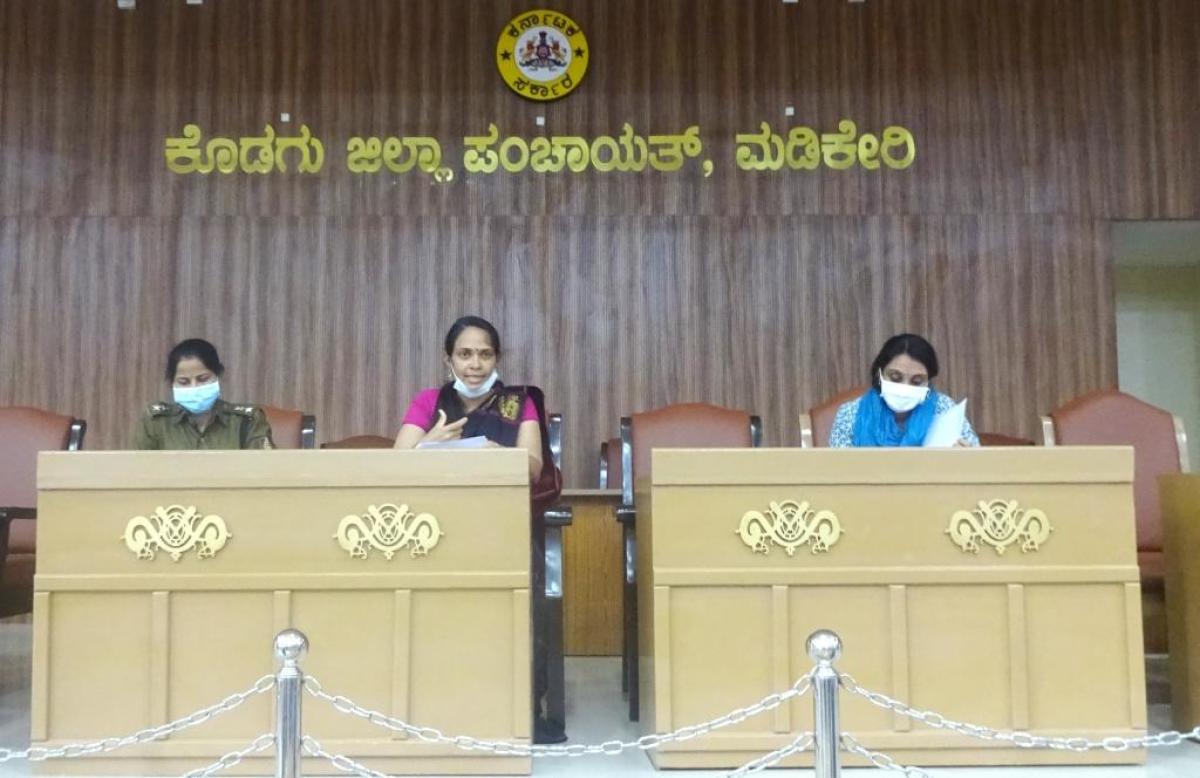
Three top women officers are leading from the front the fight against COVID-19 pandemic in Kodagu.

Deputy Commissioner Annies Kanmani Joy, Superintendent of Police Suman D. Pennekar and Zilla Panchayat Chief Executive Officer K. Lakshmi Priya, who were in the vanguard when Kodagu was devastated by floods and landslides last year, are once again in the frontline of the campaign titled #KodaguFightsCorona.

In fact, Ms. Pennekar was serving the district when Kodagu witnessed unprecedented floods and landslides in 2018. Srividya P.I. was the Deputy Commissioner of Kodagu during the 2018 floods.

The top officers worked as a team and used to visit the affected areas together to realise the situation and provide relief accordingly.

In the fight against COVID-19 pandemic, the district administration, the district police and the zilla panchayat are again in “battle mode”.

source: http://www.thehindu.com / The Hindu / Home> News> States> Karnataka / by Special Correspondent / Mysuru – April 09th, 2020

Chef Kavan Kuttappa shares a simple recipe you can try at home when social distancing

Akki roti with eggs and greens by chef Kavan Kuttappa   | Photo Credit: Special arrangement
Akki roti with eggs and greens by chef Kavan Kuttappa | Photo Credit: Special arrangement

The Head of Creative Culinary at ph4 Food and Beverages, which runs The Permit Room and Toit, talks about learning from the expert in traditional Coorgi cuisine: his mother.

Chefs don’t usually get a lot of time at home. I live in a family home in Bengaluru so I am spending a lot of time with my parents. It has given us the time to bond better.

At home, it is traditional Coorgi food that we are cooking. My mom is the expert at making it. I am helping her out, brushing up (my skills) and being hands-on like never before.

My father cooks once in a while. He has his signature dishes, like pork ribs. He has not had the time and we are not getting things very easily. So, we’re trying to cook with what we have and what we saved, instead of trying to go out and buy things.

Chef kavan Kuttappa   | Photo Credit: Special arrangement
Chef kavan Kuttappa | Photo Credit: Special arrangement

The most famous staple Coorgi dish is a pork dish called pandi curry which I have been making for a while now. There are also a lot of rice accompaniments that we do that need a little bit of experience to perfect.

There is a flat rice cake called paputtu. It is like idli, but made with coarser grains of broken rice and topped off with freshly grated coconut. We made that for breakfast. Then there is a rice ball, called kadambuttu, which we are making at home.

We had preserved some small mangoes (sakkare guthi variety) in the freezer. We do that as a family; we get them in season and we keep them for the whole year. So, we made a mango curry with some mustard, curry leaves (just a basic tadka) with a bit of jaggery and some spices.

Once in a while, I whip up something with what we have at home. The other day I had a packet of instant noodles; I think it was a very mellow-flavoured one. I had some elk sausage in the fridge so that added some depth to the noodles. I had done it once before; it turns out great. I think a friend got the sausages for me from Germany a long time ago. That stuff is nuclear-war proof. Nothing happens to it (laughs).

__________________________________

Akki Roti with eggs and greens

Ingredients:

2 eggs; 1 cup cooked rice (day-old is also okay); 1/2 cup rice flour; salt to taste; 1/4 bunch spinach (can use any local greens); 1/2 sliced onions; 1 dried red chilli; a pinch of mustard; 2 tsp oil; 5-6 chopped cashews; 1 dry red chilli; 5-6 curry leaves; a pinch of mustard; 2 tsp ghee

Method:

For the akki roti : Mix the cooked rice and rice flour (in increments) to make a evenly mixed dough where you can still lightly see the rice grains. Make small rotis using a roti press and cook on a tava and finish on open fire to get the char.

For sauteed greens:

Heat oil in the pan, saute mustard, onions and chilly. Add the greens, cook till done.

To temper:

Heat the ghee in a small pan, add the mustard, red chilli and cashews. Heat till cashews turn slightly brown and crispy. Add the Curry leaves and finish.

Finally, Make a soft scramble with the eggs, once all the other components are ready. Assemble the greens and scramble on the akki roti and garnish with the cashew tempering.

Recipe by chef Kavan Kuttappa
_____________________________________

Regarding work, we had just finished trials and were about to launch a new menu at The Permit Room and then this happened. So, what I am doing right now is spending the time documenting. As chefs, we don’t like to really sit down and document recipes but I have been getting more time, so that is what I have been focusing on.

A lot of focus has also been on taking care of the staff, which I feel is very important.

Overall, our company (pH4 Food and Beverages) has about 450 employees. In Bengaluru, The Permit Room has about 50 employees who stay in staff housing and Toit, owned by the same company, has over 100 employees.

The staff stay in accommodation that the company provides. We are cooking meals (rice, dal and vegetables with egg once a week) for them at the restaurant everyday and delivering it. They are not hungry, if nothing else, and they have a roof over their heads. [Ensuring] this has been a major responsibility and task.

In this series, India’s popular chefs and restauteurs share their lockdown cooking habits and recipes with us.

source: http://www.thehindu.com / The Hindu / Home> Life & Style> Food – The Lockdown Chefs / by Aparna Narain / April 16th, 2020

Kodagu district administration offers telemedicine facility

Soon after launching an online supermarket for door delivery of essentials to the people confined to their houses during lockdown, the Kodagu district administration has taken its e-initiative forward by offering telemedicine facility.

Making use of technology, the Kodagu district administration has started a website www.kodaguedoc.letstart.in for the benefit of dispensing telemedicine at a time when most health facilities, including clinics, across the State have shut.

People feeling unwell or having flu symptoms need to sign up, fill in details, sign in, and register before making appropriate selections for self or a family member and call the doctor. Patients or their attendants registering on the website through a mobile phone can make use of the option to call the doctor available on the website or call 9480610807.

The doctor, who will receive the call at the control room of the telemedicine facility, will provide consultation to the caller after taking the registration ID and prescribe necessary medication through an SMS. The prescription can also be downloaded from the website.

Though the doctors offering telemedicine facility will mostly address common complaints of flu and cough, necessary guidance will also be provided to patients with symptoms of COVID-19.

The telemedicine facility is also aimed at checking the rampant practice of self-medication among the people since the neighbourhood clinics have been closed.

After a large number of people begun taking medicine over the counter, the district administration has directed drug stores in the district to stop dispensing medicine without a prescription that is less than a week old.

To popularise the telemedicine facility, the district administration has come out with a short video which provides new users with details on how to sign up and register.

The facility offered by the Kodagu district administration follows the launch of an online supermarket to deliver groceries, vegetables, fruits, and milk to doorsteps by involving grocery stores and other establishments dealing with essentials.

source: http://www.thehindu.com / The Hindu / Home> News> States> Karnataka / by Special Correspondent / Mysuru – April 17th, 2020

Telemedicine fever clinic launched in Kodagu

The district administration has launched an online telemedicine fever clinic, for consultation with doctors.

The website is www.kodaguedoc.letstart.in

A control room has also been set up with a doctor and the number is 9480610807.

People having fever and other symptoms of Covid-19 can log into the website and register. Later, with the help of the registration ID number, the person should call the control room number.

The doctor in the control room will obtain the registration ID and will prescribe the medicine through the website.

The person should later log into the website again and download the prescription and consult the doctor online.

The website will be operational soon, Deputy Commissioner Annies Kanmani Joy said.

source: http://www.deccanherald.com / Deccan Herald / Home> State> Karnataka Districts / by DHNS / April 15th, 2020