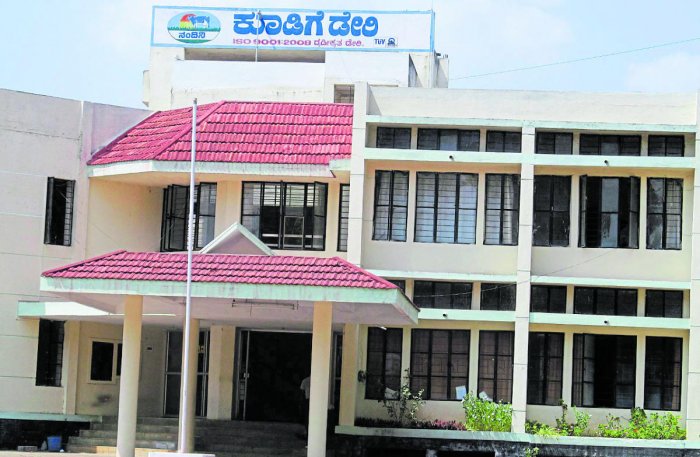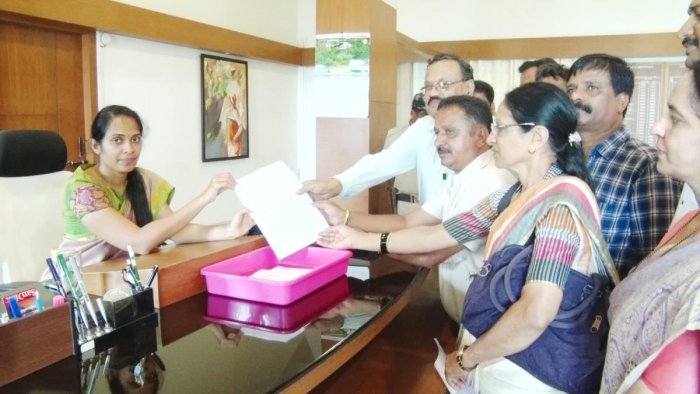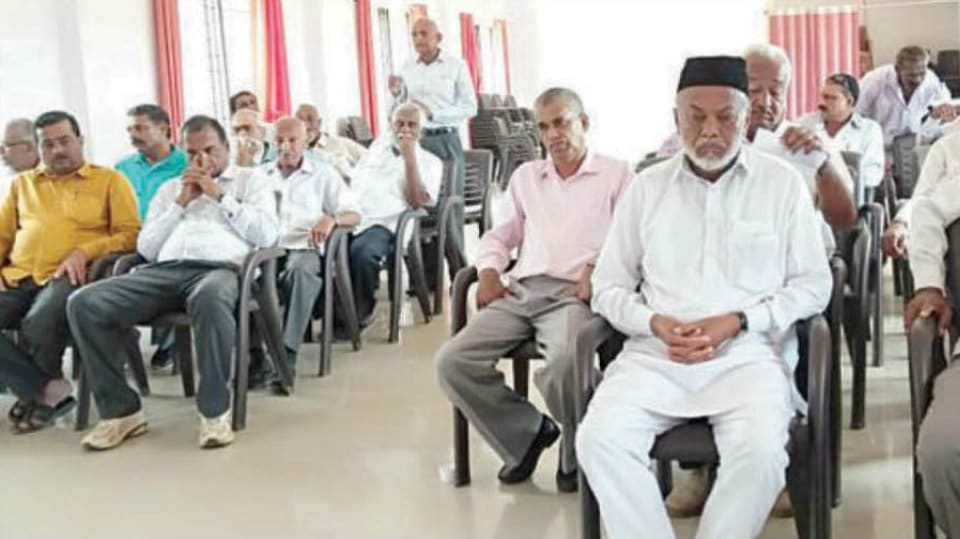
Deputy Commissioner Annies Kanmani Joy, who is also the chairperson of Indian Red Cross Society (IRCS) district committee, performed the ground-breaking for Red Cross Bhavan at Stewart Hill in the town on Thursday.
Speaking during the formal programme, IRCS State Committee Chairman Naganna said that the IRCS had always assisted in the relief measures, including the floods in Kodagu.
“The Red Cross Bhavan will provide timely assistance to the people affected by calamities”.
Naganna said that a grant of Rs 50 lakh was reserved by the IRCS district committee and Rs 25 lakh by the state committee for the Red Cross Bhavan.
He said another Rs 10 lakh will be provided in the next phase by the IRCS state committee. Making use of the funds provided by elected representatives, a state-of-the-art auditorium, a warehouse and an office will be constructed, he added.
IRCS Kodagu head B K Ravindra Rai stated that the Red Cross Bhavan was planned to be constructed at a cost of Rs 1.30 crore on 12.50 cents of land, and the work would be carried out by Nirmithi Kendra.
IRCS Kodagu General Secretary H R Muralidhar said that the branch of the IRCS was commissioned in Kodagu in 1952, with the efforts of the then Chief Minister of Coorg state, C M Poonacha.
Former IRCS State general Secretary Ashok Kumar Shetty, Kodagu Institute of Medical Sciences Principal Dr Vishal, Nirmithi Kendra Officer Sachin, CMC Commissioner M L Ramesh and IRCS district Vice President H T Anil were present.
source: http://www/deccanherald.com / Deccan Herald / Home> State / Muhammad / by DHNS, Madiker / February 27th, 2020
A house that was damaged in the flood in 2019 in Kodagu district.
Chief Minister B S Yediyurappa will present State Budget on March 5 and the people in Kodagu are expecting a bonanza for the district.
During the coalition government in the state, the then chief minister H D Kumaraswamy had announced a few proposals to the coffee land and thereby had tried to win the hearts of the people.
The two BJP MLAs from the district have already submitted a list of basic facilities that require grant in the budget. The district requires a special package to rebuild the lives of natural calamity victims.
The district was hit by natural calamity in 2018 and also in 2019. Only 33 victims of heavy rain in 2018 have received houses. The rain victims of last year, who are still waiting for sites, are in the doldrums. The natural calamity victims are are expecting a few projects for their welfare in the budget.
In the pre-budget consultation meeting, coffee growers had impressed upon the chief minister on the need to solve their problems. They have demanded free electricity for pumpsets up to 10hp, complete waiver of loans borrowed by coffee growers, compensation for damage to coffee plantations hit by landslides and so on. The growers are expecting the fulfillment of at least a few demands in the budget.
Further, 35,000 labourers, who are working in coffee plantations, are shelterless in the district. The shelterless at Balagodu are already staging a protest demanding a roof over their head. The labourers are expecting announcement on providing either house or site in the budget.
The natural calamity that hit the district has also badly affected tourism in the region. The budget is expected to announce new projects to give a fillip to the tourism. There are possibilities of announcing Cauvery rejuvenation programme and river bank protection projects in the budget.
“New taluks of Kushalnagar and Ponnampet have not received any benefits. We have appealed to the government to announce grants for development works in the newly carved taluks,” activists of taluk associations said.
In 2018-19 budget, Siddaramaiah had announced promotion of cultivation of exotic fruits like Passion fruit, Rambutan, Durian, Dragon, Licchi, Butterfruit, Strawberry, Custard Apple and others, which has not been materialised so far.
Seeking additional grants, MLA K G Bopaiah has written a letter to the chief minister. The MLA has sought Rs 100-crore special package for the development of roads in the district.
Bopaiah has also sought Rs 1 cr for construction of outdoor stadium at Gonikoppa, Rs 1 cr for sports meets, Rs 25 crore for laying fences made out of train tracks, Rs 15 crore for the construction of Bhavans (community halls) of Kodava, Arebhashe, Okkaliga Billava, Bunts and other communities and free electricity for growers using pumpsets up to 10hp.
source: http://www.deccanherald.com / Deccan Herald / Home> State> Mangaluru / by Adithya K A / DHNS, Madikeri / February 25th, 2020
The Tamara Coorg in Karnataka is a byword for sustainability, which boasts a magical landscape that melds an ancient forest with tales of a martial race.
The Tamara Coorg is ringed by nature in all its bounty
As the veil of mist lifts over the Western Ghats of Karnataka, a panorama unfolds. Rows on rows of coffee bushes, their leaves a lush velvet green, the ruby-red orbs produced here yield the heady Arabica brew.
The Tamara Coorg is ringed by a capillary of streams, creepers of perfumed spices, pepper vines and tropical fruit trees.
Blending into this forested landscape are the unique cottage-style villas built on stilts propped up on the plantation’s terraced rows.
A byword for sustainability, the cottages are forest and land continuum. Crafted out of roughly finished logs of wood, they are an extension of the wilderness.
Calm, meditative and a bit rough around the edges, the private sundecks with a 180-degree view of the valley allow you to seamlessly connect with nature and its rhythms even as the cloud-cloaked hills form grey specks in the horizon.
It’s a magical landscape, one that melds an ancient forest with the history of a martial race, the Kodavas.
Inside The Tamara, expect a visceral avian experience of the Western Ghats, featuring the Malabar Grey Hornbill, the Scarlet Minivet, the Grey Wagtail and their other feathered friends.
This lush haven of fauna can be punctuated with tranquil coffee drinking sessions, where the perfect cuppa is miles away from jostling cafes and their prohibitively expensive caffeine fixes.
Instead, Blossom to Brew is a customised coffee brewing session organised by the resort, where enthusiasts can sort their favourite coffee beans, make the desired blend, roast it to specifications and grind them manually.
Coorg is, however, not all plantation terrain with a soundtrack of crickets and rainfall. History buffs will get their fix at the Nalknad Palace, which was built between 1792 and 1794 AD, and is hemmed in by the tiny hamlet of Yavakapadi.
The history of Nalknad is, at its heart, a narrative of political intrigue between diverse Indian states and empires in colonial India. The palace itself was the final shelter of the last of the Haleri kings of Kodagu, Chikka Veerarajendra, who was exiled to Varanasi by the British.
The two-storeyed palace, built by the exiled king’s ancestor Dodda Veerarajendra, is a fantasy of highly decorated wooden pillars, windows and doorjambs.
Steps to the main door of the palace come appointed with elephant balustrades, while the Durbar Hall offers a royal welcome by way of 18th and 19th-century paintings.
Coorg effortlessly manages to bundle the twin experiences of history and nature. With the caressing sound of raindrops on coffee bushes, the past lurks in the nooks and corners of this lush landscape.
The Madikeri Fort, right in the heart of its namesake town, is such a portal to history. Some of its elevated structures help you see the city skyline in new and interesting ways.
Built in the later part of the 17th century by Muddu Raja, the then king of Coorg, the fort, though crumbling and overrun with creepers now, boasts of a unique character.
Once believed to be made of mud during the reign of the Kodagu Rajas, it was later re-constructed using granite masonry and laterite blocks after being captured by Tipu Sultan.
Today, the fort premises are home to the Madikeri Deputy Commissioner’s Office. Below the fort ramparts Madikeri hums along, with its chaotic traffic, independent businesses and throngs of spice and chocolate shops.
Even everyday Coorg is a balm to the restless soul.
source: http://www.newindianexpress.com / The New Indian Express / Home> Magazine / by Susmita Saha / February 16th, 2020
– Land acquisition for Mysuru-Kushalnagar Economic Corridor from next month
– Mysuru-Bengaluru 10-lane Highway will be completed in 24 months from now
Mysore/Mysuru:
Land acquisition for the Mysuru-Kushalnagar Economic Corridor Expressway Project from Paschimavahini in Mysuru till Kushalnagar in Kodagu along the existing Mysuru-Madikeri National Highway (NH)-275 will begin next month, said Mysuru-Kodagu MP Pratap Simha.
Addressing a press conference at Pathrakarthara Bhavan in city this morning, the MP said that the Ministry of Road Transport and Highways had approved the project long back and after necessary ground work, the National Highways Authority of India (NHAI) has prepared the land alignment and land required for the project.
The road has a design length of 93 kilometres and bypasses have been proposed having an aggregate length of 84 kilometres at Kushalnagar, Periyapatna, and combined bypass for Hunsur, Bilikere and Mysuru. It is a four-lane corridor that directly connects Bengaluru with Madikeri, bypassing Mysuru. The 115 km-long Expressway costing Rs. 6,000 crore is a centrally-funded project and is executed by NHAI.
The Expressway will connect Madikeri with Bengaluru bypassing Suntikoppa, Kushalnagar, Periyapatna, Hunsur and even Mysuru city by touching the Mysuru-Bengaluru Highway (which is getting converted into a 10-lane Highway) at Paschimavahini near Srirangapatna. The Expressway will have a road median and the alignment for the new corridor has been done. The Expressway will reduce the journey time between Madikeri and Bengaluru to five hours from existing seven hours.
The MP said that the existing four-lane road between Mysuru and Madikeri (NH-275) has reached a saturation point and there is an urgent need to build a separate road. Travelling on the existing Highway is a nightmarish experience especially during weekends and holidays when thousands of vehicles move between Mysuru and Madikeri, a hill station, he added.
“It will be a 14-metre wide road. Rs.6,000 crore has been set aside for land acquisition only and the project will use 25 percent of the existing roads, 40 percent Government land and the remaining 45 percent land will be purchased from private parties. A dedicated office for land acquisition ‘Special Land Acquisition Officer and Competent Authority (Mysuru-Madikeri Section) NH-275’ has been set up at No.984, First Floor, Geetha Road, Chamarajapuram, in city,” he added.
10-lane Mysuru-Bengaluru Highway
On the 118-km Mysuru-Bengaluru Highway that is being upgraded to a 10-lane highway including four service roads on either sides of the six-lane main carriageway, Pratap Simha said that from Bengaluru-side, 35 percent of the road works have been completed and from Mysuru-side, seven percent of the works have been completed,.
NHAI has taken up the core works at an estimated cost of Rs. 7,400 crore and once the project is realised, commuters between Bengaluru and Mysuru can travel the distance in just about 90 minutes from the present 3 hours, he added.
“The NHAI has awarded the project to Bhopal-based Dilip Buildcon and the project is fully funded by the Centre including the distribution of compensation for the land acquired. The Company has taken up the highway works in two packages.
Work in packages
The first package covers the development of 56.1 kms highway stretch from Bengaluru to Nidaghatta in Maddur taluk at the cost of Rs. 3,000 crore including 900 acres of land acquisition. The second package of works includes the development of 61.2 km highway from Nidaghatta to Mysuru at the cost of Rs.3,500 crore, he added.
The project is being taken up under new Hybrid Annuity Mode (HAM) adopted by NHAI. As per this, NHAI will fund just 40 per cent of the total project cost while the remaining 60 per cent will be invested by the contractor or developer. The contractor/investor will get fixed annual revenue while the Highway Authority takes care of the toll collection.
The Company has taken up both the package works after setting base camps at every 20 kilometres. Six bypass roads will be constructed at Srirangapatna, Mandya, Maddur, Channapattana, Ramanagara and Bidadi. An estimated 36,000 vehicles ply between the two cities everyday and traffic density has increased, Simha added and expressed confidence that the project will be completed in 24 months from now. The NHAI has a deadline of 30 months.
City BJP President T.S. Srivatsa, District BJP President S.D. Mahendra and NHAI Superintending Engineer Sridhar were present at the press conference.
source: http://www.starofmysore.com / Star of Mysore / Home> News / February 20th, 2020
A kalyani and a stall (right) at a site in Madikeri where the Tourism Department is developing a facility that depicts a typical village.
In an effort to boost tourism post floods and landslips in Kodagu, the government has sanctioned a sum of ₹21 crore for various tourism development works across the region, which is limping back to normalcy.
Many tourist sites and roads connecting them had been damaged. The department had proposed new attractions and rebuilding activities.
“Some works are in various stages and proposals for a few are awaiting approval. Kodagu got an allocation of ₹21 crore for the works,” said Tourism Assistant Director Raghavendra.
A project had been launched along the concept of developing a typical Kodagu village near Raja Seat in Madikeri that signifies thelocal culture and traditions besides making available the crafts, spices and other commodities popular from here. This village will have about 10 rooms for tourists’ stay. This project had been taken up at a cost of ₹98.5 lakh.
Development works near Sri Omkareshwar temple, development of parking at Dubare elephant camp and development of a road connecting Nalaknad Palace at Kakkabe near Napoklu are among the projects approved, he said.
source: http://www.thehindu.com / The Hindu / Home> News> States> Karnataka / by Special Correspondent / Mysuru – February 17th, 2020
The Ibnii Spa and Resort in Coorg, Karnataka, weigh the food wasted by customers and makes them pay for it at the time of checkout.
The guests have to pay Rs 100 for every 10 gram of food wasted by them. | Image: Unsplash | Photo Credit: Representative Image
Bengaluru:
Food waste is definitely not a good taste. A luxury resort in Karnataka came up with an ingenious way to decrease the wastage of food by its guests. The Ibnii Spa Resort started charging its customers for wasting food.
The resort which is located in the hills of Coorg, Karnataka, has come down from 14 waste bins to just one since the initiative was implemented.
The composting unit of the resort used to be overworked with 14 huge garbage bins of leftover food daily. The resort decided to decrease the quantity of waste by informing guests that they could place their orders any number of times.
However, when the wastage of food did not stop, the resort came up with the unique idea of making the guests pay for the food they ordered but did not eat.
How much do the guests pay for wasting food?
The idea was simple. At the end of every meal, all the leftover food is weighed on a weighing machine in front of the guests. At the time of checkout, the guests are told how much food they wasted during their stay. They have to pay Rs 100 for every 10 gram of food wasted by them. The amount is to be dropped in a donation box which goes to a not-for-profit organisation that feeds children at an orphanage in Madikeri.
How have the guests reacted to the initiative?
The initiative which was started six months ago has made a huge impact on the conscience of the guests. “We have seen a drastic decrease in the quantity of food waste. From fourteen waste bins every day, we now only need one,” Shreya Krishnan, CSR adviser at The Ibnii, told Deccan Chronicle. The guests have appreciated the resort’s efforts to reduce food wastage.
How much food do we waste?
One-third of the food produced in the world for human consumption every year gets lost or wasted, according to the Food and Agricultural Organisation of the United Nations.
Not only is wasting food doing wrong to the farmers who grow the crop and to the chefs who cook the dishes but it is also unfair to those people who can’t afford two meals in a day and impacts the environment too.
source: http://www.timesnownews.com / TimesNowNews.com / Home> News> Buzz / by Saumya Agrawal / February 21st, 2020
People dancing to the tune of the traditional ‘Kodava Valaga’, during the fruit and flower show at Raja Seat. DH Photo
Hundreds of visitors thronged the Raja Seat in Madikeri on Saturday and Sunday, for the fruit and flower show.
The four-day-long fruit and flower show organised by the district administration and the department of horticulture, began on Friday.
On Sunday, the localities and tourists who gathered in the venue, danced to the tunes of traditional ‘Kodava Valaga’ during the cultural programmes organised by Karnataka Kodava Sahitya Academy. ‘Arebhashe Kolata’ and ‘Sobhane Pada’ enthralled the audience.
Selfie zones set up at various parts of Raja Seat, were the centre of attraction among youth during the flower fest. Photo frames were designed with flowers for the purpose.
Open street
The police department restricted the movement of vehicles from M M Circle till Kundurumotte junction, from 6 pm to 10 pm on the evenings of the fruit and flower show. Raja Seat was made completely free from vehicular movements and the stalls featuring various snacks were opened on the road, reminding the ‘Open Street Festival’ organised during the Pravasi Utsav held in Kodagu last year. Traditional Kodava snacks were also sold in the stalls.
Students were provided with a chance to watch the fruit and flower show free of cost. A lot of students witnessed the show on Saturday and Sunday. Most of them were accompanied by their teachers.
The people also visited the stalls set by the departments of agriculture, horticulture, animal husbandry, fisheries and various other departments.
‘Mamateya Marukatte’
Various items such as children’s toys, unused clothes, stationery items, and electronic items in the working condition, were featured at ‘Mamateya Marukatte’ stall set up by Green City Forum and Madikeri City Municipal Council. The items were collected at Kaveri Kalakshetra.
The amount collected from the sale of these items were provided to the civic workers and stree shakti groups. Most of the items have been sold, said Satya, a member of Green City Forum.
source: http://www.deccanherald.com / Deccan Herald / Home> State> Mangaluru / by DHNS, Madikeri / February 10th, 2020
Find out how Orange County transformed to Evolve Back Luxury Resorts
Luxury Lily Pool Villas at Evolve Back Resort in Coorg, Photo Credit: Evolve Back Luxury Resorts
Evolve Back started life as Orange County. How did it all begin?
We are from Kerala, although we’ve been in Karnataka for close to 100 years. Primarily, we are a family of planters, growing coffee, rubber, pepper, cashew and so on. We still have plantations in different parts of south India. It’s a small family of 11 children (laughs): seven boys and four girls. I’m the seventh boy.
Coorg was not a tourist destination when we were growing up. But we used to go there for holidays and found the weather wonderful and the place beautiful. Our estate in Chikkana Halli had a great location by the Kaveri. So we thought we could set up something. Since we used to grow oranges, we decided to call it Orange County. This was in 1994. At that point we had not envisaged multiple resorts.
Why did you rebrand ?
In 1999, we started going for international travel exhibitions. That’s when we realised our brand name had a strong association with California. The first resort did well and in 2000 we started thinking of the second. Work started in 2005 and we opened Orange County Kabini in 2007.
In 2005, we did an internal workshop on branding, where we came up with our ‘spirit of the land’ concept. All our experiences try to capture the localness of the destination. Our guests stay in luxury but experience the local culture. But it was a while before we rebranded.
Jose T. Ramapuram
Tell us more about ‘spirit of the land’.
Our managing director is an architect. So when we launch a property he studies the life of the place: people, architecture, food, clothes, etc. All these elements are blended in with luxury to create our experiences.
So the architecture of our Kabini property is inspired by the Kuruba tribes of the region. A name like Orange County wouldn’t really do justice to it. We next went to Hampi, where we built a palace inspired by the architecture of the Vijayanagara empire. We also had plans to expand outside of India. That’s when we took a call to rebrand as ‘Evolve Back’, which is more in sync with our philosophy. As we evolve as human beings, we look back and draw inspiration from the past, when we had cleaner air, cleaner food, cleaner water. The new identity was adopted in 2017.
What are some of your brand values?
Our brand values are well defined. They are eco-sensitivity, straight-from-the-heart, constant innovation, elegance, attention to detail, going the extra mile.
When we enter a destination, we want to be the best there. We don’t go to places where there are too many players. We also like our properties to be small and intimate.
What are some of the responsible tourism practices you’ve adopted?
We have always had a deep connection with the land. I first heard of responsible tourism at WTM in London in 2002. As I studied more, I realised we were already doing this stuff. We just hadn’t formalised it. So in 2006-2007, we did. Environment, community and culture are the three areas we focus on.
When we acquired Kabini it was agricultural land. We reforested it with local species and brought the biodiversity back. We banned all plastic bottles in 2005. The roof in Hampi has solar panels. We’ve invested in wind power.
In Coorg, we have adopted the local government school, besides launching our own state-of-the-art pre-school. After the kids are through with the pre-school, we will sponsor and place them in good schools. We have a policy of 60 per cent local employment and try to improve staff quality through education.
Not one drop of water at any of our hotels is let out. It’s all treated and used for gardening. We have an onsite waste segregation programme and 97 per cent of our waste is either recycled in-house or sent out to a proper recycling centre.
Where are you opening next?
We’ve just acquired a private game reserve in Botswana spread over 110 sq km. It’s in a pristine location, very exclusive. We’ll upgrade it before lending the Evolve Back name to it. Mandu and Bhutan are also on the cards.
You cannot go into any place without having a negative impact. If we’re going into a destination, we always try to contribute more positives. We believe in low-impact, high-end tourism. That’s why we are looking forward to our Bhutan project. The country is so forward thinking it’s trying to bring its annual tourist arrivals of 500,000 down to 400,000.
Jose T. Ramapuram is the executive director at Evolve Back
INFORMATION: Evolve Back, 2nd floor, St. Patrick’s business complex, 21, Museum road, Bengaluru; info@evolveback.com, evolveback.com
source: http://www.outlookindia.com / Outlook Traveller / Home> Travel News> Story / by Amit Dixit / January 29th, 2020
CM to lay foundation stone for 450-bed hospital block Kodagu Institute of Medical Sciences (KIMS), which became operational four years ago in Madikeri, is being expanded with the foundation stone for a 450-bed hospital attached to the institute to be laid on Monday.
Chief Minister B.S. Yediyurappa will give a start to the construction on the existing teaching hospital premises. Once the 450-hospital facility (300-bed unit and 150-bed unit) is ready in about two years, the number of beds for healthcare services will rise to 750 as the existing hospital has 300 beds.
Deputy Chief Minister and Minister for Medical Education C.N. Ashwath Narayan and Minister in-charge of Kodagu V. Somanna will be present. MLA Appachu Ranjan addressed presspersons at Madikeri on Saturday to present details about the hospital project.
KIMS has an intake of 150 seats and currently 600 students are pursuing a medical degree and post-graduate courses. In 2016, the district hospital was converted into the teaching hospital of KIMS and it was in need of an upgrade in complying with the norms of the Medical Council of India. Accordingly, the hospital is now being expanded with additional 450 beds at a cost of ₹100 crore. The construction for 300 beds will be take place on the existing hospital premises while the 150-bed facility will come up on the premises of women and children’s hospital.
Cariappa K.B., Dean and Director, KIMS, told The Hindu that the expansion of the hospital will benefit the people of Kodagu as well as neighbouring taluks since the outpatient load had risen to 900 from 200 in three years. Multispeciality services will be convenient for those looking to Mysuru and other places for those services as Madikeri has only a few hospitals and nursing homes under private ownership.
Radiology department
On an average, 75% of beds are occupied in the hospital and the expansion will give rise to adding up of more speciality departments, he added. “We are in need of manpower for the radiology department as the hospital is equipped with ultrasound and CT scan equipment,” he said.
source: http://www.thehindu.com / The Hindu / Home> News> States> Karnataka / by Special Correspondent / Mysuru – January 26th, 2020
– Investors from Keiretsu Forum Chennai will also be participating
– Rage Coffee plans to expand its product line with the funding
– The company sells on ecommerce and 400 offline stores
New Delhi-based food & beverages brand Rage Coffee has raised funding in a round led by early-stage investment firm Refex Capital. Angel network Keiretsu Forum Chennai and some other “prominent” investors will also be participating in this round.
The list of participants include T.D Mohan, former joint MD of CavinKare; Dr Rajan Srikanth, co president of Keiretsu Forum Chennai and Singapore; Prakash Katama, former CEO of TVS Electronics; Uday Sodhi, former business head at SonyLIV, private equity investor Ajay Sarupria, actor Rannvijay Singh Singha; A. Kumar, Founder of Gemini Paints, and Sawan Gupta, MD at Spero Group.
Founder and MD of Wazir Advisors, Harminder Sahni, joined Rage Coffee’s board of advisors for the fundraise. Moreover, Sridhar Parthasarathi, who is the managing partner at Refex Capital, has also joined the Board.
With this funding, Rage Coffee will expand its product offering and omnichannel distribution, scale up production and strengthen its team. The company aims to “capture market share of the category devoid of any innovation – be it the ingredients, formulations, manufacturing techniques, packaging, distribution or use of data to be agile.”
Founded in 2018 by Bharat Sethi, Rage Coffee is a fast-moving consumer goods (FMCG) brand that deals in different varieties of coffee, without using any chemicals and is full of vitamins. The company claims to blend its coffee from plant extracts and natural compounds — Tea extract L-Theanine, fossil Ginkgo Biloba, L-Glutamine, and Panax Ginseng, among others.
Rage Coffee’s founder and CEO, Bharat Sethi, in a press statement, said, “Our approach to supply chain, sourcing, consumer segmentation, product R&D [Research and Development], D2C [Direct To Consumer] data-driven DNA combined with a hybrid distribution model and, most importantly, our close relationship with our customers places us in a great spot to build a brand that is truly poised to capitalise on the immense market opportunity.”
Rage Coffee retails its products through its website, other ecommerce platforms like Amazon and over 400 offline stores/touchpoints. The FMCG company plans to quadruple its sales and reach over 2000 outlets by the end of 2020. Rage Coffee will be banking on institutional and the foodservice industry — hotels, restaurants, cafe (HoReCa) business — to clock a significant chunk of sales.
To achieve its goals, Rage Coffee also appointed Arijit Mitra, former National Sales Head at Coke Beverages, as Director of Sales to grow the offline business in June 2019.
According to a Frost & Sullivan report, functional food & beverages in India is currently still in its initial stages growing at rate of 17.1% CAGR, expected to be valued at $4Bn in 2020. Some other players in this segment include Siliguri-based Udyan Tea, Mumbai-based Open Secrets and Bengaluru-based Hector Beverages with its brand Paper Boat.
In December 2019, Open Secrets raised funding in a round led by Matrix Partners India. Angel investors such as Paytm founder Vijay Shekhar Sharma, Snapdeal cofounders Kunal Bahl and Rohit Bansal and CEO of Godrej Consumer Products, Vivek Gambhir also participated in the round.
source: http://www.inc42.com / Inc42.com / Home> News / by Kritti Bhalla, Inc42 Staff / January 08th, 2020
WELCOME. If you like what you see "SUBSCRIBE via EMAIL" to receive FREE regular UPDATES.
Read More »