Category Archives: Business & Economy

₹5723.09 cr. potential-linked credit plan for Kodagu

The Potential Linked Credit Plan for Kodagu district has been pegged at ₹5,723.09 crore for the financial year 2020-21.

The plan was prepared by NABARD and the authorities envisage an outlay of ₹4,134.64 crore for the agriculture sector and ₹522.53 crore for micro, small and medium enterprises in the district.

The PLC plan was unveiled at a review meeting in Madikeri early this month and the potential for credit outflow for housing sector has been pegged at ₹360 crore while the education sector will receive nearly ₹238.50 crore.

The district has achieved 38 per cent progress or ₹1,705.9 crore in the priority sector for the current year and the banks were exhorted to strive to attain the target of ₹4,500 crore by the end of March this financial year.

source: http://www.thehindu.com / The Hindu / Home> News> States> Karnataka / by Special Correspondent / Mysuru – January 06th, 2020

India’s First World Coffee Conference In Bengaluru From Sept. 7

Three-day event at Bangalore Palace to be organised by London-based International Coffee Organisation

IndiasFirstKF02jan2020

Madikeri:

Bengaluru will host the fifth edition of the World Coffee Conference (WCC), a high-profile international event, between Sept. 7 and 9 in 2020. Earlier editions were held in the UK, Brazil, Guatemala and Ethiopia.

The three-day event that will be held at the sprawling Bangalore Palace will be put together by London-based International Coffee Organization (ICO), Ministry of Commerce and Industries, Coffee Board of India and India Coffee Trust (ICT), which is a forum for coffee growers and exporters.

The event is themed ‘Sustainability Through Consumption’ and will celebrate all things of coffee in an immersive experience with the conference addressed by international speakers, coffee exhibition, buyer-seller meets, competitions and awards, skill building workshops, amongst many others.

ICT President Anil Kumar Bhandari told reporters in Madikeri yesterday that the prestigious WCC coming to India for the first time means huge international recognition for Indian coffee. The Who’s Who from the world of coffee will be descending on Bengaluru for this event. This will give a fillip to the Indian cuppa in the global market. Over Rs. 15 crore is being spent to organise the conference, he added.

The participants will include the world’s leading coffee brands and café chains, retailers, roasters, equipment manufacturers, coffee organisations from round the globe, policy makers, industry captains, exporters, manufacturers and a whole host of players associated with the commodity.

Conference attendees

Around 3,000 international delegates from 80 countries, 2,000 Indian delegates, over 1,00,000 coffee growers and exporters, representatives of HORECA (Hotel/Restaurant/Café sector) and hundreds of coffee connoisseurs are expected. There will be more than 100 speakers, 150 exhibitors and over 300 business-to-business and business-to-consumer meeting.

Coffee being the world’s most favourite beverage with 2.5 billion cups consumed every single day is produced in about 70 countries most of them belonging to the developing countries like Africa, Latin America and Asia. India is the sixth largest producer of coffee in the world, accounting for about 5 percent of world coffee production.

Innovation to conference

At the conference, the Coffee Board of India and the International Coffee Organisation (ICO) will bring in innovation to the conference and expo by crowd-sourcing ideas from citizens. They will look at ways that will make Indian coffee a brand that is recognised worldwide and formulate ways to make India a sustainable destination for coffee.

Methods will be explored to make coffee farmers stakeholders in the value chain as this will have a positive impact on the 25 million families who depend on coffee cultivation the world over. “This is a great opportunity that India has got and the organisers will welcome to India participants from more than 80 countries for the expo and conference,” Bhandari said.

Connecting with growers

India is also emerging as the major coffee consuming country. The Government of India has also a strong focus on increasing coffee plantation and the global community also desires to connect with coffee growers in India and Asia and WCC-2020 offers an opportunity to explore India and Asia to the global coffee community.

Bengaluru is the coffee capital of India and produces nearly 70 percent of India’s coffee that is produced in Kodagu, Malnad, Hassan and Chikkamagalur. As the theme of WCC-2020 is sustainably through consumption because the world coffee production is increasing and having a negative impact on coffee prices, this can be offset by increasing consumption, therefore consumption is the key to sustainability. The focus will be on economic, agriculture, commercial, environmental, social and cultural impact.

source: http://www.starofmysore.com / Star of Mysore / Home> News / December 31st, 2019

Mini-Airport At Kushalnagar

KushalnagarAirportKF23dec2019

– Bidding open under UDAN 4.0 by Civil Aviation Ministry

– Airport first proposed by Madikeri MLA Appachu Ranjan

Kushalnagar:

In a significant development, Kushalnagar in Kodagu has been selected among the four airports in Karnataka for which bids have been announced under the fourth round of Regional Connectivity Scheme (RCS) or the Ude Desh ka Aam Nagarik (UDAN) 4.0 recently. The other three airports are Ballari, Karwar and Kolar. It will be a mini airport in Kushalnagar.

The four airports are under the unserved airport category. Unserved airport means any airport at which there have been no scheduled commercial flights during the last two flight schedules published by the Director General of Civil Aviation (DGCA) on its website.

The Airports Authority India is the implementing agency of the Regional Connectivity Scheme and it has invited the bids. Bids have been called to operate 20-seater planes (category 1) of the RCS.

For a 20-seater aircraft to land and take off, a one-kilometre runway is needed and the land in Kushalnagar has this facility.

Boost to tourism

If the mini airport in Kushalnagar becomes a reality, it will boost extended tourism from Mysuru to Kodagu. At present, flyers from Kushalnagar either come to Mysuru or Bengaluru to take flights to different destinations.

Flyers to Gulf countries either travel to Kannur or Mangaluru from Kushalnagar by road. A flight from Kushalnagar connecting Mysuru, Kannur, Bengaluru and Mangaluru will boost air travel in the region.

Appachu Ranjan’s proposal

An airport to Kodagu was first proposed by Madikeri MLA M.P. Appachu Ranjan when he was the Minister for Youth Services and Sports in 2012.

Speaking to Star of Mysore, Appachu Ranjan said that he was happy that Kushalnagar Airport has been selected under RCS (UDAN) of Prime Minister Narendra Modi Government.

The land for the airport had been identified near Byadagutta, Madapura and Koodige and of this, land behind the Kodagu Sainik School at Koodige was finally selected. “There is 45 to 50 acre land owned by the Agricultural Department at Doddathoor Village till the border of Basavanathoor village that has been mentioned in the surveys conducted by the Public Works Department. In June this year, a team of officials from the Airports Authority of India (AAI) had visited the site and had accepted the land proposal. If more land is required, it can be acquired,” he said.

Aviation Training Academy

The MLA said that along with the airport, an Aviation Training Academy will come up next to Kushalnagar Mini-Airport and this Academy will train flight aspirants from Kodagu, Mysuru and surrounding regions. “I am following up the establishment of the Airport and the Academy,” he added.

300-acre Government land

Nagendra Prasad, President of Kodagu District Hotels, Resorts and Restaurants Association told SOM that when P.I. Sreevidya was the Kodagu Deputy Commissioner, a 300-acre Government land was identified near Aanekaadu on the National Highway 275 for the Airport. This land falls behind the 6-acre KSRTC Depot at Basavanahalli. The land had come up for discussion before the present DC Annies Kankani Joy too four months back.

“This proposal was, however, dropped due to opposition from environmental groups. Now that the AAI has approved the land behind the Koodige Sainik School, we can hope for a small airport in the near future. As per the RCS, an operator has to fly three flights per week. Even if it is a 20-seater aircraft, flight services from Kushalnagar will be a big boost for Kodagu tourism,” Nagendra Prasad added.

Water-logging problem

The Airport is in the backdrop of Doddathoor, Chikkathoor and Koodige hill ranges (though there is no official name for the hill ranges) and there are over 50 families residing in the vicinity. If the Airport has to come up, the families have to be evacuated and relocated.

The only hitch here is that the land behind Koodige Sainik School was submerged last year when more than one lakh cusecs of Cauvery water was released from Harangi reservoir. Villagers said that at present, the Agricultural Department grows paddy in this land and the location is near Harangi Dam. If Kushalnagar Airport has to become a reality, then the Government must take steps to prevent water-logging, say villagers.

source: http://www.starofmysore.com / Star of Mysore / Home> News / December 19th, 2019

‘Coorg Village’ near Raja Seat to promote tourism

The work on Coorg Village in progress near Raja Seat in Madikeri. DH Photo

Those who visit Raja Seat in Madikeri are disappointed with only the park and hilly ranges in the surroundings. To attract tourists, the Department of Tourism and Horticulture have chalked out a plan for constructing ‘Coorg Village’ in two acres of land belonging to the horticulture department in front of Kundoorumotte Temple near Raja Seat.

The department has decided to use the land with a small lake for commercial purpose. Utilising Rs 98 lakh from the Department of Tourism, a total of 15 stalls will be constructed. Tourists who visit Omkareshwara Temple, Old Fort and Nehru Mantapa can spend their evening at the Coorg Village.

Under Coorg Village, three shopping complexes will come up with six, four and five stalls each in different locations. The home-made products prepared by SHG members under the Women and Child Development Department, food products prepared by flood victims will be sold in the stalls.

In addition, there are plans to develop the lake in the said land to promote tourism. Walkers path and seating arrangement will also be constructed for the tourists, said tourism department officials.

There are no plans to shift the stalls near Raja Seat right now. It has been decided to allocate stalls for the various departments, said tourism department assistant director Raghavendra to DH.

The surrounding nature is not harmed in the name of ‘Coorg village’, he added.

The foundation work on the complex has commenced. The stalls will be ready for inauguration before the monsoon, said labourers engaged in the work at the site.

Greens oppose idea

Kodagu Hasireekarana organisation has opposed the permission given to construct stalls for the flood victims in the land belonging to the horticulture department near Raja Seat.

Kodagu Hasireekarana president K G Harish said the department of horticulture has taken unilateral decision to allocate land for construction of stalls without gathering public opinion. The work should be stalled immediately.

He said, “Let the district administration identify government land in Madikeri and provide alternative facilities for the victims. The construction of stalls near Raja Seat will increase traffic congestion and will also increase the garbage mess. The district administration’s move to set up Coorg Village without floating tender and giving information to the public has raised doubts.”

He said there is a need to give priority to eco-friendly tourism. It is not right to spoil nature in the name of tourism promotion. The land owned by horticulture department should be earmarked for the park. The lake on the site should be rejuvenated.

Office-bearer of Kodagu Hasireekarana Kadratanda Pali Devaiah said, “The pedestrians will face inconvenience once bus services start on Race Course Road. The promise to instal a slab on the open drain to facilitate the movement of pedestrians by the CMC has not been fulfilled so far.”

source: http://www.deccanherald.com / Deccan Herald / Home> State> Karnataka Districts / by DHNS, Madikeri / November 29th, 2019

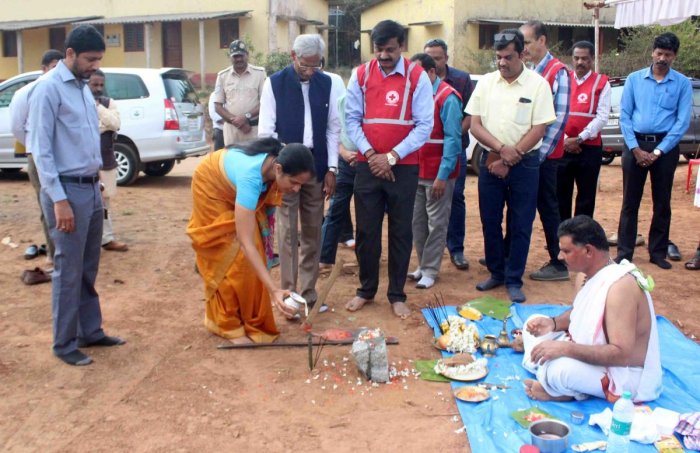
Bhoomi Puja For Fish Cultivation Pond At Harangi

10,000 rare Mahseer fingerlings released to Harangi River at Koodige

Kushalnagar:

There are many possibilities of utilising Harangi Reservoir in Kodagu and its backwaters. One among them is fishing and fisheries development. Realising this potential, an exclusive fishing cultivation pond will be set up at Kushalnagar with Rs. 2 crore assistance from National Bank for Agriculture and Rural Development (NABARD).

The Bhoomi Puja for the 2-acre pond was performed recently in Kushalnagar by Madikeri MLA M.P. Appachu Ranjan. Speaking on the occasion, the MLA said Harangi was one of the major reservoirs built across River Cauvery. “Due to the reservoir, there are great possibilities of pisciculture in a large scale due to abundant availability of water backed by groundwater support. Rare fish varieties like the Mahseer can be cultivated and six such ponds will be constructed in the land owned by the Fisheries Department,” he said.

Traditional fishing is being held from many years in the backwaters of Harangi, which spreads over 1,886 hectares in area. Lakhs of fingerlings are released into the reservoir every year. “As part of the project, fish cultivation enclosure has been set up in the backwaters of Harangi Reservoir and the sample of fish is being collected to study the growth of fingerlings, said Sachin, Assistant Director, Harangi Fish Rearing Centre.

BhoomiPoojaHarangi02KF26nov2019

He added that the Centre was set up by the Government 25 years back to support farmers who are willing to rear fish in the cultivation ponds. Varieties of fish, including Mahseer, Katla and Rohu, are reared in the Centre. Along with these, fingerlings procured from Kabini and Bhadra reservoirs are being provided to farmers at subsidised costs, he said.

On the occasion, over 10,000 Mahseer fingerlings were released to 5.6 km Harangi River stretch from the Dam to Koodige Bridge. “Through this, we intend to cultivate the Mahseer fish that is on the verge of extinction. Fishing has been banned on this particular stretch to save the Mahseer variety,” he added.

source: http://www.starofmysore.com / Star of Mysore / Home> News / November 25th, 2019

Emergency response vehicles launched in Madikeri

Superintendent of Police Dr Suman D Pennekar launches Emergency response vehicles 112, in the premises of the SP's office in Madikeri on Friday
Superintendent of Police Dr Suman D Pennekar launches Emergency response vehicles 112, in the premises of the SP’s office in Madikeri on Friday

Superintendent of Police Dr Suman D Pennekar flagged-off the emergency response vehicles in the premises of the SP’s office on Friday.

Speaking on the occasion, the SP said that the emergency response number 112 will be used nationwide and the people may send emergency information through voice, SMS, e-mail and mobile application, through 112 helpline round the clock.

Police, fire and emergency service and medical services will be provided to the needy through the helpline. A mobile application has also been designed, she added.

Stating that there are facilities for panic alert, the SP said that the people can press the power button of the smartphone three times to send emergency messages.

Request can be sent to: www.ka.ners.in or erss112ktk@ksp.gov.in

DySP Dinesh Kumar, I P Medappa and Rachaiah were present on the occasion.

source: http://www.deccanherald.com / Deccan Herald / Home> State> Mangaluru / by Adithya K A. DHNS, Madikeri / November 22nd, 2019

KSRTC starts new bus services to Virajpet, Madikeri

The Karnataka State Rroad Transport Corporation (KSRTC) on Friday introduced new services from Bengaluru to Virajpet and Bengaluru to Madikeri, Kodagu district.

Bengaluru :

The Karnataka State Rroad Transport Corporation (KSRTC) on Friday introduced new services from Bengaluru to Virajpet and Bengaluru to Madikeri, Kodagu district.

Airavat Club Class services will operate on these routes. People can book tickets at Karnataka State Rroad Transport Corporation counters as well as online.

Timings

The bus from Bengaluru to Virajpet via Mysuru and Gonikoppa will leave Bengaluru at 3.30pm and reach Virajpet at 9.45pm.

The same bus will leave Virajpet at 8.30am and reach Bengaluru at 1.20pm.

The bus from Bengaluru to Madikeri via Kushalnagar will depart from Bengaluru at 5.30am and reach Madikeri at noon.

The same bus will leave Madikeri at 2.30pm and reach Bengaluru at 8.30pm.

source: http://www.newindianexpress.com / The New Indian Express / Home> States> Karnataka / by Express News Service / November 23rd, 2019

India’s Coffee Board registers 30,000 farmers on blockchain marketplace

Image Copyright: Volff / BigStock Photo

After a tepid launch earlier this year, the Coffee Board of India‘s (CBoI) blockchain coffee marketplace is seeing rising demand. The platform now has about 30,000 farmers registered compared to just 23 when the platform was launched, reported Down To Earth.

CBoI is one of the first government agencies in the country to have an in a production blockchain platform. The Coffee Board has developed a mobile app and a web portal with support from Eka Software Solutions.

The coffee supply chain is highly fragmented, with intermediaries such as farmers, traders, roasters, curers and other processors. In the past few years, global coffee prices have also stumbled. To remedy the situation, the Coffee Board has turned to blockchain and its ability to immutably track and trace products in supply chains.

“Blockchain offers unmatched traceability and increases the transparency, accountability and efficiency of the coffee supply chain,” Shuchi Nijhawan, vice-president, New Business and Global Human Relations, Eka Software Solutions told Down to Earth.

The platform aims to enable farmers to get better prices for their produce by eliminating agents and other intermediaries.

Based on Ethereum distributed ledger technology, the marketplace employs smart contracts to capture information regarding the product and ensure settlement. The Coffee Board is also training its staff to provide certificates to guarantee the quality of coffee, which can be uploaded to the marketplace.

Food traceability is in high demand due to conscious consumers who want to know what they are buying. Blockchain for coffee traceability is being trialed elsewhere in the world as well. Two months ago, blockchain firm GrainChain signed agreements with the Honduras coffee industry participants to unite them on its platform.

Another project is being led by blockchain startup Farmer Connect which has onboard coffee companies such as The J.M. Smucker Company and Jacobs Douwe Egberts (JDE) for coffee traceability. Farmer Connect’s platform is planned to go live in 2020.

Meanwhile, the coffee brand Starbucks is working with Microsoft Azure Blockchain for coffee traceability.

source: http://www.legderinsights.com / Ledger Insights / Home> News> Supply Chain / by Ledger Insights / November 21st, 2019

24 Hours In Life Of Anil And Pamela Malhotra: Life In Lap Of Wilderness, Surrounded By Elephants

Foresters Anil and Pamela Malhotra have found peace among the coffee plantations of Coorg. Embracing nature has been their passion.

PHOTOGRAPH BY AJAY SUKUMARAN

Around four in the evening, after a late lunch, Pamela Gale Malhotra is standing at a bay window of her living room looking out at a picture-perfect landscape—a gushing stream in a rain-soaked forest with the abutting Brahmagiri hills framing the backdrop. It was about 25 years ago that she first stumbled onto this view. At the time, she was out scouting for a site for their home and had been hurrying up a hill trying to escape the rain and leeches when it struck her speechless.

The place is now more wooded than it was in 1995 when Pamela, 67, and husband Anil Malhotra, 78, built their home in south Coorg—in a coffee estate that had been listed. How they got here is quite a story, told amidst a primordial symphony—the burble of the stream and the call of the crickets.

Their first port of call in India was in the Himalayas in Uttarkashi along the Assi Ganga, where they stayed for nearly a decade before deciding to move south. After scouting through a few states, they finally found what they were looking for at the Brahmagiri foothills in Theralu—a remote plantation where they could raise a forest, as bizarre as it sounded to the folks around back then.

It might still sound like a nutty proposition, until you drive past the gates of the Save Animals Initiative (SAI) Sanctuary. Suddenly, you are in a thicket with a narrow driveway that meanders some distance to a garage and beyond that the dark peach walls of the Malhotra home. Around you is a 300-acre native rainforest through which the elephant and tiger freely saunter.
___________________________________________

“When you are away from Nature you aren’t thinking clearly…This is our passion.”
___________________________________________

Every morning, in more hospitable weather, Pamela and Anil set forth into this grove—their walks take an hour-and-a-half usually unless she’s checking on the dozen or so camera traps dotting the landscape, replacing batteries, swapping memory cards or switching locations. Over the years, Pamela has collected a mountain of data—otter, porcupine, leopard, sambhar, all kinds of species on video. Since it’s a wilderness—whatever remained of the coffee plants became humus for the trees—the couple merely follow the paths the elephants have cleared.

“We’ve set up this private model,” Anil tells Outlook. “We want other Indians who can afford it, we need even those who can’t, to join together to build this.”

The hills get covered up and the rain comes down. It’s been bucketing down all through the south-west monsoon this year, casting a gloomy outlook for coffee growers in Coorg. “When we came here, it was normal to have 350 inches of rain a year. Even if it was buckets of it, we had this,” says Pamela, pointing to the woods. “This is what the forest canopy is for. It’s like using an umbrella with pores in it, it’s going to break it up and slow it down.” But over the decades, Coorg’s forest cover has been dwindling. “The coffee plant is useless when it comes to retaining moisture…they have extremely small, shallow roots. We’ve warned people again and again, “don’t cut down your big native trees.””

The Malhotras put together their 300-acre sanctuary piece by piece, starting 1991, first by purchasing a 55-acre coffee estate. “Patches were cleared for coffee. So what we did was to fill up the patches with native trees,” says Anil. They planted jackfruit, Nandi, Rosewood, Matti and hundreds of fruit trees. “And, of course, the native trees come out way on top in absorbing carbon,” adds Pamela, pointing to sequestration studies which show that SAI Sanctuary acts as a carbon sink, helping the neighbourhood as well as providing a haven for the wildlife moving between the Brahmagiri reserve forests and Nagarahole national park, an hour away by road.

Down by the stream, a snake slithers away as we approach the water. Most days, the couple crosses over onto two rocks on a small island to meditate. “We were sitting on these rocks once and a matriarch elephant came up,” says Anil. It didn’t sound pleased, he recalls. “We kept sitting and mentally saying we have come in peace. They may not speak English but they know vibrations. She started eating the bamboo and then 8-10 members of the family came. They surrounded us for 45 minutes. It was such a beautiful experience.” Frequently, local people and the forest department bring them injured animals—dogs, cats, parakeets—which find a ready home.

Anil says it is possible for others to do what they did—buy land and restore forests—even if it’s difficult. “It can be done. People tell us “we haven’t made the money you made in America”. We bought at the right time. I can’t afford it today.”

Pamela and Anil met in the US in the early 1970s at her hometown, Red Bank, New Jersey, where he ran an Indian restaurant. She worked at an all-night cafe at Asbury Park, where a young Bruce Springsteen (then playing in a band called Steel Mill) would drop in to play sometimes during breaks from the music club upstairs.

“But Anil and I were on complete opposite sides of the political spectrum then,” she laughs. “I’ve always described it as fire and petrol…explosive encounters.” Mostly over the Nixon presidency and the anti-war movement. Soon after, she went back to college to study political science—the breaking-out of her conservative mindset of ‘materialistic Americana’ happened then. He sold up and followed her to Colorado, where they stayed for a few years, she working as a sales rep in a pharma company and he with a mortgage firm. The commissions he got were reinvested in real estate in Colorado and then in a forested patch in Hawaii, which they fell in love with on their honeymoon. The couple moved to India in 1986 to visit Anil’s ailing father and eventually settled in Uttarkashi where they wanted to recreate their wooded Hawaii home. The land ceiling regulations prompted the decision to look at plantation land in the south.

“I could have continued the real estate and all that in America, but what is the point of life then. I can’t take it after me,” says Anil. “I’d rather drink pure water and breathe fresh air than breathe carbon dioxide and be ill half the time and give all my money to doctors and hospitals.” Adds Pamela: “Being in Nature helps us physically. Kids today are being hot-wired by not having time out in Nature to play.”

Pamela, who received the Nari Shakti awards for her efforts in afforestation in 2016, has given numerous presentations across the country—including a recent one at the Apple facility in Cupertino while on her first visit to the US in 20 years—to raise awareness. She’s currently working on an autobiography titled From the Heart of Nature, slated for publication next year. “When you are away from Nature you aren’t thinking clearly,” says Anil. “Grow fruit trees, grow organic food…the demand far outstrips supply. We have planted thousands of native fruit trees now. Last year, we distributed thousands of saplings at schools and colleges telling them this is the future.”

The Malhotras, like successful permaculturalists, are mostly self-sufficient for most of the year. They rely on roof-top solar panels, installed in 1997—a year after the house was built. The patch next to the house is an organic food garden where most of their vegetables and salads come from. Pamela prefers cooking on biogas.

“Everything comes out of our pockets, except approximately two per cent in the form of donations if we are lucky,” says Pamela. Eco-tourism—they have four rooms for guests—helps meet expenses. “This is our passion, our life. So we have to keep things going. But there are things we’d love to do, like Payment for Ecosystem Services. We’d like to sponsor more organic farming,” says Pamela. “I cannot tell you how frustrating it has been trying to raise money for any of these programmes.”

The rain lets up for a bit, but the clouds hang low. Pamela and Anil climb up a wet, metal ladder to the rooftop for a sweeping view of their sanctuary. Pamela recalls a dream she once woke up with, years earlier. “I had seen a house on a small hill, overlooking a pond with the river flowing past in the middle of a wooded valley with white-capped mountains all the way around and a lot of wildlife. This was that view…those mountains are white-capped from the mist.” This was before they bought this place in Coorg. “I thought we’d find that in the Himalayas. But it wasn’t in the Himalayas, it was here. So, you never know.”

By Ajay Sukumaran in Coorg

source: http://www.outlookindia.com / Outlook / Home> Magazine> National> Cover Stories / by Ajay Sukumaran / November 21st, 2019

Ammatti–Meenupete Road widening taken up

Virajpet MLA K G Bopaiah performs the ground-breaking ceremony for the widening of Ammatti-Meenupete Road on Wednesday

MLA K G Bopaiah performed the ground-breaking ceremony for the much-discussed Ammatti–Meenupete Road widening project.

The work has been subjected to discussion and protests too have been carried out against the work.

Bopaiah, who spoke on the occasion, said that undertaking the road-widening work has become inevitable, following the increase in traffic density.

“The people must cooperate with the authorities. Citizens who are affected will be recompensed on humanitarian grounds,” he promised.

The legislator also directed the officials to complete the work within the speculated time.

Zilla Panchayat member Mookonda Shashi Subramani, Taluk Panchayat member B M Ganesh and PWD engineer Suresh were present on the occasion

Court stay

The work on the widening of the 10-km stretch is being undertaken at a cost of Rs 14.5 crore.

Thirty-two people have approached the court and brought a stay on the work. The buildings owned by the petitioners will not be demolished till the stay is vacated.

Another group, however, demanded that the road-widening work be taken up in public interest.

source: http://www.deccanherald.com / Deccan Herald / Home> State> Mangaluru / DHNS, Virajpet / November 13th, 2019