An Army Recruitment Rally will be held at the District Sports Stadium in Madikeri from Oct.13 to 18 for the posts of Sainiks (General and Technical), Trademen, Clerks, Store-keepers, Nursing Assistants and Pharmacists.
Candidates, who have passed SSLC, PUC and D.Pharma, are eligible to participate.
Candidates from Kolar, Bengaluru City/ Rural, Tumakuru, Mandya, Chamarajangar, Ramanagar, Chitradurga, Kodagu, Hassan and Mysuru districts can participate in the rally.
Registration should be done online by visiting www.joinindianarmy.nic.in before Sept.29.
For details, contact Ph: 0821-2489972.
source:http://www.starofmysore.com / Star of Mysore / Home> In Briefs / September 15th, 2019
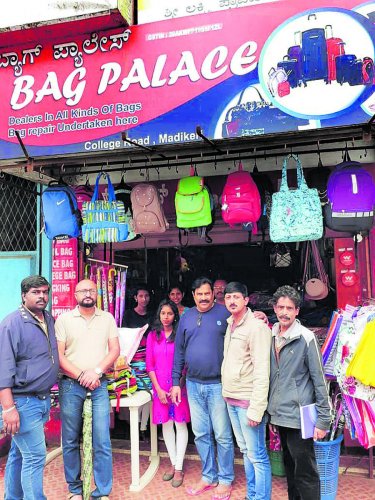
Madikeri Hitharakshana Vedike members with Bag Palace owner E J Peter (third from right).
A trader in Madikeri has handed over more than 350 valuable bags to rain-affected people.
His act comes close on the heels of a Kerala merchant donating dress materials to the flood victims.
The humble act by E J Peter of Bag Palace on College Road in Madikeri is well-appreciated by many.
Madikeri Hitharakshana Vedike members had posted on collecting relief materials on Facebook and WhatsApp. More than 20 members of the Vedike had been visiting shops and business establishments. They have been collecting essential commodities like clothes, umbrella, rain coat and medicines and supplying it to the relief centres.
Responding it, Peter handed over all the bags in his shop. “It has given me the satisfaction of helping those in distress. The financially well-off should support the education of children who are in distress,” said Peter.
“When we visited Peter’s shop, he lauded our efforts and handed over school bags and hand bags,” said Vedike member Acchandira Pavan Pemmaiah.
Vedike president Ravi Gowda said, “Many have come forward to help those who are in distress. Many are unaware of how to reach materials to the relief centres. The Vedike is bridging the gap and is helping reach relief materials to the needy at the relief camps.”
Shop-keepers have helped by donating textbooks, notebooks, pens, bed, clothes, vessels, rice, jaggery, sarees, sweater, oil and other essential commodities, he said.
Pavan Pemmaiah said, “The collected commodities have been distributed among rain victims at Nelyahudikeri, Valnooru, Tyagathooru, Moornadu, Dubare, Theppadakandi, Balamuri, Siddapura, Kattimadu and other areas.”
source: http://www.deccanherald.com / Deccan Herald / Home> State> Mangaluru / by DH News Service, Madikeri / August 19th, 2019
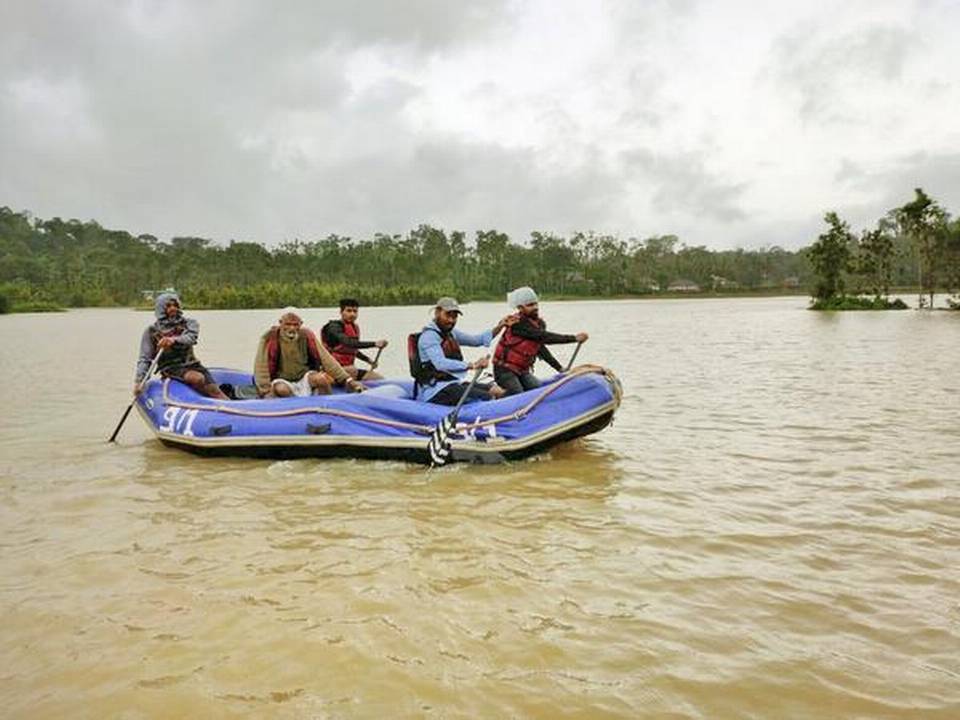
In action: For the people of flood-hit region, the presence of rescue personnel has infused a strong sense of security. | Photo Credit: Special Arrangement
Rescue prersonnel tread treacherous terrain in flood-affected Kodagu
Wading through slush, climbing slippery slopes, and battling inclement weather from dawn to night without respite is a matter of routine for the rescue teams stationed in the flood-affected Kodagu.
Rain may have abated but the search for missing persons continued at Thora village late on Wednesday as well, when the rescue teams recovered a body of a person buried in the mud.
The teams include three units of the National Disaster Response Force (NDRF), a column of the Indian Army, and Garuda — the State Commando team under the Centre for Counter Terrorism, apart from personnel of the Fire and Emergency Services, Civil Defence Quick Response Team, KSRP, and the local police, and hundreds of volunteers. For them it is the second consecutive year of battling a natural calamity in the district.
Thora, the toughest
A senior member of the Garuda team who was part of the mission said Thora was the worst affected this year and was comparable to Jodupala in 2018 in terms of the treacherous nature of the terrain. “There were other places too in Kodagu where people were affected by the overflowing river. But in terms of landslips and mud, Thora reminded one of Jodupala,” said the official. He said it was an impossible situation with a river of mud flowing down the hills and one was not sure if the ground beneath the feet was stable.
The team camped at a place nearly a kilometre away from the main road on sighting a few shreds of clothes and other signs of human habitation, which was otherwise obliterated. “Based on the assessment of the ground situation, we zeroed in on a specific point to dig out the mud and found the buried body,” said the Garuda force member.
The trek back was equally dangerous as they had to carry the body on a stretcher for nearly a kilometre in a terrain where their legs would sink knee deep in mud. They made it back to the base camp late in the night. This was just one of the many missions undertaken during the week when Kodagu was inundated.
For the people of the region, the presence of rescue personnel in their orange outfit — as in the case of the NDRF — has infused a strong sense of security. The Kodagu district administration had ensured the deployment of rescue teams and conducted a few rescue drills before the advent of the southwest monsoon in June. As the first signs of the unfolding crisis emerged, with water rising owing to heavy rain, the rescue teams swung into action to evacuate people to safety.
source: http://www.thehindu.com / The Hindu / Home> News> States> Karnataka / by R. Krishna Kumar / Mysuru – August 15th, 2019
‘They are stuck in their home State owing to NRC procedures’
The ongoing verifications for National Register for Citizens (NRC) in Assam have stopped thousands of workers from returning to the coffee estates of Karnataka. The Assamese workers left the estates in March-April, ahead of the parliamentary elections, and a majority of them are yet to return.
In Hassan district alone, more than 10,000 people from Assam are employed in many estates. Similarly, they work in estates of Chikkamagaluru and Kodagu districts. For the last 15 years, the estates in the three districts have been dependant on workers from northeastern States, Odisha and Madhya Pradesh.
Estates suffer
The final draft of the NRC was published in July 31, 2018. Many workers, whose names did not figure in the draft, were worried. They left to resubmit documents to claim citizenship. B.N. Jagaish Shetty, manager of IBC company-owned Hasirugudda Estate in Belur taluk, said last year more than 100 workers from Assam were in the estate. Now, there was none. “A few of them had returned very late and by then, we had made alternative arrangements. They must have gone to other estates,” he said.
The final NRC is expected to be published on August 31 and people are worried about leaving their native until then. U.M. Thirthamallesh, president of the Karnataka Growers’ Federation, said 25 Assamese were working in his estate and they had not yet returned. “The last communication I received was that they would come back after Bakrid (August 12). I hope they return as our estates are dependant on them,” he said.
This year owing to decrease in rainfall, the demand for labour is minimum. Anticipating dip in production, estate-owners are trying to manage with the available workforce. “But if the workers delay further, the activities in the estates will suffer,” he added.
“Coffee production has always been dependant on outsiders. In the past, there were workers from Dakshina Kannada. Later, it was Tamil Nadu. Many of them settled here over the years,” said B.A. Jagannath, planter and former member of the Coffee Board. People from Assam are stuck in their home State because of the NRC procedures and the floods. They will not return until their citizenship issue is settled, he said.
source: http://www.thehindu.com / The Hindu / Home> News> States> Karnataka / by Sathish G. T / Hassan – August 05th, 2019
The foreign pest, which is thought to have arrived in India through trade routes, devours tender leaves and stems, completely destroying plants.
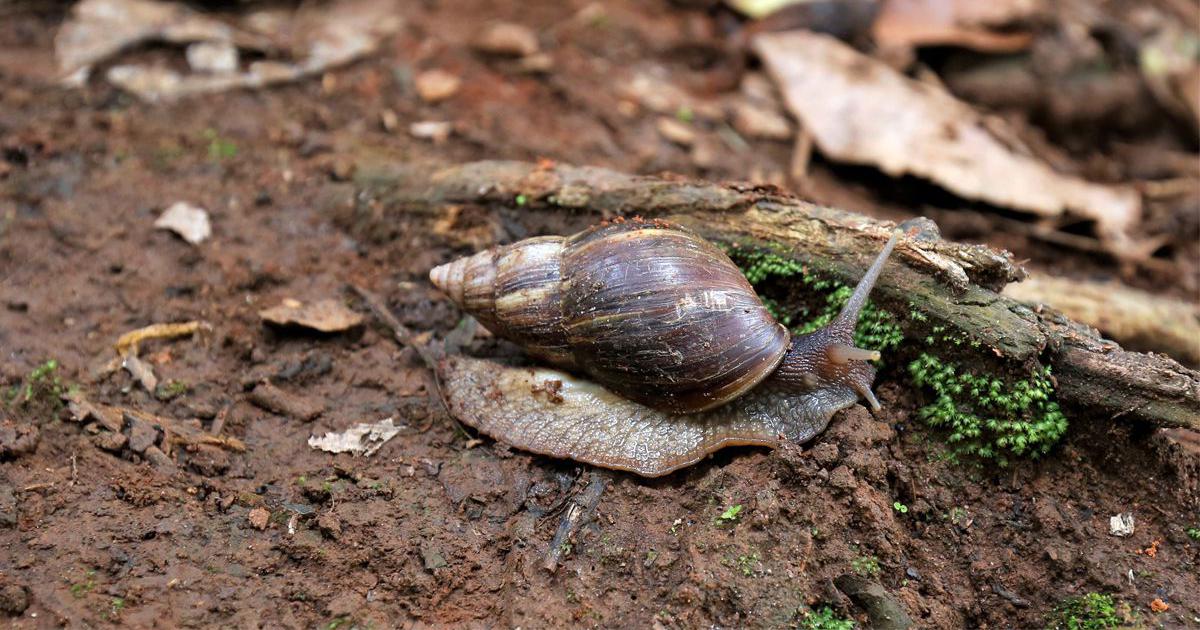
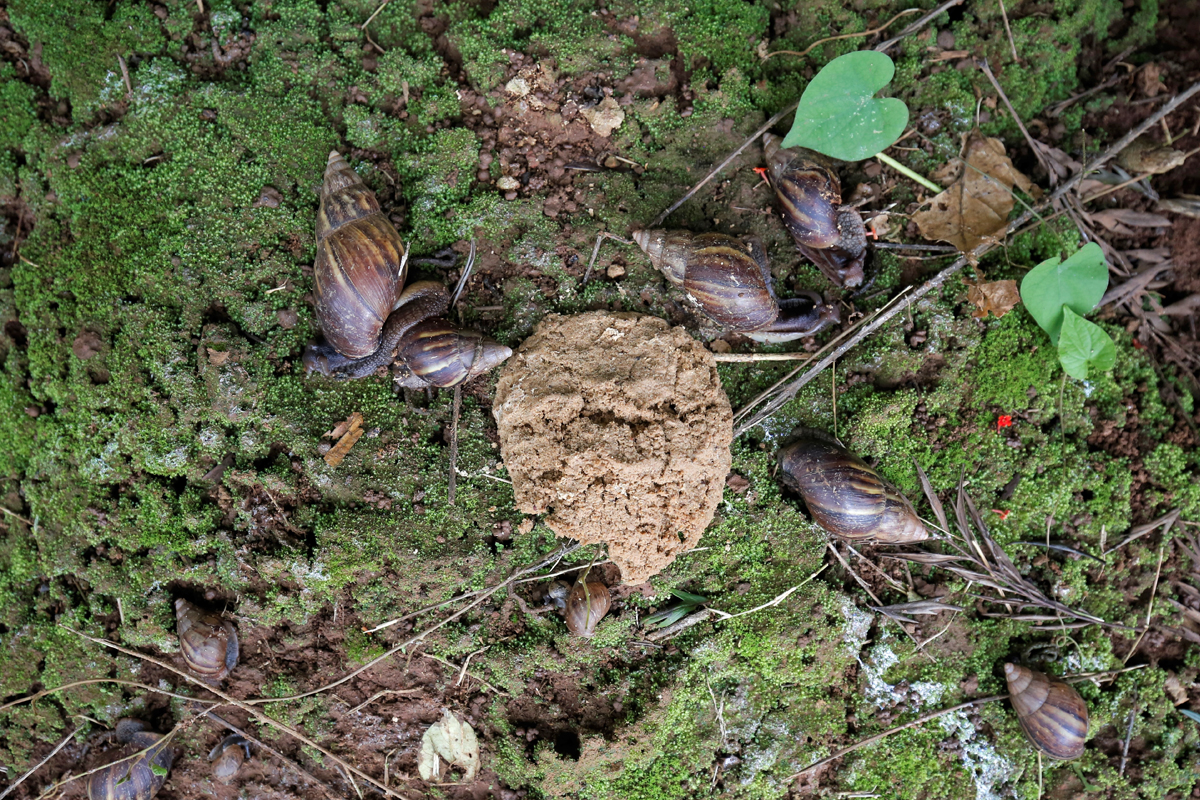
A giant African land snail, Achatina fulica, in a coffee estate in Kodagu district, Karnataka. | Abhishek Chinnappa/Mongabay
The monsoon rains have arrived late this year in the verdant hills of Kodagu – commonly known as Coorg – in Karnataka, the coffee capital of India. For some planters, it’s a mixed blessing. A delayed monsoon is bad news in the Western Ghats mountain range, where farmers and planters have found themselves at the receiving end of extreme weather events triggered by climate change. Last year in August, unprecedented rains and floods harmed crops and coffee plantations, affecting many lives and livelihoods.
In recent years, the rains have brought another problem with them – an infestation of giant African land snails that have caused massive losses to some 40-45 plantations spread over 300 acres of land in Northern parts of Kodagu.
The foreign pest, which is thought to have arrived in India through trade routes, attacks young coffee plants and devours tender leaves and stems, completely destroying the plants. These giant snails, whose shells can grow up to 20 cm in length, are not picky eaters. They eat over 500 plant species and adapt easily to different ecosystems, researchers have found.
Giant African land snail, an invasive species, infest a coffee plant in Kodagu, Karnataka. Planters lose up to Rs 12,000 per acre in efforts to get rid of the pest. Credit: Pradeep Kumar/Mongabay
A fast breeder, this snail has emerged as a major problem for planters in the Shanivarasanthe area of Somwarpet taluk in Kodagu. “They multiply in large numbers within a short span of time,” said Pradeep B Shekar, who owns 40 acres of a coffee plantation.
The giant African land snail, locally known as shanku hoola or conch worm due to the shape of its shell, appeared in Kodagu for the first time in 2012-’13 in 50-60 acres of coffee plantations in Shanivarsanthe. The local plantation owners fought the infestation and thought they have ridden themselves of the pest.
But in 2017, the snails reappeared, wreaking havoc in an expanded area of 300 acres belonging to some 40-45 plantations. The planters say the pest attack costs them an additional expense of between Rs 10,000 and Rs 12,000 per acre, mainly due to the efforts to contain them. This shrinks their profit margins from the produce.
source: http://www.youtube.com
Invasive species
The International Union for Conservation of Nature lists the giant African land snail Achatina fulica as one of the worst invasive species in the world. An invasive alien species is “a problematic species introduced outside its natural, past or present distribution,” the International Union for Conservation of Nature says. “They may lead to changes in the structure and composition of ecosystems, detrimentally affecting ecosystem services, human economy and well being.”
African snails spread to new locations via trade routes, piggybacking on agricultural products, equipment, cargo and plant or soil matter. While there is no consensus on how they found their way into the pristine landscape of Kodagu, it is certain that these pesky visitors have come with no exit plan.
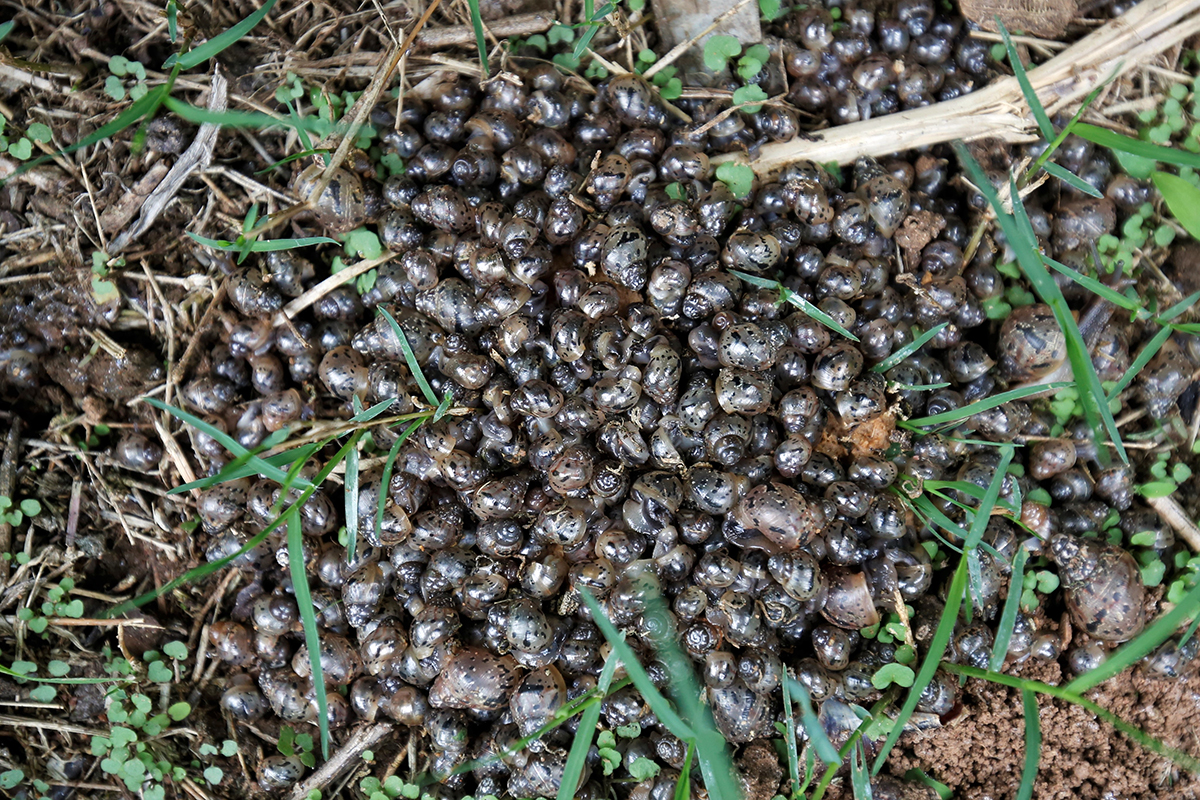
Giant African land snails in their early development stages inside a coffee estate in Handli village, Kodagu district. These fast-breeding snails have a lifespan of almost 15 years and can produce approximately 1,000 eggs in that period. Credit: Abhishek Chinnappa/Mongbay
Achatina fulica is one of the four species of giant snails belonging to the Achatinidae gastropod family native to Africa. It is classified as an obligate-outcrossing hermaphrodite, which means that just one externally fertilised snail can establish a population. These snails reproduce in large numbers.
The snails begin laying eggs at six months of age and can lay around 100 eggs in their first year, and up to 500 in the second year. Their life expectancy is around five years, and one snail can produce up to 1,000 eggs by then. The shell length of these snails ranges from 5 cm to 10 cm, though some adults may exceed 20 cm, and their average weight is about 32 gm.
Effective solution
Despite the destructive potential of the giant shells, the planters in Kodagu have been successful in tackling the infestation. They have reduced the infestation by about 90%, a remarkable achievement given that people in the neighbouring state of Kerala have been fighting this pest unsuccessfully for close to three decades.
The Coffee Board of India has emerged as the unlikely hero in this battle with the African snail. Researchers at the Central Coffee Research Institute in Balehonnur in Chikmagalur district of Karnataka and research sub-station in Chettalli in Kodagu devised a bait for the snail, in a method they dubbed “catch and kill”.
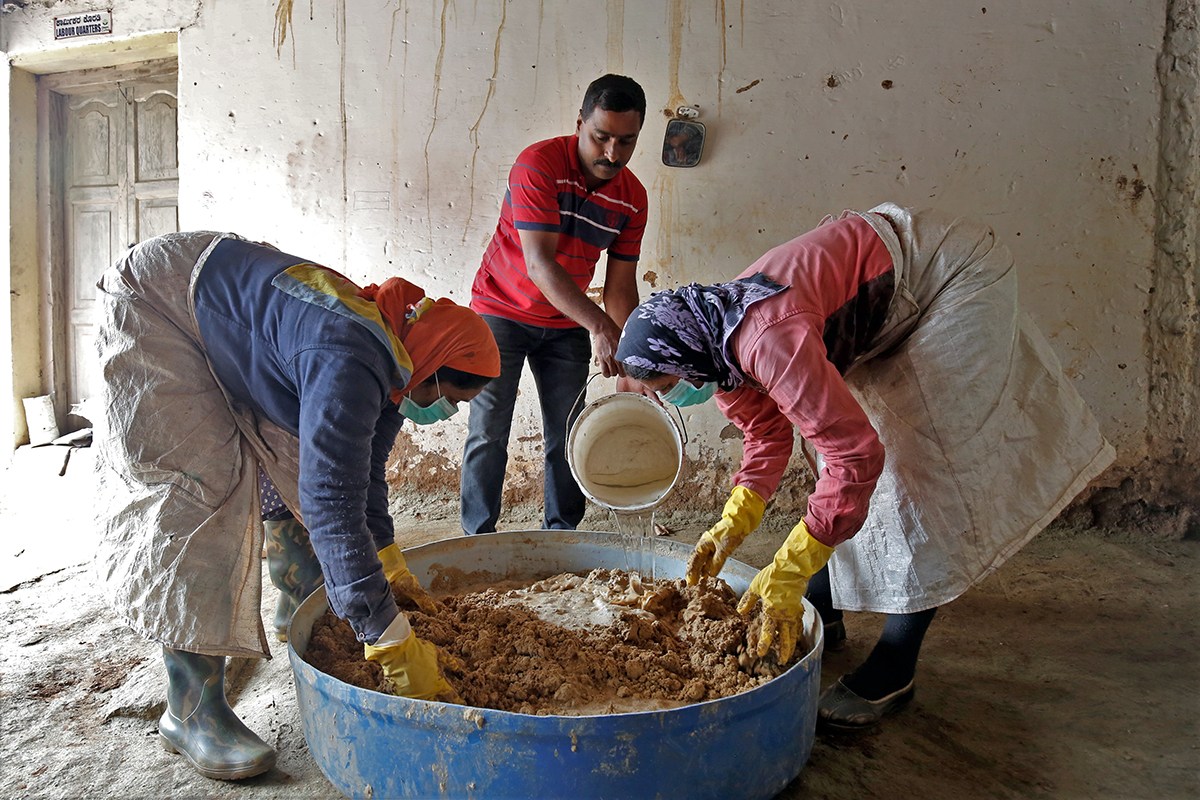
“The bait is made of rice bran, jaggery, castor oil and a chemical, thiodicarb,” explained Vishwanath Hadagalli, junior liaison officer of Coffee Board at Shanivarsanthe. “These are mixed together and balls of it are placed between four coffee plants.”
Researchers at the Central Coffee Research Institute in Chikmagalur district of Karnataka devised a successful catch-and-kill method to control the snail’s invasion. A bait made of rice bran, jaggery, castor oil and a chemical, thiodicarb, is used to lure and kill the pests. Credit: Abhishek Chinnappa/Mongabay
The researchers experimented with methomyl, a broad-spectrum insecticide, but it has been banned because the cost to the soil is too high. Thiodicarb is considered a less harmful insecticide that is effective against in killing the giant snails. “We tried every method available in the literature to get rid of these pests and this bait was found to be the most effective,” said Manjunath Reddy, assistant entomologist, coffee research sub-station at Chettalli, Kodagu.
In 2015, the Coffee Board used this bait and killed as much as 30 tonnes of snails. Encouraged by this, the Board, with active participation from Karnataka’s Horticulture Department and the Planters Association of Shanivarsanthe, upped their act through regular awareness meetings and distribution of bait kits to all the affected planters. The kit consists of a pair of gloves, 25 kg of rice bran, 100 gm of Larvin branded thiodicarb, 3 kg of jaggery and 100 ml castor oil. It costs Rs 1,000 but is distributed among the farmers at a subsidised rate of Rs 100.
Co-ordinated operation
“This has to be a collective effort,” said Pradeep Kumar, an affected farmer from Handli village in Shanivarsanthe. “If one affected farmer doesn’t participate, the infestation cannot be contained.” Hadagalli said there’s 90% success in eliminating these pests from Kodagu farms. “While we did not maintain records properly for the years 2014, 2015 and 2016, dead snails weighing 24 tonnes were collected in 2017, which came down to eight tonnes in 2018,” he said. “We expect much lower infestation this year.”
The Coffee Board also came up with the innovative idea of buying back the dead snails. It initially offered Rs 4 per kg of dead snails, which has since been increased to Rs 8 per kg. “The dead snails are disposed of in a pit that’s one-and-a-half feet deep,” said Hadagalli. “Salt is put over the dead ones to ensure even the last of the caught snails are dead and then buried.”
This burial is a precautionary measure against the spread of any disease through the snails. The giant snails are known to serve as intermediate hosts of several parasites that cause diseases in pets, free-ranging vertebrates and humans. They are hosts of rat lungworm Angiostrongylus cantonensis, which causes Eosinophilic meningitis in human beings.
Workers prepare a concoction to bait the giant African land snails inside a coffee estate. Co-ordinated efforts of farmers and officials have recently helped curb the infestation. Credit: Abhishek Chinnappa/Mongabay
Kerala experience
“In the past 5-6 years, seven children and at least one adult have been reported to have contracted meningitis through contact with giant African land snails,” said TV Sajeev, a scientist at Kerala Forest Research Institute, which who has been involved in the eradication of these snails in Kerala.
Although the fight against the snails has been largely successful in Kodagu, the experience is Kerala, where these creatures are seen as a nuisance, has been different. There have been as many as 223 outbreak points from 12 districts out of 14 in the southern state.
There is a cogent reason for this, said Sajeev. “The chemical used in the bait is not suitable for areas where there is human activity. These chemicals are found to be harmful, especially to aquatic organisms,” he said. “The case of Kerala, where the infestation is in towns and villages, is very different from that of an estate.”
Sajeev said one of the main problems that an invasive species brings with it is the invitation to use strong chemicals to eliminate them. Research has shown that exposure to chemicals like thiodicarb can be detrimental to human and animal health. The Kerala Forest Research Institute has been spraying an organic decoction of tobacco mixed with copper sulphate on snails that are lured with crushed papaya and cabbage leaves as bait.
Another big challenge in Kerala, said Sajeev, is the difficulty in organising people in these areas to work in tandem. “In Kerala, more than the destruction of agricultural crops, snails are a nuisance because they are seen in and around houses,” he said, adding that it is nearly impossible to get all the people in these houses to work together against the snails.
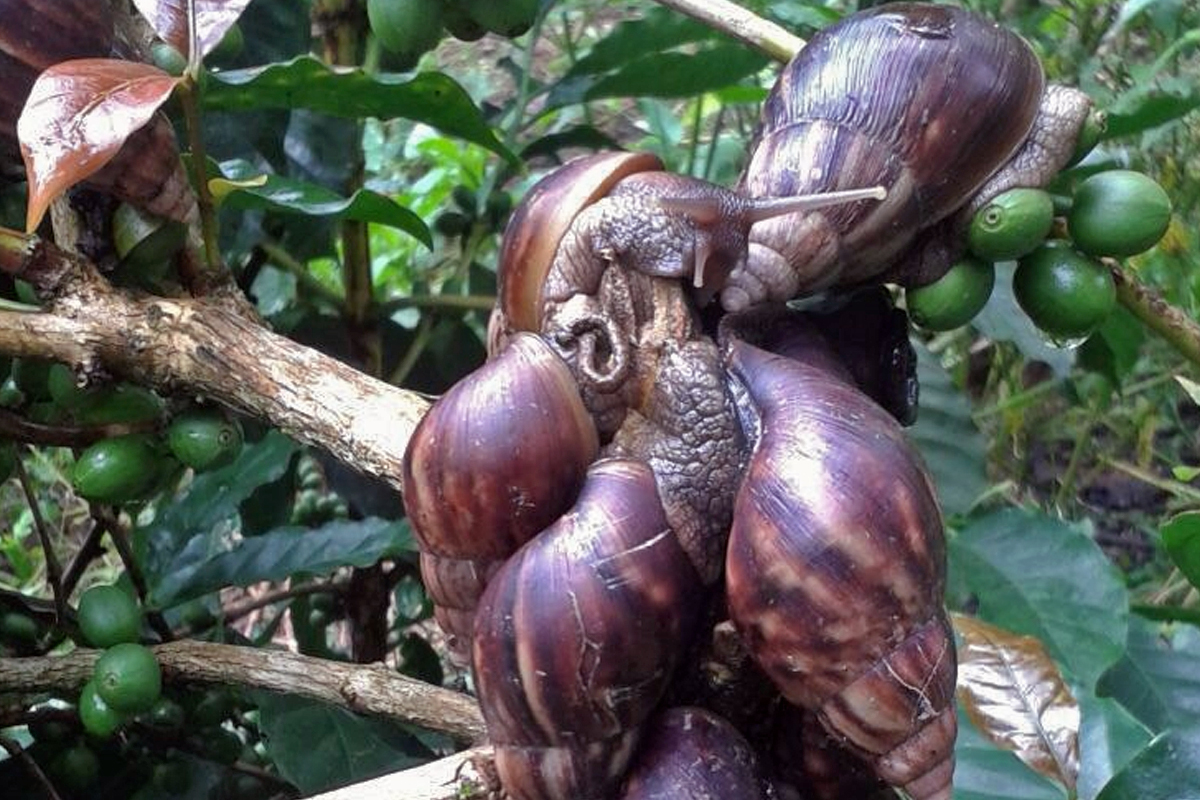
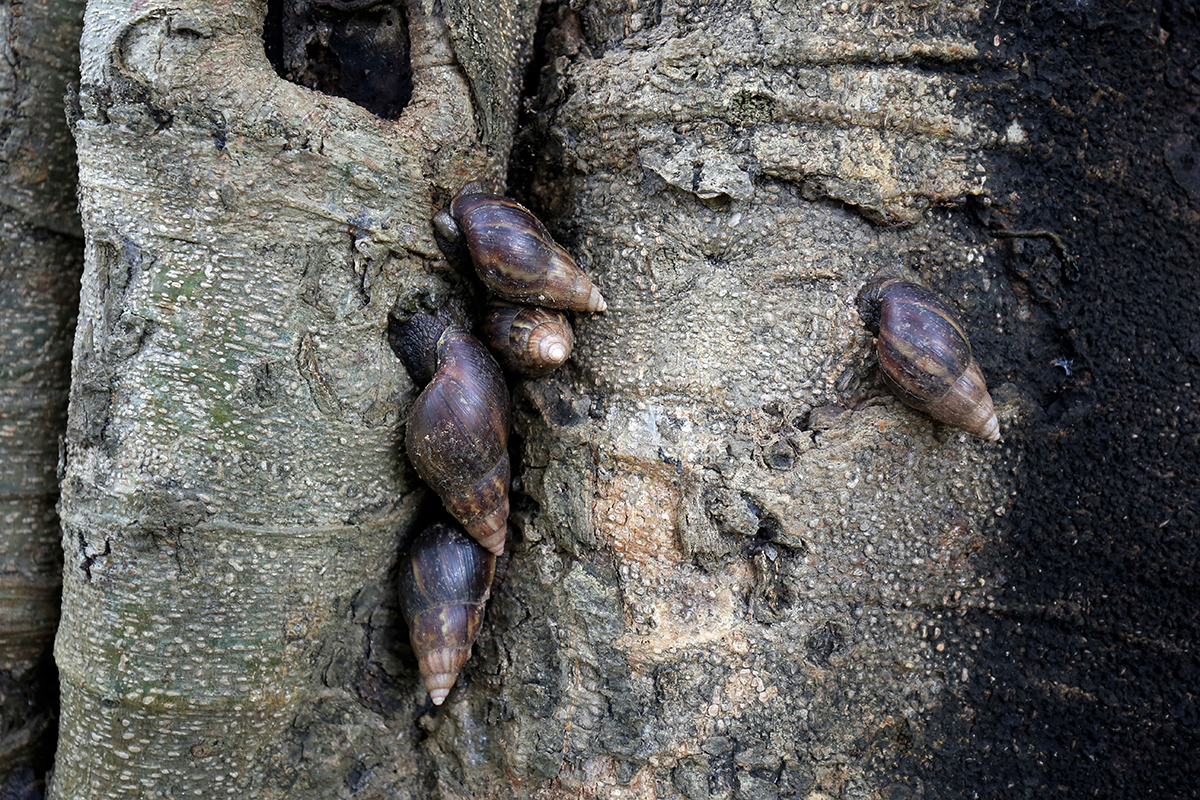
An escargatoire of giant African land snails on a ficus tree inside a coffee estate in Kodagu. While the infestation seems to be under control in the estates of Kodagu, Kerala is yet to find a solution. Credit: Abhishek Chinnappa/Mongabay
This article first appeared on Mongabay.
source: http://www.scroll.in / Scroll.in / Home> Pest Control / by Arathi Menon / August 05th, 2019
Provides sensor-based online real-time data on storage level to officials in New Delhi
Madikeri/Mysuru:
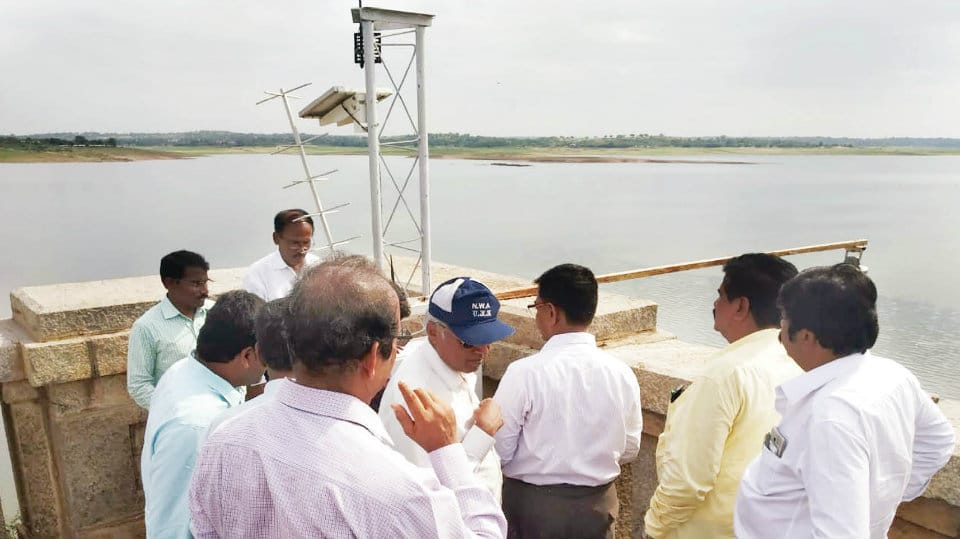
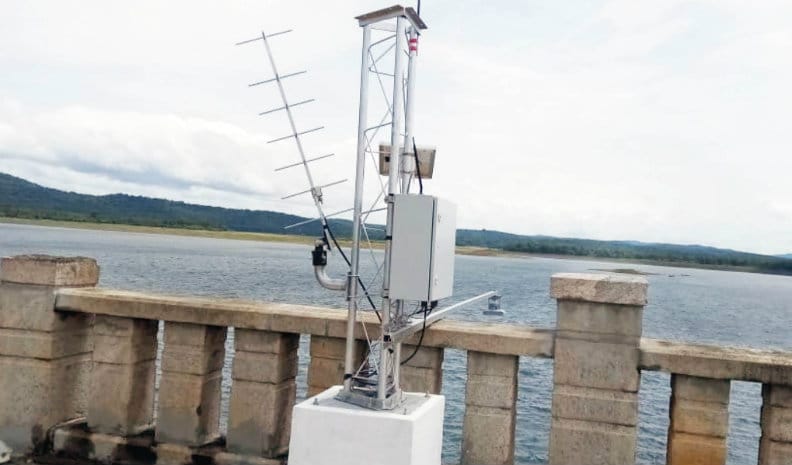
Telemetric Water Gauge has been installed at Krishna Raja Sagar (KRS) Dam in Mandya district and also at Harangi Dam in Kodagu for sensor-based real-time data on the storage level, inflow and outflow of the reservoirs.
The installation comes weeks after an Internal Committee of Cauvery Water Management Authority (CWMA) visited the two Dams in the first week of June this year. The team, after studying the water levels and reporting mechanisms, had decided to set up Online Monitoring System for all the reservoirs in Cauvery Basin through Telemetry-based Real-time Data Acquisition and Transmission.
The facility transmits data to CWMA Office in New Delhi and the authorities who decide on the water release as mandated by Supreme Court need not wait for the data from the Dams. They can easily access the data through the Telemetry Transmission system.
No room for errors: All these years, the authority sitting in New Delhi had to obtain data from each reservoir every day to determine the storage levels, inflow and outflow. This system was prone to errors as the people manning the Dams take physical measurements. Now with the new system, errors are eliminated and accurate real-time data can be accessed, making the decision-making process easy and accurate.
The Union Government has constituted the CWMA and and Cauvery Water Regulation Committee (CWRC) as directed by the Supreme Court and an Internal Committee comprising Irrigation experts from the Cauvery Basin States of Karnataka, Tamil Nadu, Kerala and Puducherry has been formed.
Real-time data acquisition
During their visit, the CWMA team discussed real-time data acquisition and transmission, installation of water-level sensors, flow rate sensors at all canals / outlets taking off from all the eight Reservoirs coming under Cauvery Basin and technical issues such as capacity enhancement of Dams, safety of Dams, prevention of leakages, modernisation of canals for prevention of seepage, etc.
The new advanced telemetry system has been installed based on the directions from CWRC. Sources said that such a system has been installed at Reservoirs including Hemavathy, Harangi, Kabini and KRS in Karnataka and in Banasura Dam at Kerala and Lower Bhavani, Amaravathi and Mettur dams in Tamil Nadu.
On mobiles
Speaking to Star of Mysore this morning, Vasudev, Assistant Executive Engineer of Cauvery Neeravari Nigam Limited (CNNL) that manages KRS and Harangi, said that the Telemetric Water Gauge gives live data to CWMA and CWRC authorities and they can access the data at any given point of time on their mobile phones.
The system transmits live data from the Dams and an exclusive cell has been set up at CWMA Office in New Delhi to receive the data and send them real-time through mobile phones. “With this system, now no one can bluff the CWMA by constantly claiming more water, hiding the real storage level data at the Dams. Even the CNNL authorities can access the data,” he said.
The data will measure minute details about number of canals and their location, water levels inside the canals, their turbulence, number of sluice gates, size of gates and the amount of water discharged from the crest gates. It also records spill- over water.
source: http://www.starofmysore.com / Star of Mysore / Home> News / July 26th, 2019
These firms are tapping governments, insurers, banks, farming co-operatives, development agencies and corporate social responsibility programs to create a business and help farmers.
Startups and technology firms are trying to break into India’s agricultural landscape using newer business models. These firms are tapping governments, insurers, banks, farming co-operatives, development agencies and even corporate social responsibility programs to create a viable business and help farmers. Most farmers have small holdings. Some even rent the land they farm on from others. Farmer distress is widespread.
Farming contributes around 15% to India’s gross domestic product. In short, India has few large farms that can pay for technology solutions. When CropIn Technologies first started out in 2010, the company tried selling its agri-tech solutions directly to farmers.
After investing lakhs of rupees, however, it managed to earn just Rs 6,000. Now, it tailors its solutions to specific needs. “Each customer segment that we deal with, we have a different value proposition for them,” said Jyoti , head of business development at CropIn Technologies. Large companies that depend on agricultural produce want information on sowing and pre-harvest activities up to harvest.
Development agencies are keen to develop sustainable farmer livelihoods, Vaddi said. CropIn is working with the World Bank in Bihar and Madhya Pradesh on a climate resilience project. It is also identifying a model where farming communities can adopt technology to create sustainable benefits — such as weather alerts on phone, best practices on farming, and advice on taking care of pest attacks. Agri-tech companies such as CropIn are also finding a market in banks and non-banking financial companies that give agricultural loans. The lenders are seeking CropIn’s expertise to help manage risk.
“If they have invested money in certain loans with farmers, the bankers want to know if it performing, how the crop is doing. Sometimes, a farmer takes a loan to sow one crop and then sows half his field with something else. There could be a genuine reason, but this is information a banker would want to know,” Vaddi said. CropIn is working with public and private sector banks as well as NBFCs. For banks and insurers, the company provides a platform that has data on the historical crop yields yields of a district. This helps in forecasting yields using machine learning.
The company also uses remote sensing satellites to determine what crops are sown in a region, using crop signatures it has collected over the past five years. Large technology companies, such as IBM and Microsoft, too are involved in the agri-tech space. The Weather Company, an IBM unit, provides hyperlocal weather information to farmers, along with data on soil moisture and temperature, which aids farmers in making informed decisions on how and when to irrigate. The company has tied up with agro-tech startup AgroStar to create crop disease prediction algorithms. “We are not expecting marginal farmers to pay for this.
We work with governments, banks, insurers, corporates who have business interests in agriculture and corporates that want to do meaningful CSR work,” said Himanshu Goyal, India Business Leader at The Weather Company. “It is not very expensive. It is cheaper than what a normal software costs and it is affordable,” he said. The company looks at delicately balancing value and cost, which even a company can appreciate, and one where people can build in affordability in business models, he said.
Microsoft is working with agrochemicals company United Phosphorus and the International Crop Research Institute for the Semi-Arid Tropics (ICRISAT) to provide agri-tech solutions to farmers. State governments and government-promoted organizations are also potential markets for agri-tech companies. The agriculture ministry signed a statement of intent earlier this month with IBM for a pilot study on using artificial intelligence and weather technology solutions in agriculture.
Tie-ups with governments also use sensors in agricultural fields to measure soil health and ground-level conditions. Pilots that require placing sensors on farms are also underway. Eka Software, which has built a digital commodity management platform that is used by the likes of Cargill and Rio Tinto, has built a blockchain platform for coffee farmers in a tie-up with the Coffee Board of India. The platform aims to help farmers get a good price for their product, while offering coffee roasters and exporters data on crop quality. “There is a lot of scope to use technology to digitise agriculture in India and curb waste,” Manav Garg, CEO of Eka Software, told ET in an interview earlier.
“We have built this platform for coffee, but we can also create similar platforms for other agricultural commodities.” State governments are also looking to invest in blockchain technology to help cashew and shrimp exports. “India is one of the largest exporters of shrimp to the European Union, and the EU has put in requirements to disclose the health of the shrimp. In Andhra Pradesh and Tamil Nadu, the governments are putting in place blockchain (technology) in which the manufacturers of the shrimp feed the content and that is made available to buyers. Kerala is doing the same thing for cashew nut,” said NG Subramaniam, chief operating officer of India’s largest IT services company Tata Consultancy Services. The blockchain technology is being launched by the state fisheries department, the Marine Product Export Development Authority and Tata Trusts, the Tata Group’s philanthropy arm. Business models are still evolving at at the farm level, experts say, whereas at the retail level — organic food or providing farm produce directly to homes — it is more established.
The government’s increased focus on improving farm incomes is also resulting in more pilot projects in the agri-tech space. “Future scale-up models will need farmers to have a stake, both to have ownership over and to demand accountability from the services. This is an emerging context,” said Amit Vatsyayan, Partner – Government and Public Sector Advisory Services, EY India. “A platform approach is very much needed for greater acceleration and adoption.”
Agritech Startups in India
CropIn
Offers farm management solutions for agricultural sectors. Works with farming companies, agri-input companies, crop insurance providers, seed production companies and government.
Total Funding: $16 million
Investors: Chiratae Ventures, Bill and Melinda Gates Foundation, Ankur Capital and 8 Other Investors
AgroStar
It provides agri-inputs including fertilizers, seeds, manures, farm equipment, etc. to farmers.
Total Funding: $15 million
Investors: Accel Partners, Aavishkaar, Chiratae Ventures and 3 Other Investors
FarmBee
Has an online platform providing data-driven agricultural solutions. It offers agricultural content, commodity prices, weather data, and contextual advice to the farmers. Enterprise customers include TAFE, RBL Bank, Pepsico etc.
Total Funding: $9 million
Investors: Sandeep Bhammer, Ravikant Banka, Shailaja Reddy and 23 Other Investors
NinjaCart
Has a B2B marketplace connecting farmers with retailers. Initially started out with a hyperlocal grocery marketplace but pivoted to B2B marketplace for sourcing fresh fruits and vegetables, staples and FMCG goods directly from farmers and brands after 6 months of launch. Currently works with about 120 retailers.
Total Funding: $48million
Investors: Accel Partners, Syngenta Ventures, Neoplux and 13 Other Investors
Stellapps Technologies
Uses IOT, mobility and data analytics to improve agri- supply chain parameters including milk production, milk procurement, cold chain, animal insurance and farmer payments. Offers a platform SmartMoo, which gathers data via sensors that are embedded in milking systems, animal wearable, milk chilling equipment & milk procurement peripherals and provides insights for management of cattle, organization of dairy farms and for logistics management.
Total Funding: $11 million
Investors: Bill and Melinda Gates Foundation, IndusAge Partners, Qualcomm Ventures and 8 Other Investors
source: http://www.economictimes.indiatimes.com / ET Rise / Home> Business News> RISE> Startups> News Buzz / by Jochelle Mendonca, ET Bureau / July 26th, 2019
The Union Government is expected to soon set up a task force that will engage with various stakeholders in the coffee sector, examine the issues faced by it and make suitable recommendations to the Union Commerce Minister.
According to Jeffry Rebello, chairman of the coffee committee of the United Planters’ Association of Southern India, the industry representatives held detailed discussions with Commerce Minister Piyush Goyal recently on the issues faced by the sector.
This included the need for better research, permitting growers to add value, bringing down the percentage of chicory permitted to be mixed with coffee and schemes of the Coffee Board.
“We had presented a memorandum too. The Minister had announced that a two-member team will be formed and it will meet the stakeholders. The team is expected to submit its report to the Minister by August 31,” he said.
Welcoming the announcement on the task force, Mr. Rebello said it is likely to be set up soon after the Budget session of the Parliament, he said.
source: http://www.thehindu.com / The Hindu / Home> Business / by Special Correspondent / Coimbatore – July 27th, 2019
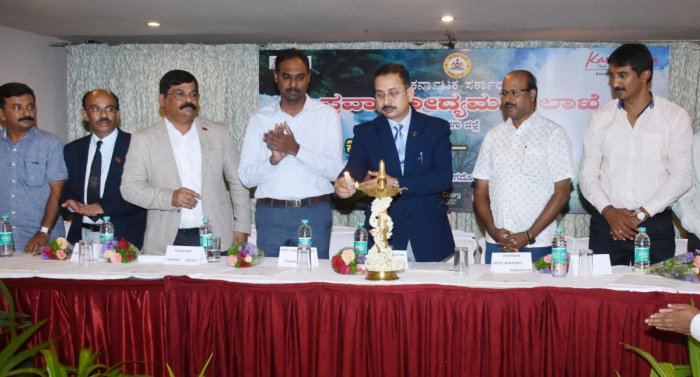
Karnataka State Tourism Development Corporation Managing Director Pushkar Kumar inaugurates, ‘Connect’, a preparatory meeting on tourism, in Madikeri on Friday.
Priority will be given for the promotion of tourism in Kodagu district, said Karnataka State Tourism Development Corporation Managing Director Pushkar Kumar.
Speaking at ‘Connect’, a preparatory meeting, organised for tourism department at Coorg International Hotel on Friday, he said the tourism department is organising Karnataka International Travel Expo in Bengaluru from August 25 to 27.
India ranks 11th in the tourism sector at the global level. Kerala is moving ahead in the promotion of tourism. All efforts are being made to promote tourism in Karnataka, he added.
He said several programmes are organised to promote tourism in various districts in the state.
Hotel, Resort Association President Nagendra said, “All should cooperate for the development of tourism in the state. There is a need for improving basic facilities at the tourist spots in Kodagu district.”
A tourist information centre should be set up in Madikeri to provide information to tourists on the tourist spots, he said.
Suitable facilities should be provided for trekking to Nishani, Pushpagiri and Tadiyandamol areas. Nalkunadu Palace should be developed. Free entry should be provided for tourists at Harangi, he added.
State Tourism Society Joint Secretary Ravindra and others were present at the meeting.
source: http://www.deccanherald.com / Deccan Herald / Home> State> Mangaluru / by Adithya K A / DH News Service, Madikeri / July 19th, 2019
Rafting, an activity that is a big favourite of tourists at Dubare, is back. As a result, the tourist camp is buzzing with activities again.
As river rafting had been banned in River Cauvery at Dubare a year ago, the number of tourists had dipped drastically.
The rafting association had urged the district administration and District In-charge Minister Sa Ra Mahesh to lift the ban on rafting and support the local entrepreneurs.
As the ban has been lifted, tourists are now making a beeline during weekends to take part in the adrenaline-pumping and adventurous activity.
This, in turn, has left the organisers of the rafting activities as well as the local vendors smiling.
River water level
Water rafting at Dubare is being conducted along a distance of eight kilometres. The water level in River Cauvery too has risen, following good rain in the district. More number of youth were seen enjoying rafting.
The sport was relaunched at Barapole as well. Barapole is located 35 kilometres away from Madikeri. A fee of Rs 600 is charged per head for those keen on rafting activity.
River rafting was introduced in Dubare in 2002. In case of good rain, rafting activities can been conducted till December.
Dhanush, a software engineer who took part in rafting at Dubare, said, “The plans to take part in the rafting activity could not be realised a year ago as it had been banned. Now, we got a new experience.”
Elephant camp
Businessmen said that as the rain was less this year, more number of tourists were landing in Kodagu. Many of the tourists have also been visit the elephant camp at Dubare.
Randeep from Bengaluru said that he would like to explore all tourist sites in Kodagu.
Tourists have been thronging Raja Seat, Abbey Falls, Mallalli and Irpu Falls. The homestay and resort business has also been revived, the businessmen added.
source: http://www.deccanherald.com / Deccan Herald / Home> State> Mangaluru / by Adithya K A / DH News Service, Kushalnagar / July 19th, 2019
WELCOME. If you like what you see "SUBSCRIBE via EMAIL" to receive FREE regular UPDATES.
Read More »