Category Archives: Business & Economy

Smiles are back in Kodagu’s tottering hospitality sector

Tourists at Kodagu, the best known hill station in Karnataka.   | Photo Credit: M.A. SRIRAM
Tourists at Kodagu, the best known hill station in Karnataka. | Photo Credit: M.A. SRIRAM

After last year’s landslides, hotels and resorts in the coffee land saw 100 per cent occupancy for the first time this weekend.

After a gap of almost a year, hotels and resorts in Kodagu, which is back on its feet after last year’s worst-ever floods and landslides, have registered 100% occupancy.

The hospitality sector was badly hit since the tragedy in the district and it took almost a year for the industry to witness tourists coming in droves to the land of coffee.

Hotels and resorts in Kodagu have about 6,000 rooms, and almost all of them had been occupied since Friday. “We need to remember this weekend forever as it gave a new lease of life to the hotel industry, which was in a miserable state with tourists staying away from the hill station. This had forced many promoters to put up their hotels for sale,” said Nagendra Prasad, President, Kodagu Hotels, Restaurants and Resorts Association.

He told The Hindu that about 30,000 people are directly employed in the tourism industry in Kodagu of which the hospitality sector accounts for about 6,000 employees. As many as one lakh people are indirectly dependent on the industry for their livelihood. “People can breathe easy if tourism thrives in Kodagu. If weather permits, the season can be extended till June first week before the monsoon sets in,” he observed.

One of the reasons for the increase in footfall was the end of exams, and also elections in this part of the region. People visit the hill stations to beat the heat. But, this time, even Kodagu has not been spared with the temperature hovering around 32 degree Celsius, which is high by Kodagu’s standards, according to the stakeholders.

“Some parts of Kodagu had rains over the last week. A few more spells of rains will cool the coffee land, making it comfortable for visitors. After June, the season starts only in October for Dasara vacation. So, we are keeping our fingers crossed and expecting the season in May to be better,” said Mr. Prasad.

Unconfirmed statistics put the number of rooms in home-stays at 20,000. Kodagu alone has 4,000 of them. If rooms in hotels and resorts are added, Kodagu has over 30,000 rooms. All these used to get filled up before floods struck the land, the stakeholders said.

Worrying times
Though the hill station had recovered from the natural calamity, tourism had not picked up despite efforts from both the government as well as the stakeholders. The hospitality sector was unable to cope with the loss of business.

“We had been telling throughout the year that Kodagu is safe to visit. The turnout since Friday showed people believed in what we said,” said Mr. Prasad.

source: http://www.thehindu.com / The Hindu / Home> News> Cities> Bengaluru / by Shankar Bennur / Mysuru – April 22nd, 2019

Metro People: Aviva Bidapa turns a designer

Aviva Bidapa
Aviva Bidapa

Actor-turned-designer Aviva Bidapa, Director, India of Prasad Bidapa Associates, was always high on creativity. She knew that there was so much more talent within her that was waiting to be unlocked.

Aviva recently launched her swimwear collection. Talking about her collection, she says “I have two separate collections this season. One is inspired by the Japanese Carp/Koi fish and the other is deconstructed polka dots, which I think is a classic”. She says that she wanted to cater to both the moods she has as a woman. “My collection has a neat mix. I have added a hint of red solids to the polka dots and a yellow solid to carp. The collection is bright and colourful,” adds Aviva.

Who was her inspiration to turn a designer? “I never really wanted to be a designer but I knew I wanted to be creative. When I met Linea Aqua, the company that makes my swimsuits, I saw an opportunity to combine both my passions — business and creativity. I love swimwear and I am a passionate customer,” explains Aviva.

Her next collection is sequins and snake skins. “I want to stay true to my taste and also work on something that is in fashion. It will be out in June or July. I intend to first showcase it at the Colombo Swim Week and then bring it to India,” she concludes.

source: http://www.deccanherald.com / Deccan Herald / Home> Metrolife> Metrolife Cityscape / by Nina C. George / DH News Service, Bengaluru / April 16th, 2019

‘Kaluru Stores’ 2nd outlet to open on April 14

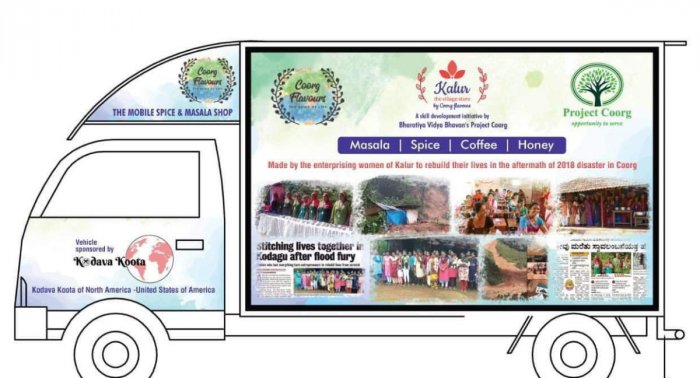
Women Kaluru, who had been affected by the natural calamity in Kodagu, have turned entrepreneurs by releasing ‘Yashaswi’ spices, initiated by ‘Project Coorg’.

The second outlet of ‘Kaluru Stores’, exhibiting and selling articles made by the women affected by the natural calamity in the district, will be inaugurated in town on Sunday, April 14.

The store has been conceptualised by ‘Project Coorg’.

Post-floods, ‘Project Coorg’ identified women from Kaluru, who had been affected by the natural calamity, and trained them to prepare spices at the Bharatiya Vidya Bhavan, Kodagu centre. The spices graded and packaged were sold in the market under the brand name ‘Yashaswi’.

The first outlet of ‘Kaluru Stores’ was opened near Raja Seat with assistance of Kodagu district administration.

The second outlet is ready to be opened in front of Shishu Kalyana organisation near the government bus shelter in Madikeri.

‘Project Coorg’ head Balaji Kashyap said that the opening of the second outlet of Kaluru products had boosted the confidence of the women entrepreneurs. The women underwent training for 180 days in preparation of the spices, he added.

The second outlet will be inaugurated by the Dakshina Kannada Kannadigara Sangha president Ramachandra Upadhyaya at 11 am on April 14.

Bharatiya Vidya Bhavana Kodagu Kendra president K S Devaiah, legislators K G Bopaiah and Appacchu Ranjan, MLCs Sunil Subramani, and Veena Acchaiah, Kodagu Shishukalyana Samsthe president K Mohan Monnappa and writer Nagesh Kaluru will take part in the inauguration of the outlet, sources said.

source: http://www.deccanherald.com / Deccan Herald / Home> State> Mangaluru / by Ashwani Kumar NKR / DH News Service, Madikeri / April 12th, 2019

‘Transport to ferry specially abled to polling booths’

Mysuru Regional Commissioner T K Anil Kumar speaks at a meeting in Madikeri on Wednesday.

Transport facilities will be arranged to ferry physically challenged voters to the polling booths to exercise their franchise, said Mysuru Regional Commissioner T K Anil Kumar.

Wheelchairs should also be arranged at the polling booths, he added.

Speaking at a meeting on Wednesday, he said all the polling booths have toilet, drinking water and electricity connections.

In addition, he said that the roads leading to the polling booths should be in good condition.

Kodagu is a Malnad district. The schools are situated in hilly areas. As a result, the road leading to the polling booths from the main road should be repaired, he told the nodal officers.

The Election Commission to has given special emphasis for the physically challenged to reach the polling booth. All the guidelines issued by the Election Commission should be adhered to, said Anil Kumar.

Systematic Voters’ Education and Electoral Participation (Sveep) Committee Chairman and Zilla Panchayat CEO K Lakshmi Priya said that Kodagu district has 3,090 persons with disabilities. Madikeri Assembly segment has 1,696 persons with disabilities, while Virajpet has 1,394 persons with disabilities. Of these 3,090 persons, 1,978 are men.

She said that ramp facilities have been provided at all the 543 polling booths. As many as 357 wheelchairs, 463 magnifying glasses, 380 braille voter slips will be utilised.

In addition, the services of 146 jeeps and autorickshaws will be utilised for ferrying specially abled persons to the polling booth. A total of 670 volunteers will help specially abled people at the polling stations, she explained.

The CEO said that the services of rural rehabilitation workers will be utilised, to get the specially abled to the polling booths to exercise their franchise. Already, awareness programmes have been organised including candle march, demonstrations on on EVM and VVPAT, jatha, rally, street plays to create awareness on voting. Even specially abled persons have been appointed as ambassadors to spread the message on ethical voting.

Deputy Commissioner and District Election Officer Annies Kanmani Joy also spoke at the meeting. Additional Deputy Commissioner P Shivaraju and others were present.

source: http://www.deccanherald.com / Deccan Herald / Home> State> Mangaluru / by Adithya K A / DH News Service, Madikeri / April 03rd, 2019

Afoozo, CCD win India Coffee House franchise; McCann roped in for brand facelift

During the first two years of the pilot phase, the Coffee Board intends to open 50 franchises of India Coffee House on lease.

IndiaCoffeeCentreKF05apr2019

Mumbai-based Afoozo and Bengaluru-based Cafe Coffee Day (CCD) have won the franchise bid to run and expand the Coffee Board-owned India Coffee House. Currently, with 15 outlets across India, directly operated by the Coffee Board, the proposed public-private model is aimed at giving the India Coffee House a facelift, turning it into a full-service franchise. The Coffee Board invited bids to establish and operate the outlets in July last year.

Confirming the development, the Coffee Board CEO Srivatsa Krishna said that Afoozo and CCD won the bid. “We have just awarded the contracts and currently, we are undertaking location visits and will take four-five months to start working on it.”

During the first two years of the pilot phase, the Coffee Board intends to open 50 franchises of India Coffee House on lease. It will also open some outlets at Coffee Board-owned locations.

“Both companies agreed to the same upset price (franchisee fee). Since the tender provides for multiple franchising, we will split the locations,” said Krishna. Currently, the board is looking at locations such as IIT, Chennai and IIM, Bangalore, to expand India Coffee House’s footprint.

Under the franchisee model, Afoozo and CCD will be permitted to use the Coffee Board’s ‘India Coffee House’ brand name and its trademark. They will also be provided with a complete business system, including branding and communication guidelines. However, no sub-franchising will be allowed according to the terms of the contract. Moving away from the revenue-sharing model, the selected franchisee will follow a ‘per location’ paying model for an initial period of three years. Further extension can happen on a price mutually agreeable to both parties.

While private companies will run the outlets, the Coffee Board will prescribe product pricing. With the board already fixing the maximum retail sale prices of products as part of the bidding contract, the franchisees will not be at liberty to increase pricing. A 100 ml of Arabica coffee sold at Rs 100 at other coffee shops will be priced at Rs 30, while a mini coffee of 60 ml will be priced at Rs 25.

“People remember India Coffee House for the quality of food and its affordable pricing. We now want to turn it into a business version of CCD,” said Krishna .

The board has roped in McCann ad agency to provide a brand facelift and has also mandated a two-year digital campaign starting around Diwali. The contract is likely to be signed soon.

source: http://www.businesstoday.in / Business Today / Home> Big Story> Story / by Rukmini Rao / April 03rd, 2019

Coffee trade goes live on blockchain platform

The initiative was announced by Suresh Prabhu, Union minister for commerce and industry, in Delhi in September, 2018. Mint

– The project was announced by Suresh Prabhu, minister for commerce
and industry, in Delhi last September

– The blockchain platform will allow a coffee producer to directly
transact with multiple buyers.

The Coffee Board on Thursday launched the pilot of the country’s first blockchain-based marketplace app for trading in Indian coffee, aimed at getting growers better returns by removing myriad middlemen.

Known as the Coffee Blockchain initiative, the pilot was activated simultaneously by Jose Dauster Sette, executive director of the International Coffee Organisation from Nairobi and Anup Wadhawan, India’s commerce secretary from New Delhi.

The project was announced by Suresh Prabhu, minister for commerce and industry, in Delhi last September. So, why did it take six months for the project to go live?

“There were more than 20 stakeholders from three different countries. We had to get all of them on board, and then test the platform. We believe this is perhaps only the third attempt at a coffee blockchain after France and Ethiopia,” said Srivatsa Krishna, chief executive officer and secretary of the Coffee Board, a government organisation tasked with promoting Indian coffee.

The blockchain platform will allow a coffee producer to directly transact with multiple buyers.

In India, coffee is cultivated in about 454,000 hectares by 366,000 coffee farmers — 98% of them small farmers — whose returns are meagre. Krishna said the aim of using blockchain is to “premium-ise” coffee, add “bean-to-cup traceability” and cut the role of middlemen.

The blockchain-based solution was developed in coordination with Eka Software Solutions. Manav Garg, the company’s CEO and founder, said the idea of using blockchain is to “record the first smart contract on a blockchain with the 20-odd stakeholders, and establish trust in the marketplace”.

“With this activation, we are confident that the Coffee Board of India will help the Indian coffee trade make more inroads into the premium market internationally and make India one of the top three coffee producers in the world,” Garg added.

Krishna said the Coffee Board is also “testing” blockchain-based solutions from a couple of other vendors but added that “the one from Eka Software was the most suitable at this moment”.

Blockchain is no longer a technology that is just about powering cryptocurrencies like bitcoin and ether. A distributed digital ledger technology (DLT), it is also being used by manufacturing companies to improve their supply chains; by healthcare and electricity companies; and by the financial sector to make transactions more transparent.

source: http://www.livemint.com / Live Mint / Home> Explore / by Leslie D’Monte / March 29th, 2019

Five coffee varieties get GI tag

Global praise: Tribal women harvesting organic coffee on a plantation near Girliguda in Araku, Visakhapatnam.The Araku Valley coffee which is processed and marketed with the help of the tribal farmers cooperative society recently won the gold medal for the best coffee pod in the Prix Epicures OR 2018 Award in Paris.   | Photo Credit: K.R. Deepak
Global praise: Tribal women harvesting organic coffee on a plantation near Girliguda in Araku, Visakhapatnam.The Araku Valley coffee which is processed and marketed with the help of the tribal farmers cooperative society recently won the gold medal for the best coffee pod in the Prix Epicures OR 2018 Award in Paris. | Photo Credit: K.R. Deepak

The government on Friday said it has awarded Geographical Indication (GI) tag to five varieties of Indian coffee including Coorg Arabica.

The move is expected to help the growers get maximum price for their premium produce.

The Department for Promotion of Industry and Internal Trade, under the Ministry of Commerce and Industry, has recently awarded this tag to — Coorg Arabica coffee from Karnataka, Wayanad Robusta coffee from Kerala, Chikmaglur Arabica from Karnataka, Araku Valley Arabica from Andhra Pradesh, and Bababudangiris Arabica coffee from Karnataka.

The Araku coffee is produced by the tribals, who follow an organic approach in which they emphasise management practices involving substantial use of organic manures, green manuring and organic pest management practices, the ministry said in a statement.

Similarly, it said, Bababudangiris Arabica coffee is selectively hand-picked and processed by natural fermentation.

In India, coffee is cultivated in about 4.54 lakh hectare by 3.66 lakh coffee farmers of which 98 per cent are small farmers.

Coffee cultivation is mainly done in the southern states of India including Karnataka, which accounts for 54 per cent of the total production. It is followed by Kerala (19 per cent), Tamil Nadu (eight per cent).

It is also grown in non-traditional areas such as Andhra Pradesh and Odisha (17.2 per cent) and North East states (1.8 per cent).

India is the only country in the world where the entire coffee cultivation is grown under shade, hand-picked and sun dried, it said adding the country produces some of the best coffee in the world, grown by tribal farmers in the Western and Eastern Ghats, which are the two major bio-diversity hotspots in the world. Indian coffee is highly valued in the world market and sold as premium coffee in Europe.

“The recognition and protection that comes with GI certification will allow the coffee producers of India to invest in maintaining the specific qualities of the coffee grown in that particular region. It will also enhance the visibility of Indian coffee in the world and allow growers to get maximum price for their premium coffee,” it added.

A Geographical Indication (GI) is primarily an agricultural, natural or a manufactured product (handicrafts and industrial goods) originating from a definite geographical territory.

Typically, such a name conveys an assurance of quality and distinctiveness, which is essentially attributable to the place of its origin.

Darjeeling Tea, Tirupathi Laddu, Kangra Paintings, Nagpur Orange and Kashmir Pashmina are among the registered GIs in India.

Experts said that award of GI tag gives protection to the producer of those genuine products, which commands premium pricing in the markets both domestic and international.

“Once the GI protection is granted, no other producer can misuse the name to market similar products. It also provides comfort to customers about the authenticity of that product,” National Intellectual Property Organisation (NIPO) President T.C. James said.

Such products also get premium pricing in the markets, he added.

source: http://www.thehindu.com / The Hindu / Home> Business> Industry / by PTI / New Delhi – March 29th, 2019

Tata Coffee appoints Chacko Purackal Thomas as MD And CEO

– Thomas will replace the current MD and CEO Sanjiv Sarin following
his retirement effective 31 March

– He currently works as the executive director and deputy CEO of the
Tata Group firm

Tata Coffee on Friday announced the appointment of Chacko Purackal Thomas as the managing director and chief executive officer. He will replace Sanjiv Sarin, who retires on 31 March. He will assume the charge from April 1, 2019.

Thomas, currently working as the executive director and deputy CEO of the Tata Group firm, has been associated with the company since 2015.

In a statement to the NSE, Tata Coffee said Thomas has a Bachelor degree in Science, with a specialisation in Computer Science from the University of Jodhpur. He has over 27 years of experience in the plantation industry.

Before joining Tata Coffee, Thomas was managing director, Kannan Devan Hills Plantations Company Private Limited, Munnar.

source: http://www.livemint.com / LiveMint / Home> Explore / March 22nd, 2019

Indian delegation promotes coffees in Canada

Delegation visits Classic Gourmet Coffee, Vaughan

The Coffee Board of India, Ministry of Commerce & lndustry, Govt. of India in association with The Consulate General of India, Toronto organized a special program to promote coffees of India and to facilitate Indian coffee trade. The Indian Delegation comprised of executives from the Coffee Board of India, key exporters, coffee roasters and a coffee planter.

Coffee occupies a place of pride among plantation crops grown in India. India ranks seventh in global coffee production with an annual average profusion of around 320,000 tons contributing to approx. 3.5% of global production and stands at the fifth position in terms of exports contributing to 5% of the global coffee trade. Indian Robustas are perceived to be the best in the world and high-elevation shade-grown Indian Arabicas are sought after as premium eco-friendly coffees. Canada is one of the major importers and consumers of coffee, and imports around 350,000 tons of coffee annually. However, India’s share in this high-value coffee import market in Canada is quite negligible.

The composite delegation led by Mr. Srivatsa Krishna, lAS, CEO & Secretary, Coffee Board of India met with Canadian regulatory officials and Canadian business community on March 11, 2019 at the Indian Consulate in Toronto. The Consul general of India, Mr. Dinesh Bhatia and CEO of Coffee Board of India, Mr. Srivatsa Krishna opened the program by addressing delegates and guests.

The program included an in depth presentation on ‘coffees of India’ followed by a coffee cupping session and exclusive one-to-one interactions with top coffee manufacturers and key stakeholders from the coffee industry of India. On the following day, March 12, delegates Dr. Mandappa I.M (Coffee Quality Specialist, Coffee Board), Shri. N.N. Narendra (Director of Finance, Coffee Board), Mr. V.E Ovian (Director, Indcaffe), Mr. Kaashif Asghar (Managing Partner, The Aldur Group) and key Indian traders met up with Indo Canadian Chamber of Commerce, South Indian Business Community and prominent Canadian coffee business giants in order to create inroads for Indian coffees with the prime objective to benefit all stakeholders including Indian coffee traders, roasters and farmers. -CINEWS

source: http://www.canindia.com / Can India / Home> Community / by CanIndia News Online Edition / March 22nd, 2019

Bopanna’s Master Blend: Tennis & Coffee

 © Rohan Bopanna Rohan Bopanna has his own blend of The Flying Squirrel Coffee called 'Rohan Bopanna's Master Blend

© Rohan Bopanna
Rohan Bopanna has his own blend of The Flying Squirrel Coffee called ‘Rohan Bopanna’s Master Blend

Learn about Bopanna’s off-court success

Rohan Bopanna has served plenty of aces in his career. But the Indian doubles star also serves something else on the ATP Tour: coffee expertise.

“When I go to the tournaments, everybody comes to me and says, “Rohan, this is bad coffee!’ Bopanna said, cracking a laugh. “I say, ‘I’m sorry but I can’t do anything with it’!”

Bopanna is more than just a coffee connoisseur. The 39-year-old, currently No. 36 in the ATP Doubles Rankings, has his own line of The Flying Squirrel coffee: Rohan Bopanna’s Master Blend.

“To be honest, the coffee came first, before my tennis. That’s something which has been part of the family. We grow coffee, hence the coffee love came,” Bopanna said. “I’ve been through the whole process of how it works, how the plants grow. Now I’m learning so much more about getting the right blend, roasting the coffee and everything from the past three years. But the growing part I’ve always known how to grow the coffee and all of that goes back to my childhood.”

Bopanna’s family estate, home of their coffee plantation, is in Coorg, a district in the state of Karnataka, in southwest India. When the former No. 3 doubles player in the world was growing up, his father had not started a coffee company — they simply sold beans to those who were interested in buying. But nevertheless, it’s been a part of his life as long as he can remember.

“Me being the only son, I feel there is an opportunity for me to go back whenever I’m done [with tennis] to take care of that plantation,” Bopanna said. “This [venture] was something added on, something different and yes, of course, I would love to still be very much part of it. One of the reasons I started now is that with tennis, obviously [my life] as a player is going to end one day. There’s something more to look for and coffee’s been a pure love from the beginning, so why not continue with it?”

Not only does Bopanna get to share his work with other players on the ATP Tour, but by travelling the world, he gets to try different blends every week. The 18-time tour-level titlist does bring his own beans and filter on the road with him, though.

“Tennis takes us to some beautiful cities, where automatically I get to taste all the greatest coffees,” Bopanna said. “Australia has some great coffee places. Even last week I was in Phoenix, Arizona. I was in the old town of Scottsdale and that had exceptional coffee places at the different cafes.

“Tennis has given me an opportunity to taste different coffees and hopefully take that experience to improve Indian coffee more.”

BopannaCoffee02KF22mar2019

While it is as catchy as hot shots you see on the court, one may wonder where the name of the company — ‘The Flying Squirrel’ — came from.

“The family friend who I tied up with, at the estate, we have flying squirrels there,” Bopanna said. “When I started my blend, I thought the best way was to tie [my line] up with his [brand] since they already have the roasters and everything… to start everything from scratch would have been tough, hence the name ‘The Flying Squirrel’.”

While Bopanna takes his coffee seriously, he’s certainly not done on the court yet. At this week’s Miami Open presented by Itau, Bopanna is competing alongside #NextGenATP Canadian Denis Shapovalov. The Indian also played with Shapovalov at the BNP Paribas Open in Indian Wells.

“The idea is to obviously try and do well in these big tournaments, big Masters series events. That’s the key,” Bopanna said. “I’m at a stage that when I play these tournaments, I’m looking to obviously do well and try to win the tournament. You’ve been on the [ATP] Tour for such a long time. You know every player out there, you know what to expect and you’re going there to try to win the tournament.”

As Bopanna continues to try to make his mark on the court, he’s trying to win over his colleagues’ taste buds, too.

“Indian coffee I feel has really grown in a big way in India and I feel we can really bring it out to the world to try to experience it. I feel the best way for me is to try to use my tennis platform to give a lot of my homegrown coffee to all the tennis players who love coffee,” Bopanna said. “I’ve gotten great feedback from all these players who have tried it and enjoyed it so far. It’s something very, very different, and I enjoy doing it.”

source: http://www.atptour,com / ATP Tour / Home> News / by Andrew Eichenholz / March 22nd, 2019