Inspiration drawn from fashion capitals like Paris or Japan in the business of design is routine. However, when you hear of a handbag collection that is inspired by the Kodagu district of Karnataka, the offbeat element is intriguing. Bengaluru-based luxury handbag label, Aranyani, has launched a line of totes, hobos and clutches that narrate design influenced by Kodagu’s landscape and culture.
“This collection tells the story of Kodagu, its flora and fauna, and culture seen through the eyes of its princess Victoria Gowramma, the first Indian royal to have landed in Britain in 1952. The bags are made with goat’s leather and handloom from Salem,” said CEO Haresh Mirpuri, who launched the label a year ago.
“Kodagu is known for its 250 species of birds like peacocks and birds of paradise that have translated into our design story in the form of motifs and colour schemes. The waterfalls of the mountain province, the nari-mangala or tiger wedding culture and medallions worn by brides at their wedding have been woven into the collection story,” he explained.
Interestingly, Mirpuri was stranded in flood-stricken Kodagu while working on this collection. “My brand draws inspiration from nature for all our lines. Stranded in Kodagu during its recent heavy monsoon and witnessing the devastation first-hand made me realize that we need to be serious and champion the cause of nature,” he said.
The Bengaluru brand has a celebrity client list that includes names like Hollywood singer Vanessa Williams and Bollywood actor Chitrangada Singh and comes in the price range of Rs 8000-75000.
Currently, it is retailed at flagship stores in Bengaluru, Surat and New York. Soon, they will expand to Delhi and Bali.
source: http://www.economictimes.indiatimes.com / The Economic Times / Home> Panache / by Smita Balram, Economic Times Bureau / October 11th, 2018
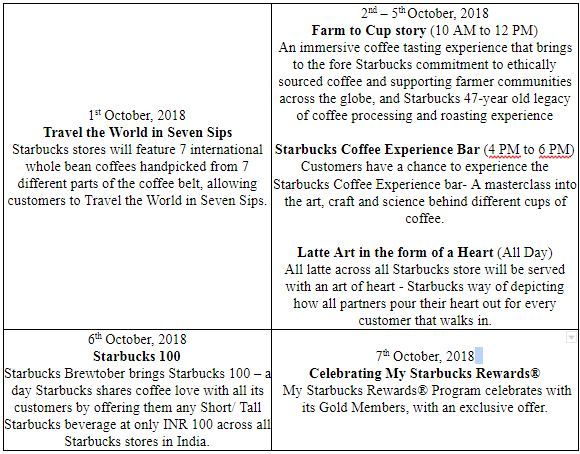
With the advent of this year’s International Coffee Day, Tata Starbucks is celebrating “Starbucks at 100” along with a line-up of week-long activities called Brewtober. Bringing to life the coffee heritage and inspiration through this initiative, the company is offering coffee lovers with a unique way of celebrating coffee, starting with various immersive coffee experiences to the big day of “Starbucks 100” — a day when the organisation shares coffee love with its customers by offering all its short/tall handcrafted beverages for Rs 100.
Veetika Deoras, who recently came on board as the CMO — marketing, category and digital at TATA Starbucks, is a seasoned Tata Administrative Services Officer with 16 years of experience in the Tata Group. At Starbucks, she oversees all related facets of the joint venture in India that focus on capturing relevant growth opportunities and ensure keeping customers at the heart of everything and delivering the authentic Starbucks Experience in India. Excerpts:
Q Share some customer experiences with Brewtober and also with the recently debuted Pumpkin spice latte?
Starbucks has a 47 year legacy of coffee sourcing, roasting and processing. To bring to life this coffee heritage and inspiration, Tata Starbucks has launched Starbucks Brewtober, which is a week-long celebration of our coffee and our customers which offers heavenly experiences and special promotions across all our stores in India.
The celebration is offering customers with authentic in-store experiences rooted in high-quality Arabica coffee. Our Starbucks stores will feature various international coffee blends, handpicked from seven different parts of the coffee belt, and offer to our customers coffee-forward experiences like Farm to Cup — an immersive coffee tasting exposure that brings forth the company’s commitment to ethically sourced coffee and supporting farmer communities across the globe and Starbucks Coffee Experience Bar — a master class into the art, craft and science behind different cups of coffee.
Through Starbucks Brewtober, we are both honoured and excited to share our love and passion for coffee with the customers. We look forward to welcoming them to our stores.
Pumpkin Spice Latte is an iconic beverage that is loved by customers all over the world and we are always delighted to bring this global seasonal classic beverage to our customers in India. Our partners have handcrafted the beverage to perfection. Featuring Starbucks espresso at the core and unique ingredient combinations, the beverage is a novel sensorial experience.
Q What are the various factors that the organisation keeps in mind every time a new promotion like Brewtober or a product is launched?
At Starbucks, innovation is always brewing. We take great pride in partnering with customers in their journey of coffee exploration. With our innovative products and experiences like Brewtober, we want to deliver our coffee passion and the highest quality coffeehouse experience to all our customers. We at Starbucks are focussed on innovating customer experiences, based on their feedback. We listen actively to our customers and work towards exceeding their expectations. For us every moment is one of connection and recognition.
Q What strategy does the company follow to attract customers? Is Brewtober aimed at increasing footfalls?
India is one of the most exciting markets in the world, with very diverse and dynamic customers. Since opening our first store in Mumbai in 2012, the way they have embraced the Starbucks experience humbles us, and makes us very optimistic for the long-term. We carry forth a rich legacy of coffee. Starbucks Brewtober, a week-long celebration of coffee, is a coming together of the spirit and legacy of the company where our customers can experience superlative coffee, warm partners and inviting stores. Brewtober is a reflection of the coffee heritage of Starbucks, as well as the coffee passion of our store partners and customers.
Q What is the future of the Tata Starbucks association in India? How has your association been with the company?
We are proud to be partnering with Tata, an organisation which shares our values, as we seek to build a socially responsible company that is creating rewarding careers for our partners and delivering a positive impact in the communities we serve.
Q What is the secret of the company’s sustainability?
Starbucks is known for the iconic third place experience, which is a composite of great coffee, warm partners and superior store ambience. It is passionate about delivering the highest quality coffeehouse experience to customers. The world-class service of our partners and their passion and commitment is what, I believe, truly sets us apart. Customers come for coffee, stay for the inviting warmth and return for the very human connection.
source: http://www.thestatesman.com / The Statesman / Home> Supplements> Evolve / by Ratikanta Dutta / October 06th, 2018
Single-origin coffee celebrates terroir. Some of the country’s brightest coffee experts explain the art of brewing drinks with unique flavours
Ashish D’Abreo, Co-Founder, The Flying Squirrel
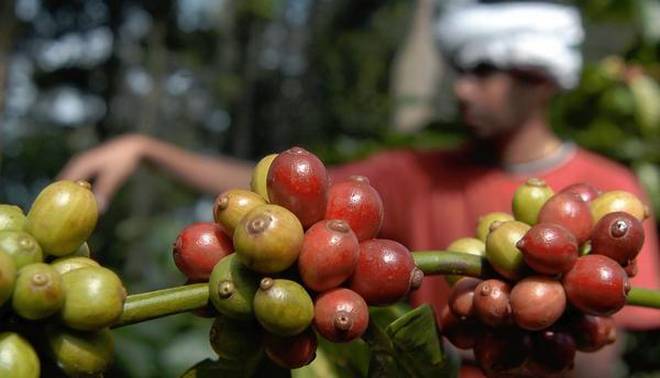
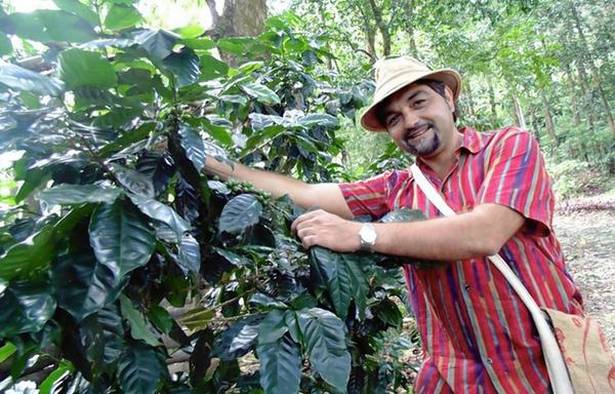
Single-origin coffee is completely dependent on the farmer. Which is why not all single-estate coffees taste good. The flavour of the end product depends on how well the crop is taken care of by the farmer; how much care is put into cultivating it, such as pruning the plants, picking the beans on time. This is what makes single-estate coffee different from commodity coffee, that’s a mix of coffee grown at various places. Coffee grown at various regions tastes different. For instance, coffee from high altitudes is sweet, whereas that from lower altitudes is low on sweetness. Coorg and Chikmagalur produce some of the best coffee in the country. My favourite single-estate coffee is obviously ours — my partner Tej (Thammaiah) is a third-generation farmer and really knows what he’s doing.
Marc Tormo Altimira, Founder, Marc’s Coffees
The Auroville-based coffee entrepreneur, Q Grader, roaster, brewer and creative consultant, says that single-origin coffee comes under ‘speciality’ coffee. “This term is used to describe coffee that is traceable to the farmer who grows it. He will place quality ahead of quantity and will produce the highest quality possible in his plantation. This is something unique and people will be willing to pay more for it. Speciality coffee is a way out for those who cannot compete in the commodity market where prices are subject to stock market rates. To produce it, the farmer needs an understanding and knowledge of drying, fermentation, and other techniques. I feel all regions in India produce world-class coffee — from Tamil Nadu, Kerala, to Karnataka and Andhra Pradesh.”
Sadhavi Ashwani, co-founder, Baba’s Beans
Single-origin coffee is different from single-estate coffee. Coffee from say, Coorg or Chikmagalur is single-origin, while that from one particular estate in these regions is termed as single-estate. It’s farming practices and the soil in which the coffee is grown that add personality to a coffee, ensuring that it is immaculate in the cup. In India, for instance, since we grow a lot of spices, our coffee naturally takes on nutty, chocolatey notes. Most of our country’s coffee is shade-grown; the cherries are hand-picked and wet-processed by passing them through gushing water; it is raised on hilly terrains under the shade provided by the silver oak. Pepper wines creep on the trees and this adds to the soil. At Baba’s Beans, we have a variety that’s grown under the shade of fig trees, so it ends up taking on fruity notes. Every single-estate coffee has a story; every cup has a unique flavour owing to the personality imparted by the soil, the plants that it is grown next to and that of the farming techniques.
Krittivas Dalmia, founder, Kaffa Cerrado
I don’t think single-estate coffee will ever replace regular, processed coffee. Neither is entirely replaceable. Coffee itself, as an industry, is still in the nascent stage, if you look at consumption in terms of percentage of population. Even among those who do drink coffee, the taste that they are used to, which includes chicory, is a very distinct one. So while there is an obvious difference in taste, flavour and aroma when it comes to single-estate coffee, the shift will take time. It has begun, though: in India, we seem to have skipped the stage of brewed coffee that is not single-estate (except outlets like CCD, which haven’t penetrated the local market that much), and moved directly to single-estate coffee. There can be ecological advantages to this, but it differs from estate to estate. Many estates are taking on bird-friendly or shade-grown practices, encouraged by the coffee board. It’s easier for the consumer to check which producers are following these practices and which aren’t. Plus, if you buy directly from the estate, the farmer gets the market price directly and middlemen are reduced to a large extent. You could count that as an advantage.
Compiled by Akila Kannadasan and Meghna Majumdar
source: http://www.thehindu.com / The Hindu / Home> Life & Style> Food / Octobe 05th, 2018
Crop grown in Kodagu, C’magaluru, Bababudangiri among 5 varieties being considered for the GI tag.
Soon, coffee grown in Kodagu, Chikkamagaluru and Bababudangiri will get geographical indication (GI) tag, said Srivatsa Krishna, CEO and secretary, Coffee Board, on Monday.
Speaking to reporters on the sidelines of ‘Naya Bharat: Coffee Par Soch,’ as part of International Coffee Day, he said that the Board had applied for GI tag for coffee grown in five southern regions, based on their uniqueness. Of these five places, three are from Karnataka. The list also comprises coffee grown in Araku valley (Andhra Pradesh) and Wayanad (Kerala). The GI tag is likely to come by January 2019.
This is the first time that GI tag has been applied for coffee-growing regions. In 2008, GI tag was obtained for Monsoon Malabar coffee blend. “The idea of doing this is to recognise the coffee, promote the brand and increase local sales. Over 70% of India’s coffee is grown in Karnataka, but the market needs to be strengthened,” he said.
To increase the production of coffee, regain the market position and encourage farmers, Mahatma Gandhi National Rural Employment Act funds will be helpful, Krishna said.
“I request the Coffee Board to tie up with zilla panchayats to recoup and expand the areas. Funds for coffee planters under MGNREGA will be given, on the lines of mulberry and sericulture,” he said. Krishna said the floods in Kodagu had an impact on coffee production, but things were improving.
On the occasion, the Board announced the launch of Atal Incubation Centre at Coffee Board in Bengaluru. This centre will help startups and coffee growers to become entrepreneurs. The centre is set up under the Atal Innovation Mission (AIM) to nurture innovative startup businesses.
So far, in India, 20 centres have been established, Coffee Board is the 21st and the first such in India, said R Ramanan, mission director, AIM. This centre is being set up in partnership with Nasscom and FKCCI.
The Coffee Board also announced its partnership with Ernst and Young for ‘The Future of Coffee-Roadmap’, and with National Institute of Public Finance and Policy for a study on subsidies for Coffee Industry.
source: http://www.deccanherald.com / Deccan Herald / Home> State> Top Karnataka Stories / by Bosky Khanna, DH News Service / October 01st, 2018
Coffee lovers in the city must be a happy lot. There many options in places to have a hot cuppa and newer varieties and blends are being discovered regularly.
Metrolife spoke to owners of some of the popular cafes in the city who brew their own coffee, farm to cup style.
The Flying Squirrel
Starting off as a purely coffee making business, owners Ashish Dabreo and Tej later decided to open a cafe in Koramangala a couple of years ago. They have an estate in Coorg.
The cafe offers about eight varieties of coffee. The bean and powder are also retailed online and at the cafe.
Ashish says, “We follow the artisanal method to create our coffee. Depending on the type of coffee we are using, the process also varies according.”
One of their products, Sunkissed Coffee, is made with pulped sundried robusta bean. “There are two ways in which you can roast coffee — you either remove the skin and pulp and then dry it, or leave some of the pulp when drying. We follow the latter for Sunkissed coffee. The bean is fermented and then left to dry for 12 days. In this case, the fruitiness in the pulp gets absorbed into the bean, giving the coffee a distinct flavour.”
Each of the varieties offered here goes through various experimentations like pulping, drying, smoking and roasting before it goes on the shelf.
“Sometimes, cross plantation with citrus and vanilla gives different outputs too. And when that’s done, the storing process also needs to be monitored so that we get the consistency required,” adds Ashish.
He says that they are able to experiment with each harvest as the city is open to newer blends.
Coffee Mechanics
Ganga Prabhakar, co-founder, explains that their motto is to educate coffee lovers about the varieties they offer.
“We have three estates in Srilakshmi, Bhadrapura and Kuttinkhan, each of which give us different outputs as they are micro-farmed in different soils. With the difference in elevation at which the beans are grown, the flavour differs too. Depending on the roasting technique, the shade changes from light roasted to darker,” she explains.
The more you roast it, the more caramelised it becomes. However, if almost burnt, it becomes ashy which ruins the taste. The lightly roasted ones give a tangier taste which the brewers call ‘acidity’. “The higher you roast, the lesser the acidity. And then it can become caramelised or chocolatey — depends on what you prefer.”
Third Wave Coffee Roasters
Unlike other brewers, Third Wave Coffee Roasters don’t have their own plantation. They get samples from various farms between the months of March to May which they use to roast, cup and sample before they decide which coffee they want to buy for the year.
Co-founder Ayush Bathwal says, “Most of our coffees come from Yercaud and Kerala. We work with single origin farms so that we can maintain the authenticity of the beans available. We mix the beans only if we are experimenting with certain blends.” So how does their blending and brewing process work? “We buy close to 1,000 kg of green beans which we roast according to need. Once roasted, we store them in airtight containers. Each blend last two to four weeks.
They follow the Specialty Coffee Association of America meter. They finalise the product only if the bean scores more than 80 points.
source: http://www.deccanherald.com / Deccan Herald / Home> Metrolife> Metrolife on the Move / by Anila Kurien, DH News Service, Bengaluru / September 30th, 2018
Coffee cupping, exhibition of coffee berries to be held.
The Coffee Board of India, in association with Way Win, a farmer-producer company in the coffee sector in Wayanad, and Vikaspaedia, an initiative of the Union Ministry of Electronics and Information Technology, is organising various programmes to mark International Coffee Day on October 1.
Ports Minister Kadannappally Ramachandran will inaugurate the programme at the Town Hall here at 10 a.m. on the day.
Coffee Board Deputy director (Research) Vijayalakshmi will deliver the keynote address on the occasion.
Coffee cupping, a practice of observing the tastes and aromas of different brewed coffee varieties, would be the major attraction of the programme, organisers said in a release here on Thursday.
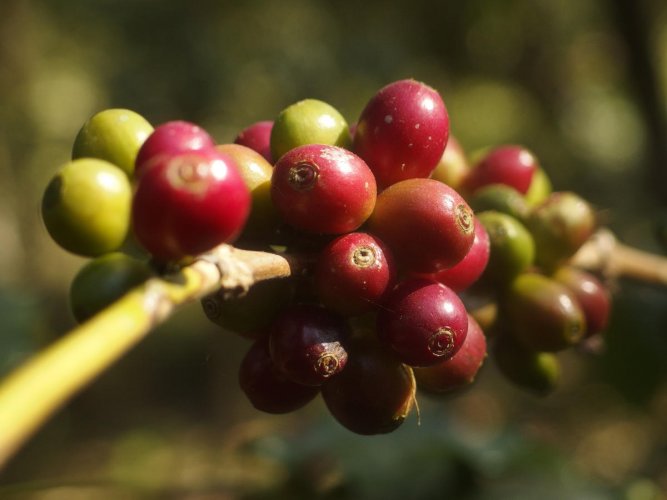
Exhibition of various types of coffee berries will also be held.
source: http://www.thehindu.com / The Hindu / Home> National> Kerala / by Staff Reporter / Kalpetta – September 28th, 2018
Ties up with National Institute of Public Finance and Policy for study on impact of subsidies on industry
Bengaluru :
The Coffee Board is to celebrate International Coffee Day on October 1 with a slew of partnerships. The board has roped in consulting firm Ernst & Young to prepare a strategy – “The Future of Coffee-Road Map”.
The National Institute of Public Finance and Policy will conduct a ‘Study of subsidies on coffee Industry’. Finally, the board plans to open 150 incubation centres under the Niti Aayog’s Atal Innovation Mission.
According to a senior board official, Ernst & Young would outline a strategy to improve the overall coffee sector performance across the value chain, from production to consumption, by analysing production challenges and proposing need-based interventions to strengthen small coffee growers, proposing a strategy for effective positioning of Indian coffee in the global and domestic markets, and technological interventions to overcome identified challenges.
The study would include assessment of production level challenges, value chain analysis, effective positioning of Indian coffee and drawing up a conceptual framework with technological interventions.
Impact of subsidies on coffee industry
The National Institute of Public Finance and Policy is to help in assessing the impact of various subsidies extended by the Coffee Board to farmers and exporters. The assessment report would consider how far the government incentive schemes have helped the overall coffee sector, in terms of both production as well as productivity, with suggestions on policy-level interventions required to help scale up overall coffee production as well as exports.
The key topic areas would include assessing the extent of outlay provided to implement ICDP, examining the impact of incentive schemes on production, productivity and quality of coffee, understanding implementation issues at the ground level and providing inputs to the government with regard to continuation of existing schemes as well as identifying the relevant incentive mechanism for the grow of the sector.
Atal Innovation Mission
The Centre has set up the Atal Innovation Mission (AIM) in the NITI Aayog to promote a culture of innovation and entrepreneurship in India. Towards creating world-class incubation facilities across various parts of India with suitable physical infrastructure in terms of capital equipment and operating facilities, coupled with the availability of sectoral experts for mentoring the start-ups, business planning support, access to seed capital, industry partners, training and other relevant components required for encouraging innovative start-ups, AIM is supporting the establishment of Atal Incubation Centres (AICs) that would nurture innovative start-up businesses in their pursuit to become scalable and sustainable enterprises.
For this, the AIC-CCRI Foundation for Entrepreneurship Development is being established at the Coffee Board’s head office in Bengaluru. The incubator, spread over an area of 10,000 square feet, would possess world-class infrastructure to provide space, product development laboratories, meeting rooms, auditoriums and contemporary IT infrastructure to incubatees.
The incubator would be supported by teams of national and international mentors to provide mentoring services to incubatees. Besides supporting the incubatees in Bengaluru, the AIC would also support virtual incubates through a network of partner institutions located across the country. The incubator would offer pre-incubation as well as accelerator services for coffee and agri-based start-ups. It is expected that AIC-CCRI Foundation for Entrepreneurship Development would result in the establishment of at least 150 innovative scalable businesses in the coffee and agribusiness sector in the next five years. This would contribute to growth in domestic demand for coffee and the overall development of the Indian coffee sector.
source: http://www.thehindubusinessline.com / Business Line / Home / by Anil Urs / September 28th, 2018
Tata Starbucks in India is taking its coffee heritage and inspiration to celebrate International Coffee Week this year with coffee-forward experiences and special promotions across its stores.
Recognised in delivering consistent, authentic in-store experiences, rooted in high-quality Arabica coffee, Tata Starbucks is celebrating the art of coffee from heritage to brewed innovation over a seven-day celebration titled ‘Starbucks Brewtober’, beginning October 1.
To celebrate coffee, Starbucks stores, which bring to life the Third Place experience, will feature seven international whole bean coffees handpicked from seven different parts of the coffee belt, allowing customers to ‘Travel the World in Seven Sips’ this International Coffee Day- October 1.
Other experiential activities during the week include ‘Farm to Cup’ story – an immersive coffee tasting experience that brings to the fore Starbucks’ commitment to ethically sourced coffee and its 47-year old legacy of coffee processing and roasting; ‘Starbucks Coffee Experience Bar’- a masterclass into the art, craft and science behind different cups of coffee and ‘Latte Art’ – a showcase of the craft of Starbucks partners.
On October 6, Starbucks Brewtober brings ‘Starbucks 100’ – a day Starbucks shares coffee love with all its customers by offering them any short/ tall Starbucks beverage at only Rs 100 across all its stores in India.
Continuing with the celebrations, Starbucks is also offering My Starbucks Rewards Gold Members an exclusive offer on October 7.
“At Starbucks ,we take great pride and joy in partnering with customers on their journey of coffee exploration and are committed to delivering an unparalleled coffee experience. With ‘Starbucks Brewtober’, Tata Starbucks commemorates coffee with a week-long celebration. ‘Starbucks Brewtober’ offers coffee lovers a unique way of celebrating coffee, starting with various immersive coffee experiences to the big day of ‘Starbucks 100’ – a day when Starbucks shares coffee love with its customers by offering all its short/ tall handcrafted beverages for only Rs 100,” said Veetika Deoras, Head – Marketing, Category, Digital and Loyalty at Tata Starbucks Limited.
“We hope to celebrate coffee and the spirit of Starbucks through the week and look forward to welcoming our customers in our stores,” she added.
International Coffee Week will be celebrated across all Starbucks stores in India from October 1 to 7, 2018.
SOURCE: ANI
source: http://www.siasat.com / The Siasat Daily / Home / by Syed Qayam Ali / September 26th, 2018
With donors from across the state contributing to CM’s Relief Fund, exclusively released to Kodagu district, over Rs 62 crore has been collected as on September 20.
Madikeri :
Following the natural disaster in Kodagu district, the numerous families that had lost houses and other properties were handed over Rs 3,800 – Rs 1,800 for clothing and Rs 2,000 for utensils and other household goods (per family)- under SDRF/NDRF guidelines.
Since the damage has been severe and the process of permanent rehabilitation will take some more time, the district administration including Deputy Commissioner Sreevidya P I and Kodagu District Minister Sa Ra Mahesh had proposed a request to the State government to increase the amount from meagre Rs 3,800/- per family to Rs 50,000, in a letter dated 28 August.
While the State and National Disaster Fund guidelines do not allow any changes to be made to the gratuitous funds, the state revenue department had stepped into people’s aid and had forwarded the proposal of releasing Rs 50,000/- each for the distressed families from the Karnataka Chief Minister Relief Fund-Natural Calamity 2018. The proposal, which was forwarded to CM H D Kumaraswamy was later forwarded to the Cabinet Committee for approval, which has now been sanctioned.
With donors from across the state contributing to CM’s Relief Fund, exclusively released to Kodagu district, over Rs 62 crore has been collected as on September 20. As many as 1,156 families have been directly affected by natural disaster and 186 houses have been damaged completely, 530 houses have been damaged severely and 404 houses have undergone partial damage.
While Rs 320 crore has been allotted to Karnataka under SDRF, an additional state fund of Rs 400 crore is provided to the state.
source: http://www.newindianexpress.com / The New Indian Express / Home> States> Karnataka / by Express News Service / September 22nd, 2018
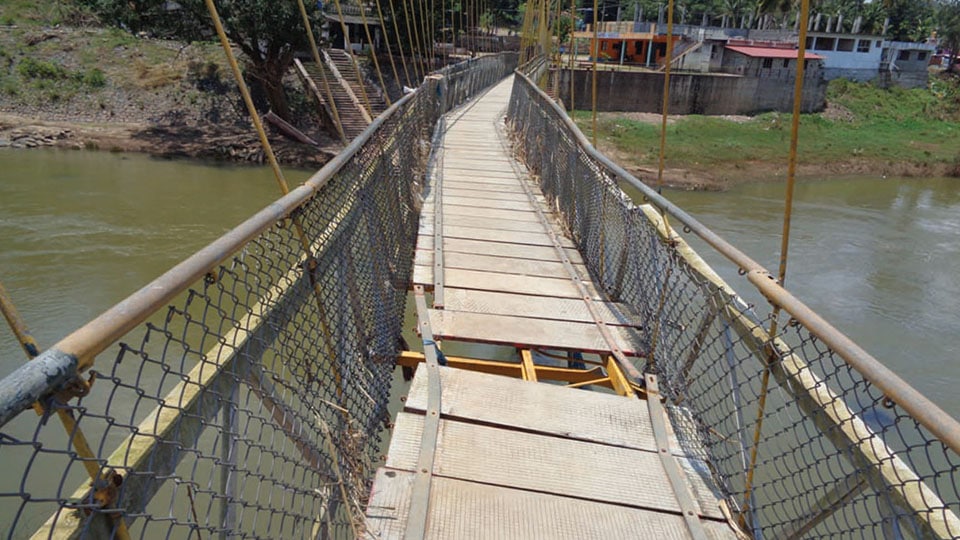
The hanging bride built across Cauvery River near Sri Ramalingeshwara Temple at Kanive close to Kushalnagar in Somwarpet taluk of Kodagu District has been severely damaged by recent floods that devastated Kodagu.
The hanging bridge connects villages along the border between Kodagu and Mysuru Districts. It also acted as a bond between villagers. The bridge with its unique nature, also attracted thousands of tourists. But heavy rains resulting in the flooding of Cauvery and Harangi Rivers, has caused huge damages to the bridge, which is on the verge of collapsing.
The Steel-Suspension Bridge supported by piers on both the banks of the river, has been so devastated by floods, that even pedestrians too are scared to walk on this bridge.
The steel rods that hold the bridge have broken and the wooden planks meant for pedestrian commute, have come apart. Thousands of people who depended on this bridge for their daily commute to work, are now scared about their future, with the bridge no longer safe for commuting.
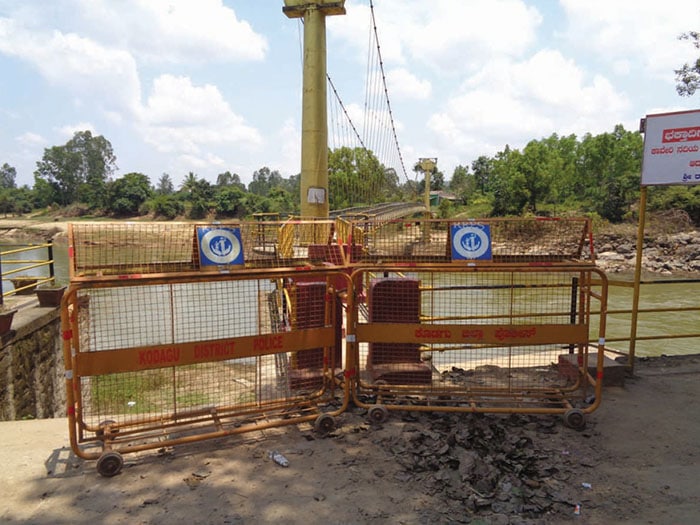
Entry to the bridge has been banned by the Police.
This hanging bridge was built eight years ago at a cost of Rs. 45 lakh, funded by Malnad Area Development Board (MADB), Shivamogga. Sullai’s renowned suspension bridge expert Girish and his team constructed the bridge using the latest technology. The bridge had been the dream of thousands of people living in villages along Kodagu’s border with Mysuru District. The bridge connects many villages of Periyapatna taluk in Mysuru District, including Dodda Kammanahalli, Shanubhoganahalli, Dindigadu, Muttina Mulluroge, Kanagalu, Hanumanthapura and Karadi Lakkanakere with Kodagu villages such as Kanive, Bhuvanagiri, Huluse, Hakke, Kudige, Mararu and Hebbale. Before the construction of this hanging bridges, the villagers had to cross the river on boats and on the dangerous bridge along the aqueduct built at a height of over 50ft. This dangerous and risky bridge was a bane to hundreds of students and labourers who used to commute daily. The authorities taking note of the daily hardship of the people, built this bridge at Kanive.
As flooding waters submerged this bridge and caused considerable damage to it, pedestrian movement on the bridge has been banned. The Police have erected barricades across the bridge. With the closure of his hanging bridge, villagers along the border are forced to take a detour of about 20kms via Avarti to reach Kushalnagar and other places.
With the recent floods weakening the bridge, the villagers have urged the Kodagu District Administration to repair this bridge at the earliest and throw it open once again for the benefit of villagers, who consider this bridge as a very important part of their life.
Unfortunately, for the people who depended on the bridge, the District Administration has not yet announced any funds to repair the bridge.
The bridge is crucial for the devotees to go to the historic Ramalingeshwara Temple and as the bridge is unsafe now, many people are robbed off the opportunity to go to the temple, said Bharadhwaj K. Anandatheertha, a writer from Kanive.
source: http://www.starofmysore.com / Star of Mysore / Home> News /
September 16th, 2018
WELCOME. If you like what you see "SUBSCRIBE via EMAIL" to receive FREE regular UPDATES.
Read More »