Category Archives: Business & Economy

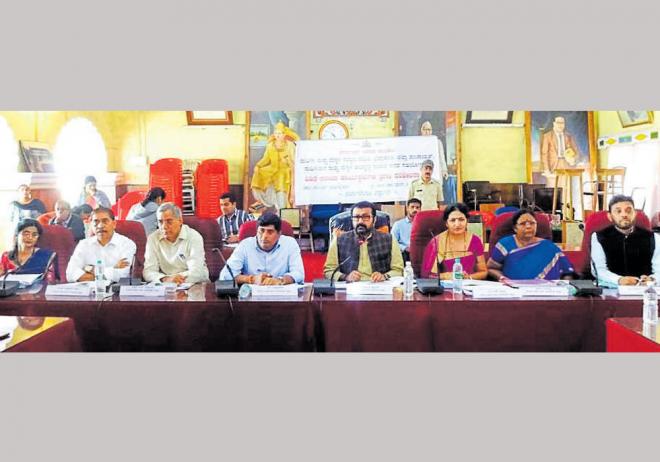
Dakshina Kannada, Kodagu district Congress meet on July 7

A convention of the elected members from Congress party from Dakshina Kannada and Kodagu districts will be held at Adyar Grounds in Mangaluru on July 7.

B. Ramanath Rai, Minister in-charge of the district, told reporters here on Monday that Chief Minister Siddaramaiah and AICC General Secretary K.C. Venugopal will participate in the convention.

Mr. Rai said elected members and those who were defeated in the elections will be called to the convention organised to work out ways to win all the legislative assembly seats in the two districts. Following the election of C. Harish Kumar as president of Dakshina Kannada Pradesh Congress Committee, Mr. Rai said there will be changes in the block level of the party in the district and have activists who will work 24×7 for the party in the coming months.

In a ceremony held later, Mr. Kumar took charge of his new post.

source: http://www.thehindu.com / The Hindu / Home> News> States> Karnataka / by Special Correspondent / Mangaluru – July 03rd, 2017

Environmentalists join hands to save Kodagu

Bengaluru :

A group of environmentalists and activists has come together to try and change the present narrative of development so that Kodagu doesn’t fall prey to unchecked expansion and urbanization.

During their meeting, the activists agreed to come up with an action plan to safeguard Cauvery’s catchment area in Kodagu and prevent upcoming railway and highway projects from harming the environment.

Citing the felling of 54,000 trees for the MysoreKozhikode power line via Kodagu, Devika Devaiah, from Save River Cauvery, said such situations shouldn’t be allowed to happen again. Colonel C P Muthanna, president of Coorg Wildlife Society, pointed out that the main stakeholders are not only the inhabitants of Kodagu, but also those living downstream including the residents of Bengaluru, who will be severely affected by water shortage and deforestation. Naresh Narasimhan of Citizens for Bengaluru (CfB) said sustainable models of tourism should be introduced in the region. “Development has started to mean destruction. Every project is seen as a way to make money. The reason we were successful in bringing a halt to the steel flyover pro ject was because we pointed out how procedures were bypassed,” he said.

Prakash Belawadi, also from CfB, said categorization of the Cauvery Basin and Talacauvery as world heritage sites would help in their preservation. “We should not let the region get exploited and allow more treecutting. International attention is required to safeguard it. Petitioning the National Green Tribunal would be a good move to get legal backing,” he said.

The group also discussed protection of endangered animal species, prevention of unruly urbanization due to transportation projects and acting against commercial lobbies with vested interests.

source: http://www.timesofindia.indiatimes.com / The Times of India / Home> News> City News> Bangalore News / by Arpita Raj / TNN / July 02nd, 2017

Forest dept files case against Cesc for elephant deaths

Four elephants were electricuted in an estate in Kodagu.

Following the electrocution of four elephants at an estate in Kodagu on Tuesday, the Forest department has filed a case of abetment and hunting against Chamundeshwari Electricity Corporation Limited (Cesc).

This is the second such case filed against the power supply corporation this year. This time the Forest department has filed a case after four female elephants came in contact with a snapped high tension live wire at Ammathi Vontiangadi village in Virajpet, Kodagu and died on the spot on Tuesday.

Manoj Kumar, Chief Conservator of Forests, Kodagu Circle, told DH that the case was filed against Cesc and not the estate owner as the deaths were not because of his negligence. A vigilance committee has also been formed to investigate the case. The committee will file a report detailing the causes and practical remedies.

During an interaction with Ravi Kumar, additional chief secretary, Environment, Forest and Ecology, in Kodagu on Wednesday, the Energy department showed interest in joining hands with the Forest department to shift all the existing and new cables under ground.

“Shifting of cables will cost around Rs 3,000 crore. Instead, the department can spend Rs 200 crore on strengthening and enhancing forest areas and corridors. Following the high court orders, the power supply companies have invested crores of rupees in erecting 22,000 poles to ensure that cables are not hanging, posing threat to the elephants. But this has shown limited effect,” Kumar said.

Meanwhile, the Forest department has intensified the search for land around the forest patches and near the elephant corridors to purchase them and increase the forest patch. A senior Forest department official said that since the estate owners are also worried, getting land with the funds assured by the state government will be easy and quick.

“We have also started training estate owners and workers on how to react when confronted with an elephant. Erecting more fences will only aggravate the problem. There is a need for people to understand the problem. The department has spent around Rs 1 crore towards crop loss compensation in last one year. The number of conflict cases have also increased. Due to drought over the last two years, some estate owners have extended their support in helping us resolve man-elephant conflict,” Kumar added.

WhatsApp group formed

For the first time, the Forest and Energy departments together have created a WhatsApp group for Kodagu division. They have brought all the ground staff of both the departments together to give quick ground information and provide timely help.

source: http://www.deccanherald.com / Deccan Herald / Home> State / by Bosky Khanna / DH News Sercive, Bengaluru / June 30th, 2017

Krishi Bhagya to benefit Kodagu farmers from this year

Decline in rainfall forces govt to extend scheme to Malnad.

The Krishi Bhagya scheme, introduced by the state government to help farmers, has been extended to Malnad, hilly areas and coastal districts.

Accordingly, the scheme will be introduced in Kodagu in the current year. The scheme was implemented in 2014-15 to help farmers cultivate dry land, mainly due to vagaries of monsoon and was restricted to 23 districts and 107 taluks.

The farming activities in district, however, had taken a set back the last few years with deficit rain. There has been decline in rainfall over the years in Kushalnagar, Somwa­rpet, Shanthalli, Shanivarasanthe and Kodlipete region.

“Although the district has the Harangi reservoir, it has covered only 2,000 hectare farm land. About 400 hectare land was irrigated through the Chiklihole dam. The government introduced the scheme aimed at harvesting rainwater to protect crop during a crucial time through farm ponds. It also supports horticulture crops, mixed cropping and dairy farming” Agriculture Department joint director K Ramappa told DH.

“Financial assistance will be provided for digging farm ponds, subsidy for diesel or solar pump sets. In the scheme, around 90% subsidy was given to Scheduled Castes and Scheduled Tribes beneficiaries and 80% to the general category beneficiaries, 50% subsidy for a polyhouse,” he added.

“The application forms are available at the offices of the joint director and the assistant agriculture officer and the Raitha Samparka Kendra. The target in the district is to dig 300 farm ponds,” said Ramappa.

source: http://www.deccanherald.com / Deccan Herald / Home> District / by Aditya K A / DH News Service / Madikeri – June 21st, 2017

Congress celebrates farmer’s loan waiver in Madikeri

Madikeri :

Jubilant Congress supporters celebrated the loan waiver scheme announced by CM Siddaramaiah to distressed farmers in the city.

Napoklu block congress President B S Ramanath led the procession with former President Naramonda Umesh, state forest development board vice President Padmini Ponappa also attended.

Chanting pro-government slogans, the procession passed through private bus stand and through main roads of the city. Sweets also distributed to public.

By waiving farmer’s loans the Congress government shows that its policies are pro farmer and urged Central Government to step in to waive loans from nationalised bank, as the UPA government done during former PM Manmohan tenure.

Speaking to reporters, district congress labour union president V P Shashidar said, by announcing farmer loan waiver up to 50,000 rupees, the state government came to the rescue of poor farmers who are debt ridden.

Former district president KK Manjunath while speaking on the occasion said, the Congress government policies are always pro poor and farmer loan waiver is an another bold step, opined the leader.

-(KCI,NAV)

source: http://www.citytoday.news / CityToday / Home> Headlines> Prime News – Karnataka / by CT Bureau / Madikeri – June 28th, 2017

CFO of audiology practice named business woman of the year

Albuquerque, NM :

The Professional Business Women-Albuquerque chapter has selected an executive of a hearing care practice as “Albuquerque Business Woman of the Year.” Honored was Naina Ballachanda, chief financial officer of Premier Hearing Center, which serves thousands of patients with hearing loss from five locations New Mexico, Arizona, and Texas.

In the award citation, Ballachanda was described as a “strong female leader [who] leaves an outstanding impression on people.”

The honoree is married to Bopanna Ballachanda, PhD, CEO and director of audiology at Premier Hearing Center, who was formerly on the faculty at Purdue University and the University of New Mexico.

source: http://www.hearinghealthmatters.org / Hearing Health & Technology Matters / by David Kirkwood / November 12th, 2011

New wage structure for plantation workers

Agreement signed revising salary and service conditions of plantation workers

The Estate Staff Union of South India (ESUSI) has signed a bilateral agreement with the United Planters’ Association of Southern India (UPASI) recently at Coonoor, revising salary and service conditions of staff working in the plantations of Karnataka, Tamil Nadu and Kerala for three years from January 1, 2017.

The revised salaries will ensure that workers will obtain a 23.5 % increase in their salary and this was the 20th wage revision settlement with UPASI, with the first being in 1947, a press release from ESUSI read.

“The DA is revised to Rs. 32 per point from Rs. 28. The pay scale is revised, a probationer will get Rs. 10,750 as starting salary, [revised] from Rs. 7,300.

The daily bata is revised for half day to Rs. 200 from Rs. 100, for full day Rs. 500 from Rs. 200 and for full day involving night stay Rs. 1,200 from Rs. 500. Leave Travelling Concession from Rs. 1,750 to Rs. 2,500, and Rs. 2,000 to Rs. 3,000 while annual travelling allowance will increase to Rs. 5 from Rs. 2,” the press release read.

The agreement was signed by D Vinodh Sivappa, President of UPASI, TT Jeyaram, Vice President of UPASI, Ullas Menon, Secretary General of UPASI and eight management persons representing Association of Kerala, Karnataka Planters’ Association and Planters Association of Tamil Nadu which are constituents of UPASI.

source: http://www.thehindu.com / The Hindu / Home> National> Tamil Nadu / by Staff Reporter / Udhagamandalam – June 27th, 2017

Coffee growers present wish list to Union Minister

Union Minister of State for Commerce and Industry Nirmala Sitharaman inaugurating a public meeting at Mudigere in Chikkamagaluru district on Thursday.

Demands include support to coffee cultivation and checking elephant menace

Union Minister of State for Commerce and Industry Nirmala Sitharaman interacted with coffee growers at Mudigere on Thursday. The growers placed a number of demands before her, including finding a permanent solution to the elephant menace.

Representatives of Karnataka Growers’ Federation, Black Gold League and other organisations participated in the interaction.

B.L. Shankar, coffee planter and former MP, said the production of Arabica coffee had been declining every year. He wanted the government to take steps to support Arabica cultivation.

“Coffee cultivation has been hit by many problems; there is also shortage of workers,” he said.

Lok Sabha member Shobha Karandlaje stressed the need for research to address the stem borer attack, which had been causing huge losses to the growers.

C.T. Ravi, Chikkamagaluru MLA, wanted an ESI hospital in Chikkamagaluru, as there were a large number of workers in the plantations. Black Gold League president Kenjige Keshava appealed to the Minister to set up a spices park in Chikkamagaluru.

Interest waiver

Representatives of Karnataka Growers’ Federation sought waiver of interest on coffee loans and also five instalments to repay the dues.

B.S. Jairam, chairman of the federation, told The Hindu: “We submitted a memorandum listing all our demands. We have sought waiver of interest and bringing down interest on loans. We have also urged the government to take measures to check elephant menace in Hassan, Chikkamagaluru and Kodagu districts.”

Ms. Sitharaman said the government would take steps to increase coffee production and expand its market overseas.

“Growers in Andhra Pradesh, who began coffee cultivation only a few years ago, have succeeded in marketing it in America. If they could do, why can’t the growers in Hassan, Kodagu and Chikkamagaluru do?” she asked. The government was committed to encouraging coffee growers. After many years, and for the first time, a coffee planter had been appointed chairman of the Coffee Board. This showed the government’s commitment to supporting coffee cultivation, she added.

Coffee Board chairman M.S. Boje Gowda was present during the interaction.

source: http://www.thehindu.com / The Hindu / Home> News> States / by Special Correspondent / Chikkamagaluru – June 16th, 2017

How wildlife-friendly is your brew?

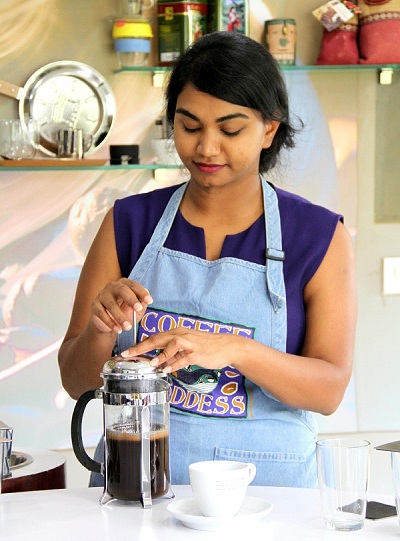
WildKaapi01KF03jun2017 Wild Kaapi, your morning coffee comes from certified estates that support gaurs, elephants and monkeys, along with Arabica beans

Under the cool canopy of native trees in the Western Ghats, coffee bushes spread out, gleaming with red berries. In the early morning hours, if you are lucky, you may spot rare species like the Malabar grey hornbill, water snow flat butterfly or the Asian fairy bluebird among these shade-loving plants. And now, thanks to the efforts of Wild Kaapi — the world’s first ‘certified wildlife-friendly’ coffee brand — you can ensure your morning brew comes from plantations that foster fauna on their lands. Started by wildlife conservationist, Krithi K Karanth — who has has been working in the Western Ghats, a biodiversity hotspot, for the last 19 years — and her husband, Avinash Sosale, the coffee brand got its certification this April and opened its doors to buyers last month.

(photo credit: Ramki Sreenivasan)

Live and let live

Wild Kaapi started as an offshoot of a three-year research project (part of a grant by the National Science Foundation to study coffee, areca and rubber plantations in the Western Ghats). Karanth, of the Centre for Wildlife Studies — with Paul Robbins of the University of Wisconsin-Madison and Dr Ashwini Chhatre of University of Illinois — measured biodiversity, and studied labour practices and market dynamics of the farming areas.

During the project, she interacted with over 1,000 planters in the three coffee growing areas of Karnataka — Kodagu, Chikmagalur, and Hassan — and realised how frustrated they were “because they weren’t getting value for their coffee due to the middlemen involved”. That’s when the idea for Wild Kaapi originated, and the duo is now exploring new ways to get a premium price for products that support wildlife. “This includes social enterprises that can contribute to conservation action. (After all) traditional wildlife conservation relies heavily on donors,” says Sosale, who quit a career in automotive business to be a part of the venture. “At this stage we have two commitments: we have told coffee growers we will pay them the highest price, and, with the profit we generate, we will build a conservation fund to award grants to young conservationists,” he adds.

WildKaapi03KF03jun2017

Animal tales

Millennials are more discerning towards coffee, observes Sosale. “Today’s consumer is informed. Ethical and conscious consumption is what we want to tap into.” To qualify for certification, the coffee not only had to have a good cupping (tasting) score, but the plantation had to support a vast biodiversity. Of the more than 187 farms they audited (recording the species of birds, butterflies, mammals, amphibians and trees), only four made the cut: Agora (with 124 species), Bindiga (137), Hulikere (119) and Cornerstone (120). Wild Kaapi has named their single-origin Arabicas after the plantations they are sourced from.

WildKaapi04KF03jun2017

Shreedev Hulikere, a third-generation coffee grower with 60 acres in Chikmagalur, who is partnering with Wild Kaapi, says he wasn’t aware of the numerous wildlife species on their estate till now. “While my ancestors traditionally hunted, I’m a conservationist. I tell my labourers not to destroy any bird nests. I know that barbets nest here and they eat the borer worms that destroy coffee. Similarly, I’m not going to chase away the monkeys and civets that eat my coffee because I’m being compensated elsewhere. Just because a porcupine destroys a pepper creeper, I’m not going to hunt it down,” he says.

Love thy neighbour

The audit also revealed a few surprises. “We found frogs listed as endangered or threatened in the IUCN Red List (the world’s most comprehensive inventory of global conservation status) at these plantations,” says Karanth. The certification not only places their coffee in a premium space, but also paves the way for a new movement. “If you have wildlife-friendly practices, you can promote sustainable agriculture. We are trying to establish a new model — a profitable enterprise that also enables better livelihoods. This hasn’t been tried before; it’s a new way of thinking,” says Karanth.

(photo credit: Ramki Sreenivasan)

While their immediate goal is to prove that such a model is sustainable, Sosale is also mulling introducing coffee scrubs, soaps, candles and flavourings — all huge product lines in the international space. Moving into pepper and cardamom, which grow hand-in-hand with coffee, also holds much promise.

Prices start at ₹390 for 250 gms.

To know more, and buy the coffee, check out wildkaapi.com.

source: http://www.thehindu.com / The Hindu / Home> Life & Style> Homes and Gardens / by Bhumika K / June 02nd, 2017

Boosting domestic offtake is the key: new chief of Coffee Board

Coffee Board chairman M S Boje Gowda, at a function in Bengaluru on Wednesday. Somashekar GRN

Boje Gowda rues India’s low 200-g consumption compared to 7-8 kg in the West

Bengaluru :

Boosting domestic consumption is crucial to protecting the interests of coffee growers, according to MS Boje Gowda, the newly-appointed coffee Board Chairman.

After 70 years, the Coffee Board has a grower as its chief in Boje Gowda, who is third generation planter. Till recently, bureaucrats headed the apex decision-making body for the coffee sector, under the Ministry of Commerce.

Gowda, of Krishnagiri Estate in Chikmagalur, takes over at a time when growers are grappling with volatile prices, fluctuating output that’s largely being influenced by a changing climatic pattern on account of erratic rainfall, and pest issues such as the white stem borer.

Addressing growers after assuming office, Gowda said the annual per capita coffee consumption in India is not even 200 grams, while in the western world it is 7-8 kg, thereby leaving tremendous scope to boost the domestic offtake. He said there was a need to boost consumption beyond the traditional consuming States of Karnataka, Tamil Nadu, Andhra Pradesh and Kerala. “It would become a difficult situation for the growers unless the domestic consumption expands,” he said.

Gowda, a large planter, said Prime Minister Narendra Modi has set a target of doubling coffee output from the current 3 lakh tonnes to 6 lakh tonnes. India consumes merely a third of the coffee produced in the country as over two-thirds of the output is exported, mainly to Europe and Russia.

Karnataka, the main growing region that accounts for about two-thirds of the country’s coffee output, has been reeling under a drought for the past three years. Gowda said he would focus on improving the water storage facilities and take up the growers’demand for higher subsidy for increasing the coverage of drip irrigation.

Coffee growers gets only 25 per cent subsidy on the equipment cost for taking up drip irrigation, while for other plantation products such as rubber and cardamom, the subsidy component is around 80 per cent, Gowda said.

Drones to forecast crop
Addressing growers, Coffee Board Secretary Srivatsa Krishna said the body was exploring the option of using drones for better crop forecasting. Krishna said the current crop estimation was not right and the Board was looking at ways to improve the crop estimate. The Board has been in talks with 7-8 start-ups on deployment of drones for improving the accuracy of crop forecast.

Krishna said the Board is also working on creating water harvesting solutions and is exploring options such as cloud seeding. On the issue of white stem borer, a pest that attacks plants of arabica coffee, Krishna said the board has reached out to biotech firms to evolve a solution and that pilots are being carried out in some plantations.

Highlighting the importance of branding, Krishna said the growers should come out with region-specific brands such as Chikmagalur and Mysuru.

source: http://www.thehindubusinessline.com / Business Line / Home> Agri Business / by The Hindu Business Line Bureau / Bengaluru – May 17th, 2017