Category Archives: Business & Economy

Army recruitment rally in Madikeri to be held from May 29 to June 2

Army recruitment rally will be held at the district stadium here from May 29 to June 2.
Addressing media here on Wednesday, Col Jaideep Sharma of recruitment division (Karnataka and Kerala), said, the rally is open for the eligible candidates from Kodagu, Mandya, Mysuru, Chamarajanagar, Hassan, Bengaluru Urban and Rural districts, Kolar, Tumakuru, Ramanagaram, Chikkaballapur, Ballari and Chitradurga districts. Those in the age-group of 17 years and six months and 23 years are eligible to take part.

During the rally, the candidates will be considered for the posts of soldier general duty, steno, storehouse keeper technical, soldier technical, attender, assistant, tradesman (dresser, decorator, steward and carpenter).Inerested candidates may enrol their names on www.joinindianarmy.nic.in and download the ID card 10 days ahead of the rally. The enrolment has started from March 30.

Explaining about the recruitment procedure, Sharma said, in the initial stage physical tests will be conducted where the candidates have to run a distance of 1,600 metres. It will be followed by pull-ups, medical examination. The doctors from Bengaluru will examine the candidates for any medical disorders. If the experts rule out any problems, the candidates will be allowed to take written exams to be conducted on the last Sunday in the month of July and August.

The candidates, belonging to the family of ex-servicemen and serving personnel, should submit a certificate that they had not obtained any facilities during recruitment rallies conducted in the past. The candidates from NCC background will get bonus marks during the written exams. No cellphones and wrist watches are allowed during exams. Food and water should not be taken inside the hall.

Those having natural moles below knee will be considered for the rally. The candidates wi-th tatoos on any part of the body are not allowed. The recruitment process will be conducted in a transparent manner.

In-charge Deputy Commissioner Charulata Somal,  Department of Sainik Welfare and Re-settlement Joint Director Geetha M Shetty were present.

source: http://www.deccanherald.com / Deccan Herald / Home> District / Madikeri – DHNS, April 06th, 2017

Coffee’s humble roots in India – Planting of the very first seeds

CoffeeKF30mar2017

Famous for its coffee plantations, South India didn’t grow the crop naturally. Now a major producer with several hill tracts growing unique flavours of coffee, it is where the story begins… well, not exactly.

The southern Indian state of Karnataka is strewn with coffee plantations. The state is, in fact, one of the major producers of coffee in India. ‘Arabica’ and ‘Robusta’ are the kinds of coffee that are grown here under methods which are unique to this part of the country, rather, to the world.

The coffee here is grown under the shade of tress and is often inter-cropped with spices like cardamom, cinnamon, nutmeg and clove, giving it a unique flavour and aroma.

Interestingly, growth of coffee here is so dense that it might come across as shocking when someone tells you that it all started with the seeding of mere seven coffee beans, which were smuggled to the hills of Karnataka.

The story that goes around in the coffee plantations down south is that an Indian saint, named Baba Budan, once went on a pilgrimage to Mecca and from there to Mocha – a port city in Yemen and a major coffee hub.

It was here, in the 18th century, that Baba Budan first discovered coffee, when he tasted it in form of a dark and sweet liquid called Qahwa. It is said that he found the drink so refreshing that despite it being a protected Arabic beverage and industry, he sneaked out seven coffee beans by strapping them to his chest and brought them to India.

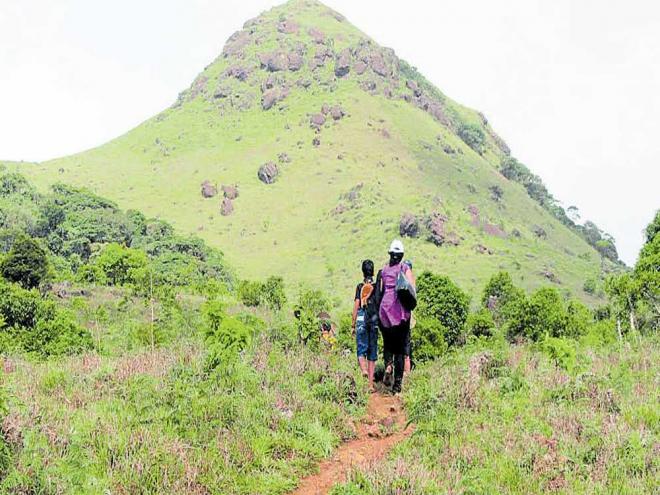
The Baba Budan Hills in Karnataka

These seven beans, Baba Budan planted in the courtyard of his home, in Chikmagalur, Karnataka – the place now synonymous to the origins of coffee in India. It is from this small patch of land that coffee began to spread over an entire hill – now called the Baba Budan hill – and then gradually to rest of Karnataka and South India.

Coffee cultivation further boosted in India under various colonies. First, the Dutch began to grow coffee in the Malabar region of south India and then the British steered its movement all over the peninsula, where they found the conditions to be apt for the growth of the crop.

In fact, coffee plantations in India were made commercial under the management of JH Jolly of Parry & Co, a trading company. Jolly saw the potential of coffee beans growing in the plantations of Chandragiri in Andhra Pradesh and had a petition sent to the Mysore government in the adjoining state of Karnataka, for 40 acres of land to grow coffee.

This not just boosted the growth of coffee but, post this, the plantations flourished with their production turning into the sole business of many from the region and coffee becoming a major commercial product. Eventually, a coffee board was also set up, which took care of the marketing of Indian coffee. It is this board that we know as the Coffee Board of India, the Indian government’s body taking care of coffee commerce in India.

Today, the coffee industry in India continues to be a flourishing one with the hill tracts of South Indian states dominating its production and the states of Kerala and Tamil Nadu following Karnataka in the list of traditional coffee growing regions. Coffee routes have further elongated to non-traditional areas, including Andhra Pradesh and Odisha on the eastern coast of the country and Assam, Manipur, Meghalaya, Mizoram, Tripura, Nagaland and Arunachal Pradesh of North-Eastern India.

The production of the crop that started on an ambiguous note has prospered into a full fledged industry, supporting the livelihood of many, especially, in the remote hilly areas of South India.

source: http://www.mediaindia.eu / Media India Group (MIG) / Home / posted in Freestyle / by Surbhi Kapila / New Delhi – March 30th, 2017

Coorg brews a winner

StarbucksReserveKF30mar2017


Coffee grown in the hills of Karnataka is making its way to the Starbucks Reserve store in Seattle

Coffee is undergoing something of a transformation in India. Local beans, grown in the country, are finally making it onto store shelves, where provenance and growing techniques are emphasised. Meanwhile, a certain section of savvy consumers trawls the Internet, searching for new ways to brew their daily cuppa using a range of different home-grown beans, each of which comes packaged with tasting notes that emphasise subtle flavours.

Meanwhile, an ocean away, India’s coffee prowess was given a different stamp of approval, when last October, Starbucks sold Indian coffee for the first time at its flagship Starbucks Reserve store in Seattle, the city in which the brand was founded. The coffee came from Tata’s Nullore estate in Kodagu, Karnataka, and was the company’s first microlot coffee. While Tata has 19 plantations in Kodagu (spread over 7,300 hectares), this was the first time that the company’s arabica beans made it to international shelves.

Microlot coffee refers to beans that are generally the best of the estate, and are those that imbibe flavours of the terroir. Arabica is one of two types of coffee beans, and is prized for its flavour, lower caffeine content and almost twice the concentration of sugar than is found in robusta. As a result, arabica is more expensive, and harder to grow.

Place of origin

Walking around the Nullore plantation’s block 19 (where the beans grew), what strikes you is the sense of calm that comes with standing in the midst of a 505-acre estate.

The microlot that was ultimately produced got its flavours from plants and trees that fruit bats propagate, while they make their homes in the silver oak trees above that provide shade to the arabica plants below. This two-tier system allows the coffee to grow under a canopy of trees, which includes jackfruit, pepper vines and fruits such as orange and lychee. On a tour of the block, Mandana, plantation manager, says, “We collected the coffee berries separately from eight hectares of this [block], where the fruit bat population is high.”

Changing trends

The story of the coffee though, goes beyond its growth, and rather is the story of how Tata Coffee is responding to changing customer demands, especially at the high-end, where international coffee drinkers are willing to spend between $10-30 to buy beans with unique tasting notes. Sunalini Menon, a well-known coffee cupper, who is also an independent member of the Tata Coffee board, has been instrumental in galvanising the plantation managers to experiment with microlot coffee. Chacko Thomas, the deputy CEO and executive director, says, “As a result of Nullore, we have 150 [microlot] experiments in progress.” Processing aside, the recognition has showed employees, that the beans grown in Kodagu can be cupped alongside the best in the world.

source: http://www.thehindu.com / The Hindu / Home> Life & Style> Food / by Aatish Nath / March 30th, 2017

A KPA Founders Tale

MandepandaKF30mar2017

by : Mandepanda B Appaya was a founder and a former chairman of the KPA

I am perhaps one of the lucky planters to have participated at the inauguration of the KPA and still living. The function held at the Sports Club, Mysore was inaugurated by the late Maharaja.

Late Mr. CL Machia who was my boss, as managing director of Coffee Lands Ltd, had invited me to the function. He read a long report emphasizing the need for the association [KPA].

The late Mr. M. Appaya was seated beside the Maharaja.

As I was the then manager of the Hunsur Coffee Curing Works owned by Coffee Lands, Mr. Machia had asked me to attend the function. Here I was introduced to Mr. Lakshmana Gowda and a few other planters. My association with the KPA began when I had to leave the Hunsur Coffee Works after its sale to its present owners. I then started taking an interest in the KPA and was elected from Kodagu as member very soon, I became the vice chairman when the Late Mr. AC Shivegowda was the chairman. We had a lot of problems at the KPA Level. The Land Ceiling Act was published. Although alI agricultural lands, including coffee, tea and rubber were exempt, if anyone had any other Land, both together could not exceed 48 acres. In other words, our paddy, arecanut plantations got a severe blow. Both, Late Shivegowda and I had to toil and we stayed in Bangalore for 27 days at a stretch to solve the issue.

We met almost all members of the Assembly pleading for exemption for one ceiling area of crops excluding coffee. We had an uphill task.

Fortunately, D Devaraj Urs, the then chief minister of Karnataka, who was a good friend from my days at Hunsur, helped us a lot by convincing the Congress party our case. Thus, we were allowed one ceiling area of other crops much against the will of the then revenue minister.

Mr. UK Lakshmana Gowda, being an MP was helpful from the beginning. He helped us not only for getting the ceiling area, but also with wealth tax.

It cannot be emphasized less that he had a big hand in helping us. He was friendly with all MPs, which helped us in securing wealth tax exemptions on plantations. Mr. FM Khan, MP, has also helped us get wealth tax exemption.

I was the chairman of the KPA in 1973.

My association with the Coffee Board began in 1971. I was a member of the Coffee Board for four terms, though not at one stretch. During 1971 there was a shortage of curing works as the business was not attractive. A committee was formed to visit all the curing works and know of their expansion plans. Mr. PG Gurger and myself visited all the curing works in the state and submitted a report to the chairman. We were both traveling from Hassan to Mangalore. Enroute we heard of the surrender of Pakistan after the Bangladesh war. GeneraI Manekshaw was then made Field Marshal for the success.

Mr. UK Lakshmana Gowda who I used to call Bhishma Pitama, was of great help in the Coffee Board. When we used to have heated arguments on certain issues with the intelligent Kerala members, it was Mr. UK Lakshmana Gowda who used his knowledge and experience to solve the issues. Late Narasimha Rao, IAS, once sent me to Delhi to negotiate with Russian representatives regarding discount on coffee sold to them.

During 1988-89′ both Mr. Lakshmana Gowda and l went to Moscow for that year’s sale to the erstwhile USSR. We had to go during December and stayed for eight days. Finally we agreed to allow 38 percent discount on international prices. The then chairman of the board, Late SK Warrier had come with us.

Normally, we sold 50,000 tones to the USSR. But every year the discount went up. At New Delhi we decided to allow 37 percent discount on the International prices.

We had no choice as we had to sell one-third to the quota countries and one-third for internal consumption and one-third for non-quota countries. For sales in the internal market, the government fixed the minimum price. Thus planters suffered.

To add to their woes we had to pay 102 percent purchase tax since we had lost the case in the Supreme Court. lt was kept pending for 10 years before the retiring chief justice gave the decision on the last day of his sitting. Karnataka government, in addition to this, levied a 15 percent sales tax on every bean sold by the growers.

We met even Rajiv Gandhi in Bangalore and made representations to him. He asked us to meet the adviser to the governor as there was no government then. Mr.Rangarajan heard us patiently for 45 minutes but gave no decision. Finally there was an agitation for the abolition of pooled marketing by the growers and they succeeded and now free trade of coffee is allowed.

I became chairman of UPASI in 1983. Mr. Tika Bedi insisted l should take this position since l did not accept it due to certain physical constraints. Anyway, I served the UPASI in the committees from 1972 to 1983.

So my career in the KPA, Coffee Board ended in 1983. I served the Mysore Race Club for over 15 years which celebrated the centenary in 1992 with an eye hospital for the poor and the needy as a centenary project. I was the chairman of the Race Club from 1988-92.

I am now over 87 years old, yet take keen interest in many of the activities I used to participate in.

source: http://www.kpa.org.in / Karnataka Planters’ Association / Home> About Us> History / by Mandepanda B. Appaya

Emergence Of Indian Coffee Industry

As the divisions of Coffee Day – the B2C service Cafe Coffee Day, in B2B the Coffee Day Beverages, Coffee Day Exports and Coffee Beans is sold to customers

CoffeeBizKF30mar2017

The caffeine buzz has caught up in all cities in India closing the generation gap which once drank tea and coffee. At the BW Hotelier Indian Hospitality Awards & Summit 2017 at The Leela Ambience Hotel, Gurugram, a session on “Showcasing the Best of Indian Coffee” moderated by Bikramjit Ray, Executive Editor of BW Hotelier, the panelists spoke about the growing importance of coffee in the contemporary times.

The session was opened by Abhrajyoti Chatterjee, from Coffee Day who mentioned how their brand intends to serve coffee with passion. Coffee Day is a brand which exports coffee to Europe, Middle East, EU and many other places. They even have 1500+ acres of area for the production of coffee.

CoffeeBiz02KF30mar2017

As the divisions of Coffee Day – the B2C service Cafe Coffee Day, in B2B the Coffee Day Beverages, Coffee Day Exports and Coffee Beans is sold to customers. Their brand has 41000 coffee machines in India with presence in over 1000 cities. Every year Coffee Day expands in nearly 100 cities. The machines like BMF, Indus, Sienna, Orion are the several machines which produce coffee. It also has divisions such as Coffee Day Lounges and Express Outlets in India.

The national coffee brand has a presence in 28 states, 127 cities and 665 technicians. Their huge setup which is only a backup and then we have our various outlets across India. The variations of coffee are like morning java, classic roast, filta fresh, arabica and robusta blend.

During the session it was discussed how the idea of coffee and tea could be interchanged in the earlier days. However, India is the fifth largest producer of coffee in the present times.

The session covered by Vishrut Gupta, Director Food & Beverages, Pullman New Delhi Aerocity Delhi and Sanjiv Mediratta, Group Advisor, F&B Soution and New Business Strategy, Coffee Day discussed how they are bringing a new experience for millennial in coffee. The idea of an expresso was mixing coffee with chocolate powder. More people are educated about coffee at present.

The QSR has had an impact on the purchase of coffee on people. The taste for coffee being lighter or stronger is understood by people. People liking to click more pictures with coffee is also gaining more customers for this beverage. The automatic machines also gives people the right experience of coffee.

Innovation was always present in food; but was lesser for beverages. Whether expresso, americano or latte, the youth being more exposed to the world is aware of the global trends of coffee.

source: http://www.businessworld.com . BW – Business World / Home / by Anisha Aditya / March 24th, 2017

How this coffee startup founder is pursuing three diverse professions at once

“Boredom at work sets in soon nowadays. This is probably the reason why IT professionals opening restaurants is on the rise,“ says Ashish D’Abreo (40), on the logic driving him to pursue three diverse professions.

ashishKF22mar2017

“Boredom at work sets in soon nowadays. This is probably the reason why IT professionals opening restaurants is on the rise,“ says Ashish D’Abreo (40), on the logic driving him to pursue three diverse professions.

When not building brands as a creative director of an ad agency (Origami Creatives), D’Abreo is either blending barista for his artisanal coffee startup (The Flying Squirrel) or delivering dialogues on stage as a freelance theatre artist over weekends.

Mind you, this jack of all trades has met with enough success in each sphere. His 15-year-old ad agency has clients like Chai Point, Caratlane.com and Bluestone.com. After gaining foothold in the online space, his coffee company recently ventured into the offline market with a microroastery café.

The avid coffee drinker has been dabbling in theatre for over a decade. This weekend too, he is performing in a play called `Park’ at Ranga Shankara. “When I was with Rafiki Theatre, I would act in 2-3 productions. Since my plate is full today , I just invest in one production at a time with Sandbox Collective,“ says D’Abreo, an MBA graduate from St Jose ph’s Colle ge of Commerce.

Question is how did a copywriter arrive at this triangle of work in the first place? “Idea was that when we can ideate for other brands, why not our own,“ says D’Abreo, who launched his coffee startup in 2013.Little did he know that the hobby of selling gourmet coffee from his friend’s plantation in Coorg would scale up one day.

D’Abreo traces the roots of his success in being an ad-man. “At my ad agency, we played each other’s roles all the time -be it design, layout, press visits, photoshoots or menial desk work. All streams flowed into each other seamlessly . Brainstorming sessions, where we switched from vodka to jewellery brand in a split second, coached me to juggle efficiently,“ says D’Abreo.

Each chosen profession gets a fair share of his time every day. “My play rehearsals are usually in the morning. By midday, I start looking into the online coffee orders and the micro roastery. Post-lunch, I dedicate time to my creative agency,“ says D’Abreo, who advocates the joint venture entrepreneurship module for those who wish to add professions to their career repertoire.

The father of a six-year-old also lists communication, support from family and time-management as requisites. Of course, travel and cooking often for family add brownie points besides working as his stress-busters.

“One is constantly trying to wear different thinking hats. However, it’s in this challenge that your life runs like a well-oiled machine and becomes interesting. This juggle is nirvana for me,“ he notes.

source: http://www.tech.economictimes.indiatimes.com / ET Tech / Home> Technology News> Latest Technology News> People / by Smita Balram / ET Bureau / March 22nd, 2017

Budget 2017: Kodagu to get airstrip, blood separation unit, prison

The budget by Chief Minister Siddaramaiah on Wednesday presented a few goodies to Kodagu district. Though the budget has not fulfilled major expectations of the people, it has not disappointed the people as well.

Though the budget announced formation of 49 new taluks, the people of the region have been disappointed that Kushalnagar in Somwarpet taluk and Ponnampet in Virajpet taluk haven’t made it to the list.

As Kodagu experiences heavy rainfall, the roads get damaged often. A total of Rs 50 crore has been earmarked as a special package for the development and widening of roads. The budget has announced development of airstrip at Madikeri. As a large number of VIPs arrive in Kodagu district for relaxation and to tour, they have to come to Kodagu via the road from Mysuru airport. The development of airstrip will boost tourism in the region. A 3D mini planetarium at a cost of Rs 5.75 crore has been announced for Madikeri. The budget has also promised to set up a prison at Virajpet.

In addition, a blood seperation unit has been sanctioned to district hospital in Madikeri, which was one of the long-pending demands of the region. Without a separation unit in Kodagu, the patients would travel to Mangaluru and Mysuru hospitals for treatment. The setting up of the unit will help the patients suffering from anaemia, said DHO Dr O R Srirangappa told DH.

In addition, the budget has set aside fund for the modernisation of canals of Harangi Reservoir in Kushalnagar. A sum of Rs 200 crore has been set aside for the development of Jenukuruba, Koraga, Soliga, Kadukuruba, Erava community members. The budget has announced framing of special rules for appointment of tribal communities living in forests and on the periphery of forest, to the posts of guard, watcher and other ‘D’ group posts, which is a welcome move, felt tribal leaders.

‘Disappointing’
The coffee planters who had availed loans from co-operative societies were expecting the chief minister to announce loan waiver. However, failure to announce loan waiver has disappointed the growers. No special package was announced to check human-elephant conflict in the region. The proposal on coffee museum and package for conserving river Cauvery has not found their place in the budget.

What they say
District JD(S) unit president M Sanketh Poovaiah termed the budget disappointing. There was no proposal on loan waiver. At a time when farmers have been ending their lives due to debts, the government should have announced loan waiver. No measures have been announced to arrest elephant menace in the district, he said.

DCC president T P Ramesh said the budget has announced welfare programmes for farmers, women and deprived class. Special emphasis has been given for the welfare of women. In addition, the honorarium for Asha workers have been hiked.

Stating that the budget is anti-farmer, district BJP unit president B B Bharathish said the state government should have announced loan waiver. “Though we were demanding an airport, the government has announced only a airstrip to Madikeri, which will benefit only the rich,” he said.

MLC Sunil Subramani said no special package was announced for the district. The burning issues in Kodagu did not find any place in the budget. He said the budget is disappointing.

Avinash, a software engineer in Madikeri, said there is a recognition at the national-level for coffee from Coorg. However, the demand for a coffee museum in Madikeri has not been materialised so far.

source: http://www.deccanherald.com / Deccan Herald / Home> District / by Aditya K A / DHNS- Madikeri, March 17th, 2017

Curators of the bitter beans

CoffeeBeansKF28feb2017

Not only do they handle business in acres, but also take utmost care to manage the crop sustainably. Care T Acres, a private initiative begun in 1998, has been helping coffee planters in Kodagu manage their properties. This initiative has become a boon to many planters who are unable to look after their estate.

“Care T Acres has stopped planters from selling their property and moving away from Kodagu,” says Nanjappa Kuttaiah, a coffee grower. With eight partners — Bose Mandanna, N K Chinnappa, N P Machaya, K M Cariappa, K Ajit Appachu, Aruna Biddappa, B Ram Bopaiah and K M Appaiah — the team comprises competitive planters with a combined experience of over 300 years!

The beginnings
Kodagu, the coffee haven that contributes to over 40% of India’s coffee production, has a lot of estate owners staying overseas. While selling the property has sentimental issues, maintaining them from overseas is illogical. This is where Care T Acres steps in, with the role of prime mover being Managing Director, N K Chinnappa. So, how did ‘Care T Acres’ come into existence? Among the founding members, Late Arun Bidappa was a well-known coffee trader. However, he needed expertise in maintaining his estate, which he developed with the help of expert planter Bose Mandanna.

Arun’s estate was the first property that received tendering from ‘Care T Acres’. “He (Arun Bidappa) said, ‘I help you trade your coffee, why don’t you help me look after my estate?’” recalls Bose. This conversation got the best planter friends together and thus began ‘Care T Acres’ with a maxim that “no one should neglect or sell their estate in Kodagu,” as Bose states.

The initiative is currently managing 600 acres, all under the constant supervision of Chinnappa — who grooms them like brides-to-be. The bottle green coffee plants nurtured by him are shaped like woven skirts. “Chinnappa’s way of raising and nurturing estates is a win-win proposition,” notes Nanjappa.

Professional care & support
The service (for estates that are more than 30 acres) begins with the client signing a five-year contract. Once done, the company starts looking after the ailing estates and fosters them like their own. When a grower approaches them, the team members visit the estate and analyse it. Then, the operations required to revive the estate are prioritised and the ‘surgery’ begins. “The person who can take care of his estate very well will not come to us. It is always the owner unable to manage his property who comes to us. In many cases, the grower would be suffering financial loss. So, the foremost ‘operation’ would be to clear the debt,” explains Chinnappa.

The team acts not just like a doctor but also that of an antibiotic as the second step towards betterment would be to develop proper infrastructure. Drying yards, labour line, proper cut roads, pulping yard and irrigation facility are developed to make the estates sustainable and self-reliant. Simultaneously, the grooming session begins — coffee plants are pruned, nourished, irrigated and shades are regulated to produce better yield.

With constant efforts, the estate breathes a new life. While they work for remuneration in the first two years, they sign up for a 30% profit from the third year. “I might be getting 70% of the profit, but that is equal to 150% of what I was earning before. Also, you get the profit without having the headache of managing it,” opines Nanjappa.

Another grower, Dalia Chengapa, has her estate being cared for by the company since 2007. She recalls how the estate owned by her father, Late A T Chengapa, lost its focus after he fell ill. “My father was a wonderful planter and he looked after the estate properly. But after his health deteriorated, the estate needed support. My sister Ramona and I stayed in different cities, and we did not have the practical knowledge for growing coffee. My father was unable to guide us as he was unwell. That is when we approached ‘Care T Acres’,” she recalls. While her estate incurred loss before the team took over, it is now making good profit.

Nanjappa’s story goes on the same lines. His mother passed on and the 45- acre estate in Suntikoppa that she looked after relied on him for tending. He had known that ‘Care T Acres’ turned the estates around and yearned for their support; eventually the deal was sealed. “Eight competitive planters, financially trustworthy and among the best planters in the district took over my estate and it was a blessing at the right time,” he says. Chinnappa started the work here and looked at two primary problems. Firstly, he pruned the coffee plants in a better way — there were more branches and nodes earlier, which reduced the picking cost. “When pruning is done properly, the plant flows down and it becomes easy to pick berries. The yield also increases,” explains Chinnappa. Secondly, the roads were laid for convenient movement.

The estates cared for by the team improve their pepper yield as well. With a systematic auction and tendering system in place, planters get an optimal price for pepper. The team has taken up risks as challenges and revived many estates. However, Mandanna explains, “While we have gone beyond limits and put money from our pockets to revive the estates, there are instances where we have rejected a few. These estates are uncultivable and there would be no absolute hope for coffee.” Chinnappa adds, “It is not just about profits but it is about leaving a legacy behind.”

One can contact the team at rkpagastya@gmail.com.

source: http://www.deccanherald.com / Deccan Herald / Home> Supplements> Spectrum / Prajna GR / November 22nd, 2016

25 GPs in Kodagu selected under PM Krishi Sinchayee Yojane

At a time when ground water table is depleting in Kodagu, Pradhan Mantri Krishi Sinchayee Yojane will be a boon for conserving the ground water. The Agriculture department has been getting ready to conserve water in 25 gram panchayats.

With the recede in rainfall, the ground water table in the district has depleted drastically. Water would be available by digging 100 feet, 10 years ago. Now, even after sinking for 300 to 400 feet, water is not available in the district.

Though Pradhan Mantri Krishi Sinchayee Yojane came into effect last year, the department has decided to implement it effectively during the current year. The Union government, based on satellite images, has identified a few areas in Western Ghats where water conservation activities can be taken up. Accordingly, percolation pits will be dug in 81 villages in these gram panchayats.

The beneficiaries whose land is identified in the satellite image will get Rs 60,000. The amount could be used for sinking the pits, removing the silt of the pit, development of the pit in the next five years, said an official from Agriculture department.

To increase the ground water table, even ‘Thottilu Gundi’ will be constructed in coffee estates. The work on construction of vented dams, planting of silver trees would be taken up under the scheme. Kodagu district would get a sum of Rs 3.17 crore for five years. If the scheme is implemented effectively, then water table would increase in the district, said officials.

Under the second phase, 11 villages of three gram panchayats in Madikeri taluk, the percolation pits have already been dug. With this, the recharge of ground water table would be taken up during the monsoon. 15 metre long, 15 metre wide and three metre-deep pits have been dug.

In the third phase, 10 gram panchayats in Somwarpet taluk have been selected. In 2018, nine gram panchayats in Virajpet and five gram panchayats in Madikeri will be included.

Agriculture department officer Robert told DH: “Decline in rainfall has depleted ground water table. It is a challenge for the growers in Malnad to safeguard the long term crops. Percolation pits help check erosion of fertile soil. “The department will not select the farmers. Based on the satellite image, the survey number farmer will be the beneficiary.”
DH News Service
source: http://www.deccanherald.com / Deccan Herald / Home> District / by Aditya K A / DHNS- Madikeri, January 28th, 2017

International Expo on Tea & Coffee comes back to Mumbai with brand new features

From 16th – 18th Nov 2017

The vision of World Tea Coffee Expo Mumbai India is to expand the Indian Beverage business by providing all sourcing requirements under one roof

Growing in size and stature every year, the 5th edition of World Tea Coffee Expo comes back to Mumbai from 16th Nov – 18th Nov 2017 with a host of enhanced features and activities covering the entire gamut of the Hot Beverage sector.

Globally recognized at a complete trade show for Tea, Coffee and allied sectors, the three day annual event shall witness about 90+ exhibitors from 8 countries showcasing latest innovative products, machineries, equipment, packaging, technologies, vending solutions, flavours, Retail Chains, certifications, Premixes, government boards etc.

The 5th edition shall have additional features like an upscale Display showcase, wider range of networking events, a special section for e-commerce companies, more educational content and speakers at Conference and interactive workshops – including tasting sessions – by some of the best Baristas/Trainers, Tea Sommeliers and Chefs. 5th World Tea Coffee Expo Mumbai India is supported by Sri Lanka Tea Board and leading associations and chambers from across the world have pledged their support to this important industry initiative.

Since its launch in 2013, the expo has brought global industry players closer, enabled mega deals in addition to being the definite launch pad for new products and technologies especially for start-ups and SMEs who aspire for national / international expansion but have low budgets.

The 2016 edition hosted 67 companies – including Pavilions from Tea Board of India and Sri Lanka Tea Board – which showcased their best to a business visitor base of 3400+ which included senior level decision makers comprising of Retailers, Wholesalers, Distributors, hypermarkets/multi-product retail chains, Tea/Coffee Estate owners, potential franchisees, purchase managers of medium-to-large offices, HoReCa sector professionals many of whom placed large orders with exhibitors. The 2-day hi level conference discussed issues facing the sector and workshops on last day imparted technical skills. Experts from across India were a part of the conference and workshops.

“This niche Expo provides the perfect environment for the hot beverage industry to meet face-to-face and develop real business opportunities. WTCE facilitates participants to strike bulk deals, joint ventures/alliances, franchise deals, appoint marketing agents, knowledge-sharing, meeting government officials and generate large number of business leads.” said Ms Priti Kapadia, Director, Sentinel Exhibitions Asia Pvt. Ltd, the organizers of this unique trade show.

The global market for RTD (Ready-to-Drink) Tea and Coffee is expected to reach $150 billion by 2021 with an annual growth rate of 7%. The Asia-Pacific region is the largest market and also showing maximum growth. The Indian tea and coffee market is one of the largest in world in terms of production, consumption and growth prospects. However, future success depends largely on use of latest technology, seamless upgradation of existing facilities, adapting to ecommerce and cost effective processing – something WTCE strives for. For further information please log onto www.worldteacoffeeexpo.com or call on +912228625131 or email to info@worldteacoffeeexpo.com

source: SentinelPR priti@publicrelationindia.com / Press Release / February 21st, 2017