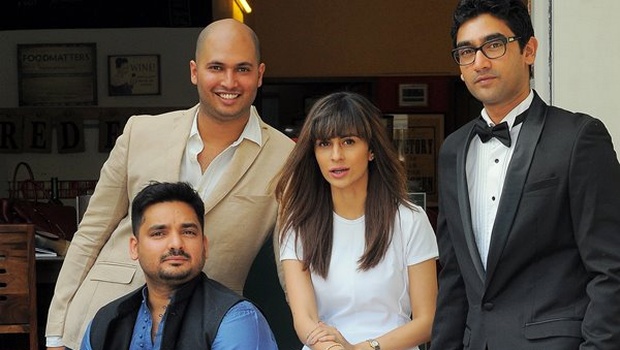
Prasad Bidapa is doing a fashion show. What’s new, you might ask. Well this one is in Pakistan.
And naturally, Bidapa is thrilled.`Shaan-e-Pakistan: Kya Dilli Kya Lahore’, organised by Huma Nassr, is an annual three-day event in Lahore intended as a plat form for the singers, dancers and designers of both nations.
And Bidapa has company not just from the fashion industry but from the music industry as well, such as popular singer Atif Aslam.
Now this is a cross-border collaboration worth strutting his stuff for.
source: http://www.timesofindia.indiatimes.com / The Times of India / News Home> Entertainment> Kannada / Bangalore Mirror Bureau / March 23rd, 2016
The Rs 50 crore sanctioned for Kodagu will be used exclusively for the development of rural roads in the district, said the CM. He confirmed that the medical college in Madikeri will begin admissions from 2016-17.
Kodagu was a separate state and during that period many records lay in the then chief commissioner’s office. To computerize all these documents, the chief minister has sanctioned Rs 1 crore.
The agricultural income tax exemption for coffee will continue along with tea and rubber. Kodagu Chamber of Commerce president B N Prakash said that the chamber welcomes the amount sanctioned for road development. tnn
source: http://www.timesofindia.indiatimes.com / The Times of India / News Home> City> Mysore / TNN / March 19th, 2016
Flight trials conducted at facility in Kerala, 58 km from Virajpet.
Flight trials were undertaken on Monday at the newly constructed international near here.
Though the facility is not in the district and is part of the neighbouring state of Kerala, it is expected to provide an impetus to the economic development of the district, especially in the tourism sector.
The airport has come up at Mattanur (Kannur district), just 58 km from here. Though the official inauguration is slated for a later date, preparations for the trial run were being made for the past one month. Work on the runway was undertaken, overcoming many hurdles.
The construction of 2,400-metre of the proposed 3,050-metre runway has been completed in the first phase. Monday’s trial run was conducted on 1,500 metres of the runway.
Commercial operations are likely to begin in September this year, if all goes well, sources in the government and the Kannur International Airport Authority said.
The opening of the airport will put pressure on the Virajpet-Kannur interstate-highway that passes through Virajpet town, the Virajpet-Hunsur highway and the Virajpet-Madikeri highway. But work on upgrading and expanding these stretches is still in the initial stages.
The construction of the airport is expected to cost a total of Rs 1,892 crore and the project was approved when C M Ibrahim, who hails from the State, was the union minister for civil aviation in the Deve Gowda government at the Centre. At present, the Mandakalli airport in Mysuru is the nearest to the district (100 km from Virajpet). The other nearby airports are the Mangaluru airport (160 km from Virajpet) and the Kempegowda International Airport in Bengaluru (250 km from Virajpet).
The new airport at Mattanur is also expected to help exports of the commercial crops grown in the district. It will also be useful for those pursuing studies and seeking employment abroad, besides giving a boost to cultural exchanges with foreign countries. The real estate sector in the district is likely to witness a boom too.
source: http://www.deccanherald.com /Deccan Herald / Home> State / Virajpet(Kodagu) / DHNS – March 01st, 2016
Deputy Commissioner Meer Anees Ahmmed said a report on the construction of a private bus stand, submitted by a private institute, has been submitted to the Transport Department for verification and to elicit opinion on the report.
Chairing a meeting of the Regional Transport Authority (RTA) here on Wednesday, he said the department has been asked to prepare a comprehensive traffic plan for the city. Action will be taken after obtaining opinion from the department. “It will be impossible to build the private bus stand at RMC Yard on Mysuru Road. The RMC land should be used for the purpose it is meant for,” he remarked.
Raising the issue, Private Bus Owners’ Association President Hosur Ramesh Joyappa said the shifting of the private bus shelter is being discussed from the last several years. It has not seen any progress so far. It will be better to identify land on Mysuru Road for the construction of the bus shelter, he added.
Autorickshaw Drivers’ Association President Medappa said autorickshaws have been permitted to travel 10-km from the district headquarters. However, the residents of remote villages which do not have transport facilities, depend on autorickshaws for transport. Hence, the permission for the travel from headquarters should be be increased to 20-km, he urged.
Reacting to it, the DC said permission will be granted only after verifying the areas where permission needs to be given and it will be known in the next RTA meeting.
The private bus owners said they are facing a lot of inconvenience due to lack of a bus shelter for private vehicles in Kushalnagar. At least, two private buses should be allowed to park near the KSRTC Bus Stand. Objecting to it, the KSRTC officials said private buses should not be allowed to be parked within 100-metre radius of the bus stand. The DC said he will inspect the site before taking a decision.
Bus service sought Vanachalu residents said people, labourers and students are facing difficulty without any proper bus services to the village. A KSRTC bus should be operated on the stretch. The meeting agreed to start a bus service to Vachanalu.
The KSRTC officials said private buses cannot operate on Kushalnagar and Guddehosur State Highway. The private buses can operate via Siddapura and Harangi route, they added.
Privte Bus Owners’ Association Secretary Nanda Poonaccha said the police fail to receive complaints in the police station.
Reacting to it, the DC said that complaints can be filed online or to the SP’s office.
source: http://www.deccanherald.com / Deccan Herald / Home> District / Madikeri – DHNS / February 25th, 2016
This Railway Budget will surely bring smiles on the faces of residents of Mysuru and Kodagu. Reason: the much-awaited 85-km railway line project between Mysuru and Kushalnagar will finally take off with the Railway Ministry giving its green signal in the budget.
Speaking to SOM from New Delhi, Mysuru-Kodagu MP Pratap Simha said that Kodagu was the only district in the State that did not have rail connectivity and he was glad that he was able to finally get the approval for this long pending project.
The Railway Ministry, which had earlier conducted a feasibility test, has sanctioned Rs. 667 crore for the project and the works is expected to begin soon.
source: http://www.starofmysore.com / Star of Mysore / Home> General News / February 25th, 2016
The zilla and taluk panchayat elections held in Kodagu and Chikkamagaluru districts were peaceful on Saturday.
The polling received a lukewarm response in plateau region in Chikkamagaluru district till afternoon.
Twenty-three per cent polling was recorded at Karthikere in Kuruvangi zilla panchayat constituency at 11 am. The polling percentage similar at Kalasapura in Ambale constituency at 11.30 am.
A 95-year-old Jayamma was carried to the polling booth by her son Siddalingappa at Pillenahalli.
The labourers left for their work after exercising their franchise in Malnad. The political parties had even arranged vehicles to ferry the voters to the polling booths at a few places.
District Congres Committee President D L Vijaykumar exercised his franchise at Balegadde polling station.
Report from Kodagu
Elections were held in 29 zilla panchayat and 50 taluk panchayat constituencies in Kodagu district.
A total of 117 candidates are contesting in the zilla panchayat election and 169 candidates are in the fray in taluk panchayat election.
Technical glitch was experienced was an elctronic voting machine at Athooru polling station at Somwarpet taluk. There was brisk polling since morning in the district.
Women and men were seen standing in long queues to exercise their franchise at Kedakal, Suntikoppa, Guddehosur, Nanjarayapatna, Kambibane, Chettalli, Nelyahudikeri, Siddapura, Ammathi, Moornadu, Mekeri and other areas.
Ninety-six-year-old Ponnamme arrived to exercise her franchise at Kedakal polling station.
Krithika, who excercised her franchise for the first time at Suntikoppa, said, “I am feeling happy that I have excercised my franchise for the first time. Voting is a sacred right.” Jayalakshmi, a first-time voter, expressed similar views at Guddehosur.
People were seen discussing about the election in groups outside 100 metre radius of a few polling booths in the district.
Deputy Commissioner Meer Anees Ahmmed visited Kadagadalu, Abhyathmangala, Chettalli, Nelyahudikeri, SIddapura, Makkandoor, Madapura, Athooru, Guddehosoor and other polling booths. The counting of votes will be held at 8 am on February 23.
source: http://www.deccanherald.com / Deccan Herald / Home> District / Chikkamagaluru – Kodagu / DHNS – February 21st, 2016
R Nagaraja Rao (on left), Executive Director, Bayar’s Coffee, with R K Krishna Kumar, Trustee of the Tata Trust.
Bengaluru :
Bayar’s Coffee, a leading coffee manufacturing company from Bengaluru, has bagged the ‘Best Roasters Platinum Award-2016’ instituted by the Coffee Board of India and the India Coffee Trust.
The award was presented for adoption of food safety standards, implementation of new technology, and for producing high quality coffee blends.
The award was given at a glittering ceremony held at Mumbai, presided over by Leena Nair, Chairperson of the Coffee Board. R K Krishna Kumar, Trustee of the Tata Trust, felicitated R Nagaraja Rao, Executive Director, Bayar’s Coffee, with the “Best Roasters Platinum Award-2016”.
Expressing his happiness over the award, Nagaraja Rao said, “We have introduced a variety of speciality coffee blends in tune with customer needs. We are happy that Bayar’s Coffee has bagged the award four times in a row. Our responsibility to provide high quality coffee to our customers has increased.”
source: http://www.thehindubusinessline.com / Business Line / Home> Companies / by Anil Urs / Bengaluru – January 27th, 2016
Coffee growers in Kodagu, Chikkamagaluru and Hassan districts are, however, apprehensive.Many want to know the measures taken to protect small and marginal farmers, who constitute 90% of growers in Karnataka.
Bengaluru :
When coffee growers in Karnataka were going through a rough patch due to labour shortage, elephant menace and unprecedented fall in prices, the Centre in November last year allowed 100 % FDI in five plantation crops: Coffee, rubber, cardamom, palm oil and olive oil. The decision, meant to rejuvenate the sector, is expected to have a huge impact on Karnataka, which accounts for 70% of India’s coffee production.
As of now, 100% FDI is allowed only in tea plantation. “Relaxed FDI norms will help coffee and cardamom growers since it is expected to bring in big overseas investors and retail giants besides enhanced technology utilization, automation, research, management and production of value-added products. Permitting foreign investment will also boost India’s coffee exports offering better prices for growers here, ” says Coffee Board chairperson Leena Nair.
Coffee growers in Kodagu, Chikkamagaluru and Hassan districts are, however, apprehensive. Many want to know the measures taken to protect small and marginal farmers, who constitute 90% of growers in Karnataka. Some coffee growers’ associations are holding talks to oppose the move as they fear small growers would be forced to sell their estates to foreign investors. Their entry may prove detrimental for small coffee planters, who may not be able to match the wages and technology of foreign players.
“The Centre should have held consultations and allayed fears before allowing FDI. But they have done in it in a hush-hush manner and kept us in the dark, making us believe that there is a hidden agenda,” says NK Pradeep, a Coffee Board member from Chikkamagaluru. Former Coffee Board vice-chairman Sannuvanda Kaverappa says a parliamentary committee that visited Chikkamagaluru last year to interact with coffee growers left in a huff. Nair allays all fears of growers saying: “The small-grower segment need not worry as enough safeguards have been provided and the Centre and the state government can always reject any FDI proposal in their segment.”
A Coffee Board executive says FDI will benefit coffee growers. The measure is expected to make the coffee industry vibrant like the tea sector, which opened gates for foreign investments in 2002. “Rather than starting a new venture, foreign investors may partner with existing plantations or trading companies. FDI will help boost developmental activities such as replanting, rejuvenation and R&D that need huge funding. It may also help in upgradation, modernization and automation of coffee-processing, curing, marketing,” he adds.
source: http//:www.retail.economictimes.indiatimes.com / ETRetail.com / Home> Industry / February 12th, 2016
Coffee plantation owners keen to use drones to assess crop health
Mumbai:
Enabled by unmanned aerial vehicles (UAVs), drones are leading agricultural data collection and facilitating precision analysis in agriculture globally, helping to improve crop yield.
Though the use of drones by civilians is as yet restricted in India, speakers at a recent coffee seminar urged the government to allow these hi-tech machines to help detect the health of the crop.
Apart from their military use, millions of farmers across the country could use drones and the new emerging technology to boost production and efficiency in their farms.
“We are on the cusp of a new era of farming, where precision agriculture practices can offer a new approach to crop management. We now have a technique that wrings out waste and uses data to maximise crop yields and profits. UAV technology is reshaping farming,” said Jaisimha Rao, coffee plantation owner and entrepreneur.
Game changer
Passionate about technology and agriculture, Rao noticed the lack of data-driven decision making while working on his family’s coffee plantation. He decided to combine the versatility of UAVs and computers, and ensure algorithms to analyse crops. Aiming to bridge the gap, Rao, who holds a Bachelors degree in Electrical and Computer Engineering from the Carnegie Mellon University, founded TartanSense. The company uses UAVs to capture and analyse aerial imagery.
Blanket restrictions
“Flying drones and gathering data is a game changer for agriculture, and especially for large plantations like coffee. How we can use this technology in India is the moot point, since the Directorate General of Civil Aviation (DGCA) has restricted the use of drones,” he said.
Pointing out that the “blanket restriction by the DGCA to operate drones would kill the enthusiasm of start-ups” such as his, Rao said his drones had worked in Indonesia, Japan as well as in the US, with drones costing upwards of $100,000.
Speaking about the new technology, Sanjiv Sarin, Managing Director and CEO, Tata Coffee, who was moderating the talk, said, “We are entering the future of the coffee industry. The Coffee Board can work for government clearances to use drones in agriculture.”
Though coffee is shade-grown among silver oak trees, Rao said, “drones will soon be able to look at a tree and avoid it. Over the next 6-12 months, we are going to have an UAV that can fly under the canopy, measure each and every coffee bush and get data for the planter. Canopy penetration will be the true essence of precision farming.”
Big data
Agricultural drones are UAVs used for precision agriculture, which is a modern method of farming globally that uses big data, aerial imagery and other means to optimise efficiency.
The drone collects the crop’s image and makes a colour coded map based on its health, which is then assessed by the UAV firm.
Drones are helping assess the exact nature and area of crop damage during natural calamities, and are helping save huge amounts.
Stating that a lot of people are fascinated by drones, Rao said the real value add “is not the hardware, which is about how to fly them and get the data, but to analyse it and benefit the farmer.”
Detailing the functioning of the UAV, Rao said, “Our drone flies for about 20 minutes, and then the battery is dead. It can survey about 150 acres. We send the images up to the cloud, and can then stitch the data into a nice map. Once you get the image and sensor data in a map, one can get an actionable report and help the farmer. This is where the real skill lies.”
source: http://www.thehindubusinessline.com / Business Line / Home> Economy> Agri Business / by Amrita Nair-Ghasalla / Mumbai – February 05th, 2016
Chennai-based actress, model and ex-VJ Pooja Gallyot graduated from green tea to coffee last year and now is so hung up on the beverage that she is fast becoming an addict. On the other hand, Kolkata-based fashion designer Kiran Uttam Ghosh, a bona fide coffee lover, zeroes in on new cafes in the places she visits. For naturalist and wildlife conservationist Shrilekha, coffee shops present the ideal rendezvous to conduct business. It is these little tell-tale signs that have had coffee majors scent a business opportunity, even cleverly imparting magical qualities to the brew in that anything can happen over a cuppa. Truth be said, it’s a dramatic cultural switch that’s got the entire nation swaddled in its intoxicating embrace. According to the latest Technopak report, the chain café market, currently at Rs 1,820 crore, is growing at 20 per cent in value and commanding 27 per cent of the Rs 6,750 crore overall cafe market.
Were it not for pilgrim Baba Budan’s temerity in smuggling a few coffee beans into Chickmagalur, Karnataka, we might never have got introduced to this refreshing drink. This history aside, coffee seems to be edging out tea in the social circuit with cafes being the perfect place to hang out, chat or simply relax. That certainly augurs well for business, with Café Coffee Day, popularly called CCD, the biggest player in the Indian market, competing with international brands such as Starbucks, Barista and Costa Coffee, not to mention the popular local hangouts.
To date, CCD maintains its Numero Uno position having added 58 more outlets to the 1,480 it held at the beginning of 2015. CCD’s principal Coffee Day Enterprises set the stock market abuzz with the largest Initial Public Offering last year. It had fixed its public offer price at Rs 328 per share, taking the total proceeds to Rs 1,150 crore. But when the IPO closed on October 16, it was over-subscribed 1.81 times with a demand worth Rs 2,000 crore.
“Customers today are looking at a differentiated food experience along with their coffees at cafes. Which is why we have introduced a special food menu called the ‘SuperMenu’—a range of soups, sandwiches, burgers and desserts,” says a CCD spokesperson. “We have also started a home delivery service in Bengaluru as a pilot project.”
Costa Coffee entered India in 2005 when it opened outlets at Connaught Place in Delhi. Today, it has close to 100 in 11 cities across India. While a good number is present in metro cities such as Delhi, Mumbai, Chennai and Bengaluru, they’re spreading out in tier II cities such as Agra, Jaipur, Pune, Kochi, Ludhiana, Chandigarh and others. “While southern states have always had a strong culture of drinking coffee, over the past decade or so, the drink has penetrated to other parts too,” says Ashish Chanana, Chief Operating Officer, Costa Coffee.
Another chain that is fast expanding is the US-based Coffee Bean & Tea Leaf Ltd, which tied up with Pan India Solutions to start a single outlet at Select Citywalk mall in Delhi. It has grown to 32 stores in 10 cities from 11 in 2008. “We source our coffee from seven different countries,” says Dina Banerjee, CMO, Pan India Food Solutions Pvt Ltd, Mumbai.
Though all eyes are on the newest entrant, US giant Starbucks, which joined hands with Tata Coffee Ltd to set up shop in India in 2012. By 2014, it had more than 60 outlets and the end of 2015 saw it operating 78. It had also managed to clock in Rs 171.2 crore, an 80 per cent jump from previous year’s Rs 95 crore.
Coffee shops have so much become revenue models that another giant has jumped on the bandwagon.
The most telling of entries is American fastfood chain McDonald’s McCafe in the country with its first cafe being launched in Mumbai. “The concept fits in well with what the Indian customer needs. Our plan is to increase the 40-plus McCafes to 60-65 by this fiscal-end and double it within 12-18 months,” says Amit Jatia, Vice Chairman, Westlife Development, franchisee of McDonald’s in South and West India.
There’s a good reason behind the dramatic rise of coffee cafes in India. Fashion designer Ghosh spends her holidays finding new cafes and spending her time reading, sketching and dreaming there. “Cafes across the world reflect the essence of its people and place,” she says, adding that the habit of going to cafes late at night with friends has earned them the moniker, ‘the owls’.
Chanana is in agreement too. Says he: “Coffee shops have given people across all age groups—especially the young—a legitimate, safe and cool place to hang out. Youngsters can go on a date without burning a hole in their pocket. Friends can spend time together at a conveniently located place. We’re also seeing a lot of older couples taking time out to catch up with each other over a cup of coffee. At Costa, we have lots of customers who are by themselves.”
Gallyot is a big fan of Starbucks. “I have gotten used to their coffee as wherever I travelled, I came across an outlet. It’s become like a comfort drink for me,” she says. For 24-year-old MBBS student Anjali Reddy, Starbucks doubles up as a place for study. In fact, people have come to associate coffee concoctions with different times of the day. “Post-noon, the choice of beverage quickly changes to Americano and Expresso. It’s become like a lifestyle craving,” says Kazem Samandari, Chairman of L’opera, Delhi.
Besides cultivating friendships and fun, these places have become the haunt of many working people. Wildlife conservationist Shrilekha often frequents Chamiers, an upmarket café in Chennai. “As I work from home, I often meet business associates at cafeterias and I love Chamiers which while elegant has a lot of breathing space,” shares Shrilekha.
Visiting cafes has widened the horizon of Delhi-based interior designer Parull Mahajan’s social interactions. The caffeine rush helps her mind to stimulate her creativity. “I visit the two of my favourite cafes—Choko La and Starbucks—at least three-four times a week and cannot do without my standard two or three cups a day. It’s an addiction I have no intention of wearing off,” she says.
In keeping with the global trend, coffee shops have become de facto offices for consultants, entrepreneurs, and writers. “Some of our Costa outlets in Delhi, Bengaluru and Mumbai have had the privilege of hosting many start-ups, where the founders polished their business idea over several cups of coffee,” says Chanana. Work is also what takes Anitha KS, National Corporate Sales Manager at Vodafone, to Costa Coffee at the Lulu Mall in Kochi. “After meeting clients in the morning, I come here and carry on my work sipping on a cold coffee or cappuccino,” says Anitha. For his part, the outlet’s manager Anup Anand is delighted with the increased bottom line. “We have plans to open more outlets in Kochi and other cities of Kerala.” That’s significant given that Kerala is predominantly a tea-drinking state.
Coffee reigns with an aromatic fist even as south India leads in the production of coffee, with the drink dominating social interactions. Apart from the big players, there are a host of small and medium joints that gets people over for coffee and chitchat. In Bengaluru, which is the hub for rich traditional filter coffee, local brands such as Maiyas, Adigas, Shanthi Sagars, the SLVs, Hatti Kapi, Katte Kapi, Brahmin’s Coffee Bar and Coffee Board outlets are still going strong. Small joints rule the roost in Chennai too, courtesy Madras Coffee House, Leo coffee outlets (under brand Mylapore Mocha) and Kumbakonam degree coffee outlets.
Unique to the Bengaluru-Mysuru region is the ‘by-two’ coffee culture, a mini dose of coffee whose origins can be traced to some 100 years back during the literary and Independence movements. Then literary figures, freedom fighters and political leaders, with hardly any money in their pockets, gave impetus to this culture of having multiple servings of half a cup of coffee over endless discussions.
For many in the garden city, the small joints are the place to be. Marketing professional R N Prasad feels that the prominent coffee cafes are good only to conduct business with coffee being incidental. Each day, he drives some seven kilometres to have a cup of coffee at the Brahmin’s Coffee Bar. According to city historian Arun Prasad, tourists prefer the traditional filter coffee served at small joints.
In the grand theatre of coffee culture, there are the veterans—India Coffee House and Coffee Board outlets. K S Achyuthan, Kannada author and media professional, has been visiting the Coffee Board outlet near Vidhana Soudha in Bengaluru for more than 50 years. “This is a meeting point for many journalists and lawyers as well as musicians and guests who come to All India Radio. I have also seen many legislators, MPs and even celebrities in this place which has hardly changed all these years.” Kannada filmmaker and environmentalist Suresh Heblikar makes it a point to visit India Coffee House whenever he passes by the place.
The India Coffee House in Puducherry, a heritage structure, came close to being torn down in 2008 until INTACH and concerned citizens appealed against the move. With CM N Rangaswamy’s support and renovations later, it opened in mid-2014 and has begun to attract crowds. This outlet also finds a mention in Yann Martel’s Life of Pi.
Looks like the old and the new will exist side by side even as coffee aficionados seek out their happy place.
with Meera Bhardwaj, Ayesha Singh, Shevlin Sebastian, Jonathan Ananda and Suhas Yellapuntala
source: http://www.newindianexpress.com / The New Indian Express / Home> Magazine / by Sunita Raghu / January 23rd, 2016
WELCOME. If you like what you see "SUBSCRIBE via EMAIL" to receive FREE regular UPDATES.
Read More »