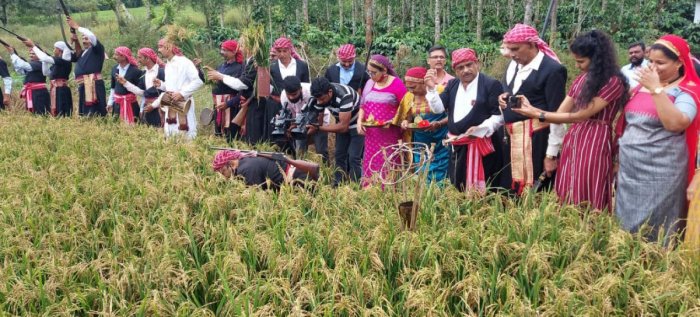
The paddy sheaves were cut by the CNC members during Huthari celebrations at the paddy field belonging to Nandineravanda Uthappa, in Chikkabettageri.
The Codava National Council (CNC), led by its president N U Nachappa, celebrated Huthari or Puthari — the harvest festival of Kodagu, at a paddy field of Nandineravanda Uthappa, in Chikkabettageri village, near Kushalnagar, on Friday.
Wearing traditional Kodava attire, the members participated in the celebrations by cutting paddy sheaves. Later, they offered prayers for the prevalence of peace and to eradicate Covid-19 from the world.
The members offered prayers to the gods and initiated the process of Huthari celebrations by ‘Nere Kattuva’ ritual using the leaves of Arali, mango, jackfruit, Kumbali and cashew nut trees.
After the rituals, the members took out a procession to the paddy field, accompanied by the ‘Dudikottpat’. After firing thrice in the air, Nachappa offered puja rituals and cut paddy sheaves.
Later, the paddy sheaves were brought back to the house and puja rituals were conducted.
CNC members presented ‘Kolata’, ‘Pareyakali’ and other cultural programmes.
Later, they also danced to the traditional beats and relished rice payasa, ‘Thambittu,’ ‘Kadubu,’ ‘pandi curry,’ ‘chicken curry’ and others.
Speaking on the occasion, Nachappa urged the government to declare a national holiday for the Puthari festival.
The Kodavas should be considered as a separate race to save the Kodava tribal culture for the future generation. Kodava language should be included in the Eighth Schedule of the Constitution, he said.
“Kodava culture has all the qualifications to be included in the Intangible Cultural Heritage List of Unesco. By showcasing our rituals, we can assert our rights,” he added.
source: http://www.deccanherald.com / Deccan Herald / Home> State> Mangaluru / by DHNS, Kushalnagar / November 19th, 2021
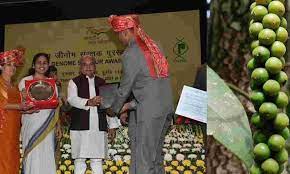
Left, N Poonacha receiving the award at the ceremony in New Delhi. Right, Snapshot of the indigenous ‘Adi Pepper’ spikes.
HIGHLIGHTS
Napanda Poonacha of Kodagu district, a progressive farmer, who hopes to be recognized as a pro-nature farmer
He was recently granted the Plant Genome Saviour Farmer Reward (2019-20) for his efforts to save indigenous ‘Adi Pepper’ crop
Napanda Poonacha of Kodagu district, a progressive farmer, who hopes to be recognized as a pro-nature farmer and has set examples for the other farmers to come forward to encourage them. He is working hard to establish commercial crops that have minimal or no negative impact on biodiversity, and he was recently granted the Plant Genome Saviour Farmer Reward (2019-20) for his efforts to save indigenous ‘Adi Pepper’ crops.
The Union Agriculture Ministry’s Protection of Plant Varieties and Farmers’ Rights Authority bestowed the honour on Poonacha, who received it from union agriculture minister Narendra Singh Tomar at an event in New Delhi on November 11.
He is the owner of Adi Pepper Demo Farm and Research Center in Garvale, where he is actively engaged in discovering natural crops in the district that have the capacity to become commercial crops while inflicting minimal environmental impact.
Napanda Poonacha expressed his happines for recieving the award. He said that farmers who recognise, conserve, and cultivate crops that are beneficial to biodiversity have been given this honour. Furthermore, He received the prize for his research, conservation, and promotion of the ‘Adi Pepper,’ an indigenous kind of pepper mainly grown across the natural habitat of Garvale village borders in Kodagu, India.
He further explained that Adi Pepper crops can be discovered all around the Garvale region in their natural habitat. They undertook the responsibility at the research centre to obtain this species of pepper registered under PPFRI, and in 2015, this high-quality pepper was recognised as a farmer’s variety pepper. This is the only pepper species that has passed biochemical testing, and it is regarded the best of the seven pepper species growing in Kodagu.
Since that particular form of pepper was once known as forest pepper and was mainly used for domestic reasons by the people, it has recently reached a brand value of Rs 3500 per kilo, generating more than six times the earnings of the other black pepper species sold in the district.
source: http://www.thehansindia.com / The Hans India / Home> News> State> Karnataka / by Susmita Modak / by Hans News Service / November 19th, 2021
The Management of Kodava Samaja, Mysuru, has decided to celebrate Puthari Namme (harvest festival) on Nov.20 in the premises of Kodava Samaja in Vijayanagar I Stage. Earlier it had been decided to celebrate the festival in the premises of Sree Cauvery Educational Institutions in Kuvempunagar.
Now due to incessant rains since a week and also keeping in mind the forecast of rains for 4 more days, the Samaja has decided to change the venue. The celebrations will commence at 5 pm at the Samaja premises. All traditional Kodava dances will be performed on the occasion by both the men’s and women’s teams.
Arrangements have been made to distribute Kadh (new paddy crop) on that day. All the members are requested to note the change of venue and cooperate in the celebrations, according to a press release from Malachira M. Ponnappa, Honorary Secretary, Kodava Samaja.
source: http://www.starofmysore.com / Star of Mysore / Home> In Briefs /November 19th, 2021
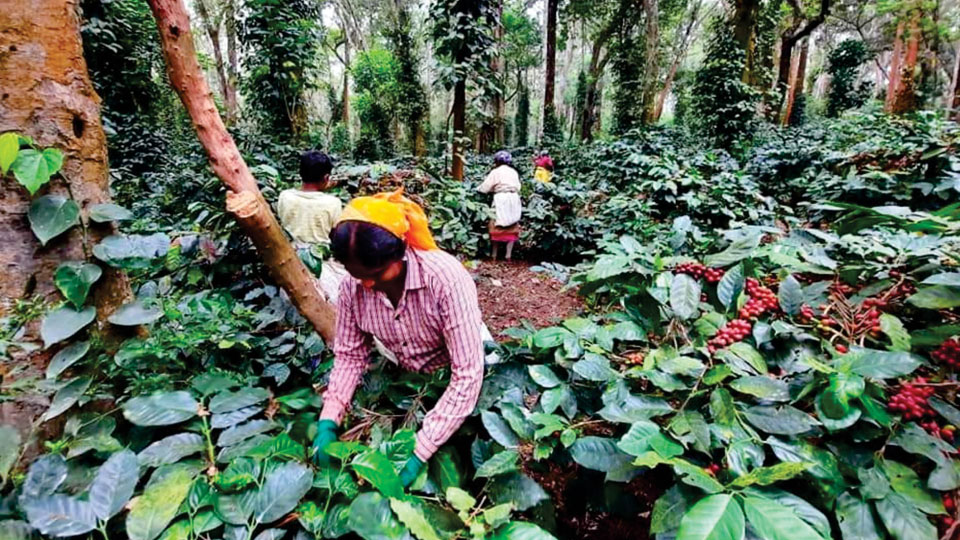
With rainfall still continuing to lash parts of Kodagu, the growers are faced with a herculean task of picking the beans in the rain.
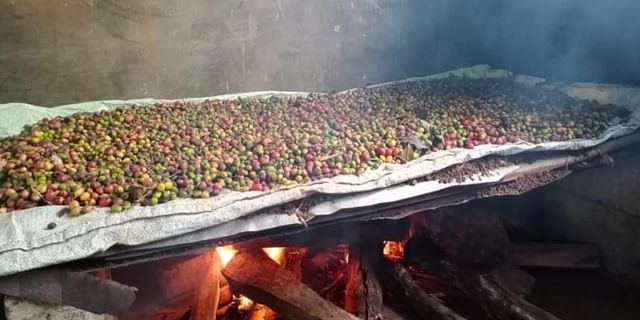
The wood fire installed by coffee grower Vikas to dry beans.
Madikeri :
The change in the weather pattern has increasingly affected the coffee growing sector in Kodagu. As rainfall continues to lash the district in November, the coffee growers are struggling to save what is left of the coffee yield.
The coffee picking season for Arabica variety begins in November and the picked ripened beans are to be dried under the sun. However, with rainfall still continuing to lash parts of Kodagu, the growers are faced with a herculean task of picking the beans in the rain. Further, the collected beans cannot be dried in the rainfall and many growers are building make-shift stoves to save the ripened beans.
K Vikas, a coffee grower in Makkanduru village has raised a make-shift stove to dry the ripened coffee beans. Coffee beans, which are usually dried under the sun, are now being dried on a wood fire stove. “The bad weather condition has forced us to take this non-traditional method of drying coffee beans,” Vikas explained.
Meanwhile, the ripened beans without drying do not possess any demand in the market and are not bought by the traders due to the existing risks concerning the weather. “The coffee curing centres will not accept yield that has a mixture of ripened and unripened beans; the cost of separating these two beans cannot be managed by the growers in the current scenario. The curing centres are also sceptical about purchasing un-dried coffee following the present weather condition,” explained BN Ramesh, a coffee trader in the district.
The unseasonal rain had already inflicted heavy loss to many growers as the coffee plants witnessed increased droppings and rotting. The continuation of rainfall in the month of November is now threatening to wipe out what is left of the crop damage.
source: http://www.newindianexpress.com / The New Indian Express / Home> States> Karnataka / by Pragna GR, Express News Service / November 14th, 2021
Here is a chance for coffee growers to get additional cash from their plants throughout the year apart from income from the sale of beans. Mysuru-based Central Food Technological Research Institute (CFTRI) has developed a technology to prepare a value-added product from coffee leaves that packs in health benefits too.
Coffee is only harvested for a few months every year, depending on the country’s harvest season. This can leave a number of producers and workers without work (and income) for a significant portion of the year.
Pushpa S. Murthy
However, some producers have decided to diversify the crops that they grow and sell. As coffee leaves are constantly being produced, growers can harvest them in the off-season if there is demand, according to Pushpa S. Murthy, Principal Scientist (Spice and Flavour Science Department) of CFTRI.
This technology follows a CFTRI project on the development of value-added products from coffee leaves taken up in 2019. The project was funded by the Union Ministry of Food Processing Industries.
If farmers can use the leaves which can be harvested during the off-season or during pruning, without interfering with coffee bean growth, it will have a great impact on the social elevation of coffee farmers, she said.
Around 70 percent of the coffee industry is unemployed or underemployed during nine months of the year due to the nature of the growth cycle of the coffee beans. The project aimed to provide a year-round sustainable process for the coffee farmers.
With CFTRI technology, the brew can be prepared with water, allowed for a few minutes to steep, filtered and consumed. The institute has initiated the transfer of this technology to the coffee industry, and a few industry participants have already extended their consent, she said.
The leaf brew does not really taste like coffee, according to Murthy. “The brew is subtle with less caffeine compared to coffee or tea,” she said. On the nutritional value of the beverage, she said coffee leaves are rich in phenolic acids with potential health benefits. A coffee leaf contains around 17 percent more antioxidants than green tea. The beverage should be consumed plain.
The beverage accords health-promoting polyphenols like chlorogenic acid and mangiferin which help in reducing blood glucose levels, inflammation and blood pressure, she said.
Leaf drink ‘kuti’ and ‘kahwa daun’ popular in Sumatra, Ethiopia
Coffee leaf tea has been consumed in Sumatra, Ethiopia, Jamaica, Java and Sudan for centuries. From the 16th century to the 19th century, Ethiopian farmers set aside their harvested coffee for trade or consumption in special ceremonies. As a day-to-day drink, the Harari people in Ethiopia instead enjoyed ‘kuti’.
‘Kuti’ tea was made by boiling coffee leaves in hot water, sometimes with a pinch of salt or some sugar. It was generally boiled for at least 30 minutes, as it was believed that the longer the leaves were boiled for, the sweeter the resulting brew would be.
Coffee leaf tea bears some similarities to green tea, but it is more earthy and sweeter. It is lower in caffeine than green tea, and thanks to its high levels of antioxidants, it has historically been believed that it cures or relieves cold symptoms.
In the 19th century, Dutch colonists transported coffee plants to designated farming regions in Indonesia. Workers on the coffee plantations were forbidden from consuming the coffee they harvested, so they drank something called “kahwa daun” instead.
‘Kahwa daun’ was made by drying coffee leaves in the sun to reduce their bitterness. The leaves were then smoked and roasted for a few hours. Finally, they would be steeped in boiling water, and then served in a coconut shell.
source: http://www.starofmysore.com / Star of Mysore / Home> Top Stories / November 14th, 2021
Minister in charge of Kodagu district Kota Srinivas Poojary and others at the Kannada Rajyothsava celebrations in Madikeri on Monday. | Photo Credit: Special Arrangement
Labs, libraries for 15 govt. schools: Minister
Minister in charge of Kodagu district Kota Srinivas Poojary on Monday said each household in the limits of 12 gram panchayats in Kodagu will be getting drinking water, 100 per cent segregation and collection of solid wastes, scientific handling of sewage generated daily besides the installation of solar projects and setting up of digital libraries in the respective villages.
All these works will be done as part of ‘Amrith’ Grama Panchayat programme which has been announced in the State identifying 750 GPs as part of platinum jubilee celebrations of Independence. The 12 GPs in Kodagu are Peraje, Kunchila-Kakkabbe, Maragodu, Kedamullur, Karmad, Nalkeri, Thithimathi, Koodumangaluru, Shirangala, Igooru, Haradooru and Dundalli, the Minister said in his speech during the Kannada Rajyotsava celebrations in Madikeri.
As part of the 75th independence daycelebrations, the State government has announced 13 special programmes and they include Amrith gram panchayat, Amrith rural housing scheme, Amrith farmer producer organisations, Amrith Nirmala Nagara, Amrith anganwadi centres, Amrith self-help micro enterprises, Amrith community development programme, Amrith health infrastructure upgrade programme, Amrith skill training programme, Amrith startup programme, and Amrith sports adoption programme.
As part of Amrith Rural Housing scheme which is being implemented in the district, housing will be provided to the homeless persons who will be identified in the 12 GPs in the coming days.
The Minister said farmers, fishermen and weavers will get financial support as the government has launched Amrith farmer producer organisations. Each organisation will get a sum of ₹30 lakh in a span of three years. Amrith Nirmala Nagar scheme has also been launched in the district where programmes will be taken up for maintaining hygiene in the limits of local bodies.
Amrith school scheme entails funding of ₹10 lakh to each identified school for developing buildings, labs, libraries, toilets and other facilities. The 15 schools identified in Kodagu are at Hodawada, Sampaje, Kadanga, Madapura, Kodlipet, Walnoor, Thagattur, Hebbale, Suntikoppa, Heggala, Pollibetta, B. Shettigeri, Thithimathi, Gonikoppa and Kutta.
In Kodagu, 25 anganwadi centres will be upgraded with each one of them getting a sum of ₹1 lakh under Amrith Anganawadi scheme.
The Minister said the government is committed to protecting Kannada and the culture of the land and expressed happiness that the use of Kannada language in digital mediums has been on the rise. Karnataka is rich in culture and tradition, he said, calling upon the youth to be part of the overall development of Karnataka.
He also called upon the people to adopt Kannada in their lives, showing interest in the language, literature, culture and art of the land, and become successors of the rich tradition of the land.
source: http://www.thehindu.com / The Hindu / Home> News> States> Karnataka / by Special Correpondent / Mysuru – November 01st, 2021
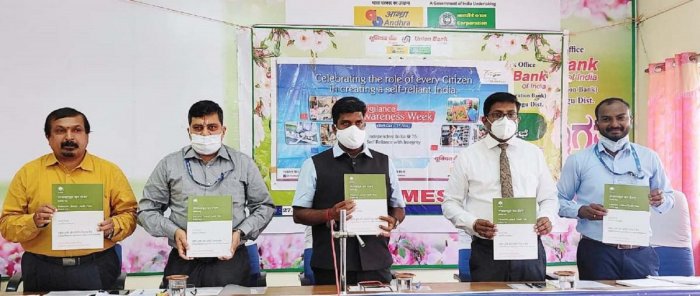
Deputy Commissioner Dr B C Sateesha and others release a credit plan prepared by Nabard in Madikeri.
Deputy Commissioner Dr B C Sateesha released a credit plan of Rs 6,205.84 crore prepared by the National Bank for Agriculture and Rural Development (NABARD) for 2022-23 on Wednesday.
He reviewed the progress of the banks after releasing the credit plan at the Lead bank hall in Madikeri.
The credit plan has given emphasis to priority sectors of agriculture, small industries, education and housing. The loans should reach the eligible beneficiaries, said NABARD district manager V Ramesh Babu.
More emphasis has been given to agriculture, dairy farming, fisheries, horticulture and small industries. The credit plan has also given the emphasis on basic facilities in agriculture markets, he added.
More loan facilities will be available for self-help groups under the Pradhan Mantri Formalisation of Micro food processing Enterprises (PMFME) scheme, he said.
Even schemes under Atmanirbhar Bharat are also being implemented. Priority has also been given for skill development, he added.
Venkatesh Gopal representing the RBI said that the banks should work towards the welfare of the farmers.
Union Bank regional manager Jyothi Krishnan said that the government has implemented several programmes for the welfare of the farmers.
Funds allocated
Of the total credit, an outlay of Rs 3,794.29 crore has been earmarked for the agriculture sector, while Rs 154.63 crore for agriculture-related basic facilities, Rs 801 crore for medium and small enterprises, Rs 409.60 crore for the export sector, Rs 121.50 crore for education, Rs 676.80 crore for housing, Rs 9.17 crore for alternative energy and Rs 27.70 crore for basic facilities.
Zilla Panchayat project director Srikanta Murthy and others were present on the occasion.
source: http://www.deccanherald.com / Deccan Herald / Home> State> Mangaluru / by DHNS, Madikeri / October 27th, 2021
KG Jagadeesh, CEO and Secretary of the Coffee Board, told The New Indian Express, “This new variety of cuppa yields more, and has a good cupping quality.
For representational purposes
Bengaluru :
To boost coffee economy, help farmers and consumers, the Board has decided to promote a new variety of brew. To ease farmers into adopting the new variety of Chandragiri coffee, the board has asked the state and central government to provide planters a soft loan with lower interest rates and moratoriums.
KG Jagadeesh, CEO and Secretary of the Coffee Board, told The New Indian Express, “This new variety of cuppa yields more, and has a good cupping quality. The beans are bold and has a lot of resistance to leaf pests. The taste and quality of this variety is also good, but its acceptability among farmers is only 10 per cent. Since getting a subsidy is difficult, the board has asked the government to offer them soft loan schemes. Farmer will not clear their standing crop and sow fresh saplings and wait for five years, without any returns. This issue needs to be addressed to have a better market.”
The Board is not just working on promoting Chandragiri in Karnataka and southern states of Tamil Nadu and Kerala, but to other Indian states like Odisha.
Jagadeesh said that the aim is to increase productivity, so that the exports and domestic sales also increase.
The Board officials pointed out that in Karnataka and southern regions, the most grown variety is Cauvery and Arabica, but assessment of samples have shown that Chandragiri is better. According to the Board’s statistics, the yield has been good at 1,037 kg per hectare of Arabica and Robusta in Karnataka in the year 2020-21.
source: http://www.newindianexpress.com / The New Indian Express / Home> States> Karnataka / by Bosky Khanna, Express News Sevices / October 21st, 2021
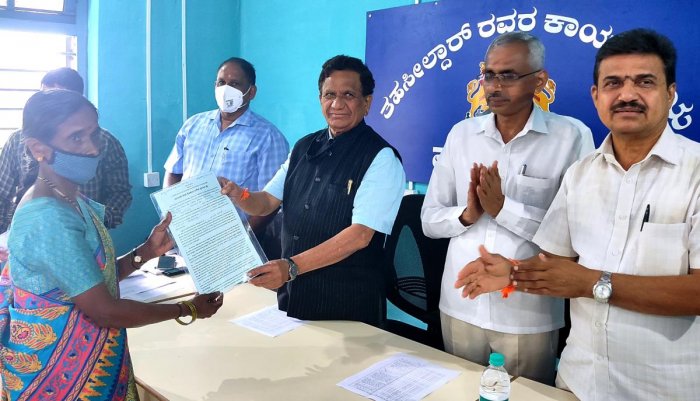
MLA K G Bopaiah distributes a cultivation chit to a beneficiary coming under the Virajpet Assembly constituency in Madikeri taluk.
MLA K G Bopaiah distributed cultivation chits to 32 families under the Akrama Sakrama Scheme.
The cultivation chits were handed over to eligible beneficiaries from Sampaje, Bhagamandala hobli, Peraje, Hakathoor, Chembu, Made, Kolagadalu, Bettathooru, Korangala, Kaggodlu, Bengoor, Karugunda, Tavoor and other villages.
Speaking on the occasion, Bopaiah said that the cultivation chits have been distributed to those who have been cultivating on the said land for several years.
The land should not be sold. The land can be used for the construction of houses and carrying out agriculture activities, he said.
Madikeri Taluk Akrama Sakrama Samiti president Nagesh Kundalpadi said that owing to the efforts of the MLA, the cultivation chits could be distributed.
source: http://www.deccanherald.com / Deccan Herald / Home> State> Mangaluru / by DHNS, Madikeri / October 09th, 2021
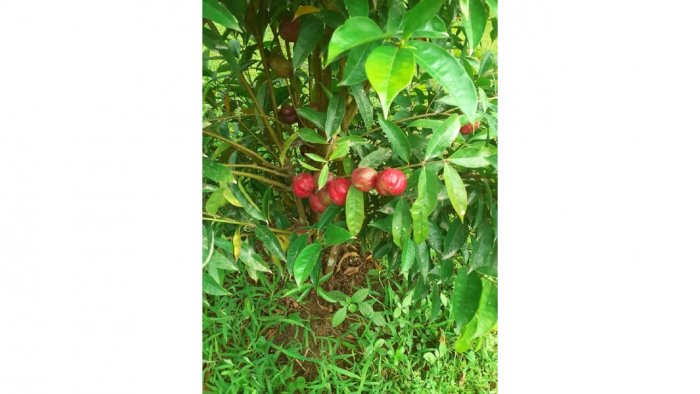
Ketolira Shammi has been cultivating about 50 varieties of fruits on his land. Now, apple is added to the list
Apples cultivated by Ketolira Shammi.
Along with varieties of fruits, a farmer in Kolakeri near Napoklu has grown apples.
He had procured the plant from Ooty four years ago and now the plant has borne fruits.
He has harvested about 4 to 5 kg of apple as a first crop.
The weather in Kodagu is conducive for apple cultivation as well, he said.
Normally, the growers in Kodagu cultivate oranges amid coffee plantations. However, after the orange plants were infected with diseases, the growers have started looking for alternative crops.
Ketolira Shammi has been cultivating lychee, rambutan, dragon fruit, egg fruit, butter fruits and others.
source: http://www.deccanherald.com / Deccan Herald / Home> State> Mangaluru / by DHNS, Napoklu / October 10th, 2021
WELCOME. If you like what you see "SUBSCRIBE via EMAIL" to receive FREE regular UPDATES.
Read More »