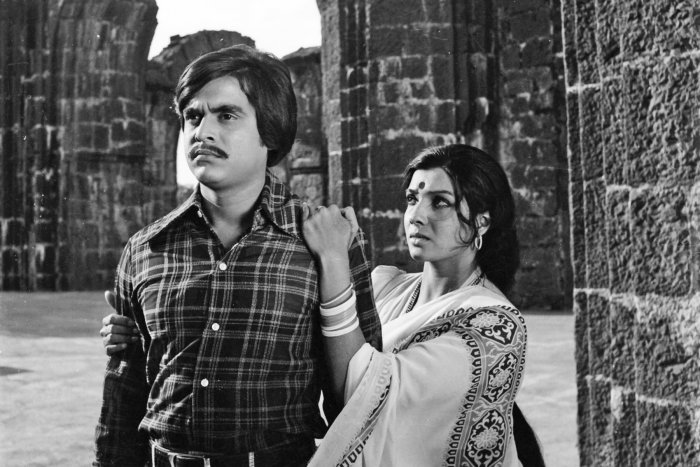
Puttanna Kanagal cast Jagadish as the lead in ‘Phalitamsha’ even though he had no prior experience in acting.
After the first few days of shoot of Phalitamsha, he wanted to give up
Filmmaker Jai Jagadish had no background in films or interest in it during his childhood. He belonged to a family, where his father, a farmer, insisted on Jagadish becoming a double graduate.
Puttanna Kanagal cast Jagadish as the lead in ‘Phalitamsha’ even though he had no prior experience in acting. Filmmaker Jai Jagadish had no background in films or interest…
Childhood and films
Hailing from Somwarpet taluk, Kodagu, he belonged to a family of coffee, pepper, cardamom and paddy growers. “My family consisted of five daughters and two sons. My father was a farmer.”
The filmmaker studied at the government school nearby. “I was a naughty child and uncontrollable, so I was sent to study in Sri Ramakrishna Vidyashala, Mysuru.” Jagadish’s father insisted on him becoming a double graduate. He did his BA from St. Philomena’s College, Mysuru.
Jagadish never acted in a drama, and never thought of acting in films. “Cinema was not my cup of coffee. My friend, Manjappa, a college leader from Maharaja’s College asked me if I would act in a Puttanna Kanagal’s film, if he got me the role. I was amused by the idea and I challenged him to find me a role,” he says.
Jagadish had read in film magazines that no actor had been finalised for ‘Phalitamsha’. In a couple of days, he got a call for the role, against four heroines. “I said I wasn’t going to act in it. My friends tried to convince me. I told them that I had other intentions and want to start my own business,” he says.
Even so, he went to Bengaluru, to meet Puttanna Kanagal. “I was asked if I knew anything about acting and I immediately responded that I didn’t. My looks and physique came in my favour, I was offered the role. I was shocked.”
Jagadish was told to leave to Badami and join the shoot immediately, but he insisted on informing his family. “I made a lightning call to my father. I knew he wouldn’t agree, and as expected after I called and explained, expletives followed. In the corner of mind, I knew I shouldn’t let go off the opportunity so I went for it,” he says.
After a few days of shoot, he wanted to give up. “I had only one lungi and a toothbrush on me and I decided to flee from the sets. Kitty, Kanagal’s wife’s brother, saw me from a distance and asked me what I was doing, he told me to rethink and give best shot at acting,” Jagadish says.
Jagadish’s first film released in a grand manner but didn’t do well. “In ‘Phalitamsha’, some shots were taken at the flying training school, Jakkur. The principal of the school, Patil, was impressed by me and I spoke about my interest in flying. A year later, I met him on M G Road and he told me to meet him at the school next day,” he says.
Jagadish was asked to do some medical checkups and joined the school. He studied for almost two-and-a-half years, while he waited for acting roles. “S Siddalingaiah called me and asked me to play the role of Vishnuvardhan’s brother’s role in ‘Biligiriya Banadalli’,” he says.
The role with dark shades, created a new turn in his career. “Directors were looking for a young villain, which led me to many other films.”
He was soon seen in films like ‘Bandana’, ‘Paduvarahalli Pandavaru’, ‘Daranimandala’ and ‘Parajitha’
He has worked with different actors like Vishnuvardhan, Srinath, Rajkumar (in Guri), Puneeth Rajkumar. Ravi Chandran. “I’ve worked with maximum films with Vishuvardhan, he was my favourite hero and a good friend. I’ve acted with films in Ambareesh to…
Planter now
Jai Jagadish has an estate in Kodagu, and he calls himself a planter and farmer now. “This is my work now. I have decided to stay away from filmmaking as I won’t be able to withstand the losses now,” he says.
Demonetisation soaked the spirit of filmmaking off him. “Most people decided to not invest into films. After ‘Yaana’ that was directed by my wife and starred daughters Vainidhi, Vaibhavi and Vaisiri, didn’t do as expected in the box office, I decided to stay awayfrom production,” he adds.
source: http://www.deccanherald.com / Deccan Herald / Home> Entertainment> Entertainment News / by Tini Sara Anien / DHNS / October 04th, 2020
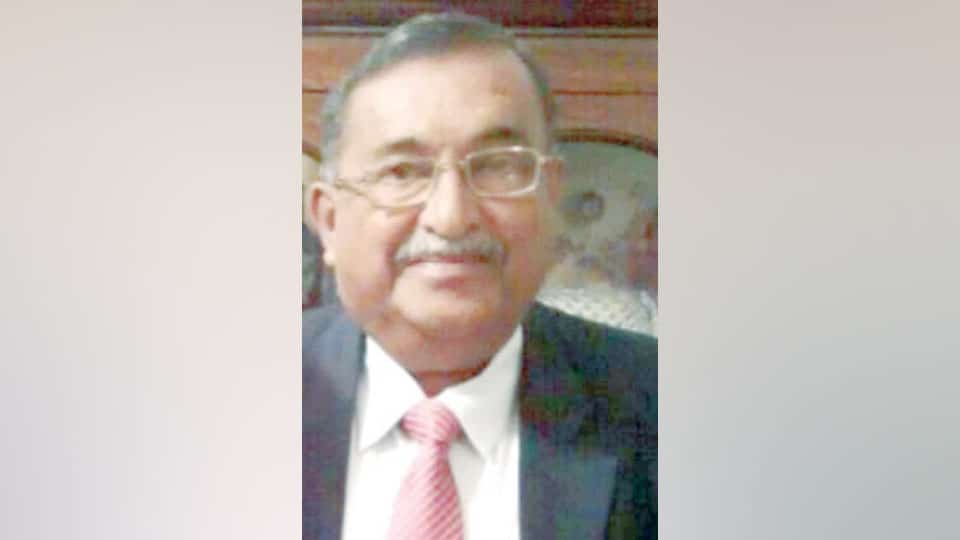
Dr. Chaitra Narayan, an entrepreneur, has been appointed as the Syndicate Member of University of Mysore.
As per the notification issued from the Office of the Governor, the term of office shall be for a period of three years with effect from Sept. 22, 2020.
Dr. Chaitra, Founder of Codagu Agritech and Shivam Distillations, holds a Ph.D and MSc in Microbiology from the University of Mysore.
She was selected by Rashtrapathi Bhavan, New Delhi, for the Festival of Innovation and Entrepreneurship in 2018 to present her ideas before President Ram Nath Kovind. She also presented the Biocapsule technology, which is a ‘Make in India’ initiative before Prime Minister Narendra Modi.
Currently working for the farmers of Kodagu, Hunsur and Periyapatna regions since 2016 towards alternative farming which involves cultivation of medicinal and aromatic plants, it has successfully led to an increase in revenue generation of farmers along with an assured buy-back market.
Codagu Agritech is a Biocapsule Manufacturing Company which helps farmers go for safe and sustainable farming while Shivam Distillations focuses on providing farmers of Hunsur and Periyapatna regions to cultivate aromatic crops as an alternative to tobacco cultivation.
An aromatic plant processing and distillation unit has been set up in the region to provide the farmers with the market at their doorstep.
source: http://www.starofmysore.com / Star of Mysore / Home> News / September 29th, 2020
Public criticism forces ZP to seek government’s help to deal with the situation resulting from bad roads
The members of Kodagu Zilla Panchayat have met Minister for Rural Development and Panchayat Raj K.S. Eshwarappa and urged him to release a sum of ₹20 crore for urgent repair of roads that have become unmotorable following heavy rains over the last three years.
Kodagu had witnessed widespread floods and landslides three years in a row, resulting in extensive damage to the road infrastructure and causing hardships to the local people. The bad roads have led to resentment against the elected representatives, especially the members of the Zilla Panchayat whom the public are blaming for the apathy.
The public have been resorting to novel protests across the district demanding immediate repair and asphalting of damaged roads. There have been instances of public planting saplings on the potholed roads to vent their ire.
A delegation from the Kodagu ZP led by president Harish met Mr. Eshwarappa in Bengaluru on Tuesday and apprised him of the condition of roads besides the urgency for releasing funds for their repair and asphalting.
In a letter to Mr. Eshwarappa, Mr. Harish said tourists had been sharing messages and photos on the poor condition of roads in Kodagu on various social media platforms.
He sought an immediate grant of ₹20 crore for improving the condition of roads.
source: http://wwww.thehindu.com / The Hindu / Home> News> States> Karnataka / by Special Correspondent / Mysuru – September 24th, 2020
Karnataka State Industrial & Infrastructure Development Corporation Limited also plans to develop a helipad
Kushalnagar:
The Karnataka State Industrial & Infrastructure Development Corporation Limited (KSIIDC), the nodal agency for the development of airstrips across Karnataka, has listed the proposed airstrip at Kushalnagar as a priority one.
In its website, the KSIIDC has listed the 950-metre Kushalnagar airstrip as located adjacent to Sainik School with land availability of 49.5 acres. There is a proposal to develop the area as an airstrip and a helipad. An airstrip would have basic minimum facilities like the airstrip, terminal with security post, fencing and security by local Police.
The Government Order to develop Kushalnagar airstrip along with other airstrips at Chikkamagalur, Karwar, Raichur, Gadag, Bagalkot, Davanagere and Udupi was issued way back in 2018 after the Narendra Modi Government announced Regional Connectivity Scheme (RCS) or the Ude Desh ka Aam Nagarik (UDAN) Scheme. Among them, airstrips at Chikkamagalur, Karwar and Kushalnagar are being taken up on priority.
Last December, the Union Civil Aviation Ministry had selected Kushalnagar airstrip under the fourth round of RCS-UDAN Scheme. The airstrip was listed under unserved airport category — any airport at which there have been no scheduled commercial flights. But there were no bidders last time as the Kushalnagar airstrip was in nascent stage. Now that the land has been identified, the Government is looking forward to private companies to develop the airstrip under Public-Private-Partnership (PPP) model.
Agri Minister unhappy
The land for the airstrip has been identified behind the Kodagu Sainik School at Koodige. Over 49.5 acres land owned by Agricultural Department at Doddathoor village till the border of Basavanathoor village has been identified for the airstrip and in June last year, a team of officials from the Airports Authority of India (AAI) had visited the site and accepted the land proposal.
But Karnataka Agriculture Minister B.C. Patil has not taken the land issue lightly as 49.5 acres is being taken from his Department. At a recent meeting of Agriculture Department in Madikeri, the issue was brought to his notice by some officials and the Minister categorically stated that the Department land would not be handed over to the airstrip.
Justifying his move, Patil told the officers that the Department had 475 acres of flat land in Kushalnagar. A part of the land was later given to Sainik School which occupied over 66 acres. Likewise, over 15 Departments including Koodige Sports School, Dairy and Poultry Farms of Animal Husbandry Department and Horticulture Department have got lands.
“If we go on giving lands to all, our Department would suffer as we too need land for our agriculture research and extension activities,” Patil reasoned, refusing to hand over the land to the airstrip.
Ideal place for airstrip: MLA
Patil’s statement notwithstanding, Madikeri MLA Appachu Ranjan, who first proposed an airport to Kodagu when he was the Minister for Youth Services and Sports in 2012, told Star of Mysore that the land has been finalised and there is no question of changing it at this juncture.
“A 50-acre flat land is not available anywhere in Kodagu that is a hilly terrain. This land is ideal and we will get it for sure. As there is a Sainik School next to the airstrip, there is a proposal to establish an Aviation Training Academy where this Academy can train flight aspirants from Kodagu, Mysuru and surrounding regions. This is an ideal place for the airstrip, helipad and the Aviation Training Academy,” he explained.
source: http://www.starofmysore.com / Star of Mysore / Home> News / September 12th, 2020
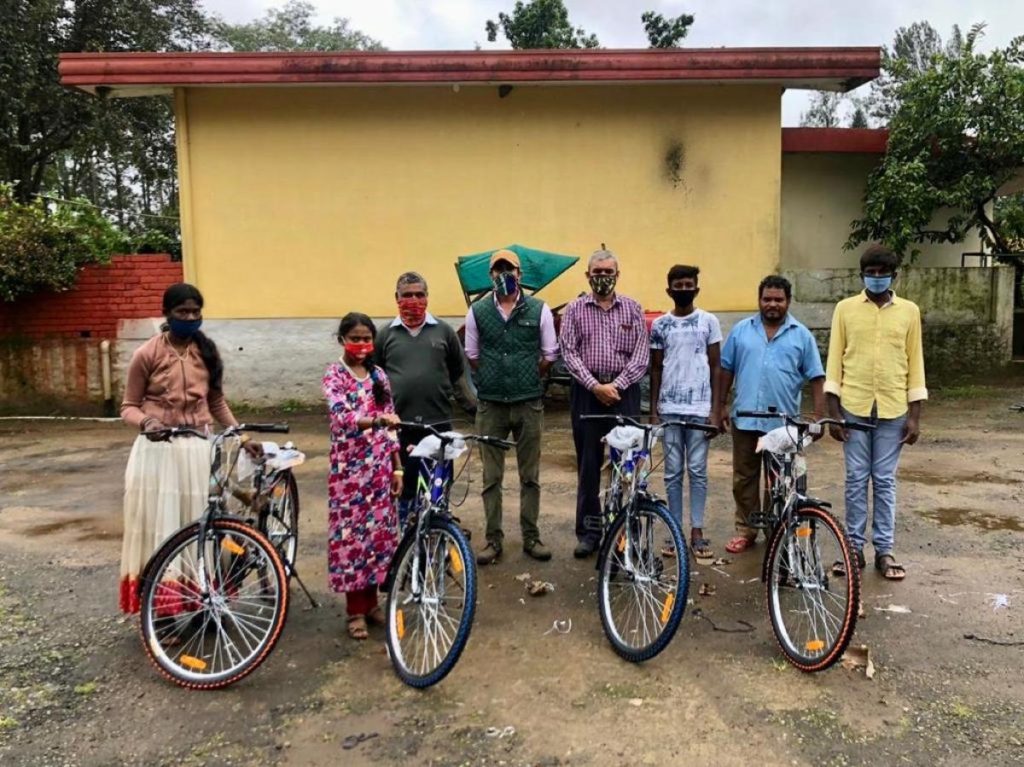
Planters and father-son duo Vinod Sivappa and Vishal Sivappa donated bicycles to the needy workers and students. DH Photo
Extending a helping hand to the needy students and agricultural labourers, a father-son duo from Suntikoppa have donated new bicycles to labourers and students to help them commute easily.
Planters and father-son duo Vinod Sivappa and Vishal Sivappa donated bicycles to the needy workers and students. DH Photo Extending a helping hand to the needy students and agricultural labourers to reach from one place to another. The livelihood of the labourers, who are dependent on plantation work, was affected due to the lack transportation facility.
Realising this Vishal Sivappa and his father Vinod Sivappa, planters from Suntikoppa, distributed bicycles to the needy workers and students.
Vishal said that his parents and grandparents were involved in social service. During the current situation, people are in need of assistance as their livelihood is affected.
“I see many students walking 5 km to 10 km to their schools and workers in various estates walk several kilometers on a daily basis. Donating bicycles would definitely help them reach their destination much faster. This is very small contribution and I am really happy to help them,” he added.
Vishal’s father Vinod is also engaged in farmer welfare programmes over the past few years. Vinod said that he felt proud to extend his support to his son’s initiatives directed towards the welfare of the needy labourers.
source: http://www.deccanherald.com / Deccan Herald / Home> State / by DHNS / August 12th, 2020
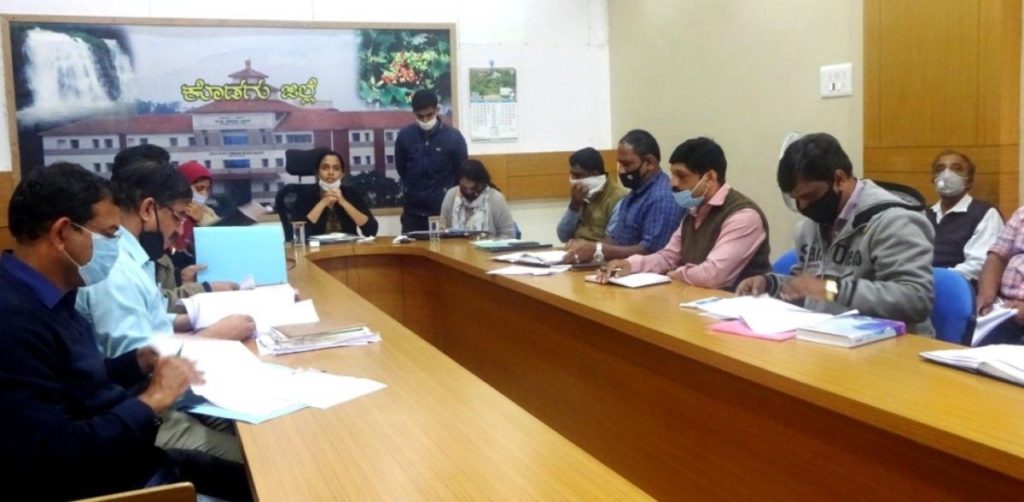
Deputy Commissioner Annies Kanmani Joy chairs a meeting in Madikeri on Friday.
Now, farmers can directly enter the details of the crops they have cultivated in their RTCs (record of rights, tenancy and crops) with a few clicks on the app on crop survey.
The last date for entering the details on the crop survey is August 24. The ‘Farmers Crop Survey App 2020-21’ has been developed by e-governance department of Karnataka, said Deputy Commissioner Annies Kanmani Joy.
Chairing a meeting on implementation of the crop survey, she said the farmers should mention survey number, hissa number of the land owned by them and upload details on agriculture crops, horticulture crops and other forest crops cultivated by them.
The DC said farmers had to take photographs of the crops cultivated on the land and fill in the details. Depending on crop details and extent of area cultivated that are documented in the pahani, government will announce support price and compensation during the natural calamities. The crop survey will benefit in documenting the details of the crops cultivated in pahani, Annies said
If farmers are unable to conduct survey of crops on their own, then they can seek the assistance of private individuals to document the details after August 24, she added.
The details uploaded by the farmers will be verified by the officials. The farmers can visit Raitha Samparka Kendra, revenue inspectors, village accountants and assistant agriculture and horticulture officials, for any query.
Agriculture Minister B C Patil, in a video conference with Deputy Commissioner, said that the crop survey should be implemented like a ‘Utsava’. For the first time in the country, the crop survey is carried out by the farmers themselves using an app.
In the past, objections were raised when the crops that the farmer claimed to have grown was different from the one recorded on the RTC. As the farmers themselves take up the survey, the mistakes in the RTC can be avoided, Annies said.
The ‘Farmers Crop Survey App 2020-21’ can be downloaded from Play Store. A farmer should register his name and mobile number using an OTP. The farmers should select district, taluk, hobli, village and add survey number of the land and then furnish details of the crops cultivated.
MLA M P Appachu Ranjan visited the rain-affected Makkandooru and other areas on Friday. He inspected the affected farmland, houses and public roads in Makkandooru, Kadagadalu, Hodduru Gram Panchayat jurisdiction along with officials.
source: http://www.deccanherald.com / Deccan Herald / Home> State> Karnataka Districts / by DHNS, Madikeri / August 14th, 2020
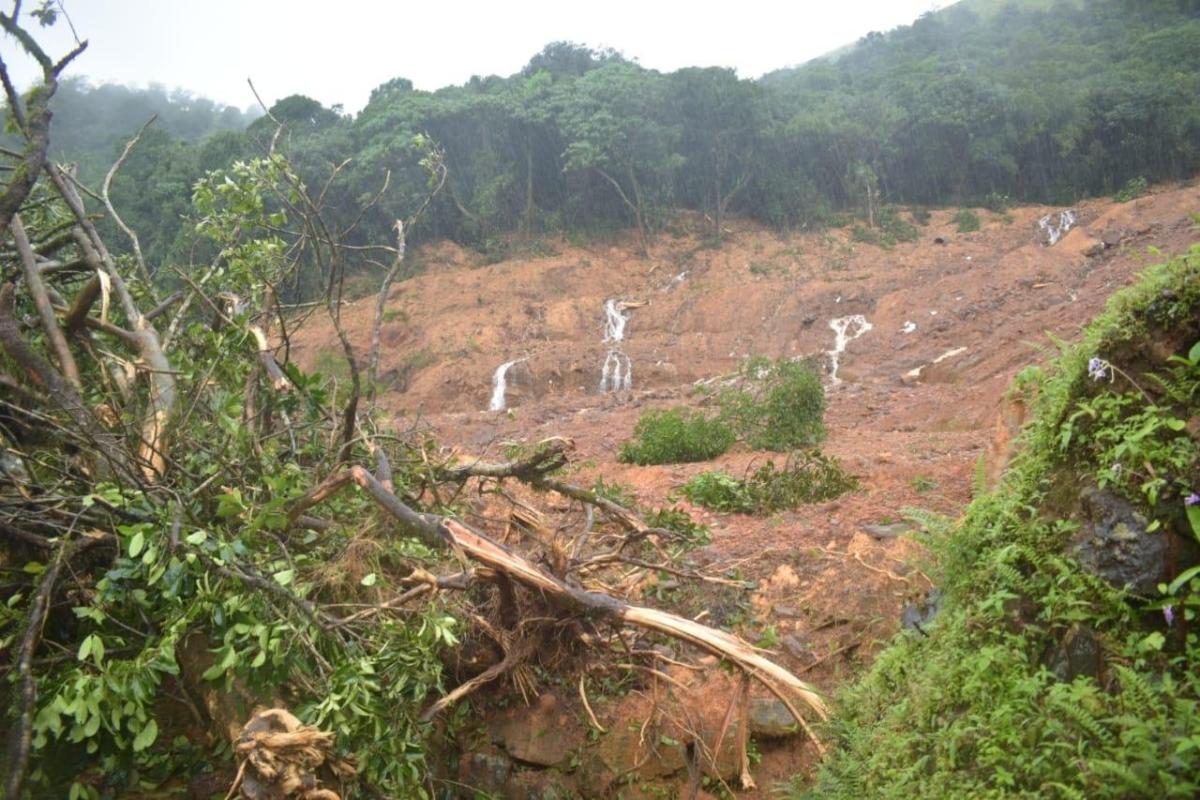
The site of landslide in the Brahmagiri range, Kodagu. DH Photo
The oft-cited maxim of the ecological sensitivity of the Western Ghats, repeated ad nauseam over the past two decades or so, has fallen on deaf ears. The failure to prevent the degradation of forests in the Sahyadris, along with the increasing instances of extreme rainfall over a short period of time — especially over the past three years — has wreaked havoc in this lifeline of South India.
The Karnataka government, which has improved its performance in terms of flood preparedness, relief work and rehabilitation measures, seems to have taken little action to prevent or mitigate future landslide hazards.
Despite the devastation, the government has either proposed or persisted with over 20 linear projects that could damage more than 25,000 hectares of forest in the region. These projects include Yettinahole River Diversion project, Kalasa-Banduri project, Sharavathy pumped storage power plant, Hubballi-Ankola railway line and many road construction and widening projects.
Worse, this year landslides have been reported in 80 locations between Mangaluru and Karwar, where highway construction work has been taken up.
Apart from infrastructure projects, change in land use norms, the lack of a long-term mitigation policy to address deterioration of green spaces and improve forest cover, and relentless expansion of plantations in the Malnad districts are just some aspects contributing to a looming environmental disaster in one of the world’s biodiversity hotspots.
Several activists, who relentlessly protested against projects in the Western Ghats, have hung up their boots, and lament the futility of their past efforts to ensure legal protection to the ecosystem.
There is no dearth of comprehensive reports on the cause of problems in the region and how to address them. In 2011, the report submitted by the Western Ghats Ecology Expert Panel, under the chairmanship of Prof Madhav Gadgil, had warned of impending natural disasters unless immediate and sustainable measures were taken to protect the ecosystem. The report sought to designate over 60% of the Western Ghats as highest-priority Ecologically Sensitive Zones.
All the states who are the custodians of the Western Ghats ignored this report. The states couldn’t come to a consensus on the subsequent Kasturirangan report even after four draft notifications, with Karnataka repeatedly rejecting the recommendations.
The Gadgil committee report was back in focus last year, as most of the places where the landslides took place were considered ecologically sensitive by the committee.
Now, the state government has set up another panel to study landslides in the region.
The benefit of commissioning a new report is still unclear. However, the government’s actions have made it evident that it is not keen on conserving the Western Ghats; experts say the degradation of forests here will have cascading effects, triggering landslides, choking streams and posing a flood threat for downstream areas, something we are witnessing today.
A scientific paper by Prof T V Ramachandra, Centre for Ecological Sciences, Indian Institute of Science and others shows that the extent of evergreen forests shrank by 16% in Kodagu between 1973 and 2018, from 40.47% to 24.17%; a loss of around 67,000 hectares of forest land. “The region had 32% of forest cover under interior or intact forests in 1973, whereas in 2018 it covers only 19% in various protected areas,” says the study.
“The expansion or construction of linear alignments would result in irreversible ecological degradation. The recent floods and landslides are certainly a warning to the decision makers of likely implications, with the drastic changes in the land cover eroding the native forest ecosystems. Further interventions will worsen the ecology and hydrology as well as livelihood, with increase in instances of human-induced calamities,” the paper warned. Yet, the state revenue department lifted a ban on the conversion of land use in Kodagu in February this year.
Degradation main cause
While environmental degradation triggering landslides is starkly evident in Kodagu, similar situations persist in all districts bordering Western Ghats – Hassan, Chikkamagaluru, Shivamogga, Dakshina Kannada, Uttara Kannada, Dharwad and Belagavi.
Conservation biologist Keshava H Korse pointed out that major landslides are being reported at core ridges of Western Ghats due to repeated disturbance of vegetation in such areas. “Bhagamandala, where major landslides were reported in the past two years, is one such area which has loose soil,” he said.
The area was classified as a highest-priority ecologically sensitive zone in the Gadgil committee report, where all development projects were expressly forbidden due to the fragility of the ecosystem. Yet, several projects were taken up here.
“The injuries to the Ghats cannot be healed in one go. Just to recover the natural vegetation where landslides have occurred, it will take four years,” Korse said.
Among the alarming incidents during the downpour in the first two weeks of August this year, were the landslides reported just six km from Linganamakki reservoir in Shivamogga district, pointed out Ananth Hegde Ashisara, Chairman of Biodiversity Board. He is heading a 10-member committee set up in February this year, to study the main causes for such landslides and to suggest an action plan to mitigate them.
Some of the places highly prone to landslides include the Kodagu DC office, villages near Jog Falls and settlements situated in the Western Ghats. “Our major challenge is to ensure people relocate from areas which are dangerous. It is a difficult task as people don’t want to move away from their homes or agricultural land,” Ashisara said.
Though reasons for landslides were varied across Malnad districts, he suspected that vegetation loss was one of the key triggers for extensive damages witnessed in Kodagu and Chikkamagaluru.
“Deforestation is high, non-agricultural use of land near the forests are prominent. The ecosystem can rejuvenate by reducing human interference in such regions. The ecosystem will revive on its own; this can be accelerated by planting flora indigenous to the region,” Ashisara said.
G S Sreenivasa Reddy, former chairman of Karnataka Natural Disaster Monitoring Cell and a member of the committee, said that there were observable changes in rainfall patterns that have triggered the crisis. “We will give recommendations on what each department should do to mitigate the problem,” he said.
According to him, the cascading effect of disturbing the Western Ghats will worsen fluctuations in the intensity of rainfall, affecting water security and crop cultivation patterns.
Col (rtd) C P Muthanna, former president of Coorg Wildlife Society, noted that Western Ghats are susceptible to even minute changes. “We are talking with the district administration to discuss measures to prevent such incidents. We are against converting land for commercial use as it causes degradation,” he said. Efforts are also being made to encourage planters to cultivate native trees inside plantations.
Sundar Rao Bantwal, who put an end to his environmental activism after the Yettinahole project was cleared, painted a gloomy picture on how environmental concerns were always sidelined over profits by politicians and contractors. “Despite a strong opposition, large projects are taken up in eco-sensitive zones. Even if we drag the cases to court, it will be of little consequence. Approaching the Green Tribunal too won’t help,” he said, citing the controversial project as an example. The project might fail in 10-15 years and neither those who approved it nor the ones constructed will take responsibility for the disaster, he added.
Ramachandra said despite recurring disasters, as many as 55% people in Kodagu are for ‘development’, while 40% are for conservation measures, with a small minority undecided. “After the last floods, we managed to convince the Deputy Commissioner to impose restrictions against resorts mushrooming in the district, which used to occupy natural courses of water. Recently, the restrictions were lifted after political interference,” he said.
Virajpet MLA K G Bopaiah was of the view that climate change was responsible for the widespread devastation. “Save for the last three years, receiving 20 inches or more rainfall in less than a week is unprecedented,” he said. Disputing that change of land use was the major cause for landslides, he said that landslides were reported where thick forests were present. “Nobody has even considered interfering in such dense forest areas,” he said.
Noting that several areas of the district were susceptible to landslides following heavy rainfall, he said that measures will be taken to address the same.
source: http://www.deccanherald.com / Deccan Herald / Home> Specials> Insight / by Akram Mohammed, DHNS, Bengaluru / August 15th, 2020
Following copious rains across Kodagu district, the Harangi reservoir is almost full. The dam is two feet short of reaching its maximum level of 2,859 feet at 2,857 feet this morning.
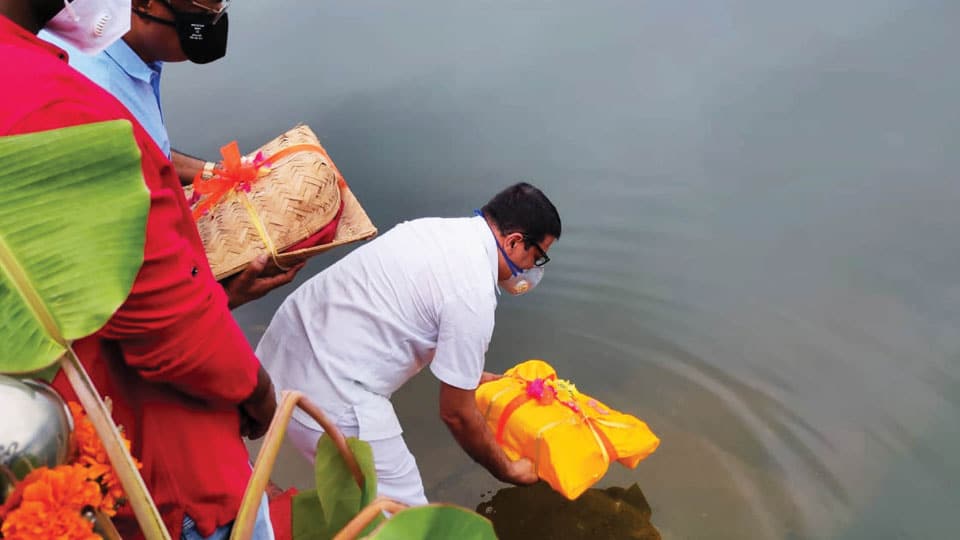
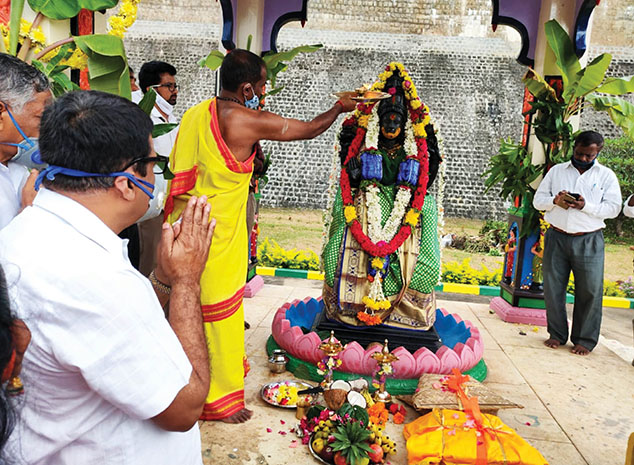
Before the crest gates were opened, Madikeri MLA M.P. Appachu Ranjan offered ‘Bagina’ to River Cauvery after performing puja to the statue of River Cauvery located at the base of the reservoir this morning.
Executive Engineer Rajendra, Harangi Reservoir Assistant Engineer Nagaraju and other BJP leaders were present on the occasion.
This reservoir is the main source of water for KRS dam in Mandya district. Irrigation Department Executive Engineer Rajendra said that water from the Harangi reservoir is now being released into the river.
Following heavy flow in recent days, water is also being released into irrigation canals.
The right bank cannals feeding irrigated lands in Hunsur and KR Nagar taluks of Mysuru district are getting 1,500 cusecs of water every day while 400 cusecs of water is being released to left-bank canals feeding lands towards Hassan district. The inflowing water is much clear compared to last year.
Experts opine that this is probably due to growth of vegetation at the areas of landslides, which had caused heavy damage in the region, last year.
Harangi Dam provides irrigation facility to thousands of acres of farmland in Periyapattana, Hunsur and KR Nagar of Mysuru district, Arkalgud taluk of Hassan district and Kodagu district.
The Harangi Dam can hold 8.5 TMC of water.
source: http://www.starofmysore.com / Star of Mysore / Home> News / July 31st, 2020
Horticulture Department has produced over 54,000 saplings for distribution among growers this year.
Kodagu is known for its oranges besides coffee and spices. But, the last two years of devastation triggered by floods and landslides affected the crop, causing losses to growers. Over the years, the crop area has not expanded much with issues over falling prices and pest attacks.
In a bid to expand the crop which is primarily cultivated amidst coffee plantations, the Department of Horticulture has produced over 54,000 orange saplings for distribution among the growers for planting them in their plantations this year. These saplings had been produced at State-run horticulture farms across Kodagu.
“We have set a target of increasing the crop size by at least 10 per cent a year. The department has eight farms where the saplings of Kodagu oranges were carefully produced to expand its area of cultivation. Kodagu’s climatic condition is unique and the oranges grown here come with a lot of pulp and also taste good,” said Shashidhar, Deputy Director of Horticulture, Madikeri.
The area of cultivation has come down over the years to less than 5,000 hectares and the yield has also been falling because of climate change. Subsidy is offered to growers to boost cultivation of the fruit, also called Coorg Mandarin
Appanna, a progressive farmer from Gonikoppal, has over 100 orange trees and was harvesting over two to three tonnes a year. “I suffered loss because of excessive rains. I used to harvest 30-40 kg from each tree but the yield fell to less than 10 kg and the fruit quality had also dropped,” he explained.
source: http://www.thehindu.com / The Hindu / Home> News> States> Karnataka / by Shankar Bennur / Mysurue – July 30th, 2020
WELCOME. If you like what you see "SUBSCRIBE via EMAIL" to receive FREE regular UPDATES.
Read More »