Category Archives: Agriculture

Avocado growers in Kodagu find market in Bengaluru’s apartments

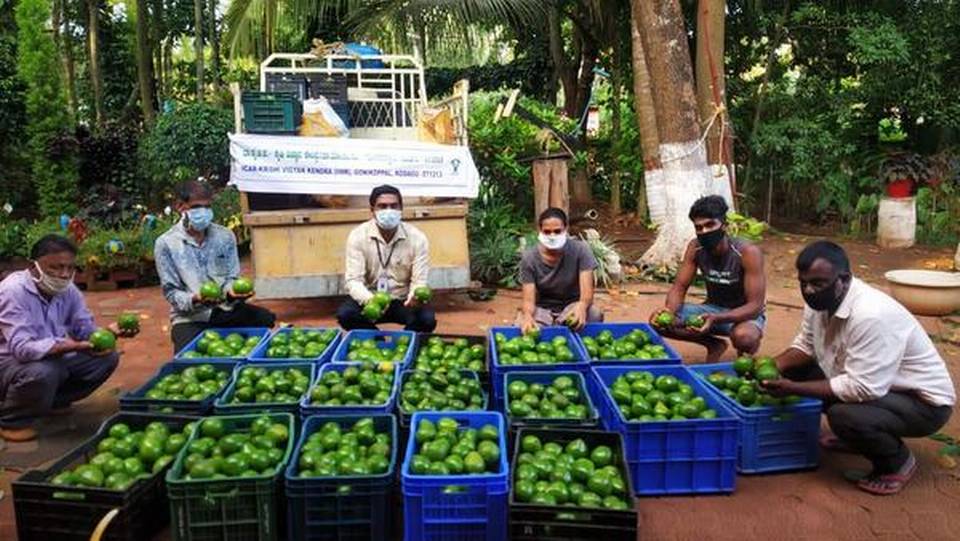
Avocado fruit stacked in boxes in Kodagu for transport to Bengaluru.   | Photo Credit: SPECIAL ARRANGEMENT
Avocado fruit stacked in boxes in Kodagu for transport to Bengaluru. | Photo Credit: SPECIAL ARRANGEMENT

Gonikoppal KVK provides the link for direct marketing

Avocado or butter fruit growers in Kodagu heaved a sigh of relief after their produce, which was facing a threat of spoilage with no takers in the district due to lockdown, finding a “promising” market among apartment dwellers in Bengaluru.

Thanks to ICAR-Krishi Vignana Kendra (KVK), Gonikoppal, the growers, who had lost hopes of marketing their produce and worried over crop loss, managed direct marketing to the consumers in Bengaluru. The returns were reasonably good considering the COVID-19 crisis.

Around one tonne of avocado, which is described as a “miracle fruit” for its health and nutritional benefits, was sold in a single day on Sunday.

The fruit is grown on about 500 hectares in Kodagu amidst the plantations and the area of cultivation had seen a rise in the recent years, thanks to its popularity among the urban masses, especially the youth.

Appanna Cheppudira, who quit his lucrative bank job and took up farming, managed to sell 15 quintals of fruit harvested from 25-plus trees at his estate near Gonikoppal. “Avocado is a highly perishable fruit. It needs to be consumed within 3-4 days of its harvest. Growers like me were at a loss with no market for our produce post-lockdown. We broached the problem with KVK Gonikoppal and it showed a direct market route for the fruit,” the pleased farmer said.

Like Appanna, three other growers, including one Somanna and his daughter, found instant market in Bengaluru, and their produce was sold out. Remarkably, the fruit which was sought for ₹20-25 a kg in Kodagu, was sold for ₹60-75 a kg in Bengaluru.

The direct marketing helped growers get some income although the fruit used to fetch a much higher price during normal days.

Kodagu has an ideal climate for cultivating the fruit. Kodaikanal in Tamil Nadu and Wayanad in Kerala are among the major avocado growing areas, according to KVK.

Speaking to The Hindu, KVK Head and Scientist Saju George said market access was restricted due to the lockdown. In normal times, the fruit was mostly transported to cities including Bengaluru and mainly bought by juice shops. With the closure of juice shops and restaurants, there were no takers for the fruit, putting growers in trouble.

Mr. George said the KVK decided to help farmers market their freshly harvested, spot-free and ‘A’ grade quality fruit and as a result established a direct marketing link among four to five apartments in Bengaluru. “This model has worked as the consumers ended up buying in bulk seeing the quality of fruit.”

The KVK was approached by other growers seeking help to market avocado. “We have established the link between growers and consumers. The growers need to harness this link for marketing their produce. The apartment societies can also approach the growers for fresh supplies,” the scientist said.

However, growers were facing labour shortage for fruit harvest. “I have about 10-15 quintals of fruit ready for harvest and I am unable to get workers. Each tree needs at least three workers for harvest. With great difficulty, I managed to source some locals for plucking the fruits which is a painstaking task,” explains Appanna, while thanking the KVK for its gesture.

source: http://www.thehindu.com / The Hindu / Home> News> States> Karnataka / by Shankar Bennur / Mysuru – May 13th, 2020
Project On To Remove Silt From Cauvery River In Kushalnagar

Kushalnagar01KF12may2020

Kushalnagar:

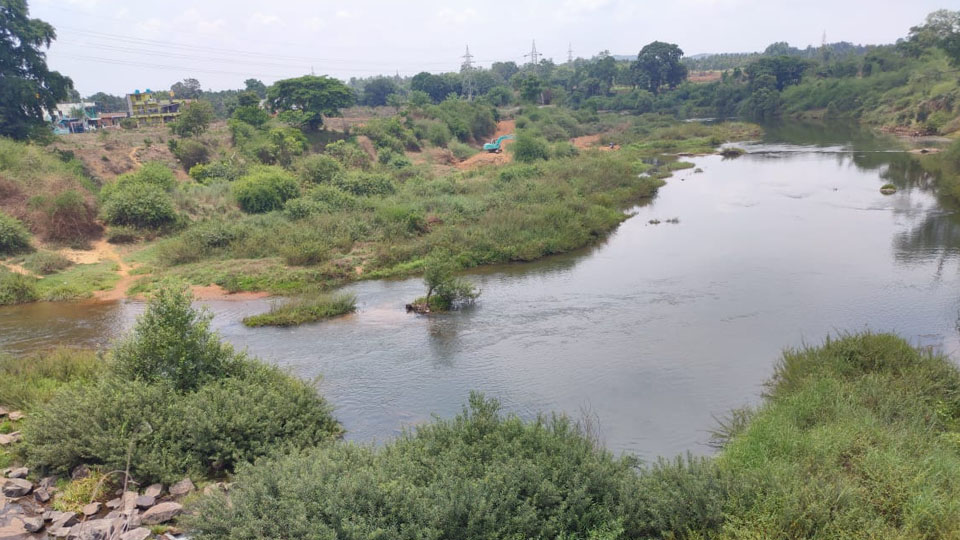
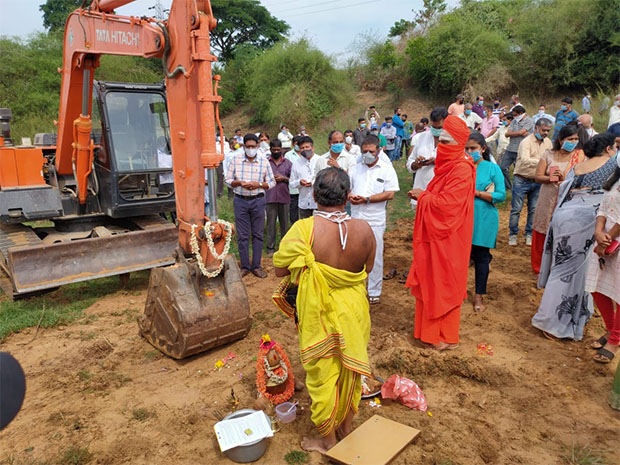
Ground-breaking ceremony for a mega Rs. 89-lakh project to remove silt from River Cauvery in the Kushalnagar belt to prevent flooding of the town was performed this morning. Madikeri MLA M.P. Appachu Ranjan performed the ceremony in the presence of Kodlipet’s Kirkodli Mutt Seer Sadashiva Swamiji.

The Kodagu District Administration had agreed for the project based on the request by Kushalnagar Cauvery Pravaha Santhrasthara Vedike (Forum for flood affected) and funds were released accordingly by the State Government.

Previous two years, there was unprecedented flooding in Kushalnagar and most of the areas inside the town were under water for weeks together. Kodagu received the highest-ever rainfall for August 2018 surpassing an 87-year-old record. Last year too, the district received high rainfall and as a result, rivers were in full spate.

Kushalnagar02KF12may2020

Last year, for the first time, the 400-year-old bridge near Kushalnagar-Koppa border (next to the newly-constructed bridge) submerged on Aug. 10. This rain, coupled with huge water release from Harangi Dam, brought untold miseries to the people of Kushalnagar.

This year, the silt is being removed to prevent flooding like in the previous years. An area of 300-metre length and 100-metre width has been identified in the surroundings of Rasool Layout, Muthappa Swamy Temple and Ayyappa Swamy Temple.

The mud-and-sand combined silt is being removed by earth movers and the excavated earth will be dumped on the river side. Also, channels will be built so that rainwater that floods Kushalnagar town can smoothly enter the river. PR Constructions has been given the contract of silt removal.

Silt removal from Harangi Dam

MLA Appachu Ranjan told ‘Star of Mysore’ today that a proposal to lift over one tmcft (one thousand million cubic feet) of silt that has accumulated at Harangi Dam is pending with the State Government.

Harangi is the main Cauvery water supply reservoir from the catchment areas to Krishna Raja Sagar (KRS) Dam in Mandya, the lifeline of South Karnataka and Tamil Nadu. Due to heavy silt deposit, enough water cannot be stored, leading to annual water shortage. Therefore, it has been recommended to the Government to take measures to remove silt so that more water can be stored, he said.

The Karnataka Engineers Research Station (KERS) at KRS Dam in Mandya and Geo Marine Solutions Pvt. Ltd. had studied the silt deposits and accepting its recommendations, the State Government had released Rs. 75 crore to remove silt. “We have requested the Government to release Rs. 130 crore and the proposal is yet to be accepted as the Government is busy in COVID-19 battle,” the MLA said.

River course correction

Due to major landslides, many rivers and tributaries have changed its course. Last year, the inflow from River Cauvery was more than Harangi River. Every year, Harangi River reports highest inflow to the Harangi Dam and last year’s phenomenon was unique. While Harangi River originates in the Pushpagiri Hills, Cauvery takes birth in Talacauvery and flows through Bhagamandala, Kushalnagar and Koodige. Both the rivers meet at Koodumangaluru and flow into KRS Dam.

“Last year, Harangi River reported an inflow of 30,000 to 35,000 cusecs while Cauvery River reported an inflow of 80,000 to 85,000 cusecs. This is because the rivers have changed course and have accumulated huge silt due to landslides of 2018. We need money for river course correction and silt removal and that’s why we have asked for Rs. 130 crore,” Appachu Ranjan said.

Dy.SP Shylendra, Kushalnagar Panchayat CEO Sujay Kumar, Kushalnagar Cauvery Pravaha Santhrasthara Vedike President Chandra Mohan, members Uday Kumar, M.M. Charan, Varadha and Kodagana Harsha were present.

source: http://www.starofmysore.com / Star of Mysore / Home> News / May 11th, 2020

COVID-19: Karnataka coffee growers demand special package

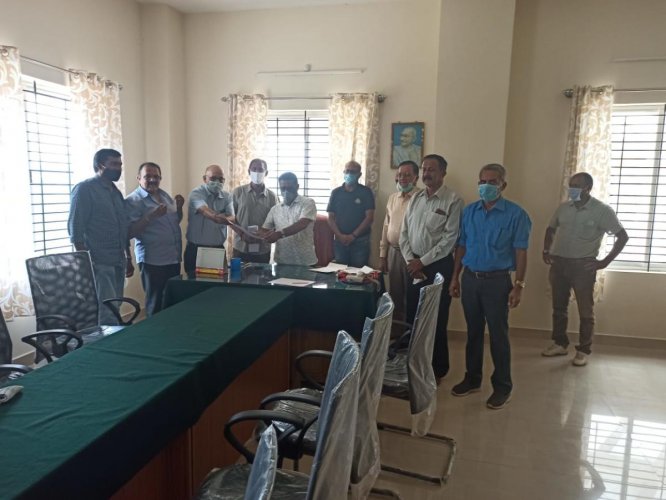
Members of Kodagu district Growers' Federation submit a memorandum to MLA Appachu Ranjan. DH Photo
Members of Kodagu district Growers’ Federation submit a memorandum to MLA Appachu Ranjan. DH Photo

Coffee growers in the district have demanded special package from state government, as planters are facing hardships in the wake of Covid-19 lockdown.

Members of the planters’ association have submitted a memorandum to the MLAs of the district in this regard and have urged chief minister to come to their rescue.

Kodagu district is affected by floods for past two years and the lockdown has worsened the situation, they said and pointed out that harvesting of coffee and pepper in most of the plantations had come to a standstill, resulting in the loss of crops.

It is feared that next year’s yield too will be lost as the growers are finding it difficult to maintain of their plantations.

The growers urged the government to provide special package for the coffee growers.

Vegetable and plantain cultivators too sought assistance from the government, stating that most of the cultivators in the district have been dependent on Kerala market. But, due to the lockdown, the fruits are getting rotten and has led to a huge loss.

The government should announce support price and should procure ‘Nendra’ banana and other fruits from the farmers, the growers said and also requested the government to waive the interest on the loans availed by them.

“A committee of elected representatives should be formed towards formulating plans to encourage farmers to take up cultivation in barren lands,” the memorandum stated.

source: http://www.deccanherald.com / Deccan Herald / Home> State> Mangaluru / by DHNS, Madikeri / May 08th, 2020

Catch Of The Day! 38-Kg Fish Caught From Harangi Backwaters

FishKF06may2020

Kushalnagar:

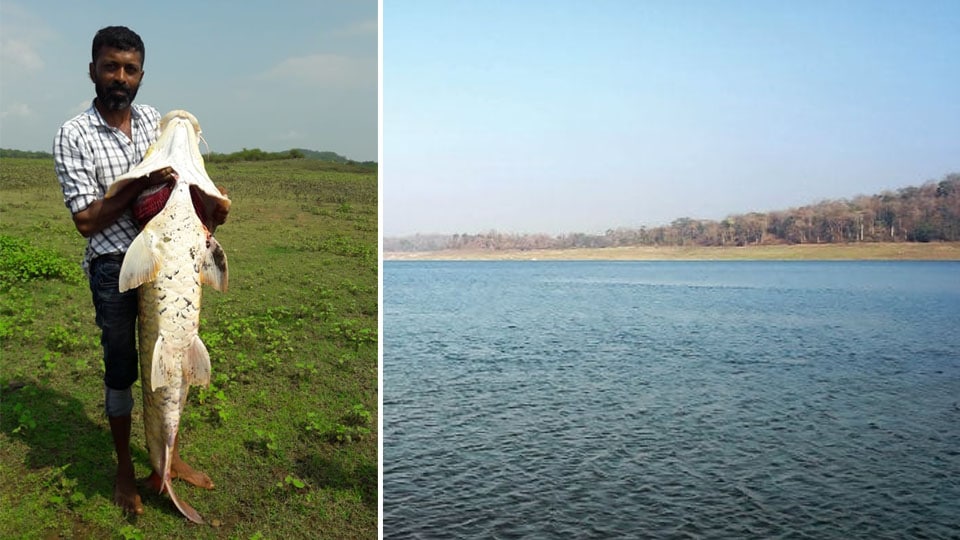
A group of youths who were fishing at Harangi backwaters in Kodagu District this morning were in for a pleasant surprise as they caught a giant fish that weighed 38 kgs. The fish was caught with the traditional method of fishing rod and angler.

The fish, Catla variety, was caught at Nakoor village along the Harangi backwaters by Preveesh, who then uploaded the same on his Facebook page. He said that though he was hoping for a good catch he did not expect this big a catch. Earlier too he had caught giant Catlas but this particular fish was his biggest catch. Today’s fish was sold at the local market.

Due to lockdown and lack of activities, there is a lot of fishing going on in the Harangi backwaters where youths come in many groups to fish. Typically, the fishing activity starts early in the morning and ends at around 11 pm. Local villagers from Nakoor, Shirangala, Suntikoppa, Hosathota, Kusboor and Madapura come to the backwaters to fish on the 5.6 km Harangi River stretch from the Harangi Dam to Koodige Bridge.

Traditional fishing is being held from many years in the backwaters of Harangi, which spreads over 1,886 hectares in area. Lakhs of fingerlings are released into the reservoir every year.

Some innovative villagers have even dug up irrigation ponds in the backwaters to supply water in summer to their fields. When the water storage is high at the Harangi Reservoir, these irrigation ponds get filled and submerge and when the water at the dam recedes, these ponds are full of water and fish.

Varieties of fish, including Mahseer, Catla and Rohu are released to Harangi every year and along with these, fingerlings procured from Kabini and Bhadra reservoirs are being provided to farmers at subsidised costs. Many families in this belt depend on fishing for their livelihood.

source: http://www.starofmysore.com / Star of Mysore / Home> News . April 29th, 2020

Pepper prices rise 15% amid lockdown on hope of healthy post-monsoon sales

Farmers hold on to stocks due to great demand for high-quality Indian produce.

Some farmers who had finished harvesting had sold in panic.

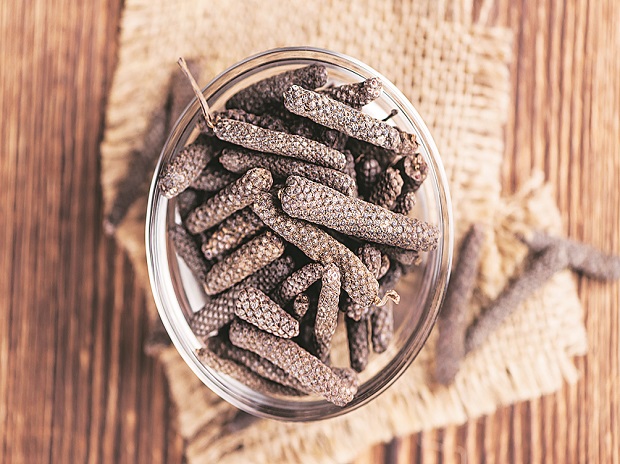
Pepper prices have turned buoyant again rising by as much as 15 per cent in India to Rs 325 per kg from Rs 285 earlier.

Rohan Colaco, a planter from Karnataka and a member of Karnataka Planters Association, said that pepper prices had been sliding prior to the lockdown. The spice was trading at around Rs 285 a kg and was expected to go down to Rs 260.

Some farmers who had finished harvesting had sold in panic. Also there was unripe pepper wine harvest and selling this year. After the lockdown, the prices opened at Rs 305.

“It is expected that there will be no inward movement of pepper through international borders. There is also good demand for high quality Indian pepper. Many farmers are keeping stocks to sell after the monsoons as winter demand will start strengthening. These reasons are pushing pepper prices up,” said Colaco.

He added that the spice had hit a high of Rs 330 about a year back. He believes pepper may approach this price as there already exists a huge stock of imported pepper.

source: http://www.business-standard.com / Business Standard / Home> Markets> Commodities / by T E Narasimhan / April 27th, 2020

Brew-tiful Coorg

The Karnataka district is a rich blend of history and hospitality

Coorg coffee is grown at a high altitude and under a well-defined two-tier mixed shade canopy /  Picture: Karen Anand
Coorg coffee is grown at a high altitude and under a well-defined two-tier mixed shade canopy /
Picture: Karen Anand

I recently visited Coorg in southern India. And as my dear husband keeps saying, I immerse myself so wholeheartedly wherever I am that I invariably want to move there… or at the very least make plans to revisit very soon! Coorg is no exception.

About 250km from Bangalore, it’s an area with a sense of nobility and belonging, of dense forests, coffee plantations and some spectacular estates. The terrain is very, very different from the rest of south India. As you take the gentle climb from the plains to Coorg, or Kodagu as it is now known, you have beautiful mountainous rocks, areca palms that produce betel nut, palm trees and then paddy — it’s a really stunning scape that looks like a painting at every glance.

The capital of Madikeri or Mercara as it was called before, looks like a town like any other town in India, but as you dig a little deeper, visit the vast estates and eat with locals, you find a generosity of spirit, an unbelievably high education level (almost 100 per cent literacy) and a joy of preserving traditions… and that includes food.

Coffee and spices

Kodavas look physically very different to people from Karnataka and the neighbouring Tamil Nadu. They are traditionally warriors, hunters and now landowners. Their livelihood is mainly coffee and this area of just 5,000sq km is the largest coffee-producing area in India. History has it that there was a gentleman called Baba Budan who brought coffee beans to the Chandragiri Hills in Chikmagalur from Yemen in the 17th century. Then the British came in the 19th century and found that this was a crop that could be exploited since conditions for growing coffee were pretty perfect. That was the birth of widespread coffee plantations and coffee farming in this area.

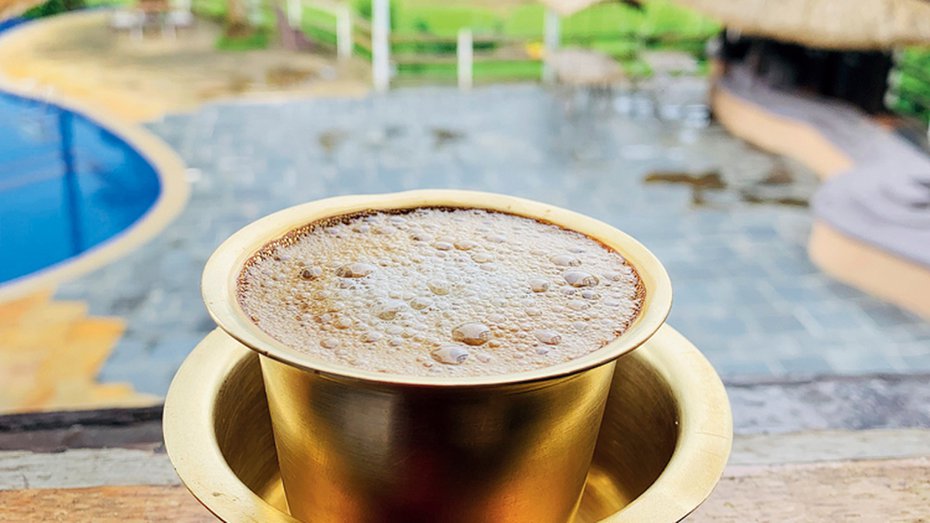
Coorg coffee is grown at a high altitude and under a well-defined two-tier mixed shade canopy. Among the bigger evergreen trees are tall jackfruit, rosewood and wild fig trees which protect the coffee from seasonal variations in temperature and also enhance the soil by providing nutrients from deeper layers. The second layer is pepper, cardamom, cloves, orange and banana. It also protects the coffee from the harsh rays of the sun in summer. Conditions are similar in Colombia and Kenya, considered the best coffee-producing regions in the world.

Coorg is known for “spicy” food. There are lots of spices in their spice mixes — pepper, cardamom, cloves and the tiny bird’s eye chilli known as parangi. Spices are roasted and ground, which gives complexity and density of flavour to their dishes, both vegetarian and meat. Although Coorg is known for the famous pork dish, pandi curry, which is a specialty, there are a host of vegetable dishes that use local vegetables like bamboo shoot, wild mushrooms and a kind of red-leafed spinach, all quite delicious and different.

The method of most of their cooking is roasting and dry-grinding spice combinations, which are thrown into a pot of meat or vegetables with a little black vinegar from the kachampuli, a very sour mangosteen-like fruit which is dried till it’s black and from which an intensely sour vinegar is made. Rice is the staple grain and is eaten as is or made into dumplings with coconut and steamed (kadambuttu), rice rotis and rice cakes (paputtu).

Contrary to what I have up to now believed about food in five-star hotels, the cuisine at the rather magnificent and spanking new Coorg Wilderness Resort exceeded all my expectations. It was beautifully served and tasted like real home cooking. From painstakingly researched local recipes to produce wondrous Coorg lunches to the perfect Chicken 65 and velvety fish molee, chef Ranjan and his team nailed it every time. It poured while we were there but the resort itself is something quite fantastic in terms of space and facilities. So if you do want to experience the wilderness, want to have a memorable lunch set in the middle of a forest and come back from a plantation visit to the comfort of a heated bathroom floor and a glass of Paul John single malt, this is the destination for you.

Plantation life

A one-stop shop in Madikeri for all things Coorg is the utterly delightful AINMANE (www. ainmane.com). Thamoo Poovaiah and his partner Narendra Hebbar started the shop four years ago. They source local products like coffee and chocolate made from south Indian cacao beans. You’ll get a brilliant espresso here and have the opportunity to try many blends before you buy.

They produce and package pickles and squashes (passion fruit is a local delicacy), spices and the most extraordinary honey. The problem with Coorg coffee is that half the world’s great brands use Coorg beans in their roasts and blends. The Coorg plantation owners themselves seem content to sell their raw green Arabica and Robusta beans and leave it to others to create the magic, do the marketing and reap the benefits.

We went to Petu Kariappa’s enchanting 100-acre estate called Harangal in Madapur — by Coorg standards this is small. He is one of the few farmers who successfully grows the much-sought-after “diva” of coffee beans, Arabica. The beans are much more difficult to grow than the better yielding and bigger bushes of Robusta. Like many growers, he washes, removes the pulp and dries his beans and sells green coffee to bigger companies who then cure, roast and blend.

We also visited Sadat Sathak, the young man behind Old Kent Estates. One of India’s oldest coffee plantations, it was developed in the 1800s by lieutenant colonel W.R. Wright, an army officer in British India. After his death in 1898, the property remained with his family until 1964 when it was bought by its present owners. Sadat has studied abroad, speaks fluent Italian and has an MBA. It shows. He already successfully exports his beans to Italian coffee companies. The stunning little British-style bungalow has been restored and converted to a boutique hotel with spacious cottage accommodation (the bathrooms are large and built with skylights designed to allow you to have a private spa-like experience) and an English country garden.

We had lunch at the much-talked-about Evolve Back (aka Orange County Resort). It does all it promises in keeping with tradition and nature. And I must say for a 25-year-old property, it has sustained and still gives an excellent level of hospitality.

The rain unfortunately hampered our plans to see more but I will go back and so should you.

Karen Anand is a culinary consultant, food writer and entrepreneur. In recent times her name has been synonymous with farmers’ markets. Follow her on www.facebook.com/karenanand

source: http://www.telegraphindia.com / The Telegraph, online edition / Home> Travel / by Karen Anand / November 02nd, 2019

DCF of Madikeri division passes away

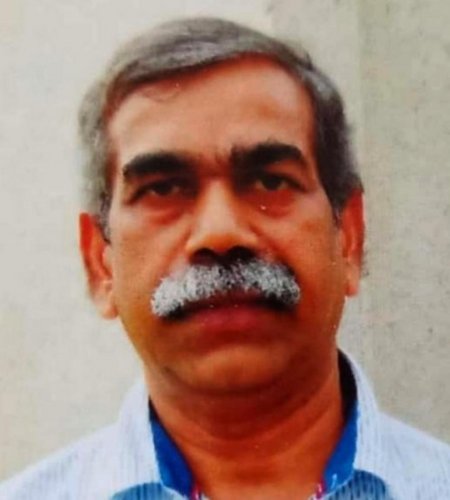
T P Shivaiah
T P Shivaiah

T P Shivaiah, who was serving as Deputy Conservator of Forests of Madikeri Wildlife Division, passed away on Friday. He was 59.

He had suffered a heart attack on April 19 and was admitted to a hospital in Mysuru. However, he did not respond to the treatment and breathed his last on Friday morning.

The final rites were performed with state honours at his native place in Bidalli village in Somvarpet taluk on Friday evening.

Deputy Commissioner Annies Kanmani Joy, CCF Hirelal, DCF Prabhakaran, Nagarahole DCF Mahesh Kumar, Virajpet DCF Shivashankar and other paid their respects to the departed soul.

Shivaiah is survived by wife, a son and a daughter. Both of his children could not take part in the last rites as son is based in USA and daughter in Australia.

source: http://www.deccanherald.com / Deccan Herald / Home> State> Mangaluru / by DHNS, Somwarpet / April 24th, 2020

Ration Articles Distributed To Mahouts At Dubare Elephant Camp

MahoutKF20apr2020

Kushalnagar:

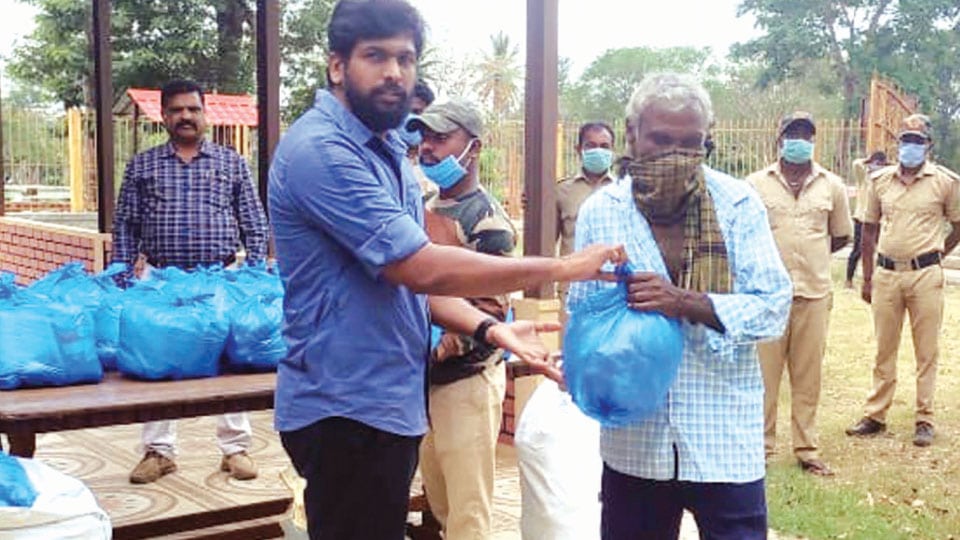
The Forest Department distributed ration to over 60 Mahouts and Kavadis of Dubare Elephant camp near here on Saturday.

Speaking after distributing ration, Madikeri Sub-Division Conservator of Forests (CF)Prabhakar said that the families of Mahouts and Kavadis who live in tribal hamlets were facing a lot of difficulties due to the lockdown.

The Department, taking note of their plight, decided to distribute ration and essential items kits to them. Asking the Mahouts, Kavadis and their family members to stay at home in order to maintain their health in the wake of COVID-19, he highlighted the need for everyone to maintain social distance in order to be safe.

Somwarpet ACF Nehru, Virajpet ACF Dayanand, Kushalnagar RFO Ananyakumar, Dubare Sub-Division Forest Officer Ranjan and others were present.

source: http://www.starofmysore.com / Star of Mysore / Home> News / April 12th, 2020

CNC Celebrates Edmyar-1 Kodava New Year Day By Ploughing Paddy Fields

Edmyar01KF15apr2020

Madikeri:

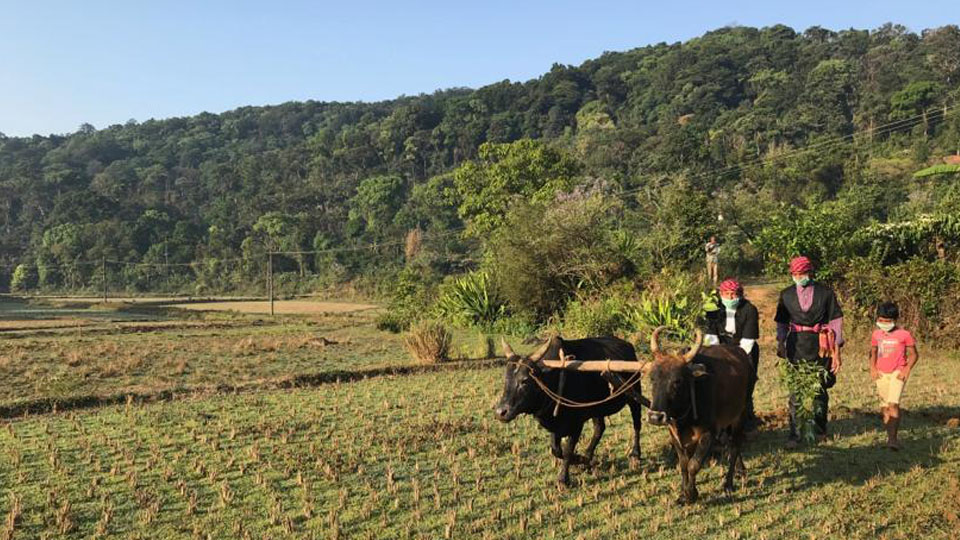
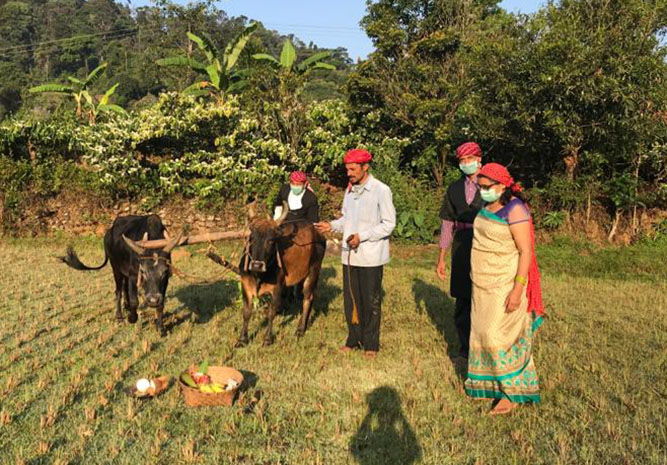
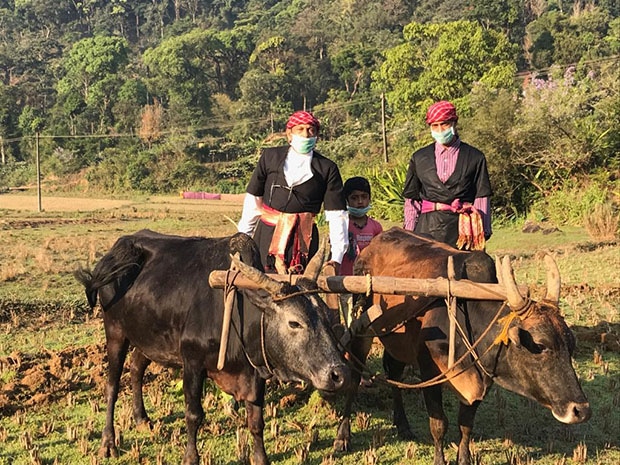
Codava National Council (CNC), which is aspiring for Codavaland Geo-Political Autonomy and ST tag for Kodava tribalism, celebrated its 26th Annual Codava (Kodava) New Year Day Edmyar-1 as per Kodava tribal almanac by ritualistic ploughing of paddy fields.

CNC President N. U. Nachappa offered prayers to Guru-Karonas at Koopadira clan and reverential prayers to Mother Earth, Sun, Moon before two bullocks named Karianna – Kulla, ploughed a few rounds in the wetlands of Koopadira clan.

To herald the unbreakable bondage of Kodava tribal world with mother soil to entire universe, CNC is determined to showcase and display the age-old folkloric cultural traits and genus of Kodava tribal ancestry. In other words, all these ancient festivities enriched the civilisation of Kodava martial tribe.

Edmyar02KF15apr2020

CNC also prayed for the well-being of all the people of this world that is reeling under the pandemic COVID-19. Koopadira Sabu, Koopadira Mohan Muthanna, Lt. Col. Parvathi, Kompulira Myna Purandara and Koopadira Pranam participated in the celebrations.

Due to Corona pandemic, CNC’s Annual Edmyar-1 evening’s torchlight (pombolak) procession at Gonikoppal, is not being celebrated today. Speaking on the occasion, Nachappa said, “All Codava folkloric festivities and rituals mirror the agro-pastoral commitment, hunting skills and warrior hood of Codava tribal folk from time immemorial which depicts that we are above the tenets of caste and religion who are living in the rustic hills, mountainous terrain in the midst of rivers and rivulets.”

Edmyar03KF15apr2020

“We are happy that the Founding Father of the Constitution of India, Dr. B. R. Ambedkar’s birthday coincides with Codava New Year. We are ever grateful to Dr. Ambedkar for his yeomen contribution of accommodating space for expressing grievances of micro-minority tribes like Codava tribe,” he observed.

source: http://www.starofmysore.com / Star of Mysore / Home> Covid News / April 14th, 2020

All about an extreme love of Coffee: In this novel, a young couple on an adventure quest discovers their passion for warm frothy concoctions and each other

An excerpt from Harish Bhat’s book “An Extreme Love of Coffee”. Harish Bhat is the author of the bestselling book “Tatalog” and chairman of Tata Coffee Ltd.

Author Harish Bhat. Harish is chairman of Tata Coffee Ltd. and brand custodian of Tata Sons Pvt. Ltd.

Three shrines of coffee have I now foreseen, three goddesses that nurture our love for the bean. From river to ocean, each shows you the way. Find me these shrines, and then will I say: Here’s my treasure, let it fill up your day.

Rahul read the lines aloud to Neha for the tenth time that morning. What did they actually mean? Both of them looked at each other silently and acknowledged that they were stumped. Totally clueless.

Outside, dawn had broken and they could hear the high-pitched charr-charr notes of a single woodpecker breaking the stark silence of the coffee plantations around them. Inside, most of the coffee beans had fallen off the bed and were strewn all over the floor. It had been a memorable night and now they knew for sure that coffee was a great stimulant.

But where was the stimulant that would help them figure out this puzzle, one written by a mysterious monk who had died long ago, leaving a great treasure hidden? Where were these three shrines that the monk had spoken of? Where exactly should they begin?

Pooviah brought them their morning coffee in an elegant tray with a pot and two cups of white bone china. ‘Sir, I used those pink coffee beans you gave me to make coffee for Madam and for you today. The smell of this coffee is getting better with each passing day, Sir.’

The old woman’s coffee! In the midst of all the other excitements of the past two days, Rahul had nearly forgotten about this. ‘Yes, yes, Pooviah, please pour coffee for us.’

The walnutty flavour came back to them once again. Superb! As they sipped the coffee, Neha leant back and read the puzzle once again. Suddenly, she could clearly see the author himself, the venerable monk. He appeared vividly in her mind. Orange-robed monk, fat, bald and peaceful, walking somewhere. Where was he walking to? And then, behind the monk, she saw flowing waters. A few words from the puzzle swam in front of her now-dilated pupils: From river to ocean, each shows you the way.

She sat up with a start. ‘Rahul, listen. Listen to me. We need to go to a river, one that will show us the way to the first shrine. That’s what the monk meant when he wrote “from river to ocean”. The river first, and then the ocean will show us the way. That’s why he put those words in his note, to give us a clue. I can see him in my mind, Rahul. He is walking by that river, right over there, right now.’

Rahul glanced at the lines once again. What Neha said made sense. They had nothing else to go on anyway. Then, he remembered something, a local guidebook kept in their room that he had briefly gone over yesterday. It spoke of a river nearby. He went into the room, brought out the small guidebook, turned a few pages, and began reading aloud:

The Kaveri is the patron goddess of all coffee growers in Coorg. Flowing through the beautiful coffee plantations and nurturing them like her own special children, the Kaveri is the great river of this region. Originating in the foothills of the Western Ghats, the river meanders through the region of Coorg and the vast Deccan plateau before it eventually flows into the Bay of Bengal. The Kaveri quenches this region’s thirst for water and makes it one of the most fertile lands known to mankind. From these lands of the Kaveri come some of the finest coffees the world has ever known.

Rahul turned to Neha. ‘Neha, I think you are absolutely right. We must go to the Kaveri. That’s where we will begin.’

He continued reading the guidebook.

The Kaveri is not merely a river, but a goddess who is worshipped by everyone in this coffee growing region of Coorg. The unique coffee of Coorg springs from the sweet waters of this sacred river. Coffee requires a lot of water for its flowering, and the Kaveri provides it in abundance. The varieties of coffee grown on the fertile banks of the Kaveri are known for their robust body, light acidity and soft liquor, making them some of the most sought-after beans in the world.

Rahul paused here, absorbing this beautiful description of the coffee. ‘Robust body, light acidity, soft liquor, wow! I must taste these coffees from the banks of the Kaveri.’ Then he saw something in the guidebook which made his pulse quicken. He read it out in hushed tones:

There are many shrines built for the Kaveri, to worship and celebrate this goddess, who is the presiding deity of the region. The best known shrine is located at the source of the river called Talakaveri. The river originates near this shrine, as a spring, and the water then flow underground to emerge as the magnificent Kaveri some distance away. The road to Talakaveri is surrounded by coffee plantations and suffused by the intoxicating aromas of coffee. Many monks and holy people visit this shrine throughout the year.

Rahul turned to Neha. ‘We must go to Talakaveri, Neha. I am sure that is where our Japanese monk has left directions for us. He must have visited this shrine and left something there. This is a shrine of the river that nurtures coffee, and so it is a shrine of coffee itself. That is what the monk must have meant. This is where our search must begin.’

CoffeeBookKF31mar2020

Excerpted with permission from An Extreme Love of Coffee: A Novel, Harish Bhat, Penguin India. Read more about the book here and buy it here.

source: http://www.thedispatch.in / The Dispatch / Home> Book House / by Harish Bhat / March 30th, 2020