Category Archives: Agriculture

Brewing coffee and culture: From bean to cup

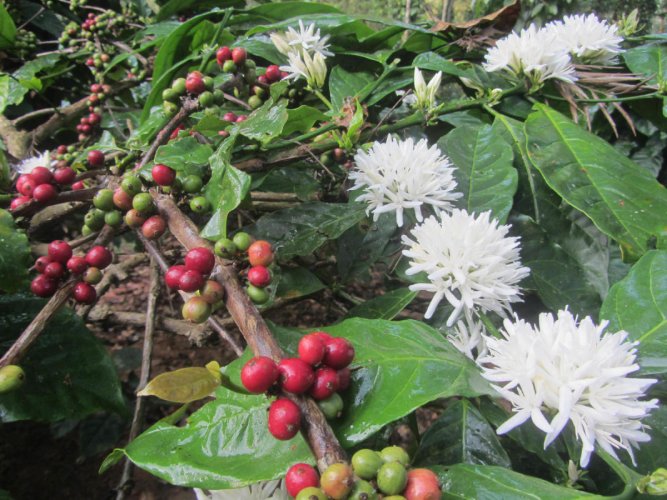
Coffee cherries and flowers. Photos by Author and Adithya K A

Coffee pervades the lives of people in Hassan, Chikkamagaluru and Kodagu districts. From the decades-old jaggery coffee to the current flavoured ones, coffee as a product has seen a huge transformation. What has remained unchanged is its association with almost anything momentous in our lives.

The journey of coffee to India is well- documented and etched in our memories through the story of Arab traveller Bababudan bringing seven coffee beans to Chikkamagaluru in 1670 AD. He sowed these seven seeds in Chikkamagaluru’s Bababudangiri hills (Chandradrona Parvatha). Today, India is world’s third-largest producer of coffee.

The earliest and most prominent coffee planters of the yesteryears in the country were the British. They introduced the system of check-rolls which is an attendance register of the labour. They maintained a diary which explained the daily activities in the estate to which the owner signed every day. These rather important systems are intact and in place even today, and any estate that you visit here will show you daily records from as back as 50 years ago!

These documents serve as important pieces of information for future generations. The British were particular about closing the accounts by the end of March wherein the savings and loans availed by the labourers were tallied. This tradition continues to this day.

Other customs that we have inherited are the practices of maintaining lush green and colourful gardens at our homes, rearing about half a dozen hunting dogs and possessing rifles and pistols for safety from wildlife.

Blossom shower

Coffee plantations receive blossom shower (rains) around March every year. Coffee estates that blossom with white flowers are a sight to behold. While this is a visual treat for us, this also guarantees a good crop for the coming year.The joyous mood is also seen before coffee picking when the entire family thanks god and prays before picking the berries.
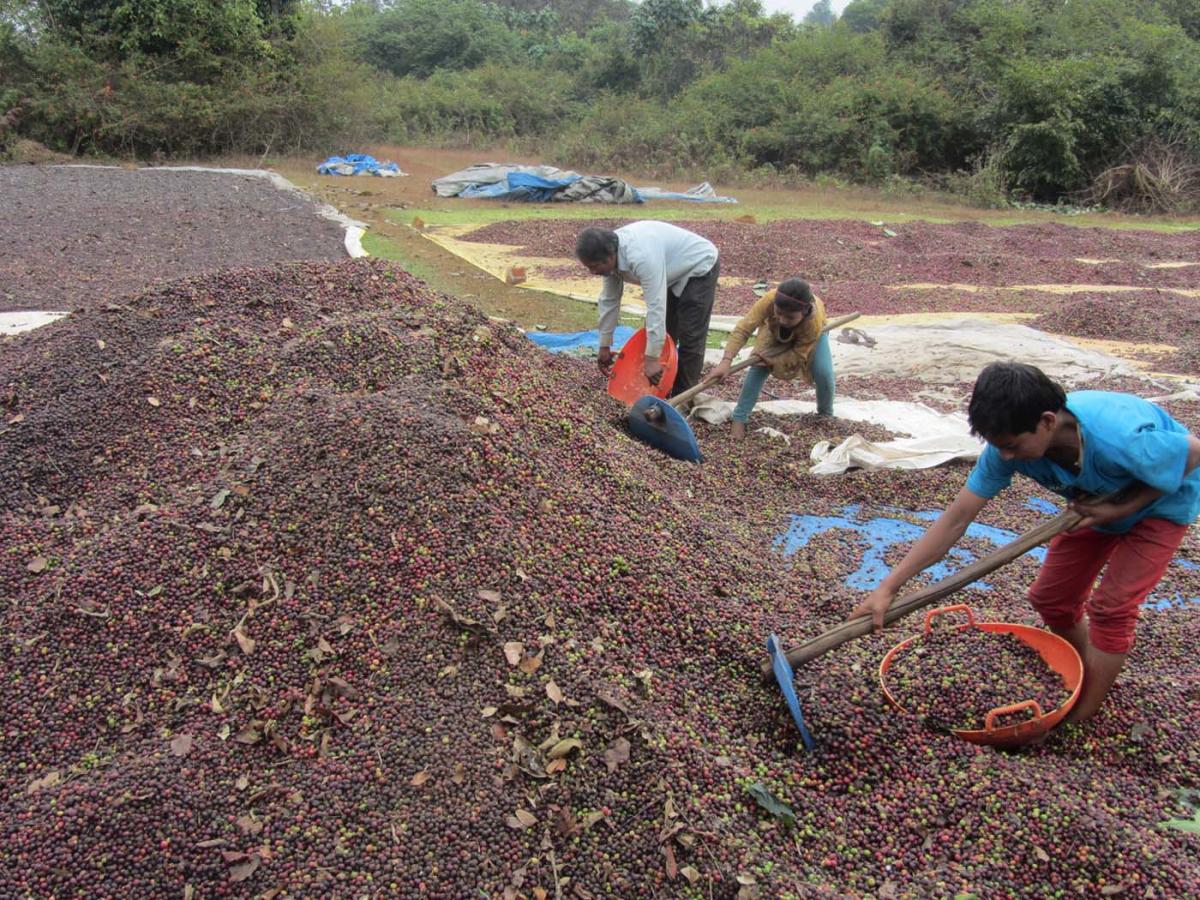
Cherries being dried

The book Bettadindha Battaligey by H N Nagegowda beautifully traces the history of coffee in India and also the culture associated with it.

Coffee estates coexist with thick and lush green forests in these Western Ghats districts. These estates are also home to a rich variety of endangered flora and fauna. Each year, hundreds of varieties of birds migrate to coffee estates. These plantations nurture forest species which act as nesting grounds for these birds.

Estate owners take an active interest in increasing the number of trees that they have on their lands. Artificial lakes and tanks in the estates quench the thirst of animals including elephants and tigers.

The vibrant culture of coffee land in the state could also be traced to the presence of major rivers such as Cauvery, Tunga, Bhadra, Nethravathi and Hemavathi.

A majority of the labour force in Karnataka’s coffee estates hails from Dakshina Kannada. Of late, a healthy influx of migrant labourers from Assam can be seen in the estates. The estate owners provide accommodation and healthcare facilities to the labourers.

The monsoons of 2018 and 2019 played unimaginable havoc in the lives of growers in the core coffee zones of Kodagu and Chikkamagaluru.

They lost all their lands overnight to mudslides and torrential rainfalls. Despite this, they are trying hard and not giving up in their quest to rebuild everything that they lost.

However, their spirit to endure and rebuild is shattered due to the failure of markets. Coffee growers are going through their worst crisis ever where they are not able to make ends meet because coffee prices have crashed to record lows.

Prices have collapsed to as low as what it was 26 years ago while the cost of inputs like fertilisers and machinery has skyrocketed.

Also, the price of spices like pepper which are grown as intercrops has fallen to 60% lower than the price received half a decade ago. As a result, the growers are saddled with neck-deep debts.

Key driver

There is a misconception that the consumption of coffee leads to health problems such as gastritis. This problem arises when one consumes coffee that is blended with a high quantity of chicory.

As per the Coffee Board of India statistics, coffee is grown in 4,00,000 hectares of land in the country. Karnataka grows 70% of the country’s total coffee production, with its annual production of up to 2.75 lakh metric tonnes. About 65% is robusta variety while 35% is of the arabica variety. The country exports 75% of the yield. India is home to 2,20,825 coffee growers of which 98.5% are small-scale growers. The economy of Kodagu, Chikkamagaluru and Malnad regions of Hassan district is heavily influenced and dependent on the coffee industry. It is the key driver of the economic activities of these regions.

Karnataka Growers’ Federation (KGF)which was formed in 1985 brings the coffee growers in one platform and works towards their welfare while also representing them in international platforms. This apex organisation is well networked with 21 regional organisations. KGF is headquartered at Sakaleshapura, Hassan district with a membership of 50,000 women and men.

U M Thirthamallesh, president of Karnataka Growers’ Federation said that the coffee price crash is mainly due to the surplus supply of coffee into India from international markets. Southeast Asia, he claims, has unfair market practices, low labour standards and excessive state subsidy which are all in violation to World Trade Organization norms while Indian Coffee growers follow all international norms by the book.

Coupled with this is excessive addition of the additive chicory into coffee which results in the substandard taste of the coffee. Labour shortage and disease are other problems that have affected the coffee industry.

Value addition

In an effort to overcome challenges, the coffee community is also paying attention towards the value addition of coffee. In the process, some brands have become popular. They’re involved in the preparation, marketing and sales of coffee powder; garlands made using coffee beans; coffee chocolates and coffee-based wine. In some areas, specialised coffees, like organic coffee and tribal coffee are also being tried.

Copsy Coffee Powder which is produced at Arehalli Co-operative Society and 7 to 7 Coffee which is produced by a group of women at Women’s Coffee Promotion Council, Sakaleshpura are some well-known local brands.

Another brand which has caught the attention of coffee connoisseurs is Talacauvery Eco-Coffee Works which is based out of Kodagu. This coffee is produced by an all-women self-help group called Sri Rajarajeshwari Self Help Group in Kargunda.

A vibrant culture has evolved around coffee in the last three centuries in the coffee land of the state rooted in self-reliance and innovation.

source: http://www.deccanherald.com / Deccan Herald / Home> Spectrum> Spectrum Top Stories / by Poornima Kanahalli / December 14th, 2019
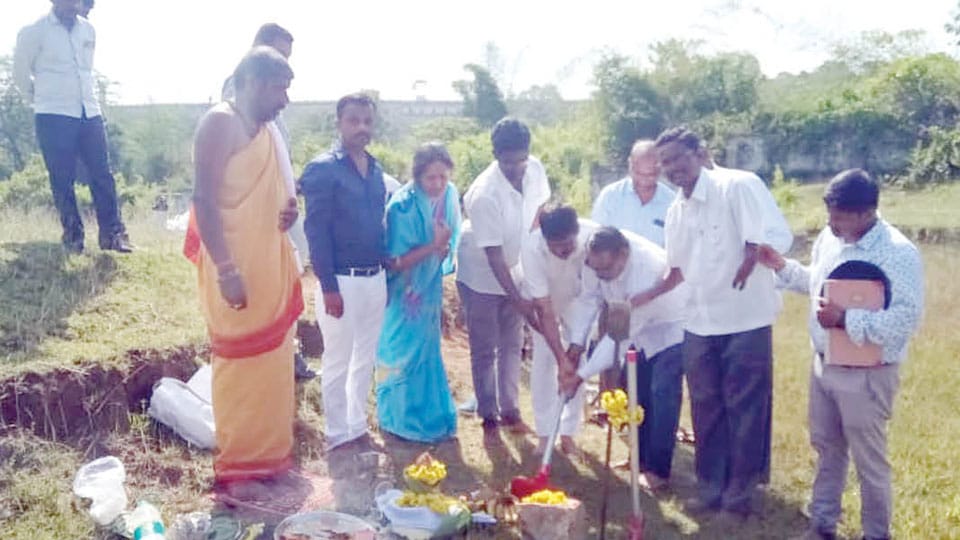
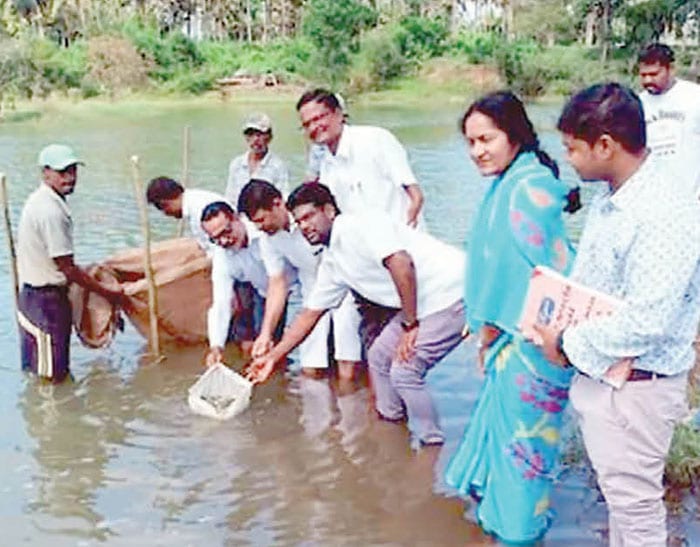
Bhoomi Puja For Fish Cultivation Pond At Harangi

10,000 rare Mahseer fingerlings released to Harangi River at Koodige

Kushalnagar:

There are many possibilities of utilising Harangi Reservoir in Kodagu and its backwaters. One among them is fishing and fisheries development. Realising this potential, an exclusive fishing cultivation pond will be set up at Kushalnagar with Rs. 2 crore assistance from National Bank for Agriculture and Rural Development (NABARD).

The Bhoomi Puja for the 2-acre pond was performed recently in Kushalnagar by Madikeri MLA M.P. Appachu Ranjan. Speaking on the occasion, the MLA said Harangi was one of the major reservoirs built across River Cauvery. “Due to the reservoir, there are great possibilities of pisciculture in a large scale due to abundant availability of water backed by groundwater support. Rare fish varieties like the Mahseer can be cultivated and six such ponds will be constructed in the land owned by the Fisheries Department,” he said.

Traditional fishing is being held from many years in the backwaters of Harangi, which spreads over 1,886 hectares in area. Lakhs of fingerlings are released into the reservoir every year. “As part of the project, fish cultivation enclosure has been set up in the backwaters of Harangi Reservoir and the sample of fish is being collected to study the growth of fingerlings, said Sachin, Assistant Director, Harangi Fish Rearing Centre.

BhoomiPoojaHarangi02KF26nov2019

He added that the Centre was set up by the Government 25 years back to support farmers who are willing to rear fish in the cultivation ponds. Varieties of fish, including Mahseer, Katla and Rohu, are reared in the Centre. Along with these, fingerlings procured from Kabini and Bhadra reservoirs are being provided to farmers at subsidised costs, he said.

On the occasion, over 10,000 Mahseer fingerlings were released to 5.6 km Harangi River stretch from the Dam to Koodige Bridge. “Through this, we intend to cultivate the Mahseer fish that is on the verge of extinction. Fishing has been banned on this particular stretch to save the Mahseer variety,” he added.

source: http://www.starofmysore.com / Star of Mysore / Home> News / November 25th, 2019
India’s Coffee Board registers 30,000 farmers on blockchain marketplace

Image Copyright: Volff / BigStock Photo

After a tepid launch earlier this year, the Coffee Board of India‘s (CBoI) blockchain coffee marketplace is seeing rising demand. The platform now has about 30,000 farmers registered compared to just 23 when the platform was launched, reported Down To Earth.

CBoI is one of the first government agencies in the country to have an in a production blockchain platform. The Coffee Board has developed a mobile app and a web portal with support from Eka Software Solutions.

The coffee supply chain is highly fragmented, with intermediaries such as farmers, traders, roasters, curers and other processors. In the past few years, global coffee prices have also stumbled. To remedy the situation, the Coffee Board has turned to blockchain and its ability to immutably track and trace products in supply chains.

“Blockchain offers unmatched traceability and increases the transparency, accountability and efficiency of the coffee supply chain,” Shuchi Nijhawan, vice-president, New Business and Global Human Relations, Eka Software Solutions told Down to Earth.

The platform aims to enable farmers to get better prices for their produce by eliminating agents and other intermediaries.

Based on Ethereum distributed ledger technology, the marketplace employs smart contracts to capture information regarding the product and ensure settlement. The Coffee Board is also training its staff to provide certificates to guarantee the quality of coffee, which can be uploaded to the marketplace.

Food traceability is in high demand due to conscious consumers who want to know what they are buying. Blockchain for coffee traceability is being trialed elsewhere in the world as well. Two months ago, blockchain firm GrainChain signed agreements with the Honduras coffee industry participants to unite them on its platform.

Another project is being led by blockchain startup Farmer Connect which has onboard coffee companies such as The J.M. Smucker Company and Jacobs Douwe Egberts (JDE) for coffee traceability. Farmer Connect’s platform is planned to go live in 2020.

Meanwhile, the coffee brand Starbucks is working with Microsoft Azure Blockchain for coffee traceability.

source: http://www.legderinsights.com / Ledger Insights / Home> News> Supply Chain / by Ledger Insights / November 21st, 2019

Citizens come together for wildlife conservation

Surendra Varma, a scientist at Indian Institution of Science, said he was happy to see the turnout during the festive season.

Bengaluru :

Heavy rain and Deepavali celebrations didn’t stop corporate communication professional, Danielle S, to attend an event organised by Friends of Elephants, an informal group dedicated to promote wildlife diversity. “I have attended previous events of this group. I was out of town and came back soon to attend it. These are good knowledge-sharing platforms,” she said, adding that she and her friends believe in celebrating festivals in meaningful ways like this.

Friends of Elephants conducts panel discussions and art and cultural activities on every fourth Sunday. Titled Elephants, Tigers and Lions (conservation and conflict), their last event on October 27 included movie screenings like Shanti Samsara by Ricky Kej, talks by Manoj Kumar, chief conservator of forests, Kodagu Circle, and Ravi Chellam, wildlife expert, and panel discussion with speakers and villagers from Bandipur. The forest officers shared their experiences of tackling wild animal attacks in estates and their translocation, while villagers shared how difficult their day-to-day life is because of animal attacks.

Surendra Varma, a scientist at Indian Institution of Science, said he was happy to see the turnout during the festive season. “We had organised one event during an IPL match in the city. There was no drop in the number of participants,” he added.Prabha Ramakrishnan, a resident of Indiranagar, said she always tries to attend the events. “We are a small group of women who are interested in nature and wildlife. We go for trekking, visit wildlife sanctuaries and attend events. Why should one miss such events in the name of festival?,” she asked.

source: http://www.newindianexpress.com / The New Indian Express / Home> Cities> Bengaluru / by Lesly Joseph / Express News Service / October 29th, 2019

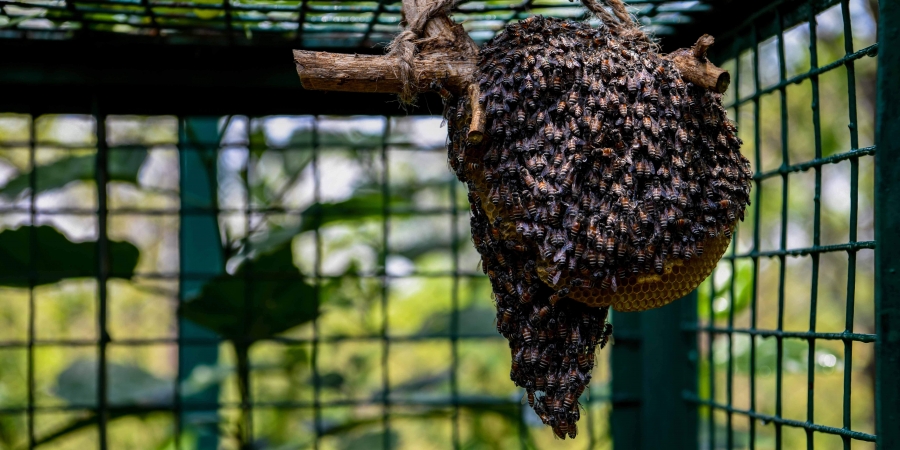
Not just honey, bees can make you money too; find out how

Indian and European bees are the most sought after while stingless bees are slowly catching our attention for its medicinal properties.

(Photo | Meghana Sastry, EPS)

Your favourite mango will definitely become dearer if not extinct, if we don’t act now. Pollinators, which include bees, need a major protection boost.

There are 2,00,000 pollinators of which honeybees are the most sought after, why?

There’s a popular saying ‘as busy as a bee’. That term comes from the fact that honey bees are the only species who identify a flower and make multiple visits to the same flower until they get all the nectar and pollen out of it. They are the best pollinators and work in the most methodical fashion. From identifying to communicating and dividing work. Their social structure is fascinating and one that we can learn a lot from. There are 20,000 types of bee species of which the ones mentioned below are the most popular types in India. Indian and European bees are the most sought after while stingless bees are slowly catching our attention for its medicinal properties.

____________________________________________________________

Common Name Scientific Name Natural Nesting Site Honey Yield
(KG)
____________________________________________________________
Indian Bees Apis Cerena Cavity, Termite Mounds, Tree Hollow etc. 8-10

European Bees Apis Mellifera Cavity 25-30

Rock Bees Apis Dorsata Tree Branches, Buildings etc 30-35

Dwarf Bees Apis Florea Twig in a bush <1 Himalayan Rock Bees Apis Laboriosa Underside of rock cliffs 40-45 Indian Stingless Bees/Dammer Bees Tetragonula Iridipennis Cavities, Hollows in tree trunks and walls <500 grams _______________________________________________________ There’s been a lot of buzz about bees going extinct and people have been trying to find a way around it. Here is a story from beekeepers who have found it very lucrative to harvest them. There are multiple beekeepers like Apoorva - the bee man of India and organisations like the University of Agricultural Sciences in GKVK, Bangalore who conduct workshops and help people understand the importance of bees, train them on beekeeping and provide them with bee boxes. Honey02KF29oct2019

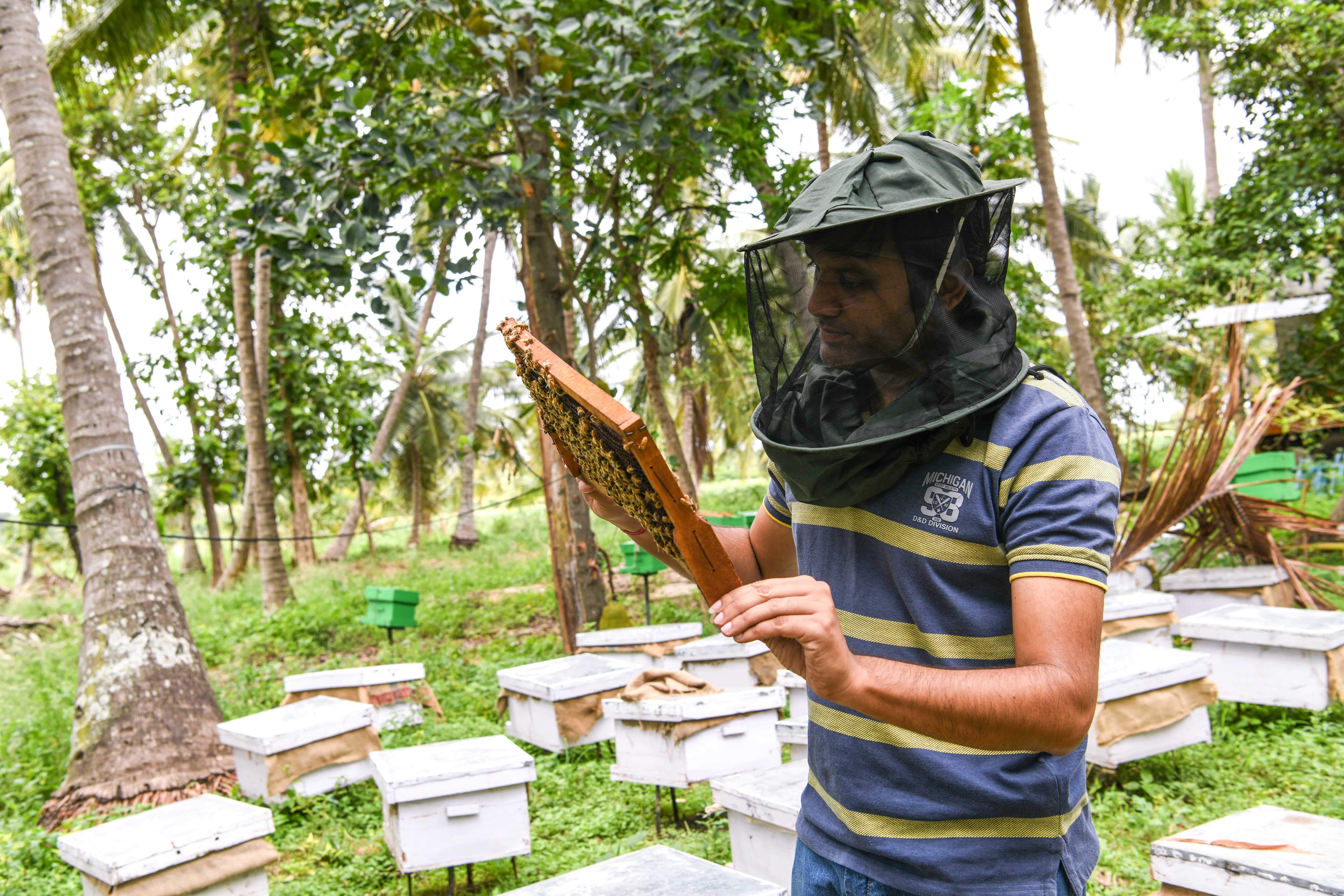
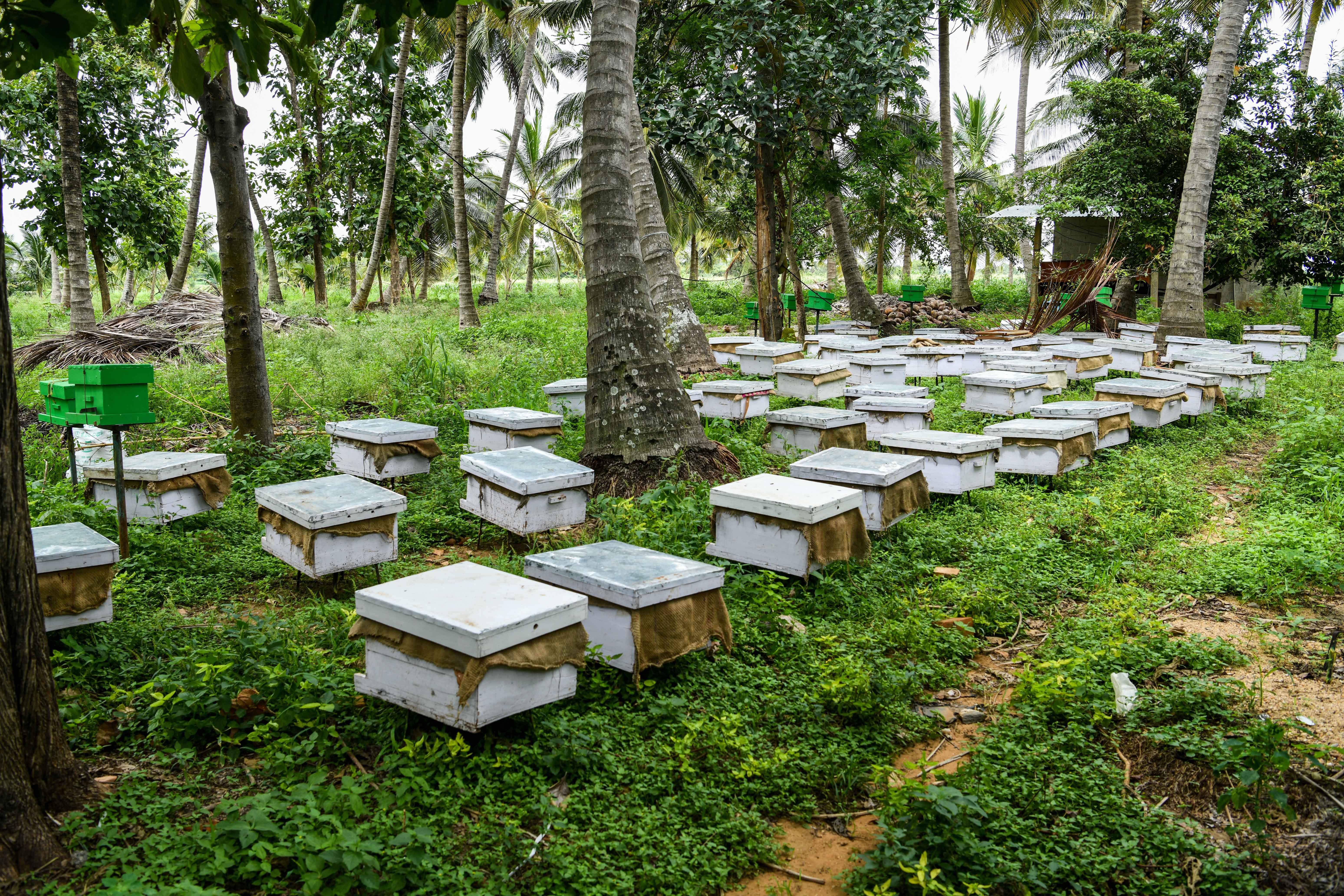
Apoorva visits his bee farm in Bidadi regularly to check the health of the bees. He is a mechanical engineer but a beekeeper by profession. He found his passion for bees even before he graduated and took it up soon after. He’s been working on bees for over 10 years and works closely with farmers across the country. He travels, meets farmers, trains them, gives them bee boxes, follows up with them on the progress and reviews the health of the bees regularly. He also helps them sell their produce. While Apoorva works with a lot of people across the country, this is a story close to home where he’s been working with flood victims in Coorg.

He is involved in multiple activities such as honey production, bee breeding, manufacturing beekeeping equipment, selling honey and beehive by-products, mainly wax. His company’s annual turnover is over 2 crores. He has both Indian and Italian bees.

Honey03KF29oct2019

He initially collected bees from hives and then started breeding them in his apiary during the natural division season of bees. He also buys colonies from farmers when they multiply. This bee farm is near a cornfield which is rich in pollen. It is important to understand your demography he says. Having bee flora next to an apiary is very beneficial to harvest more honey and keep bees in good health. He harvests Indian bees in forests and hilly regions and also promotes only Indian bees to farmers as it’s easier since most of them cannot handle migratory beekeeping.

European bees which in India are Italian bees requires 4-7 migrations in a year for which, he travels around 1,200 kms pollinating thousands of acres in North Karnataka mainly Sunflowers, Til, Niger, Coconuts, Arecanuts, Banana, Avacado, Litchi and more. Honey yielding fields for Italian bees are Sunflowers, Eucalyptus, Til and Niger. He has more than 200 colonies now and will split them to make about 800 during the breeding season. A farmer keeps anywhere between 4-25 boxes. He needs about 3 boxes per acre and has to distance each colony by at least 10 feet.

Bee Harvesting has helped Coorg flood victims make a livelihood

Vijay Panduranga talks about the effects of the flood and the rehabilitation work in Coorg.

After the floods in 2018 that hit Coorg, a lot of farmers lost their land in turn livelihood and haven’t received much relief from the government. There were rescue operations but then not much is being done on the rehabilitation front.

With paltry compensation from the govt. Coorg flood victims are finding solace in the new beekeeping venture. Nectar flow is an initiative/program started by a few local people, spearheaded by Retd. Brigadier Devaiah to help provide a steady income to people interested in beekeeping. People have seen returns in the 1st few months. They say that the money that comes in lets them breathe. While beekeeping in an age-old tradition in Coorg, the methods are ancient. Devaiah was on the lookout for someone with a scientific approach to help them and that’s when he found Apoorva and sought help. Apoorva readily agreed and continues to work closely with the farmers. He has helped the farmers understand the species better, eventually getting them better yields. At Coorg, each farmer makes a minimum of 5 kgs of honey per year and each box sells at Rs. 600/- per kg. They also make money by selling colonies at Rs. 1,500/- per colony. Farmers produce about 2-3 kgs of beeswax per year which is approximately Rs. 350/ kg

Farmers from the North East, Chhattisgarh, Coorg and other parts of India find it difficult to sell the honey and wax that they produce. Apoorva helps them by buying the whole lot from them, filters them further if there’s moisture and sells them as and when he gets enquires. Honey is labeled as per the flowering season such as litchi, cardamom, clover, mustard, chilli, etc., the honey tastes different too.

The by-products such as beeswax, royal jelly and bees venom are other sources of income and, used in pharmaceuticals and beauty products.

The below-mentioned statistics are only an example of how bee pollination increases the yield anywhere between15% – 80%. These are scientifically proven numbers in ideal conditions (these are underestimated values).

Estimated global economic value of pollination is 217 billion USD in 2005

_______________________________________________

Crop Increase in yield per acre (%) Increase in yield per acre Income generation by pollination per acre
_______________________________________________

Coffee 15% 5 Bags 15,000/-

Aracanut 25% 2 Quintals 64,000/-

Coconut 20% 3,000 nuts 36,000/-

Banana 20% 5 Quintals 10,000/-

Watermelon 80% 4 Tonnes 20,000/-

___________________________________________

Farmers tell us their personal stories of how beekeeping has helped increase their yield with pollination in crops such as coffee, fruits and spices. They also make a good livelihood but extracting honey and wax. What they make is pure and unadulterated making the quality far more superior than the ones available off the shelves at supermarkets.

Honey04KF29oct2019

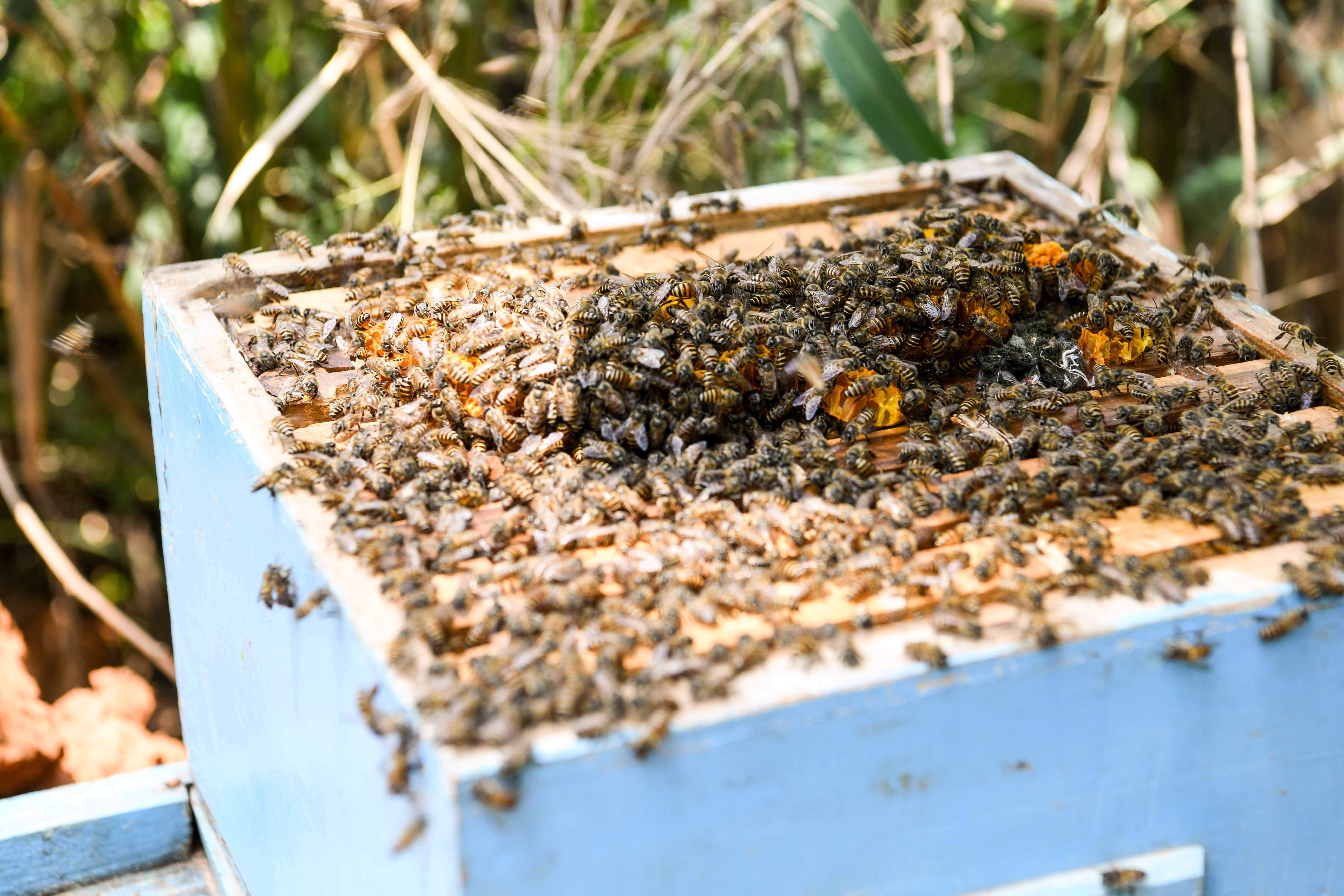
This is what a bee box looks like. This is one bee colony. They come on top to feed. There are multiple wooden frames inside quoted with wax, which help them construct combs.

Honey05KF29oct2019

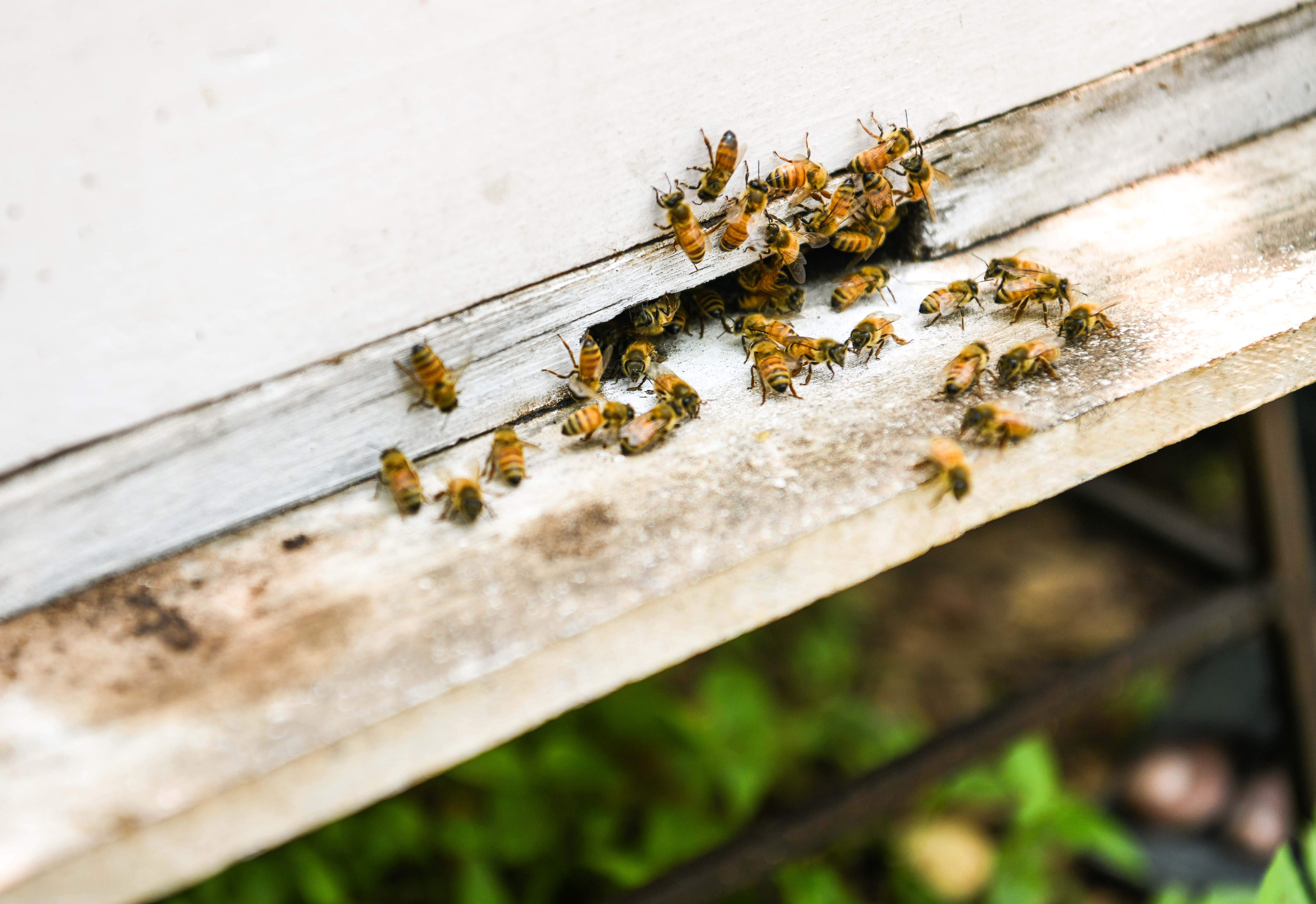
Every bee box has an opening at the bottom which allows the bees to move in and out of it, to go out and collect nectar and pollen. Some farmers who have these bee boxes are also given out on rent for pollination to seed producers or other farmers who are in need of pollination.

Honey06KF29oct2019

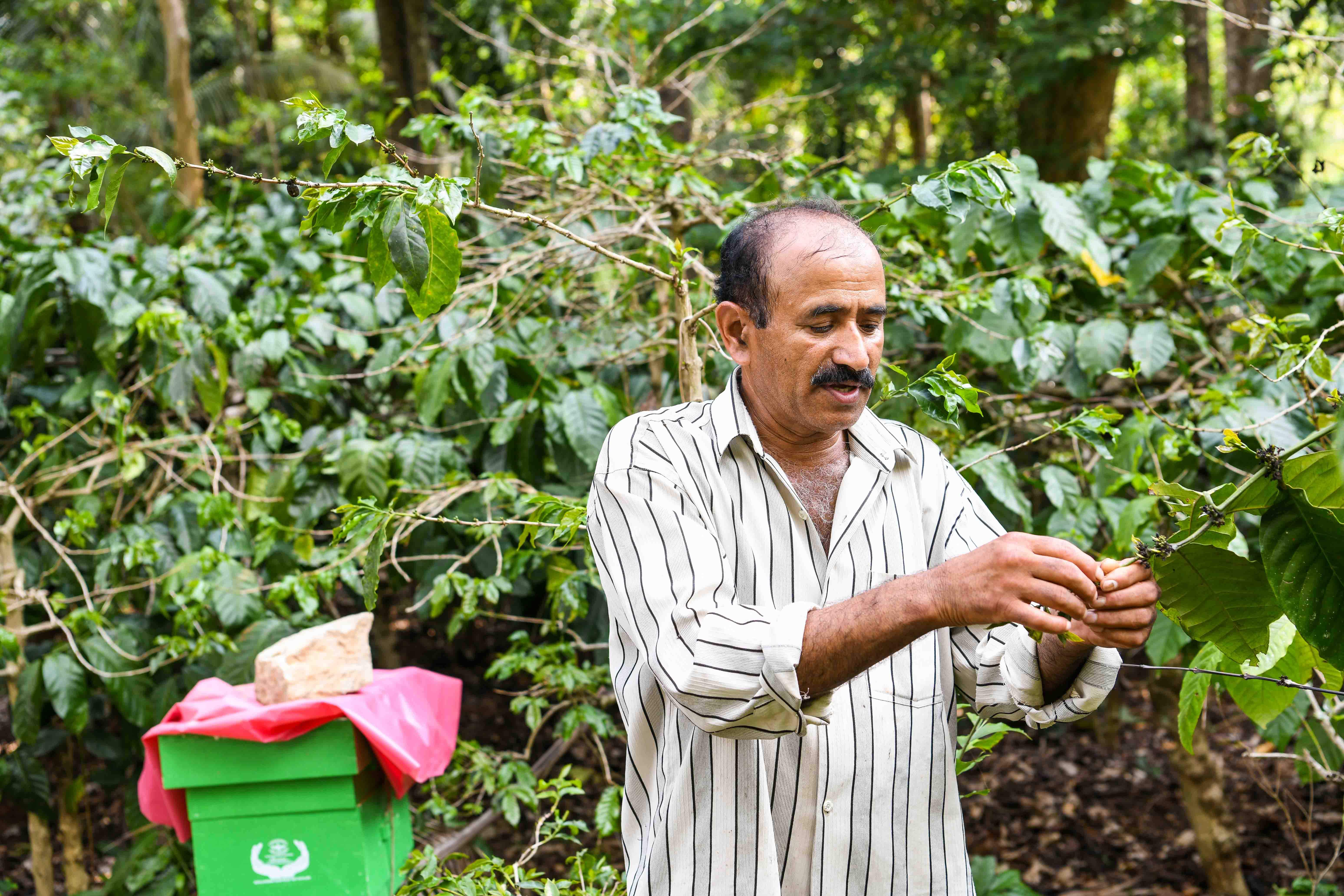
Naganna (Saachi) Kalappa lives 3 kms away from the main Madhapur town in Somwarpet Taluk. He has been harvesting bees for 18-20 years. Bees were available in abundance then as the ecology was healthy and rich, and filled with plants that the bees needed to survive. However, the species has seen a massive decline in numbers as the human population has been increasing and trees are being cut down for personal benefits such as planting silver oak trees as it yields timber and in a short span of time. Since the decline in numbers, they now need to procure boxes and up their skills and knowledge. After adopting this scientific method, he has benefited as his crops are multiplying. He is making enough money to take care of the needs of his family. He also says I request people to stop destroying forests and help in sustaining them and grow trees that are required for agriculture instead of timber to improve the ecology.

Honey07KF29oct2019

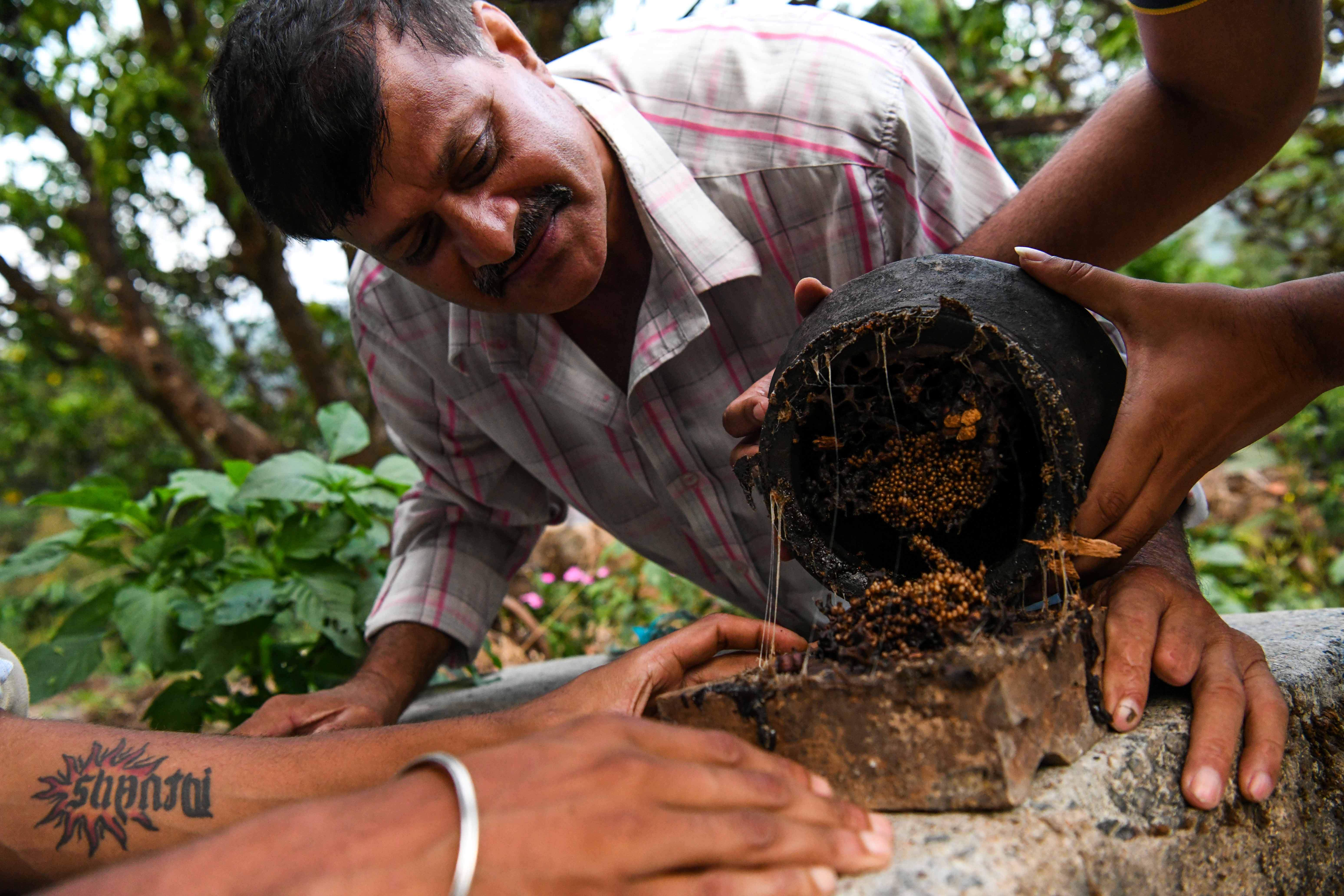
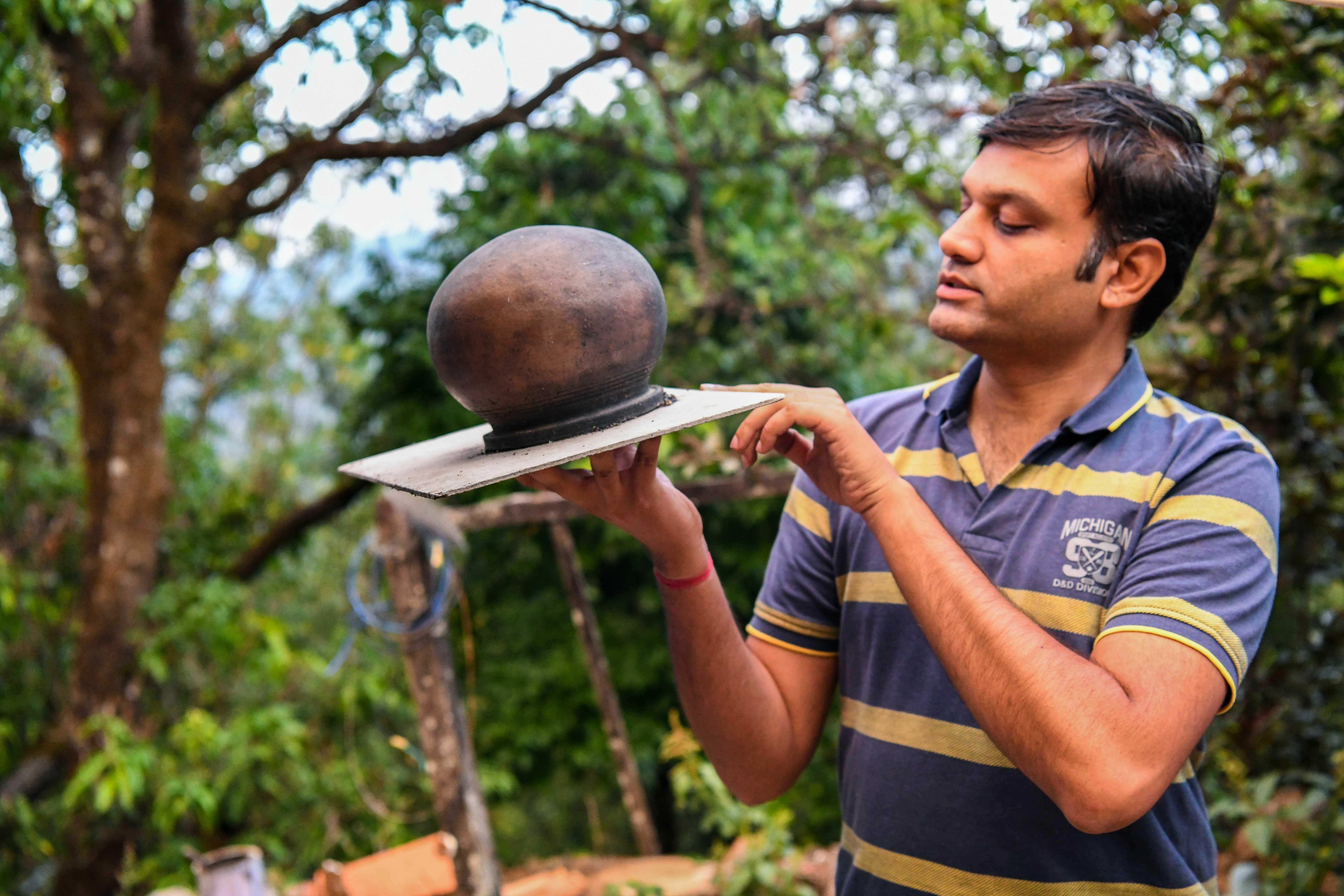
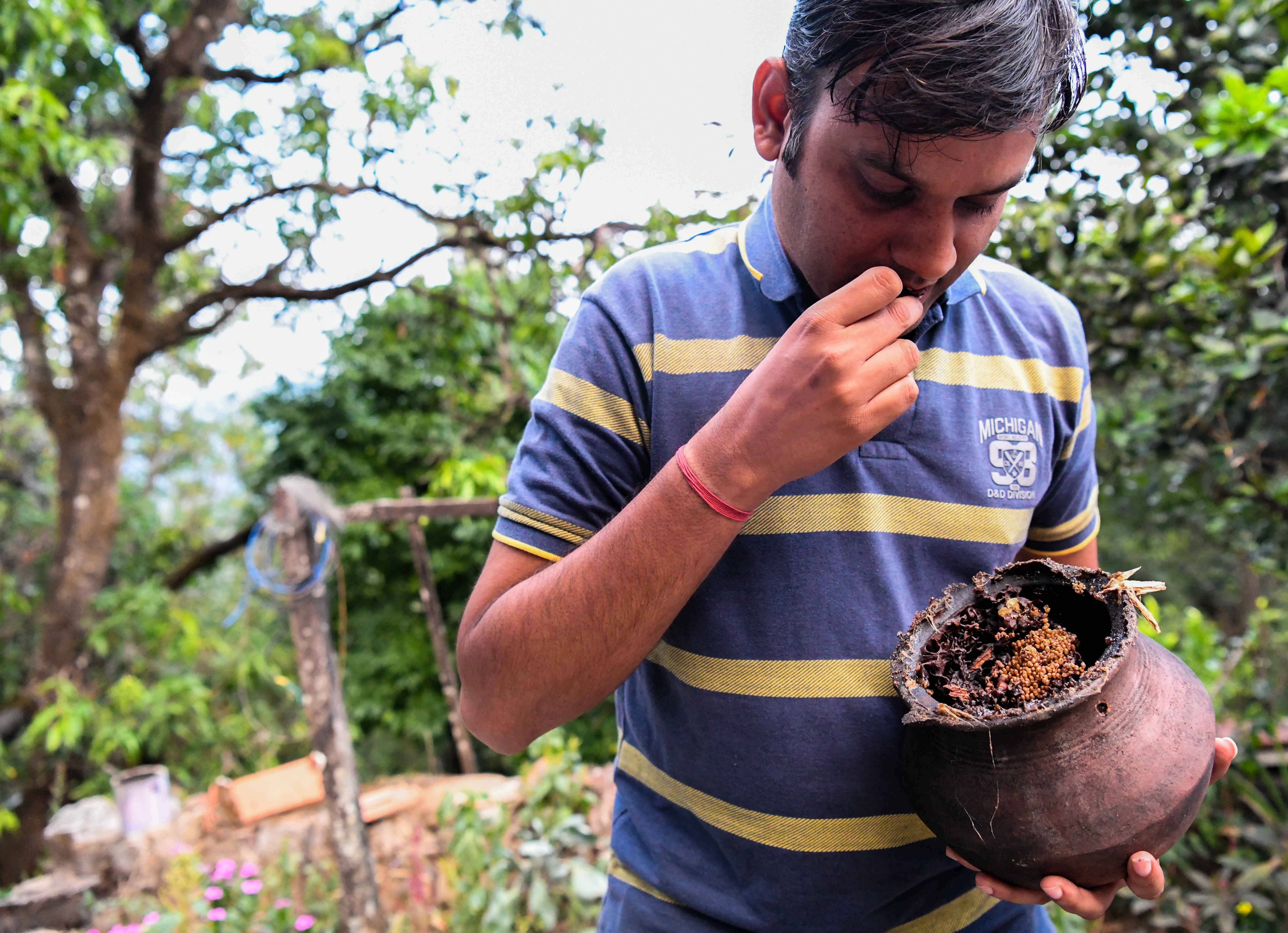
Thammaiah CB (Dolly) lives 7 kilometers away from the main Madhapur town in Somwarpet taluk in the Coorg district. This part of Coorg witnessed the worst of nature’s fury in 2018. While he has been harvesting Indian Apis Cerena Bees in boxes he also harvests stingless bees in pots. The quantity of honey is way lesser than what is produced by other bees however, the quality is far more superior as it has a lot of medicinal properties and is sold at a much higher rate.

Honey08KF29oct2019

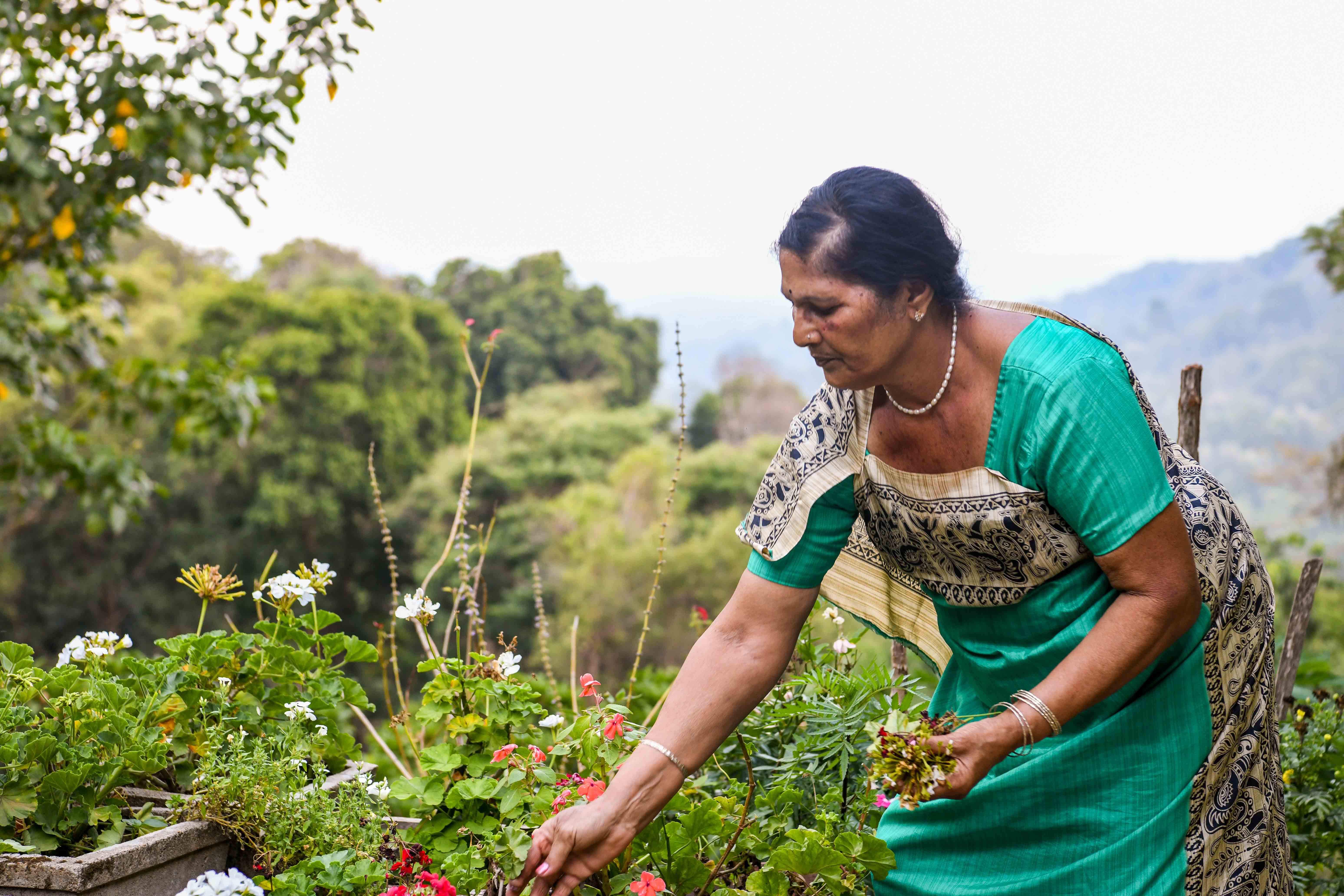
Thammaiah’s mother tends to her garden every day. She says it isn’t enough if you just harvest bees and have a coffee estate, it is very important to understand what kind of flowers and fruits attract them and cultivate them in your garden. This helps in increasing pollination and nectar production.

Honey09KF29oct2019

Fruit especially those with seeds are good pollinators.

Honey10KF29oct2019

Plants that one should cultivate to yield better results

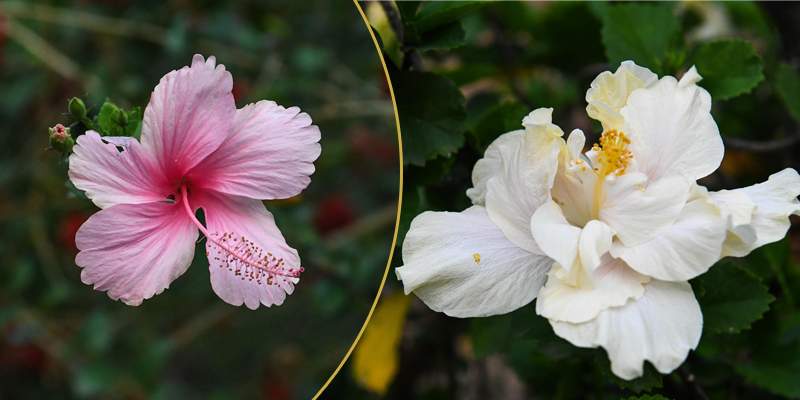
Nectar: Plants such as Avocado, Litchi, Hibiscus etc.

Pollination: Plants such as Sunflower, Sesame, Mustard, Coriander, Niger, Coconut and more (bees are attracted to vibrant colours such as yellow and blue)

Honey11KF29oct2019

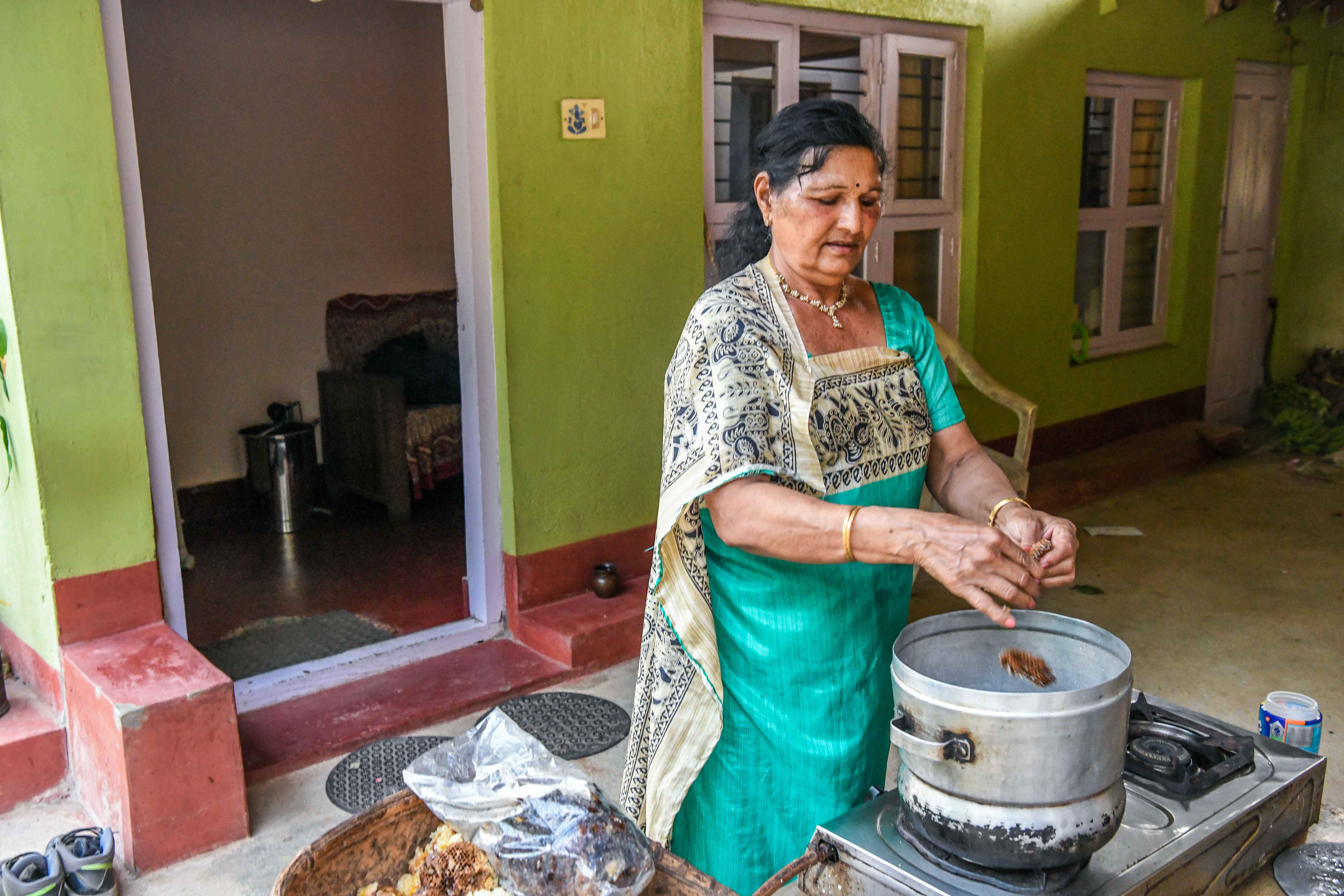
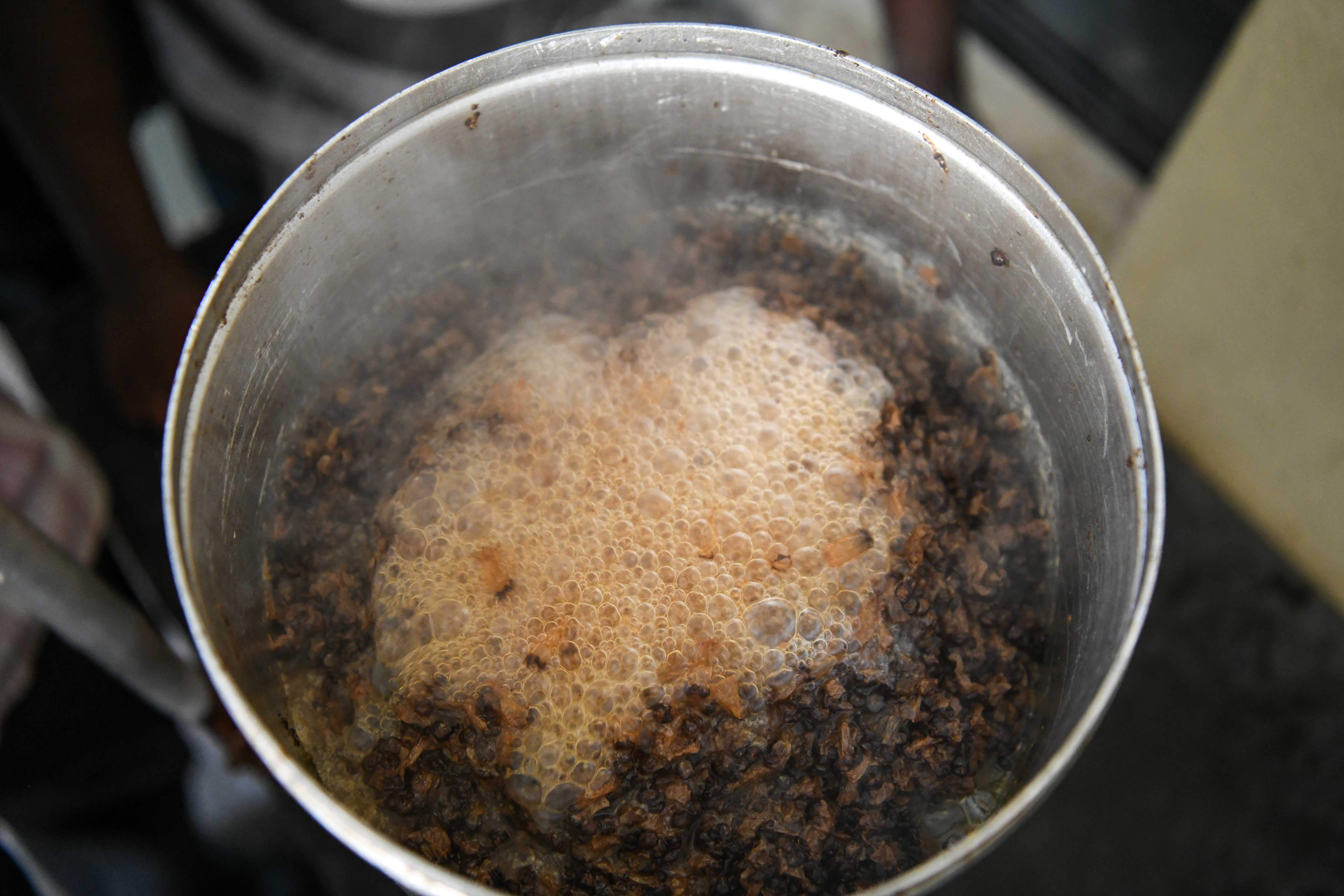
She also makes beeswax at home which is another income generator. She says that it is not a very laborious process and demonstrates. You first break the comb into a utensil with enough water and let it boil.

Honey12KF29oct2019

You let it boil until it reaches the required consistency.

Honey13KF29oct2019

You then squeeze out all the excess water and use the residue to make wax cakes.

Honey14KF29oct2019

This is the final product.

Honey15KF29oct2019

Apoorva pays regular visits to all the farmers across the country and conducts a health check.

Honey16KF29oct2019

It is very important to taste it as well. Every house he goes to gives him honey to taste. He jokes and says I am glad I don’t have diabetes. If I did, for the amount of honey I consume, I would be in a lot of trouble.

Honey17KF29oct2019

Bose Mandanna is the fourth generation coffee grower. He moved back to Coorg 53 years ago after completing a bachelor’s degree in Agricultural Economics. He talks of how he has seen farming change in the years to come. Back in the day farming was done in a very environmentally friendly way. Over a period of time, when they found pests taking over the plantation, they used some chemicals to deal with the pest issue. However, they soon realised that they were not only harming humans but also the bees and other pollinators in the environment. These chemicals known as weed killers have cancer-causing properties. On realising this, they decided to go back to organic farming. However, a lot of farmers have been affected by this chemical especially in Punjab as they are one of the largest agriculturists, and the Punjab mail is popularly called the cancer express as a lot of them are coming to Bombay for treatment. Also to note the groundwater gets affected by these chemicals. People are saying that there are bee-friendly pesticides available. He jokes and says “there are all chemicals and they cannot be friendly, they might not kill you but make you unconscious”. Please avoid chemicals and use bio controlled agents.

Honey18KF29oct2019

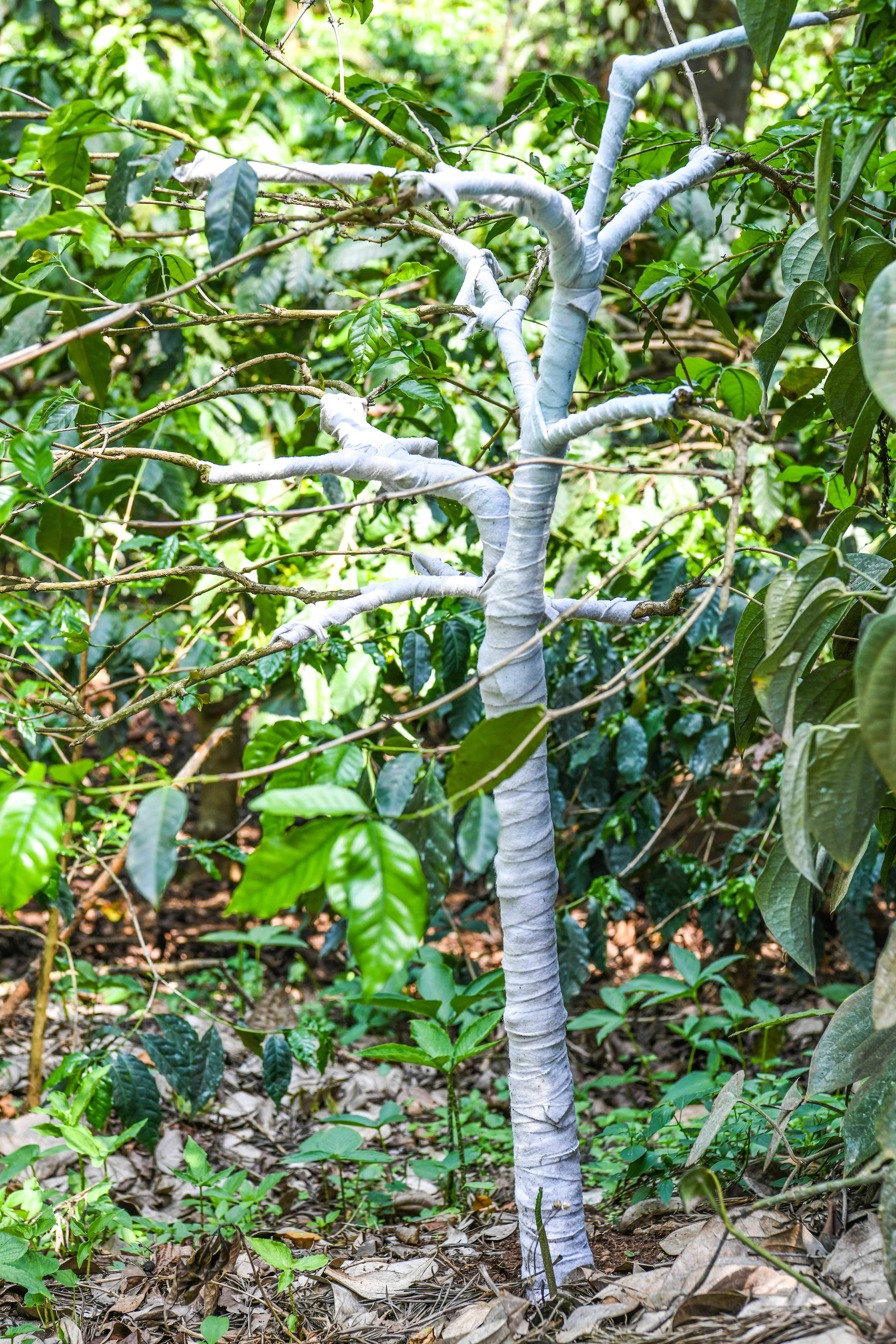
White Stem Borer Problem: These pests are known to attack the coffee plants and wreak havock hence they wrap the plants with white cloths to avoid this menace. There is a mild chemical in it but it only
touches the trunk of the plant and does not reach the coffee flower thereby not harming humans or bees.

Honey19KF29oct2019

May 20th is International Bees Day. UAS in GKVK conducted a 2 day class for people interested in beekeeping. Urban beekeeping is also becoming popular as people from the cities have started showing
interest.

Honey20KF29oct2019

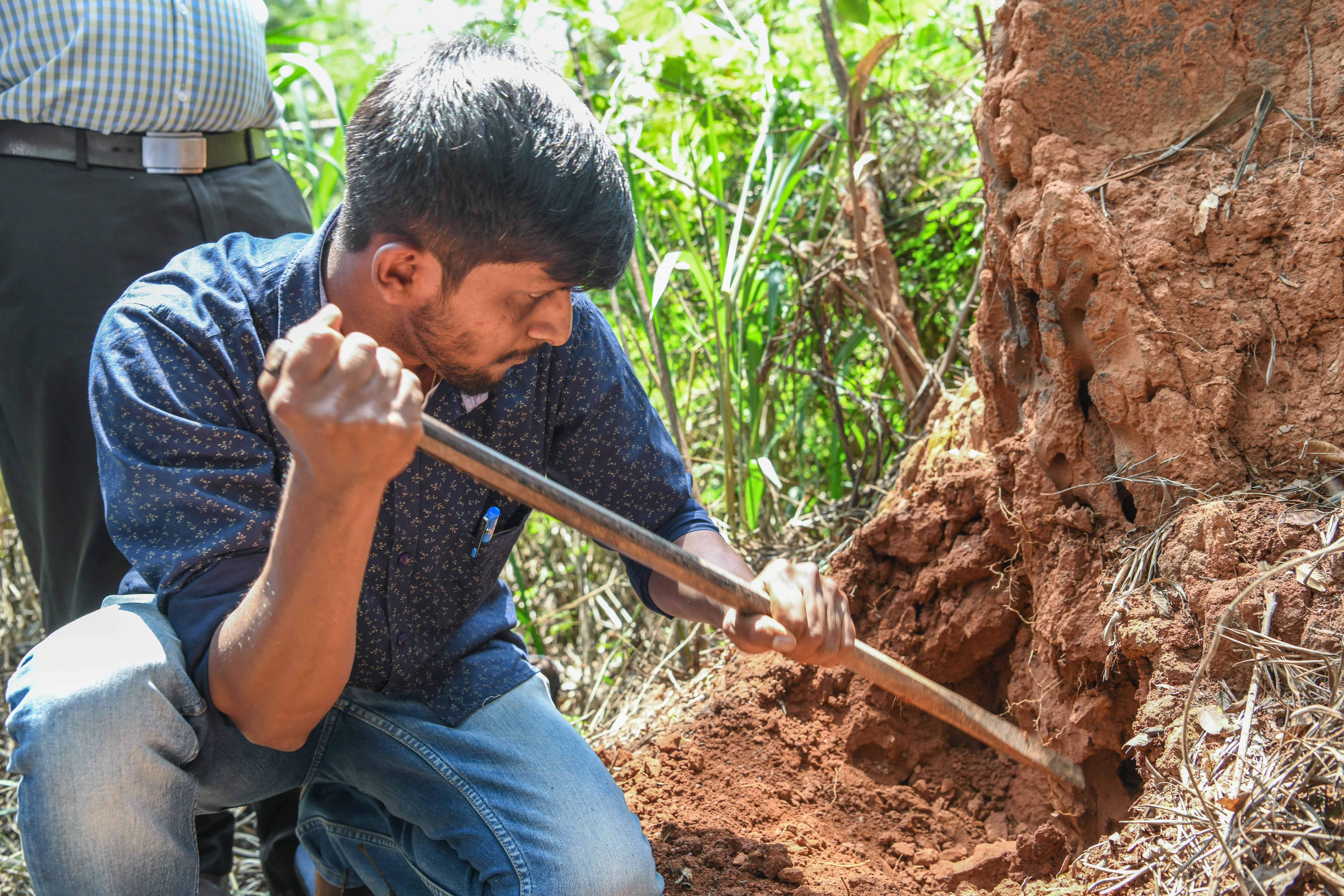
The staff showed them how to identify and dig out for a beehive as they can build hives anywhere. This has to be done with caution so as to not break the hive.

Honey21KF29oct2019

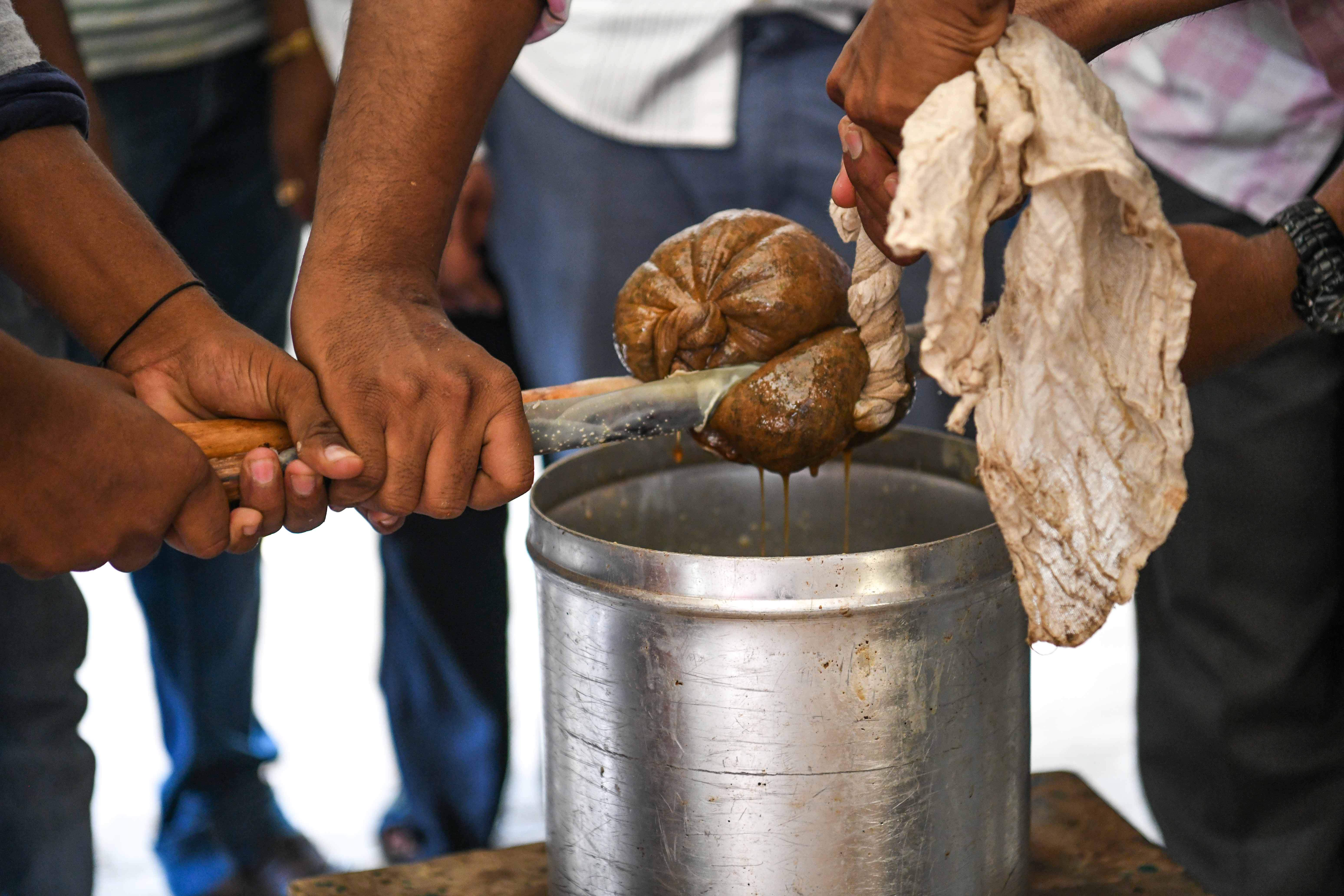
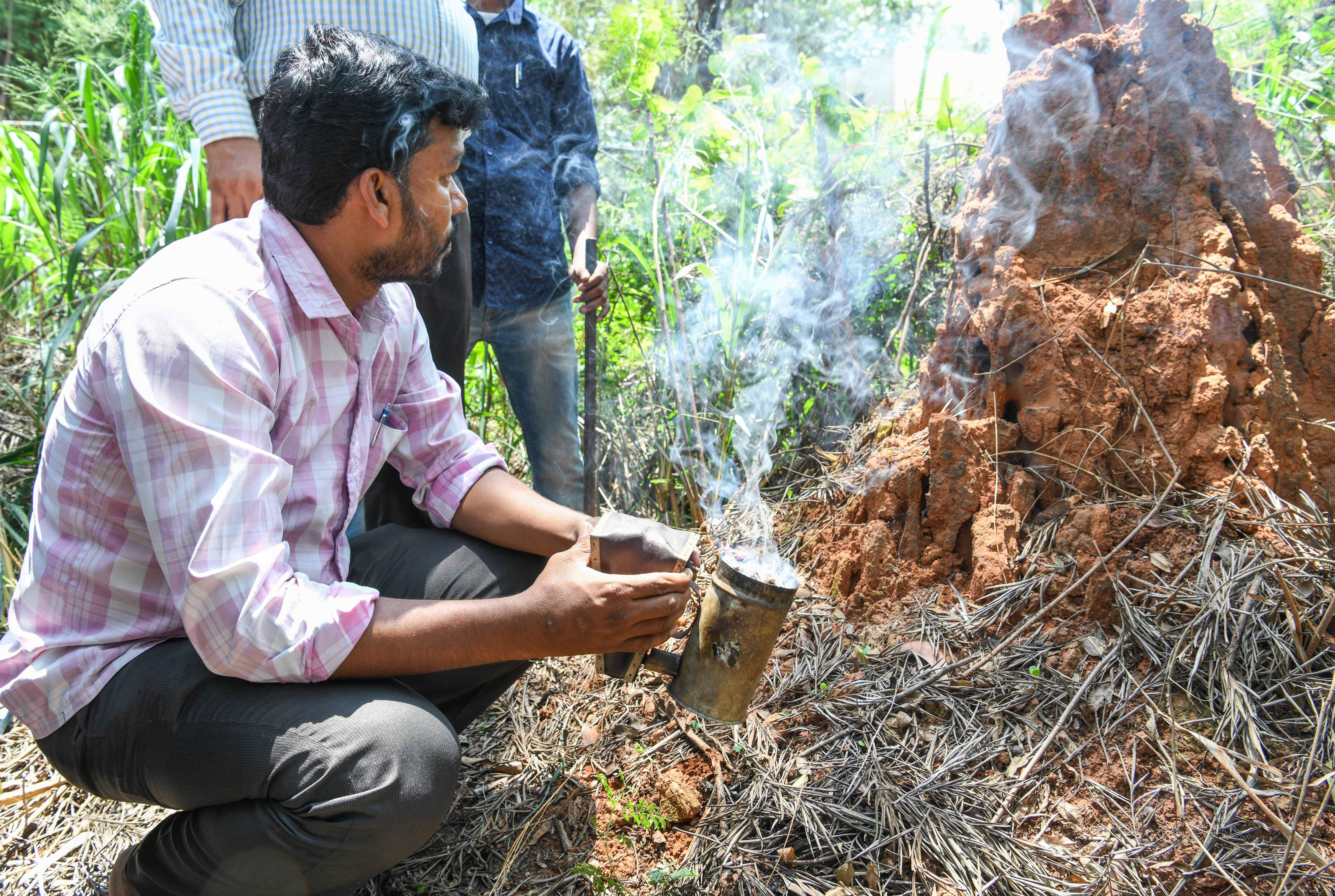
You then mildly sedate the bees with some smoke by burning dry cotton cloth and get the comb out

Honey21KF29oct2019

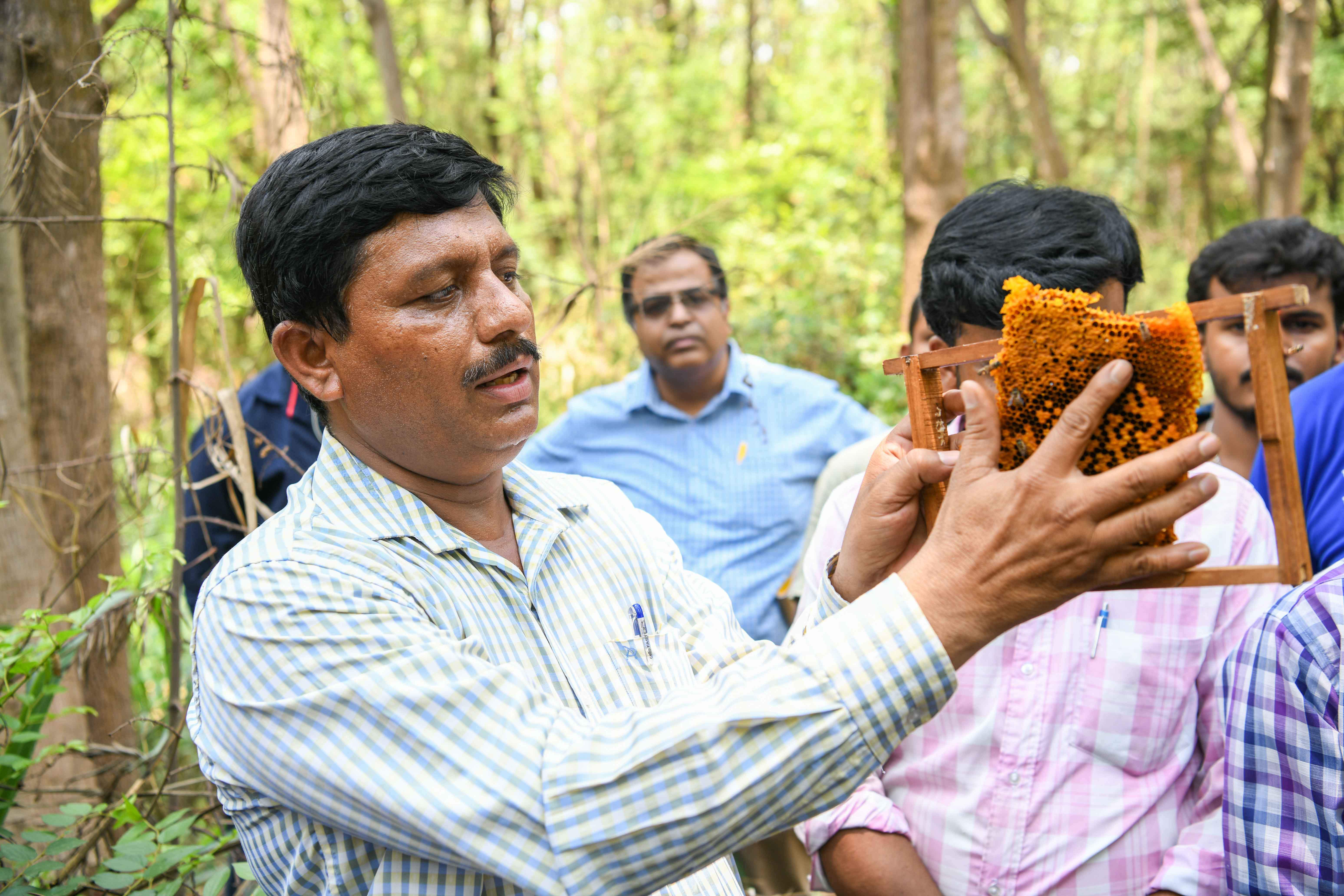
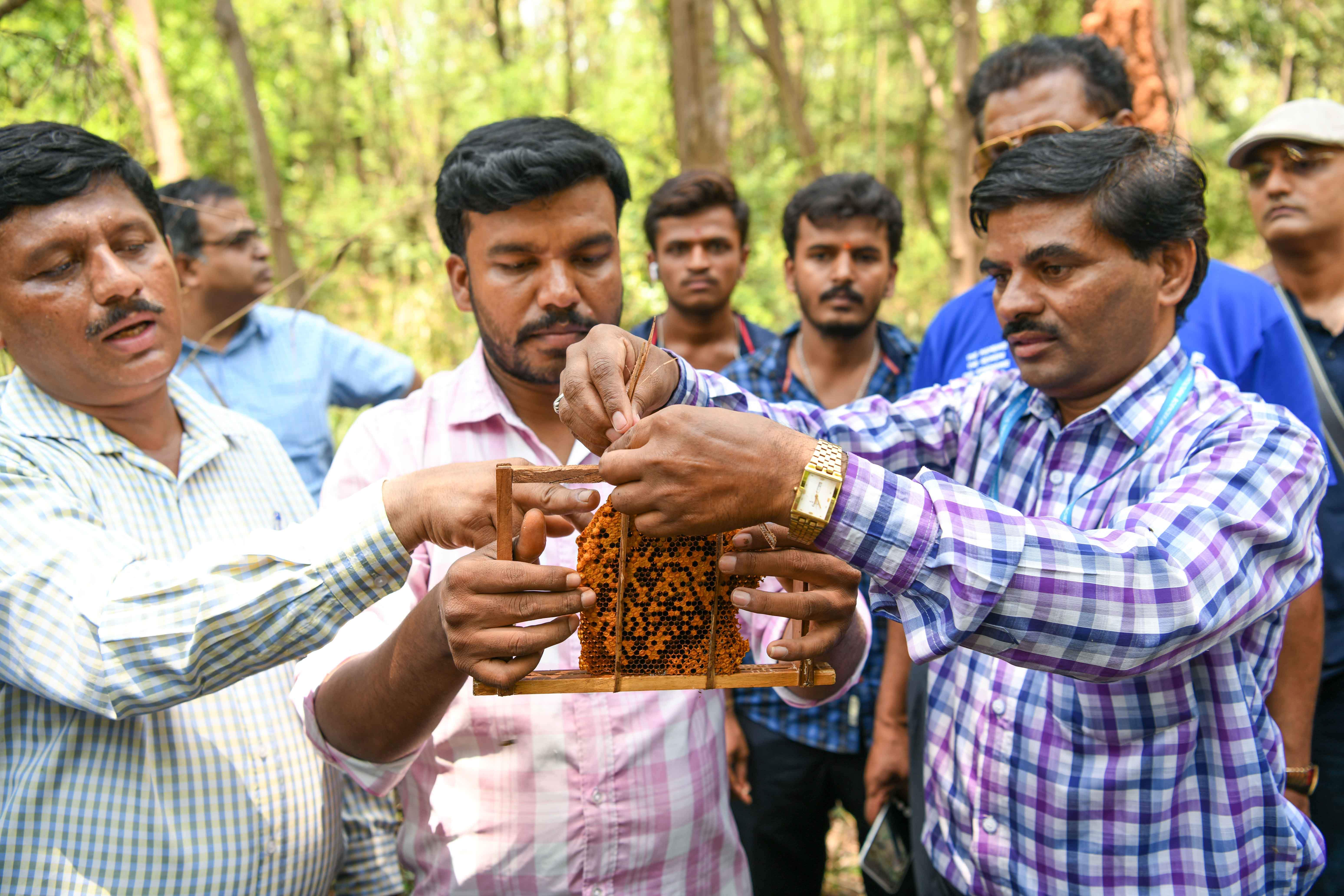
Once you get the comb out, you tie them tightly to a frame but not so tight that they break.

Honey22KF29oct2019

Students learn to tie the comb to the frame.

Honey23KF29oct2019

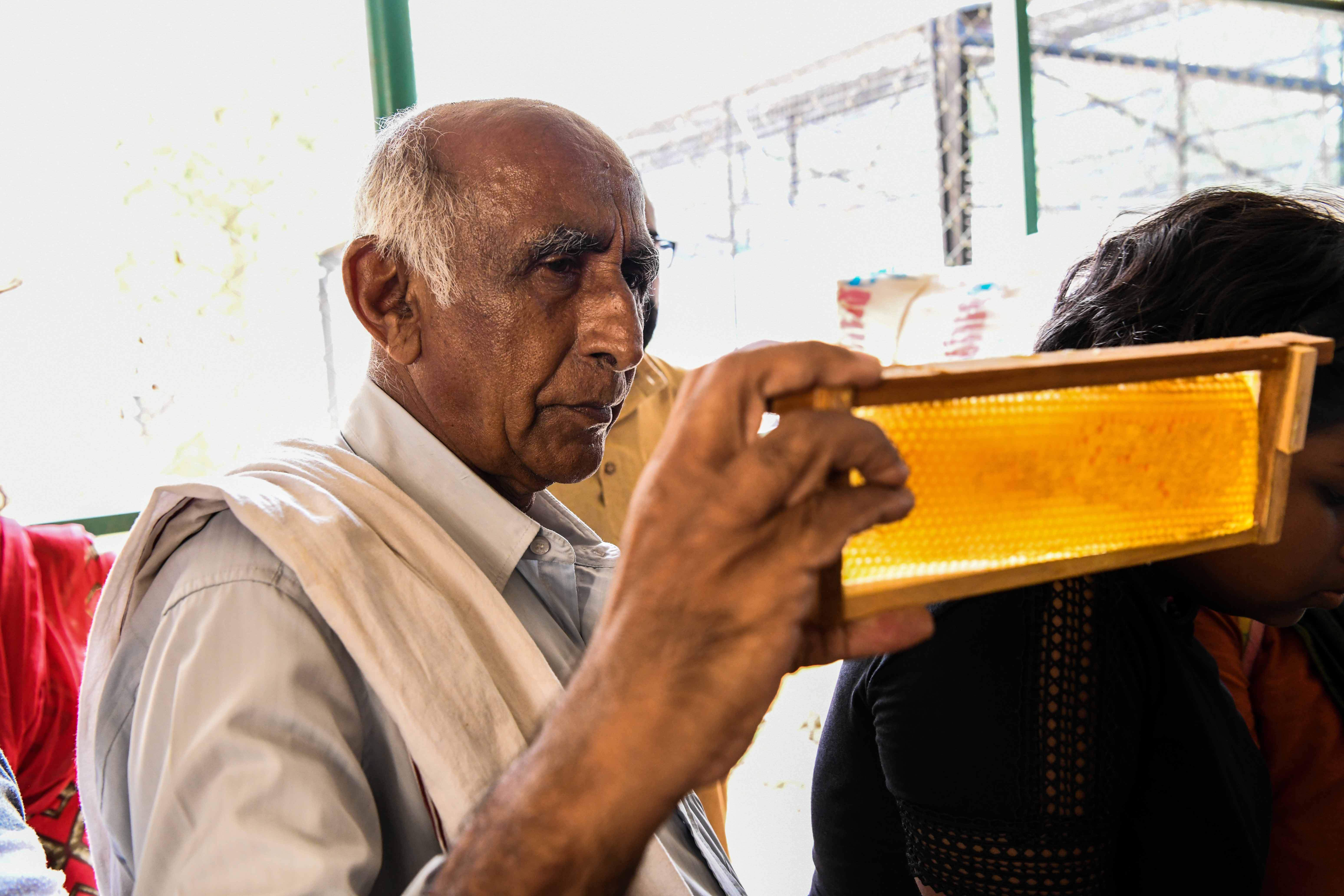
While they learn to make honey, a student observes the comb.

Honey24KF29oct2019

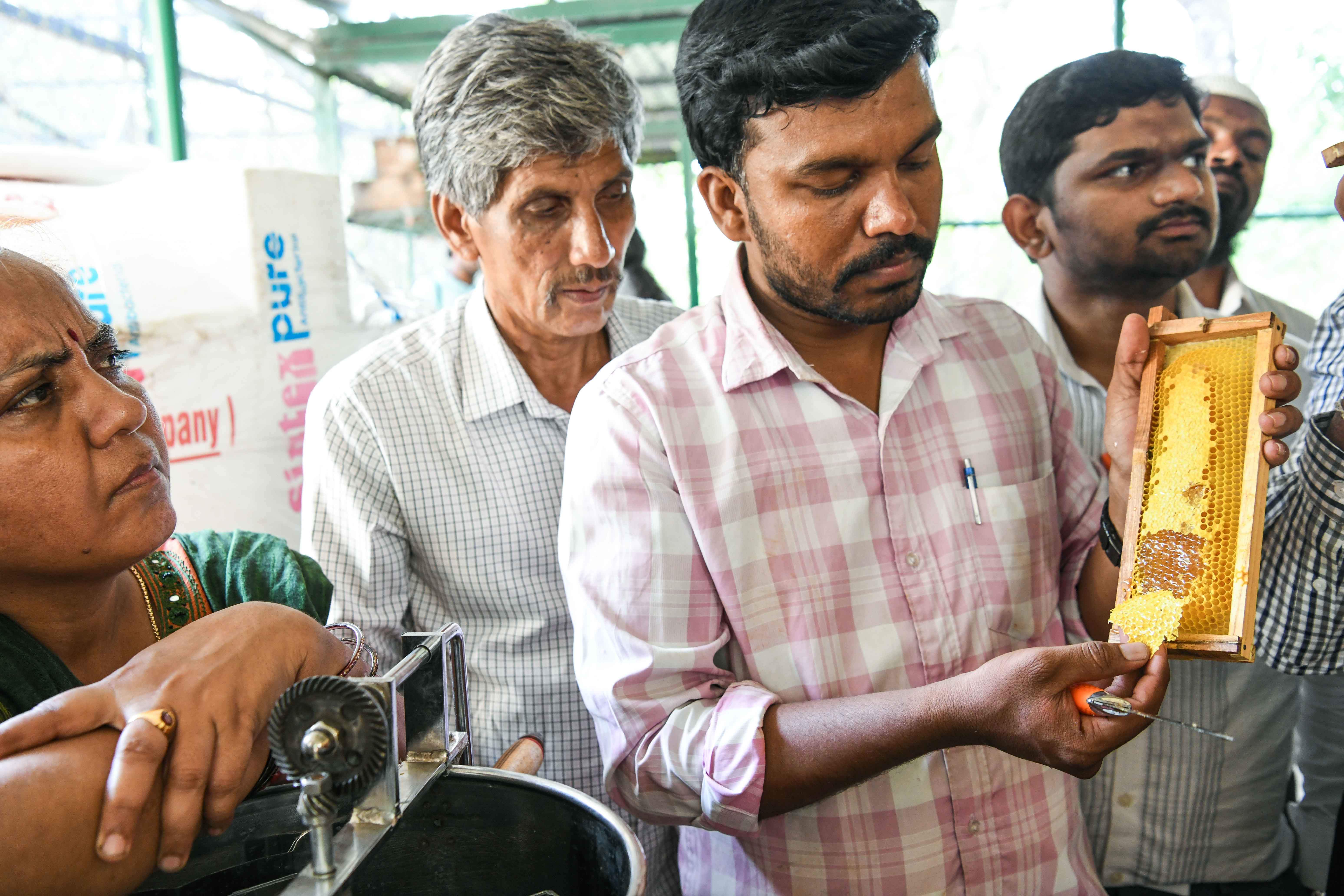
Santosh from the faculty shows the class how to peel the comb before you can put it into a vessel to churn honey. The peeling has to be very fine.

Honey25KF29oct2019

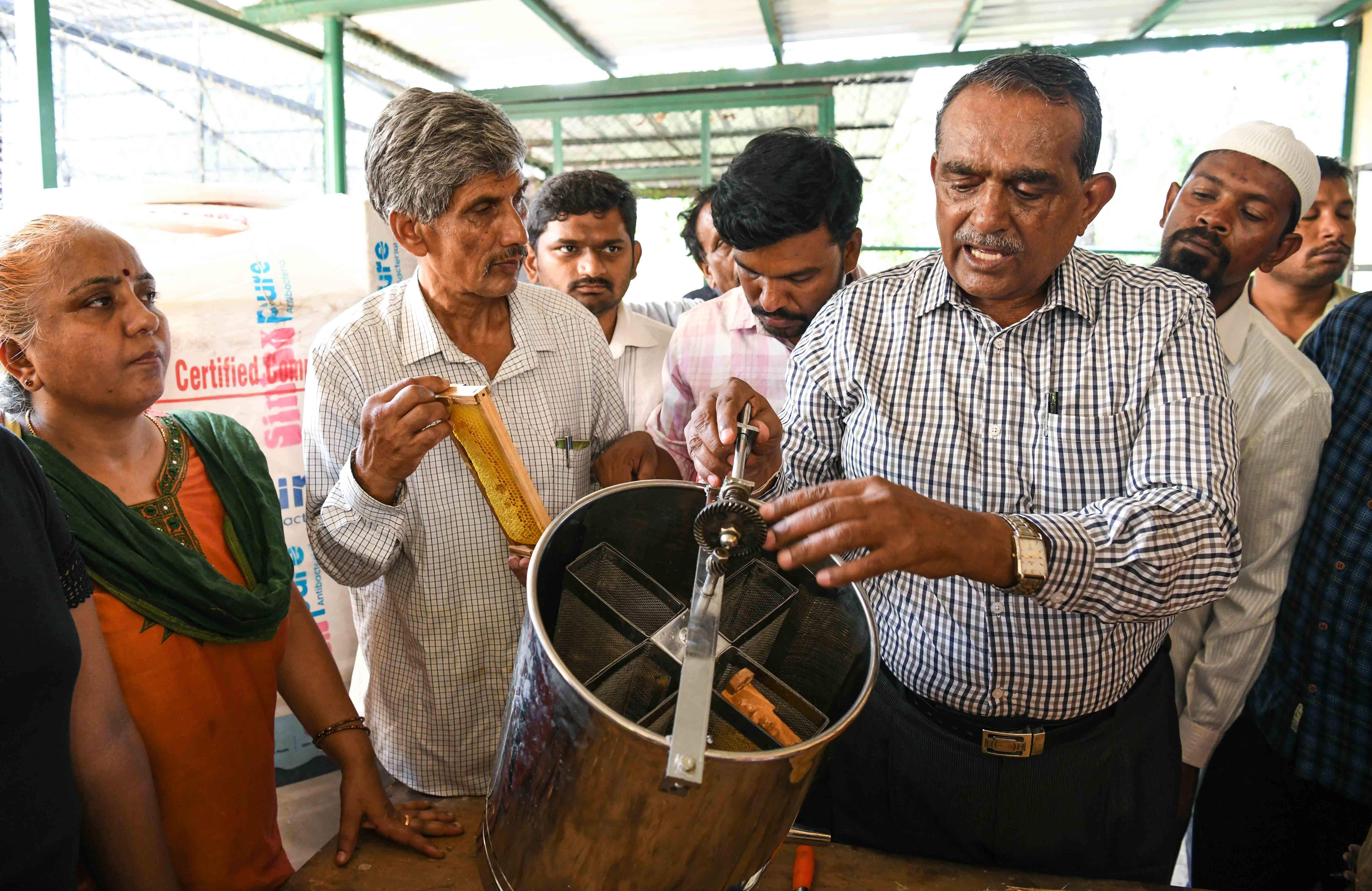
These are the machines in which you put the combs in to extract honey. These machines are also made by Apoorva and sold to the farmers. There is a particular way the combs have to be kept and then manually churned.

A small community of farmers can only do so much, the government needs to step up and help take this initiative forward, make this bigger and reach more people.

source: http://www.newindianexpress.com / The New Indian Express / Home> Specials / by Meghana Sastry / Express News Service / October 28th, 2019
India’s coffee growers share history with Nobel winner Michael Kremer

The winners of the 2019 Nobel Prize in Economics in the screen grab — Abhijit Banerjee, Esther Duflo and Michael Kremer (AP file)

– Michael Kremer, a Harvard University professor, was the co-Founder of ‘Precision Agriculture Development’ or PAD

– It advised the Coffee Board to pilot a missed-call enabled service to help coffee farmers in Karnataka
___________________________________

Bengaluru:

India’s Coffee Board, a state-run body that promotes coffee production and drinking, shares a slice of history with Michael Kremer, who won the Nobel Prize in Economics along with Esther Duflo and Abhijit Banerjee.

Kremer, a Harvard University professor, was the co-Founder of ‘Precision Agriculture Development’ or PAD, which advised the Coffee Board to pilot a missed-call enabled service to help coffee farmers in Karnataka. The IVR call service can give precise advise to the grower from scientists at Central Coffee Research Institute.

“Under his guidance and leadership, Team PAD have been working with Coffee Board of India and the coffee ecosystem for more than one year now. Thanks to the stellar efforts of Michael, Shawn, Madhur, Niriksha and Team Coffee Board, we have been able to have a positive impact on the lives of 15000 coffee farmers using a simple missed call service, free of cost to coffee farmers,” said Srivatsa Krishna, Chief Executive Officer of Coffee Board, in a statement to the media.

The service, Coffee Krishi Taranga, gives registered growers a weekly advisory on critical farm operations and daily market statistics through an automated push call when a farmer places a missed call on the helpline (080-37685000) run by the Board. It has helped growers improve productivity, profitability and environmental outlook, and will be expanded to cover 50000 growers shortly, according to the Coffee Board.

The PAD’s journey in India begun as an academic experiment in Gujarat with cotton farmers in 2011, when Narendra Modi, then chief minister of Gujarat, encouraged testing a similar service in his state called Krishi Tarang, said Srivatsa. “On behalf of the entire Indian coffee ecosystem, the finest shade-grown, hand-picked rainforest Coffees in the world, we congratulate Dr.Kremer and thank Team PAD for their contributions,” said Srivatsa Krishna.

source: http://www.livemint.com /Live Mint / Home> Explore / by Nidheesh M.K. / October 15th, 2019

Farmers To Take Out Talacauvery To Bengaluru Bike Rally

FarmersKF28sept2019

Mysuru:

Urging the State Government for effective tackling of floods and drought in the State, the Karnataka Rajya Raitha Sangha (KRRS) will take out a bike rally from Talacauvery to Bengaluru next month.

Addressing farmers from 6 districts of Mysuru region at Jaladarshini Guest House here recently, KRRS President Badagalapura Nagendra said the bike rally will be launched at Talacauvery, the birth place of river Cauvery, on Oct.12.

The rally will pass through Periyapatna and Hunsur to reach Mysuru where a massive farmers meet will be held at Town Hall on Oct.13. After the meet, the rally will travel to Mandya, passing through Srirangapatna. The rally will then travel to Shivapura near Maddur where a farmers meet will take place. After the meet, the rally will proceed to Channapatna, where the rallyists will stay for the night.

The rally will reach Bengaluru on Oct.14, where a massive conference of farmers will take place at 1 pm, Badagalapura Nagendra said and added that over 10,000 farmers from different parts of the State are expected to take part.

He further said that the farmers meet will demand a special package for restoration of flood hit areas, scientific compensation to displaced farmers and constitution of an expert committee for management of drought and floods.

source: http://www.starofmysore.com / Star of Mysore / Home> News / September 27th, 2019

Kodagu Disaster: GSI Must Be More Pragmatic And Purposeful

Kodagu01GSI17sept2019

Sir,

This is in response to the letter by Geologist Mrinmoy Chakraborty (SOM dated Aug.11, 2019) defending the views of the Geological Survey of India (GSI) published in SOM dated Apr.25. I write this to bring to light a few facts that go to show that Chakraborty has hastened to defend the warnings given by GSI a bit too early and to furnish some clarifications regarding the extreme events that wreaked havoc in Kodagu this August and perceptions arising out of them.

The series of landslides that devastated Kodagu in 2018 occurred mostly during the period 15th, 16th and 17th August. Some intriguing data on rainfall pertaining to this period tells the story. This data is from the rain gauge at Kudigana, a place near the border of the catchment of Harangi, which witnessed the worst kind of disasters in 2018.

Record rainfall

Till 6th August, the station had recorded about 5,500 mm of rain, and then on rainfall on the successive days read (in mm): 81, 250, 269, 90, 115, 121, 262, 295, 320, 461 (16th), 394, 197, 164, 95, the total for the fortnight amounting to 3,114 mm (Mysuru’s annual rainfall is 780 mm). Probably the 5-day extreme rainfall recorded then at Kudigana (1,686 mm) is the highest ever recorded in the rain gauging history of Kodagu (which extends for over 120 years now), the earlier highest being 1,462 mm in 1964 pertaining to the station of Bhagamandala.

On the other hand, the records at Kudigana for this year read thus: Total rainfall up to 1st August – 2,041 mm; then on – 30, 0, 16, 136, 183, 254, 312, 276, 298, 158, 90, 46, 35, 100 (15th), during the next 14 days – this is the period when the floods ravaged the district. The extremes here are just about 75% of last year’s and the total for season up to 20th Aug. is not even half of last year’s (nearly 4,090 and 8,614 mm respectively).

Kodagu02GSI17sept2019


Once in 10-12 years

The highest one-day rainfall recorded this year has been reported from Bhagamandala, places around which contribute to flow in Cauvery and stands at 400 mm. The seven-day extreme for this year here has been 1,142 mm. Strangely, these values have return periods of 12 years and 10 years respectively.

This means, the type of flood-causing rain that fell this year occurs, according to data available, nearly once in 10-12 years. Even the flood magnitudes in the four rivers of the basin that were reported this year have return periods of 15 – 20 years.

On the other hand, the rainfall of 2018 that caused havoc in areas around Madikeri and in the catchment of Harangi shows a return period of over 50 years! This is the reason why even though Kodagu experienced severe floods this August, only just a couple of incidents of severe landslides have occurred.

Technical data

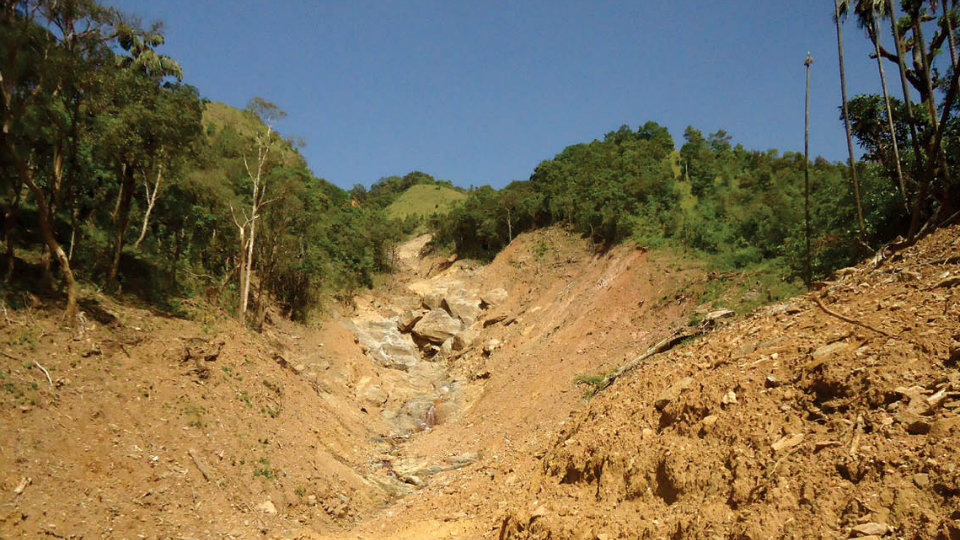
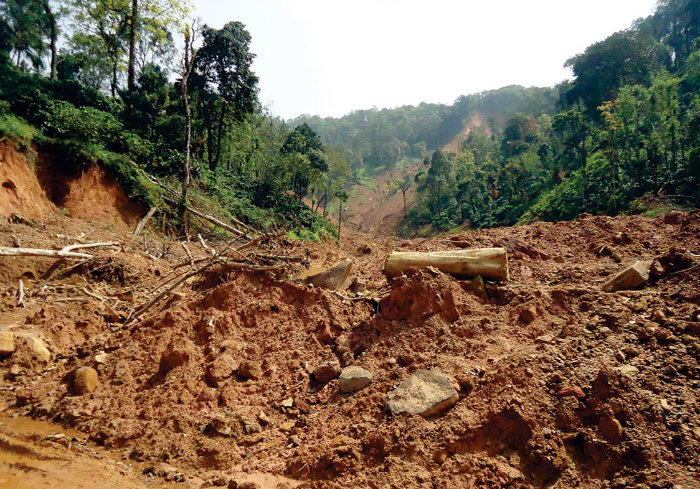
Very often, blockage of roads due to mud falls from tall and nearly vertical cuttings (Plate 1), many times triggered by uprooting of trees and washing away of the valley side road formations, are also termed as landslides, while the landslides of 2018 were removal of unimaginably large portions of hills, mostly in the valleys.

A large number of the over 150 landslides that occurred then got initiated far away from the highways and inhabitations (Plate 2), in total contrast to the common belief that tampering with nature and cutting land indiscreetly is the root-cause of landslides.

Many of these slides carried tens of thousands of cubic meters (like 200 m x 100 m x 2 m) of earth submerging hundreds of hectares of land downstream in mud (Plate 3 and 4). However, even earth falls of volume of a few hundred cubic meters (20 m x 10 m x 2 m) block roads and cause damage to houses — only one landslide of the former nature has been reported this year. It is not strange that extremes not quantified by measurements are blown out of proportion, painted colourfully and projected as catastrophes in this era of rampant use of mass and social media.

Predictions fail

Dr. H.S.M. Prakash, Director General of GSI, is reported to have explained (SOM, 25th April) thus: “There are indications of excessive downpour happening in five phases just like last year …”; “likewise, three to four more similar downpours are likely to be experienced… The rainfall in August is likely to result in floods”. Yes, one spell of rainfall has resulted in floods. But what about the rest? It is a common experience that any astrologer, once approached, would point out a number of cases in which his predictions have gone perfectly right, hiding others! The fact is that rainfall in Kodagu this year has been very poor except for that one spell — even after that week of deluge, the total seasonal rainfall for the year remains 25-40% lower than the normal (except in small pockets of Virajpet), while the last year it was about 25-50% higher than the normal.

Strong low pressure

It is claimed by Chakraborty (SOM, 11th Aug.) that the predictions for this year have been those based on “evidences”. Dr. Prakash had explained: “There is a possibility of heavy rain being caused due to volcanic eruptions in Hawaii and Mauritius. And, as if an indication, it has already started raining in Kodagu (in April)”.

It is utterly sad that an agency with a legacy of 200 years has fished out evidences for the floods in August, in the excessive rainfall of April! It is well established that the pre-monsoon rains of April and May are a phenomenon occurring due to local convections, while the monsoon rains in Kodagu are due to the global circulation, aided by strong low pressures in North/ Central India and the local orography (high rising mountains) of the Sahyadris.

It is now popularly known that the excessive rainfall of the ten days of August this year has been due to a strong low pressure that developed in the Odisha coast, and experts from GSI claim it to be due to excessive heat of magma in Mauritius!!

Better to err on safer side

Being half correct about events not known of is one hundred perfect in Statistics — probably the messengers, the people at the helm of affairs, believe that it is better to err on the safer side than on the other. Sweeping and arbitrary long-range predictions are not only unwarranted, but are also dangerous.

Rather, there shall be healthy introspection and debate on why even extreme events of smaller magnitude have been resulting in excessive damages in recent days. Further, very little of the Hydrology of this region has been understood, much remains to be done. It is hoped that the agencies concerned take a more pragmatic and purposeful look at the recent events and use them to learn about the region.

– Yadupathi Putty, Mysuru, 3.9.2019

You can also mail us your views, opinions, and stories to voice@starofmysore.com

source: http://www.starofmysore.com / Star of Mysore / Home> Voice of the Reader / September 16th, 2019

‘Cauvery Calling’ campaign kickstarted at Talacauvery

Isha Foundation Chief Sadhguru Jaggi Vasudev at the launch of ‘Cauvery Calling’ campaign, at Talacauvery in Kodagu, on Tuesday. Actors Rakshith Shetty and Diganth took part in the rally.

Cauvery Calling, a campaign conceptualised by Isha Foundation was launched in Talacauvery, the birthplace of River Cauvery, on Tuesday.

Isha Foundation Chief Sadhguru Jaggi Vasudev rode a motorbike himself to arrive in Madikeri on Sunday. Film actors Rakshith Shetty, Diganth and Shashi followed him.

A puja was offered at the ‘Theerthakundike’ in Talacauvery, earlier to the launch event.

Sadhguru Jaggi Vasudev said that through the campaign, there is an aim to plant 242 crore saplings on the banks of River Cauvery.

Trees help to increase the capacity of soil to retain water. Isha Foundation will work towards getting the necessary assistance from the government, he said.

He pointed out that the River Cauvery has become thinner by 39% in the last 70 years.

“The groundwater level in the river catchment area has been depleting drastically. Due to excessive deforestation in the catchment areas of the river, water is not flowing further and the river is getting dry even before reaching the sea. As a result, a drought-like situation has been arising during the months of April-May itself. This has created repercussions in terms of droughts in Karnataka and Tamil Nadu. Around 47,000 farmers living on the banks of River Cauvery have ended their lives in the last 10 years. It is noteworthy that the places of massive landslides have been due to excessive human interference. It is the need of the hour to wake up to the warning sign,” said Sadhguru Jaggi Vasudev.

Udupi-Chikmagalur MP Shobha Karandlaje said that the Central and the state governments will support the ‘Cauvery Calling’ campaign.

This month, the state government will sign a memorandum of understanding with Isha Foundation in this regard, she said.

MLA K G Bopaiah strongly felt the need to conduct a scientific study so as to know the reason behind massive landslides in Kodagu. He also demanded action against those who have encroached the government lands.

Air Marshal (retd) K C Nanda Cariappa and sportsperson Ashwini Nachappa were present during the programme held at Crystal Hall in Madikeri.

PM tweets

Replying to a tweet by Sadhguru Jaggi Vasudev, Prime Minister Narendra Modi tweeted at 4.13 pm on Tuesday, conveying his wishes to ‘Cauvery Calling’ campaign.

“Happy to know about your effort. It will surely add to the endeavour of harnessing Jal Shakti and preventing unnecessary wastage of water,” said the prime minister.

He also wished Sadhguru on his birthday saying, “Also wishing you a Happy Birthday! Praying for your long life and best health!”

15-day bike rally

The motorbike rally organised as a part of ‘Cauvery Calling’ campaign will pass through Hunsur, Mysuru, Mandya and Bengaluru. Public functions will be held in these places. The rally will reach Bengaluru on September 8.

The bike rally will traverse a distance of 1,500-km in Karnataka and Tamil Nadu and will culminate in Chennai on September 17.

source: http://www.deccanherald.com / Deccan Herald / Home> State> Mangaluru / by DH News Service, Madikeri / September 03rd, 2019

After Cracks At Ayyappa Swamy Betta In Virajpet… Cracks In Brahmagiri Hill Worries People Of Kodagu

CracksKF22aug2019

Madikeri:

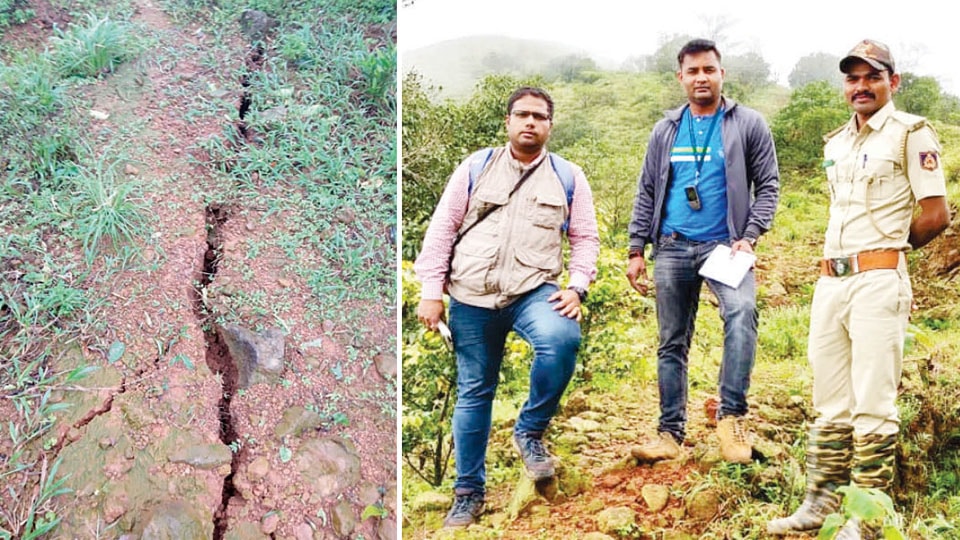
A day after inspecting cracks developed at Ayyappa Swamy Hill in Virajpet, a two-member GSI (Geological Survey of India) team visited Brahmagiri Hill range in Talacauvery on Sunday, following reports that huge cracks had developed at several locations in the Hill range.

The GSI team comprising Sunandan Basu and Kapil Sharma inspected Brahmagiri Hill range and studied the hill’s ecology, geology and geographical characteristics.

The team also got to know that the Forest Department had dug pits and planted saplings using heavy machinery, which may have caused loosening of the soil layer on the Hill range, leading to wide cracks.

Basu and Sharma also visited Korangala, where massive landslides were reported and studied about the reasons for such huge landslips.

The cracks on Brahmagiri Hill in Talacauvery, the birthplace of River Cauvery, the lifeline of crores of people along the river basin, has been a cause of worry for local people.

The residents have appealed the Government and the District Administration to take immediate measures to save Brahmagiri Hill range, which they consider as holy and also ecologically sensitive for its lush green cover.

The GSI team, after conducting a thorough study on all factors that have caused cracks in hillocks, is likely to submit a report to the Government on the measures to be taken.

Many Hills under threat of collapse

Meanwhile, many other hillocks elsewhere in Kodagu district are facing the threat of collapse, as cracks have reportedly surfaced in some of them.

After Brahmagiri Hill range in Bhagamandala, Ayyappa Swamy and Malethirike in Virajpet and Manipare Hillock at Thora village along the Kerala border, several other Hills too are said to have developed cracks, giving rise to serious concerns among local people.

Although the district has got a break from rains for the past couple of days, the people living near the hillocks still feel that their troubles are not far from over.

Many residents of Kodagu feel that this year’s rainfall is the highest in decades and has similarities with the 1972 deluge, when rain caused havoc and untold misery. But then, there were not much causalities as the population was less and urbanisation was yet to pick up pace.

But this year, the damage has been extensive with many homes collapsing and hundreds of people taking shelter in relief camps set up by the District Administration.

The district is facing the deluge for the second successive year. Last year, the deluge had devastated the district to such an extent that it will take many years for reconstruction.

Following last year’s rain ravage, a GSI team had extensively toured the district to undertake a detailed study of landslides and landslips. The GSI then had classified dangerous zones under four categories and had warned that villages coming under these zones could face nature’s fury once again. As such, the District Administration had taken many measures on a war-footing to prevent casualties and damages to properties as much as possible.

source: http://www.starofmysore.com / Star of Mysore / Home> News / August 21st, 2019