Category Archives: Agriculture

Mother Mirra’s Coffee’s 100-year legacy

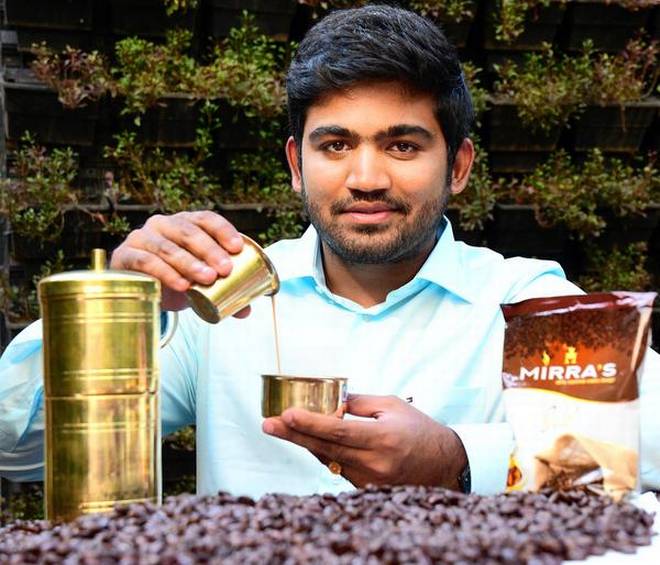
Chasing the perfect brew Sundar Subramaniam, Executive Director of Mirra's Coffee   | Photo Credit: S_SIVA SARAVANAN
Chasing the perfect brew Sundar Subramaniam, Executive Director of Mirra’s Coffee | Photo Credit: S_SIVA SARAVANAN

As Mirra’s Idhu Namma Veetu Kaapi now steps into the new age with its latest filter coffee variants, we look back at the company’s 100-year-old legacy.

“I promise, you will keep coming back for more,” declares Sundar Subramaniam with a confident smile. The executive director of Mother Mirra Group of Companies offers me a fragrant brew, made with coffee powder from Mirra’s Idhu Namma Veetu Kaapi brand. The group recently launched three variants of filter coffee. It’s limited to retail in Tamil Nadu and Puducherry for now, but Sundar is bursting with plans.

“We are marketing Mirra’s Coffee with the line ‘I want you to buy my coffee once’… we plan to give away free brass coffee davara sets with every packet soon. And, there will soon be wet sampling at malls and stores.”

Mother Mirra’s Coffee has a 100-year-old legacy. It comes from the house of the first Asian planter, PPR Subramaniam (Sundar’s great-grandfather) and his Virakesari Plantations. PPR was an entrepreneur and journalist from Avanipatti village, in the Sivagangai district of Tamil Nadu. He also started Virakesari, the first Tamil newspaper in Sri Lanka in the 1930s, to give a voice to the rights of plantation workers.

“Back home, our community was often associated with the money-lending business. My great-grandfather set a new path. He moved to Sri Lanka at a time when plantations were still owned only by the British and the Scottish,” Sundar says with pride.

Later, PPR moved to Malaysia, where he bought more plantations. “My grandfather Sundarakesari continued the tradition and owned plantations in Coorg. My father S Subramanian followed suit,” says Sundar, now settled in Coimbatore.

Today, their plantation AA — or Premium Arabica — variety of beans is exported to countries within Asia and beyond. They also have a line-up of Arabica and Robusta with varying ratios of chicory content in them.

“Our wholesale market is thriving. We also sell online on Amazon, Flipkart, Paytm, and Big Basket, something I introduced after I took over in the last six months. My focus is on digital marketing. We are getting a good response from our active social media pages too.” The group has also branched into budget homes and service apartments.

“I did my masters in business marketing at Cornell University in New Zealand. I wanted to work abroad, but my father had other plans. He met me at Singapore and handed me my return ticket to Coimbatore,” laughs Sundar.

What followed was the launch of the retail brand. They added more German machineries to the factory at Coorg and introduced three new products — pure coffee (100% premium Arabica), premium filter coffee (with 15% chicory) and Gold (with 47% chicory). A network of 350 dealers ensures that the filter coffee reaches stores in Coimbatore, Madurai, Chennai and Puducherry. “In a couple of months, we want to start exporting to Singapore and New Zealand.” They also plan to enter the Sri Lankan market, from where it all began. A particular street in Colombo, from where Virakesari was born, still goes by the name Chettiar Street, to honour his great-grandfather.

Among new products, a green coffee is in the offing. Sundar also plans coffee counters at airports: where one can sow coffee, roast, grind and brew a perfect davara.

source: http://www.thehindu.com / The Hindu / Home> Life & Style> Food / by K Jeshi / July 20th, 2018

Marshy field sports held in Madikeri amidst rain

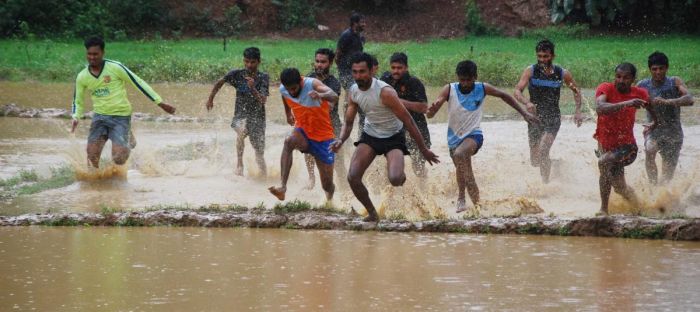
Youth take part in a marshy field race in Madikeri. DH PHOTO

From tiny tots to the elderly, a large number of people became a part of fun and frolic amid rain, at a marshy field in Madikeri on Sunday.

Various competitions were held at a marshy field belonging to Kukkera Palangappa in Devasturu village in Madikeri taluk, as a part of ‘Aatinaati Koodukoota’ organised by Karnataka Arebhashe Samskruthi mattu Sahitya Academy.

Men and women took part in volleyball, tug of war, throw-ball and running race. Rural games were conducted for children.

Speaking on the occasion, MLA M P Appacchu Ranjan felt the need to preserve paddy transplantation for the next generation.

“People should not think about profit alone and should get into the marshy field, as an effort to rediscover traditional agriculture which is vanishing,” said Ranjan.

Pattedar of Devastur, Kukkera Thammaiah flagged-off the paddy seedling transplantation and marshy field race.

He said that agriculture was a social activity in the past and people in the village help each other in paddy seedling transplantation work. But, today, fields have been left fallow.

In a good development, a few youth associations have come forward to carry out paddy transplantation work, he added.

Karnataka Arebhashe Samskruthi mattu Sahitya Academy Chairman P C Jayaram said that the traditional methods of agriculture reflected social harmony.

MLA K G Bopaiah, Kolar Excise Department Deputy Commissioner Sumitha Lingaraju, academy members Ramesh Joyappa, Kakkera Pradeep and A K Himakara were present among others.

source: http://www.deccanherald.com / Deccan Herald / Home> State> Districts / by DH News Service, Madikeri / July 22nd, 2018

Video Of Class 8 Boy Narrating Kodagu’s Rain Woes Goes Viral

KalleraFatehMPOs16jul2018

Madikeri:

While many people have expressed their dissatisfaction about Chief Minister H.D. Kumaraswamy (HDK) for not sanctioning any funds to Kodagu in his Budget, this little boy from Yemmemadu village near Napoklu takes the cake. In a video that has gone viral, the boy vents his anger at the CM and at the same time highlights how Kodagu is ravaged by rain and how man-animal conflict has made lives miserable in this tiny district.

In the video, the Class 8 student, Kallira Fateh, son of Kallira Ummar and Rukya, says the district which has given River Cauvery to Mysuru, Mandya, Bengaluru and Tamil Nadu has got nothing from Kumaraswamy.

Hailing from a farming and daily wager family, Fateh, holding an umbrella, is seen pleading with the CM to provide relief to the rain-affected Kodagu farmers. Taking a dig at the Chief Minister for ‘neglecting’ Kodagu district in the Budget, Fateh said, “Mysuru, Mandya and half of Tamil Nadu get water, if it rains in Kodagu district. But the unrelenting rain has destroyed coffee, pepper, areca and paddy crops in Kodagu.”

“The wild elephant menace is on the rise in Kutta, Birunani, Balele and Ponnampet because of which daily wagers and agriculture farmers fear to venture out of their houses. The rain-battered Kodagu-Kerala Road has become non-motorable. “Who should people approach to get their problems addressed? It is you (CM), who else,” he said.

He continued, “Kumaraswamy has meted out injustice to Kodagu by not sanctioning grants to Kodagu and added that the CM should treat all districts equally.”

The boy then addressed BJP State President B.S. Yeddyurappa to impress upon Prime Minister Narendra Modi to announce compensation for the distressed farmers.

“Modiji is Prime Minister for 130 crore people of the country. He should treat people of all religions and castes on equal footing. This holds good for the CM too,” Fateh said.

The video went viral and reached the CM too. Kumaraswamy told reporters in Bengaluru that since Independence, many rulers have come. “Why am I being targeted, that too after taking charge just two months ago? I know about the problems faced by people of Kodagu. I will visit Kodagu and stay there for two days and hear the grievances of people and solve their problems,” he said. Fateh’s father Umar said his son was pained by the destruction of standing crops on 3,500 acres of paddy fields in the village.

“Our paddy field has been waterlogged for the past 13 days. No official or people’s representative visited our area. In our village, we get electricity only for six months a year. All this upset him,” he said. “I’m happy that the State Government and the CM have responded to our demands,” he said.

source: http://www.starofmysore.com / Star of Mysore / Home> News / Madikeri – July 15th, 2018

Tree Lovers Club Plants 700 Saplings At Vijayanagar

Urban greening initiative…

TreeLoversKF14jul2018

Mysuru:

The newly-floated Tree Lovers Club, Vijayanagar, planted around 700 saplings including fruit-bearing indigenous trees in Vijayanagar 3rd Stage on Sunday last.

The Club, an offshoot of Vekare Ex-Servicemen Trust (VKET), will take up urban greening and promote it by example and through public campaigns.

Speaking to SOM, VKET and Tree Lovers Club President Mandetira N. Subramani said that it is the responsibility of every citizen to take care of the ecology and environment around their neighbourhood, first by planting a couple of fruit-bearing saplings in places wherever it is feasible. Subsequently, it should be the individual’s responsibility to nurture them after their maintenance for five years till they grow at least 15 feet in height.

He said, it is the collective responsibility of the residents and NGOs to take the initiative to impress upon the Forest Department to plant more saplings.

He further mentioned that the Tree Lovers Club will accomplish its mission of apprising the Chief Conservator of Forests in Mysuru to plant over 5,000 different species of saplings including fruit-bearing trees in Vijayanagar 1st, 2nd, 3rd & 4th Stages.

Vice-President Shakunthala Subramani, Gen. Secretary A.B. Bojappa, Jt. Secretary Poornima Raghu, Treasurer S. Somashekara and Hon. Advisor P.S. Bose Subramani led the morning walkers and residents of Vijayanagar 3rd Stage, numbering over 150, in planting the saplings.

Addressing the gathering after planting over 25 fruit-bearing trees in the Park opposite Heritage Club, the Tree Lovers Club President thanked the participants, members of Brahmagiri Kodava Association and Heritage Club for giving moral support to the Club in accomplishing the greening initiative. Tree Lovers Club intends to adopt the Park in Vijayanagar 3rd Stage for development and maintenance after obtaining the consent of authorities concerned.

Speaking on the occasion, A.B. Bojappa said that the Club would form a Committee of Tree Lovers to look after the saplings already planted in Vijayanagar 3rd Stage in the past one week.

The Secretary also requested those present to give their suggestions to improve the ecology of Vijayanagar 3rd Stage via e-mail: tree.lovers@yahoo.com or infowicket@gmail.com

source: http://www.starofmysore.com / Star of Mysore / Home> News / July 10th, 2018

Mulled and brewed at home

Bottled Goodness

WineKODAGU11jul2018

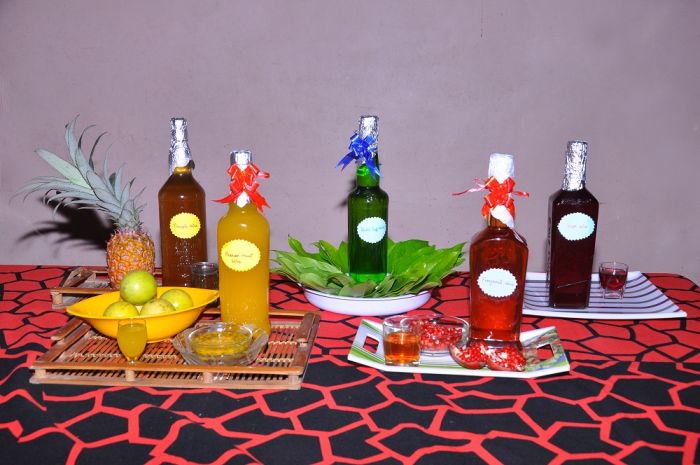
It is common to think of grapes when we talk about wines. But women of Chikkamagaluru, Kodagu and Hassan districts have shown that there’s more to wine than just grapes. Here, wine is made from a wide range of locally grown fruits and spices like jamun, ginger, pepper, betel leaf, gooseberry, orange, cashew apple, rice, banana, coffee, etc. These wines, traditionally mulled and brewed in the coffee estates of the State, are being perfected to be sold in domestic and international markets. Women entrepreneurs, who are at the helm of winemaking, ferment different flavours of wines as well.

In these districts, it is a custom to serve a cup of freshly brewed coffee to guests. In addition to coffee, homemade wine is now offered as a welcome drink at weddings and other joyous gatherings. It is also presented as a gift to relatives and friends. Not just that, it has become a good addition to the various products that travellers look for in these places.

Wine heritage

Amongst the three districts, Kodagu holds a prominent place as the producer of wine. The district has a uniformly distributed wet climate. The British have left their cultural footprints here, which reflects in the culture and lifestyle of the Kodavas. The wine has historically been a part of the Kodava diet and heritage and has been bettered through generations.

With the tourism sector experiencing a steady growth in the district, more than 1,000 women are now engaged in winemaking. While many of them brew for home consumption, the number of women taking it up as an income-generating activity is also on the rise. Winemakers say that since they produce wine in small quantities, they don’t have to register with the Wine Board.

Wine is made throughout the year and the ingredients change with the season. This art of perfecting homemade wine has seen higher success rates with the involvement of self-help groups. One such group is Rajarajeshwari Self-Help Group(RSHG) established by the women of Kargunda village in Madikeri taluk. For the past 16 years, the members of this group have been selecting the best quality fruits grown in their coffee plantations and blending them with various other locally sourced ingredients to make homemade wine.

RSHG is one of the first such groups to be formed by the Coffee Board of India. With 18 women entrepreneurs in its fold, two women work every day to ensure continuous production. “The health benefits of these wines are significant. For instance, black plum has positive effects on controlling diabetes and ginger has several medicinal effects,” says Jarina Uthappa, president of RSHG. Members Saroja Kalappa, Girija Chermanna and Gowramma Kaverappa say that over the years, there is an increase in tourist footfall to their shop, which is located on the route from Madikeri to Bhagamandala. And, many consider this outlet as a must-stop place for tourists.

The process

Sugar and the fruit of choice are added to boiled water and stirred at regular intervals for a period of five days. Then it is kept for 25 days, after which the fruit and sugar mixture is filtered into a bottle without any traces of the pulp being mixed. In order to separate the pulp from the liquid, Muslin cloth is used in the filtration process.

Only good quality fruits are used in winemaking. They do not use alcohol, yeast or any other form of preservatives during preparation. Of late, sugarless wine is also prepared. Customers can buy their products after tasting samples. The wine wine has a shelf life of up to two years. However, due to the natural process of fermentation, as years go by, the wine acquires five to 10% of alcohol content in it. It is safe to consume wine up to 60 ml after which it leads to intoxication. They sell about 150 to 200 bottles in a month and one bottle costs Rs 200.

Another successful self-help group, Coorg Wine Association(CWA) in Suntikoppa, is also a known name in wine production. Manu, a member, states that Kodavas have a cultural association with wine and it is seen as an energy drink here. At CWA, the process of fermentation is carried on for 90 days. Along with fruits, they also use pudina(mint), Bermuda grass and mulberry. At CWA, the filtration process takes place after 50 days and the wine is sold at Rs 250 to 300 per bottle.

Distinctive methods

Though the wine culture is not as widespread as Kodagu, the concept of homemade wine is catching up in Chikkamagaluru and Hassan districts, mainly because of the demand created by the tourists. “It has also become a source of regular income for women entrepreneurs,” states winemaker Divya Uday of Kitthagalale estate in Sakaleshpura.

Every winemaker follows a distinct method and even the ingredients vary. For one kilogram of fruit, Divya Uday adds one handful of rice, wheat flour, cloves, cinnamon, a pinch of yeast and little black pepper. The wine is sold at homestays in and around Sakaleshpura. She adds that beauty parlours are now placing orders for grape wine, which is used in facial cleansing.

I then interacted with two innovative entrepreneurs, Geeta Sunil and Sumitha Raghudev, in Chikkamagaluru. They have created a niche for themselves in the field with a wide variety of wines such as cashew wine, rose wine, passion fruit wine, pomegranate wine, pineapple wine and betel leaf wine. They have been supplying these unique flavours to homestays located in the region.

Bhagya Lakshman, an experienced winemaker in Mudigere taluk, remembers that in her childhood, after a day of hard labour, to de-stress from the physical and mental strain endured, people used to consume a primitive form of wine before dinner. The ingredients were mainly fruits and berries picked from surrounding community forests and plantations. The fruits were blended with jaggery, sprouts, ginger, black pepper and rice.

Over the years, there has been a lot of changes in the preparation and consumption practices, reflecting the evolution of customs, traditions and culture. And the change is for the better, she feels. She says that many Ayurvedic practitioners recommend consumption of one spoon of betel leaf wine or ginger wine on a daily basis to maintain good health.

It is very fashionable these days to serve wine as a welcome drink in the social gatherings that women organise. It is always served in limited quantities. Wine must always be stored in glass bottles and must never be refrigerated. Wine, when preserved for more than seven years, gives the same intoxicating feeling as whiskey.

So, when you visit this part of the State next time, don’t forget to try these fruity flavours.

source: http://www.deccanheral.com / Deccan Herald / Home> Spectrum> Spectrum Top Stories / by Poornima Kanahalli / July 07th, 2018
It’s Honey Calling

CoorgHoney01KF02july2018

Madikeri:

Any talk of Kodagu often begins with the aromatic coffee, golden-glazed honey and some lip-smacking authentic delicacies. Honey has a special place in the district and Kodagu is known to produce distinct and rich honey that is famous for its originality, purity, taste and longevity even when stored in closed containers for years together.

However, the district hit a low in honey production in the 1990s as Thai Sac Brood disease hit the industry hard. Said to have originated in Thailand, the disease killed bees, including the queen bee and so far there has been no effective remedy for the disease. Also, the red ant menace further crippled the industry and most of the apiculturists were forced to switch to other means of livelihood. So badly affected was the industry that the honey production in Kodagu has dipped to a low of 50 percent in the late 1990s.

Now slowly the industry is regaining foothold and thanks to people who are growing conscious about their health and healthy habits, there is a global market for Coorg Honey. Honey is produced mainly in Bhagamandala, Galibeedu and Cherangala of Madikeri taluk, Birunani, T. Shettigeri and Kedamulloor in Virajpet taluk, Shanthalli, Jakkanalli, Soorlabbi, Hammiyala, Hachchinadu, Kumbaragadige and Mutlu in Somwarpet taluk.

CoorgHoney02KF02july2018

At present, Kodagu has over 7,000 bee-keepers and Bhagamandala region alone accounts for more than 50 percent of production of the district with the total being about 850 tonnes.

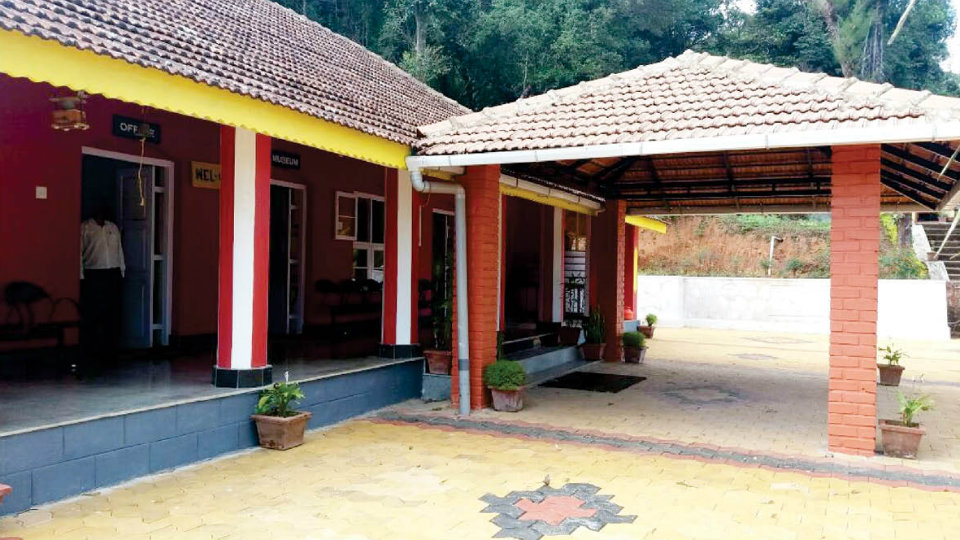
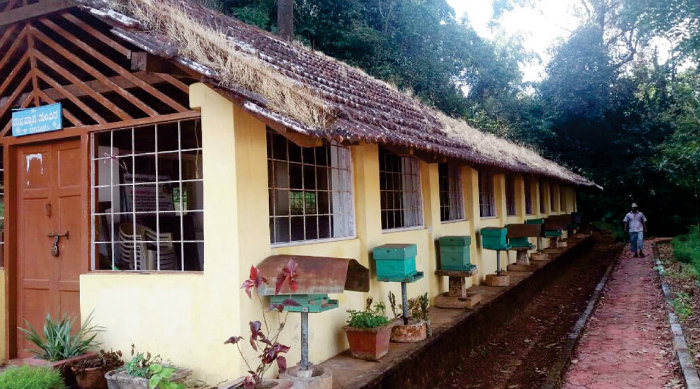
To bring back the glory of honey production in Kodagu, the State government has set up a Honey Park in Bhagamandala where the only Apiculture Technical Training Centre of State is located. The Park also houses a Honey Museum. The Park and the Museum are the first in the State.

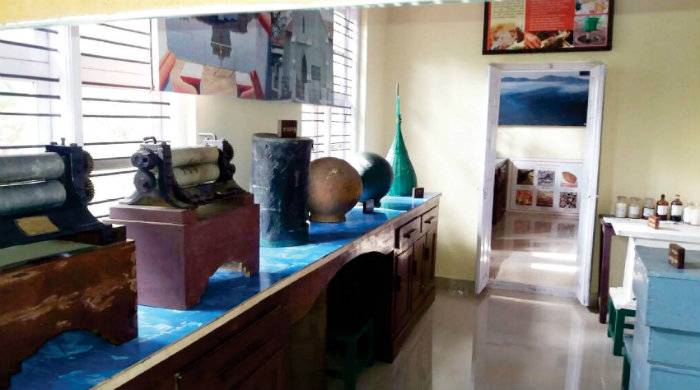
Honey extractors, beehives, honey containers, honey pots on display at the Honey Museum.

Built at a cost of Rs. 1.42 crore, works on the Honey Park began in 2015 and is completed now. The Park is housed at Apiculture Technical Training Centre that was established at Bhagamandala way back in 1948 by the then Coorg State Government. Funds for the Honey Park was released by the State Horticulture Department and initially in 2015-2016, Rs. 50 lakh was released. Later, in 2016-2017, Rs. 82 lakh was released and Rs. 10 lakh was released in 2017-2018.

A honeycomb kept for demonstration at the Honey Park.

The Honey Park acts as a comprehensive centre for honey production and related activities. It would also endeavour to provide marketing facilities for the product in the entire State. The Park is being maintained by food processing division of Agriculture Department. The Park has been set up to promote apiculture, which will supplement the income of the farmers.

According to officials managing the Honey Park, they get regular visitors who want to know about honey production, the costs and apiculture procedure.

CoorgHoney05KF02july2018

Certificate course

“We will provide a three-month certificate course during November-December-January for students and professionals who want to take up apiculture as a part-time business,” they said. Hostel facilities will be provided to the trainees during their three-month stay at Bhagamandala and already many students from Mysuru, Belagaavi, Koppal and Dharwad have enrolled for the training programme.

This apart, the Honey Museum traces the history of honey in Kodagu, its origin, golden period, its gradual decline owing to diseases and the present state. Also, it gives the visitors information about global honey growth and how it has become popular among health freaks. Models have been prepared and ways and means of honey extraction with machines and bare hands without getting bitten or stung by bees are demonstrated here.

A short movie screening is another attraction in the Honey Park. It captures the honey development in Kodagu. The centre will train local tribals and farmers in apiculture. Tribals will be trained in collecting honey in forests. This in turn will help in improving their economic conditions.

source: http://www.starofmysore.com / Star of Mysore / Home> Feature Articles> News / June 30th, 2018

Coffee sector seeks govt support for re-plantation

City: Chennai

With a large majority of coffee plantations having turned old and unproductive, coffee sector is seeking a Colombian-model re-plantation support from the government.

Abysmally low yield, lower price realisation and high levels of debt have been restraining the sector from taking up re-plantation on its own.

Re-plantation is long overdue for 65-70 per cent of India’s coffee farms. About 65 per cent of plants are more than 40 years old and for those varieties, the maximum yielding age of the plants is 35-40 years. Some of the better-yielding newer varieties have a shorter life of around 25 years and a good number of these newer varieties are also due for re-plantation, said AL RN Nagappan, coffee committee chairman of UPASI.

By retaining the older plants, both production and yield has been coming down. Coffee production, especially arabica production has been falling year-after-year in the past five years. From 120,000 tonnes, it has dropped below 90,000 tonnes.

The yield too is abysmally low. “We cannot even compare our yield with that of Brazil or Colombia. If an acre of coffee plantation provides 1.5 tonnes of coffee in Brazil, it would hardly produce 300 kg in India,’ said Nagappan. Inability to mechanise the plantations due to the hilly and rocky terrain also has been affecting the yield. According to Ramesh Rajah, president of the Coffee Exporters Association, coffee growers in the India are not in a position to take up the task of such large-scale re-plantation as most of the growers are incurring losses due to lesser price realisation and higher input cost.

“If the input cost on an acre is around Rs 70,000, the income would be around Rs 40,000 to Rs 45,000. The grower is incurring a loss of around Rs 30,000 on an acre of coffee plantation,” said Boje Gowda, chairman, Coffee Board of India.

The growers have been relying on the pepper vines to make up for the losses. “But the pepper prices too are down this year,’ added Nagappan.

According Gowda, almost 80 per cent of the growers have defaulted on their loans and the non-performing assets of the coffee plantation have become a burden for the banks.

In such a scenario, the sector is looking forward for support from the part of the central and state governments. “The government should take a leaf out of the re-plantation scheme being provided for growers in Columbia. The government has been providing financial support for the past few years and now the country has been able to enhance its production significantly,” said Rajah.

Since 2009, Colombia has been replanting around 85,000 hectares of coffee plantations every year. The government has been providing subsidy for the every replanted coffee.

“We have been requesting both central and state government to provide subsidies on the inputs like fertilizer electricity and machines,’ said Gowda.

As the grower has to forego the income during re-plantation, he also wants financial support during that critical period. “We are also expecting an interest waiver for the loans so that the growers can pay back at least the principal,” said Nagappan.

source: http://www.mydigitalfc.com / mydigitalfc.com / Home> Miscellany / by Sangeetha G

Demand for crabs, bamboo shoots rises in Madikeri

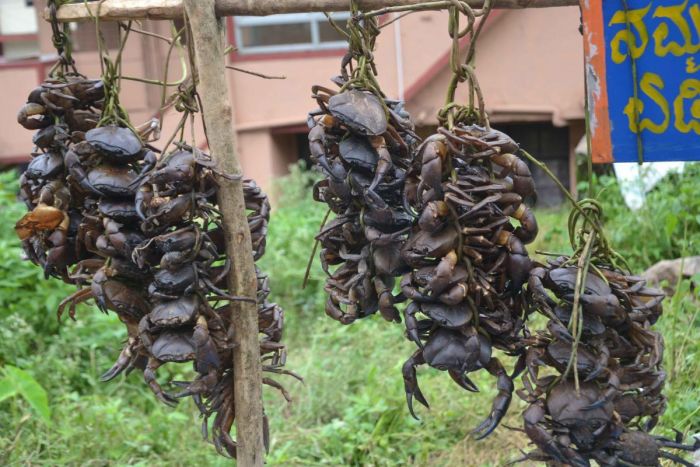
Crabs kept for sale beside a road in Madikeri.

It is the time of the year when people in Madikeri throng to purchase crabs and bamboo shoots.

Crabs, bamboo shoots and “Marakesu” have already entered markets in the district.

People consider crab as good for generating heat in the body which helps in braving the chill during monsoon.

The crab sellers collect 30kg to 40kg of crabs from H D Kote, Bheemanahalli and come to Madikeri to sell them. A bundle of crab (12 crabs) are priced at Rs 300. Crab fetches Rs 250 per kg.

In the past, crabs were available in plenty in paddy fields and water bodies. Now in spite of an increase in demand, there are a few people who sell it.

The availability of crabs has also declined, said crab seller Kumar.

Even the tourists who come here during weekends purchase bamboo shoots while returning home. The bamboo shoot is sold for Rs 40 to Rs 50 for half a kg.

The demand for “Marakesu” leaves also increases during the monsoon. The leaves are used for the preparation of “pathrode” and “bajji.”

The monsoon delicacies are served not only at home but at homestays and resorts as well.

There is a good demand for crab curry, crab fry, bamboo shoot pickle and bamboo shoot dry curry, said homestay owner Suyog.

source: http://www.deccanherald.com / Deccan Herald / Home> State> District / by DH News Service , Madikeri / June 24th, 2018

Rampant land conversion in Kodagu leads to reduced flow of water in Cauvery

Kodagu district is the major watershed and catchment for the Cauvery and has witnessed rampant conversion of not just forest land but also wetlands and coffee plantations.

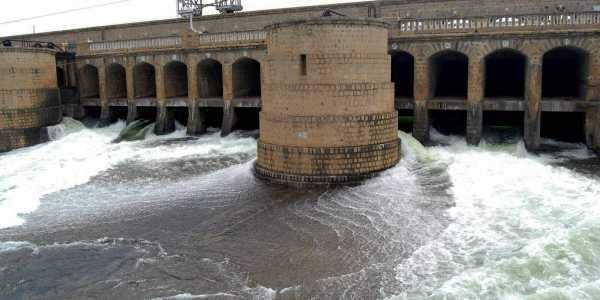
Water flowing from a dam across the Cauvery river. (File | EPS)

Bengaluru :

With 2,800 acres of land converted for commercial purposes in the last decade in Kodagu district, environmentalists decry the continuing change in land use and say it has decreased the annual flow of water in the Cauvery.

Kodagu district is the major watershed and catchment for the Cauvery and has witnessed rampant conversion of not just forest land but also wetlands and coffee plantations.

The statistics revealed by the district authorities are shocking as between 2005 and 2015, more than 2,800 acres of paddy field, coffee plantations and highlands were converted to residential layouts, sites, commercial complexes and resorts.

Col C P Muthanna, president, Coorg Wildlife Society said, “We have received this data from the district authorities as a reply to our RTI application. This is a matter of grave concern as the tiny district is the lifeline of not only south Karnataka but also Tamil Nadu. The river’s catchment areas have made way for buildings … the district has also been losing its tree cover to infrastructure projects, high tension power lines and railway lines.”

The Coorg Wildlife Society has met the district authorities in this regard and submitted a memorandum highlighting how large scale conversion of wetlands/highlands without even getting a NoC from the gram panchayats have taken off and legalised later by paying bribes. They have requested the authorities concerned to carry out a site inspection in the three taluks and a proper assessment on conversions. Col Muthanna adds, “The DC has tentatively agreed to our request. Further, we have requested for a study on carrying capacity of tourism in Kodagu that may finally result in policy measures for sustainable tourism.”

Environmental activist Sundar Muthanna, who has started an online petition ‘Stop the two railway tracks to Kodagu and Save Cauvery River’ and addressed it to PM and 14 others says, “Implementing the two railway lines will involve cutting of lakhs of trees in the catchment region. Kodagu has already lost 54,000 trees for a high tension power line to Kerala and now hundreds of fresh applications for conversions are pending with the department. Land conversion seems to be the government term for ‘ecological suicide’.”

Railways and highways are being planned to promote tourism and business. “When tree-holding agricultural land is converted for commercial purposes, the trees are cut for construction activities. In river catchment area, less trees is … simply put … less river. The Cauvery went completely dry in Kodagu in March this year … we don’t seem capable of understanding the many warnings that nature is giving us,” Muthanna says.

Environmentalists say a study done by researchers of Indian Institute of Science has already revealed the decreasing water flows to the Cauvery from the catchment areas of the district. Prof T V Ramachandra, head of Wetland and Energy Research Group, IISc headed this study — Modelling Hydrologic Regime of Lakshmanthirtha Watershed, River Cauvery. The study outlines how change in land use in Kodagu has decreased the flows into Cauvery. The assessment showed that out of five watersheds, four had high deficiency of water for over three months.

Kodagu DC was not available for her comments.

source: http://www.newindianexpress.com / The New Indian Express / Home> States> Karnataka / June 13th, 2018

Vintage Car Collector In Kodagu Dies As Tree Branch Falls On Him

AhmedKuttiMPOs12jun2018

Madikeri:

A farmer and a vintage car collector died after a tree branch fell on him at Nellihudikeri village near Siddapura in Kodagu district yesterday.

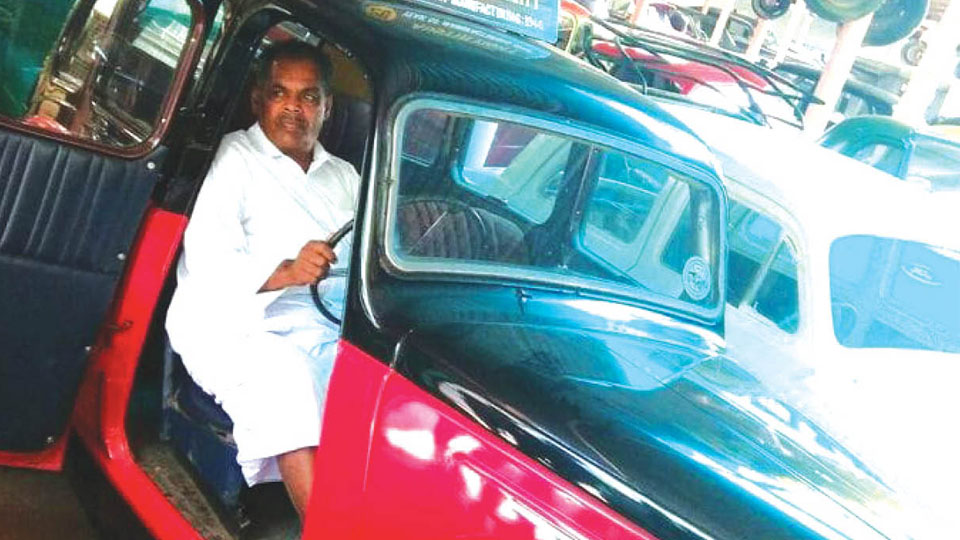
The deceased, 67-year-old P.C. Ahmed Kutti Haji, was working in his Mubarak Estate along with his son Ashraf at around 11.30 am. Due to heavy rain and wind, a branch of a banyan tree fell on Ahmed Kutti. He was immediately rushed to a hospital. But he succumbed to his injuries in the hospital. Kodagu Deputy Commissioner P.I. Sreevidya has announced Rs.5 lakh compensation to his family. She sent the cheque through the Tahsildar.

With his death, Kodagu has lost a collector of Vintage ‘beauties

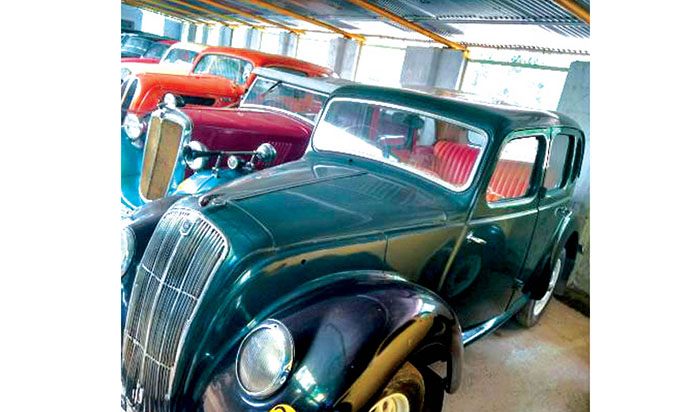
Ahmed Kutti Haji is a coffee planter and also an industrialist. He has a huge collection of vintage cars which he threw open to public. Collecting vintage cars was a hobby for Ahmed who has 86 of them and over 15 vintage petrol jeeps. Not to stop there, he also has 20 old two-wheelers, a 125-year-old bicycle and a 200-year-old bullock cart. The oldest car in the collection is 1925 model.

Normally vintage car collectors eye Bengaluru to add cars to their collection. Changing the trend, Ahmed focussed on old workshops in Kodagu and surrounding areas to hunt vintage ‘beauties.’ After picking them, Ahmed gave old cars a fresh coat of paint and tuned them to working condition.

Almost all foreign cars owned by Ahmed were manufactured between 1925 and 1965. Barring Dharmasthala, no other place in the State has such a wide collection of vintage cars.

With his death, Kodagu has lost a vintage automobile enthusiast.

source: http://www.starofmysore.com / Star of Mysore / Home> News /June 10th, 2018