Agreement signed revising salary and service conditions of plantation workers
The Estate Staff Union of South India (ESUSI) has signed a bilateral agreement with the United Planters’ Association of Southern India (UPASI) recently at Coonoor, revising salary and service conditions of staff working in the plantations of Karnataka, Tamil Nadu and Kerala for three years from January 1, 2017.
The revised salaries will ensure that workers will obtain a 23.5 % increase in their salary and this was the 20th wage revision settlement with UPASI, with the first being in 1947, a press release from ESUSI read.
“The DA is revised to Rs. 32 per point from Rs. 28. The pay scale is revised, a probationer will get Rs. 10,750 as starting salary, [revised] from Rs. 7,300.
The daily bata is revised for half day to Rs. 200 from Rs. 100, for full day Rs. 500 from Rs. 200 and for full day involving night stay Rs. 1,200 from Rs. 500. Leave Travelling Concession from Rs. 1,750 to Rs. 2,500, and Rs. 2,000 to Rs. 3,000 while annual travelling allowance will increase to Rs. 5 from Rs. 2,” the press release read.
The agreement was signed by D Vinodh Sivappa, President of UPASI, TT Jeyaram, Vice President of UPASI, Ullas Menon, Secretary General of UPASI and eight management persons representing Association of Kerala, Karnataka Planters’ Association and Planters Association of Tamil Nadu which are constituents of UPASI.
source: http://www.thehindu.com / The Hindu / Home> National> Tamil Nadu / by Staff Reporter / Udhagamandalam – June 27th, 2017
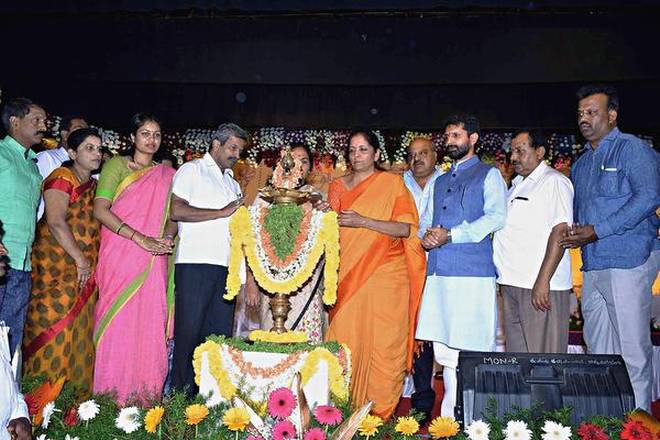
Union Minister of State for Commerce and Industry Nirmala Sitharaman inaugurating a public meeting at Mudigere in Chikkamagaluru district on Thursday.
Demands include support to coffee cultivation and checking elephant menace
Union Minister of State for Commerce and Industry Nirmala Sitharaman interacted with coffee growers at Mudigere on Thursday. The growers placed a number of demands before her, including finding a permanent solution to the elephant menace.
Representatives of Karnataka Growers’ Federation, Black Gold League and other organisations participated in the interaction.
B.L. Shankar, coffee planter and former MP, said the production of Arabica coffee had been declining every year. He wanted the government to take steps to support Arabica cultivation.
“Coffee cultivation has been hit by many problems; there is also shortage of workers,” he said.
Lok Sabha member Shobha Karandlaje stressed the need for research to address the stem borer attack, which had been causing huge losses to the growers.
C.T. Ravi, Chikkamagaluru MLA, wanted an ESI hospital in Chikkamagaluru, as there were a large number of workers in the plantations. Black Gold League president Kenjige Keshava appealed to the Minister to set up a spices park in Chikkamagaluru.
Interest waiver
Representatives of Karnataka Growers’ Federation sought waiver of interest on coffee loans and also five instalments to repay the dues.
B.S. Jairam, chairman of the federation, told The Hindu: “We submitted a memorandum listing all our demands. We have sought waiver of interest and bringing down interest on loans. We have also urged the government to take measures to check elephant menace in Hassan, Chikkamagaluru and Kodagu districts.”
Ms. Sitharaman said the government would take steps to increase coffee production and expand its market overseas.
“Growers in Andhra Pradesh, who began coffee cultivation only a few years ago, have succeeded in marketing it in America. If they could do, why can’t the growers in Hassan, Kodagu and Chikkamagaluru do?” she asked. The government was committed to encouraging coffee growers. After many years, and for the first time, a coffee planter had been appointed chairman of the Coffee Board. This showed the government’s commitment to supporting coffee cultivation, she added.
Coffee Board chairman M.S. Boje Gowda was present during the interaction.
source: http://www.thehindu.com / The Hindu / Home> News> States / by Special Correspondent / Chikkamagaluru – June 16th, 2017
The Travancore wolf snake sprawled near the bathroom mirror of the author’s room / Photo by Medha Saxena
Homestays in Coorg offer visitors a glimpse of a unique eco-system. Coorg or Kodagu is part of the Western Ghats that have been declared a world heritage site. It has many plantations that host hundreds of threatened species
It had beautiful dark coffee-brown scales with yellowish stripes and a sinuous slender body stretching no more than two feet.
The languid Tranvancore Wolf snake lay sprawled on the bathroom mirror. It had sneaked in to avoid the gentle night precipitation and was basking in the steam left behind by the hot water running earlier. It was hard to miss once the solar light was flicked on.
Gradually, it coiled back and slithered to a safer, darker corner behind the mirror. I was not sure at the time if it was venomous since it resembles the common Krait and is often targeted for the same reason. Suffice to say that I lay awake for most part of the night, wondering whether my nocturnal guest would like to take a peek at the room as well.
This was my penultimate night at the Rainforest Ecolodge on Mojo Plantation nestled at 1100-m altitude in Kodagu, Karnataka. The monsoon in a rainforest comes with its own delights and surprises. Leeches are a case in point. They crave to attach themselves to any warm body passing by to satisfy their desire for blood. But their presence also indicates a fertile soil and ecosystem. They are both the predator and the prey.
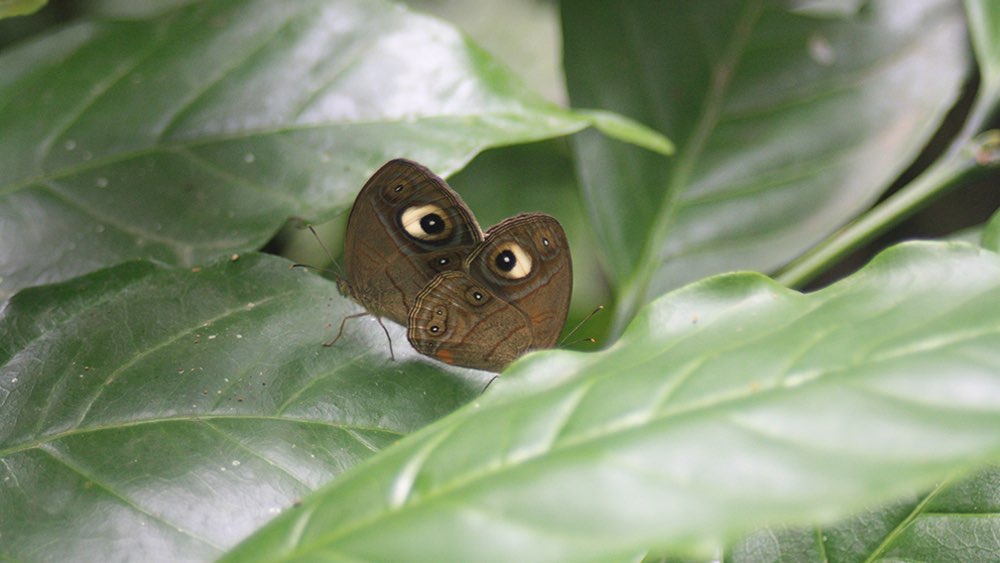
Beautiful butterflies found in plenty during monsoon in the rain forests of the Western Ghats / Photo by Medha Saxena
Then there are the frogs, toads, spiders, wasps, dragon flies, lizards, snakes and birds. Their tribe multiplies and diversifies with every shower of water it seems. And the heavens provide them plenty of those here. But they only proliferate in undisturbed habitats. Each one of the creatures that call the rainforest home have adapted themselves to it over the millennia.
Each adaptation and evolution is a fascinating revelation. Weaver ants are a marvellous example. Thousands of them coordinate with each other to stitch together nests out of leaves much bigger than themselves.
Trees themselves appear like curated art installations climbing vertically and horizontally. They are draped with vines, creepers, fungi, moss, lichen, orchids and a variety of other epiphytes that resemble emeralds and jewels on a bride. They glisten and shine best on bright wet mornings.
Twinkling fireflies circle the trunks during nightfall. The valley was covered with a million of these mating fireflies a month or so earlier in a perfect ‘symphony in light’ as the student-interns Meghna and Lily, working at the plantation recounted.
Being in a rainforest during monsoon is also a musical extravaganza. Its inhabitants are engaged in a synchronised performance at all hours of the day. Louder than revellers in a marriage procession the frogs and cicadas often accompany the sound of rain, streams and wind. The cacophony is coupled with serenity in equal measure. If you listen hard enough everything in the forest sings. But how many of us really listen?
Geography and Bio-Diversity
Kodagu is part of the wide-ranging Western Ghats, older than Himalayas, spanning from Gujarat to Kerala for 1600 kms. It directly intercepts the Indian monsoon winds. One of the eight ‘hottest hotspots’ of biodiversity, it has 325 globally threatened species (flora, fauna, bird, amphibian, reptile and fish) and many that are unique to this area.
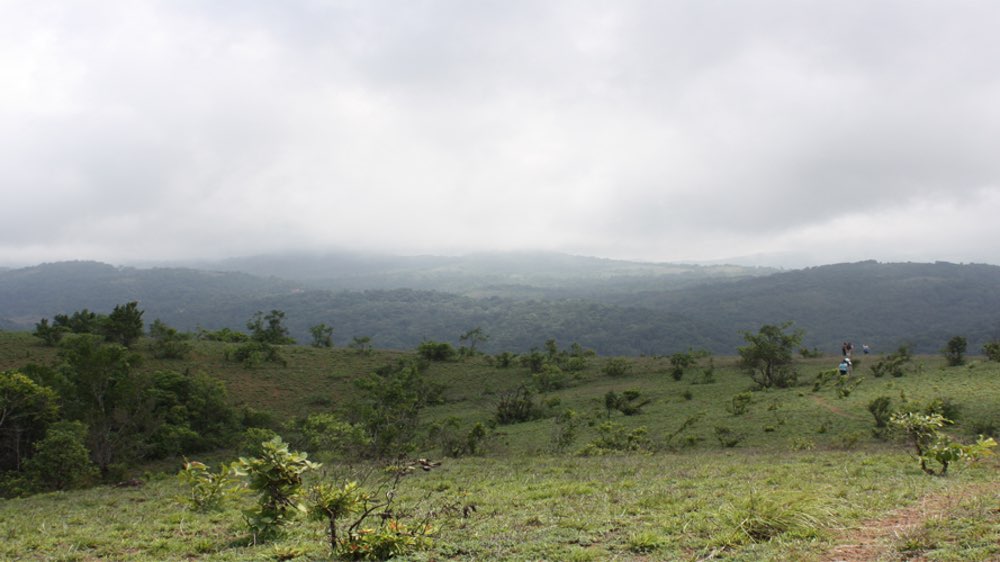
The lush green forests also help with carbon sequestration and reduction of global warming / Photo by Medha Saxena
This mosaic of natural beauty was inscribed as a world heritage site in 2012 meant to be protected by the Western Ghats Natural Heritage Management Committee (WGNHMC) and receive international support.
The tag was achieved after much opposition by states that feared that development will be impeded. Critics said that an informed consent was not obtained from the gram sabhas and Forest Rights Act 2006 was not implemented properly during drafting of the proposal for grant of heritage status. It could also violate the historic customary rights of the adivasis.
The forests of Western Ghats, however, aid economy and transportation by keeping the ports and creeks along western coast silt-free. The forests and mangroves also help with carbon sequestration and reduction of global warming.
Other critics say that the declaration has no effect on damaging developmental activities. As recently as June 2, 2017, there were protests in Madikeri over destruction of wildlife habitat, Cauvery river catchment area and forest land for the construction of railways, highways and power lines. As more of the landscape is disturbed there is more human-elephant conflict. Illegal construction, mining and corruption have caused water scarcity during summer months in an area that is generally overfed by rains.
The ensuing struggles repeatedly point us back towards essential questions of what is development. Who is it meant for? Who do the forests belong to? And how are decisions to be taken in the interest of all parties concerned?
Organic Farming
In ancient times the exotic products of the Kodagu region were traded along the Silk Route and on oceanic routes via the Arabian Sea. Cardamom and black pepper were indigenous to this region. Rice was the main crop. Coffee was brought from Yemen to Chikmagalur in India by Baba Budanin in 1670.
Legend has it that the Coorg Rajas may have given land to Moplahs near Nalkanad who introduced coffee seeds to the area. In the mid-1850s many European coffee plantations sprung up followed by private Indian ones. When the British left, they sold their lands to the local population. There are strong remnants of British culture here, like the North Coorg Planters Club dating back to 1883.
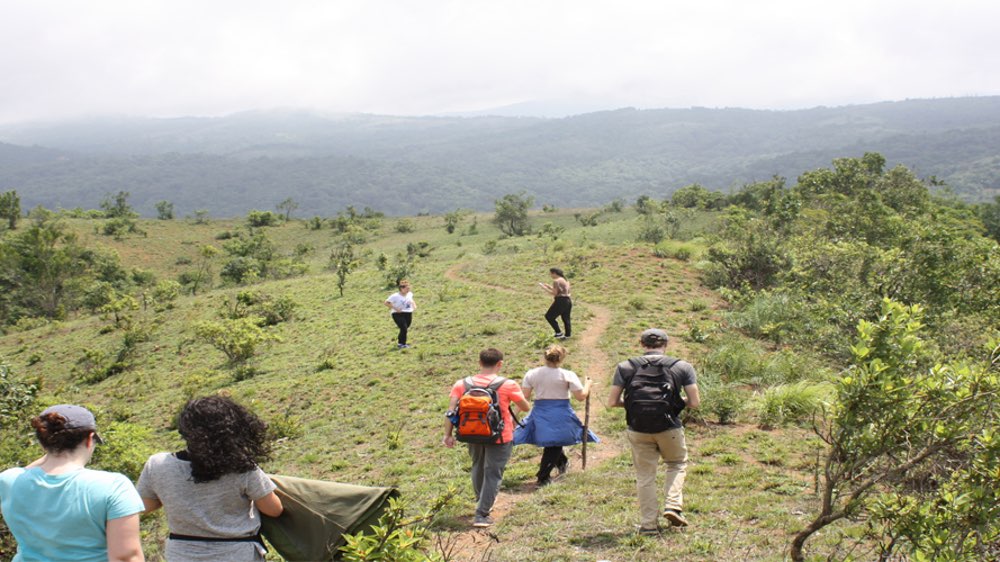
A walk through the greens gives an idea of the rich biodiversity of the region / Photo by Medha Saxena
Now a good chunk of the land is covered in coffee, tea, rubber and palm oil plantations. Commercial chemical-based farming and unsustainable agriculture have eroded this landscape. Smaller landholders and farmers still find it difficult to turn a good crop and farmer suicides affect the Western Ghats as well. There has been an attempt to set up farmer-owned companies by Agriculture and Organic Farming Group India. Hundreds of homestays have also come up in Coorg in the past few years to complement agricultural income.
Sujata and Anurag Goel, owners of Mojo Plantation, have successfully experimented with organic farming doing multiple cropping with cardamom, black pepper, coffee and vanilla under the shade of the rainforest. Spice trees, fruits and vegetables are also grown in open areas.
A molecular biologist, Sujata Goel explained that fungi secrete enzymes to release nutrients from decaying wood and dead organisms. Shivani, the manager, described on a tour of the plantation that fungal mycelium act as telecommunication networks for the trees to convey threats. They are also used as biological pest control. Similarly, termites redistribute soil and recycle nitrogen. Even weeds have an important role to play as temporary hideouts for insects.
Plants themselves synthesise compounds (terpenes, tannins, phenolics) to repel insects and convey distress signals to other plants and predators. Chemical pesticides kill the natural defence mechanisms of plants..
The Wise, Old Relic
Meghna and Lily recount a magnolia tree that they variously describe as a ‘tree of life’, ‘tree mother’, ‘earth mother’, ‘magical beautiful wise old relic’ that has twists, turns and huge branches that one can climb and roots that open up into giant cave systems and tunnels underneath – in the middle of a coffee plantation.
It was ‘a metaphor for India’ for them, probably signifying layers of wisdom, age and continuity in a land of general mayhem. Neither trees nor our bodies survive in exclusion to their environment. The commune with nature is complete. If you listen carefully, everything in the forest sings.
The author teaches in Delhi University
source: http://www.nationalheraldindia.com / National Herald / Home / by Medha Saxena / June 10th, 2017
Arjun Belmar owns 34 acres in T Dasarahalli, off Tumkur Road
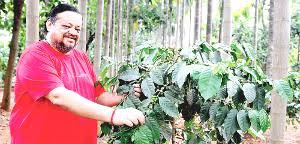
For close to 30 years, Arjun Belmar hasn’t spent a penny on buying coffee. He lives in the city and grows his own coffee. Yes, you read that right. He does. Belmar and his family offer proof that coffee is not only grown in Chikkamagaluru and Kodagu, but also right here in our city.
The businessman has been growing coffee in the face of scorching summers or water scarcity. “Bengaluru is 900mt above sea level and the land can be utilised for coffee. But one needs to grow it properly in the shade,” he explains.
When Bangalore Mirror visited his 3,000 sq ft coffee plantation, it felt like a forest in the middle of the concrete hub.
“Years ago, T Dasarahalli was away from the city. Just about 100 people lived here and we had only one bus to our house from City Market. My father used to love plants and we grew everything on our land. Not just variety of trees and plants, we also had many cows which used to give us 200-300 lt of milk. We used to share it with whoever came to our home,” Belmar says.
The grand old times are gone, but the family continues its green tradition. They keep bees and harvest honey too on their property.
However, Belmar, remembers a time when they just had to dig up to half a foot to find water. “That is how we were able to grow ginger, grapes, vegetables, paddy, wheat, sugarcane, betel, pepper and other plants,” he said.
On how they started growing coffee, Belmar’s explanation is simple – Everyone in the family loves coffee and wanted to taste the authentic thing. “We used to have our own cows and buffaloes for milk and grow sugarcane for jaggery and sugar. Why then, can we not have our own coffee plants, we thought. Then we went to
Chikkamagaluru in search of the plants.”
Though they were unsure if coffee plants can survive in Bengaluru, they kept going with their plan. “Today we have around 50 plants,” he says. “We had other bigger trees on the land. Coffee grows in semi-shade so we put them between these big trees. We watered the plants continuously and saw the first flowers on the plants,” he says.
He recalls that his father had tears in his eyes when he saw the coffee plant flowering at last.
“Each coffee plant gives around 2-3kg of coffee fruit. In a year, we get close to 50 kg. We pluck the fruit and clean it and keep it for drying. Once it has dried properly, we give it for processing and get it done in a customised manner. We tell them whether we want it with or without chicory,” he said.
His friends and family, who visit the farm, are in awe of the plantation. “My friends used to ask me if I were living in Madikeri or Bengaluru. They love the coffee we give them in packets. People who visit us from abroad wait to visit again to refill their stock,” he said.
Belmar also grows the cocoa plant. He has close to 150 cocoa plants, the seeds of which he sends to Mangaluru for processing.
“We drink premium coffee personally handled by us. It is better than the coffee grown in Chikkamagaluru,” he says, with a hint of pride.
It’s all about the honey
Belmar says they started keeping bees as his grandfather was one of the founders of the Bee-keepers Association in the city. “We have been harvesting honey on our land for the past 40-50 years. Keeping bees easy here because of the rich bio-diversity.”
Bee-keeping in the city dates to the times the British were here. Belmar says, “It was during the British rule that the Bee-keepers Association began. These days, people are trained to keep bees and harvest honey.”
He has one special information about the honey. “When the Neem tree is flowering, the honey tastes best and it is clear. In the mango season, the honey is quite reddish and very sweet. When the tamarind tree is flowering, honey is a little sour. For each season, we have a different flavour of honey.”
source: http://www.bangaloremirror.indiatimes.com / Bangalore Mirror / Home> Bangalore> Others / by Kumaran P, Bangalore Mirror Bureau / May 10th, 2017
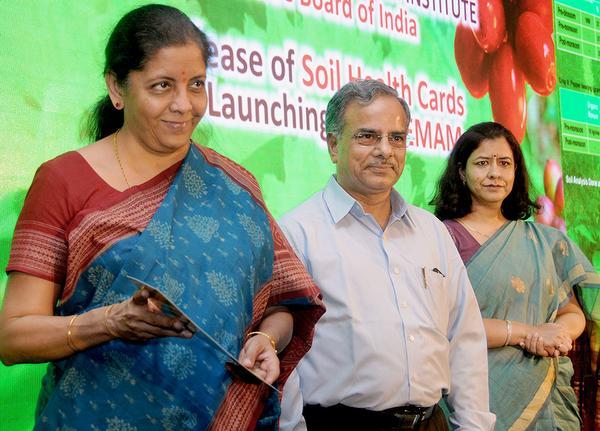
Fresh brew Union Commerce Minister Nirmala Sitharaman at the launch of the Coffee Board’s soil health cards and web portal, in Bengaluru on Friday. To her right are GV Krishna Rau, Advisor -Agricultural Marketing & Tribal Welfare, Government of Andhra Pradesh, and Arati Dewan Gupta, Director of Finance, Coffee Board
Bengaluru :
Union Minister of State for Commerce and Industry Nirmala Sitharaman exhorted the Coffee Board on Friday to take up aggressive branding and promotion of Indian coffees.
“It’s the age of branding. You need to brand everything. You need to have high profile marketing for everything to reach even the lower end of the pyramid,” she said.
The Minister was speaking at an event where she distributed soil health cards to growers and launched a web portal — a Coffee Board initiative towards soil fertility appraisal and soil health monitoring in traditional growing regions.
Citing the recent example of Araku Valley coffee making its presence felt in Paris with the support of industry, Sitharaman called upon the Board to “break the usual trodden path” in branding and marketing of Indian coffee. “If Araku on its own can go to Paris, Coffee Board should have pushed itself and said — I will market Coorg coffee. We should brand it,” she said. Branding ensures the market is sustained, she added.
Noting that countries such as Cambodia, Vietnam, Laos and even Myanmar have made long strides in packaging, value addition, presenting and marketing of coffee, the Commerce Minister said: “The Coffee Board obviously is now going to have to be on its toes.”
Sitharaman further said newer areas such as Uttarakhand and Himachal are attempting to grow arabica coffee. “The new growing areas have a great deal of enthusiasm and the energy they have is fantastic,” she remarked while expressing confidence that there will be expansion in area under coffee.
The Commerce Minister also indicated that the ambit of the Pradhan Mantri Krishi Sinchayee Yojana will be expanded to even small coffee growers, who have been facing the brunt of erratic rainfall pattern in recent years.
About 98 per cent of India’s coffee holdings are less than 10 hectares and held by small growers.
The Central Coffee Research Institute (CCRI), in collaboration with the National Bureau of Soil Survey and Land Use Policy, has started creating a database on the soil health in major growing regions and rendering site specific nutrient recommendations through soil health cards.
“The card is designed to present information on soil health indicators like pH, electrical conductivity, organic carbon and micro nutrient content, among others. It will enable judicious use of fertilisers and correct nutrient deficiencies,” said Y Raghuramulu, Director, CCRI.
Coffee flavoured stamp
After coming out with sandalwood, rose and jasmine flavoured stamps, the Postal Department will launch a stamp that will have coffee flavour.
Telecom Minister Manoj Sinha will be releasing the stamp in Bengaluru on Sunday that will be a collector’s version, Sitharaman said. The coffee flavoured stamp will be priced at ₹100. “There is a lot of interest in Government of India in promotion of coffee. The coffee flavoured stamp is going to induce a lot of people to taste coffee,” she added.
source: http://www.thehindubusinessline.com / Business Line / Home> Markets> Commodities / by The Hindu Bureau / April 21st, 2017
The state government on Tuesday took a decision to survey the disputed forest land, wherein the Jenu Kuruba tribals of Diddahalli had gone on an agitation, in Madikeri, Kodagu.
After an hour long meeting with chief minister Siddaramaiah, forest minister B Ramanath Rai, social welfare minister H Anjaneya, revenue minister Kagodu Thimmappa said the government has decided to verify the land records of Diddahalli before taking a final decision.
“After a detailed discussion, the government has decided to verify the land records of Diddahalli on whether the land is forest land or revenue land. If we verify the land records as being forest land, then we will make all efforts to provide them suitable rehabilitation area with amenities. But if the land records show that it is revenue land, then within eight days we will ensure that they have the title deeds for that land,” said Thimmappa.
The revenue minister said he will be personally camping in Kodagu on April 16 or 17 for resolving the issue.
Thimmappa said the deliberation was held with all stakeholders and that valuable inputs were shared on the case from all parties.
“The government is keen on resolving the issue and we will try to do it at the earliest,” he said.
In December 2016, the Jenu Kurubas of Madikeri who were working in the nearby coffee plantations had been agitating against the eviction by forest department and local police citing it was forest land.
Later that month, the Bettale Seve (nude protest) by a tribal woman in Diddahalli and the alleged insensitivity shown by cops in trying to disrupt the protest held by members of Jenu Kuruba (a tribe) had drawn sympathy from several quarters.
This being the last year before elections, this looter government will do anything to get the votes.
The Diddahalli faceoff had put the government in a spot, with members of civil society strongly criticizing the move.
On Monday, former MLC A K Subbaiah who spoke on behalf of the civil society, which has been seeking respite for the agitators, welcomed the government decision and expressed his hope that the state will give justice to the tribals.
source: http://www.timesofindia.indiatimes.com / The Times of India / News> City News> Bangalore News / by Sandeep Moudgal / TNN / April 11th, 2017
Inbreeding among trees and higher rates of offspring deaths may see some tree species in isolated forest patches die out slowly. In perhaps the first elaborate study of its kind in the Western Ghats, a team of researchers from across the globe has found that breaking up forests by even 200 metres can lead to the gradual death of tree species.
The results of the study — published recently in the journal New Phytologist — are disconcerting and show that less than 10% of germinated seeds survive in such patches owing to genetic faults, when compared to over 50% in contiguous forests.
Researchers from ETH Zurich in Switzerland, University of Aberdeen in the United Kingdom, and College of Forestry in Ponnampet, Kodagu, along with Ashoka Trust for Research in Ecology and the Environment (ATREE) and the University of Agricultural Sciences — both in Bengaluru — studied the seed dispersal patterns of Dysoxylum malabaricum (white cedar) which harbours the Malabar grey hornbill. More than 35 sacred groves of Kodagu, protected and worshipped by the local community, were studied across a 216 sq.km landscape where these forest patches are islands surrounded by paddy or coffee plantations.
The team used a combination of GPS and genotyping (DNA sequencing) to find out the lineage of the offspring in these isolated forests. Of the 321 trees that were sequenced, just 0.3% had emerged from “parents” that were in different patches. A staggering 267 trees (83%) had both their “parents” from the same forest patch.
“The seedlings are often mutated and completely devoid of chlorophyll (that is, their leaves have no colour), and these die out in a few months. This has affected forest regeneration,” said G. Ravikanth from ATREE.
The researchers also found that 95% of the seeds were dispersed within 200 m of the parent tree, but the sacred groves are usually situated at least 400 m and even 24.5 km apart; this leaves inbreeding as the only option. “The growth of areca and coffee plantations over three decades has isolated these forests and we are now seeing the effects of inbreeding depression. When the older trees die, we will start to see these forests disappear entirely,” said Mr. Ravikanth.
C.G. Kushalappa, Dean of the College of Forestry, said that while wind-dispersed species could perhaps overcome the gaps in forests, species that rely on birds or insects for pollination will struggle to get genetic diversity to survive.
Re-establishing tree corridors
The disappearance of plant species owing to inbreeding can be contained either through artificial dispersal of seeds or by setting up tree corridors, say researchers.
The research comes at a time when the lush forests of the Western Ghats are fragmented by reservoirs, hydroelectric projects, large highways, industries and plantations. At present, the team is researching on dispersal rates of wild nutmeg (an important tree for the hornbill population), the wild Amla tree in M.M. Hills and B.R.T. Reserve, and other plants in order to study the effect of fragmentation.
While the concept of corridors for elephants and tigers is well established in the country, the need for a similar approach to ensure constant gene flow for trees has been ignored. “We are trying to establish tree corridors to connect broken-up patches. Near Tiruchirappalli, we are restoring the connections of Myristica swamps. These corridors will provide genetic flow between forest patches,” said G. Ravikanth of the Ashoka Trust for Research in Ecology and the Environment.
In terms of conservation, the disappearance of plants and trees will have an adverse effect on animals that are symbiotically linked. For instance, hornbills and butterflies prefer only certain species of trees or shrubs.
source: http://www.thehindu.com / The Hindu / Home> News> States> Karnataka / by Mohit M Rao / Bengaluru – April 03rd, 2017
by : Mandepanda B Appaya was a founder and a former chairman of the KPA
I am perhaps one of the lucky planters to have participated at the inauguration of the KPA and still living. The function held at the Sports Club, Mysore was inaugurated by the late Maharaja.
Late Mr. CL Machia who was my boss, as managing director of Coffee Lands Ltd, had invited me to the function. He read a long report emphasizing the need for the association [KPA].
The late Mr. M. Appaya was seated beside the Maharaja.
As I was the then manager of the Hunsur Coffee Curing Works owned by Coffee Lands, Mr. Machia had asked me to attend the function. Here I was introduced to Mr. Lakshmana Gowda and a few other planters. My association with the KPA began when I had to leave the Hunsur Coffee Works after its sale to its present owners. I then started taking an interest in the KPA and was elected from Kodagu as member very soon, I became the vice chairman when the Late Mr. AC Shivegowda was the chairman. We had a lot of problems at the KPA Level. The Land Ceiling Act was published. Although alI agricultural lands, including coffee, tea and rubber were exempt, if anyone had any other Land, both together could not exceed 48 acres. In other words, our paddy, arecanut plantations got a severe blow. Both, Late Shivegowda and I had to toil and we stayed in Bangalore for 27 days at a stretch to solve the issue.
We met almost all members of the Assembly pleading for exemption for one ceiling area of crops excluding coffee. We had an uphill task.
Fortunately, D Devaraj Urs, the then chief minister of Karnataka, who was a good friend from my days at Hunsur, helped us a lot by convincing the Congress party our case. Thus, we were allowed one ceiling area of other crops much against the will of the then revenue minister.
Mr. UK Lakshmana Gowda, being an MP was helpful from the beginning. He helped us not only for getting the ceiling area, but also with wealth tax.
It cannot be emphasized less that he had a big hand in helping us. He was friendly with all MPs, which helped us in securing wealth tax exemptions on plantations. Mr. FM Khan, MP, has also helped us get wealth tax exemption.
I was the chairman of the KPA in 1973.
My association with the Coffee Board began in 1971. I was a member of the Coffee Board for four terms, though not at one stretch. During 1971 there was a shortage of curing works as the business was not attractive. A committee was formed to visit all the curing works and know of their expansion plans. Mr. PG Gurger and myself visited all the curing works in the state and submitted a report to the chairman. We were both traveling from Hassan to Mangalore. Enroute we heard of the surrender of Pakistan after the Bangladesh war. GeneraI Manekshaw was then made Field Marshal for the success.
Mr. UK Lakshmana Gowda who I used to call Bhishma Pitama, was of great help in the Coffee Board. When we used to have heated arguments on certain issues with the intelligent Kerala members, it was Mr. UK Lakshmana Gowda who used his knowledge and experience to solve the issues. Late Narasimha Rao, IAS, once sent me to Delhi to negotiate with Russian representatives regarding discount on coffee sold to them.
During 1988-89′ both Mr. Lakshmana Gowda and l went to Moscow for that year’s sale to the erstwhile USSR. We had to go during December and stayed for eight days. Finally we agreed to allow 38 percent discount on international prices. The then chairman of the board, Late SK Warrier had come with us.
Normally, we sold 50,000 tones to the USSR. But every year the discount went up. At New Delhi we decided to allow 37 percent discount on the International prices.
We had no choice as we had to sell one-third to the quota countries and one-third for internal consumption and one-third for non-quota countries. For sales in the internal market, the government fixed the minimum price. Thus planters suffered.
To add to their woes we had to pay 102 percent purchase tax since we had lost the case in the Supreme Court. lt was kept pending for 10 years before the retiring chief justice gave the decision on the last day of his sitting. Karnataka government, in addition to this, levied a 15 percent sales tax on every bean sold by the growers.
We met even Rajiv Gandhi in Bangalore and made representations to him. He asked us to meet the adviser to the governor as there was no government then. Mr.Rangarajan heard us patiently for 45 minutes but gave no decision. Finally there was an agitation for the abolition of pooled marketing by the growers and they succeeded and now free trade of coffee is allowed.
I became chairman of UPASI in 1983. Mr. Tika Bedi insisted l should take this position since l did not accept it due to certain physical constraints. Anyway, I served the UPASI in the committees from 1972 to 1983.
So my career in the KPA, Coffee Board ended in 1983. I served the Mysore Race Club for over 15 years which celebrated the centenary in 1992 with an eye hospital for the poor and the needy as a centenary project. I was the chairman of the Race Club from 1988-92.
I am now over 87 years old, yet take keen interest in many of the activities I used to participate in.
source: http://www.kpa.org.in / Karnataka Planters’ Association / Home> About Us> History / by Mandepanda B. Appaya
Not only do they handle business in acres, but also take utmost care to manage the crop sustainably. Care T Acres, a private initiative begun in 1998, has been helping coffee planters in Kodagu manage their properties. This initiative has become a boon to many planters who are unable to look after their estate.
“Care T Acres has stopped planters from selling their property and moving away from Kodagu,” says Nanjappa Kuttaiah, a coffee grower. With eight partners — Bose Mandanna, N K Chinnappa, N P Machaya, K M Cariappa, K Ajit Appachu, Aruna Biddappa, B Ram Bopaiah and K M Appaiah — the team comprises competitive planters with a combined experience of over 300 years!
The beginnings
Kodagu, the coffee haven that contributes to over 40% of India’s coffee production, has a lot of estate owners staying overseas. While selling the property has sentimental issues, maintaining them from overseas is illogical. This is where Care T Acres steps in, with the role of prime mover being Managing Director, N K Chinnappa. So, how did ‘Care T Acres’ come into existence? Among the founding members, Late Arun Bidappa was a well-known coffee trader. However, he needed expertise in maintaining his estate, which he developed with the help of expert planter Bose Mandanna.
Arun’s estate was the first property that received tendering from ‘Care T Acres’. “He (Arun Bidappa) said, ‘I help you trade your coffee, why don’t you help me look after my estate?’” recalls Bose. This conversation got the best planter friends together and thus began ‘Care T Acres’ with a maxim that “no one should neglect or sell their estate in Kodagu,” as Bose states.
The initiative is currently managing 600 acres, all under the constant supervision of Chinnappa — who grooms them like brides-to-be. The bottle green coffee plants nurtured by him are shaped like woven skirts. “Chinnappa’s way of raising and nurturing estates is a win-win proposition,” notes Nanjappa.
Professional care & support
The service (for estates that are more than 30 acres) begins with the client signing a five-year contract. Once done, the company starts looking after the ailing estates and fosters them like their own. When a grower approaches them, the team members visit the estate and analyse it. Then, the operations required to revive the estate are prioritised and the ‘surgery’ begins. “The person who can take care of his estate very well will not come to us. It is always the owner unable to manage his property who comes to us. In many cases, the grower would be suffering financial loss. So, the foremost ‘operation’ would be to clear the debt,” explains Chinnappa.
The team acts not just like a doctor but also that of an antibiotic as the second step towards betterment would be to develop proper infrastructure. Drying yards, labour line, proper cut roads, pulping yard and irrigation facility are developed to make the estates sustainable and self-reliant. Simultaneously, the grooming session begins — coffee plants are pruned, nourished, irrigated and shades are regulated to produce better yield.
With constant efforts, the estate breathes a new life. While they work for remuneration in the first two years, they sign up for a 30% profit from the third year. “I might be getting 70% of the profit, but that is equal to 150% of what I was earning before. Also, you get the profit without having the headache of managing it,” opines Nanjappa.
Another grower, Dalia Chengapa, has her estate being cared for by the company since 2007. She recalls how the estate owned by her father, Late A T Chengapa, lost its focus after he fell ill. “My father was a wonderful planter and he looked after the estate properly. But after his health deteriorated, the estate needed support. My sister Ramona and I stayed in different cities, and we did not have the practical knowledge for growing coffee. My father was unable to guide us as he was unwell. That is when we approached ‘Care T Acres’,” she recalls. While her estate incurred loss before the team took over, it is now making good profit.
Nanjappa’s story goes on the same lines. His mother passed on and the 45- acre estate in Suntikoppa that she looked after relied on him for tending. He had known that ‘Care T Acres’ turned the estates around and yearned for their support; eventually the deal was sealed. “Eight competitive planters, financially trustworthy and among the best planters in the district took over my estate and it was a blessing at the right time,” he says. Chinnappa started the work here and looked at two primary problems. Firstly, he pruned the coffee plants in a better way — there were more branches and nodes earlier, which reduced the picking cost. “When pruning is done properly, the plant flows down and it becomes easy to pick berries. The yield also increases,” explains Chinnappa. Secondly, the roads were laid for convenient movement.
The estates cared for by the team improve their pepper yield as well. With a systematic auction and tendering system in place, planters get an optimal price for pepper. The team has taken up risks as challenges and revived many estates. However, Mandanna explains, “While we have gone beyond limits and put money from our pockets to revive the estates, there are instances where we have rejected a few. These estates are uncultivable and there would be no absolute hope for coffee.” Chinnappa adds, “It is not just about profits but it is about leaving a legacy behind.”
One can contact the team at rkpagastya@gmail.com.
source: http://www.deccanherald.com / Deccan Herald / Home> Supplements> Spectrum / Prajna GR / November 22nd, 2016
At a time when ground water table is depleting in Kodagu, Pradhan Mantri Krishi Sinchayee Yojane will be a boon for conserving the ground water. The Agriculture department has been getting ready to conserve water in 25 gram panchayats.
With the recede in rainfall, the ground water table in the district has depleted drastically. Water would be available by digging 100 feet, 10 years ago. Now, even after sinking for 300 to 400 feet, water is not available in the district.
Though Pradhan Mantri Krishi Sinchayee Yojane came into effect last year, the department has decided to implement it effectively during the current year. The Union government, based on satellite images, has identified a few areas in Western Ghats where water conservation activities can be taken up. Accordingly, percolation pits will be dug in 81 villages in these gram panchayats.
The beneficiaries whose land is identified in the satellite image will get Rs 60,000. The amount could be used for sinking the pits, removing the silt of the pit, development of the pit in the next five years, said an official from Agriculture department.
To increase the ground water table, even ‘Thottilu Gundi’ will be constructed in coffee estates. The work on construction of vented dams, planting of silver trees would be taken up under the scheme. Kodagu district would get a sum of Rs 3.17 crore for five years. If the scheme is implemented effectively, then water table would increase in the district, said officials.
Under the second phase, 11 villages of three gram panchayats in Madikeri taluk, the percolation pits have already been dug. With this, the recharge of ground water table would be taken up during the monsoon. 15 metre long, 15 metre wide and three metre-deep pits have been dug.
In the third phase, 10 gram panchayats in Somwarpet taluk have been selected. In 2018, nine gram panchayats in Virajpet and five gram panchayats in Madikeri will be included.
Agriculture department officer Robert told DH: “Decline in rainfall has depleted ground water table. It is a challenge for the growers in Malnad to safeguard the long term crops. Percolation pits help check erosion of fertile soil. “The department will not select the farmers. Based on the satellite image, the survey number farmer will be the beneficiary.”
DH News Service
source: http://www.deccanherald.com / Deccan Herald / Home> District / by Aditya K A / DHNS- Madikeri, January 28th, 2017
WELCOME. If you like what you see "SUBSCRIBE via EMAIL" to receive FREE regular UPDATES.
Read More »