Category Archives: Agriculture

CNC celebrates Huttari festival

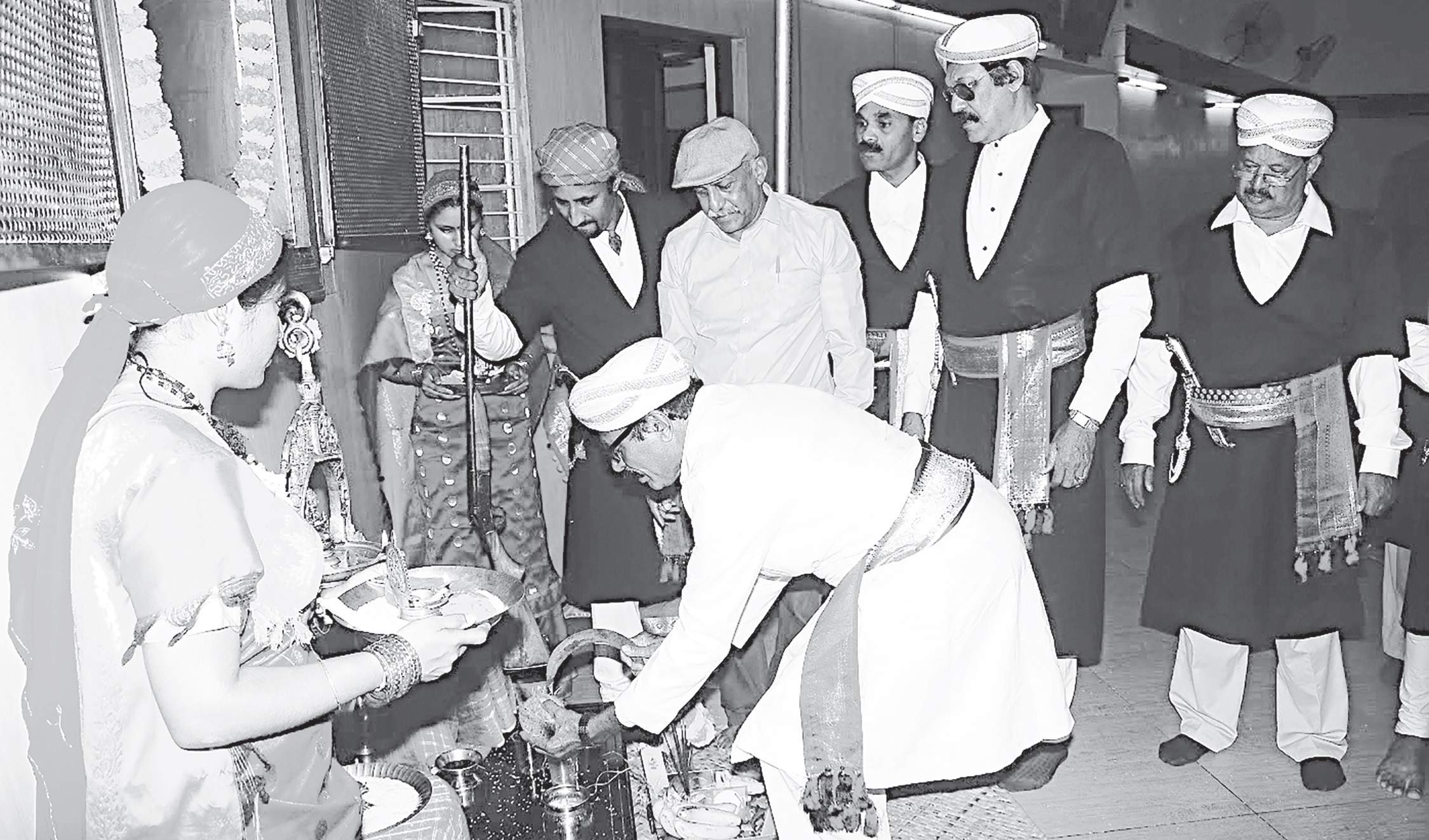
Codava National Council (CNC), led by its president N U Nachappa, celebrated Puttari (Huttari), the harvest festival of Kodagu at a paddy field of Uthappa at Chikkabettageri near Kushalnagar on Tuesday.

The festival symbolises the homecoming of ‘Dhanya Lakshmi’. The Codava National Council members, wearing traditional attire, participated in the celebration.

Before cutting the paddy sheaves, the members offered prayers and offered by tying the leaves of ‘Arali,’ mango, jack, ‘Kumbali’ and cashew- nut.

After the ‘Nere Kattuvo’ ritual, the participants walked in a procession to the paddy fields accompanied by the ‘Dudikottpat’ (dudi is a small drum of Kodavas). Nachappa cut the paddy sheaves and initiated the celebrations. Before harvesting, they shouted slogans ‘Poli Polio Deva’ and fired three times in the air.

The Codava National Council members presented traditional Kolata, ‘Pareya Kali,’ ‘Chowkata’ and other cultural programmes, adding colour to the festivity. ‘Payasam’ (sweet) was prepared from the new rice and was offered to the God.

Mouth-watering dishes like ‘Thambut,’ ‘Adikehittu,’ ‘Kadubu,’ ‘Payasam’ and others were savoured on the occasion.

Later speaking to reporters, N U Nachappa said the Kodavas should be entrusted with the constitutional security. The government should announce autonomous status to Kodava land.

source: http://www.deccanherald.com / Deccan Herald / Home> District / DHNS – Kushalnagar, December 14th, 2016

‘Taking coffee to the common man’s cup’

manyepandakf13dec2016

Manyepanda Madaiah Chengappa recently took over as the Chairman of Karnataka Planters Association (KPA). Karnataka accounts for more than 70% of the coffee production in India.

According to United Planters Association of Southern India (Upasi), Karnataka’s post-monsoon estimated coffee production for 2015-16 was 253,340 tonnes, with the all-India number standing at 350,000 tonnes. KPA has about 700 members as of date.

In an interview with Furquan Moharkan of DH, Chengappa says that his aim as the chairman is to make domestic demand for the cup of coffee transform from an elitist drink to a common man’s drink.

What are the challenges that coffee plantation sector faces today?

Climate change has increased, apart from pests and diseases impacting the coffee crop productivity. The Arabica coffee crop yield has reduced from 1,200 kgs, to 600 kgs per hectare, while Robusta coffee has decreased from 2,000 kgs, to 1,400 kgs per hectare, over the last decade. For instance, this year, Kodagu has 300 mm less rainfall over the previous year, and Chikkamagaluru has also suffered a similar fate, which affects the standing coffee crop and development of new shoots in coffee plants for the coming season.

Labour wage constitutes over 60% of the total cost of coffee cultivation. The annual wage increase was below 6% till 2007-08. From 2008-09, the increase was very steep. Against 2007-08’s wage of Rs 79 per day, the current wage is at Rs 263 — an increase of 232% or an annual average increase of 15%. This could be the highest percentage increase for any industry in Karnataka. Also the statutory and welfare costs for the labour, which are over and above the wages and benefits, works out to an additional 50% of the wages. This is an additional financial burden for both corporate and proprietary planters.

However, the sale price for coffee at the farm gate hovers around Rs 2,800 to Rs 3,500 for a 50-kg bag, while the labour and fertiliser costs have spiralled disproportionately. The need to invest more funds for R&D to develop better quality coffee plants that are high-yielding and pest-resistant is another challenge.

What are your priorities after taking over as Chairman of the KPA?

Primarily, my major objective is to make domestic demand for the cup of coffee transform from an elitist drink to a common man’s drink. I would seek the Coffee Board’s assistance to establish coffee kiosks at public places like government offices, bus and railway stations, airports, shopping malls and educational institutions. This would make the demand for coffee explode in the country. Towards this objective, it would be necessary to jointly pursue vegetative clonal and tissue culture propagation of coffee, with United Planters Association of South India (Upasi) and Central Coffee Research Institute, Balehonnur, Karnataka. Also, to push for the import of pest and disease-resistant high-yielding coffee plant material. Identify biological viable and effective methods to treat effluents.

Also, request the state government and its Department of Agriculture to allocate Rs 1.9 crore in the state budget to fund the Upasi-KPA coffee research project. To establish soil and leaf analysis laboratories at Chettalli, Kodagu district and Chikkamagaluru district for the convenience of small and large growers.

A lady planters sub-committee has been constituted to promote community outreach programmes and showcase their achievements in cultivation of coffee, plantation nurseries, local marketing initiatives at national and international levels, home stays and plantation cafes for income augmentation.

What is the impact of the GST regime on the coffee plantation sector?

GST does not affect the coffee grower directly, as being agriculturists, they come under zero tax brackets. GST is applicable only after curing at the roasting and powdering stage, when the value-addition takes place, and the coffee can be consumed as a cup of coffee. According to Rule 7B (1) of Income Tax Act — “Income derived from the sale of coffee grown and cured by the seller in India shall be computed as if it were income derived from business, and 25% of such income shall be deemed to be income liable for tax.” This I-T Rule needs to be amended to tax coffee only at the stage of roasting and powdering that would enable the grower to sell coffee, which is plantation-specific, directly to the local and global markets.
Do you think that the import of pepper from Sri Lanka could affect domestic trade?

Import of poor quality pepper is killing the Indian pepper market. A regulatory price mechanism is necessary, whereby the price of pepper imported should be about 5% lower than the Cochin pepper auction price of equal quality of the day. Also, quality parameters of the imported pepper should be strictly monitored by a suitable government agency.

Your comments on the degradation of forests and environment pollution that have a bearing on the plantations in Karnataka.

The National Forest Policy is under amendment and a high-powered committee has been instituted for the purpose. The KPA and Upasi have jointly made a representation to the Union Ministry of Environment and Forests. Also the elephant menace in Kodagu district has assumed dangerous proportions due lack of proper fodder and vegetation in the game sanctuaries. Plantation crops, fruit trees and human beings are being trampled upon and destroyed. Therefore, the translocation of elephants appears to be the only solution, as all other forms of deterrents and barriers have proved ineffective.

While tourism has phenomenally raised the socio-economic level of people in the plantation districts, it should not lead to environmental pollution. Therefore, it is necessary to promote eco-tourism in the plantation districts of the state. Also, aggressively ban all types of pollutants, plastics, discharge of sewage and chemical effluents into the rivers. People need to be aware of waste segregation, its recycling and proper disposal through the media platforms to promote eco-tourism.

source: http://www.deccanherald.com / Deccan Herald / Home> Supplements> Economy & Business / by Furquan Moharkan / DHNS – December 12th, 2016

Madikeri DC tells engineers to expedite water works

Deputy Commissioner Richard Vincent D’souza on Monday has threatened the engineers concerned that they would be held accountable for any complaints/problems pertaining to drinking water supply.

Chairing a meeting on drinking water works and fodder issues, the deputy commissioner expressed his anguish against the engineers over the tardy progress in the drinking water works taken up at a cost of Rs 1 crore last year. The DC was upset over the underutilisation of funds sanctioned for the water works. “If there is failure in utilising the amount, sanctioned last year, to its fullest, how can we seek funds for the current year, the DC questioned.

The deputy commissioner directed the engineers to expedite the water works and address the water woes in the district.

Additional Deputy Commissioner M Satish Kumar said, “A Cabinet sub-committee headed by Revenue Minister Kagodu Thimmappa has been constituted. The sub-committee should be apprised of the measures taken.”

The officials should furnish information related to measures taken to address drinking water complalints, cattle feed among others, he added.

The Addl DC also instructed the officers to speed up drought relief works.
Zilla panchayat deputy secretary, planning director, chief planning officer and executive officers of respective taluk panchayats were told to work in tandem to mitigate drought.

Rural Drinking Water Engineer Shashidhar, along with assistant executive enginers from three taluks in the district, apprised the meeting of the status of the works taken up in the district.

source: http://www.deccanherald.com / Deccan Herald / Home> District / DHNS – Madikeri, December 13th, 2016

Gather your sickles,it’s a harvest

kodavasgatherkf11oct2016

Bengaluru :

As Kodavas retreat to their Kodagu homes from the hurry-burry of the city to rest and celebrate the annual harvest festival, there are some who will be celebrating the Puthari (also known as Puttari and Huttari) festival in the city this time.

“It is hard for me to head back home this time because Puttari falls mid-week,” says Pratvii Ponnappa, who is born and brought up in Bengaluru but usually heads back to Coorg to celebrate the festival. “My father will be going to Coorg, but I will be staying back and celebrate it on the day local Kodavas decide”.

“Celebrating in Coorg means coming together with your family, celebrating in the city means coming together with your community,” Pratvii says.

M T Subbaiah, administrative officer of Kodava Samaja, says, “We have 13,000 Coorgis in the association. This year there will definitely be more celebrating the festival with us since it falls on a week day.” Around 3,000 to 4,000 people are expected to attend this year’s Samaja festival.

Puthari, which means the paddy festival, will be celebrated on December 13 this year. Last year it was in the end of November.
On the day of the festival, family members assemble in their ancestral house or ‘Ain Mane’, which is decorated with flowers, mango and banana leaves.

The children play with fire crackers and in an “auspicious hour” the eldest of the family hands a sickle to the head of the family.

The auspicious time is decided by the Igguthappa temple.
The family together head to the paddy field. A woman leads the procession holding a lit lamp in her hands. A paddy stick is cut and a gunshot is fired to mark the beginning of the harvest. The chanting of “Poli Poli Deva” is recited and the paddy is stacked in odd numbers to be carried home and offered to the gods.

Small bundles of paddy straw are handed to the family members, which are received as a symbol of prosperity.

Since there are no paddy fields in and around the city, the Kodava associations usually get paddy from Coorg and distribute them among the people who come to celebrate. This year, the Kodava Samaja will be celebrating it on Tuesday evening.

The programme will commence at 6:30 pm when all the members will gather for an annual awarding of scholarships and for a speech by community leaders. By 7 pm, everyone will gather in a small 10*8ft piece of paddy land in the office premise to follow the customary ritual. At 9 pm special foods such as thambuttu (made of mashed bananas and roasted rice powder and topped with grated coconut and melted ghee), kadaumbuttu (rice dumplings with coconut milk and ghee), holige (flatbread from flour, jaggery and ghee) and puttari payasa (from rice, coconut milk and jaggery) will be served.

Kishoo Uthappa is heading to Coorg today for the festival since he has grown a small amount of paddy in the field for this festival and he does not want to miss it.

“I am an entrepreneur so I can take off whenever I want,” he says. “Most importantly, I don’t want my children to miss the festival.”

source: http://www.newindianexpress.com / The New Indian Express / Home> Cities> Bengaluru / by Regina Gurung / Express News Service / December 10th, 2016

Rainforest Retreat Coorg: Life on an organic farm

MojoKF30nov2016

If man learnt the blues pickin’ cotton, he shall rediscover it learning how to grow coffee. And no any ordinary coffee, mind you, but organic gourmet robusta.

The upper echelons of Coorg’s rain-slopes resonate not with the hum of mountain maidens, but Big Mama Thornton belting away the blues. Welcome to Mojo Rainforest Retreat, a 25-acre organic farm perched at 1100m in the lush Western Ghats of Karnataka. Mojo is as famous for its unimaginable shades of green as for its collection of blues, believed to be the largest in the country. If Robert Johnson’s wandering soul were to reincarnate as a farmhand, this is where it would come to rest.

Take it from Doc. That’s Doctor Anurag Goel, who claims to have seen every big blues act while doing his Ph.D. in Molecular Biology from Toronto. His wife Sujata, a Ph.D. from the Department of Botany (Delhi University), is a walking encyclopedia of natural remedies. Along with their ‘nature child’ Maya, the Goels have accomplished what most people only dream of in their dreams. They quit the rat race of urban drudgery to pursue a more harmonious existence with nature.

After extensive travel through this vast country, they chose to settle in the rainforests of Coorg. The retreat was set up in 1999 to raise awareness about their environmental NGO.

Initially, they intended to name it Worldwide Association for Restoration and Preservation of Ecological Diversity but realized that a name like WARPED would find little credibility.

And so, after a little juggling of alphabets and a National Geographic grant later, they settled for WAPRED Research Foundation in 1996. Today, the idea has blossomed into a heady mix of eco-tourism, offbeat adventure travel and the blues.

Coorg’s rich flora and fauna have earned it international recognition as one of the most important hotspots of biodiversity that need to be preserved. To say that it’s a challenge is an understatement. This here is Wild West Country, where every house boasts of a licensed rifle and most of the region’s wildlife can be found on the walls of living rooms in Coorg.

Some of course, like the wild boar, have met a more honourable end. The transformation from a vile burrowing creature to a bowl of delectable pandi-curry can only be attributed to the genius of a people who have understood the very soul of the animal.

Sadly, the importance of nature’s treasures has been lost on them. The heavy use of toxic pesticides has seriously endangered the region’s fragile eco-system.

The falling prices of coffee have spurred the use of chemical fertilizers and a mysterious disease has wiped out the orange from ‘Orange County’. However, there’s one bastion that seems to be holding out – Mojo.

The farm is a perfect example of how to live in harmony with nature without necessarily exploiting it. The Goels use solar panels for their basic power supply. Crops are grown under the shade of rainforest trees using biological methods of pest control.

A medicinal plant garden nurtures the wealth of traditional knowledge.

Coffee berries are handpicked, hand-processed and specially roasted to obtain a special blend without using chemicals or chicory.

The cuisine – mostly locally grown organic produce – is a delicious blend of continental and Indian dishes, homemade bread, cottage cheese, pastas, roasts, preserves and gourmet organic coffee.

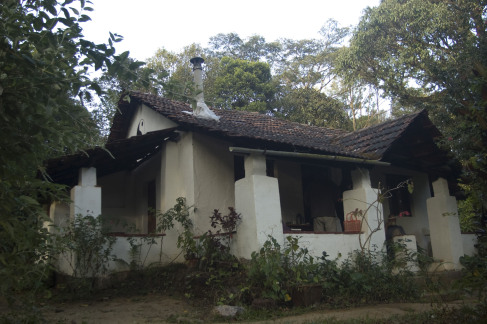
Even the accommodation at the Rainforest Retreat is an unforgettable experience. A beautiful brook-side bungalow, set in a picture-postcard thicket of bamboo, banana, orange and pineapple, conforms to international standards of style and comfort. It has two bedrooms, a spacious living room, sit-out and perhaps the best rainforest loo any side of the equator.

A second, more rustic shelter is the Yin Yang Cottage inside the plantation. A thin wisp of smoke rising from the bathroom chimney indicates that Muttu Pandey (the farmhand) has already heated the water. Before the stimulating bath can lull me to sleep, there’s a Doc on my door. It’s time for a first-hand learning experience at the farm.

Mojo is home to the Habanero, the world’s second hottest chili. The Red Savina Habanero used to be the hottest until it was deposed by our own Nagahari chili from Tezpur, Assam.

Another brilliant flash – this time at the treetop – catches my eye and I wonder if it’s a bird, a plane or Superman. Doc angrily shakes his head and says it’s the Southern Birdwing, India’s largest butterfly.

There’s Dendrobium Nutantiflorum, he motions to an orchid clump and that’s the raucous call of a Green Barbet. Stupefied, I try to keep pace with one new discovery a minute and forget more than I can remember.

Doc plays the razor-sharp schoolmaster to my stupid boy from Botany class. A walk through the dense cardamom under-hang leads to a clearing where Doc comes to a halt in front of a tree.

He has the reverence one would show to an Inca shrine. With all the compassion of a shaman consecrating a totem, he caresses the thick leaves of a creeper. “After saffron, vanilla happens to be the most expensive spice in the world”, he chuckles. “One kilo of cured, processed vanilla extract fetches as much as Rs.11,000 in the international market.”

But before this article can trigger off rampant cultivation of vanilla in any available garden patch, let me add that it takes 5 kg of beans to process 1 kg vanillin extract. A lucky farmer may get about Rs.700 for a kilo of beans.

What’s more, in the absence of its natural pollinator the Melipone bee, the orchid’s flowers have to be hand-pollinated. The flower opens in the morning and closes in the afternoon, never to open again. If left pollinated, the flower will drop the very next day.

Oddly content that I was not a vanilla farmer, I pick up samples of the local produce. Habanero extract, cardamom, pepper (which are indigenous), coffee (which was introduced), Garcinia (aka Kokum, used as a refreshing drink and a souring agent in curries) and a lovely set of picture postcards, all of which fund WAPRED.

Back at the main house, Sujata thrusts into my hand what she calls a ‘hibiscus suspension’. I admire the glass like a potential Nobel Prize winning entry, when a patient feminine voice explains, “It’s a coolant; you are supposed to drink it”.

“And next time, use kerosene on your boots. It’ll keep the leeches away”.

This region gets so much rainfall it would make Mawsynram blush. The rains get so severe that leeches give up their positions on the ground and cling to overhanging branches to throw themselves like kamikaze warriors on to passing targets. If you’re into pain, I highly recommend Mojo in the monsoons.

Among the other denizens of the farm are the dogs – Jupiter, Janis (named after Janis Joplin), UB (Ugly Bastard – a deformed puppy who has grown up into a stocky watchdog) and Pigpen (from a character in Animal Farm), who died recently. It’s advisable to be overtly good to them as it is they who accompany you from the main house to the Yin-Yang Cottage at night.

A solitary jaunt is not exactly spooky, but jungle walks have never been the same after The Blair Witch Project. Everything at Mojo – including Aki the Calf and Maya Hill – has been named by 4-year-old Maya. If she has finished partying with McDuff, John Barleycorn (who has a drinking problem) and her imaginary friends, maybe she’ll show you her ‘panoramic view’ and tell you about her philosophy.

Meanwhile, a Golden Oriole lands on the tree near the verandah. While I gape open-mouthed at it like a 4-year-old kid, an oblivious Maya is content watching UB play with a ball-beetle.

Mojo is the sort of place where you’d hate to blink. It tends to leave you with a strange feeling that can best be described as a mixture of envy, awe, respect, rejuvenation and rage when the honeymoon is over. However, for those few precious moments, it gives people a chance to experience an inner peace that only nature can provide.

Doc has also designed several escorted road tours that take you to interesting places nearby. There are excursions to other plantations like Ludwig Mahal, a nature walk to Galibeedu Ridge, a visit to the Dubare Elephant Training Camp and an insane drive to the Cauvery for swimming and mahseer fishing.

What makes Mojo even more special is that it’s a Mecca for bird-watchers, insect-lovers, soul-trippers and blues-brothers. The misty mountains and dense foliage of this section of the Western Ghats make it one of the best places to get lost.

In fact, Mojo adds up to such a wild weekend you might even be tempted to call it a ‘Doc Holiday’…

Author: Anurag Mallick. This article appeared in the May 2003 issue of Outlook Traveller magazine.

source: http://www.redscarabtravelandmedia.wordpress.com / Blog by anurag mallick & priya ganapathy / May 25th, 2012

Agro-forestry research station to be set up in Kodagu

The State government has initiated the process of setting up an Agro-Forestry Research Station on 100 acres of land in Madapura of Kodagu district under a project of the Indian Council of Agricultural Research (ICAR).

Announcing this while replying to BJP member Appachhu Ranjan during question hour in the Assembly on Friday, Agriculture Minister Krishna Byre Gowda said the University of Agricultural and Horticultural Sciences had made a proposal to the government to set up such a research station under the Agro-Forestry Research Project of the ICAR.

Following this, the Agriculture Department had written to the Horticulture Department to provide 100 acres from its 300-acre land in Madapura, he said.

source: http://www.thehindu.com / The Hindu / Home> News> States> Karnataka / by Special Correspondent / Belagavi – November 25th, 2016

Honey with coffee reinforces climate resilience: Kodagu coffee estates’ bee farms

The famed Kodagu coffee estates are experimenting with bee farms to add to incomes so that the forested landscape of this biodiversity hotspot is better able to sequester carbon.

The forested landscape of Kodagu provides ecosystem services. (Photo by S Gopikrishna Warrier)

While honey can sweeten coffee for the drinker, coffee farmers of Kodagu district of Karnataka are realising that raising bees for honey in the farms can sweeten their economic returns. It is one of the innovative methods being tried out in the district to provide additional financial incentives to coffee farmers so that they conserve the landscape they have inherited.

The concept of payment for ecosystem services (PES) is evolving from eco-certified coffee to that of landscape labelling of Kodagu. If the forests, coffee agro-forestry, rice fields, sacred groves, rivers and streams of Kodagu together provide ecosystem services and climate resilience to the communities living in the hills and the plains, why should not there be payment for sustaining these services?

According to a report on PES prepared by the College of Forestry at Ponnampet, Kodagu, the district has been identified as a micro-hotspot of biodiversity under the larger Western Ghats region. There is tree cover across as much as 81% of the district.

Natural forest ecosystems cover an area of 46% of the total area of the district. This includes evergreen, semi-evergreen, moist deciduous, dry deciduous and scrub forest types. Evergreen forests also include the high-altitude shola forests along with grasslands.

Key ecosystem services

Biodiversity, carbon sequestration and water regulation are the key ecosystem services from the Kodagu landscape. In addition to the economic benefit, there are also provisional, regulating, cultural and supporting services from the landscape. Thus, while eco-certification of coffee can help individual farmers, landscape labelling can benefit the district in its entirety, giving incentive to the communities to plan their development sustainably.

Charulata Somal, chief executive officer of the Kodagu Zilla Panchayat (district council), says that if PES can help channel money for the communities to conserve their landscape, there is a possibility of meeting the genuine aspirations of the people without compromising on the environment. “We plan to take the concept of PES through the elected representatives from the district.”

The PES report from the College of Forestry estimates the economic value of the various ecosystem services in Kodagu. The nutrient recycled has a value between INR 237 and INR 1167 per hectare, with a mean value of INR 700 per ha. The economic value of timber is between INR 530 and INR 8340 per ha. The recreational value of biodiversity is estimated as INR 27,000 per ha.

High sequestration

Carbon sequestration, according to the report, varies from 77 tonnes per ha to 207 tonnes per ha. Even at 90 tonnes per ha and an assumed price for carbon at USD 10 per tonne, the economic valuation is INR 40,500 per hectare.

The project for promoting bee farming (apiculture) in coffee estates was started after a study found the strong economic impact of pollination services of bees from sacred groves adjacent to the coffee farms. Kodagu has 1,214 sacred groves under community management, covering 2,550 hectares interspersed with coffee estates.

Rice paddies in Kodagu. (Photo by S Gopikrishna Warrier)

While Arabica coffee is self-pollinated, Robusta is cross-pollinated. “We researched the interaction between bees in the sacred groves and Robusta coffee to understand what the pollination impact is,” said C.G. Kushalappa, university head for forestry and environment sciences at the College of Forestry in Ponnampet. “Our research proved that in Robusta close to 31% of productivity could be increased if there is sufficient population of honeybees around the farm.”

This research, implemented by the College of Forestry under the Managing Trade-Offs in Coffee Agroforestry (MOCA) project in partnership with ETH University at Zurich, Switzerland, opened the possibility of increasing income for coffee farmers by integrating apiculture into coffee systems.

A premium for honey

“Kodagu honey has a premium in the market because it comes from the flowers of multiple species,” said R.N. Kencharaddi, assistant professor of agricultural entomology at the College of Forestry. “Honey collected from bee keeping in coffee agro-forestry system can get the premium price.”

The college introduced bee boxes in 40 farmers’ fields in 2015 at a density of four to five colonies (bee boxes) per acre, so that they can grow their own bees and produce honey. The team has been researching to select bee colonies that have the most desirable traits for propagation.

“We are looking for bees that do not abscond from their colonies and do not divide into new colonies before the hive is fully built,” said Kencharaddi. “We also check whether the bees are efficient at collecting honey and have disease resistance. Most important, we check on their ferocity, for we do not want the bees to attack the farmers.”

Apis cerana indica or the Indian honeybee is the species that the college is using for propagation. Though the college has not yet done any research on the subject, beehives have been successfully used in East Africa to protect farms from ravaging elephant herds. If this is experimented with and found successful then it could also serve as an additional benefit for Kodagu farmers, who are tired of elephant herds destroying their crops.

“There are elephant herds in Kodagu in which calves and young adults have not seen the forests,” explained M.C. Cushalappa, a coffee farmer from Siddhapura. “These herds have moved out of natural forests years ago and not returned since. They move from farms to villages, without returning to their natural habitat.”

The species of bees used in East Africa and that used in Kodagu are different, according to Kencharaddi. The specie of the African bees that scare elephants is Apis mellifera caucasica, which are more ferocious than their Indian counterparts. The African bees also come out during the night, whereas the ones that the college is working with are active only during daylight.

With bees feeding on the flowers of multiple trees to give premium quality honey, there would be a greater incentive for coffee farmers for protecting their landscape, according to Kushalappa. “This is how we are evolving into the concept of getting landscape labelling for produce from Kodagu’s coffee agro-forestry systems — coffee, honey, pepper and cardamom. Once we can get a brand presence for the Kodagu landscape, the farmers can market multiple produce. Depending on the prices the farmer can move the appropriate produce to the market.”

With the CEO of the Kodagu Zilla Panchayat committing to get elected representatives oriented to the concept of PES and landscape labelling, this method of promoting produce from Kodagu even while conserving the environment is likely to grow wings in near future. Honey with coffee could become the trigger for this.

(This piece was originally published on India Climate Dialogue and has been reproduced here with permission.)

source: http://www.thenewsminute.com / The News Minute / Home / by S. Gopikrishna Warrier / Monday -November 07th, 2016

KPA urges centre to amend Rule 7B of Income Tax Act

The Karnataka Planters Association (KPA) on Thursday urged the Centre for an amendment in Rule 7B of Income Tax Rules.

kpakf27oct2016

According to KPA Chairman Baba P S Bedi, “In Rule 7B of Income Tax Rules, they consider ‘Coffee Curing’ as value-addition. If you cure coffee, you can’t drink it. However, you can drink it, only once it is roasted and powdered. How can they treat it as value-addition?”

KPA will submit a memorandum routed through The United Planters’ Association of Southern India (UPASI) to the central government to amend Rule 7B R/w Section 2 (1A) of Income Tax Act so as to give effect to the changes in the ruling to cover ‘Coffee Curing’ is within the meaning of ‘Coffee Grown’.

The Government of India is keen to introduce the Goods and Services Tax (GST) from April 1, 2017. Bedi said, “If coffee is made taxable under GST, input tax paid by the agriculturist on inputs used or consumed by the agriculturist in growing this product should be allowed to be set off.”

Appointment of chairman

A full-term chairman of Coffee Board has not been appointed yet.

“We have requested the Ministry of Commerce and Industry to appoint a full-time chairman to the board. The former chairman Jawaid Akthar’s tenure came to an end on May 11, 2015,” a statement from KPA said.

However, Leena Nair, a 1982 batch IAS officer from Tamil Nadu cadre, was given the additional charge of Chairman, Coffee Board.

Currently, the 1997 batch IAS officer of Uttar Pradesh cadre, M K Shanmuga Sundaram, has been accorded with the additional charge of the post of Chairman in the Coffee Board, Bengaluru, under the Department of Commerce.

source: http://www.deccanherald.com / Deccan Herald / Home> Business / DHNS – Bengaluru, October 14th, 2016

Kodagu’s Cauvery – A River In Trouble

Kodagu, in Karnataka, is the main catchment area of the river Cauvery – and the environmental health of this district has a direct impact on the river itself. As the battle between states continues over the sharing of Cauvery waters, we visit the source of the river to see the ecological challenges at the birthplace of this precious river.

Kodagu’s Cauvery – A River In Trouble
PUBLISHED ON: OCTOBER 6, 2016 | DURATION: 18 MIN, 49 SEC
04:12 / 18:48

source: http://www.youtube.com

http://www.ndtv.com/video/shows/ndtv-special-ndtv-24×7/kodagu-s-cauvery-a-river-in-trouble-434019

Mushrooming enclaves hit Cauvery flow

Bengaluru :

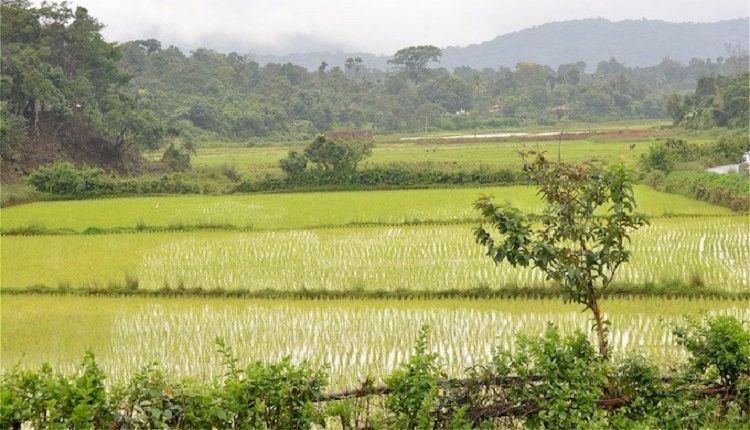
Near Ponnapet in Virajpet taluk, Kodagu district, the sight that greets the visitor is one of lush paddy fields extending till the very edge of the horizon. However, a wide stretch of land leaden with construction material with a tiny makeshift office, is a blemish on Kodagu’s otherwise pristine landscape.

White boards reading Converted Site For Sale and pointing, rather ironically, towards verdant green fields is a common sight across the district. Interestingly, some of these plots cost more than a flat in the heart of Bengaluru.

Reflecting on the sharp spurt in the price of land in the district in the past decade, president of the Coorg Wildlife Society, Colonel CP Muthanna said, “Ten years ago, an acre cost Rs 7 lakh. Now, it is almost Rs 1 crore, and many layouts have cropped up in the last five years.” The many residential enclaves that have cropped up, mostly on wetlands and agricultural fields, might have resulted in the land prices shoot up, but they have had a disastrous effect on the flow of rain water into the many streams and brooks that feed the Cauvery River, which originates in the district. A school built on paddy fields near Gonikoppa in Virajpet is faced with the problem of flooding almost annually.

However, it is those who practise agriculture who have to bear the brunt of these ill-thought out development projects. Gopakumar M, who has been studying otters in the Cauvery River, said, “Paddy was the primary crop that was grown by farmers here. Now, cultivation has come down by 50%, since many have abandoned it because of labour costs, irregular rainfall pattern and lack of business.”

However, Muthanna laid the blame at the government’s feet, for its failure to encourage cultivation of indigenous varieties of paddy. “Sellers are saying that they are giving up because of high labour costs and rainfall patterns; they aren’t good enough reasons. Most sell them for the money,” he said.

source: http://www.timesofindia.indiatimes.com / The Times of India / News Home> City News> Bangalore / Aditi Sequeira / TNN / October 15th, 2016