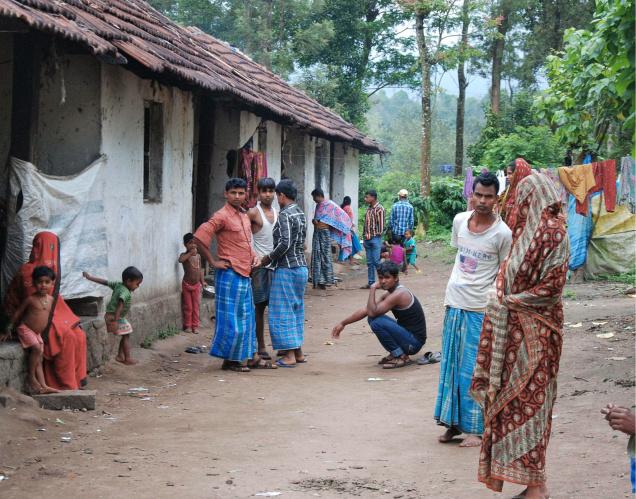
More than 5,000 people from Darang and neighbouring districts of Assam have found work in plantations of Belur and Sakleshpur taluks.— Photo: Prakash Hassan
Assam may be famous for its tea gardens, but a good number of Assamese workers have found employment in the coffee estates of Chikkamagaluru and Kodagu.
More than 5,000 people from Darang and neighbouring districts of Assam have come to work in plantations of Belur and Sakleshpur taluks. Many more work in estates spread over Chikkamagaluru and Kodagu districts.
“We hardly find jobs in our hometown. If we get work for a week, we remain jobless for next few weeks,” said Habizur Rahman (25), who has been working in Hasurugudda Estate of IBC company near Arehalli in Belur taluk for the last four years. Both men and women are enrolled as contract workers in estates for a daily wage of Rs. 228. In Assam, women hardly get the opportunity to earn in fields, he said.
The wave of migration started five years ago, when a manager of an estate in Belur taluk came in contact with planters in Kodagu, where workers from Assam had begun to arrive. “Those days we were struggling to get local people to work. We were looking for people who could work. The first batch of 25 people came from Assam five years ago. As they got work for the entire year and wages were better than what they got in their homeland, they brought more people from their State,” said Fazlur Rahman, manager with IBC estate.
Election trips
The manager pointed out that many planters have employed Assamese as they are hard workers, though they are not well-versed in the skill of maintaining coffee. These workers have brought their family and all of them make a trip to their homeland during elections. “Voting is significant as there is a serious issue of illegal migrant voters from Bangladesh,” said Shwahidul Islam, who always keeps his voter’s identity card in his pocket.
However, the workers are unhappy with the poor facilities provided in the estates. Around two or three families are forced to settle in one house with plastic sheets to separate them. For over 80 families there is only one toilet, in one of the estates visited by The Hindu .
“We repeatedly demand for proper facilities, but our cry does not reach the people concerned. If anyone falls sick, we neither get paid holiday nor medical expenses reimbursed,” said Habizur Rahman.
The district administration has set up a tent school for children of migrant workers, but they find this of no use. “We need a proper school where our children can get education from teachers who know Hindi,” said Marina Khatun, one among the women workers in the estate.
source: http://www.thehindu.com / The Hindu / Home> National> Karnataka / by Sathish G.T. / Hassan – September 27th, 2015
N. Dharmaraj, President and D.Vinod Sivappa, Vice – President
Mysuru :
N. Dharmaraj was elected as the President and D.Vinod Sivappa as Vice- President of United Planters’ Association of Southern India (UPASI) for the year 2015-16 at the Annual General Meeting of UPASI held on Sept.24 at Coonoor, Tamil Nadu.
Dharmaraj has over 41 years of experience in plantation business, working with companies like Brooke Bond, Unilever etc. He is currently the Chief Executive and Whole-time Director of Harrisons Malayalam Ltd.
Dharmaraj was Chairman of the UPASI Tea Committee and Chairman of the UPASI Commodities Exchange Limited. He was a member of the Tea Board of India and Founder-Convener of the Golden Leaf India Awards (TGLIA). He is currently a Member of Tea Council of South India constituted by the Tea Board as also a Member of the Core Committee of the Tea Board of India.
Vinod Sivappa, son of former President of UPASI (late) D. Sivappa in the year 1970-71, hails from a coffee growing family for more than 160 years. Vinod Sivappa was on the Committees of Codagu Planters’ Association and also was the Chairman of the Karnataka Planters’ Association. He is involved in many sporting activities. He is a Director of many organisations and various companies, according to a press release from Ullas Menon, Secretary General, UPASI.
source: http://www.starofmysore.com / Star of Mysore / Home> General News / September 27th, 2015
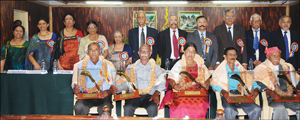
The senior members of Kodava Samaja, Mysuru (sitting from left): Machura N. Kaveriappa, Napanda U. Aiyappa, Kakamada Ganga Chengappa, Bottolanda M. Ponnanna and Ponjanda S. Arjuna, who were felicitated with a shawl, garland and memento at the annual get-together held at Field Marshal K.M. Cariappa Community Hall in city yesterday, are seen with (standing from left) Ponjanda Lovely Appaiah (Hon. Secretary, Sree Kaveri Kodagu Mahila Sangha); Thambanda Neena Devaiah (Jt. Secretary, Kodava Samaja); Balyamanda Sarasu Nanaiah (President, Sree Kaveri Kodagu Mahila Sangha); Chembanda Nanjamma (President, Kodagu Sahakara Sangha); Mechanda Mithra Karumbaiah; Mechanda M. Karumbaiah (President, Kodava Samaja); chief guest Kambeyanda C. Biddappa (retired Senior Vice-President, ITC); Moovera K. Kuttappa (Vice-President, Kodava Samaja); Kekada M. Belliappa (Hon. Secretary, Kodava Samaja); Kuppanda P. Subbaiah (Treasurer, Kodava Samaja) and Prof. Kambeyanda C. Belliappa (Chairman, Sree Cauvery Educational Institution)
Mysuru :
The annual Kail-Poldh get-together was celebrated at Field Marshal K.M. Cariappa Community Hall in Vijayanagar 1st stage here yesterday under the auspices of Kodava Samaja, Mysuru.
The day-long programme began with Ayyalapanda Pattu Pemmaiah performing Ayudha Puja to the traditional weapons of Kodavas. Kail-Poldh festival is celebrated in Kodagu during the end of the paddy sowing. Kail means weapon or armoury and Poldh means worship. The festival also signifies the day that men should prepare to guard their crop. Hence, on the Kail-Poldh day, the weapons are taken out of the puja room, cleaned and puja is offered.
Kambeyanda C. Biddappa, retired Senior Vice-President, ITC Ltd., who was the chief guest, felicitated eminent Kodavas and senior members of the Samaja in recognition of their service to the Samaja and the society.
Speaking on the occasion, K.C. Biddappa said that higher education was the most important enabler for all-round development of a community. He then said it was unfortunate that while Kodava students in urban areas are doing well academically their rural counterparts are lagging behind and needed help.
“These rural poor Kodava students need support from the community, and organisations like Kodava Samaja, Coorg Education Fund and Deena Bandhu Charitable Trust should help poor Kodava students without making merit the only criteria,” he added.
Stating that in most of the district head quarters every community has hostels to help their poor students to study with free boarding, lodging and financial support, he rued that there was not a single Kodava hostel any where. “If only we were to have Kodava hostels in Madikeri , Mysuru and Bengaluru, a lot of poor Kodava students would have benefited and progressed,” he opined.
Referring to the dwindling population of the community in Kodagu, he said Kodavas are losing relevance in their own homeland and that the Government does not bother because Kodavas are not a vote-bank.
Stating that Kodava population in Kodagu is just between 80,000 and 90,000, he said to become relevant Kodavas needed to take the support of all the moolanivasis of Kodagu like Peggade, Iri, Amma Kodava and other original inhabitants.
“We should all unite and take up our cause under one umbrella to create a sustainable and significant vote-bank, then only the Government will respond to our demands,” he said.
Biddappa reiterated that Kodavas must be united and said if Kodavas have to survive then they should focus on higher education and support poor Kodava students.
The senior members, who were felicitated by the Samaja are: Napanda U. Aiyappa, an exserviceman; Machura N. Kaveriappa, also an exserviceman; Bottolanda M. Ponnanna, who runs a private business; Ponjanda S. Arjuna, retired Circle Inspector and recipient of Chief Minister’s and President’s Medal and Kakamada Ganga Chengappa, who runs Swastha, a school for specially-abled children in Sunticoppa, Kodagu and recipient of Rajiv Gandhi Manav Seva Award for service to special kids. The above achievers were introduced by Mandira P. Kalaiah, Ammatanda Madhu Medappa, Machanda S. Muthappa, Thambanda Neena Devaiah and Kekada M. Belliappa respectively.
Replying to felicitations, the senior members, who are actively involved in the Samaja activities, called upon the Samaja, area-wise Kodava Associations and the community members to preserve and promote the unique Kodava art, culture and tradition by encouraging the Kodava youth to come forward and pursue the same.
On the occasion, various scholarships instituted by the Samaja members were presented to meritorious Kodava students (from 7th std. to Post-Graduation) and achievers in sports.
Kattera A. Kariappa, former President of Kodava Samaja and President of Deena Bandhu Charitable Trust, Mysuru, who also spoke, sought the support of the Samaja members to the Trust, which has been helping poor and needy Kodava students in their studies.
Earlier, Keethiyanda Kavya Kuttappa, Ketolira Bhavani and Appanderanda Thara rendered the invocation. Samaja President Mechanda M. Karumbaiah welcomed and presided. Treasurer Kuppanda P. Subbaiah read the names of the deceased members after which a minute’s silence was observed as a mark of respect to the departed souls.
Ponnachanda S. Bheemaiah read the names of the scholarship awardees.
Vice-President Moovera K. Kuttappa introduced the chief guest.
Ponjanda Lovely Appaiah compered and proposed a vote of thanks.
Hundreds of Kodavas attended the day-long get-together which concluded with sports and games for the members and their children in the afternoon session.
source: http://www.starofmysore.com / Star of Mysore / Home> General News / Monday – September 07th, 2015
They have worked in the tea gardens of Assam but in Madikeri they are tending the Coffee plants. Labourers from Assam working in coffee plantations in Kodagu have become a common sight since the past two years.
It is in south Kodagu that more number of Assamese labourers find work in houses and estates.
A few days ago, nearly 200 people arrived from Assam and were divided in teams to meet the demands of the local agents.
According to the labour department officials, there are seven labour camps in and around Kodagu where these people stay.
A few big planters will host some of the Assamese labourers in their own camps in the estates.
In Kodagu, over the years, shortage of labourers have been very severe and existing workers have been demanding more salary and benefits. In 2011, the acute shortage of labour and the high demands of local labourers had put the planters in a spot.
Earlier, the planters were getting labourers from Sullia in Dakshina Kannada and Arasikere in Hassan district, but the Assamese labour comes much cheaper than the usual lot, the officials added.
A labour contractor from Dakshina Kannada, Rajappa Gowda, who takes labourers from Sullia and Puttur every week, says Kodagu has a heavy demand for labourers.
Many escape the labour work in the estates and get into more cozier jobs as servants at home-stays.
But the migrants tend to stay for longer as they get all the benefits, from schooling for their children and higher social security.
Former vice-chairman of Coffee Board of India, Bose Mandanna, told Express that though Assamese workers do not know the scientific work of coffee cultivation, those who settle here learn how to spray, borer tracing and other works. Since all migrants show records like BPL cards, voter IDs and other records, it is the responsibility of the officials to trace fake cards, he says.
However, according to Codava National Council president N U Nachappa, these workers are all Bangaldeshis possessing fake documents. He recalled the protests held early this year urging officials to verify the labourers’ antecedents.
A coffee planter from Gonikoppa told Express, “Since we are getting Assamese labour, demand for more salary from workers who come from far away places cease.”
Another planter from Suntikoppa in Somwarpet taluk said many estates would run into trouble if the Assamese labour did not flow into Kodagu.
The police department have asked all coffee growers to check the documents and collect photos of workers and their family members and submit copies to them without fail.
source: http://www.newindianexpress.com / The New Indian Express / Home> States> Karnataka / by Express News Service / August 24th, 2015
The rain deficit in Kodagu, the origin of Cauvery river, has become a major cause of worry for the farmers here.
As far as the monsoon is concerned, the rainfall seems to be following an erratic pattern.
Heavy rain lashed the district in the beginning of the monsoon causing havoc. Later, it slowed down causing a drought-like situation.
Generally, in the 90-day monsoon season, the rainfall was sufficient for farmers as it was enough to fill the Harangi reservoir. But this year, the situation is different.
Though Harangi is full, Krishna Raja Sagar (KRS) reservoir is yet to be filled as the crest gates in Harangi were opened only once.
Kodagu district received 60 cm of rain in the first 10 days of the monsoon causing floods.
In July and August, rainfall was deficient by 70 and 60 per cent respectively.
Cloud seeding was taken up in Kodagu six years ago, but it was not conducive with the weather here.
According to figures available with Express, the average expected rainfall in January was 5 mm, but the district received 0.3 mm; February – 3.2 mm (5.6 mm expected); March – 37.4 mm (14.7 mm); April – 133.4 mm (73.5 mm); May – 191.4 mm (146 mm); June – 804 mm (486 mm); July – 366 mm (938 mm) and till August 20 – 164 mm (250 mm).
This erratic rainfall seriously impacted the water requirements of paddy, coffee and pepper crops.
The total average rainfall from January to August should have been 2,100 mm, but Kodagu has recorded 1,710 mm. The district is facing a deficit of 300 mm rainfall.
A minimum of 600 mm rain is required on a weekly basis to fill the reservoirs in Kodagu.
source: http://www.newindianexpress.com / The New Indian Express / Home> States> Karnataka / by B C Dinesh / August 24th, 2015
The General Body Meeting of Mysore Coffee Curing Co-operative Society (MCCCS) will be held in Mysuru on Sept.1.
Announcing this at a press meet at Virajpet Press Club on Thursday, the Society’s former President Karnanda Raghu Somaiah called upon all members of the Society to attend the meeting.
Pointing out that the general body meeting of MCCCS, which is one of the most prestigious Co-operative Societies in Mysuru region, has not been called for years, Somaiah said that he had brought a stay from the High Court on July 9, 2015 on the moves to publicly auction the Society’s landed property estimated at about Rs. 200 crore. Earlier, the Court of the Registrar of Co-operative Societies at Bengaluru had dismissed a petition in respect of the appointment of Liquidator and not convening the general body meeting, he said.
Continuing he said that the Liquidator has asked all the members to attend the Sept.1 meeting at Mysuru while setting some conditions. The Liquidator has also asked the members to produce the original copy of share certificates held by them, he said.
Stating that a few members of the Society have died between 1998 and 2014, he demanded the Liquidator to allow all those having ID cards to attend the meeting and to ensure that the meeting is conducted as per the procedures.
Stressing on the need for an united and organised fight for the revival of the society, Somaiah said that the list of Kodagu members of the MCCCS was available at Virajpet Town Bank. The members from Kodagu can visit the Bank during working hours and check the list for their names, he added.
Coffee planter and MCCCS office-bearer Kolathanda W. Bopaiah, in his address, sought co-operation of all the members for the survival of the Society.
Kodagu Central Co-operative Bank former President Mathanda A. Ramesh, K.W. Ganapathy, K.M. Charmana, C.K. Ganapathy, K.P. Nagaraj and others were present at the press meet.
source: http://www.starofmysore.com / Star of Mysore /Home> General News / August 23rd, 2015
The 69th Independence Day was observed with patriotic spirit on the Fort premises in Madikeri on Saturday.
The marchpast by police, Scouts and Guides, NCC, NSS, and students and cultural programmes by the schoolchildren added colours to the celebrations.
Speaking on the occasion, District In-charge Minister K J George said the State government is ready to respond to the woes of the farmers. The farmers should not take extreme steps to end lives. Freedom should not be misused. It should be used for the welfare of all, he added.
St Joseph High School student Sreeja and Dechamma were felicitated for securing highest marks in SSLC examination. The highest scorers in second PUC examination — Ahalya Appacchu, B M Neelamma, Amrita Girish, Preethi Riya Pinto and Uthappa — were also felicitated.
The schoolchildren danced to patriotic songs on the occasion. In the cultural programmes, General Thimmaiah Public School team won first place while St Michael High School and Rajarajeshwari School teams stood second and third.
Guides team of St Joseph High School, Sevadala of St Michael School and Scouts of Rajarajeswari School won first, second and third place respectively in the marchpast category. Hoovaiah Gowda, who had entered into the Ginnessh Book of World Records for growing 41-feet tall sugarcane, was also felicitated. Valley Dew team presented traditional Kodava dance. Rajesh and team from Mandya presented Dollu Kunitha on the occasion.
source: http://www.deccanherald.com / Deccan Herald / Home> District / Madikeri / DHNS – August 15th, 2015
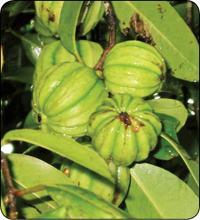
Kachampuli, a vinegar of a kind prepared out of Panapuli fruit (Garcinia gummi-gutta) juice, is an indispensable kitchen ingredient in Kodagu homes, specially for ‘Pandikari’
A bunch of raw Panapuli fruit Napoklu (Kodagu) :
Kodagu, which is known the world over for its rich and aromatic coffee, is also home to Panapuli fruit and the ‘ethnic’ Kachampuli vinegar produced from it.
Come monsoon, many people in Kodagu, especially the farmers, are busy harvesting the Panapuli fruit as there is a great demand for its dark syrup, also known as Coorg Vinegar, which is used as a souring agent in Kodava cooking.
This thick black vinegar is the concentrated juice of Garcinia gummi-gutta, the tropical fruit that is also used in dried form for cooking by some.
Panapuli fruit trees are found in some coffee estates and forest areas in Kodagu. The tree starts flowering during March-April and the fruits get ripened by June-July by which the fruit colour would have changed to yellow. The pulpy Panapuli fruit also has seeds inside it. To prepare the vinegar, the juice extracted from the ripened fruits, is boiled down in an earthen vessel using firewood till the juice turns thick and dark (brownish black). Then it is cooled and filled in bottles to be sold in the market. The Kachampuli (vinegar) is sold at rates ranging from Rs. 200 to Rs. 900 per bottle, depending upon the demand and can be preserved for years without adding any preservatives.
Kachampuli adds flavour to non-vegetarian Kodava cuisines like pork, mutton and fish. As for pork curry, chops or fry, it is a must culinary ingredient. Without it, pork preparation, specially, cannot be called a Coorg speciality dish.
Apart from extracting the juice to make vinegar, the ripened fruits are also used in dry form by many people including Keralites and Mangaloreans.
The fruit is cut into four parts and dried over an iron net under fire; before drying the fruit, first the 4 feet tall and 6 feet wide iron net with 4 supporting pillars is installed and the fire is lit under the net. The dried fruit is sold at Rs. 120-130 per kg.
Nowadays, Panapuli saplings are sold in nurseries. The fruit is a relative of Kokum, which is used in some Konkan and Maharashtrian cuisines too.
source: http://www.starofmysore.com / Star of Mysore / Home> General News / July 24th, 2015
Mysuru-Kodagu MP Pratap Simha, who is also the member of Spices Board, has demanded setting up of a Spices Park in Kodagu district.
Pratap Simha, who was in Kashmir to attend the Spices Board meeting along with former Chief Minister and MP B.S. Yeddyurappa, urged the Board authorities to set up a Spices Park in Kodagu district, which is also famous for growing spices such as pepper and ginger apart from coffee.
Speaking to Star of Mysore, Pratap Simha said that Spices Board officials had agreed for a feasibility study and added that a team of officials would visit Kodagu in the coming days to conduct a study for setting up the Spices Park.
Setting up Spices Park in Kodagu would help pepper and ginger growers in Kodagu district and Cardamom growers in Sakaleshpur in Hassan to market and get good rates for their products, he added.
Our aim is to provide a sustainable market for the spices grown in this part of the region, he said and added that there is a proposal to start a Spices Park in Haveri which intends to provide a good market for chilli growers in the region.
But, for the growers to transport spices from Kodagu and Hassan districts to Haveri would be a problem and for that reason it was proposed to set up Spices Park in Kodagu, said Pratap Simha.
He said that the State Government has to provide 50 acre land for the Spices Park like it has been done in Haveri district.
Once the land is allotted, the work on Spices Park would commence after the proposal is approved by the Spices Board officials, Simha added.
Pratap Simha further said that issues pertaining to Saffron growers were also discussed during the meeting held yesterday in Srinagar.
He said that the Spices Board has decided to work towards providing assured market for Saffron within the country and also exporting the same throughout the world.
source: http://www.starofmysore.com / Star of Mysore / Home> General News / Thursday – July 02nd, 2015
Coffee production in India is expected to touch a new peak of 3,55,600 tonnes this marketing year starting October, as the crop prospects are encouraging due to adequate rains in most growing states, state-run Coffee Board said on Monday.
The country’s total coffee output has reached a record 3,27,000 tonnes in the ongoing 2014-15 coffee year, though slightly lower than the earlier estimate of 3,31,000 tonnes made for the same period, it said in a statement.
The coffee year runs from October to September.
Releasing the initial production estimate for 2015-16, Coffee Board said: “The post blossom crop forecast for the year 2015-16 is placed at 3,55,600 tonnes. This is an increase of 28,600 tonnes over the final crop estimate of 2014-15.”
Of the total, Arabica production is estimated at 1,10,300 tonnes in 2015-16 as against 98,000 tonnes this year, while that of Robusta production is pegged at 2,45,300 tonnes as against 2,29,000 tonnes in the said period, it said.
Arabica and Robusta are the varieties of coffee.
“Overall, the crop prospects of 2015-16 at post-blossom stage are quite encouraging with a promise of highest record crop thanks mainly to the timely and adequate blossom and backing showers in traditional areas and non-traditional areas,” it said in a statement.
According to the Board, much of the production gain is expected to come from Karnataka, where total coffee output is pegged at 2,56,500 tonnes in 2015-16, as against 2,33,230 tonnes in the current year.
“The main reason for increased crop forecast in the state is that all coffee growing areas have received timely and adequate blossom and backing showers during this year.
Additionally, prevalence of good prices encouraged the growers to adopt better husbandry practices which have helped to invigorate production,” it said.
The output in three coffee growing districts Kodagu, Chikmagalur and Hassan is estimated higher at 1,38,075 tonnes, 85,250 tonnes and 33,175 tonnes, respectively, for 2015-16.
Coffee production in Kerala is estimated to increase to 69,800 tonnes in 2015-16 from 67,700 tonnes this year, while the output in Tamil Nadu is likely to improve marginally to 18,800 tonnes from 17,875 tonnes in the said period.
In non-traditional areas, coffee production in Andhra Pradesh is estimated to increase to 9,700 tonnes from 7,425 tonnes, while the output in Odisha is expected to rise to 600 tonnes from 550 tonnes in the said period.
Coffee output in north eastern region is, however, expected to decline marginally to 200 tonnes in 2015-16 from 220 tonnes in 2014-15, the Board added.
Till last week, monsoon rains were 11 per cent more than the average. Monsoon rains are expected to be normal in June but may weaken in the next month, as per the Met department.
India accounts for only 4-5 per cent of the world’s output, but exports 70-80 per cent of its produce. Italy, Russia and Germany are the top three buyers of Indian coffee.
source: http://www.ndtv.com / NDTV / Home> Sections> All India / Press Trust of India / June 23rd, 2015
WELCOME. If you like what you see "SUBSCRIBE via EMAIL" to receive FREE regular UPDATES.
Read More »