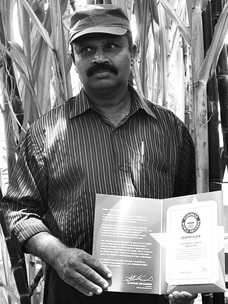
Hoovaiah, an ex-serviceman, who is serving as a mobile tower operator with the BSNL, entered the Guinness Book of World Records for growing the tallest sugarcane in the world.
As of now, the sugarcane in Convent Junction in Madikeri is 42-foot tall.
The Sugarcane grown with the support of Mobile Tower in Convent Junction of Madikeri
During an interview to Express Hoovaiah detailed the uphill task and claimed that he had to be convinced to enter the Guiness Book.
Hoovaiah, brought a stem of black variety of sugarcane from Karike four years ago and wanted to eat it once it had grown. He nurtured it with cow dung and ash apart from watering it regularly.
But when it was found that in three years the sugarcane had grown 40-foot tall with the support of a mobile tower, his friends and others advised him to get Guinness Book recognition.
When Hoovaiah approached the Guiness Book officials for recognition they asked him to pay nearly Rs 4 lakh for visiting and verifying the sugarcane.
When Hoovaiah expressed his financial constrain they asked him to submit a 22-page application as it is certified by six gazetted officers, Hoovaiah said.
Hoovaiah with the Guinness Book of Records certificate
The team that verified the documents had advocate B B Ananda, Dr Renuka and Dr Tirmala Rao of Ex-servicemen Contribution Service Scheme hospital, Dr Rajashkear and Dr Ramakrishna from Agriculture Department and Dr Sreenivasaiah of Krishi Vignana Kendra Gonikoppa. They inspected the sugarcane and sent a report to Guinness Book of World Records in California of USA on June 21 last year.
After verifying with the records worldwide, they sent a letter of record holder on June 10 this year and asked him to pay Rs 2,593 if he needed an original certificate. After he made the payment, they issued the certificate, Hoovaiah said.
He pointed out that though he was told that the sugarcane will not survive due to the radiation from mobile tower nothing happens so far. He also acknowledge the support of his family, BSNL officials and others in protecting and caring for the sugarcane.
source: http://www.newindianexpress.com / The New Indian Express / Home> States> Karnataka / by B C Dinesh / June 15th, 2015
Pepper farmers from Wayanad visiting a pepper farm in Coorg.
A study tour organised jointly by the M.S. Swaminathan Research Foundation (MSSRF) here and Directorate of Arecanut and Spices Development (DASD), Kozhikode, to various pepper plantations in Coorg in Karnataka provided a fresh experience to the pepper farmers in Wayanad.
Decades ago, Wayanad was known as the land of spices but it lost its fame in pepper production since the 1990s when the vines began to get affected by various diseases.
“We organised the tour to provide an exposure to the farmers on the significance of adopting scientific practices in pepper cultivation to keep the diseases at bay and improve pepper production, P. Ramakrishnan, training coordinator, MSSRF, told The Hindu .
The organisations have been jointly organising training programmes for progressive farmers on modern agriculture practices in pepper cultivation for the past one year. The effort is to bring back the lost glory of the district as a leading pepper producer, Mr. Ramakrishnan said.
As part of the tour, 25 farmers visited various pepper plantations in Coorg, including a farm of the DASD at Appagala in Coorg.
They were told about the way the DASD tackled the quick wilt disease that had spread in various parts of Coorg a decade ago, threatening the pepper plantations here.
Scientific agriculture practices were followed, and farmers in the area were getting an average yield of 7 tonne pepper from a hector, Mr. Ramakrishnan said.
source: http://www.thehindu.com / The Hindu / Home> News> National> Kerala / by E. M. Manoj / Kalpetta, April 01st, 2015
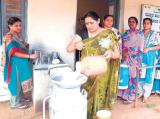
Women from the rural areas of Kodlipet hobli near Shanivarasanthe, have achieved self reliance through dairy farming and have also produced significant quantity of milk.
The Nandipura Milk Producers Women’s Cooperative Society was established in 2008 by a couple of women in Kodlipet, with an intention to attain self reliance through farming activities in the rural areas.
Presently, Pramila Ravishankar, Chinnamma and Girija Girish are serving as president, vice president and secretary of the association, respectively. While Nirmala, Yashoda, Umavathi, Kavitha, Shashikala, Manjula and Jayamma are working as directors.
248 members
There are totally 248 members in the society who are engaged in dairy farming. Out of these, 75 members are from Kyathe, Neegunda, Chikkakundha and Kelakodli villages who regularly supply milk.
The milk is tested for its purity and everyday as much as 450 litres of milk is supplied to Kodige dairy.
Thirty HF cows have been provided to members, under Amritha scheme.
The association provides Rs 24 per litre to the members while Rs 4 is be provided by the Government as the subsidy.
Nandini self help group was established after Rs 75,000 subsidy from Karnataka Milk Federation. Interest free loans of Rs 5,000 is provided to 15 members.
When a member repays the loan, another member is be provided the loan. The members pay Rs 500 evey month towards the repayment.
The members said that the income that they earned from the dairy farming had made them self reliant and also helped them save some money after managing the household expenses.
The members also run Stree Shakthi and other self help groups.
25 dairies in Kodagu
“Kodagu district has 25 dairies. The district needs a separate milk union and a better price is to be ensured. Also, the time of the delivery of milk to the dairies needs to be revised,” said one of the Directors Nirmala.
Amidst comments that the dairy farming practices are dwindling in Kodagu, the Nandipura Milk Producers Union has carved a niche for itself, by being a role model to others.
source: http://www.deccanherald.com / Deccan Herald / Home> District / Shanivarasanthe – DHNS, March 30th, 2015
Public awareness and local community support for prevention are the first line of defence in the fight against forest fires at Nagarahole National Park.
Wildlife First conducted 125 awareness camps on forest fire prevention in January and February. These were held around the borders of Nagarahole National Park in Kodagu district. As many as 23,000 students and 1,100 teachers residing around the national park and other forest areas participated, said Praveen Bhargav, trustee, Wildlife First.
He said two public rallies were organised, including one at Madikeri.. “During the course of the campaign, schoolchildren were told about the need to conserve forests and wildlife. Key facts that all forest fires are man-made and cause irreversible damage to wildlife and the eco-system were highlighted,” Mr. Bhargav said.
More than 30,000 pamphlets in Kannada were distributed with an appeal to alert the Forest Department in case of fire. Wildlife First is planning to put out radio and TV spots on AIR Madikeri Station.
source: http://www.thehindu.com / The Hindu / Home> News> National> Karnataka / by Special Correspondent / Mysuru -March 08th, 2015
The Coffee Board of India serves as the friend, philosopher and guide to the coffee sector in the country covering the entire value chain
The saga of Indian coffee began on a humble note, with planting of ‘Seven seeds’ of ‘Mocha’ during 1600 AD by the legendary holy saint Baba Budan, in the courtyard of his hermitage on ‘Baba Budan Giris’ in Karnataka. For quite a considerable period, the plants remained as a garden curiosity and spread slowly as back yard plantings. It was during 18th century that the commercial plantations of coffee were started, thanks to the success of British entrepreneurs in conquering the hostile forest terrain in south India. Since then, Indian coffee industry has made rapid strides and earned a distinct identity in the coffee map of the world.
The Coffee Board
During 1940s, the coffee industry in India was in a desperate state due to the World War II resulting in very low prices and ravages of pests and diseases. At this time, the Government of India established the Coffee Board through a constitutional act – Coffee Act VII of 1942 – under the administrative control of the ministry of commerce and industry. The Board comprises 33 members including the chairman, who is the chief executive and appointed by the Government of India. The remaining 32 members represent the various interests such as coffee growing industry, coffee trade interests, curing establishments, interests of labour and consumers, representatives of governments of the principal coffee growing states and members of Parliament.
After pooling was discontinued in 1996, Coffee Board serves as the friend, philosopher and guide to the coffee sector covering the entire value chain. The core activities are primarily directed towards research & development, transfer of technology, quality improvement, extending development support to growing sector, promotion of coffee in export and domestic markets. The activities of the Board are broadly aimed at (i) enhancement of production, productivity and quality; (ii) export promotion for achieving higher value returns for Indian coffee and (iii) supporting development of the domestic market.
Research and Export Promotion
Organised research in coffee was initiated during 1925 by the erstwhile Mysore Government by setting up the Mysore Coffee Experiment Station near Balehonnur in Chikmagalur district. After formation of the Coffee Board, the research station was brought under its administrative control. Presently the Research Department of the Board with its headquarters at the Central Coffee Research Institute and five regional stations has a sanctioned strength of 113 scientific personnel and is involved in development of improved varieties with tolerance to major pests and diseases and standardisation of technology for improving production, productivity and quality.
After liberalisation in 1996, the marketing functions were deregulated. The Coffee Board plays the role of facilitator and promoter of Indian coffee exports. However, registration of exporters is the responsibility of the Coffee Board. Under the Export Promotion scheme, exports of value added coffees in retail packs and export of coffee to high value far-off destinations are incentivised to offset the transaction costs to some extent and enable the Indian exporters to be competitive in the export market. These incentives provide opportunities to expand the footprint of Indian Coffee in higher value destinations like USA, Japan, Canada, Australia, New Zealand, etc on one hand and reinforcing presence in traditional markets i.e., European Union/ Russia and CIS etc.
Besides, the Board regularly participates in leading coffee trade shows/ exhibitions held in major consuming countries to promote awareness about quality of Indian coffee to the overseas roasters, traders and consumers. The Board also conducts Flavour of India – The Fine Cup competitions to select fine coffees and expose them to the export market. It also promotes coffee consumption in the country through 12 India Coffee Houses located in major cities across the country.
In India, coffee is traditionally grown in the Western Ghats spread over Karnataka, Kerala and Tamil Nadu. Coffee cultivation is also being expanding rapidly in the nontraditional areas of Andhra Pradesh and Odisha as well as in the North East states. Coffee is predominantly an export oriented commodity and 65 per cent to 70per cent of coffee produced in the country is exported while the rest is consumed within the country. Indian coffee industry earns a foreign exchange to the tune of about Rs 4000 crore. In the international market, Indian coffees earn a high premium, particularly Indian Robusta which is highly preferred for its good blending quality. Arabica Coffee from India is also well received in the international market.
Arabica is a mild coffee, but the beans being more aromatic, it has higher market value compared to Robusta beans. On the other hand Robusta has more strength and is, therefore, used in making various blends. India is the only country that grows all of its coffee under shade. Typically mild and not too acidic, these coffees possess an exotic full-bodied taste and a fine aroma.
India cultivates all of its coffee under a well-defined two-tier mixed shade canopy, comprising evergreen leguminous trees. Nearly 50 different types of shade trees are found in coffee plantations. Shade trees prevent soil erosion on a sloping terrain; they enrich the soil by recycling nutrients from deeper layers, protect the coffee plant from seasonal fluctuations in temperature, and play host to diverse flora and fauna.
Coffee plantations in India are essential spice worlds too: a wide variety of spices and fruit crops like pepper, cardamom, vanilla, orange and banana grow alongside coffee plants.
Training courses in coffee culture and management
The Central Coffee Research Institute, popularly known as CCRI, has grown as an internationally recognised, state-of-the-art research centre for carrying out research on all aspects of coffee cultivation. CCRI is committed to introducing emerging technologies and sustainable package of practices to benefit the coffee farmers. It plays an important role in the development and growth of the coffee agricultural sector. CCRI has 133 dedicated scientists working for the development of newer technologies in close association with a number of international institutes, reputed national institutes and pure science and agricultural universities.
The CCRI, apart from the development of new technologies, is involved in imparting training on scientific coffee cultivation to the benefit of all the stakeholders since 1953. The institute is recognised as an international centre of excellence for training in coffee culture by the FAO, Rome. Candidates from several coffee growing countries are being sponsored for these training programmers by the world
CHART
Coffee regions of India
Anamalais (Tamil Nadu): Wildlife sanctuaries in this region are the abode of spotted leopards,while the plantations are home to fine, high-grown Arabicas, including the exotic Kents.
Araku valley (Andhra Pradesh): Home to colourful parrots, it is not unusual to see a flock of chattering red and green birds, darting through trees in this scenic valley.
Bababudangiris (Karnataka): Bababudan brought seven ‘magical’ beans from Yemen and planted them in the lofty hills of this region. Deer is often spotted, grazing alongside plantations abundant with full-bodied Arabicas.
Biligiris (Karnataka/Tamil Nadu): Besides full-bodied Arabicas, this region is noted for the sambar – the largest Indian deer with huge antlers.
Brahmaputra: The mighty Brahmaputra which flows through the North Eastern states is the lifeline of this region which is home to the one-horned rhinoceros. This sturdy animal is found in large numbers at the Kaziranga National Park in eastern Assam.
Chikmagalur (Karnataka): Chikmagalur’s forests and wildlife sanctuaries are abundant with beautiful peacocks, India’s national bird. The peacock loves to show off its colourful feathers, especially during its elaborate courtship dance.
Coorg (Karnataka): Lush coffee plantations are bustling with honeybees which yield the delicious Coorg Honey, collected by nimble-footed tribals
Manjarabad (Karnataka): Gentle sloping terrain with small streams and coffee plants provide a natural habitat for the jungle fowl. This yellow-headed bird with a red comb and multi-coloured plumage is generally seen in pairs, close to the coffee plantations.
Nilgiris (Tamil Nadu): The plantations are home to fine, high-grown Arabicas, including the exotic Kents.
Pulneys (Tamil Nadu): A well-known feature of this region is the bright, bluebell-like Kurinji flower that makes a dramatic appearance, once in 12 years. The high-grown Arabicas however, are a predominant sight, year after year.
Sheveroys (Tamil Nadu): The magnificent Gaur or Indian bison is an embodiment of vigour and strength, much like the boldsized Arabicas grown here. This massive animal with its huge head and sturdy limbs grazes on the lower hill tracts of this picturesque region.
Travancore (Kerala): The national flower of India, the lotus symbolises purity and beauty. These bright, fragrant flowers with floating leaves and long stems, grow in shallow waters in this region noted for its Arabicas and Robustas.
Wayanad (Kerala): Wayanad is home to the Indian tiger, India’s national animal – a symbol of valour and courage.
source: http://www.financialexpress.com / Financial Express / Food & Hospitality World / Home> Cover Story / March 05th, 2015
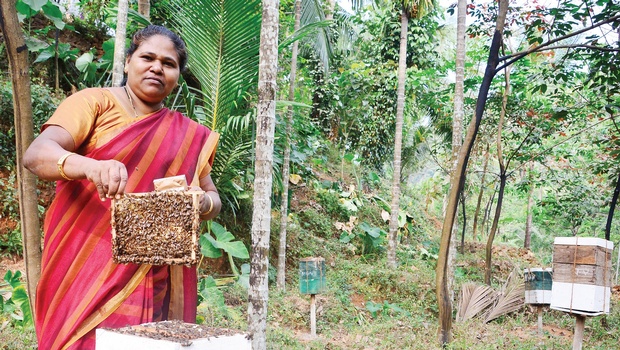
It is 9 pm. Outside their house at Panathady in Kasaragod district in Kerala, Aleyamma and her husband Siby are hurriedly placing beehives inside a van. Later, they climb in and the van sets out towards the Coorg district in Karnataka, which is only 30 km away. Once there, they quickly place the hives in three-foot-high stands, below trees, at a distance of three metres. “We have to do this before the sun comes up,” says Aleyamma. “Because at sunbreak, the bees would want to come out in search of nectar and pollen. And if we keep the hives shut they will die of asphyxiation.”
Aleyamma is a breeder who practices migratory beekeeping. Once the honey is harvested at all the hives placed near her house from January to March, she sets off to Coorg and does bee farming there. “Somehow, the quality of the honey is far better there,” she says.
But there is a reason for that. In Kerala, the major source of nectar is from the leaves of the rubber tree. “This is called unifloral honey,” says Dr Stephen Devanesan, principal scientist, All India Coordinated Research Project on Honeybees and Pollinators, Kerala Agricultural University. “But in Coorg, the hives are placed in forests where there is diverse flora. So, the quality of this multi-floral honey is much better.”
However, the collection of honey is not an easy process. First the bees have to be warded off using smoke. Then the honeycombs are removed from the hive. With the help of a honey extractor, the honey is taken out of the cells and stored in containers. All this has to happen in less than an hour, before the bees start stinging the person.
“In the beginning, the stings used to hurt a lot and there would be swelling as well,” says Aleyamma. “But now, though there is pain, there is no swelling. This is my bread and butter, so I have learnt to tolerate the aches,” she adds.
The biggest problem with honey is that it crystallises and ferments. To avoid this, Aleyamma uses the double-boiling method. In this technique, she pours water into a large container. Then she places a smaller bowl, which contains honey, inside it, resting on three bricks. The bottom container is heated, so that the temperature inside the smaller bowl reaches 45 degrees centigrade. Then the honey is taken out, and put through a sieve, to get rid of wax particles, dust and pollen. Following this, it is reheated to 65 degrees centigrade for about 10 minutes. “After the honey cools, it is filtered,” says Aleyamma. “Once this is done, the honey will last for years, without going bad.”
Interestingly, Aleyamma is the only woman beekeeper in Kerala. Last year, she produced 40 tonne of honey, thanks to the 5,000 colonies of Indian and Italian bees that she has.
And thanks to this high productivity, Aleyamma was recently conferred the Stephen Memorial Award for the best beekeeper of 2014 by state Agriculture Minister KP Mohanan. This award has been instituted by the Federation of Indigenous Apiculturists.
To get a high productivity, Aleyamma depends a lot on the Tamil workers, who are experts at bee collection. “They are sincere, hard-working and not afraid of being stung,” she says.
Aleyamma also credits her success to a workshop which she attended. This was conducted by Devanesan, along with Dr K Prathapan, director of the State Horticulture Mission. Devanesan says: “I have imparted training to Aleyamma and other breeders on how to maintain the health of the bees, manage colonies, and do high-tech apiculture. Today, they are all doing well.”
Like most good things in life, Aleyamma came to bee breeding by accident. When she got married and went to stay at her in-laws’ home in Thodupuzha, she saw beehives for the first time in the backyard. In the mid-1990s, she and Siby decided to move to north Kerala to improve their economic prospects. They tried pepper farming and rubber cultivation.
“It did not do well,” she says. “That was when I thought about bee farming. And now, here I am, the only woman in Kerala doing this work.”
source: http://www.newindianexpress.com / The New Indian Express / Home> Magazine / by Shevlin Sebastian / February 28th, 2015
Orders stoppage of tree-felling until MoEF approval
Protestors against the illegal felling of more than 50,000 trees in Kodagu for the sake of a power transmission line have a reason to smile. Ahead of their hearing by the Karnataka High Court, the National Green Tribunal’s order on Friday in a separate case seems to have revived their hopes of protecting the trees.
Order on activist’s PIL
The National Green Tribunal (NGT), on Friday, ordered all agencies to refrain from felling trees while executing linear projects in forest areas, unless an approval under the Forest (Conservation) Act 1980 was obtained. The NGT ruling was a response to a petition filed by Maharashtra-based activist Milind Pariwakam who objected to the National Highway Authority of India (NHAI)’s project of widening of NH-6 and NH-7 in the Vidarbha region. This would involve felling trees and diverting forest land through the fragile Tadoba Tiger Reserve in Maharashtra. The NGT ruling is likely to have a nationwide impact in preventing diversion of forest land for non-forest purposes.
The NGT clearly stated that all linear projects like railway lines, development of roads, canals and laying of transmission lines through forests must obtain permission from the MoEF under FCA -1980. Although the Chennai Bench of NGT had refused to stall the project last year, activists hope that the latest order will have an impact.
Speaking to Bangalore Mirror, Sajan Aiyappa, coordinator of the Save Cauvery Campaign, said, “Previously, when we approached the NGT’s Southern Bench, it had dismissed the petition on technical grounds and so we approached the High Court. The case has been posted for hearing on Monday. However, we welcome the order by the NGT in Maharashtra. We hope that the order will force authorities to take note of the seriousness of the issue and safeguard the fragile eco-system of Kodagu.”
The activists clarified that they were not against the project, but only concerned about the felling of 50,000 trees which would have a catastrophic impact on the rainfall of Kodagu. This, they say, would adversely affect the flow of water to the Cauvery and in turn affect the availability of potable water in Mysuru and Bengaluru.
Felling continues
“Despite the case being posted for hearing before the High Court, the authorities, a few days ago, cleared many trees within the limits of coffee estates. We have submitted scientific reports on the variety of species of trees in plantation areas. The court must take note of this and help us in safeguarding the eco-system,” yet another activist said.
source: http://www.bangaloremirror.com / Bangalore Mirror / Home> Bangalore> Others / by Niranjan Kaggere, Bangalore Mirror Bureau / February 23rd, 2015
The State Forest department is preparing a report on ways to mitigate the impact on the environment in Kodagu, when the 400 KV high tension power line is laid.
The report on the environment mitigation plan comprises short-term and long-term measures.
The measures are being listed keeping in mind development and protection of green cover.
It will be sent to the government by the end of this week, which will then be forwarded to the Power Grid Corporation and the Union government for funds and approval, Principal Chief Conservator of Forests (wildlife) Vinay Luthra told Deccan Herald.
Some of the listed measures include organising anti-depredation camps, building better barriers, not disrupting the existing waterholes, providing natural fodder spaces for animals, not using weapons against animals and if carrying weapons, getting them registered with the Forest department to ensure that animals are not harmed, not coming in contact with animals, not indulging in afforestation activities, not camping inside forest areas, reducing loss of green cover as much as possible and in regard to work in forest areas, ensuring that all permissions have been obtained and following rules like no-stay inside the forest during night hours, not hunting, not entering restricted forest area without permission and so on.
The report plans to ensure that no human or animal casualty is reported, but in the last 30 days two people have died due to man-elephant conflict and one person sustained injuries while working near coffee estates.
The power line from Mysuru to Kozhikode will pass through Kodagu. Of the 210-km line, 50 km will pass through coffee and paddy fields in Kodagu and the rest is through pristine Western Ghats regions – touching borders of Nagarahole Tiger Reserve, Dubare and Devamachi Reserve Forests.
This line is part of the central power grid project and will supply power to many southern regions, including Bengaluru.
Due to protests, this project been delayed by over five years. Lines have already been laid till Mysuru and Kerala, except some patches in Wyanad. It was to be completed in 2007, but was stalled. Work started again in November 2014.
During a meeting of agitators from Kodagu and power corporation companies last week, Energy Minister D K Shivakumar affirmed that the project would not be held back or delayed further. Shivakumar said that the project was important for Bengaluru and industries, to ensure 22-hour power supply daily, especially during summers. But agitators from Kodagu said that it was a scam. C P Muthanna, a retired colonel in the Army and president of the Coorg Wildlife Society, pointed out that there was already a 220-KV line in the region, which can be upgraded to 400 KV and used, instead of occupying fresh land and axing over 50,000 trees for the new line.
DH News Service
source: http://www.deccanherald.com / Deccan Herald / Home> State / by Bosky Khanna, Bengaluru / DHNS – February 17th, 2015
IIHR is targeting 35,000 hectares of paddy land mostly left fallow for 6 months to grow vegetables
If things go according to plan, Kodagu, the land of coffee and pepper, may turn into one of the major destinations for high-value vegetable cultivation a few years from now.
A survey conducted by the Indian Institute of Horticultural Research (IIHR) showed that paddy was being cultivated on about 35,000 hectares of plain land in the hilly district of Kodagu. Most of this is being left fallow for six months from October to March after the monsoon. Vegetable experts in the IIHR want to make best use of the land during the “off- season” by motivating people to take up vegetable cultivation.
“It is possible to cultivate vegetables during the off-season as their water requirement is not as huge as paddy,” says A.T. Sadashiva, Principal Scientist in the IIHR’s vegetable Crops’ Division. Also, the weather in Kodagu is similar to that of Ooty, where vegetables are in high demand, he said. Above all, vegetable farming fetches at least one-and-a-half times more returns than paddy, he says.
Preliminary work towards promotion of vegetable cultivation has already begun. The IIHR has developed model farms on about 50 hectares in different areas of Kodagu where high-value hybrid varieties developed by it are being cultivated. “We have also held four field days since 2012 in different areas such as Suntikoppa, where cultivation of different vegetables at the model farms has been showcased. Observing the overwhelming response to such events, we plan to have two more such field days shortly,” he says, while expressing confidence that it may be possible to encourage farmers to take up vegetable cultivation on a minimum of 100 hectares this year.
At present, vegetables like okra, tomato, beans, yard-long beans and chillies are being promoted, while other vegetables such as carrot will be introduced in the next phase, he says. Onion cultivation has also been introduced on an experimental basis.
The marketing network for the vegetables in Kodagu is not advanced. The IIHR is in talks with the State Horticulture Department, which has promised to provide facilities for sale of vegetables in different parts of the district, Mr. Sadashiva says, adding that plans are also afoot to sell the vegetables to other districts and States as and when the production increases.
It is possible to cultivate vegetables during the off-season as their water requirement is not as huge as paddy
A.T. Sadashiva Principal Scientist, IIHR
source: http://www.thehindu.com / The Hindu / Home> News> Cities> Bengaluru / by B.S. Satish Kumar / Bengaluru – February 22nd, 2015
Homebound Migrant workers return to their sheds after the day’s work at a coffee estate near Madikeri, Coorg. – GRN SOMASHEKAR
Though migration of labour from the east has helped revive the plantations in southern India, questions remain on the long-term implications, Vishwanath Kulkarni reports
As the harvest season starts in Coorg, Karnataka, coffee planter MC Kariappa has a lot of issues to contend with — productivity, weather and, the biggest worry of all in recent times, paucity of labourers. So when a dozen labourers from Assam landed at the gates of his coffee plantation at Madapur in January, at the start of the harvest season, Kariappa heaved a sigh of relief.
Though not adept at, or trained to work in coffee plantations, these migrant labourers -– both men and women — proved useful for Kariappa in harvesting Arabicas, the mild and premium variety of coffee. “Some of them are as good as the local workers, picking up to 100kg of ripened coffee a day,” says Kariappa, relieved that the harvest this year went off smoothly.
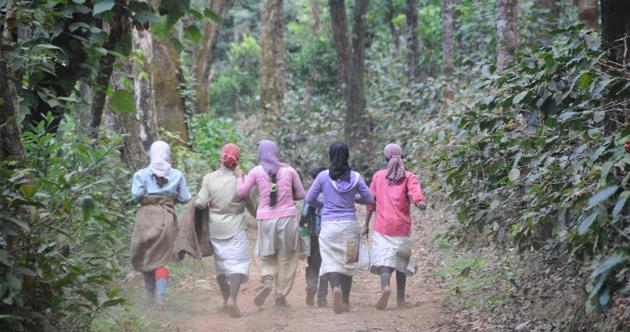
Migrant workers are now a common sight in Coorg’s coffee plantations, especially during the harvest season, as the country’s key coffee-growing region has been facing an acute shortage of labour over the past few years. Traditionally, plantations in Coorg and Chikmagalur attracted migrant workers from the drought-prone regions of North Karnataka and the plains of neighbouring Mysuru. This pool of labour now increasingly prefers urban centres such as Bengaluru, as jobs in malls, petrol bunks and garment sector are better paying. There is less toil too, compared to work in the plantations.
“Most of the worker quarters in my plantations were vacant until these people [migrant workers] landed here,” says Kariappa. Adds N Bose Mandanna, former vice-president of the Coffee Board and a planter in Suntikoppa: “Without improved labour availability, we would have been in a soup.” There are no official figures, but the number of workers from Assam and other eastern parts of the country migrating to Karnataka’s plantations are commonly believed to run into ‘thousands.’
The movement of labour is not towards Karnataka alone. Plantations across South India, including those in Tamil Nadu and Kerala, now depend on the labourer from eastern or north-eastern India.
A ‘healthy’ phenomenon
The daily wagers at Coorg’s coffee plantations largely come from Assam, while tea gardens in Tamil Nadu’s Nilgiris, and the Kerala estates growing coffee, spices, coconut and rubber get their workforce from Arunachal Pradesh, Tripura, Jharkhand, Odisha and West Bengal.
In the other two southern states — Andhra Pradesh and Telangana — the migration is confined to urban areas.
This was the case elsewhere in the south too, with migration initially confined to urban job sectors such as construction, security services and jewellery-making. The plantations have recently emerged as a favourite destination for the migrant unskilled labourer and the trend is seen to be gaining momentum now. It helped that connectivity between the two corners of the country improved with the addition of train connections.
“Growth in the South is creating employment opportunities. And migration is a healthy sign for the economy,” says Gopinath Parakuni, founder and General Secretary of CiviDep India, a non-governmental organisation working among labourers in the plantation, construction and garment sectors.
It helps that mechanisation has not caught up with plantations, as it has elsewhere in the agriculture sector for tasks such as land preparation, sowing and harvesting. In Punjab and Haryana, where farms were once a favourite destination for labourers from Bihar and Uttar Pradesh, mechanisation has taken over, leading to falling numbers of migrant farm workers.
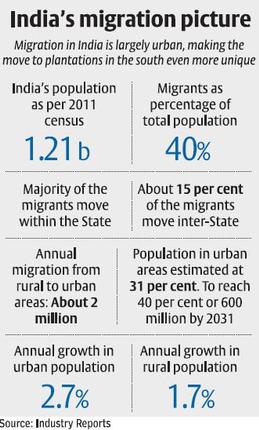
Rural migration mirrors a larger trend in the country, with about two million migrating annually from rural to urban areas and vice versa, says Ram B Bhagat, Professor and Head, Department of Migration and Urban Studies, International Institute of Population Sciences, Mumbai. In other words, about two per cent of India’s 1.21 billion population migrates every year. Half of the population is under the age of 25 and migration helps them secure jobs and livelihoods.
Inflection point
In all the southern States, the arrival of migrant workers was preceded by the movement of the local workforce to urban job markets.
In the Nilgiris, the tea sector had for decades depended on farm hands from the southern districts of Tirunelveli, Ramanathapuram and Salem. In 1999, the labour unrest in two estates set off several changes.
Workers moved to the plains and the knitwear cluster of Tirupur began to emerge as a hot destination for jobseekers back then. “This was followed by the boom in the IT services sector, which created allied jobs. The workers realised that plantation wages could not match the package offered in the urban markets. The rest is history,” says an executive from the plantations industry, who declined to be named.
Though officials from the local tea industry were unable to provide any figure, it is estimated that over 50,000 migrant workers currently work in the Nilgiris.
Tea plantations in Kerala traditionally employed labourers from Tamil Nadu, but are increasingly replacing them with migrants from the eastern and north-eastern parts of the country.
Every day, trains bring over 1,000 migrant workers, mostly unskilled casual labourers, who arrive with the help of friends, relatives or labourer-turned-labour contractors. They are immediately absorbed into the urban job markets in the far corners of Kerala, which is today home to nearly 25 lakh migrant workers — the largest pool in the southern region.
A third of the migrants joins the construction sector, while not that many find work in agriculture.
In the past five years, though, a sizeable number of them have found work in the plantation sector, including rubber estates. After the recent fall in rubber prices forced farmers to leave trees untapped, the migrant workers had to look elsewhere for work.
Moreover, “individual, homestead farmers prefer local workers,” points out Jose Sebastian of the Thiruvananthapuram-based Gulati Institute of Finance and Taxation. “Migrant workers are not much preferred on the rubber plantations,” adds Ajith BK, secretary of the Association of Planters Kerala. “Rubber-tapping demands specific skills and requires staying close to the plantation, reporting to work before daybreak and a long-term commitment, as it is not a seasonal harvest,” says Ajith. But in other plantations, the dependence on migrant labour has increased.
For a better life
Noor Mohammad has come to Coorg for the second time this year, seeking work in the plantations. This time, the 25-year-old has brought along his wife and younger brother. “It is good working here in these estates,” says Mohammad, who hails from Darrang in Assam.
He was initially brought to the plantation by a labour contractor or raj mestri. Similarly Asadullah, another worker in his mid-50s, has brought along his family from Guwahati. Back home, the likes of Mohammad and Asadullah own small plots, cultivating rice and vegetables. It is a hand-to-mouth existence, worsened by the violent unrest caused by the Bodo movement.
Life is better in Coorg. The migrants are paid on a par with their local peers, based on the quantity of coffee beans picked daily. This is different from the wages specified under the Plantation Labour Act, which is in effect during the rest of the year. The more the labourers pick, the more they earn — a major incentive. Estate owners pay ₹3.50 to ₹5 for one kg of coffee beans picked. The rates are higher when labour is scarce and time is running short for the harvest.
Many workers tend to remit their earnings back home on a weekly basis. Noor Mohammad and his family plan to save about ₹50,000 during the current season. While many return home at the end of the two-three-month harvest period, others stay back for work such as weeding and trimming.
They get accommodation on the estates and wages are paid according to the Plantation Act, which includes benefits such as provident fund, insurance and gratuity. A male labourer is paid ₹270 a day, and the female counterpart gets ₹230. “Back home, it is difficult for women to go out for work, even in their own rice or vegetable fields,” says Mohammad.
The wage structure is similar in the Nilgiris. “I was earning a daily wage of ₹95-100 back home, but am now getting more than ₹250 a day,” says Rabi, an Assamese working in a tea estate. Industry associations say there is no discrimination in the package or amenities offered to migrant workers. “They are provided accommodation, crèche and all other benefits on a par with the locals,” said the industry executive.
Social dynamics
In Kerala, migrant workers earn as much as ₹700 a day, but their living conditions are not as good as the local labourers. Although squalid, the lodging is often offered for free or at low rates, so the labourers accept them unquestioningly. Factors such as low literacy and unfamiliarity with the local language act as a barrier to integrate with the local community.
In Coorg, locals say they work in harmony with the migrant workforce. “They work on their own and we are on our own,” says Sundri, a local who has been working in coffee plantations for several years.
But experts warn that rising migration can lead to socio-economic issues. In Kerala, which ironically is a major source of manpower for West Asian countries, the locals are increasingly voicing concerns about the alleged rise in law-and-order troubles due to the migrant population. Incidents such as the one in early February where three workers from West Bengal were arrested for allegedly killing a hotel employee in Kozhikode are fuelling such fears. This has prompted the Kerala police to create a database of migrant workers, including their photographs and fingerprints.
In Karnataka, the recent arrest of a terror suspect hailing from Assam has triggered concerns. Plantation associations have advised members to insist on documents such as identity cards from the labourers as a precautionary measure. In the Nilgiris too, the situation is similar.
“It is difficult to do a background check of these people. We do not know if there is infiltration, but there is all-round concern about engaging them. We can’t shoo them away either. Estate managements maintain a register, but it is still not organised,” a planter said on conditions of anonymity.
Though the arrivals of migrants have increased the workforce, the long-term implication on the social fabric remains to be seen, Mandanna adds. This would depend on on how long they would stay back and whether they pick up the local language and integrate well with the local population.
With inputs from LN Revathy, KPM Basheer and KV Kurmanath
source: http://www.thehindubusinessline.com / Business Line / Home> Features / by Vishwanath Kulkarni / February 16th, 2015
WELCOME. If you like what you see "SUBSCRIBE via EMAIL" to receive FREE regular UPDATES.
Read More »