Category Archives: Agriculture

Apiculture park to come up in Kodagu

An apiculture park will be set up at Bhagamandala in Kodagu district to revive apiculture in Karnataka, Horticulture Minister Shamanur Shivashankarappa said on Thursday.

He told reporters here that the park would come up on six acres at Bhagamandala. The department would distribute 20,000 boxes to Jenu Kurubas, a tribe that has expertise in honey cultivation and extraction.

According to him, Rs. 60 lakh had been earmarked in the current fiscal to promote apiculture. “At present, the honey production is around 800 metric tonnes but it is possible to increase it to 8,000 metric tonnes per annum. Besides awareness, training would be imparted to the local tribe to promote apiculture. There is a lot of scope for promoting apiculture in Uttara Kannada, Dakshina Kannada and other Malnad districts,” he said.

Neera Policy

The minister said the department has submitted a proposal to the Finance Department to announce a policy on neera.

“An amendment to the State Excise Act is necessary to allow the tapping and selling of neera in the state. Already, steps have been taken to promote value-added products from the neera like palm syrup, palm jaggery and palm sugar. Now it is up to the Finance Department to table a bill in the State Legislature to pass the Neera Policy,” he said.

Proposal Submitted

He said the state government has submitted a proposal to the Union government seeking release of Rs. 100 crore to revive coconut plantations in several districts.

“Thirty per cent of the coconut plants have perished due to pests and failure of monsoon. The department is educating the farmers of rain-fed areas to go for alternative crops,” he said. According to him, the department has given Rs. 12,000 per acre to farmers for loss of coconut plants.

Auction Centres

Shamanur said two flower auction centres set up in Tumkur and Davangere would be inaugurated soon. The Department of Horticulture has provided the infrastructure but it would be managed by the Karnataka Agricultural Marketing Department.

“Floriculture is no longer a profitable venture following competitions from the African countries. In recent years, Kenya and Ethiopia have emerged as leading flower export countries after the European countries. Despite this, many flowers are being exported from Karnataka thanks to the department’s support. Fifty per cent subsidy is being given to entrepreneurs under the National Horticulture Mission to promote floriculture,” he said.

Census

He said the census of horticulture crops’ areas under cultivation and production were in progress in Bagalkot, Belgaum, Bellary, Chitradurga, Davangere, Gulbarga, Hassan, Kolar, Mysore, Shimoga and Tumkur districts. According to him, Rs. 5 crore had been earmarked for the purpose. “Nearly 50 per cent of the work has been completed,” he said.

source: http://www.newindianexpress.com / The New Indian Express / Home> States> Karnataka / by Express News Service – Bangalore / November 22nd, 2013

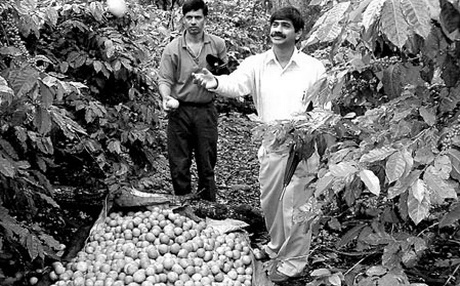
Govindappa Jayaram elected Karnataka Planters’ Association chairman

Bangalore :

Govindappa Jayaram from Kodagu district has been elected as Chairman and K Kurian from Chikmagalur district as Vice Chairman of Karnataka Planters’ Association.

Jayaram and Kurian got elected at the 55th Annual General Meeting of the Karnataka Planters’ Association.

The following have been elected to executive committee of KPA: Chikmagalur District – H.T. Pramod, Shirish Vijayendra, Mahesh Shashidhar.

Kodagu District – A.A. Ponappa, N. Bose Mandanna, M.A. Sampath (Corporate Seat).

Hassan District – V. Murali (Corporate Seat) and Baba P.S. Bedi.

Small Growers seat – Kodagu District – Dr M.M.Chengappa.

source: http://www.thehindubusinessline.com / Business Line / Home> Industry> Agri-Biz / by Anil Urs anil.u@thehindu.co.in / Bangalore – November 17th, 2013

Coffee growers spar over poly wrap method to curb white stem borer

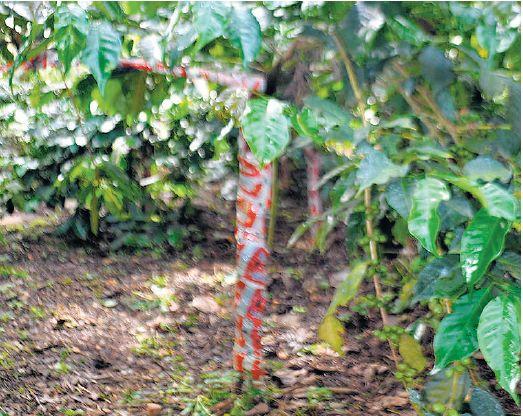
Better solution: An arabica plant stem wrapped with cellophane tapes to prevent it hosting the white stem borer on a coffee estate in Kodagu. / The Hindu

Results are good, says Coffee Board; some planters raise environmental concerns
An ingenious method has been found to control the ruinous white stem borer in coffee estates where the arabica variety is grown. But coffee planters are split over the effect of the solution with some even questioning its impact on the environment.

According to A.K. Bhandari, coffee planter and former President of the United Planters Association of Southern India, wrapping the stem of the arabica plant with cellophane, called poly wrap, helps in containing the borer menace. The wrap prevents the female beetle from laying eggs in cracks and crevices of the plant.

“We came across this solution some two-and-a-half years ago when some planters used old plastic to wrap the stems. It prevented the borer from laying eggs and controlled the spread of the pest,” he said.

Coffee white stem borer, Xylotrechus quadripes, is a pest found in arabica coffee causing huge yield loss. A blackish brown coloured beetle, it can also be found on rosewood, sandalwood and teak.

Ten to 12 days after the female beetle lays the eggs on the stem, the larvae enter the woody tissue and burrow up to the roots. This leaves the plant impaired and the only known solution is uprooting the plant totally and burning it.

“Poly wrap physically stops the insect from laying eggs on the plant. Growers had, at one point of time, wrapped plants with old fertiliser bags. Now, they have begun to use strip wraps and the results have been good,” said Jawaid Akhtar, Coffee Board Chairman.

History traces the borer menace to 1837 and the first reference was made in 1838 by H. Stokes, Mysore Commissioner. In 1868, the Madras Commissioner had reported the ravages of the borer in Mysore and Coorg.

YIELD LOSS

“We have been suffering from the borer menace for over a decade now. It has affected arabica production. In some estates, nearly 50 per cent of plants had to be uprooted,” said Bose Mandanna, a grower in Kodagu and former vice-chairman of Coffee Board.

The borer menace has resulted in arabica production stagnating around one lakh tonnes annually for almost a decade after rising to a record 1.21 lakh tonnes in 2001-02 (October-September) season. Its share in total coffee production (robusta makes up the rest) has decreased from over 50 per cent in the 1980s to around 30 per cent now.

This year, out of the estimated 3.47 lakh tonnes production, arabica output has been pegged at 1.11 lakh tonnes. However, growers expect it to be lower than 90,000 tonnes.

“The poly wrap seems to be working very well. Most of the growers have reported 99 per cent success. About 10 estates can be taken and the experiment tried for 2-3 years,” said Bhandari.

The Coffee Board had sent an advisory on the poly wrap but not much progress seems to have been made.

“Labour shortage is the reason why poly wrap has not picked up. Also, there was short-supply of wraps. That has ended now as supply is ample. Results are encouraging and the wrap does not affect the plant’s growth,” said Akhtar.

But, there are voices of dissent too.

“The poly wrap was tried in small pockets and it has not been successful when tried on a large-scale. It prevents plants from growing. The bark growth is stunted and we feel this is not a scientific solution,” said the Karnataka Planters’ Association Chairman, Nishant Gurjer.

Some of the corporates involved in growing coffee have now begun to experiment the method. “We have begun the poly wrap on Coffee Board’s suggestion and are assessing the results,” said an official of Tata Coffee at its Margolly estate in Kodagu.

However, concerns are being raised over its effect on the environment.

“When the poly wrap gets old, it could lead to environment problems since it won’t disintegrate easily,” said Mandanna.

Gurjer agrees. “Plastic will add to the mechanical damage to the plants,” he said.

Other growers say that until a better solution is found, the poly wrap method should continue.

source: http://www.thehindubusinessline.com / Business Line / Home> Industry> Agri-Biz / by M. R. Subramani subramani.mancombu@thehindu.co.in / November 07th, 2013

Tata Starbucks launches exclusive Indian blend

Blending well: India Estates Blend, Tata Starbucks’ latest product for the Indian market.

Mumbai :
Tata Starbucks has launched a coffee blend exclusively for the Indian market, on the occasion of the first anniversary of the opening of its first store in Mumbai. Called India Estates Blend, the coffee is sourced from the finest arabica beans produced at Tata Coffee’s four estates in Chickmagalur.

Tata Starbucks, a 50:50 venture between Tata Global Beverage and US-based Starbucks Corporation, has also set up a coffee roasting and packaging plant at Kushalnagar in Karnataka’s Kodagu district with a capacity to produce 375 tonnes.

The company chose India Estate Blend after testing various coffees across Tata’s estates in Kodagu and Chickmagalur. It will be sold at Tata Starbucks outlets for blending or consumption at home, according to the company’s Chief Executive Officer, Avani Saglani Davda. “Home bean consumption is catching up and India Estates Blend has been lined up for this,” she said. To be sold in packs of 250 g, the coffee will be available with six other varieties such as Home Blend, Italian and Addis Ababa.

It’s a long journey for the blend. The coffee beans are picked up from shady canopies in Kodagu and Chickmagalur estates and sent to Starbucks’ sourcing department in Seattle. This is the second blend brought out by the firm after the India Espresso Roast, sourced and roasted locally. The espresso is a popular product at Tata Starbucks stores across the country.

“The Starbucks sourcing department analysed the coffees and finalised the blend. The feedback is encouraging,” said Davda. The new blend is the first step Starbucks and Tata Coffee are taking to develop and improve the profile of Indian-grown arabica coffees in the global market. India Estates Blend is a medium roast coffee with a herbal juiciness and a chocolate finish. Tata Starbucks currently operates 24 stores across Mumbai, Delhi and Pune. “We will soon open an outlet in Bangalore,” a company official said.

(The writer visited Tata Starbucks’ Kushalnagar plant at the invitation of the joint venture firm).

source: http://www.thehindubusinessline.com / Business Line / Home> Companies / by M.R. Subramani / Mumbai – October 21st, 2013

Encroachers volunteer to vacate forestlands in Kodagu dist

There is good news for the Forest department, which is striving to clear encroached forestlands. Villagers, who had encroached upon Subraya sacred grove, in Korangala village, near Bhagamandala, have voluntarily decided to vacate the land and have submitted a letter of consent in this regard.

On survey number 106, behind Subramanya temple, in Korangala, there is sacred grove of 59.34 acres. Six persons, who had encroached upon 8.70 acres of land, have decided to vacate it voluntarily.
N S Bojappa (two acres), N J Somanna (1.5 acres) N N Kalappa (1.50 acres), J S Subraya (two acres), B N Lokanath (1.5 acres) and N N Jnanashekar (0.20 acre) have handed over the land to the Forest department. In a meeting held in front of Nangaru Ainmane, the villagers handed over a letter of consent to ACF C Shashi. Following the development, T B Somappa (0.50 acre) and K D Seetha (two acres), who had encroached upon Ayyappa sacred grove at Sannapulikotu, have also decided to vacate the land.
Speaking to Deccan Herald, J S Subraya said, “Our ancestors had encroached upon the sacred grove land, knowingly or unknowingly, and we were cultivating coffee and cardamom. The forest officials brought the issue to our notice. So, we decided to vacate the land and help conserve forests.”

There are approximately 13,371 acres of sacred grove lands in Kodagu district. Some of them have been encroached upon by local farmers. There is no exact statistics on the encroachment.

However, we can identify the encroached land, said Shashi. “We are trying to convince the villagers to vacate the land on their own. Basavanna Devara Bana Samithi had issued notices to farmers, through its lawyer, urging them to vacate the encroached land at Valnoor-Thyagathur Basavanna Sacred Grove.

Now, we have written letters to all sacred grove committees, seeking details and have asked them to vacate encroachers. If the encroachers fail to vacate voluntarily, we have to do it legally,” he said.

source: http://www.deccanherald.com / Deccan Herald / Home> District / by Srikanth Kallammanavar, Madikeri / DHNS / October 24th, 2013

Re-elected to Orange Growers’ Co-op. Society

ArunMachaiahKF26oct2013
Kodagu :

Former MLC C.S. Arun Machaiah has been unanimously re-elected as the President of Kodagu Orange Growers’ Co-operative Society for the term 2014-2018.

Kodagu Cooperative Association’s Deputy Registrar R. Sridhar was the election officer.

Rest of the office-bearers too were re-elected unanimously and they vowed to revive orange cultivation in Kodagu, which has seen improvement in the past few years.

K.G. Appaiah of Mekoor village is the Society’s Vice-President. The Directors are: Sunil Madappa of Gonikoppa town, K.U. Arun Poonacha of Devarapura, Arvind Kuttappa of Gonikoppa, S. Vishwanath of Mayamudi, C. Somanna of Balele, A.R. Krishnakumar of Devarapura, Sumi Subbaiah of Aruvathoklu, Shobha Kuttappa of Mekoor, K.K. Dinesh of Hathur and S.S. Suresh of Mayamudi.

source: http://www.starofmysore.com / Star of Mysore / Home> General News / October 21st, 2013

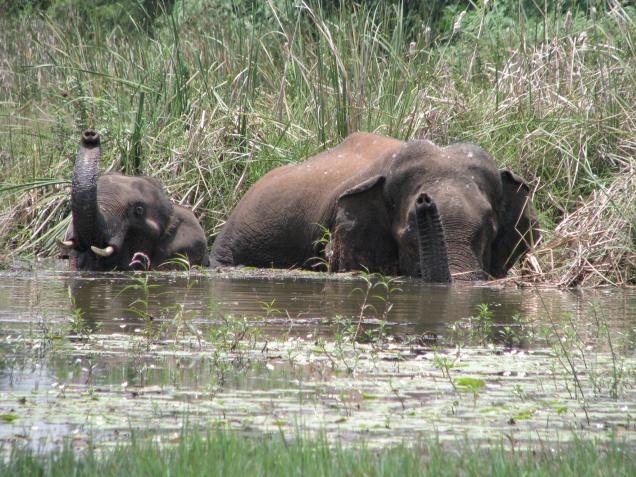
State prepares for biggest elephant capture operation since 1971 ‘khedda’

OUT OF PLACE?: In Alur taluk, a herd of 25–30 elephants inhabit a tiny 5-sq. km forest patch circumscribed by agricultural fields that they routinely raid, according to M.D. Madhusudan, a member of the Karnataka Elephant Task Force./  File photo / The Hindu
OUT OF PLACE?: In Alur taluk, a herd of 25–30 elephants inhabit a tiny 5-sq. km forest patch circumscribed by agricultural fields that they routinely raid, according to M.D. Madhusudan, a member of the Karnataka Elephant Task Force./ File photo / The Hindu

At least 25 wild elephants are set to be caught in Alur taluk of Hassan district

With a green signal from the Karnataka High Court on Tuesday, the Department of Forests now sets about planning its biggest ever operation to capture wild elephants since the State’s last ‘khedda’ in 1971, when 47 animals were captured.

At the very least, this would mean the capture and taming of around 25 elephants in Hassan’s Alur taluk, the epicentre of human-elephant conflict in the State. The Karnataka Elephant Task Force in its report to the High Court in September 2012, identified two regions — Alur and Tumkur district’s Savandurga — as “elephant removal zones” for the “unacceptable levels” of conflict they encountered.

The department, however, places “the outer limit” for the number of elephants to be captured at 150 and hope to extend the ‘removal zone’ to parts of Kodagu where human-elephant conflict is intense. “The actual number we capture will be much less, but we’ll have to take a call on areas such as Kodagu based on an assessment of conflict levels and perceptions of people here,” said Principal Chief Conservator of Forests (Wildlife) G.S. Prabhu.

‘Extreme measure’

Members of the task force don’t quite agree. Removing wild elephants from a natural landscape is “an extreme measure” and one that should be done with the “greatest judiciousness”, said M.D. Madhusudan, scientist with the Nature Conservation Foundation and task force member. Only two areas have been identified by the task force as potential “removal zones” and Kodagu is not one of them, he said.

Alur was an anomaly of sorts and justifies the approach, he explained. The conflict in Alur was intense, and the elephant population was ecologically unviable. “Here, a herd of 25–30 elephants inhabit a tiny 5-sq. km forest patch circumscribed by agricultural fields that they routinely raid.” Between 1986 and 2011, elephants killed 46 people and injured over 240, according to the task force report, creating a “fear psychosis among people that hampers their ability to work and live normal lives.”

The situation in Kodagu was not adequately studied yet, said Raman Sukumar, chairman of the Centre for Ecological Sciences, Indian Institute of Science. “We first need to assess the conflict situation in Kodagu, understand the dynamic of elephants here (are they transitory, for instance) before we decide on a course of action.”

Meanwhile, the Department of Forests has set aside Rs. 4 crore to create kraals to restrain elephants captured, which typically take a year to tame, and new elephant camps. “The project can only begin in January, after the rain,” Mr. Prabhu said, and added that the department would be using a combination of methods that incorporate elements from traditional ‘khedda’ (stockade traps) and also modern-day chemical tranquilising.

BACK TO THE WILD

Even as it prepares for a large-scale capture of elephants, the department, ironically, admits that its 10 camps, which together have 91 elephants, are too crowded.

“We are looking at the possibility of returning around 30 of these back to the wild,” Mr. Prabhu said.

source: http://www.thehindu.com / The Hindu / Home> News> National> Karnataka / by Divya Gandhi / Bangalore – October 13th, 2013

Problem elephants might be captured, tamed

Governor H.R. Bhardwaj with Ashit Sagar Puttannanavar, one of the prize winners, at the valedictory function of the 59th Wildlife Week in Bangalore on Monday. / Photo: Bhagya Prakash K. / The Hindu

Wild elephants that have for years posed a major problem to the lives and livelihoods of residents in Hassan’s Alur taluk and in Kodagu’s Virajpet could soon be captured and tamed, Principal Chief Conservator of Forests (Wildlife) G.S. Prabhu said on Monday.

The Department of Forests had, earlier this year, proposed the capture of several problem elephants that routinely raided crops and came in conflict with people.

Mr. Prabhu was speaking at the valedictory function of the 59th Wildlife Week organised by the department, where schoolchildren were given prizes for essay and painting competitions on the theme ‘The importance of environmental protection’.

A sum of Rs. 21 crore had been earmarked to mitigate the human-animal conflict in the State, Minister for Forests, Environment and Ecology, B. Ramanath Rai, said.

Governor H.R. Bhardwaj said several species across the world were endangered because of human greed. He added that the budget allocation for wildlife conservation should be increased.

source: http://www.thehindu.com / The Hindu / Home> News> National> Karnataka / by Special Correspondent / Bangalore – October 08th, 2013

Kodagu orange may see revival

Horticulture department

You may get to savour the famous ‘Kodagina Kittale’ (Kodagu orange) again. The State Horticulture Department has decided to revive the now-extinct variety.

“Our department is tying up with the Indian Institute of Horticultural Sciences (IIHS), Chettalli in Kodagu, to revive ‘Kodagina Kittale’. We are ready to pump in whatever funds required for the purpose,” said Horticulture Department Principal Secretary M K Shankarlinge Gowda.

A couple of decades ago, Kodagu was famous for its variety of orange known for its taste. Coffee planters used to grow the plants in the coffee estates. Over the years, it became extinct because of frequent pest attacks. Gowda said his department will take assistance from the IIHS to revive the citric fruit.

Chettalli farm has around 160 acres of land on which orange saplings will be raised. Once they are ready for transplantation, they will be distributed to farmers and estate owners. Scientists at IIHS will be requested to make those plants pest-resistant so that they will not vanish again. In fact, there is a group of agriculture graduates in Kodagu which is interested in the revival of the variety. “We will rope in their services to create awareness among the people to go for orange cultivation again,” Gowda said.

He said, during hey days orange was planted on more than 2,000 hectares in Kodagu district as the climate is well suited for growing this citric fruit. But now it vanished from coffee estates.

Although Kodagina Kittale cannot compete with the orange of Nagpur, still it has its own place.

No Dearthof Funds

Gowda said plenty of funds are available under Rashtriya Krishi Vikas Yojna and Competitive Horticulture Programme for promotion of horticulture crops in the state. Around `240 crore is now available with the department and it can spend this money at its discretion.

“My aim is to revive all rare fruits, flowers and vegetables for which Karnataka is known, at least for the future generation,” he said.

A Nanaiah, a resident of Kodagu, said loads of oranges were harvested and sent to neighbouring states but the pests pushed this rare variety of orange to extinct. “As children, we used to eat this orange but now we miss it,” he laments.

source: http://www.newindianexpress.com / The New Indian Express / Home> Cities> Bangalore / by Shyam Sundar Vattan / October 07th, 2013

Permission to sell Kodagu’s Jamma lands could lead to ecological disaster

The tiny hill district of Kodagu (Coorg) in Karnataka is facing an ecological disaster with the President of India giving his assent to a controversial legislation which allows the disposal and sale of Jamma lands in Kodagu located in the fragile Western Ghats. It is feared that the resultant denudation of the forests in the region could trigger an environmental damage with unpredictable consequences.

The repercussions of the legislation — The Karnataka Land Revenue (Third Amendment), Act, 2011, which received Presidential assent early this year after the bill was referred to the President by the Karnataka governor last year, will not only be severe on the Western Ghats region, considered as one of world’s bio-diversity hotspots, but will also take its toll on the customary laws, traditions and culture of the indigenous communities.

Jamma land tenure is unique to Kodagu district and it is estimated that the extent of ‘Jamma Baane’ land in Kodagu is around 2.55 lakh acres in possession of the local people — Kodavas, Amma-Kodavas, Heggades, Airis, Koyavas, Moplas and Gaudas. Jamma lands consist of wetland for growing paddy and the accompanying Baane land, initially used for cattle grazing and held free of assessment, now converted into coffee estates.

According to Sir J B Lyall, a British expert on tenures in Coorg who traced the origin of Jamma, it was originally a military tenure held on payment of half the assessment in consideration of military service. Jamma was granted under ‘sanads’ largely by the Coorg Rajas (1600 AD to 1834 AD) and to a smaller extent by the British till 1895 to the local inhabitants.

Hitherto, there was a ban on the sale of Jamma lands as the cultivator was only a ‘deemed owner’. The new legislation will confer the title of ‘occupant owner’ and allows the sale of land. The legislation, it is feared, will legitimise large scale denudation of trees and the formation of human settlements on Jamma Bane lands as there will be heavy influx of population from the neighbouring states. The presence of increased human habitation will have its impact on the adjoining forest land, its flora and fauna.

For generations, the life of the local communities, centered around the cultivation of the Jamma lands, the principal tenure in Kodagu. The Jamma lands could not be alienated as there was no provision for transferring the title of the property. The ownership was jointly held by the clan and it was managed by the head of the clan (Pattedara).

The issue went before the Karnataka high court and a full bench of the court held in its judgement delivered in October, 1993 that Jamma Baane landholders had limited privileges for cattle grazing, supply of firewood and timber for the domestic and agriculture purposes, but had no right to exploit the trees for commercial purposes, unless the holder had paid full timber value to the government. The court also held that the land-owner had no right to the sub-soil.

Customs and traditions

Once the ban on the sale of Jamma lands is lifted, the indigenous communities will be removed from their traditional Jamma holdings which formed the basis of their customs and traditions. The ‘ain-mane’ or the ancestral houses of the clans, was the focal point of all festivities and religious usages. It is feared that once the Jamma lands are sold to outsiders, the new land owners could lay claim to the ‘ain-manes,’ considered sacred to the local communities. This could lead to social tensions and law and order problem.

The biggest threat will come from the real estate mafia who were eyeing the Jamma lands all these years. With tourism boom in Kodagu, the local communities will be under pressure to sell their lands as the state will not have any control over them. It is learnt that already Jamma lands are being sold in anticipation of the new law taking effect.

The amendment to the Jamma tenure was effected during the previous BJP regime. The amendment was politically motivated and passed in haste without much debate in the Legislative Assembly, reportedly at the instance of the then Speaker K G Bopaiah who wanted to take political advantage. One of the reasons for Bopaiah’s re-election from the Virajpet constituency was on account of the political mileage he gained by getting the amendment passed.

The new amendment will create more problems than it hopes to solve. Those who drafted the amendment bill have failed to recognise the fact that apart from Jamma Baane lands, there are other types of Baanes — ‘Hithlu’ and ‘Sagu Baane’ lands.
Advocate K Sarojini Muthanna, who is knowledgeable on Jamma tenure matters, has suggested that the government should carry out further amendments to the Karnataka Land Revenue Act, 1964, devoting a separate chapter for the Jamma lands of Kodagu. The main support for the amendment has come from Akhila Kodava Samaja, representing a small section of the Kodavas. The president of the Samaja, Mathanda C Monnappa, opined that the amendment removed ‘irritants’ by way of government circulars which gave the impression that the land belonged to the government.

A large section of people, however, feel that in the interest of preserving the culture of Kodagu, and maintaining the ecological balance in the Western Ghats, the Siddaramaiah government should not give effect to the amendment to the Jamma land tenure.

source: http://www.deccanherald.com / Deccan Herald / Home> Panorama / by P.T.Bopanna / July 24th, 2013