Coffee Board, Central Coffee Research Institute (CCRI) conducts walk in interview for the recruitment of Senior Research Fellow posts in DBT sponsored project. Eligible candidates can attend walk in interview on 24-06-2013 at 10.30 AM. More details regarding educational qualifications, age limit, selection and application process are mentioned below…
Coffee Board Vacancy details:
Name of the Post: Senior Research Fellow
Age Limit: Candidates upper age limit is 30 years as on 11-06-2013.
Educational Qualification: Candidates must possess M.Sc or M.Sc (Agriculture) in Biotechnology or related subject in biological sciences from a reputed University.
Selection Process: Candidates will be selected based on interview.
How to Apply: Interested candidates can attend walk in interview along with application, bio-data, copies of all required certificates and same in original, passport size photograph held at The Divisional Head, Plant Biotechnology Division, Unit of CCRI, Dr.S. Radhakrishnan Road, Manasagangothri, Mysore-570006 on 24-06-2013 at 10.30 AM.
Date & Time of Interview: 24-06-2013 at 10.30 AM
For more details regarding age, qualifications, pay scale, selections and other information contact the Coffee Board .
Hameed Huq of Tata Coffee told CNBC-TV18 that he expected an increase in their production of Arabica crop by 30 percent. However, he anticipated a flat growth in its Robusta crop.
Hameed Huq , Managing Director, Tata Coffee
Tata Coffee expects its Arabica crop production to increase 30 percent this year, while it aims to maintain Robusta production at last year’s levels in FY14.
Robusta variety of coffee accounts for 70 percent of the company’s total production, while Arabica accounts for 30 percent, Hameed Huq, managing director, told CNBC-TV18.
In company’s standalone accounts, 20 percent revenues are from plantations while 55-60 percent is from instant coffee production.
Since a majority of its revenues are from instant coffee production, Huq said that the fall in raw coffee prices would only benefit the company.
Also read: How industries fared in April 2013: CARE Research
Below is the edited transcript of his interview to CNBC-TV18.
Q: Reports indicate that coffee output in India could suffer due to inconsistent rains at the start of the year. Could you throw some light on the coffee output for the entire seasons? What will the prices be?
A: On coffee output, we harvest Arabica first and then go on to Robusta. We are looking at almost 30 percent increase in Arabica production over the previous year.
Last year, there was an acute drought across most of Karnataka which impacted the crop. We are not seeing that. On Robusta growth, we are looking at maintaining last year’s levels. We had a very large crop last year which again is reflective of the general industry.
The crop will not be lower next year. In fact, it definitely should be higher than harvest in the season that ended.
Q: You are dependent on 70 percent of your raw material needs on Robusta. Have the prospects for that improved with the rates?
A: I will cover that in two things. In Tata Coffee , 70 percent of our plantation is Robusta and 30 percent is Arabica. We had a very good Arabica crop last year. The Robusta prices have not slid as much as Arabica.
If you look at Tata Coffee’s standalone accounts, plantation coffee constitutes less that 20 percent of our turnover. Over 56-60 percent of our turnover actually comes from instant coffee.
To that extent, whether coffee prices are moving slightly, easing up, doesn’t really impact Tata Coffee anymore because it is not totally a coffee plantation company.
However, overall also the coffee plantation is doing well, but there has been easing of prices. Q: What is the percentage of your expenses accounted by raw materials?
A: If you look at our consolidated accounts, 83-85 percent of our turnover is based on green coffee being purchased out.
If there is any easing in prices, it adds to the business and its margins. Within the space of instant coffee, anything between 65-70 percent cost is related to green coffee.
So, when you see this easing of prices, generally it is favourable to Tata Coffee, not the other way round.
Q: You closed FY13 with a margin improvement due to benign raw material prices. How are you expecting margins to pan out in FY14? Can we expect some further improvement? Any guidance or target that you could help us with?
A: We don’t give guidance. But if you look at the basic fundamentals, we are largely driven on two of our major businesses by green coffee prices. Both of them have softened.
We have just commissioned an expansion program at Theni where our instant coffee plant exists and the capacity is going up by 30 percent. The plantation has gone on stream for the same.
source: http://www.moneycontrol.com / Moneycontrol> News> Business / CNBC TV18 / June 10th, 2013
Coffee planters should think twice before using chemical fertilisers and pesticides. More emphasis has been given to environment and bio-diversity in the international market, said NABARD General Manager C P Appanna.
He was speaking after inaugurating a workshop on ‘Quality improvement, value addition and importance of butterfly rearing in coffee production’, organised jointly by Institute for Social and Economic Change (ISEC), Norwegian Institute of International Affairs (NUPI), Oslo, Agricultural University, Bangalore , Kodagu Krishi Vijnanigala Vedike, Swastha organisation and Chai Kadai, Bangalore in Madikeri recently.
“We have been growing coffee in a conducive environment in Kodagu. However, coffee from Kodagu is not getting good price in the international market. At the same time, we must get certified from an international agency on the quality of the product, to get better price for coffee,” he said.
Test
“By rearing butterflies, we need to establish the fact that no environment hazard activities have been carried out in the coffee estates. Many western countries refused to import agriculture products from India, owing to chemical content found in it,” he added.
He gave a clarion call to the farmers to adopt organic farming.
source: http://www.deccanherald.com / Deccan Herald / Home> District / Madikeri,DHNS – June 06th, 2013
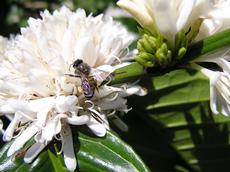
Bees of the Apis cerana (eastern honeybee) species pollinate coffee flowers. Farmers can increase the services of pollinating insects with particular cultivation methods. (Photo: J. Ghazoul / ETH Zurich)
By Peter Ruegg
No food for the human race without bees? It is not quite as straightforward as that. A case study by ecologists from ETH Zurich in a coffee-growing area in India reveals that pollinating insects are just one production factor among many. Farmers have several possibilities to increase their harvest.
All over the world, bees are dying and insect diversity is dwindling. Only recently, both the media and scientists expressed fears that insect pollination is in decline, which jeopardises food security. The (lack of) pollination has thus become a sound argument for the protection of species and natural habitats, and organic farming.
ETH-Zurich researchers from the group headed by Jaboury Ghazoul, professor of ecosystem management, set about investigating this argument by studying the influence of pollinator insects on coffee harvests in an agroforestry system at coffee plantations in the province of Kodagu in southern India. They also included soil and forest management, environmental factors such as water and soil fertility, and tree cover for the cultures in their study.
The research group thus obtained a different picture of the role of pollinators to the popular perception of this cultivation system of “no bees, no harvest”. According to their findings, pollinator bees are merely one production factor among many and to some extent coffee farmers can increase the productivity of their plantations independently of the insects. The results of the study have just been published in the journal PNAS.
Important but not the only factor
“Pollinators are important for coffee farmers,” stresses Ghazoul; “as far as effective coffee growing and increasing harvests are concerned, however, they are much less important than irrigation or liming, for instance.” This encapsulates one of the central findings from coffee farming in the Kodagu province.
Coffee is grown in a traditional agroforestry system in the region. As coffee plants must not be grown in direct sunlight, they are planted in the forest’s undergrowth or the shade of large, isolated trees. The coffee plants all bloom at the same time after heavy rains between February and March and three species of bee pollinate the flowers: the giant honeybee Apis dorsata, Apis cerana and the solitary wild bee Tetragonula iridipennis. The giant honeybee is the largest and most important pollinator, forming large colonies and needing the thick branches of tall trees to bear the weight of their nest.
Greater yield through irrigation and limestone
In order to harvest more coffee, however, the farmers have got other options than merely banking on the work of bees, as Ghazoul discovered. They can increase the yield through liming, irrespective of bee density. And instead of relying on rainfall, it is worth the farmers’ while to induce flowering with artificial irrigation. “It is particularly in a farmer’s interests to irrigate his plantations at a different time to other farmers in the vicinity,” says Ghazoul. After all, this will turn his plantations into bee magnets. This concentrated pollination increases the yield from the plantation enormously, the ETH-Zurich researchers reveal in their publication. It is a different story if the rain makes all the coffee plants in the region flower at the same time, however: the bees spread out over a wide area, the pollination is less effective and the harvest is poorer.
Trend towards deforestation
In an agroforestry system, the farmer also has another trick up his sleeve: felling trees or the forest to shed more light onto his coffee plants, which also increases the harvest. In doing so, however, he destroys the habitat of the giant honeybee (Apis dorsata).
A farmer who combines both courses of action is especially successful, initially unaffected by the disappearance of the large bees on his own plantation. Only when all farmers opt for this course of action do things take a turn for the worse. “From a plantation perspective, it makes sense to remove trees and increase yields,” says the ETH Zurich professor. “But if every farmer goes for the same option, they will all suffer the consequences of poor pollination because the giant honeybee will disappear.”
Sure enough, the researchers observed gradual deforestation in the Kodagu experiment area. Ghazoul is convinced that the farmers will lose Apis dorsata in the long run and thus – unless they take countermeasures – their valuable contribution towards coffee pollination. “It remains unclear whether the other two species of bee could compensate for this loss.” However, the farmers’ predicament is not hopeless, he says. They could domesticate Apis cerana, a very close relative of the European honeybee, and place beehives on the plantations, which would guarantee the pollination service without becoming dependent on Apis dorsata. The drawback: this absolves the farmers from their responsibility for the forest and trees. “The farmers are thus free to decide whether they want to have trees on their land or not,” stresses the ecologist, which spells bad news for nature conservation. “But good news for farmers. They have got possibilities to increase their harvest and sustain or even improve their existence.”
Unexpected threat from exotic tree species
The traditional forest trees face another danger. Farmers often replace felled local trees with the exotic Australian silver oak (Grevillea robusta), which provides the coffee plants with the shade they need. Moreover, it grows quickly and has a straight trunk, which farmers can use to grow pepper as the spice can be harvested more easily on the trunks. The sale of pepper and wood from the silver oaks is a way for the farmers to supplement their income.
However, the farmers are increasingly beginning to realise that the exotic tree also has its drawbacks. For one, its leaves barely decompose, covering the ground and coffee plants and thus becoming a breeding ground for harmful fungi and bacteria. It might also influence the nutrient cycle, which one of Ghazoul’s doctoral students is currently looking into. The silver oak leaves probably slows the nutrient cycle, preventing the coffee plants from receiving enough nitrogen in the long run, which eventually affects the harvest.
The example case of coffee growing in the province of Kodagu is interesting from a research perspective as it brings home how bees, farmers, their farming methods and natural occurrences influence and depend on each other. In this respect, the insects are not the sole influential factor in this agricultural system.
Ten principles for the reconciliation of nature and humankind
Teaming up with other scientists, ETH-Zurich professor Jaboury Ghazoul has defined ten principles that should help reconcile the conflicting interests of agriculture, nature conservation and other stakeholders with regard to a sustainable agricultural land use. The principles, which were published in the journal PNAS, include training farmers in cultivation methods that can be adapted to changing conditions. Another principle advocates taking different levels into consideration for a landscape approach, namely the landscape level itself and the individual farm level. In the example case in India, another principle is significant: the clarification of rights and responsibilities. For instance, the cultivated land belongs to the local farmers but not the trees, which belong to the state. This can cause conflicts. The principles should help to use an approach geared towards the landscape.
Further reading
Boreux V, Kushalappa CG, Vaast P, Ghazoul J. Interactive effects among ecosystem services and management practices on crop production: Pollination in coffee agroforestry systems. PNAS. 2013 May 21;110(21):8387-92. doi: 10.1073/pnas.1210590110. Epub 2013 May 13.
Sayer J, Sunderland T, Ghazoul J et al. Ten principles for a landscape approach to reconciling agriculture, conservation, and other competing land uses. PNAS 2013 110 (21) 8349-8356; published ahead of print May 21, 2013, doi:10.1073/pnas.1210595110.
source: http://www.ethlife.ethz.ch / ETH Life / Home> News Archive> Science / by Peter Ruegg / June 04th, 2013
Though agriculture was the main occupation in Kodagu district, the drastic decline in number of farmers have created a fearful situation.
According to 2011 census data there are 19,447 farmers (barring coffee estate owners). This account to 3.50 per cent of the total population in the district.
There were 38,838 farmers during 2001 census.
Paddy was the main crop in Kodagu district other than coffee. Maize, yard long beans, ground nuts, green chilly, and ginger are also grown in the district.
The district had 31.97 per cent of farmers in 1961. This slowly reduced to 23.55 pc in 1971, 23.31 pc in 1981, 19.91 pc in 1991, 7.08 pc in 2001 and 3.50 pc in 2011.
There has been drastic decline in number of farm labourers in the district. According to the latest census data, there are 12,546 farm labourers registering 2.26 per cent of the total population.
About 15.07 per cent of the total population were labourers in 1991. A total of 1,245 persons are engaged in self employment in the district. This account to 0.22 per cent of the total population.
Coffee growers have not been marked separately during the census. As a result, there is no correct figures on coffee growers. Coffee has been considered as plantation and is being included in ‘other’ category.
Other than agriculture, and coffee, there are no other sectors which generate employment in the district.
With the decline in rainfall, agriculture activities have been affected in the district. Many have deserted their farm land and have migrated to other districts in search of employment.
“There was no shortage of rainfall in Kodagu district. Inspite of having conducive atmosphere for growing crops, many have not been given priority to grow food crops.
The decline in number of farmers is a dangerous trend,” said in charge technical officer of agriculture department Ramesh.
He said “youth migrate to other districts in search of employment.
None are showing their interest in agriculture. Only aged persons are engaged in farming.
Having unable to take up farming activities, several paddy fields have remained unused in the district.”
source: http://www.deccanherald.com / Deccan Herald / Home> District / by Srikanth Kallammannavar, Madikeri / DHNS – May 29th, 2013
‘The trick is to confuse the plant to think it is summer all along and make it bear apple through the year’
Though cheery and blithe in countenance, 74-year-old Chiranjit Parmar, a horticulture scientist from Himachal Pradesh, hopes to radically change the agricultural landscape of the region. After having observed the success of apple cultivation in Batu, Indonesia, Mr. Parmar wants to introduce the fruit, hitherto associated with cooler climes, in the tropical humidity of Karnataka.
“It is an experiment. And like all experiments, it can also fail,” he told the group of farmers who had assembled in the city on Saturday for his seminar on ‘Apple cultivation in Karnataka’.
The idea sounded incredulous to farmers who had travelled from as far away as Kodagu. Apple – whose mass cultivation is associated with regions on the foothills of the Himalayas such as Shimla and Kashmir — needs to have a chilly weather for it to bear fruit in the summer. How then was it supposed to survive in a region where temperatures rarely go below 12 degrees Celsius?
“The trick is to confuse the plant. The broad principle is that just after the sapling experiences chilling in Himachal or Kashmir, it is transported here. As there is not much of a temperature change here during winter, the plant thinks it is summer all along and bears fruit through the year,” Mr. Parmar told the befuddled farmers.
He illustrates this with a picture of cultivation in Indonesia, where, while half the apple orchard bears fruit, the other half is bare. “Crops can be regulated easily, as the leaves can be removed fully to stimulate winter. While in Himachal, we get six to seven tonnes of apple per hectare, in Indonesia, they get 65 tonnes and throughout the year,” he said.
So far, the experiment has seen small orchards set up in Tumkur, Somwarpet, Sringeri, and Uppinangadi – all through saplings sent by Mr. Parmar. In his first visit to the region, he said the results were encouraging, and in Tumkur, the plants were already bearing fruit within two years. “In Himachal, apple trees take five years to bear fruit. Here, it grows faster and incessantly into very tall trees as there is no crop fall or dormancy during winter,” he said.
Challenges
However, the tropical climate also brings with it a set of problems that is yet to be scientifically dealt with. For example, trees are susceptible to a variety of diseases and insect, while methods to reduce the tree height and grafting of trees needed to be worked out.
‘The trick is to confuse the apple tree to think it is always summer’
source: http://www.thehindu.com / The Hindu / Home> National> Karnataka / by Staff Correspondent / Mangalore – April 22nd, 2013
Agarwood trees grown in Dakshina Kannada | Express Photo
Plantation and coffee estate owners in Kodagu, Hassan, Chikmagalur and Dakshina Kannada finally have a reason to cheer despite the decreasing prices of their produce.
For the last five to six years, a wonder plant agarwood has replaced the conventional silver oak in many coffee estates bringing handsome dividends to growers.
Agarwood is a high value commercial crop which is in great demand in national and international markets.
The tree is used to make ittar (natural perfume oil) and perfume.
The outer part of the stem, which is of low quality is used to make incense sticks and in paper manufacturing industries.
An agarwood sapling is easy to grow as its maintenance is inexpensive and it gives yield in eight years.
Traditionally, almost all coffee growers in India plant silver oaks as an intercrop providing shade to other plants. Recently, coffee plantations in Western Ghats and Malnad region have started planting agarwood. The origin of the tree can be traced to the evergreen forests of Southeast Asia.
Agarwood was first introduced in South India by Vanadurgi Agarwood India Limited (VAIL) which was formed with its shares distributed among planters, promoters and Vanadurgi Flavours and Extracts (P) Limited.
The company is exclusively involved in the planting, processing and marketing of agarwood.
VAIL Managing Director K N Dharmendra Kumar told Express that the company has distributed more than one million agarwood saplings to 5,000 plus growers across eight districts in Malnad region.
The company has entered into a buy-back agreement with farmers to provide good seedlings, technical guidance, artificial inoculation, setting up of processing units and purchase of their inventories.
He said that 150 to 200 agarwood trees can be planted in one acre plot of coffee, arecanut or coconut plantation.
Anil Ponnappa, a progressive coffee planter in Madapura said he has planted 600 agarwood trees supplied by VAIL in his coffee estate. Another agarwood grower N Vishwanath in Sagar, Shimoga district said he has planted 15,000 saplings on his dry land a year ago. “Agarwood is a good alternative to other crops whose prices are falling these days,” he added.
Agarwood is costlier than sandalwood in the international market as it is in great demand in Gulf countries.
A sandalwood tree takes at least 25-30 years to fully grow while an agarwood takes tree takes only 8-15 years.
The inner stem (resinous) of agarwood is valued at `10,000 per kg while agarwood oil costs Rs 10 lakh per kg in the international market. Agarwood is priced according to the density of wood, resin, purity, aroma and colour.
source: http://www.newindianexpress.com / The New Indian Express / Home> States> Karnataka / by Coovercolly Indresh / ENS – Somwarpet / December 02nd, 2012
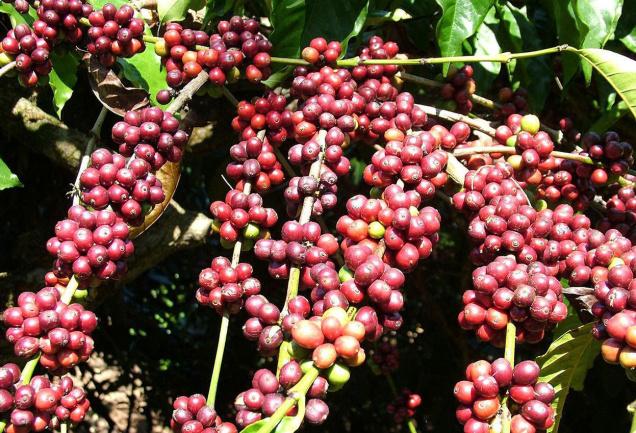
Bright outlook: Ripened coffee berries at a plantation in Karnataka. /. (a file picture.) / The Hindu
Bangalore :
Coffee-growing regions of Kodagu, Chikmagalur and Hassan in Karnataka have received good blossom showers.
“Blossom shower in the coffee belt in Karnataka is very good this year. Very good for Arabica as compared to poor to patchy rains last year,” Bose Mandana, a senior coffee planter from Suntikoppa in Kodagu told Business Line.
MARCH SHOWERS
“Rain in February, especially during mid-harvest, was worrisome, but March shower has been heavy and this has made us comfortable for the next three to four weeks,” he added.
In Kodagu rains have been good in Napoklu zone comprising Murnad, Madikeri and Napoklu whereas Gonikoppal zone, which comprises Virajpet, Gonikoppal, Kutta and Balale, needs additional showers.
For robusta, south Kodagu got early showers in February and now has received moderate March showers.
In Chikmagalur and Hassan districts, March rains have been well distributed. “Due to timely showers and moisture status being good, many planters have begun applying manure in their estates. This year, they have been able to save on irrigation,” said Mandana.
According to Nishant Gurjer, Chairman, Karnataka Planters’ Association and a grower from Chikmagalur said “Early rains in February and subsequent rains in March have been good for overall crop production.”
“Rains in the last two months have been good for robusta. Stressed period for Arabica was cut short and there was initial apprehension among the growers over early rains. But March rains, however, have been beneficial,” he added.
Last crop year (2012-13), the Coffee Board had estimated the post-blossom estimate at 3,25,300 tonnes (arabica 1.04 tonnes and robusta at 2.21 tonnes).
As for the final crop forecast, the Board has estimated 3,15,500 tonnes, of which Arabica is 1,00,225 tonnes and robusta at 2,15,275 tonnes.
source: http://www.thehindu.com / The Hindu / Home> Industry> Agri-Biz / by Anil Urs anil.u@thehindu.co.in / Bangalore, March 15th, 2013
Kodagu, which was once famous for honey, now produces just a few tonnes from what it used to produce annually nearly two decades ago. However, the apiculturists are facing several problems in the district.
There is ample opportunity for beekeeping in Bhagamandala. A few farmers are engaged in apiculture. However, in the recent years, farmers from Kerala keep the beehives in the coffee estates and collect honey and take it to their hometown for sale. This has become a headache from the local farmers.
Apiculture was taken on a large scale in Bhagamandala during 1990. The farmers started rearing malliferous bee brought from Kerala. The drastic decline in the production of honey was due to sacbrood disease affecting the honeybees.
Now, apiculture has started reviving in the district. Farmers from Kerala have started keeping beehives in the coffee plantations after taking permission from the owners. A few plantations have 100 to 150 beehives.
In Kerala, honey is produced only from rubber tree flowers. As there was no great demand for such honey, natural flowers are available in plenty in Bhagamandala region. Hence, growers from Kerala have started keeping their beehives in Kodagu.
A honeybee starts the honey making process by visiting a flower and gathering some of its nectar.
In the process of gathering nectar, the insect transfers pollen grains from one flower to another and pollinates the flower.
There is a great demand for ‘Coorg honey.’ The beehives from Kerala is kept in the plantations at Cherangala, Thannimani, Thavoor and others areas. In the past, the apiculturists were getting 25 kg honey from one beehive. However, now its has been reduced to three kg, said apiculturist.
At a time when apiculturists in Kodagu are getting ready to revive apiculture by availing loan from the banks and financial assistance from the government, honeybees and beehives from Kerala entering the district has become a headache. Gram panchayats should initiate suitable measures in this regard, said the farmers.
source: http://www.DeccanHerald.com / Home> District / Napoklu, DH News Service / April 04th, 2013
Bamboo cultivation will fetch good income for the growers, said Chief Conservator of Forest Keshavamurthy.
Speaking at a workshop on bamboo organised by the Bamboo Society of India, Kodagu Model Forest and Forest College, he said the bamboo can be grown inside the coffee estates as well. Bamboo is used in furnitures, as a fodder for animals and in preparations of medicine. The demand for bamboo is on rise in the international market.
He said that bamboo is grown on five lakh hectare land in the State. The demand for bamboo is 26.26 lakh tonne. Bamboo sticks are used in the preparation incense sticks. Along with growing ginger, farmers can also grow bamboo.
Forest College dean Dr N A Prakash also spoke. Additional Principal Chief Conservator of Forest (retd) Dr K Sundar Naik also spoke. Bamboo growers Dr L C Sona, Sanjeev, Ahammed and Sandeep spoke.
source: http://www.DeccanHerald.com / Home> District / Gonikoppa, DHNS / March 29th, 2013
WELCOME. If you like what you see "SUBSCRIBE via EMAIL" to receive FREE regular UPDATES.
Read More »