Apart from Gadag, four districts of North Karnataka were also in the ‘Good’ AQI category — Hubballi (35), Bagalkot (23), Yadgir (30) and Bidar (41).
For representational purposes
Gadag :
With an Air Quality Index (AQI) value of 22 on Tuesday, Gadag in Karnataka stood at the second position among major cities in the country with good air quality, according to the daily bulletin of the Central Pollution Control Board (CPCB). Madikeri came first in the country with an AQI value 19.
Apart from Gadag, four districts of North Karnataka were also in the ‘Good’ AQI category — Hubballi (35), Bagalkot (23), Yadgir (30) and Bidar (41). Gadag was in first place across the nation on June 5 and July 6 this year. Since then, it has been in the ‘Good’ and ‘Average’ category.
Other districts of Karnataka which are in the ‘Good’ air quality category are Chamrajnagar (44), Chikkamagaluru (33), Davangere (23), Hassan (25), Koppal (46), Kolar (50), Mysuru (29), Ramanagara (40), Shivamogga (37) and Vijayapura (45).
India follows the 500-point scale of measuring the AQI value depending on the concentration of the major pollutants. The value 0-50 is considered as Good, followed by Satisfactory (51-100), Moderate (101-200), Poor (201-300), Very Poor (301-400) and Severe (401-500).
Gadag earning the ‘Good’ air quality tag can be attributed to the nearby hill range, Kappatagudda, and low number of industries around. Since a large percentage of villagers are into agriculture, it causes less air pollution.
Gadag and Dharwad district’s Environmental Officer Shobha Pol said, “We have been observing the AQI value and this time many districts in Karnataka are in the Good category. Hubballi is in the list which was not there earlier. Reasons cannot be predicted as it needs a detailed study and survey.”
source: http://www.newindianexpress.com / The New Indian Express / Home> Good News / by Raghottam Koppar, Express News Service / November 18th, 2021
The drive on clearing of encroachments at Keere stream which was started in full spirit has remained stagnant for the past two months.
After clearing the encroachment of the bypass road drain, the taluk administration had assured of clearing the encroachment in the Keere stream which is situated in the heart of the town. The sudden stoppage of the operation has given room for speculation.
Two months ago, the encroachment of the bypass road drain was cleared with police security. The structures were razed mercilessly.
The citizens of the town expected a similar operation with the clearing of encroachment in the Keere stream.
However, the expectations were not met as the operation was stalled all of a sudden.
Excavating machines are gathering rust in the banks of the Keere stream for the last two months, it is alleged.
Residents alleged that most of the people among those who have encroached on the Keere stream belong to the ruling party and are influential. Therefore, the officials of the taluk administration have kept silent.
The operation of clearing of encroachments was initiated by Ponnampet taluk in-charge Tahsildar Yogananda. Now, Ponnampet has got a full-time Tahsildar. However, the operation has been stalled now.
“If the encroachments in Keere stream are not cleared, a protest will be staged against the taluk administration,” residents Gangadhar, Purushottam, Fayaz and Ahmed said.
Tahsildar Prashanth said that regarding the clearing of encroachments, the High Court had given time before starting the clearing operation in the Keere stream. The time has lapsed and the operation will be started soon.
Taluk Akrama Sakrama Samiti president K B Girish Ganapathy said that the government land which had been encroached in the town should be cleared as per the law. The taluk administration should take immediate action.
Kaveri Jalamoola Samrakshana Horata Vedike, Gonikoppa, president Pulinjana Poovaiah said that the compound of a private school had encroached on the Keere stream. There were other structures that had been built after encroaching the stream. The encroachments had resulted in flooding of residential areas in the rainy season. Therefore, the encroachments should be cleared.
source: http://www.deccanherald.com / Deccan Herald / Home> State> Mangaluru / by DHNS, Gonikoppa / February 14th, 2022
Start planning a romantic trip to Coorg with your sweetheart
Coorg is a beautiful destination to spend time with your special someone. This lovely hill station is surrounded by coffee and spice plantations, pepper vines, waterfalls, streams, and rice paddies, making it a top destination for nature enthusiasts and couples. You can take a romantic stroll through the verdant plantations with your lover, inhaling the enticing aromas of cardamom and coffee.
Also, the landscape, geography, and climate of Coorg have earned it the title ‘India’s Own Scotland.’ If reading all of this has sparked your interest, there is much more that the place has to offer, which you can only witness by visiting there.
Let’s know more and start planning with your sweetheart for a romantic trip in Coorg.
The weather
Plan a trip to this hill station between November to March not just for the pleasant weather but also to celebrate Puttari, the harvest festival and to indulge in some mouth-watering local delicacies.
How to reach Coorg
By Air: Coorg does not have its airport and the nearest airport to Coorg lies at Mangalore, about 135 km away. It is well-connected to major cities in India including New Delhi, Chennai, Mumbai, Bangalore, and Hyderabad. The second nearest airport is in Bangalore, which is located about 250 km from Coorg. From the airports, you can either board a bus or hire a cab to reach Coorg.
By Train: The nearest railway station from Coorg is at Mysore. Mysore railway station is connected to almost all notable cities in the country. It has a regular train schedule by which thousands of tourists visit Coorg daily. From the station, you can hire a cab or take a bus to Coorg. Apart from this, the railway stations in Mangalore and Hassan can also be conveniently used for reaching Coorg.
By Road: You can opt for your car and enjoy a long drive experience with your someone special. Coorg is well connected by road with all major cities in Karnataka. Cities like Mangalore (159 km), Mysore (120 km), Bangalore (267 km), and Hassan (103 km) are connected by a network of roads with Coorg. KSRTC also has an impressive line of deluxe buses that you can use to reach Coorg from nearby cities. You can also plan a road trip to Coorg and witness abundant natural beauty en route.
Explore beautiful places in Coorg
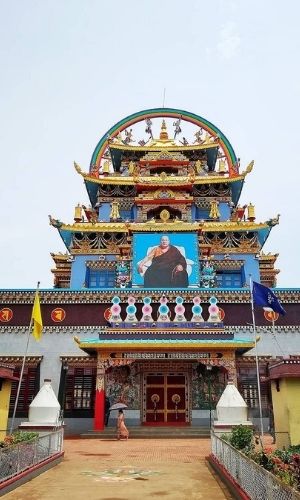
Golden Temple: Experience Tibetan Culture
Credit: Trip Advisor
There are several temples in Coorg but this one is simply stands out for its outstanding beauty. Coorg is the only place in Southern India with a Tibetan settlement. The Namdroling Monastery, better known locally as the Golden Temple is a beautiful Tibetan monastery. It’s a great way to know different cultures. The surrounding stalls also have Tibetan food like momos and thukpas! Visiting Bylakuppe is truly one of the best things to do in Coorg. It is also one of the best places to visit in Bangalore.
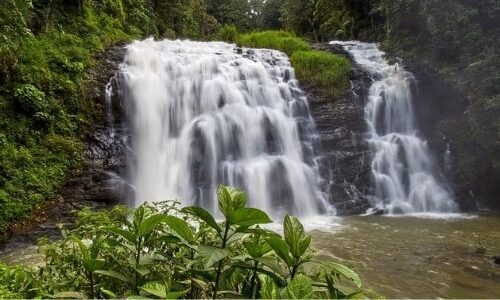
Abbey Falls
Credit: Thrillophilia
Coorg is blessed with nature’s bounty and photographing it is one of the best things to do in Coorg. The milky waterfall located in a scenic coffee and spice plantation offers a great view for that perfect Instagram photo. So don’t fret while wondering what to do in Coorg, just head to Abbey falls! This is one of the most popular waterfalls in Coorg. You can click loads of pictures there with your partner.
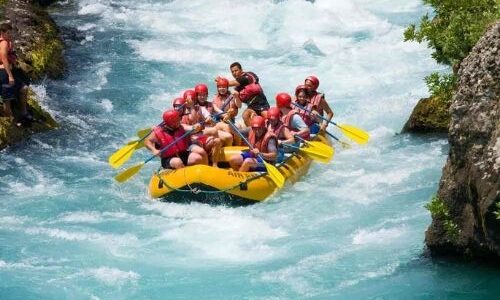
Barapole- River Rafting
Credit: Treebo
One of the most underrated activities to do in Coorg is river rafting. Coorg is a great place for whitewater rafting, especially during the monsoons. The Barapole River has grades ranging from I to V offering the ultimate adventure experience to travellers. River rafting in Coorg is one activity that you must add to your list of things to do in Coorg in August.
Amazing food in Coorg
pix05
Coorg cuisine is unique and different from the rest of Karnataka. It’s predominantly non-vegetarian and uses local ingredients like forest produce, meat, rice and rice-based products. Eating their famous pork or pandi curry is a must. For vegetarians, there is akki rotti, nool puttu, and koovaleputtu. If you are looking for things to do in Coorg at night, then enjoy one of these dishes for dinner on your trip there with your partner.
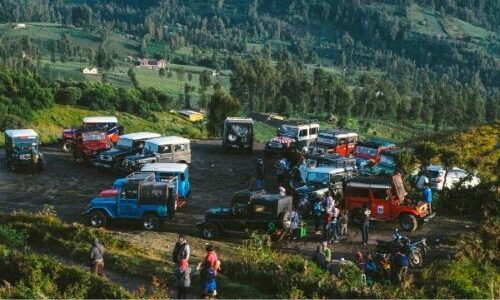
Jeep Safari- Sightseeing
Credit: Travel blogs
If you love exploring, then one of the top things to do in Coorg is to enjoy the Jeep Safari. There are various jeep safari tours available and one can choose the best one suited to their preferences. Some of the best places to explore on a jeep safari in Coorg are Kabbe Hills which offers breathtaking views of the landscape, Nishani Hills which is an off-road jeep drive, and Mallalli waterfalls which takes one to the cascading falls in Coorg.
Chettali
Credit: Etravelfly
If you are into exploring culture, an interesting thing to do in Coorg would be to visit a local village. Chettalli is a small village on the Madikeri, Siddapur Road is just the place. With the misty hills being perfectly complemented by the unending greenery it provides a great place to enjoy the serenity and relax.
When shortlisting places for Coorg sightseeing, make sure you don’t miss out on this one. The popular Cherala Bhagwati Temple in Chettalli also attracts a lot of tourists and visitors.
Microlight flying in Coorg
Credit: indiabizclub
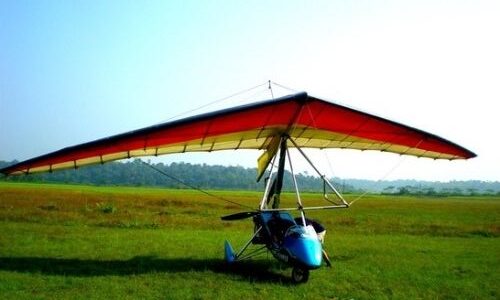
The dramatic landscape of Coorg is perfect for a microlight flying experience. Fly about 5000 feet above the ground to feel the adrenaline rush. Soar above the verdant mountains and gushing rivers to enjoy the spellbinding views. The flight starts from Ponnampet and goes to the South of Coorg. The duration is usually between 10 to 30 minutes.
Ayurjeevan
Credit: Trip Advisor
The Ayurjeevan Ayurvedic Therapy Centre is another great Place to Visit in Coorgfor couples that will certainly leave a lasting mark on your mind and heart but interestingly, not for its beauty or nature but for its wondrous services. It is where you should visit if you like to pamper yourself at exclusive spa treatments. This place in Coorg offers a wide range of authentic Ayurvedic massages and spa packages that will invigorate thoroughly. For a refreshing and rejuvenating vacation, this is a must in the places to visit in Coorg with your partner.
Romantic Places To Stay In Coorg
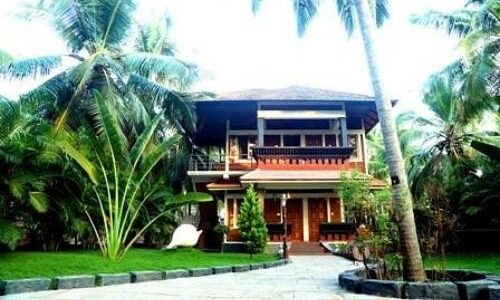
In Coorg, you will find lavish destinations to reconnect yourself to nature, or marvelling at the unique interiors of the place. Like: Taj Madikeri Resort And Spa, Woodstock Resort, Heritage Resort and more.
This was an elaborate guide to having the most of what Coorg has to offer when it comes to romantic trips. Have a splendid time enjoying the lush green pastures, nature walks, and clicking memorable pictures in coffee and tea plantations as you explore the above-mentioned romantic places to visit in Coorg. A vacation in Karnataka would be all the more amazing if the itinerary includes a visit to the romantic Coorg.
source: http://www.cityspidey.com / CitySpidey / Home> News / by Lifestyle Desk / February 08th, 2022
The Kaveri flowing through Nisargadhama in Karnataka, Photo Credit: Shutterstock
The story of how the river Kaveri came to be.
The Kaveri (earlier known as Ponni, the golden maid, because of the fine golden silt deposits) flows through Karnataka and Tamil Nadu. The river originates at Talakaveri in the Brahmagiri Range in the Western Ghats, of Karnataka’s Kodagu district,1,341 m above sea level, and flows in a south-easterly direction for about 800 km before emptying into the Bay of Bengal. It reaches the sea in Poompuhar in Mayiladuthurai district. This is Tamil Nadu’s largest river, dividing the state into north and south.
The Kaveri is a sacred river and is worshipped as the goddess Kaveramma. Its name comes from the Sankethi word for river.
Myths and legends
The story of how Kaveri came to be begins with how the sage Agastya came south. A mountain called Vindhya had an inflated opinion of itself. However, when a person praised Meru, another mountain, right in front of Vindhya, Vindhya grew jealous. Wanting to be taller than Meru, it started growing skywards.
Soon, Vindhya would block the sun. The people, animals, and trees in the forests lying in Vindhya’s shadow stopped receiving any sunlight. No matter how high the sun rose, Vindhya grew taller and blocked his light. The pleas of the people, animals, and the forests fell on deaf ears.
As a last resort, the gods approached the powerful sage Agastya for help. On reaching Vindhya, the sage asked him to bend so that he could cross over to the south. Since Agastya was known for his wrath, Vindhya did not want to be cursed and agreed to bend. After Agastya had crossed over, he asked Vindhya to stay that way till he returned. Vindhya promised to do so. The sage wisely stayed back in the south, leading to much happiness among the people around the Vindhya.
With his yogic powers, Agastya collected the most beautiful parts of creatures in the forests he visited and put them together in the form of a beautiful infant. He now wanted someone to raise the child and decided to marry.
Meanwhile, king Kavera, who ruled in that region, had also prayed to Lord Brahma for a child. In a mythologically convenient coincidence, Lord Brahma had a daughter Vishnumaya, who craved to serve humanity.
Brahma blessed Kavera so that Vishnumaya was born to him as Lopamudra. In yet another coincidence, she was also the infant Agasthya created. Lopamudra became a beautiful woman, with her craving to serve humanity intact.
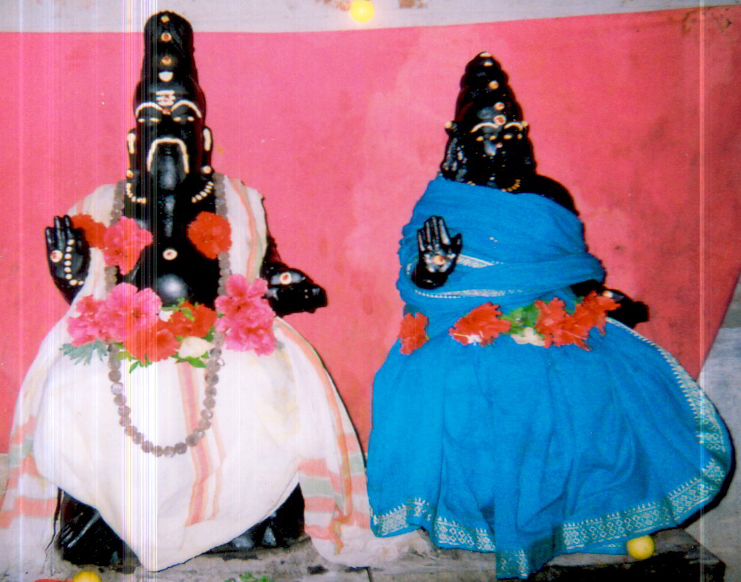
Idols of saint Agastya and Lopamudra / Photo Credit: Wikimedia Commons
On one of his many travels, Agastya met Lopamudra, and asked Kavera for her hand in marriage. He was already of advanced age, had gnarled looks, wore the clothes of a mendicant and his unkempt hair stood out. Yet, Lopamudra agreed to marry the sage on one condition—he was not to leave her alone for a great stretch of time. If he did, she would leave. Sage Agasthya agreed.
After the marriage, this unlikely couple settled down in sage Agastya’s ashram. Once, on his travels, the sage fell ill and fainted. Since no help was in sight, Lopamudra had to carry him home by herself. Somehow, the strong-willed Lopamudra began carrying him home. On the dark path home, Agastya’s dangling foot touched a sleeping holy man. Absolutely furious, the holy man cursed the owner of the foot that he would die at sunrise.
Lopamudra, however, thought that this was unfair. After all, she was the one carrying the sage and had not meant to humiliate the holy man deliberately. So, to prevent the curse from taking effect, she invoked: “May the sun not rise if I have been a good and chaste wife and helped my husband.”
The sun really did not rise and the earth was enveloped in darkness. Shaken, the gods came running to Lopamudra begging her to lift her ban on the sunrise. Explaining her reason, she offered to lift the ban only if they lifted the uncalled-for curse by the holy man. The gods did as told—sage Agastya lived and Lopamudra lifted her ban. The sun rose and all was well again on Earth.
Legend explains how Lopamudra became Kaveri. The people in the present-day Kaveri basin region were facing intense drought and crop loss. They prayed to Lord Ganesha, the remover of obstacles, for help.
Since Agastya would not part from Lopamudra, he turned her into water and left her in the kamandala he carried with him. Seeing an opportunity, Lord Ganesha took the form of a crow and toppled the kamandala leading Lopamudra to flow out as a river. The sage’s disciples tried to stop her, but she felt this was her way of serving people. Diving into the Earth, she reappeared at Bhagamandala. Much later, Agastya came looking for her and recognised her in the river she had become. This river came to be called Kaveri, as she was Kavera’s daughter.
Wanting to be the holiest river, she prayed to Lord Vishnu asking to be made holier than the Ganga. Vishnu explained that Ganga’s holiness could not be undermined as she originated from his feet. He offered Kaveri to be his garland, close to his heart—and therefore, more sacred. And that is how three of the holiest shrines of Vishnu—the Adi Ranga, the Madhya Ranga and the Antya Ranga—came to be at Srirangapatna, Shivanasamudra and Srirangam respectively. In each of these places, the temples are on islands with the Kaveri encircling it—just like the mythical garland.
From this legend comes another which says that the river Ganga herself comes, via an underground route, to bathe in the Cauvery and cleanse herself every year. Just as Vishnumaya had wanted, she flowed on Earth as Kaveri serving humanity.
Where to go
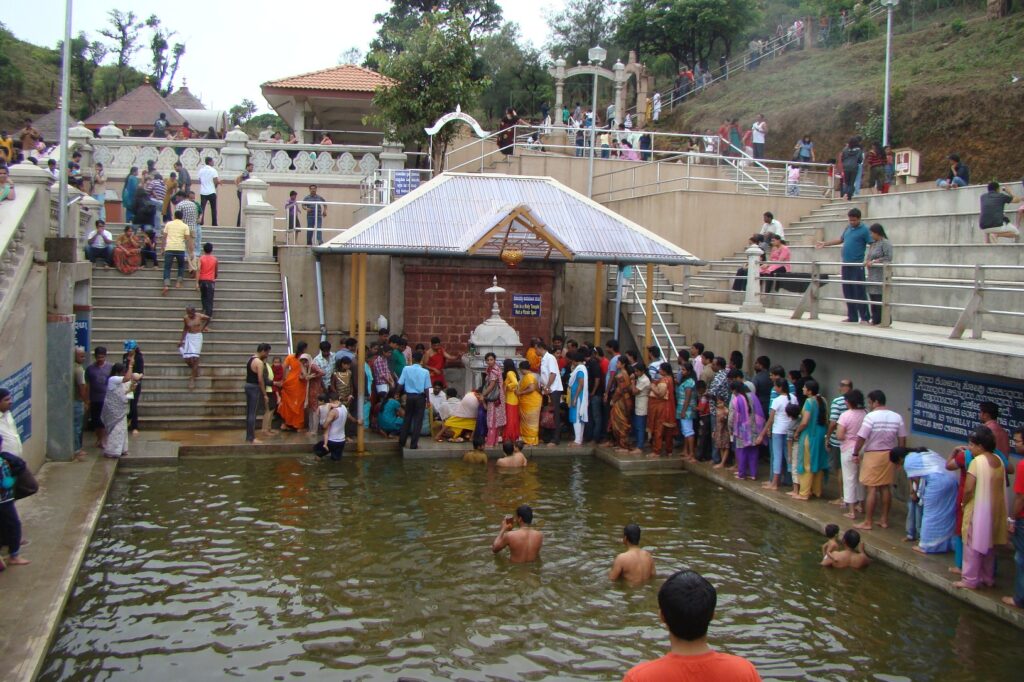
Located in the Brahmagiri Hills in Karnataka’s Coorg district, Talakaveri is generally considered to be the source of the Kaveri. A tank and a temple (in honour of the goddess Kaveramma) have been built at the spot the river is said to originate. The river itself feeds off a spring close to the tank. In normal times, thousands of Hindu devotees visit Talakaveri at the time of the Kaveri Sankramana, a festival that celebrates the annual emergence of the river. Talakaveri also offers excellent panoramic views of the surrounding Western Ghats.
Devotees flocking to and bathing at Talakaveri / Photo Credit: Wikimedia Commons
Then, there are the three river-island towns Srirangapatna—(in Karnataka), Shivanasamudra (in Karnataka) and Srirangam (in Tamil Nadu). These places house three of the holiest shrines, each dedicated to Ranganatha, an avatar of Lord Vishnu—the Adi Ranga, the Madhya Ranga and the Anthya Ranga, respectively. In each of these locations, mythology meets reality as Kaveri encircles these islands in the shape of a mythical garland.
Festival to attend
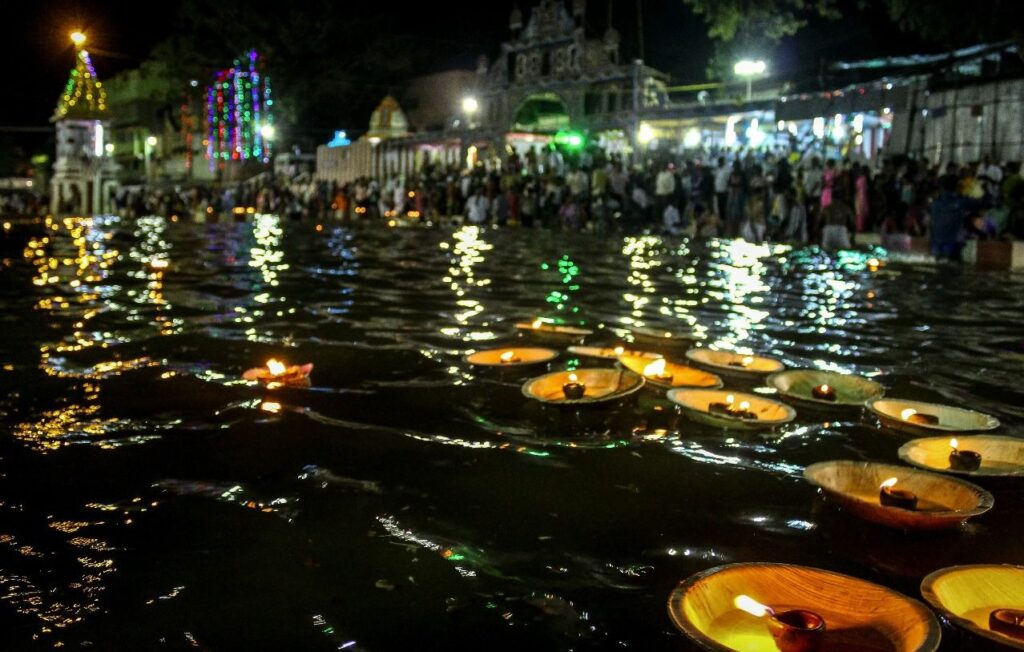
The aforementioned Kaveri Sankramana is perhaps the holiest festival associated with the river, celebrated usually in mid-October in Talakaveri every year. Another important festival is the Kaveri Pushkaram, observed once every 12 years in Mayiladuthurai in Tamil Nadu. It is marked by a ritualistic dip in the Kaveri’s waters and elaborate pujas on the Thula Ghat.
Lamps afloat in the river during Kaveri Pushkaram / Photo Credit: Wikimedia Commons
Two other festivals in honour of the Kaveri are Aadi Perukku and Kaveri Vellam. Aadi Perukku sees women worship nature and goddess Parvati by making rice and flower offerings. They also take a dip in the Kaveri at the several bathing ghats along the course of the river. Kaveri Vellam, on the other hand, is one of those rare festivals that celebrates floods. In the 12 districts that the Kaveri passes through in Tamil Nadu, people offer aartis in the flooded, overflowing river before moving to higher ground and safety. The belief is that the river will not harm the devout people and instead bless them with bountiful harvests.
source: http://www.outlookindia.com / Outlook India / Home> Outlook Traveller> Explore> Story / by OT Staff / February 05th, 2022
Surrounded by the thick foliage of bamboo groves, sandalwood and teak trees, Nisargadhama is an island formed by the river Cauvery near Kushalnagar, writes Suryakumar.
Madikeri, our holiday destination, turned out to be rather disappointing. Its fort and adjoining museum were closed, as they are every Monday. They remained shut the following day, which happened to be a government holiday. For the same reason, the residence of late General Thimayya (maintained as a memorial to his military achievements) proved elusive. As for the famed sunset at Raja’s Seat, since the sun was barely visible it could hardly disappear in a blaze of glory.
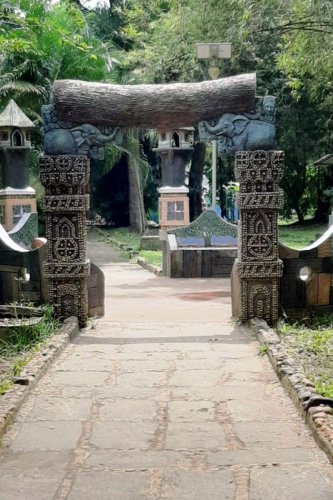
Archway at Nisargadhama. PHOTOS BY AUTHOR
Despite these setbacks, our trip to Kodagu was not a failure. There was much to enjoy at Kushalanagar, about 30 km from Madikeri. The highlight was Nisargadhama, a scenic nature resort on an island in the River Cauvery. Negotiating the hanging rope bridge that spans the water was an interesting experience. When we kept walking, it seemed steady, but if we stopped suddenly we were aware of a swaying sensation.
Once across, we found ourselves in a vast green expanse of bamboo groves and teak and sandalwood trees. There were stone seats, matching the artistically crafted archways, but tempting though it was to sit and soak in the ambience, we kept going.
We paused now and then to admire the realistic sculptures of men and women in Kodava costumes, performing traditional dances. These images are safely within enclosures, to protect them from over-enthusiastic selfie-seekers. Moving on, we came to an amazing aviary. Colourful parakeets perched on our palms, helping themselves to the birdseed provided by the person in charge.
The children among us were a bit nervous, but so gently did our feathered friends feed that we felt not the slightest discomfort. What did make us uneasy at Nisargadhama was the large number of people who were thronging the shops at the entrance, with total disregard for social distancing.
Crowds were also a problem at Harangi Dam. By contrast, Chiklihole Dam, (a small reservoir, about 15 km from Kushalanagar) was refreshing. We drove unhindered to the top (not easily accessible at other similar sites) and found it free of unmasked tourists. Not that we could entirely escape Covid! It dashed our hopes of visiting the Golden Temple at nearby Bylakuppe. The Namdroling Monastery, home to a community of monks and nuns, was barred to outsiders because of the pandemic.
St Sebastian’s Church
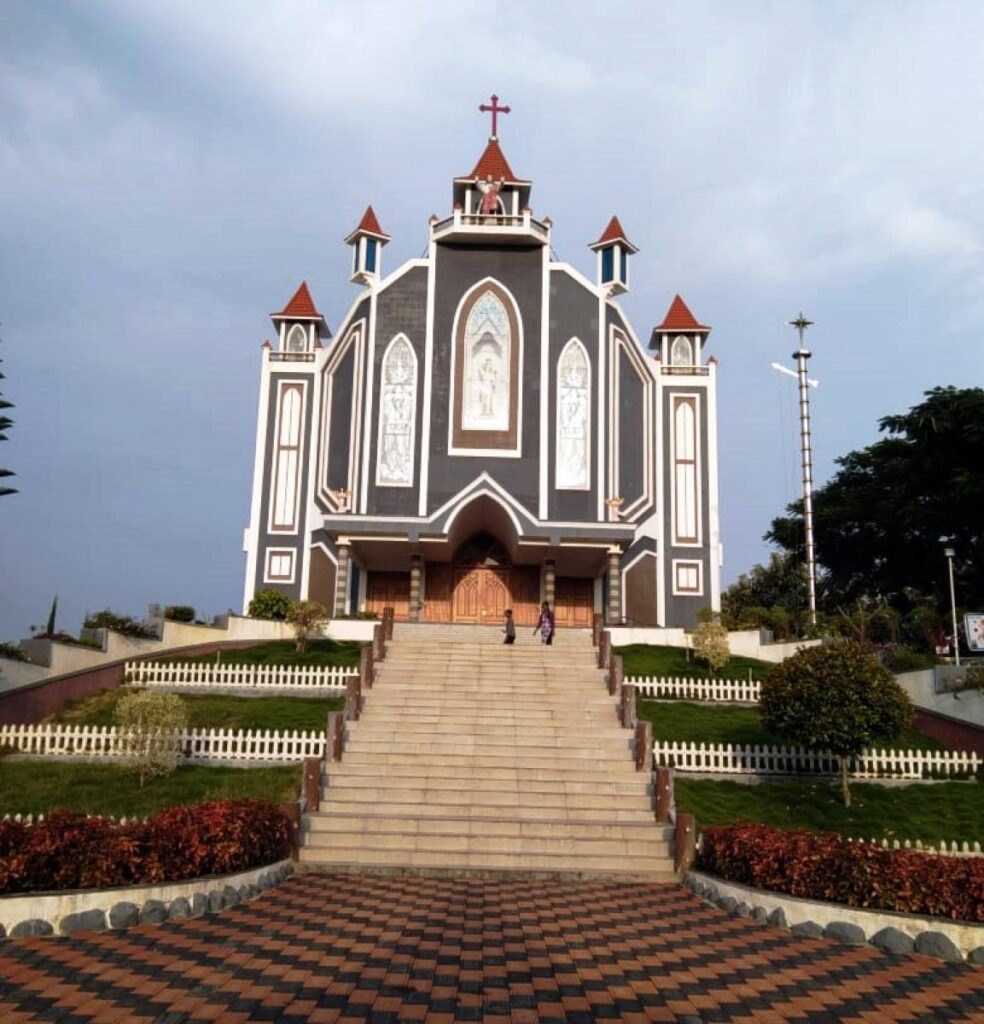
Fortunately, we managed to see another significant place of worship. Constructed a few years ago, St Sebastian’s Church stands on a hill from which one gets a panoramic view of Kushalanagar. There was scarcely anyone around, but a boy playing on the premises kindly opened a side door for us. Beautiful statues adorn the interior and exterior of this splendid edifice.
Figurines of a different sort caught our attention at a wayside stall. Each time we passed BM Road, we were fascinated by colourful life-size replicas of animals that seemed to be staring straight at us. Made of cement, and evidently intended for and evidently intended for parks and gardens, they were among the several spectacular sights of Kushalanagar.
source: http://www.deccanherald.com / Deccan Herald / Home> Sunday Herald> Sunday Herald Melange / by Suryakumar Dennison / January 30th, 2022
There is always a thrill to go to places that are off the beaten track and this time we decided to go on a short drive around the Somwarpet taluka of Coorg.
The lush greenery, the winding roads, the up and down terrain, the coffee and pepper plantations on either side made me feel really blessed to have so many rich natural wild sights to admire in South India. Even the quaint village of Shanivarsanthe felt as if time had stood still there since ages.
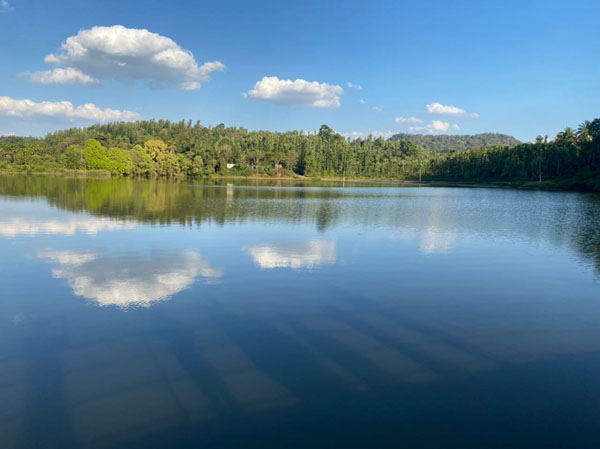
And thankfully these places are quite free of the noisy tourist crowds that I usually see elsewhere. Our dear local friend Prasanna insisted that we visit the the biggest lake in Coorg called Honammana Kere.
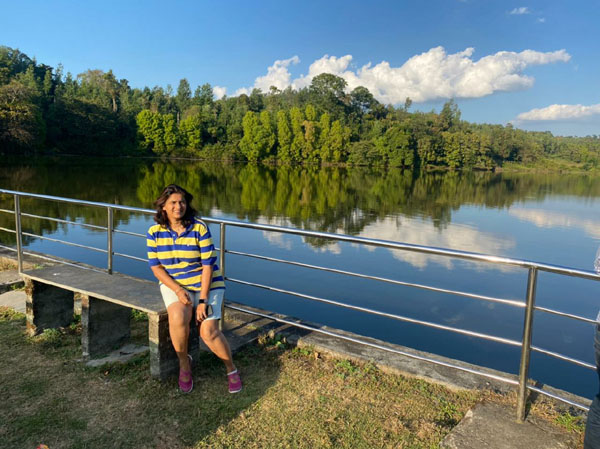
Our first impression was just a silent awe for the stunning natural beauty of this place. The reflection of the blue skies, the white clouds and the rich green foliage on the crystal clear waters was mesmerising. This lake was nestled in between the hills called Morí beta and Govi beta. On a more adventurous note, if we had more time, we could have undertaken short treks to the temples on top of the hills to admire the stunning views from the hilltops too!
There is a Honnamma devi temple besides the lake that has an interesting history. A local ancient king had prayed during the times of water shortage and refused to sacrifice his daughter-in-law, when asked to do so. However his pregnant daughter in law Honnamma walked into the waters and drowned, sacrificing her life for the well being of the people and ensuring abundance of water for all.
She is revered by the locals as a Goddess in a unique shrine dedicated to her on the banks of the lake. I noticed an ancient stone with carved inscriptions in front of the temple probably recording this interesting piece of history.
A lot of devotees come here for the powerful blessings of the Devi for marriage or child prospects. I was told that on Gauri festival day, at least 101 ladies immerse sets of many Pooja items like fruits, vegetables, turmeric kumkum, bangles etc. in the waters.
Yes, the spiritual energy of the place was something that could not be expressed in words. The calm serene feeling of the mesmerising natural ambience made the lake feel like a hidden gem. I could probably spend hours sitting on the temple steps, dipping my feet in the water and doing absolutely nothing.
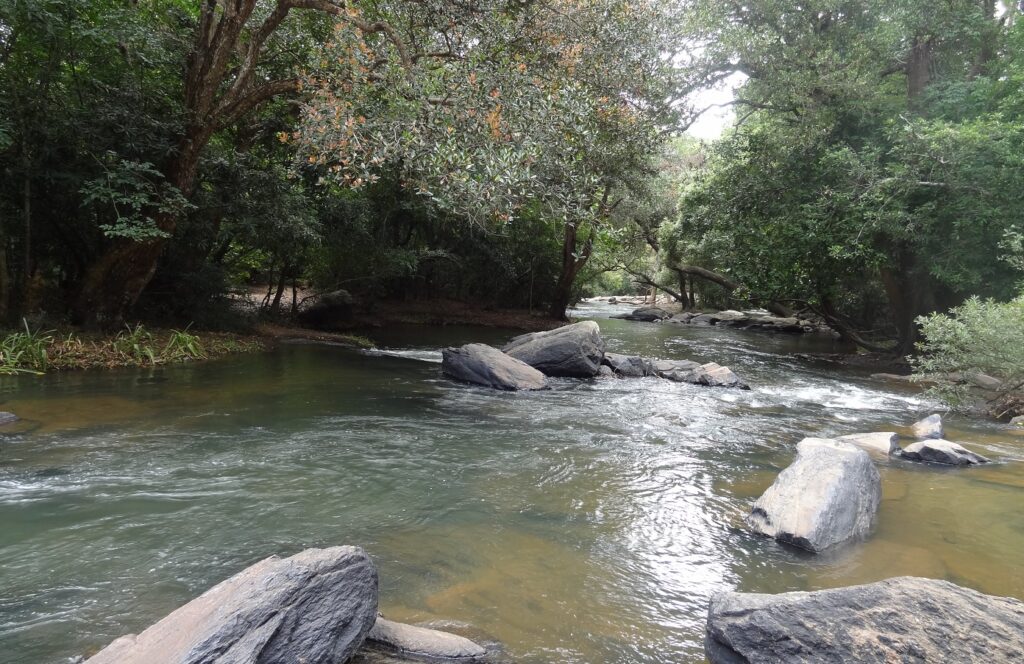
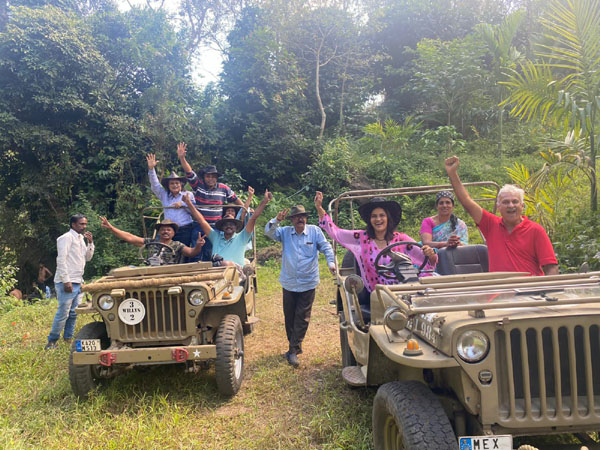
We had a sumptuous lunch with our gracious host Jairaj Shetty at a place called Whisper Valley. The 360 degree natural view made it feel as if we were in heaven! The open air jeep ride through the coffee plantation to a hidden stream was an adventure by itself! And we just had to frolic in the gushing waters feeling rejuvenated like kids again!
It was a day well spent with good friends and lots of smiles in the unknown nooks and corners of Somwarpet.
_________
Shobha Rao Smilemaker has a vision of living in a world where people use their ability to find and make smiles in any situation. She is a lawyer by qualification, a soft skills trainer by passion, a motivational speaker, a freelance journalist, a bestselling author, an avid traveler and founder of ‘Smilemakers Trainings’. She can be contacted at www.shobhasmilemaker.com.
______________
source: http://www.daijiworld.com / DaijiWorld / Home> Karnataka / by Shobha Rao Smilemaker / January 18th, 2022
The Karnataka State Western Ghats Chairman Ravi Kushalappa visited Hunsur on Thursday and apprised himself of the pollution in Lakshmanteertha river that flows through the town.
The tributary of the Cauvery is highly polluted, carrying untreated sewage from various towns along its course, and efforts to clean the river has not yielded the desired results so far.
Mr. Ravi Kushalappa met the local MLA H.P.Manjunath, Deputy Commissioner Bagadi Goutham, ZP CEO Yogesh, Deputy Conservator of Forests Mahesh Kumar and other officials and held extensive interaction on reviving the quality of the river.
Citizens of Hunsur including NGOs and environmentalists who met Mr. Kushalappa also gave their feedback and the latter promised to incorporate the suggestions while drafting an action plan to clean up the river.
The activists suggested that release of untreated effluents including sewage into the river should be stopped and measures should be initiated to treat the effluents and sewage and diverted for secondary use in agriculture.
There are small rivulets that join the river to augment the volume of water but some of them have been encroached and the flow has been blocked, said the activists. Hence efforts should be made to clear the encroachment to facilitate inflow of water.
S. Sreekanth, founder of Development through Education (DEED), an NGO working for tribal rehabilitation and empowerment, said it was imperative to take up massive afforestation along both the banks of the river and declare them as an eco-sensitive zone to improve the local environment.
There was also a suggestion to divert Konganahole rivulet to Lakshmanteertha to augment the river flow. Activists also called for a crackdown on sand mining along the course of the river and said that the action plan to rejuvenate the river should be implemented in a time-bound manner.
source: http://www.thehindu.com / The Hindu / Home> News> States> Karnataka / by Special Correspondent / January 06th, 2022
Rampant illegal mining of precious stones has been reported from Pattighat Reserve Forests (Nishane Motte) near Bhagamandala of the Western Ghats under the very nose of the Forest Department and those who are duty-bound to protect it have now been accused of openly allowing plunderers to loot the forest wealth.
These smugglers are unearthing gemstones from the forests with the help of locals and selling them at a premium to luxury hotels, jewellery shops, spas and massage parlours. These virgin forests are an integral part of Kodagu and the Western Ghats and except for wild animals and Forest Department staff, no one — not even cattle — is allowed inside.
In such a forest, covered with fully grown trees, deep pits are dug and mud is lifted out and loads and loads of mud are sieved for precious stones, especially red ones, resembling rubies. Ironically, the Forest Department camp and the tents where they stay guarding the jungles are located metres away from the places that have been dug up and still, this has not come to the notice of the Department.
The Pattighat Reserve Forests begin at the very end of Thannimaani village that can be reached from the entrance gate of Bhagamandala via Karike Road. One has to trek around a six-kilometre area that is full of ravines and steep gorges to reach there. The Reserve Forest is spread across 2,200-hectare land and joins the Subramanya- Kadamakal Forests.
While Subramanya Range Forest comes under Dakshina Kannada, Koojimalai, Suttathmalai Pushpagiri Wildlife Sanctuary and Pattighat (Nishane Motte) comes under the jurisdiction of Kodagu district. Public entry has been banned here and unfortunately, this ban is a blessing in disguise for smugglers to carry out the illegal stone mining.
The 30-ft pit dug up to extract precious stones.
Well-concealed operation
When the first report of this rampant precious stone mining was reported by some local villagers of Bhagamandala a week back, teams from the Forest Department were sent to inspect the area. But strangely, the inspecting teams did not find any pits dug up deep inside the forest. They only found mounds of mud from where the pits were dug and the same was reported by the teams to their higher officers.
Even as the Department justified that there are no pits, local villagers said that a little bit of effort would have unearthed the entire racket as the pits were cleverly covered with hay stack, small wooden blocks and mud.
The pits were finally spotted on Jan. 6 by the Forest Squad personnel who were accompanied by Assistant Conservator of Forests Mohiseen and Chairman of Karnataka State Western Ghats Task Force, Shantheyanda Ravi Kushalappa.
The Forest Department base camp at Pattighat.
Mining network spread out
According to people in the know of things, this mining activity has been going on in many reserve forests around Kodagu especially in the Bhagamandala region for the last 20 years. Before the Pattighat was declared as a Reserve Forest, the illegal mining was concentrated on one or two locations from where the stones were extracted. However, after the Reserve Forest restrictions came into place, mining spread out to many locations.
For instance, one deep pit that was used to excavate soil was closed in 2020 with cement. Recently, another 4-ft wide and 30-ft deep pit has been dug nearby and from there, another ‘L’ shaped pit has been dug up connecting this deep pit, shocking the Forest Squad.
The tent set up by forest watchers 10 metres from the pit.
Organised gangs camp in woods
So organised the gangs are that many earth-digging implements, pulleys and ropes to pull out mud, sieves, cooking vessels, fireplaces and iron rods and pipes have been recovered indicating that the smugglers camp inside the area, set up fireplaces and even prepare food. How can this be possible without the Forest Department knowing, ask local villagers. The stones earlier used to fetch a price of Rs. 500 to Rs. 700 per kg, now costs over Rs. 30,000 to Rs. 50,000 per kg, making it a lucrative deal for smugglers. The illegal trade was first reported in the 1990s at Subramanya Forest Range and Pushpagiri Ranges. Gradually, the trade spread to Madikeri and Bhagamandala ranges.
Once the stones are extracted, they are polished and marketed to massage parlours, five-star hotels and spas. Once polished, the texture and appearance of the stones change and they look similar to precious gemstones.
Jewellery shops too purchase these precious stones and they are sold with actual precious stones. The stones, in different colours, are used in ‘hot stone massage’, ‘aromatherapy’ and the quality is decided on the stones texture after polishing.
Excavation materials camouflaged to prevent detection.
Regular affair since 2007
Illegal mining at Pattighat Reserve has been rampant since 2007 and the name of an influential person from Madikeri circling around the racket. All the investigation that has been conducted so far is just an eye-wash and only lower-rung Forest Department staff has been the targets. All the senior officers who have been in-charge of Pattighat Reserve Forests since 2007 must be investigated for the truth to come out. It is clear that the Forest Department is complicit. I will press for a detailed investigation and impress upon the Government to conduct a high-level probe. — K.G. Bopaiah, MLA Virajpet
1 guard, 2 watchers missing
Our inspection clearly establishes the involvement of Forest Department staff and without their knowledge, no one can enter the core area of the Reserve Forests. This is a classic case of the fence eating the crop. Villagers here say that some unscrupulous Forest Department officers take bribes up to Rs. 5 lakh to Rs. 10 lakh to allow mining once inside the forests. One forest guard and two watchers are missing from duty and they must be arrested.
— Shantheyanda Ravi Kushalappa, Chairman of Karnataka State Western Ghats Task Force
source: http://www.starofmysore.com / Star of Mysore / Home> News> Top Stories / January 08th, 2022
The petition was filed by PS Mohan and others from Kodagu district on the ground that permission was not obtained from the central government under the provisions of the Forest Conservation Act.
Bengaluru :
The Karnataka High Court on Tuesday slapped a cost of Rs 50,000 on a group of petitioners for wasting the precious time of the court by filing a public interest litigation challenging the construction of the Jungle Lodges and Resorts (JL&R) by the Karnataka State Tourism Development Corporation (KSTDC) at Dubare forest in Kodagu district.
“We are of the view that the writ petition is filed without any material to support the contention raised in the petition and it appears that it has been filed with ulterior motives in order to pressurise the respondents — the state authorities. The conduct of the petitioners as such is deprecated for the purpose of wasting the precious time of the court by imposing cost of Rs 50,000 which has to be paid to the Karnataka State Legal Services Authority,” said a division bench of Chief Justice Ritu Raj Awasthi and Justice Suraj Govindaraj.
The petition was filed by PS Mohan and others from Kodagu district on the ground that permission was not obtained from the central government under the provisions of the Forest Conservation Act for construction of JL&R.
In counter, the government advocate contended that no permission of the central government is required for construction of the jungle lodge by the KSTDC in the reserve forest area coming under the state government.
The counsel of JL&R raised preliminary objections regarding the maintainability of the petition. It was alleged this petition was filed on some personal interest and that JL&R has installed river rafting activities in Dubare area which adversely affected the petitioners. But no public interest is involved in the petition and it has been filed with ulterior motives, the counsel of JL&R argued.
After hearing the parties, the court noted that the JL&R which was constructed in Dubare is a body created by the KSTDC which itself is totally controlled by the state government and no private interest is involved in the activities of the JL&R.
source: http://www.newindianexpess.com / The New Indian Express / Home> States> Karnataka / by Yathiraju, Express News Service / January 04th, 2022
The State Government has released Rs. 50 lakh to set up a new elephant camp at Harangi in Kodagu District. Already, Kodagu has two elephant camps, one at Dubare and another at Mathigodu near Anechowkur Gate that borders Mysuru.
The aim of the new camp is to decongest the existing eight camps across Karnataka where the pachyderm population has increased over the years. The State Government in February this year had ordered the setting up of a new elephant camp at Harangi.
Replying to a question raised by Madikeri MLA M.P. Appachu Ranjan in the on-going Legislature session at Belagavi regarding the Harangi Elephant Camp and a Tree Park, also at Harangi, Forest Minister Umesh Katti said that from 2017 till 2021-22 Rs.1.38 crore has been released by the Government and works are on to create the Tree Park.
This apart, Rs. 50 lakh has been released for Harangi elephant camp under funds from Compensatory Afforestation Fund Management and Planning Authority (CAMPA). Apart from setting up a new elephant camp, there are plans to initiate other related development programmes including developing the camp as a tourist centre and at the same time provide shelter to the elephants, he added.
File photos of Dubare Elephant Camp near Kushalnagar in Kodagu district.
The Forest Department will establish the elephant camp in a 40-acre land at Athur Reserve Forest beside Harangi Reservoir in Kushalnagar Taluk. The place, located near the Harangi Dam backwaters, is ideal to set up the elephant camp.
The Government has also plans to closely develop Cauvery Nisargadhama in Kushalnagar and together with the new elephant camp in the region, the initiatives will boost eco-tourism activities, the Minister told the Assembly.
Currently, Karnataka has eight jumbo camps housing about more than 100 tamed elephants that are used to rescue wild animals and for logging purposes at Government timber depots.
The new elephant camp is expected to reduce the burden on the nearby Dubare Elephant Camp, which currently has over 32 elephants, the highest in the State.
source: http://www.starofmysore.com / Star of Mysore / Home> News> Top Stories / December 20th, 2021
WELCOME. If you like what you see "SUBSCRIBE via EMAIL" to receive FREE regular UPDATES.
Read More »