Category Archives: Green Initiatives / Environment

After Priest’s Death in Karnataka Landslide, Kodavas Demand Their Duties Back at Talacauvery

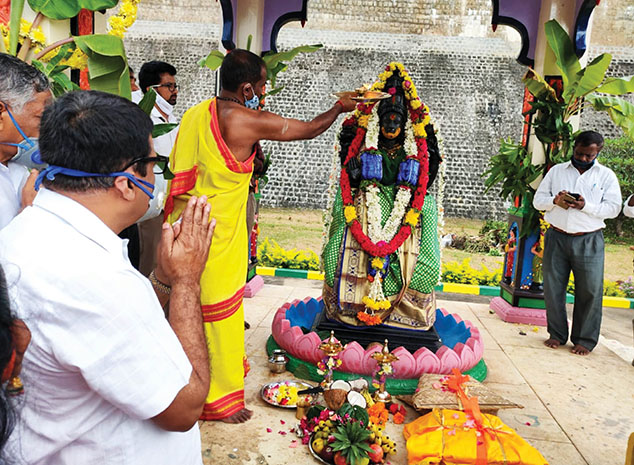
Every year, lakhs of devotees visit Talacauvery and Bhagamandala to offer prayers to goddess Cauvery. (News18 Kannada)

The Deputy Commissioner of Kodagu, Anees Kanmani Joy has informed the Kodavas that she would discuss their demand at the highest level and would try to find a solution at the earliest.

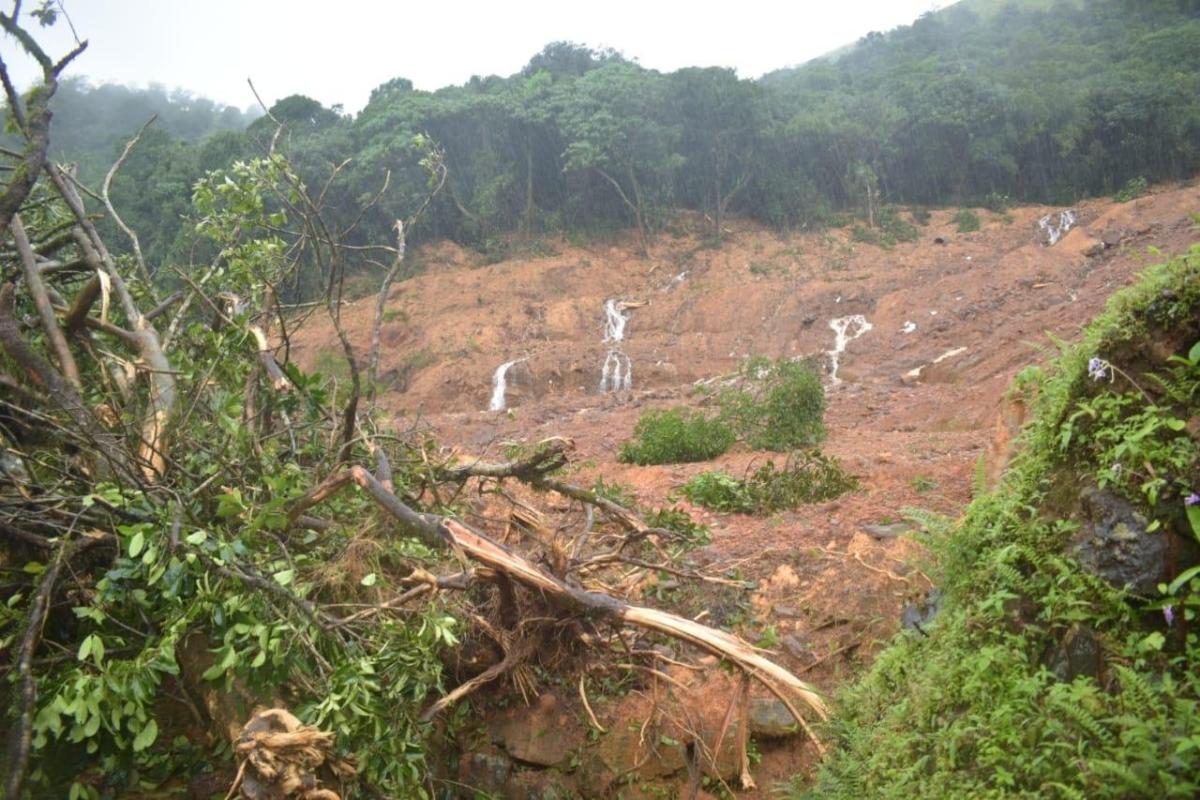
The recent torrential rains and landslide resulted in the deaths of the chief priest and his family members at Talacauvery, the birthplace of river Cauvery. The Brahmin priest Narayana Achar, his wife and three other family members perished in a huge landslide, last week.

Now, the Kodava community, the natives of the hilly district, have demanded that the state government should return priestly duties to them from the Brahmins. Locals fear that if this issue is not dealt with carefully, it might lead to a legal battle which could take on a political colour.

Every year, lakhs of devotees visit Talacauvery and Bhagamandala to offer prayers to goddess Cauvery. Amma Kodavas, a priestly class among the Kodavas have made an official request to the Deputy Commissioner of the district in this regard.

According to them, the pooja and all other associated rituals at Talacauvery were handled by Amma Kodavas for centuries and the Brahmins had no role in Kodava religious traditions and rituals. About 150 years ago, after the annexation of princely state of Kodagu or Coorg by the British in mid-19th century, the priestly jobs were transferred to the Brahmins from the neighbouring Mysore kingdom.

Since then, the Brahmins have been conducting all religious activities at Talacauvery, which is a holy place for the Kodavas and other communities. According to Amma Kodava community leader Bananda N Prathyu, their community had transferred the rights of worship to Brahmins due to certain reasons. However, they argue that there are hundreds of historical records to prove their claims that Amma Kodavas have an ancient connection with river Cauvery and its origins.

“We are the original inhabitants of Kodagu district. We are nature worshippers. Cauvery is our goddess. We have the first right to worship at Talacauvery and Igguthappa temple”, he said.

After the tragic death of priest Narayana Achar and his wife, their two daughters who live in Australia, rushed back home to perform their parents’ last rites.

According to a report in the Kannada daily Vijayavani, when the local government officials issued a compensation in their names, they informed them that they are no longer Hindus and have converted to Christianity. This revelation has now created a furore among the devotees of Cauvery. Since the deceased priest was a leader of the Vishwa Hindu Parishat (VHP), this has now taken a political colour with opposition parties questioning BJP’s commitment to Hinduism.

The priest’s daughters have declined to comment on the conversion and have gone incommunicado. Local Tahasildar has confirmed that their given names and names on record don’t match.

The Deputy Commissioner of Kodagu, Anees Kanmani Joy has informed the Kodavas that she would discuss their demand at the highest level and would try to find a solution at the earliest.

However, some fringe groups are opposing the handing over of the temple to Kodavas, by calling it a violation of old tradition. Kodagu, Karnataka’s tiny district is known as the coffee bowl of India. With its deep forests, rivers, waterfalls and hills, Kodagu is also known as the Scotland of Karnataka.

It was ruled by the Lingayat Kings from the Haleri dynasty till 1830s. The last King Chikka Veera Rajendra was a despot and the British exploited the resentment among his subjects to annex Kodagu with British India. The deposed King was sent to Vellore in Tamil Nadu and later Benares, now Varanasi, to keep him away from his subjects.

Hoping to get his Kingdom back, Chikka Veera Rajendra travelled to England to lobby with Queen Victoria and the British Parliament. After his efforts to secure the Kingdom failed, a dejected King died in London and was buried there. His granddaughter Victoria Gowramma, whose only son died in the First World War, breathed her last in London in 1930s ending the line of succession.

The British ruled Coorg/Kodagu as a separate state for over a century till 1947. It was a separate state with an Assembly till 1956. In 1956, Kodagu was merged with Karnataka State. The martial race of Kodavas have produced two of India’s best Army Chiefs Field Marshal KM Cariappa and General KS Thimmaya. They have their own language Kodava Thakk.

source: http://www.news18.com / News18 India / Home> News18> India / by DP Satish / August 26th, 2020

Now, farmers can conduct survey of crops using app

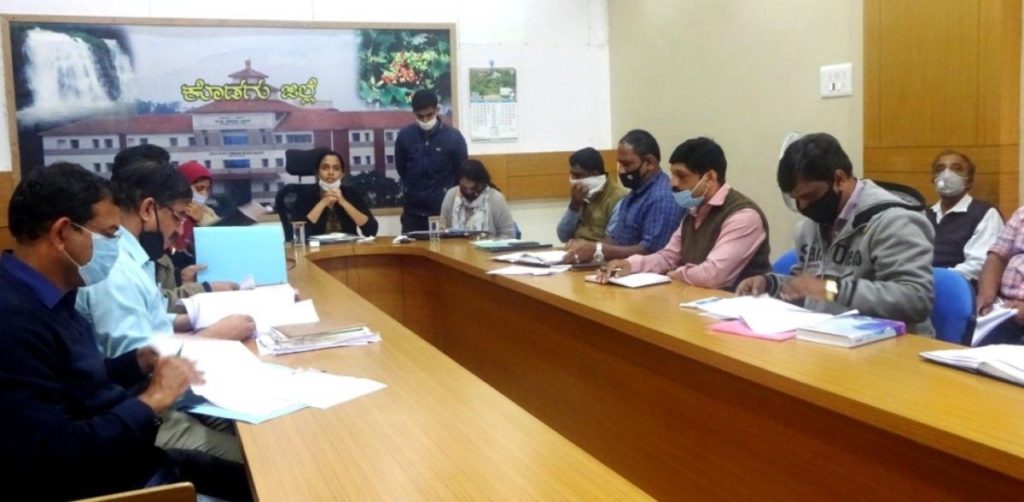
Deputy Commissioner Annies Kanmani Joy chairs a meeting in Madikeri on Friday.

Now, farmers can directly enter the details of the crops they have cultivated in their RTCs (record of rights, tenancy and crops) with a few clicks on the app on crop survey.

The last date for entering the details on the crop survey is August 24. The ‘Farmers Crop Survey App 2020-21’ has been developed by e-governance department of Karnataka, said Deputy Commissioner Annies Kanmani Joy.

Chairing a meeting on implementation of the crop survey, she said the farmers should mention survey number, hissa number of the land owned by them and upload details on agriculture crops, horticulture crops and other forest crops cultivated by them.

The DC said farmers had to take photographs of the crops cultivated on the land and fill in the details. Depending on crop details and extent of area cultivated that are documented in the pahani, government will announce support price and compensation during the natural calamities. The crop survey will benefit in documenting the details of the crops cultivated in pahani, Annies said

If farmers are unable to conduct survey of crops on their own, then they can seek the assistance of private individuals to document the details after August 24, she added.

The details uploaded by the farmers will be verified by the officials. The farmers can visit Raitha Samparka Kendra, revenue inspectors, village accountants and assistant agriculture and horticulture officials, for any query.

Agriculture Minister B C Patil, in a video conference with Deputy Commissioner, said that the crop survey should be implemented like a ‘Utsava’. For the first time in the country, the crop survey is carried out by the farmers themselves using an app.

In the past, objections were raised when the crops that the farmer claimed to have grown was different from the one recorded on the RTC. As the farmers themselves take up the survey, the mistakes in the RTC can be avoided, Annies said. 

The ‘Farmers Crop Survey App 2020-21’ can be downloaded from Play Store. A farmer should register his name and mobile number using an OTP. The farmers should select district, taluk, hobli, village and add survey number of the land and then furnish details of the crops cultivated.

MLA M P Appachu Ranjan visited the rain-affected Makkandooru and other areas on Friday. He inspected the affected farmland, houses and public roads in Makkandooru, Kadagadalu, Hodduru Gram Panchayat jurisdiction along with officials.

source: http://www.deccanherald.com / Deccan Herald / Home> State> Karnataka Districts / by DHNS, Madikeri / August 14th, 2020

Fair trade diaries: Arshiya Bose of Black Baza Coffee walks us through the basics of her coffee farming movement

Have you explored Black Baza Coffee's lineup, yet?
Have you explored Black Baza Coffee’s lineup, yet?

Very few coffee lovers actually research how ethical their go-to fair trade coffee brand really is, but Black Baza Coffee ‘s biodiversity-friendly, fair-trade coffee production is going the whole mile when it comes to ethically responsible community-building. The Bengaluru-based label is committed to the idea of ‘creating a local, participatory and meaningful movement for coffee.’ During her PhD in coffee and sustainability, Arshiya Bose, the founder of the label explored some functional biodiversity-friendly coffee farming practises which helped her get a better perspective on responsible production.

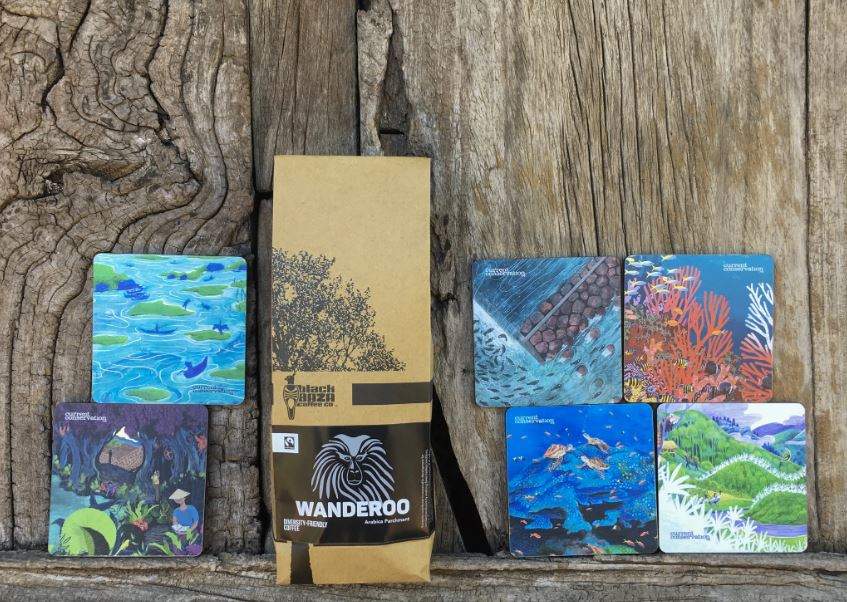
The rich and balanced Wanderoo

“Through my research I met several smallholder coffee producers, and the brand is committed to the idea of helping them grow. Black Baza Coffee is not just about eco-friendly practises but we focus on biodiversity conservation. We take a look at how various wildlife and plants make use of the coffee farms and how they can be conserved on these farms, which also includes changing the way we farm. So we go beyond organic, from looking and understanding habitats to sticking to our all-natural agenda,” Arshiya tells us. Not to mention Black Baza’s line-up is amazingly diverse, featuring coffees with layered flavour profiles, be it fermented Robusta with spicy flavour notes or washed Arabica with a balanced acidity.

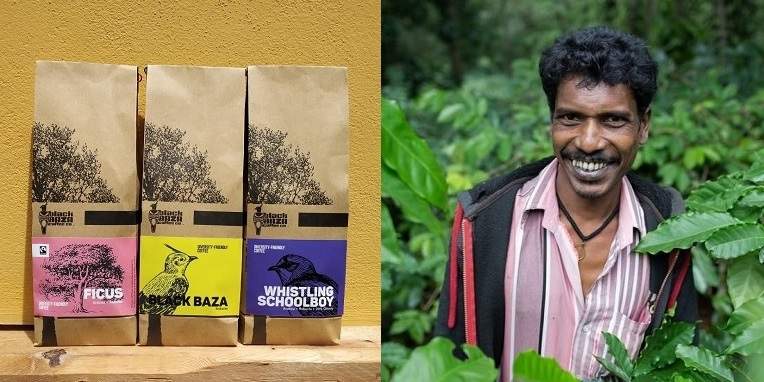
"Our Ficus coffee is named after this tree, our focus for conservation efforts in our farms," the label writes on its Instagram page
“Our Ficus coffee is named after this tree, our focus for conservation efforts in our farms,” the label writes on its Instagram page

In fact, you can even follow Black Baza’s Instagram page for their excellent fieldwork stories. We caught up with Arshiya to explore her vision further.

Black Baza Coffee has a focus on nurturing smallholders producers…

Yes, we do not work with coffee estates so we typically look at those coffee growing communities which are marginalised and vulnerable, particularly at a time like this and we work closely with them. We work with those who need our input and support the most and we are actually one of the few certified fair trade coffee brands in the country. We work with around 650 producers, we help set up coffee collectives and cooperatives. We source our coffee from The Biligirirangana Hills in Karnataka, Nilgiris, Coorg etc.

Tell us about your clientele. Do most of them share the label’s philosophy?

Yes, we have a really loyal base of customers who actively want to support communities which have suffered from the shutdown and the pandemic in general. We already had a steady base, but it has definitely grown since the pandemic started.

BlackBaza04kf20AUG2020

How has the label’s objective evolved in the four years since you started?

We are not a typical coffee brand, we function like a social enterprise, and we have definitely grown. We started out with four producers and we now work with 650, we have been able to reach so many communities who needed our support. We have also been able to source so many distinct varieties of coffees with varied flavour profiles, that’s been really interesting.

Tell us about how you’ve named each variant, like the ‘Otter,’ or the ‘Ficus’?

These coffees have been named depending on where they are grown, and represent the idea of conserving particular species of fauna which inhabit the region. The Luna coffee, for instance, is named after this interesting species of moth found in Indo-western ghats, we actively make observations of the luna moth on coffee farms, which tells us about their habitat or the vegetation around them. The names are also symbols of what we’re trying to achieve, it speaks to people about the kind of biodiversity which exists in our forests and why conserving them is so crucial.

source: http://www.indulgexpress.com / The New Indian Express – Indulge Express / by U. Roy / August 14th, 2020

Western Ghats: No lessons learnt from recurring disasters

Who is to blame?

The site of landslide in the Brahmagiri range, Kodagu. DH Photo

The oft-cited maxim of the ecological sensitivity of the Western Ghats, repeated ad nauseam over the past two decades or so, has fallen on deaf ears. The failure to prevent the degradation of forests in the Sahyadris, along with the increasing instances of extreme rainfall over a short period of time — especially over the past three years — has wreaked havoc in this lifeline of South India.

The Karnataka government, which has improved its performance in terms of flood preparedness, relief work and rehabilitation measures, seems to have taken little action to prevent or mitigate future landslide hazards.

Despite the devastation, the government has either proposed or persisted with over 20 linear projects that could damage more than 25,000 hectares of forest in the region. These projects include Yettinahole River Diversion project, Kalasa-Banduri project, Sharavathy pumped storage power plant, Hubballi-Ankola railway line and many road construction and widening projects.

Worse, this year landslides have been reported in 80 locations between Mangaluru and Karwar, where highway construction work has been taken up.

Apart from infrastructure projects, change in land use norms, the lack of a long-term mitigation policy to address deterioration of green spaces and improve forest cover, and relentless expansion of plantations in the Malnad districts are just some aspects contributing to a looming environmental disaster in one of the world’s biodiversity hotspots.

Several activists, who relentlessly protested against projects in the Western Ghats, have hung up their boots, and lament the futility of their past efforts to ensure legal protection to the ecosystem.

There is no dearth of comprehensive reports on the cause of problems in the region and how to address them. In 2011, the report submitted by the Western Ghats Ecology Expert Panel, under the chairmanship of Prof Madhav Gadgil, had warned of impending natural disasters unless immediate and sustainable measures were taken to protect the ecosystem. The report sought to designate over 60% of the Western Ghats as highest-priority Ecologically Sensitive Zones.

All the states who are the custodians of the Western Ghats ignored this report. The states couldn’t come to a consensus on the subsequent Kasturirangan report even after four draft notifications, with Karnataka repeatedly rejecting the recommendations.

The Gadgil committee report was back in focus last year, as most of the places where the landslides took place were considered ecologically sensitive by the committee.

Now, the state government has set up another panel to study landslides in the region.

The benefit of commissioning a new report is still unclear. However, the government’s actions have made it evident that it is not keen on conserving the Western Ghats; experts say the degradation of forests here will have cascading effects, triggering landslides, choking streams and posing a flood threat for downstream areas, something we are witnessing today.

A scientific paper by Prof T V Ramachandra, Centre for Ecological Sciences, Indian Institute of Science and others shows that the extent of evergreen forests shrank by 16% in Kodagu between 1973 and 2018, from 40.47% to 24.17%; a loss of around 67,000 hectares of forest land. “The region had 32% of forest cover under interior or intact forests in 1973, whereas in 2018 it covers only 19% in various protected areas,” says the study.

“The expansion or construction of linear alignments would result in irreversible ecological degradation. The recent floods and landslides are certainly a warning to the decision makers of likely implications, with the drastic changes in the land cover eroding the native forest ecosystems. Further interventions will worsen the ecology and hydrology as well as livelihood, with increase in instances of human-induced calamities,” the paper warned. Yet, the state revenue department lifted a ban on the conversion of land use in Kodagu in February this year.

Degradation main cause

While environmental degradation triggering landslides is starkly evident in Kodagu, similar situations persist in all districts bordering Western Ghats – Hassan, Chikkamagaluru, Shivamogga, Dakshina Kannada, Uttara Kannada, Dharwad and Belagavi.

Conservation biologist Keshava H Korse pointed out that major landslides are being reported at core ridges of Western Ghats due to repeated disturbance of vegetation in such areas. “Bhagamandala, where major landslides were reported in the past two years, is one such area which has loose soil,” he said.

The area was classified as a highest-priority ecologically sensitive zone in the Gadgil committee report, where all development projects were expressly forbidden due to the fragility of the ecosystem. Yet, several projects were taken up here.

“The injuries to the Ghats cannot be healed in one go. Just to recover the natural vegetation where landslides have occurred, it will take four years,” Korse said.

Among the alarming incidents during the downpour in the first two weeks of August this year, were the landslides reported just six km from Linganamakki reservoir in Shivamogga district, pointed out Ananth Hegde Ashisara, Chairman of Biodiversity Board. He is heading a 10-member committee set up in February this year, to study the main causes for such landslides and to suggest an action plan to mitigate them.

Some of the places highly prone to landslides include the Kodagu DC office, villages near Jog Falls and settlements situated in the Western Ghats. “Our major challenge is to ensure people relocate from areas which are dangerous. It is a difficult task as people don’t want to move away from their homes or agricultural land,” Ashisara said.

Though reasons for landslides were varied across Malnad districts, he suspected that vegetation loss was one of the key triggers for extensive damages witnessed in Kodagu and Chikkamagaluru.

“Deforestation is high, non-agricultural use of land near the forests are prominent. The ecosystem can rejuvenate by reducing human interference in such regions. The ecosystem will revive on its own; this can be accelerated by planting flora indigenous to the region,” Ashisara said.

G S Sreenivasa Reddy, former chairman of Karnataka Natural Disaster Monitoring Cell and a member of the committee, said that there were observable changes in rainfall patterns that have triggered the crisis. “We will give recommendations on what each department should do to mitigate the problem,” he said.

According to him, the cascading effect of disturbing the Western Ghats will worsen fluctuations in the intensity of rainfall, affecting water security and crop cultivation patterns.

Col (rtd) C P Muthanna, former president of Coorg Wildlife Society, noted that Western Ghats are susceptible to even minute changes. “We are talking with the district administration to discuss measures to prevent such incidents. We are against converting land for commercial use as it causes degradation,” he said. Efforts are also being made to encourage planters to cultivate native trees inside plantations.

Sundar Rao Bantwal, who put an end to his environmental activism after the Yettinahole project was cleared, painted a gloomy picture on how environmental concerns were always sidelined over profits by politicians and contractors. “Despite a strong opposition, large projects are taken up in eco-sensitive zones. Even if we drag the cases to court, it will be of little consequence. Approaching the Green Tribunal too won’t help,” he said, citing the controversial project as an example. The project might fail in 10-15 years and neither those who approved it nor the ones constructed will take responsibility for the disaster, he added.

Ramachandra said despite recurring disasters, as many as 55% people in Kodagu are for ‘development’, while 40% are for conservation measures, with a small minority undecided. “After the last floods, we managed to convince the Deputy Commissioner to impose restrictions against resorts mushrooming in the district, which used to occupy natural courses of water. Recently, the restrictions were lifted after political interference,” he said.

Virajpet MLA K G Bopaiah was of the view that climate change was responsible for the widespread devastation. “Save for the last three years, receiving 20 inches or more rainfall in less than a week is unprecedented,” he said. Disputing that change of land use was the major cause for landslides, he said that landslides were reported where thick forests were present. “Nobody has even considered interfering in such dense forest areas,” he said.

Noting that several areas of the district were susceptible to landslides following heavy rainfall, he said that measures will be taken to address the same.

source: http://www.deccanherald.com / Deccan Herald / Home> Specials> Insight / by Akram Mohammed, DHNS, Bengaluru / August 15th, 2020

Anandatheertha, the sage who lived for Kaveri, dies

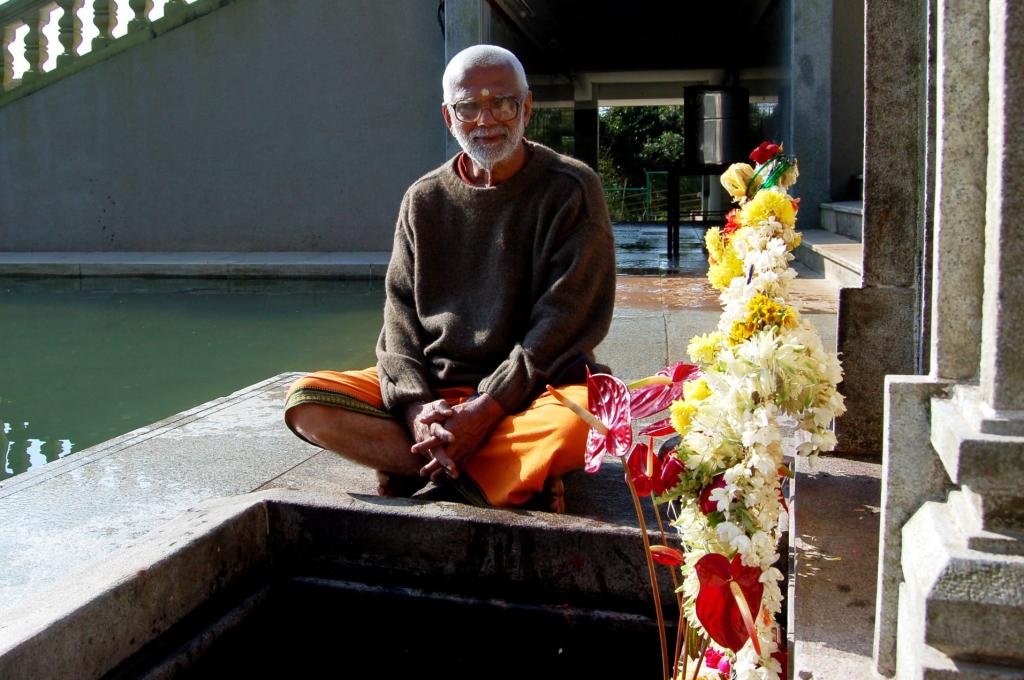
Anandatheertha lived a life of intense commitment to the Kaveri. He died in landslide in Talakaveri on August 6.
AnandateerthaKF10aug2020

Regular trips to Talakaveri, located near Bhagamandala in Kodagu district, Karnataka, are fond for river Kaveri. A temple to Goddess Kaveri, also dedicated to Shiva as Agasthyeswara and Ganesha, overlooks the ancient tank that collects water from a nearby wild spring there.

For the devotees, the tank was the origin of the east-flowing river of peninsular India. According to the legends, the river disappears in its birthplace — only to take rebirth at Bhagamandala located a little away at the foothills.

I met Swami Anandatheertha (died at 76) for the first time one September evening about a decade ago. The meeting was followed by a long conversation about the mighty river, the lifeline of vast stretches of Karnataka and Tamil Nadu.

Several conversations followed over time — and each one of them gave me the impression that he was no less than a living encyclopaedia — not just on the Kaveri but all the rivers on Earth.

It was this school teacher-turned-sage who showed me the exact origin of the river. Anandatheertha lived in Mumbai for long and taught at a school there, but returned to his native place three decades ago to become the traditional trustee and administrator of the temples in Talakaveri and Bhagamandala.

He lived a spartan life in a small house in Talakaveri, located in the Brahmagiri range of Western Ghats at an elevation of 1,341 metres. His brother-in-law was the chief priest of the temple. He lived with his sister and her husband.

A scholar with strong social and political concerns, Anandatheertha was a secular person. Between sacred and profane, he lived a life of intense commitment to the river and the surrounding forests.

In the 1980s, he was among the members of the Save Western Ghats March — a major environmental protection initiative involving scientists, anthropologists, sociologists, activists, journalists and local communities.

He marched together with others for 100 days along the length of the ghats, highlighting the socio-ecological challenges the area grappled with. He had actively engaged with almost all attempts to save the Western Ghats and the Kaveri from human encroachment and destruction.

He travelled extensively across the length and width of the river, urging local communities to save the river. He found comfort in the role of a low profile environmentalist with extreme devotion to the cause.

Journalist and filmmaker O K Johnny, who authored Kaveriyodoppam Ente Yathrakal (Journeys Along Kaveri), pointed out that Anandatheertha was always anxious about the fate of the Kaveri.

Except for the little stretch in his small locality, the river is on its deathbed. For Anandatheertha, Western Ghats and the river were integral to his existence. In a way, he always spoke in the river’s voice.

It was the place where sage Agasthya was blessed by Brahma, Vishnu and Ganesha while meditating under the ashwaththa tree. Saptarishis, or the seven great sages, had performed their yajna or ritual sacrifices at the Brahmagiri peak.

He also spoke about Lord Brahma’s daughter Lopamudra, who was rechristened as Kaveri later. Kaveri eventually turned herself into a river to serve the humankind.

Everything is a fond memory now. On August 6, 2020, Anandatheertha failed to turn up at Talakaveri temple along with the chief priest to conduct the morning rituals. One of the security guards at the temple went to check the priest and found the priest’s house buried in mud.

According to available information, the development officer of the local Grama Panchayat had issued a notice to Anandatheertha, directing him and the family of the head priest to move away from the place for the hill was prone to landslides; Anandatheertha was living at the foothills.

However, Anandatheertha refused to move away. Even the cowshed he had with over 20 bovines was buried deep in mounds of mud and rubble. The area surrounding the priests’ houses is now inaccessible, according to Kodagu district commissioner Anies Kanmani Joy.

A portion of the Brahmagiri Hill collapsed on the two houses where Anandatheertha and the priest were living. At least five people are missing as of August 7.

Other than Anandatheertha, his sister Shantha Narayana (68), her husband and temple’s head priest T S Narayanachar (70) and relatives Ravikiran Bhat and Pavan Bhat are missing.

Mud came crashing down on the two houses Wednesday midnight; around 30 acres of the mountain range collapsed. The Geological Survey of India (GSI) had predicted possibilities of landslides in Talakavery, in the close vicinity of the temple, after detecting surface cracks during last monsoon.

It had conducted extensive field study in Kodagu following the two subsequent floods since 2018 and discovered slope modification without proper precautions as the major cause of landslides.

Unbridled construction of houses by carving hill slopes resulted in land destabilisation in the region. Unsupported slope cuts for road widening also contributed to the tragedy.

A spiritual leader who always expressed concern over change in land use patterns in Brahmagiri hills and the mushrooming illegal constructions has now turned its victim.

He was always against large-scale capital investments to convert Talakaveri as a concrete jungle in the name of spiritual tourism. The encyclopaedia on rivers is no more.

source: http://www.downtoearth.org.in / Down To Earth / Home> Environment / by K A Shaji / August 07th, 2020

Harangi Dam Full: Madikeri MLA Appachu Ranjan Offers ‘Bagina’

AppachuRanjanKF04aug2020

Kushalnagar:

Following copious rains across Kodagu district, the Harangi reservoir is almost full. The dam is two feet short of reaching its maximum level of 2,859 feet at 2,857 feet this morning.

Before the crest gates were opened, Madikeri MLA M.P. Appachu Ranjan offered ‘Bagina’ to River Cauvery after performing puja to the statue of River Cauvery located at the base of the reservoir this morning.

Executive Engineer Rajendra, Harangi Reservoir Assistant Engineer Nagaraju and other BJP leaders were present on the occasion.

This reservoir is the main source of water for KRS dam in Mandya district. Irrigation Department Executive Engineer Rajendra said that water from the Harangi reservoir is now being released into the river.

AppachuRanjan02KF04aug2020

Following heavy flow in recent days, water is also being released into irrigation canals.

The right bank cannals feeding irrigated lands in Hunsur and KR Nagar taluks of Mysuru district are getting 1,500 cusecs of water every day while 400 cusecs of water is being released to left-bank canals feeding lands towards Hassan district. The inflowing water is much clear compared to last year.

Experts opine that this is probably due to growth of vegetation at the areas of landslides, which had caused heavy damage in the region, last year.

Harangi Dam provides irrigation facility to thousands of acres of farmland in Periyapattana, Hunsur and KR Nagar of Mysuru district, Arkalgud taluk of Hassan district and Kodagu district.

The Harangi Dam can hold 8.5 TMC of water.

source: http://www.starofmysore.com / Star of Mysore / Home> News / July 31st, 2020

Tiger headcount in Karnataka highest in Bandipur, Nagarahole

Other forests and sanctuaries where tiger presence has been found in significant numbers include MM Hills Wildlife Sanctuary and Madikeri Wildlife Division.

In terms of density, Nagarahole has 11.82 big cats per 100 sq.km and Bandipur has 7.7

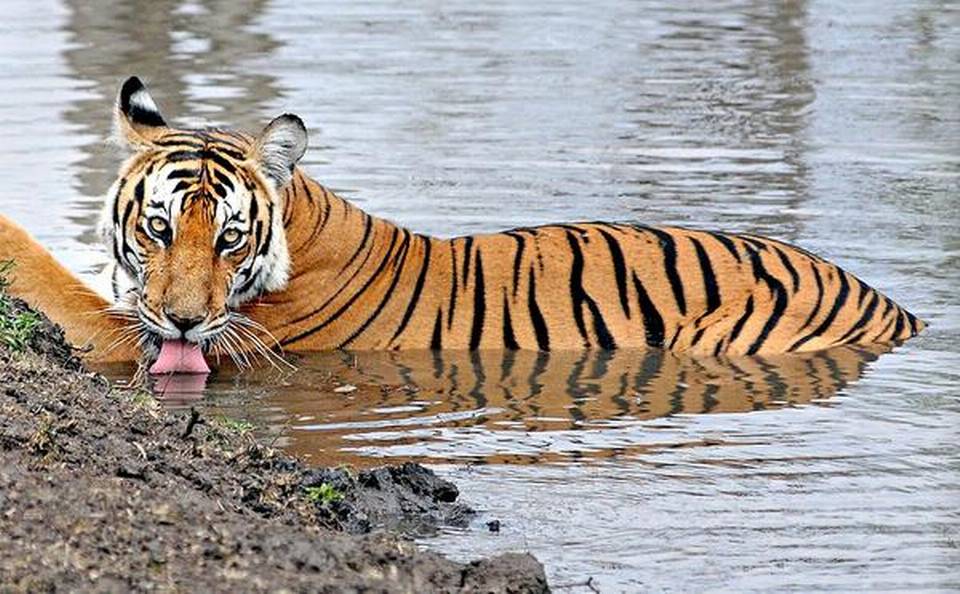
Bandipur and Nagarahole lead in tiger numbers in the State followed by BRT Tiger Sanctuary, Bhadra and Kali tiger reserves, as per the ‘Status of Tigers, Co-predators, and Prey in India’ released on Tuesday.

In terms of density, Nagarahole has 11.82 tigers per 100 sq.km, while Bandipur has 7.7 tigers per 100 sq.km. BRT has 4.96 tigers per 100 sq.km and Bhadra has a relatively low tiger density pegged at 2.86 in the same area.

Other forests and sanctuaries where tiger presence has been found in significant numbers include M.M. Hills Wildlife Sanctuary, Madikeri Wildlife Division, Madikeri Territorial Division, Virajpet Territorial Division, Koppa Wildlife Division, and Haliyal Forest Division which is part of Joida taluk of Uttara Karnataka district, among others.

Based on the camera trap images, 127 individual tigers were identified in Nagarahole followed by 126 tigers in Bandipur, 52 in BRT, 30 in Bhadra, and four in Kali (Anshi-Dandeli) tiger reserve. Officials in the Forest Department, however, said these refer to the minimum numbers only as a sizeable number of tigers from the adjoining habitats utilise the reserve too.

Based on the 2018 tiger enumeration exercise, the summary of which was released last year, the new report released by Minister for Environment, Forest and Climate Change Prakash Javadekar in New Delhi ahead of the International Tiger Day to be observed on Wednesday, also evaluates vulnerable areas that require conservation attention.

While the summary of the Status of Tigers in India-2018 released last July pegged the number of tigers in Karnataka at 524 (with a minimum of 474 and maximum of 573), the new report analyses the status of habitat corridors connecting major tiger populations apart from providing information about the prey base and their density.

The density of prey animals including chital, sambar gaur, wild boar, and barking deer were also analysed and were found to be high enough to sustain the predator population in good numbers. The chital density was pegged at 51 per sq.km in Bandipur where 36 other species of ungulates, carnivores, omnivores, and even domestic animals were photo captured. Pangolin was the rarest species photo captured, followed by leopard cat, as per the report.

Giridhar Kulkarni, wildlife activist, said the increase in tiger numbers both within and outside the reserves augurs well for conservation. But such habitats and corridors are under serious threat due to linear projects like railways, highways, transmission lines etc. and called for notifying potential wildlife habitats as sanctuaries or national parks in Shivamogga, Uttara Kannada, Belagavi, and other districts.

A case in point is the analysis pertaining to the Cauvery Wildlife Sanctuary, where the report airs apprehension of the proposed Mekedatu dam and calls for critical re-examination as the project threatens to inundate a sizeable portion of the sanctuary.

source: http://www.thehindu.com / The Hindu / Home> News> States> Karnataka / by R Krishna Kumar, Mysuru / July 28th, 2020

Water, soil from Kodagu sent to Ayodhya

Water and soil collected from Talacauvery. DH Photos

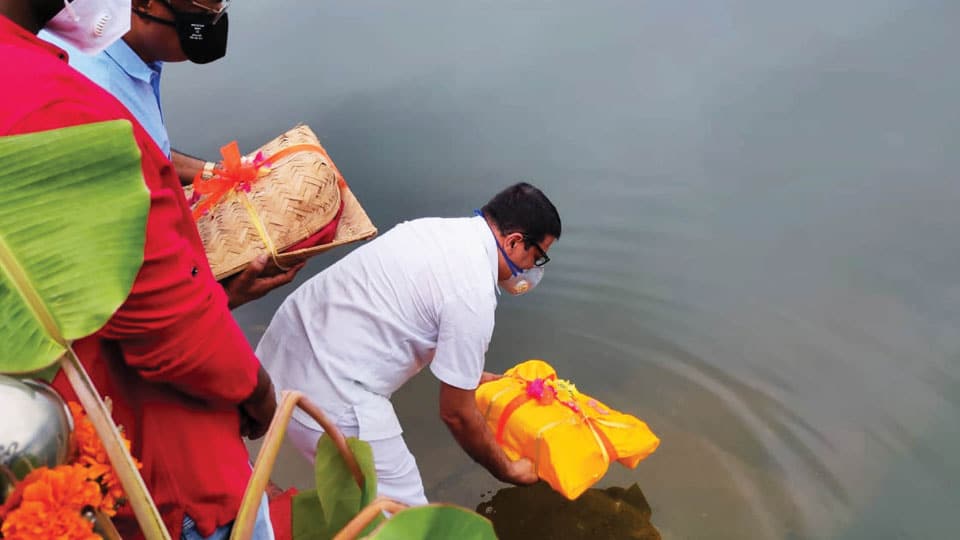
Soil from Kodagu and water from River Cauvery were sent to Ayodhya, on Thursday.

The soil and water from the district will be used while performing ground breaking for Sri Ram Mandir on August 5.

Workers of Bajrang Dal, Vishwa Hindu Parishat and Hindu Jagarana Vedike collected the soil and water from River Cauvery at Talacauvery Kshetra.

Meanwhile, special pooja was offered at Talacauvery, praying for the timely completion of the Ram Mandir in Ayodhya.

Talacauvery Kshetra Chief Priest Narayana Acharya said that justice had been made in Ayodhya issue, which had efforts of many people behind the same.

Speaking on the occasion, MLC Sunil Subramani said that the dream of constructing the Ram Mandir was getting realised. He recalled that he had visited Ayodhya in 1992.

Leader Chakkera Manu said that the long cherished dream of Ram Mandir in Ayodhya was being fulfilled.

Vishwa Hindu Parishat leader Chi Na Somesh, Bajrang Dal District Convener Chethan, VHP Madikeri taluk President Suresh Muttappa and VHP district Secretary Pudiyokkada Ramesh were present.

source: http://www.deccanherald.com / Deccan Herald / Home> State> Karnataka Districts / by DHNS, Madikeri / July 24th, 2020

Kodagu’s progressive farmer honoured with national award

Smart farming

Somengada Ganesh Thimmaiah.

Even though coffee and pepper are the prominent commercial crops in Kodagu, several farmers have been growing both agricultural and horticultural crops in integrated farming method, thereby, contributing to food security.

Somengada Ganesh Thimmaiah from Nallur village of Ponnampet in Virajpet is one such agriculturist who has scripted success through his innovative methods in farming.

Somengada Ganesh Thimmaiah was felicitated by Virajpet MLA K G Bopaiah. DH Photos

He is the winner of the National-level Babu Jagjivan Ram Krishi Samman award this year. Indian Council of Agricultural Research (ICAR), New Delhi, conferred the prestigious award on Thimmaiah during a function held recently on the occasion of its 92nd Foundation Day.

Thimmaiah has been following the integrated method in agriculture where he grows areca, coffee and paddy as main crops and a variety of vegetables and fruits and sub-crops.

Along with agriculture, he is also into apiculture, poultry and pisciculture, which gives him additional income. Thimmaiah has also been growing the ‘Beth’ plants required for honey bees.

He has successfully experimented with more than 60 paddy varieties and has implemented a mechanised system in agriculture and his paddy field is tech-savvy.

The annual produce of paddy on his farm is 350 to 400 quintal while that of coffee is about 200 bags. He said that pepper also is one of his main sources of income. He has also been cultivating butter fruit, sapota, mango, jackfruit, orange, egg fruit and rambutan as well.

A lot of youth have been visiting Thimmaiah’s farm and seeking his guidance in farming to which he says youth showing interest in agriculture and horticulture is a good sign.

Virajpet MLA K G Bopaiah visited Thimmaiah’s farm and felicitated him for winning the much-coveted award.

Forestry College, Ponnampet, too, honoured Thimmaiah. College Dean Dr Cheppudira G Kushalappa, Extension Unit Head Dr R N Kenchareddy, Agricultural Officer Teetamada Meera were present on the occasion.

source: http://www.deccanherald.com / Deccan Herald / Home> State> Karnataka Districts / by Aditya K A, DHNS, Madikeri / July 22nd, 2020

The buzz in Kodagu

Traditional beekeepers are busy bottling the flavours of Western Ghats

Pattu Cariappa and his wife Nethravathi

Madikeri :

The buzz fills the air in the north-eastern villages of Somwarpet during the spring season. Apis Cerana bees, known as the honey bees of Coorg, go around merrily collecting nectar from colourful indigenous flowers lining the Western Ghats. The sweet nectar is bottled — to produce one of the purest forms of honey in the nation — ‘Kala Thein’.

BeehiveKF20jul2020

Massive bee hives on tree trunks and building tops always fill the beholders with a sense of fear. But to the bee keepers, honey bees are their comrades. The villagers nurture and look after the bees and in return, these insects provide them with a lifeline. It would not be an exaggeration to say that the traditional beekeepers of seven villages – Kumbara Gadige, Mutlu, Kikkaralli, Hammiyala, Hacchinadu, Surlabbi and Mankya – are preserving the Western Ghats by indulging in traditional beekeeping.

Pattu Cariappa, a resident of Hammiyala village, briskly walks up to his estate and points at an earthen pot covered with fresh leaves. He then lifts the pot, which is placed upside down, and shows the bee hive where the bees are going about busily. He inserts a finger into the hive and slowly guides the bee onto one side to reveal the honey-filled comb. Ask him if he is not scared to do so, he smilingly replies, “These bees are well-acquainted with me. I won’t harm them and they don’t harm me.”“I learnt the art of beekeeping by watching my elders. The best time to start is in December.

First, we smear the heated pot, which has three to four tiny holes, with bee wax. We carry this pot into the forest and place it on a steady area. Since we know our forests well, we also know where the bees are likely to build a hive and we keep the pot in a suitable place. Once this is done, we frequently visit the spot to check if the bees have arrived. Once the bees settle into the pot, we bring the pot close to our house. We shift the pot only during evening hours – when all the bees have settled in the hive after collecting nectar,” explains Pattu.

While the beekeeping starts sometime in December, the honey is extracted and harvested only after a year and half – in June. In traditional beekeeping, the harvest method does not use smoke or other harmful gas to chase them away. Instead, the beekeepers slowly move the honeybees to one side and take out the comb. The honey is then extracted from the comb. “I do not use bare hands to squeeze out the honey as it is unhygienic. Instead, I use a clean white cloth to extract honey from the comb, which is then bottled to produce one of the purest forms of honey,” he adds.

“Some people think that pure honey does not turn sugary. But it does and settles at the bottom of the bottle. Pure honey has very less moisture content,” he says. How does one know if the honey is pure? Pattu’s wife Nethravathi explains, “If the hive is built inside the cavity of a tree, one can smell the tree bark in the extracted honey. Similarly, any form of adulteration can be found out easily through the smell. Wild honey, which uses harmful methods of extraction, is watery.” The seven villages have a good economy. While the traditional beekeepers have been harvesting honey since ages, it is only recently that they have found a sustainable earning.

“Earlier, we used to sell it on the streets across the district and did not earn much from it,” recalls Pattu.

However, they have now found a platform for their business through the initiative of ‘AinMane’ of Thammu Poovaiah. A popular café based in Madikeri, AinMane, is sourcing honey from these traditional beekeepers. “The ‘AinMane’ management is promoting the traditional form of honey and providing us with a sustainable lifestyle,” says Nethravathi.

source: http://www.newindianexpress.com / The New Indian Express / Home> States> Karnataka / by Prajna GR / Express News Service / July 19th, 2020