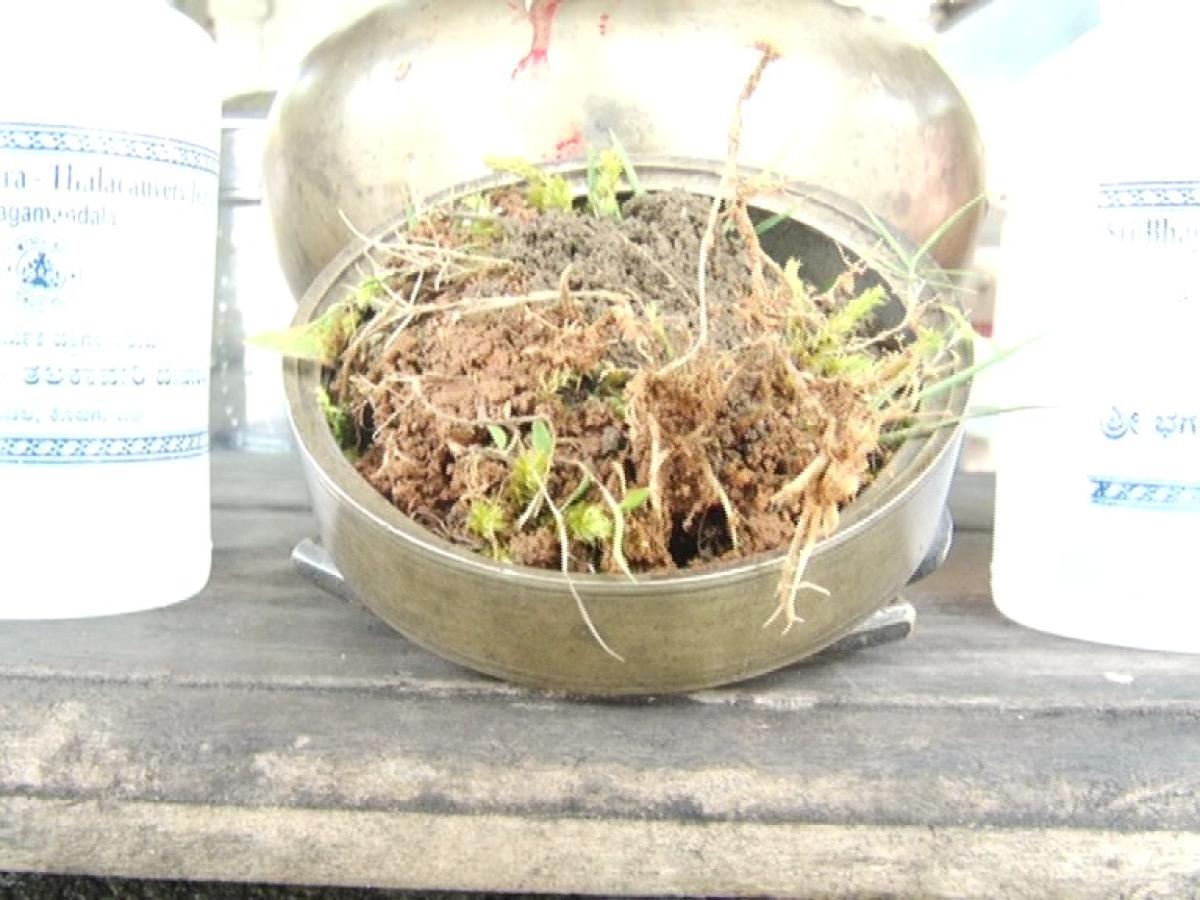
Water and soil collected from Talacauvery. DH Photos
Soil from Kodagu and water from River Cauvery were sent to Ayodhya, on Thursday.
The soil and water from the district will be used while performing ground breaking for Sri Ram Mandir on August 5.
Workers of Bajrang Dal, Vishwa Hindu Parishat and Hindu Jagarana Vedike collected the soil and water from River Cauvery at Talacauvery Kshetra.
Meanwhile, special pooja was offered at Talacauvery, praying for the timely completion of the Ram Mandir in Ayodhya.
Talacauvery Kshetra Chief Priest Narayana Acharya said that justice had been made in Ayodhya issue, which had efforts of many people behind the same.
Speaking on the occasion, MLC Sunil Subramani said that the dream of constructing the Ram Mandir was getting realised. He recalled that he had visited Ayodhya in 1992.
Leader Chakkera Manu said that the long cherished dream of Ram Mandir in Ayodhya was being fulfilled.
Vishwa Hindu Parishat leader Chi Na Somesh, Bajrang Dal District Convener Chethan, VHP Madikeri taluk President Suresh Muttappa and VHP district Secretary Pudiyokkada Ramesh were present.
source: http://www.deccanherald.com / Deccan Herald / Home> State> Karnataka Districts / by DHNS, Madikeri / July 24th, 2020
Even though coffee and pepper are the prominent commercial crops in Kodagu, several farmers have been growing both agricultural and horticultural crops in integrated farming method, thereby, contributing to food security.
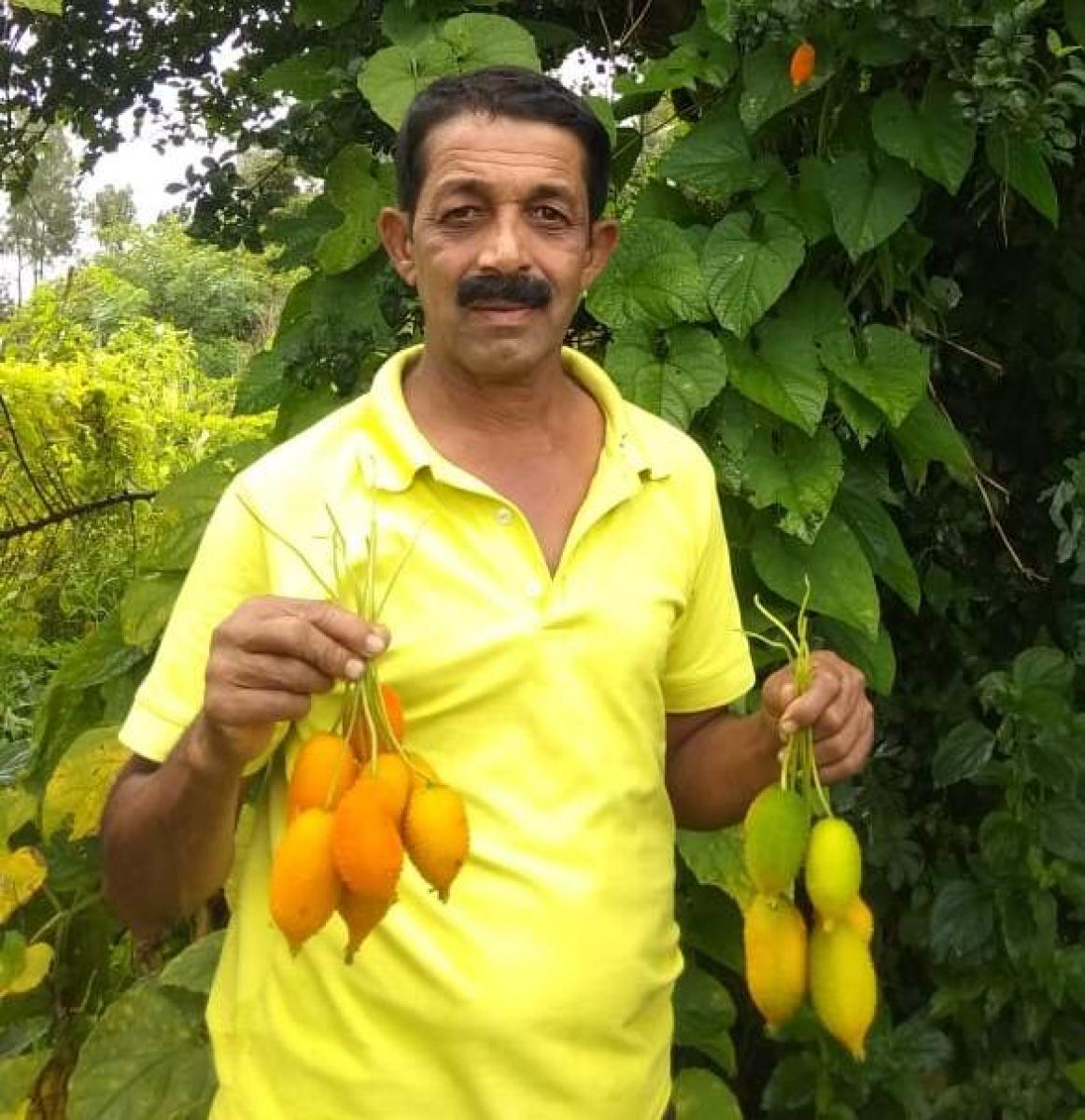
Somengada Ganesh Thimmaiah from Nallur village of Ponnampet in Virajpet is one such agriculturist who has scripted success through his innovative methods in farming.
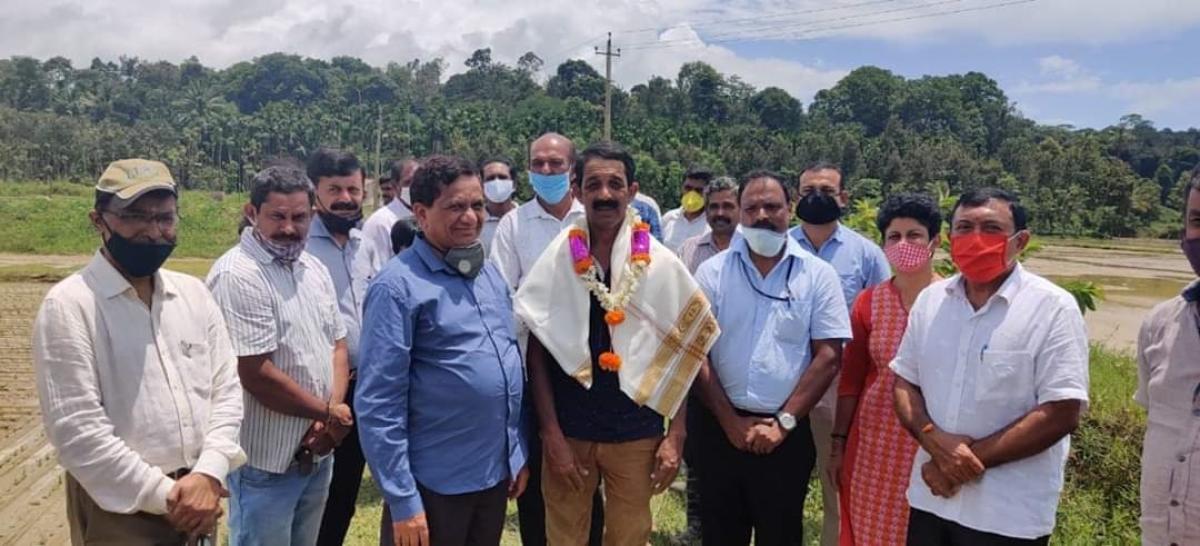
Somengada Ganesh Thimmaiah was felicitated by Virajpet MLA K G Bopaiah. DH Photos
He is the winner of the National-level Babu Jagjivan Ram Krishi Samman award this year. Indian Council of Agricultural Research (ICAR), New Delhi, conferred the prestigious award on Thimmaiah during a function held recently on the occasion of its 92nd Foundation Day.
Thimmaiah has been following the integrated method in agriculture where he grows areca, coffee and paddy as main crops and a variety of vegetables and fruits and sub-crops.
Along with agriculture, he is also into apiculture, poultry and pisciculture, which gives him additional income. Thimmaiah has also been growing the ‘Beth’ plants required for honey bees.
He has successfully experimented with more than 60 paddy varieties and has implemented a mechanised system in agriculture and his paddy field is tech-savvy.
The annual produce of paddy on his farm is 350 to 400 quintal while that of coffee is about 200 bags. He said that pepper also is one of his main sources of income. He has also been cultivating butter fruit, sapota, mango, jackfruit, orange, egg fruit and rambutan as well.
A lot of youth have been visiting Thimmaiah’s farm and seeking his guidance in farming to which he says youth showing interest in agriculture and horticulture is a good sign.
Virajpet MLA K G Bopaiah visited Thimmaiah’s farm and felicitated him for winning the much-coveted award.
Forestry College, Ponnampet, too, honoured Thimmaiah. College Dean Dr Cheppudira G Kushalappa, Extension Unit Head Dr R N Kenchareddy, Agricultural Officer Teetamada Meera were present on the occasion.
source: http://www.deccanherald.com / Deccan Herald / Home> State> Karnataka Districts / by Aditya K A, DHNS, Madikeri / July 22nd, 2020
Traditional beekeepers are busy bottling the flavours of Western Ghats
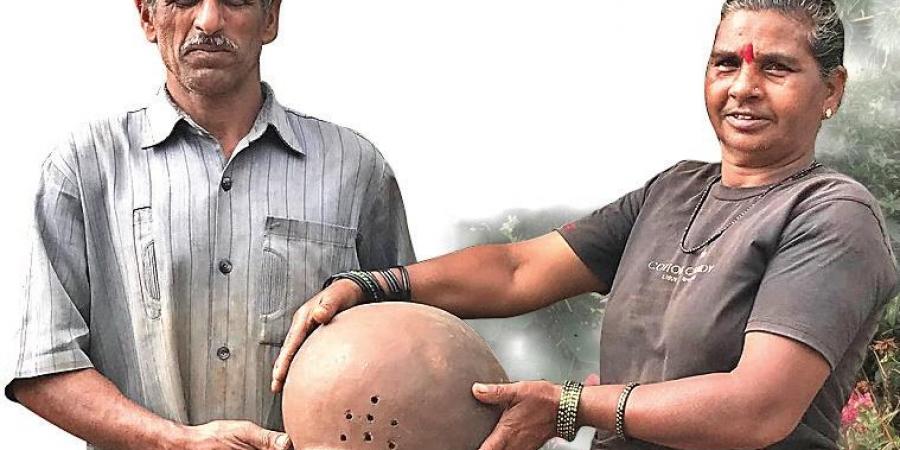
Pattu Cariappa and his wife Nethravathi
Madikeri :
The buzz fills the air in the north-eastern villages of Somwarpet during the spring season. Apis Cerana bees, known as the honey bees of Coorg, go around merrily collecting nectar from colourful indigenous flowers lining the Western Ghats. The sweet nectar is bottled — to produce one of the purest forms of honey in the nation — ‘Kala Thein’.
Massive bee hives on tree trunks and building tops always fill the beholders with a sense of fear. But to the bee keepers, honey bees are their comrades. The villagers nurture and look after the bees and in return, these insects provide them with a lifeline. It would not be an exaggeration to say that the traditional beekeepers of seven villages – Kumbara Gadige, Mutlu, Kikkaralli, Hammiyala, Hacchinadu, Surlabbi and Mankya – are preserving the Western Ghats by indulging in traditional beekeeping.
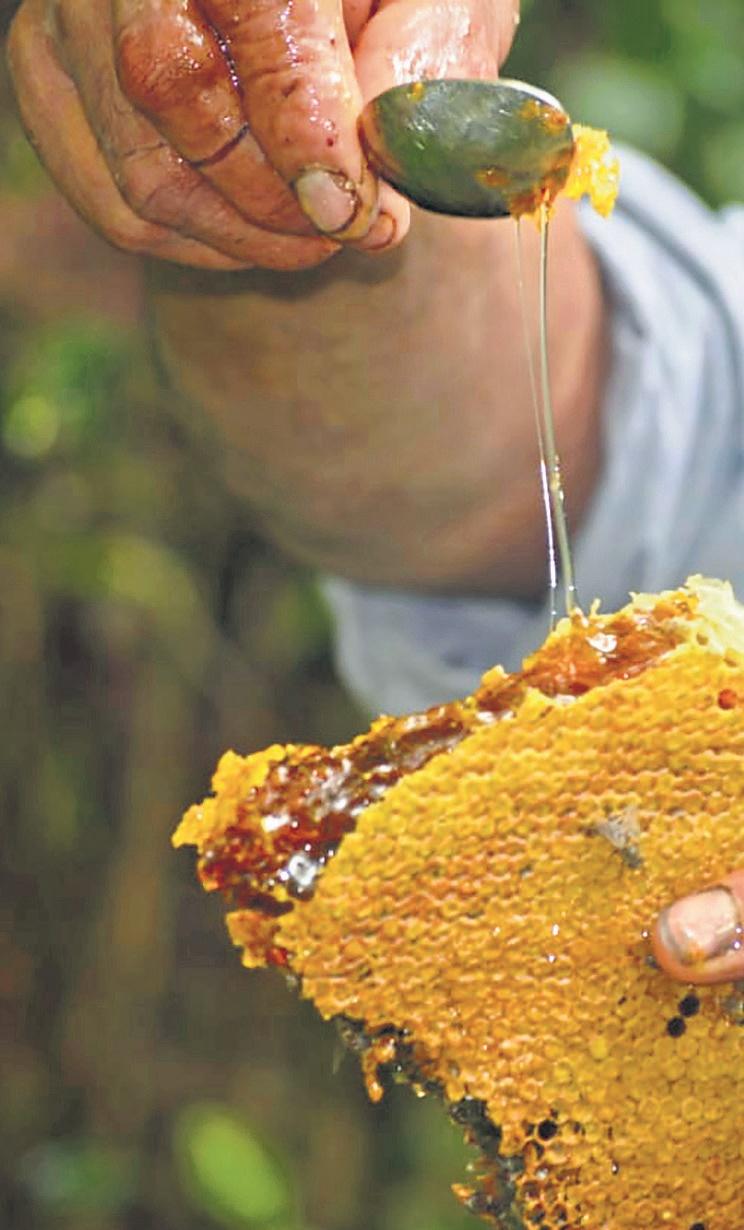
Pattu Cariappa, a resident of Hammiyala village, briskly walks up to his estate and points at an earthen pot covered with fresh leaves. He then lifts the pot, which is placed upside down, and shows the bee hive where the bees are going about busily. He inserts a finger into the hive and slowly guides the bee onto one side to reveal the honey-filled comb. Ask him if he is not scared to do so, he smilingly replies, “These bees are well-acquainted with me. I won’t harm them and they don’t harm me.”“I learnt the art of beekeeping by watching my elders. The best time to start is in December.
First, we smear the heated pot, which has three to four tiny holes, with bee wax. We carry this pot into the forest and place it on a steady area. Since we know our forests well, we also know where the bees are likely to build a hive and we keep the pot in a suitable place. Once this is done, we frequently visit the spot to check if the bees have arrived. Once the bees settle into the pot, we bring the pot close to our house. We shift the pot only during evening hours – when all the bees have settled in the hive after collecting nectar,” explains Pattu.
While the beekeeping starts sometime in December, the honey is extracted and harvested only after a year and half – in June. In traditional beekeeping, the harvest method does not use smoke or other harmful gas to chase them away. Instead, the beekeepers slowly move the honeybees to one side and take out the comb. The honey is then extracted from the comb. “I do not use bare hands to squeeze out the honey as it is unhygienic. Instead, I use a clean white cloth to extract honey from the comb, which is then bottled to produce one of the purest forms of honey,” he adds.
“Some people think that pure honey does not turn sugary. But it does and settles at the bottom of the bottle. Pure honey has very less moisture content,” he says. How does one know if the honey is pure? Pattu’s wife Nethravathi explains, “If the hive is built inside the cavity of a tree, one can smell the tree bark in the extracted honey. Similarly, any form of adulteration can be found out easily through the smell. Wild honey, which uses harmful methods of extraction, is watery.” The seven villages have a good economy. While the traditional beekeepers have been harvesting honey since ages, it is only recently that they have found a sustainable earning.
“Earlier, we used to sell it on the streets across the district and did not earn much from it,” recalls Pattu.
However, they have now found a platform for their business through the initiative of ‘AinMane’ of Thammu Poovaiah. A popular café based in Madikeri, AinMane, is sourcing honey from these traditional beekeepers. “The ‘AinMane’ management is promoting the traditional form of honey and providing us with a sustainable lifestyle,” says Nethravathi.
source: http://www.newindianexpress.com / The New Indian Express / Home> States> Karnataka / by Prajna GR / Express News Service / July 19th, 2020
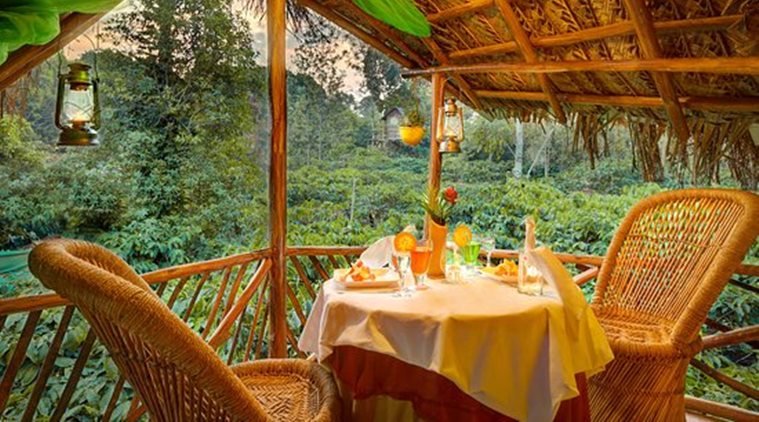
Homestays and resorts in Coorg have started a ‘Work-from-resort’ also called ‘workation’ initiative, where employees can stay at the homestays or resorts and work from there. The resorts have come up with attractive packages that offer rooms at affordable rates.
Few homestays in the hilly district have started to invest in internet connections since most of the places in Coorg have a poor data connection.
Facing a brunt due to Covid-19 lockdown, the tourism industry in Coorg (Kodagu) has come up with an innovative initiative to attract tourists.
Homestays and resorts in Coorg have started a ‘Work-from-resort’ also called ‘workation’ initiative, where employees can stay at the homestays or resorts and work from there. The resorts have come up with attractive packages that offer rooms at affordable rates.
The step has been taken to boost the income and tourism sector in the district, a few homestay owners in the district said, adding that the increase in Covid-19 cases in the area continues to be an obstruction in getting new bookings.
Speaking to indianexpress.com, Nikshan Nanaiah from Coorg Evergreen County resorts said, “The work from resort initiative gained good response especially from people in Bengaluru initially after the exit from the lockdown. We had received a good number of booking for the option for at least one week.”
According to Nanaiah, many resorts opted for this service and started to promote the ‘workation’ option. “Under the work from resort option, we are providing good internet connectivity, room, office furniture and food service. All of these are included in the affordable package ranging from two days to one-two weeks.”
The top resorts in Coorg have also started to offer the work from resort options. A manager of a branded resort in South Coorg told that they have started the bookings and many have already come to stay. “We have different packages to offer our customers and also affordable packages to our member customers. People from Bengaluru and Mysuru are coming to the resort to stay at least for one week and they are also working from here only,” he said.
Few homestays in the hilly district have started to invest in internet connections since most of the places in Coorg have a poor data connection.
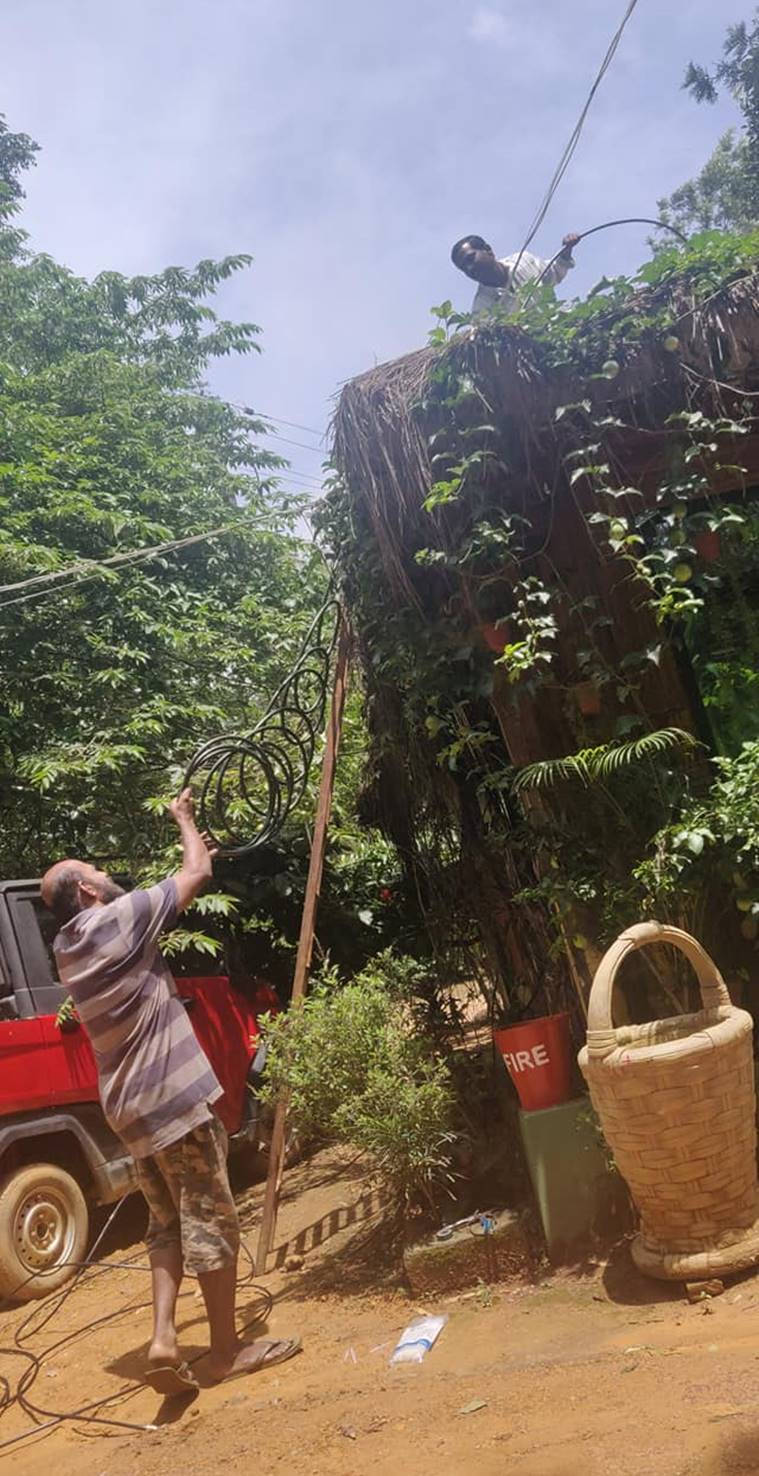
Internet cable is being set at Coorg Evergreen County resort in Coorg.
“Earlier tourists were not asking for internet connectivity since they come here to relax from their daily work life, but now after COVID-19 everything has changed, they come here to work. We have now taken good internet broadband connection to attract the tourists who want to work from here,” Kumaran, owner of Pavitra homestay in Coorg said.
Apart from the homestays and resorts offering work at their places, the major concern is about the safety of both tourists and the employees. Nanaiah says that they have made a list of precautionary measures to take. “We have thermal screening facilities, with daily temperature checks if they are symptomatic they will be sent back and we are also taking care of the employees and checking their temperature daily to ensure all are safe.”
According to the various resort owners, they are charging approximately Rs 2,000 to 6,000 per day for the workation option.
Coorg which is about 260 km from state capital Bengaluru is a hill station known for its waterfalls, national parks, wildlife, and temples. Earlier in 2018 and also in 2019 the district suffered from the back-to-back floods and landslides which had a major impact on tourist footfall.
Sagar Ganapathy, President, Association for Rural Tourism (ART) Coorg and also the owner of Jungle Mount Adventures said, “Tourism in the district has incurred a huge loss from past three years continuously due to the flood and landslides, now Covid-19 has also impacted the industry.”
“When we opened the homestays and resorts after lockdown the bookings we received were very less and we got bookings from the people who are our regular customers. Hence few resorts tried work from resort options which branded resorts are running this successfully with all the precautionary measures,” he said.
Coorg has nearly 800 registered homestays and more than 2,000 unregistered homestays which are run by families at their residence and 500 hotels and lodges. These homestays and hotels generate employment to around 50,000 people.
“Due to Covid-19 we now have no steady source of income. We opened up the business but after a week there were many cases in Coorg. So many resorts and homestays closed voluntarily. We have paid a 50 per cent salary till last month to the employees. But next month, we don’t know what to do.”
Meanwhile, the state government is planning and bring various initiatives to revive the tourism sector in the state. Speaking to indianexpress.com, Karnataka Tourism Minister C T Ravi said, “ Tourism contributes 14.8% to our gross state domestic product (GSDP), we are planning various ways to revive tourism in the state. New ideas like ‘workation’ are welcome, in the next cabinet meeting we will take up the issues faced by the homestays and resorts.”
source: http://www.indianexpress.com / The Indian Express / Home> Cities> Bangalore / by Darshan Devaiah BP / Madikeri / June 30th, 2020
Minister Kota Srinivas Poojary conducts a review meeting in Madikeri on Wednesday.
Madikeri :
Noting that Kodagu has ample opportunities for fish cultivation, Minister for Muzrai, Fisheries, Port and Inland Transport, Kota Srinivas Poojary felt the need to carry out serious efforts in this regard.
Chairing a meeting at Zilla Panchayat auditorium in Madikeri on Wednesday, he lauded the efforts of coffee growers who have been carrying out fish cultivation in their private ponds in the plantations.
The minister meanwhile directed the officials from the fisheries department to rear the best varieties of fish in Harangi fish rearing centre and provide fingerlings to interested farmers
“Innovative ideas with respect to fish breeding should be brought into effect,” he said.
Fisheries department assistant director K T Darshana said that a total of 1,886 hectares of area in Harangi reservoir is being utilized for fish rearing and has been handed over to Kaveri Meenugarara Sahakara Sangha.
Similarly, 105 hectares in Chiklihole has been handed over to the cooperative society, through tender-cum-auctioning. There are 200 fishermen, 95 fish vendors and 2,000 fish cultivators in the district, she said.
The official said that six lakes under fisheries department, 506 lakes under various Gram Panchayats, 3,000 private lakes, nine ponds and two riversides in the district have been handed over to Kodagu Vanyajeevi Samrakshana Sangha on a contract basis.
“Sale of 4,000 kg to 5,000 kg fish takes place in the district on a daily basis. Kodagu is among the first 10 districts which have the highest sale of fish. The total production capacity of fish in the district is 3,582 tonne, as per the statistics of 2018-19,” she added.
Harangi fish rearing centre official Sachin said that ponds are being created in Harangi region. Currently, there is a demand for 40 lakh fingerlings in the district and 21 lakh fingerlings are being provided by the centre.
Minister Kota Srinivas Poojary assured to provide Kissan cards to fish cultivators. Loan facility with zero percent interest up to Rs 3 lakh will be provided to fishermen.
‘Complete development works soon’
Conducting a review meeting of the Muzrai department, the minister directed the officials concerned to complete the development works in the temples soon.
He stressed on completing the work on the proposed ‘Yatri Nivasa’ guest house at Bhagamandala, on priority.
The minister assured to hold discussions with the health department towards giving permission for ‘pinda pradana’ ritual at Bhagamandala.
Deputy Commissioner Annies Kanmani Joy said that Rs 1 crore has been provided by BBMP, towards the development of Bhagandeshwara-Talacauvery temple.
Kodagu Zilla Panchayat CEO K Lakshmi Priya, Additional DC Dr Sneha and Assistant Commissioner T Javaregowda were present.
source: http://www.deccanherald.com / Deccan Herald / Home> State> Mangaluru / by DHNS, Madikeri / June 24th, 2020
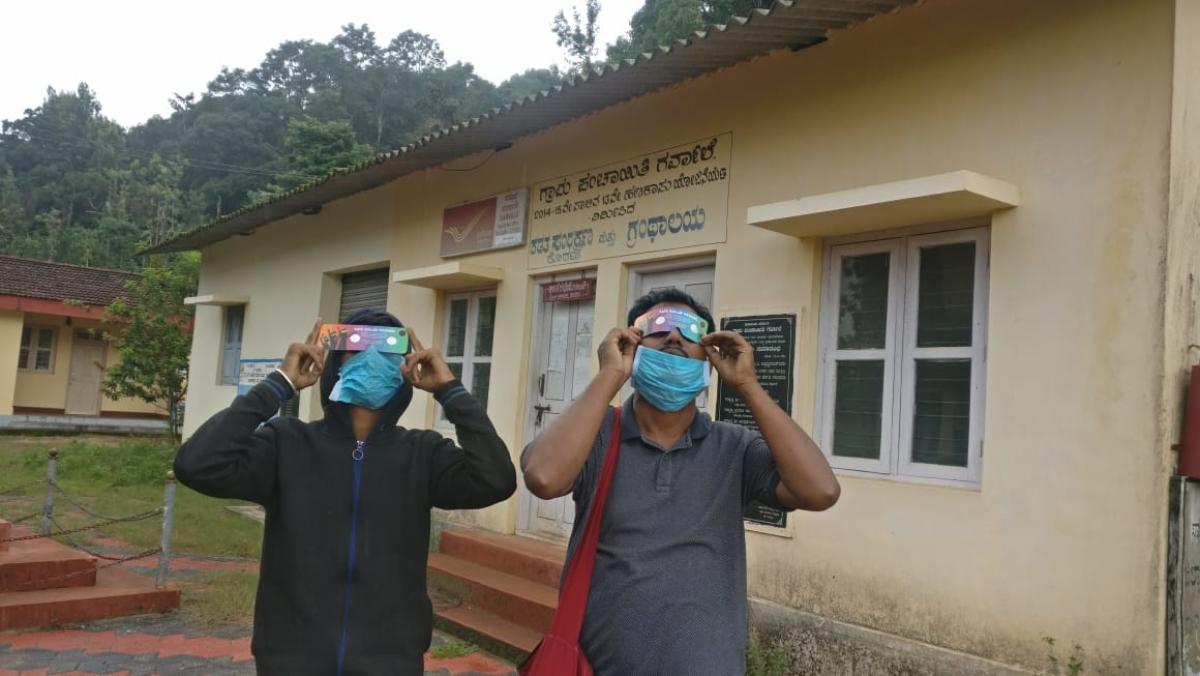
People watch solar eclipse using goggles in government high school in Soorlabbi near Madapura on Sunday. DH Photo
The first ‘ring of fire’ annular solar eclipse of the year 2020 could not be witnessed in Kodagu, as the sky remained overcast disappointing a majority of eclipse watchers.
In Madikeri, the eclipse was witnessed between 11 am and 12 noon, amidst clouds. People preferred to remain inside their houses. The astronomical incident had its impact on commercial activities too.
The previous solar eclipse to be seen in Kodagu was on December 26.
Talacauvery, Bhagamandala, Omkareshwara and Igguthappa temples remained closed after offering prayers in the morning. Entry of devotees to the temples were restricted during the solar eclipse. The temples were reopened after 5 pm for cleansing.
source: http://www.deccanherald.com / Deccan Herald / Home> State> Karnataka Districts / by DHNS, Madikeri / June 21s, 2020
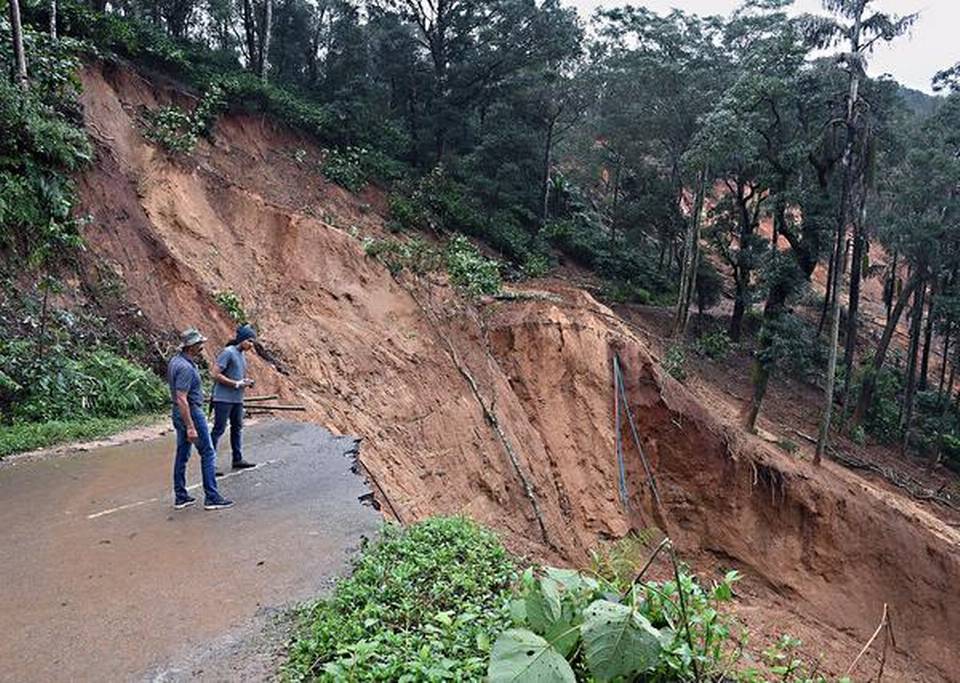
A file photo of the Makkandoor Somwarpet road after a landslip near Madikeri in 2018. | Photo Credit: G_P_Sampath Kumar
IISc. study finds built-up area rose from 1.55% to 2.69% from 2016 to 2019
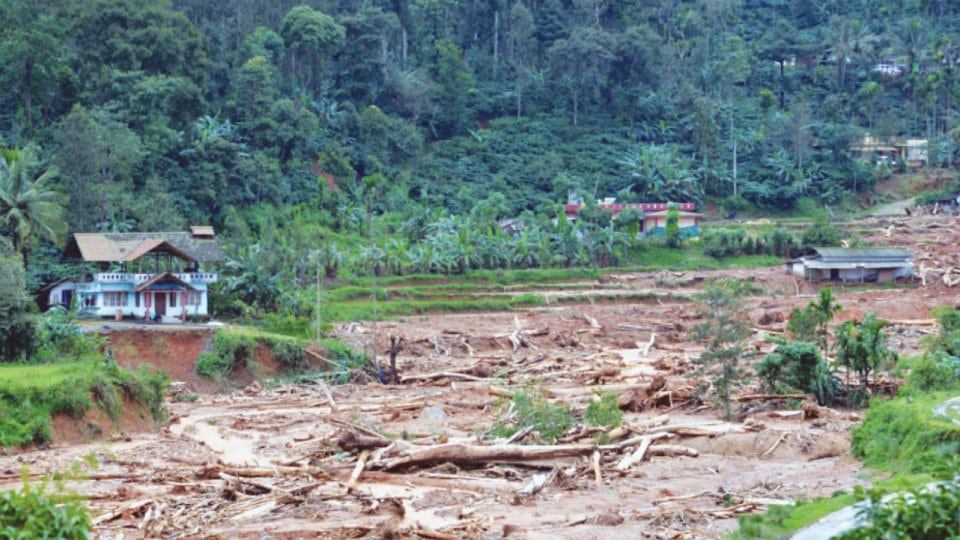
The latest landslip in Madikeri town last week, following which the Kodagu district administration decided to shift 13 families to safety, brings the focus back on the ecological sensitivity of the region which has been ignored.
This is the third consecutive year that the district is witnessing landslip and experts say this calls for urgent long-term environment mitigation policy initiatives, besides a halt on wanton destruction of the local environment.
A study by a team of experts from the Indian Institute of Science (IISc.), Bengaluru, has highlighted the dangers of increased landslip, if the current development trend is allowed to continue.
The findings are by T.V. Ramachandra, S. Vinay and S. Bharat of Energy and Wetlands Research Group, Centre for Ecological Sciences, IISc.. It has been published in a paper titled ‘Urban Dynamics in Coorg District, Karnataka’ in the ENVIS Technical Report.
The study assessed the land use dynamics of the district and the results indicated that the built-up area has increased from 1.55% to 2.69% in three years from 2016 to 2019.
Besides, the native vegetation cover including forest, scrub jungles, sacred groves have declined from 45.44% of the land area to 44.46%.
The other findings of the study also has environmental implications and it points out that the interior forest cover of the district had declined from 24% to 22.23%.
The proposal of new layouts, resorts, highway expansions and linear projects will encourage higher land use changes, according to the study.
It stated that the urbanisation process has led to chaotic growth in the region and called for determining the rate and trend of land use conversion for devising a rational land use policy. Based on the land use pattern for 2016 and 2019, the authors of the study predicted the landscape dynamics for 2031, which indicated increase in the built-up areas in Madikeri, Kushalnagar, Virajpet, Gonikoppal, and Somwarpet.
Also, the influence of road networks and tourism will encourage urbanisation along highways and identified Kodilpet, Suntikoppa, Hebbale, Maadapura, Napoklu, Ammathi etc, as per the study.
source: http://www.thehindu.com / The Hindu / Home> News> States> Karnataka / by R Krishna Kumar / Mysuru – June 22nd, 2020
Deputy Commissioner Annies Kanmani Joy said that the compensation for fruit and vegetable growers, affected by Covid-19 lockdown, would be distributed as per the eligibility and through direct benefit transfer.
Banana, papaya, fig, pineapple, watermelon, muskmelon, green chilly, tomato, cabbage, pumpkin, ash gourd, carrot, onion and capsicum crops are included under the compensation scheme.
Every beneficiary will be provided with a maximum compensation of Rs 15,000 per hectare, where the fruits or vegetables were cultivated. Minimum compensation is fixed at Rs 2,000, Annies said.
The farmers, who enrolled under Crop Survey 2019-20, will be eligible for the compensation. The list of the names of farmers enrolled in the survey will be displayed at Raitha Samparka Kendra of the taluk Horticulture department.
Two weeks time will be provided to file objections if any. The farmers need not submit any documents with the application to claim compensation for the above mentioned fruit and vegetable crops.
However, the farmers, who are not enrolled in the Crop Survey, should submit the original copy of RTC, letter of consent (in case of joint RTC), self-declaration certificate, details of bank account, IFSC code and the photocopy of the first page of bank passbook indicating name and address clearly and other necessary documents if the RTC holders have expired.
The application formats are available at the office of the taluk Horticulture departments and at all Nadakatcheri offices.
The last date to submit the application is June 17.
The filled application should be submitted, along with relevant documents, to Senior Assistant Director, Horticulture department (Zilla Panchayat), Madikeri (Phone: 9448336863) and Senior Assistant Director, Horticulture department (Zilla Panchayat), Somwarpet (Phone:855393335) and Senior Assistant Director, Horticulture department (Zilla Panchayat), Ponnampet (Phone:9448049020).
source: http://www.deccanherald.com / Deccan Herald / Home> State> Mangaluru / by DHNS, Madikeri / June 12th, 2020
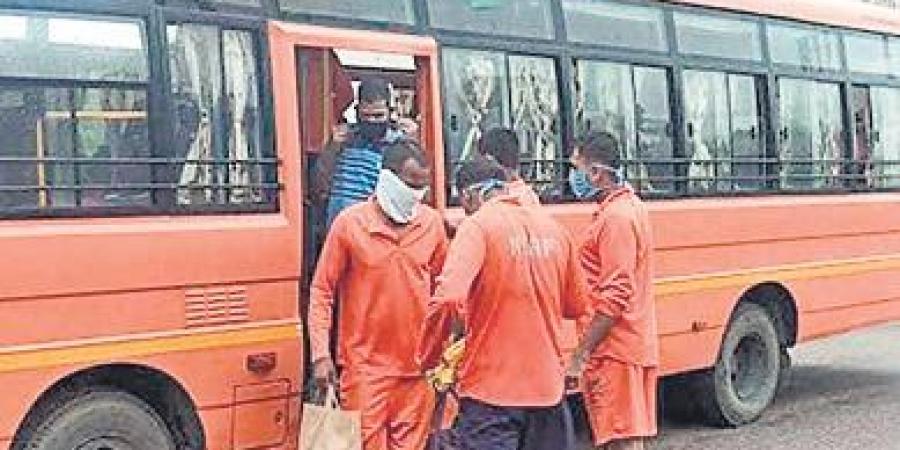
A National Disaster Response Team of 25 people reached Kodagu district on Tuesday and will be in Madikeri during monsoon. The NDRF team reaches Kodagu on Tuesday and will stay in the district till the end of this monsoon season | EXPRESS
Madikeri:
A National Disaster Response Team of 25 people reached Kodagu district on Tuesday and will be in Madikeri during monsoon. The team is likely to stay in the district till August-end. The team members are from the 10th Battalion of the NDRF and arrived from Andhra Pradesh.
The team is headed by Commanding Officer R K Upadhyaya. The team has been sent to the district following a request from Kodagu Deputy Commissioner Annies K Joy.
The NDRF team is likely to conduct mock rescue operations. Following the 2018 floods in Kodagu, the district administration is taking all precautionary steps.
The NDRF and the Karnataka Civil Defence Quick Response Team have actively involved themselves in rescue operations during monsoon across Kodagu district since 2018.
source: http://www.newindianexpress.com / The New Indian Express / Home> States> Karnataka / by Express News Service / June 03rd, 2020
Henceforth, lands will be converted based on report by Geological Survey of India (GSI)
Bengaluru:
The Karnataka Government has relaxed regulations banning the conversion of land in Kodagu district and now allows small land-owners to build their homes by converting agricultural land, a move that will allow commercial establishments and layouts to flourish in the district that was devastated by landslides two years ago.
Revenue Minister R. Ashoka said the Government decided to permit land conversion as both locals and elected representatives wanted the moratorium to be lifted. That is why the Government has decided to permit land conversion again, with some restrictions. In May 2019, the ban was relaxed to allow conversion for small individual houses.
According to Ashoka, land conversion from agricultural to residential land will be regulated and will not be allowed along buffer zones. Ten metres on each side of a river, stream or storm water drain are classified as buffer zones. Moreover, conversion is prohibited in properties with steep slopes as houses built on such terrain could collapse during landslides. Land conversion is also prohibited in regions where houses had collapsed in 2018 floods, he said.
The land can be converted for commercial purposes. Ahead of any conversion, land-owners will have to seek no-objection certificates from Deputy Commissioners and local Gram Panchayats. Only after a Committee headed by the DC, which includes a Geologist, submits a report the conversion can take place, Ashoka said.
The land will be thoroughly surveyed by the Tahsildar. The survey report (by the Tahsildar) will be reviewed by the DC under Section 95 of Karnataka Land Revenue Act of 1964 before granting conversion.
Land conversion, Ashoka said, will be based on the report by the Geological Survey of India (GSI). Those that are categorised as red-alert areas will not be converted. The conversion will be regulated so that the district does not face any landslides.
The State had imposed a blanket ban on land conversion in Kodagu following floods and landslides in August 2018. The regulations were tightened based on recommendations made by GSI. Following this, Kodagu district authorities rejected over 693 applications in the last five months to convert land for commercial use.
source: http://www.starofmysore.com / Star of Mysore / Home> News / by February 14th, 2020
WELCOME. If you like what you see "SUBSCRIBE via EMAIL" to receive FREE regular UPDATES.
Read More »