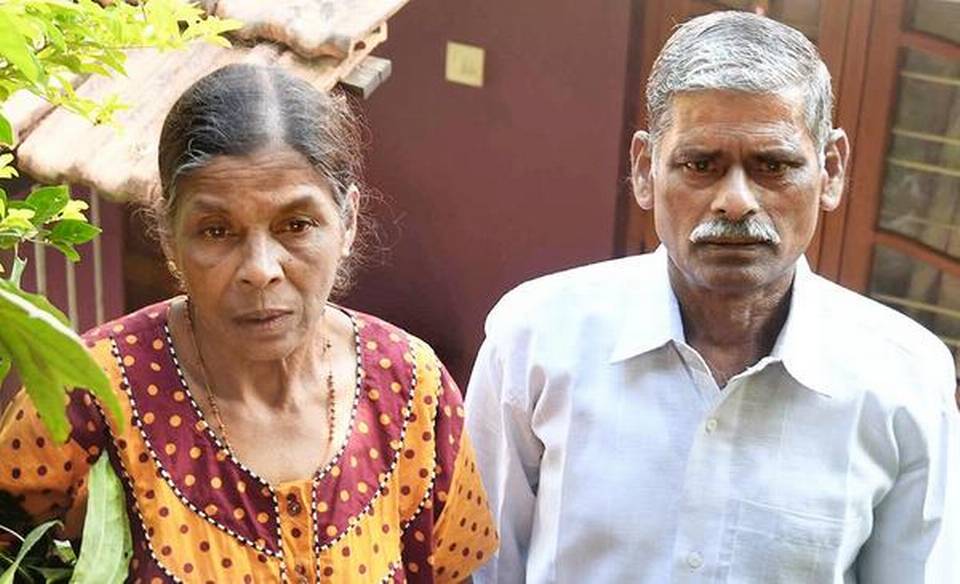
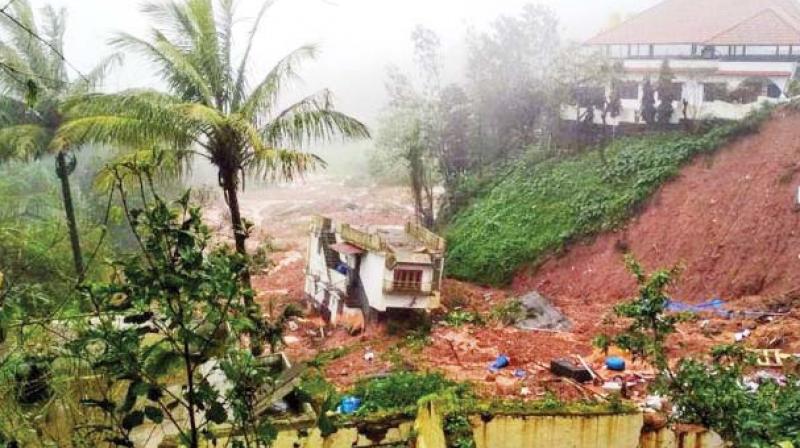
“The search for my daughter Manjula whose life was lost during the landslide and floods on Aug.17 at Jodupala where she was studying in my sister Gowramma’s house is still going on. I live in a tribal area and on that fateful day even after I came to know of the tragedy, I was not able to reach the place. It was only four days later that we were able to go there only to find that my sister and other members of the family had all died,” recalled Somaiah, father of the flood victim Manjula from Kodagu.
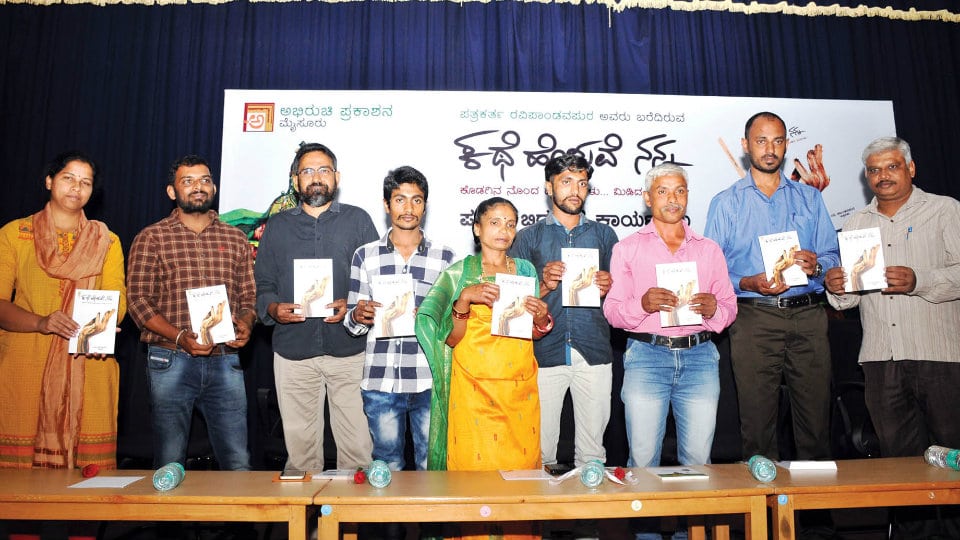
He was sharing his experience after releasing the book ‘Kathe Heluve Nanna – Kodagina Nonda Hrudayagalu… Midida Managalu’ written by journalist Ravi Pandavapura at the Rani Bahadur Auditorium here this morning and said that his daughter was a tenth standard student and he was still in search of her body.
Kodagu Superintendent of Police Dr. Suman D. Pennekar said that it was just one month before she had taken charge and this was a very new experience when the tragedy struck, which was very challenging.
“There were distress calls all around. But everyone be it the local guides, officials and the public rose to the occasion and supported us in those trying times. Even the Chief Minister, Deputy Chief Minister and Deputy Commissioner were with us. However, our first priority was to rescue those who were alive and only later we concentrated on recovering the dead bodies,” she said.
Senior Journalist Ananth Chinivar spoke about the book. Kodagu Press Club President Ajjamada Ramesh Kuttappa presided. Somaiah’s wife K.S. Jayanthi, sons K.S. Darshan and K.S. Roshan were present.
Abhiruchi Prakashna’s Abhiruchi Ganesh who has published the book and author Ravi Pandavapura were also present. The 128-page book is priced at Rs. 105 and the proceeds of the book will go towards Kodagu Relief Fund.
Follow Star of Mysore on Instagram www.instagram.com/starofmysore
source: http://www.starofmysore.com / Star of Mysore / Home> News / December 14th, 2018
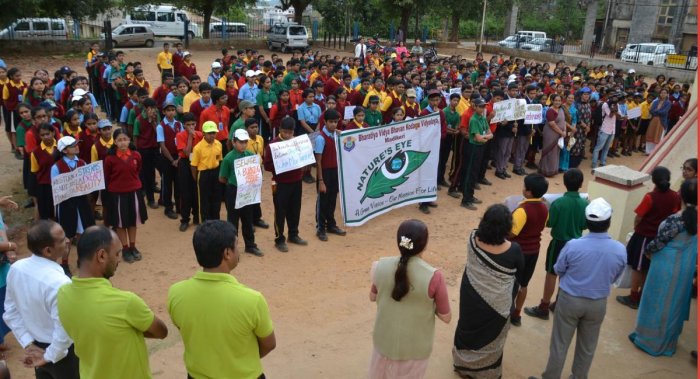
Students take part in a cleanliness jatha in Madikeri.
Green City Forum Convener Kukkera Jaya Chinnappa called upon the residents to keep their surroundings clean.
Speaking at a cleanliness jatha organised by Bharathiya Vidya Bhavan Kodagu Vidyalaya here at Madikeri on Wednesday, he said the Central government has been focusing on cleanliness and sanitation.
There is a need to ensure that all the households have toilet facilities. The residents should keep their surroundings clean, he added.
The students of Bharatiya Vidya Bhavana Kodagu Vidyalaya and General K S Thimayya Public School participated in the jatha.
The jatha was carried out from Gandhi Maidan and passed through Raja Seat Road to KSRTC bus stand. Handbills were distributed among the public.
source: http://www.deccanherald.com / Deccan Herald / Home> States> Districts / by Naina J A / DH News Service,Madikeri / December 05th, 2018
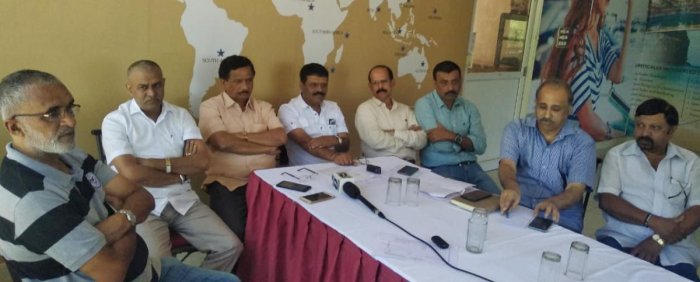
Legislators at a meeting on the implementation of the Kasturirangan report recommendations on the conservation of the Western Ghats.
MLA K G Bopaiah said that habitation area should be dropped from the purview of the ecologically sensitive area (ESA) while implementing the recommendations of the Kasturirangan panel on the conservation of the Western Ghats.
There is time till December 2 to file objections to the draft notification issued by the Ministry of Forest and Environment on the implementation of Kasturirangan recommendations, he added.
Speaking at a meeting organised to discuss on Kasturirangan report on Monday, he said the first draft notification on the recommendations was issued in 2014. The fourth draft notification was issued in the month of October.
Following a stiff opposition from the people living in the Western Ghats area, the Green bench had ordered to collect public opinion in the matter. The people from Kodagu should file objections to the report to ensure that the recommendations are not implemented, he added.
He said that the recommendations are harmful to the farmers as well. If more number of objections are submitted, it will benefit the people of Kodagu district, he said.
He appealed to the gram panchayats, taluk panchayats and zilla panchayats to file objections based on the resolution passed against the implementation of recommendations of Kasturirangan report.
Varadi Anushtana Virodhi Samithi office bearer Nanda Subbaiah said, “The Kerala government had made an on-the-spot verification of the villages falling within the ecologically sensitive areas (ESA) and kept agricultural land, plantations, and habitations out of the purview of the ESA.”
MLA M P Appachu Ranjan, MLC Sunil Subramani and others were present in the meeting.
source: http://www.deccanherald.com / Deccan Herald / Home> States> Districts / by Adithya KA, DH News Service / November 26th, 2018
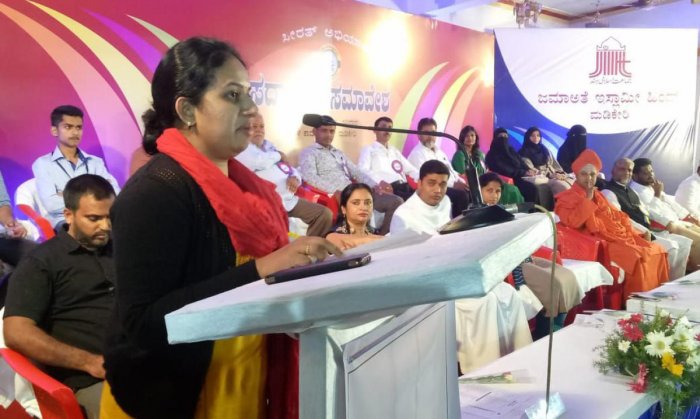
Deputy Commissioner P I Sreevidya speaks at Sadbhavana Convention organised by Jamaat-e-Islami Hind, Madikeri unit, on Saturday.
The volunteers, who took part in the rescue operations during the massive landslides and floods that ravaged Kodagu, are role models for the entire country, said Deputy Commissioner P I Sreevidya.
Speaking at the Sadbhavana Convention, organised by Jamaat-e-Islami Hind Madikeri unit on Saturday, she said volunteers not only took up rescue operations but also lent a helping hand to the district administration.
“As many as 600 victims have been provided shelter at the relief centres by the district administration. The government has been providing facilities to the victims. Members of various organisations are also extending financial assistance and providing relief materials to the victims,” added the deputy commissioner.
Kalancheri Mutt seer Shanthamallikarjuna Swami said that such conventions were essential to foster communal harmony in the society.
As many as 15 volunteers, who were part of the rescue operations, were felicitated on the occasion.
source: http://www.deccanherald.com / Deccan Herald / Home> States> Districts / by Adithya K A / DH News Service,Madikeri / November 25th, 2018
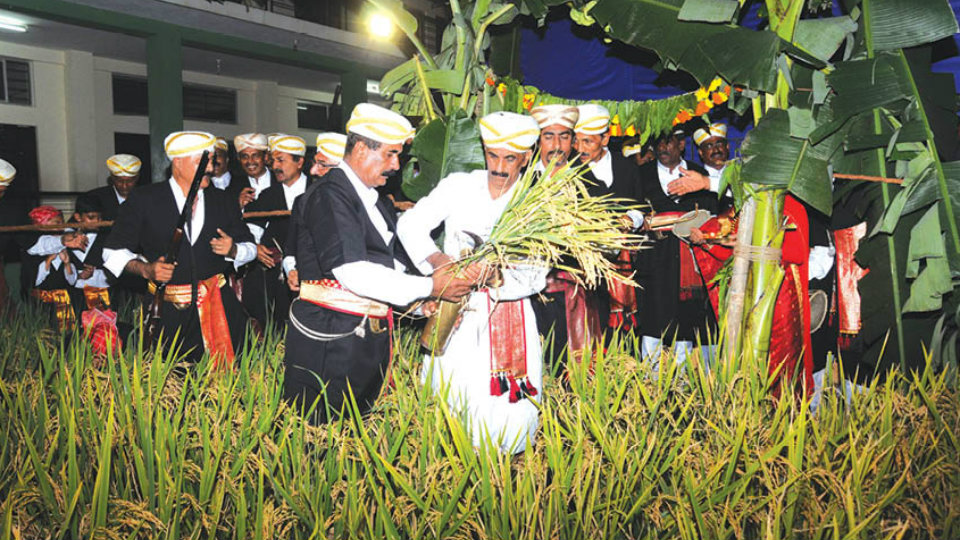
Kodava Samaja, Mysuru, will be celebrating Huthri, the harvest festival of Kodagu, tomorrow (Nov.23) at Sree Cauvery College Grounds in Kuvempunagar from 5.30 pm onwards.
On the occasion, traditional Kodava dances will be presented. ‘Nere kattuva’ ritual will be held at 7.30 pm; reaping new paddy crop (Kadiru) at 8.30 pm; distribution of thambutt prasada at 9.30 pm.
As in the previous years, Puthari Eedu was held from Nov.18 daily at 6 pm at the Samaja premises in Vijayanagar where traditional Kodava dances are practiced. The Eedu programme, sponsored by various Kodava Sanghas, will be held this evening also.
While Ketolira Ravi Belliappa trains the young and old male dancers in Bolkaat, Kolaat, Kathiyaat and Pareyakali, Kullachanda Vinutha Kesari imparts training to girls in Ummathaat.
Thanks to Kodava Samaja, Mysuru, for strengthening the community bonding and preserving the Kodava culture and tradition by holding such events and encouraging the youngsters.
The main event in traditional Kodava attires will be held during Huthri celebrations tomorrow evening at Cauvery Institutions premises.
Gowda Samaja
Huthri festival will also be celebrated under the auspices of Kodagu Gowda Samaja, Mysuru, at its premises in Vijayanagar 2nd Stage here tomorrow from 7 pm onwards. ‘Nere kattuva’ ritual will be held at 7.45 pm; reaping of new paddy crop (Kadiru) at 8.45 pm. There will be distribution of Kadiru also, according to a press release from Samaja Hon. Secretary K.S. Ganapathy.
source: http://www.starofmysore.com / Star of Mysore / Home> News / November 22nd, 2018
In Kannada, we have a proverb that can be loosely translated as “giving one’s hands and cuff too”. It indicates a situation where one unwittingly lands in a predicament due to one’s own mistake. We have several proverbs in Kannada that convey the same meaning, one even suggesting inviting a passing by ghost to come in and have a feast. (Beedeel hogo marina manege karedante)
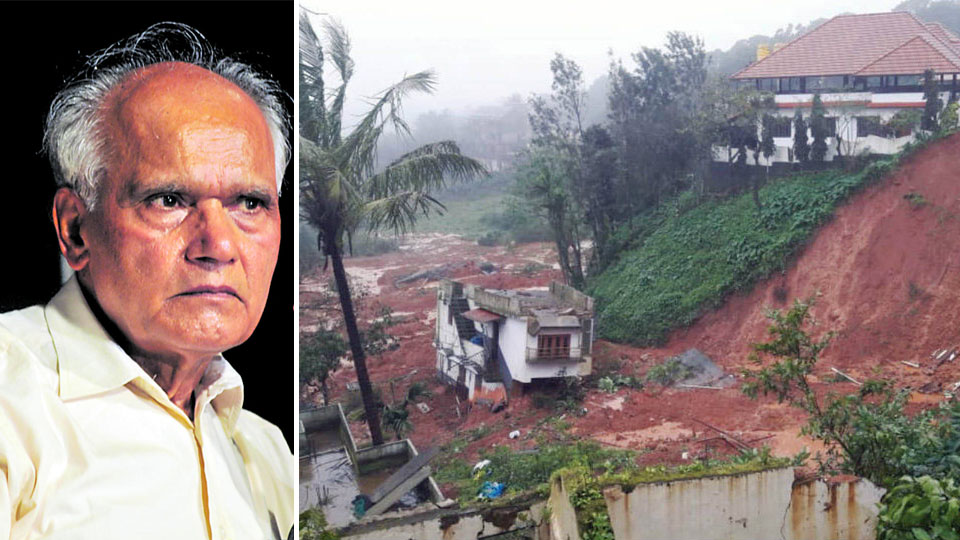
A letter written by senior author S L Byrappa to the Chief Minister suggesting that Karnataka should seek help from Tamil Nadu to rebuild flood-ravaged Kodagu can best be described thus – inviting trouble. His reasoning is that since Tamil Nadu is the “biggest beneficiary” of Cauvery water and as the river originates at Talakaveri in Kodagu, it should contribute in a big way to rebuild Kodagu.
If all were well with Tamil Nadu, Karnataka could have asked for help, but TN has never tried to hide its exaggerated claims on Cauvery water. Even when Karnataka reels under famine, resulting in a large number of farmers committing suicide, our neighbour is unmoved and holds on to its demand for Cauvery water. Now, if the State seeks help from TN and if it agrees and does give funds, then TN will declare all the more brashly that the river “belongs” to it. A previous example is the Mulle Periyar dam, which is in Kerala but TN ‘owns’ it as a result of an agreement made more than a century ago, during British rule.
If we go ahead, Karnataka will be forced to give up its right over the river and when the Tamils claim ‘Cauvery belongs to us’, Kannadigas will not have grounds to debate the claim.
Interestingly, S L Bhyrappa made this suggestion to ask TN for help recently at a special lecture series on “Current social and environmental affairs of India” at BM Sri Hall, at Manasagangotri, Mysuru. The lecture was jointly organised by H M Nayak Foundation and Kuvempu Institute of Kannada Studies. Now, all the four names associated with the lecture program – B M Srikantaiah, H M Nayak, Kuvempu and Manasagangotri – have strived all their lives for the betterment of Kannada, Karnataka, its culture and natural resources.
B M Srikantaiah’s inspiring speech 100 years ago about the lack of pride in Kannadigas and how it is the need of the hour to kindle pride and honour among Kannadigas is evergreen. Kuvempu would never agree to beg a neighbour to safeguard the State’s interest. He was instrumental in starting Manasagangotri at Mysuru and shifting the post graduate centre from Madras. Though he completed his MA in Kannada from Presidency College, Madras, he insisted that the Mysuru State required its own university. Definitely, he would not have approved of begging TN for help, as wouldn’t any other proud Kannadiga.
The TN government has consistently been in a position of advantage with regard to Cauvery water. To suggest that Karnataka seeks help from TN can only be described as suicidal and nothing short. Let us all chip in and rebuild Kodagu.
Then, there is another suggestion to build a huge statue of Cauvery and develop a Disney Land kind of amusement park at KRS dam. Who gets such ideas or who gives such ideas to the government? What is the need for it? Experts are slamming the idea saying it will be dangerous for the dam. Also, in the river/dam basin only irrigation /water storage activities must be carried out instead of indulging in amusement parks to attract tourism. Hence, the government should abandon the ideas of a statue and ‘Disney Land’ at KRS dam.
The statue culture, which Tamil Nadu defined some decades ago, is diminishing. The Statue of Unity is out of the purview of this debate as is the one of Mayawati. Now, a huge statue of Rama is being planned, which is altogether a totally different debate. A river takes its birth in a small way and then expands. The same is seen with Cauvery. Why should we have a huge statue of Cauvery? The one that is already there at KRS is small, beautiful and is being worshipped regularly. That is enough.
source: http://www.bangaloremirror.indiatimes.com / Bangalore Mirror / Home> Opinion> Others / by Pratibha Nandakumar, Bangalore Mirror Bureau / November 19th, 2018
Apolimanthera and Dominic, in front of their house at Hattihole, Kodagu.
The landscape bears the wounds of the devastating deluge; families, worried about the future, are wary of returning home.
A river, brown with muddy water, flows its usual course on a sunny afternoon, deceptive of the ravage it had caused two months ago when heavy rains and floods devastated Kodagu. On one side of the river’s bank sit two houses – both with different stories of the same tragedy.
One bears large cracks on the walls. Dominic, 63, and his wife Apolimanthera, 59, had to flee from their home in Hattihole, Kodagu district, for a week, after the water level rose on August 17, inundating their home that is below road level. “The water was up to our waist on the road, and we were asked to rush out. We stayed at the relief centre set up in the church for around a week and returned to the devastation after the levels receded,” Mr. Dominic said.
Pointing to a large tree that was swept away by the force of water, which now stands as testimony to the extent of the disaster in the middle of the river, visible from their backyard, he lamented that the river water was now unfit to be used for anything.
Next door, within the same compound is the house of Francis Montheiro, 47, now locked up. A social worker, Mr. Montheiro, known as Appu, was an active volunteer during the floods too. Mr. Dominic last saw him on the morning of August 17, after which he went missing. His body was found in the river nine days later.
Mr. Montheiro’s wife Flaviya Jyothi, 44, a nurse at a private hospital in Madikeri, and two children have shifted to the capital. “My husband used to pick up and drop me halfway. But now, with my shift timings, I decided to shift to Madikeri to make travel easier,” she said. Their sons are in Class 10. Mr. Monteiro was engaged in small businesses dealing with pepper and coffee and drove a taxi.
The house they have left behind, Ms. Jyothi said, is the only asset the family has. “We received ₹5 lakh in compensation. But how do you make up for the loss of a person? Appu is now only a name in our memories,” she added.
Francis D’Souza runs a small hotel on the main road that leads to Hattihole. Having lost his house in the flood, he now lives in a house on rent. “Not just our house, when we left for the relief centre, someone stole what was left in the house and the hotel – jewellery, homemade wine, and bottles of honey (which he sells) and sacks of pepper,” he said.
Three months after the floods, signs of devastation are still everywhere. In Thantipala, the van of a local resident lies almost fully buried in sand left behind by flood water. Mounds of flood residue comprising mud and broken trees line up either side of the road paved out.
In Udaygiri, the remains of the sole house that survived a massive landslip hinges on the edge, as locals continue to stream in, standing cautiously on the other side and trying to remember the road that once led straight to that house. Raghavendra Shetty, a school teacher, said one person had died here, and at least five houses had turned into rubble.
Normalcy is still a far cry for these families.
Says Ms. Apolimanthera, with large coffee estates being wiped out, work as an estate worker was hard to come by. “I used to earn around ₹1,800 a week. Now I am lucky if I find enough work to pay me ₹300 a day. In our 50 years here, we have never been faced with anything like this,” she said.
Apart from dealing with coming to terms with the present, many are worried about the future.
Charan Panthale drives down to his field in Devasthur, where his house stands half destroyed. A large tree trunk, brought in by the gush of water that crashed into his house, still stands. Sacks of husk lie outside the house on a bed of mud that was the land it was harvested in.
“We have lost one and a half acres. There is nothing we can do about it at present. It will take a long time,” he said. The family is temporarily living with relatives.
840 beneficiaries in the first phase
The Kodagu district administration has identified 840 beneficiaries who will be given houses in the first phase. The government will approve one of the five model houses being built by different agencies and companies.
Sreevidya P.I., Deputy Commissioner, Kodagu, told The Hindu that the report had been submitted to the government and awaited approval. The beneficiaries were chosen based on applications and cross verification with agencies such as the gram panchayats.
“There are five houses and three have been completed. The Chief Minister has also seen these. New technology has been tried out in these. We will see which of these is suitable for the hilly terrain and landslips and accordingly, one model will be selected,” she said.
The DC also said that some people had expressed willingness to build houses on their own, for which the government would provide some compensation, and they too could utilise the technology implemented in the model houses. The unit cost is yet to be decided, she said.
As for crop losses, a hectare-wise compensation based on the type of plantation – coffee, paddy, pepper, etc –would be initiated , Ms. Sreevidya said, adding that NDRF guidelines were followed for the surveys, and with Union government funds involved, they would have to wait for government approval.
(This is the first of a two-part series.)
source: http://www.thehindu.com / The Hindu / Home> News> States> Karnataka / by K.C. Deepika / November 17th, 2018
Every other day, Tamil Nadu raises Cauvery water sharing issue and regularly knocks the doors of Supreme Court demanding its share of water irrespective of rainfall and water storage levels in dams of Karnataka along the Cauvery Basin. Is it not its (Tamil Nadu) duty to come to the rescue of people of flood and landslide-ravaged Kodagu (the birth place of River Cauvery) during their time of distress?
This question of natural justice has been raised by Saraswati Samman recipient and noted Kannada Litterateur Dr. S.L. Bhyrappa. Tamil Nadu is the biggest beneficiary of River Cauvery for its drinking water, livelihood and irrigation needs and that State ensures that Karnataka releases water regularly even though there is less rainfall and the storage levels in the dams hit rock bottom.
“Tamil Nadu must come to the rescue of Kodagu residents and it will be a violation of natural justice if it does not help the affected people of Kodagu. Why is Tamil Nadu silent on this though it takes all the benefits from the river that takes birth in Kodagu,” Dr. Bhyrappa questioned. “If it is Karnataka’s ‘duty’ to grow forests and protect River Cauvery, why Tamil Nadu has the sole “right” only to use the water without doing any duties,” he questioned.
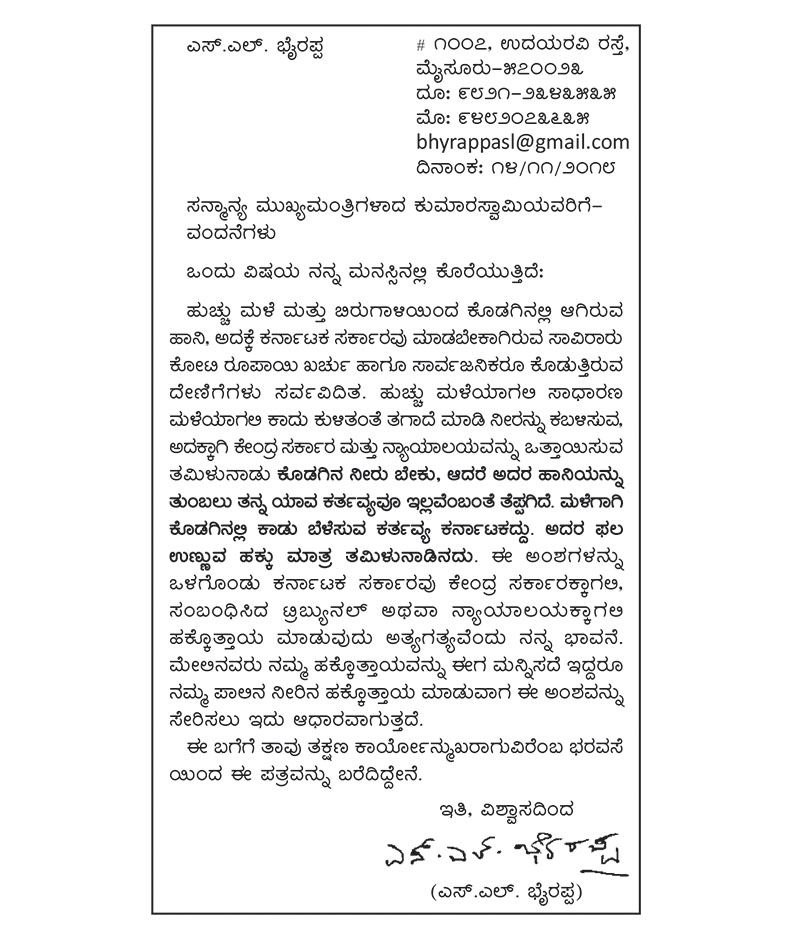
In a letter to Karnataka CM H.D. Kumaraswamy, the noted litterateur whose novels attempt to bring in a change in the society said that irrespective of the rainfall in Kodagu, Tamil Nadu waits for an opportunity to clash with Karnataka in the Courts of law on river water sharing. “While TN fights for its “right”, it seems to forget its “duty” or “obligation.” It wants water from Kodagu but is keeping quiet when the birthplace of Cauvery is suffering from natural calamity. How fair is it,” he asked.
Dr. Bhyrappa has urged the CM to present this case and assert Karnataka’s right for financial assistance from TN either before the Centre or before the Court of law or Cauvery Tribunal. “Karnataka has every right to seek financial aid from TN to rebuild the lives of affected people in Kodagu. Karnataka’s plea may not be admitted at this stage but it can definitely be included when the rights and duties of both Karnataka and Tamil Nadu are discussed in future adjudications,” he stated in his letter. [See below]
1_Page
source: http://www.starofmysore.com / Star of Mysore / Home> News / November 15th, 2018
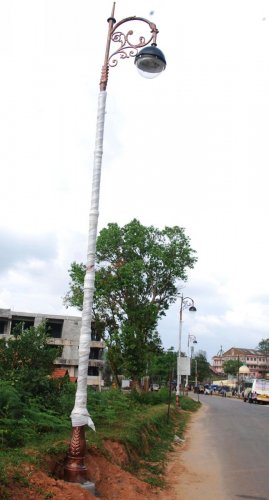
The decorative lamp posts on the road leading to Raja Seat in Madikeri.
The installation of decorative lamp posts has been completed on the road leading to Raja Seat in Madikeri. The heritage-design streetlights will light-up the streets during Deepavali.
The Urban Development Authority had taken up the work of installation of decorative lamp posts from Muthanna Circle to Raja Seat at an estimate cost of Rs 20 lakh.
The move is expected to attract more tourists.
The lamp posts, brought from Indore, are made up of cast iron with corrosion-resistant material to protect it from all kinds of corrosion. As a result, the streetlight poles will not get rusted. The poles will have 250 MHz bulbs,” said Urban Development Authority former chairman Chummi Devaiah.
The CMC had spent lakhs of rupees for installing solar lamps on the road leading to Raja Seat. However, the solar batteries were stolen by the thieves and the streetlights stopped functioning. Even the streetlight poles went missing. Now, keeping in mind the safety, decorative lamp posts are being installed.
The residents said that quality electricity poles and streetlights should be installed in different parts of the CMC jurisdiction. The solar lamps are defunct at Indira Nagar, Chamundeshwari Nagar, Gowli Beedi, Mahadevapete Road, Man’s Compound and Rani Pete Roads.
Chandan Rao, a resident of Gowlibeedi, said, “The CMC should take up the maintenance of streetlights before the onset of monsoon. All the electricity lines were damaged in the rain which lashed in August. As a result, majority of the streetlights are not functioning. The CMC should wake up and take up the restoration works.”
Indira Nagar resident Ranjitha said, “Due to the lack of streetlights on the road leading to Raja Seat and Nehru Mantapa, miscreants were creating problems for visitors during evening hours. Fearing it, many women were not taking the route for walking. The streetlights should also be installed at Nehru Mantapa.”
source: http://www.deccanherald.com / Deccan Herald / Home> State> Districts / by Adithya KA / DH News Service / Madikeri – November 04th, 2018
840 people who lost their homes have been identified. Kodagu during the flood (Representional Image)
Mysuru:
The Kodagu administration, which has identified land to build houses for 840 people, who lost their homes in the district’s floods and landslides in August this year, is getting ready to form layouts on it with all basic amenities including roads, electricity and water connection for their benefit.
According to Kodagu additional special deputy commissioner, M K Jagadish, a Rs 31.63 crore proposal has been sent to the state government to form the layouts with 373 sites in five places to begin with. Experts of the Geological Survey of India have already assessed the land identified.
While three private companies have come forward with model houses, the state government has not yet chosen one or the company for building them. “Chief Minister H D Kumarswamy has suggested we build two bedroom houses,” the officer added.
The state government, which has decided to give Rs 50,000 to each displaced family until the houses are built for them, has released Rs 6 crore towards this and the process of distribution was underway, the officer said.
While as many as 524 people have lost their houses in Madikeri taluk, 205 have been made homeless in Madikeri town, 88 in Somwarpet taluk, and 23 in Kushalnagar town. Of them 98 have decided to build houses on their own land. The land identified by the government has already been levelled, and 30 x 40 sites will be marked on it from November 2.
While most victims of Kodagu’s rains and floods have returned home, 683 still remain at seven relief camps in the district.
source: http://www.deccanchronicle.com / Deccan Chronicle / Home> Nation> Current Affairs / by Shilpa P / Deccan Chronicle / November 01st, 2018
WELCOME. If you like what you see "SUBSCRIBE via EMAIL" to receive FREE regular UPDATES.
Read More »