The seventh day of Dasara Yuva Sambhrama held at the Open Air Theatre in Manasagangothri here last evening saw the participating students sending out messages on Water Conservation, Save Kodagu and Swachh Bharat through their songs and dance.
While the students of Government Arts, Commerce and PG College, Hassan, gave a message on conservation of environment and water, the students of Virajpet First Grade College presented a dance drama for the song ‘Janana-Janana Yarado Papa, Marana-Marana Yarado Shaapa.’ The students later highlighted the devastation caused by floods and landslides in Kodagu and gave messages on the importance of forest conservation.
The students of Jnanadeepa First Grade College danced to the song ‘Mysuru Dasara Yeshtondu Sundara’ which received appreciation from the audience. JSS Women’s College students of Chamarajanagar, all dressed in green, walked up on the stage and highlighted the importance of conserving, protecting and planting trees besides sending out messages on conservation of forests.
Messages such as women empowerment by students of Devaraja Girls Government PU College, Indira Gandhi Government FGC, Sagar, on Kannada and Culture, Madikeri’s Field Marshal K.M. Cariappa College students on Freedom Struggle and Mangaluru’s Dr. P. Dayananda Pai-Dr. P. Satish Pai FGC students sent out a message on Swachh Bharat through their dance.
source: http://www.starofmysore.com / Star of Mysore / Home> News / October 07th, 2018
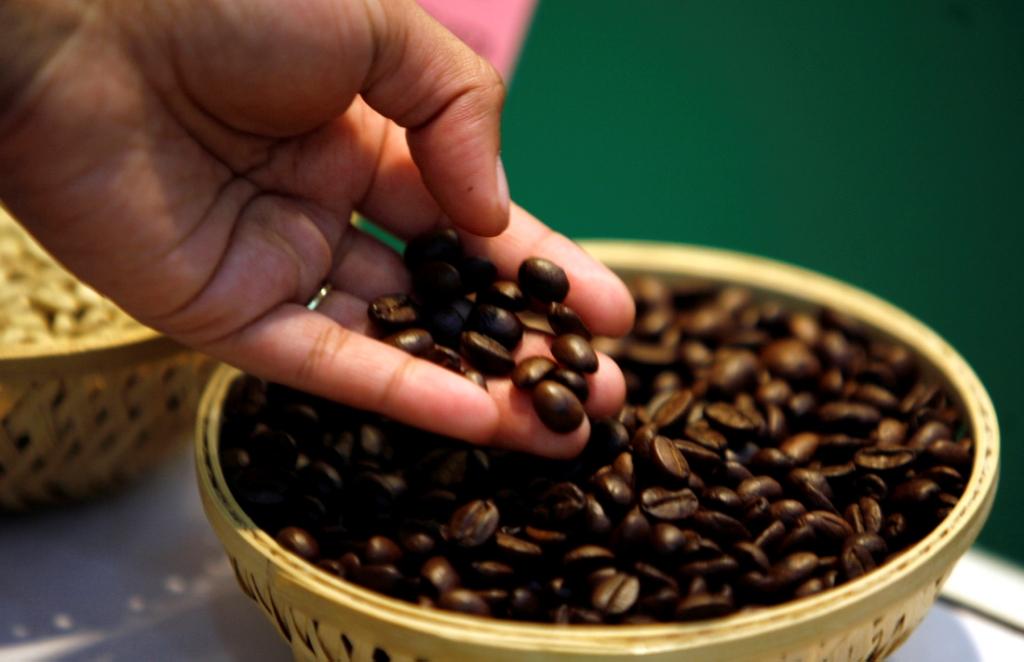
Zilient / ARCHIVE PHOTO: A visitor checks coffee beans at the ‘International Coffee Festival 2007’
Indigenous people in southern India are combatting deforestation by planting millions of fruit trees to shade their coffee crops
By Rina Chandran
Bangkok (Thomson Reuters Foundation):
Once forbidden by colonialists from cultivating coffee, indigenous people in southern India have won a prestigious award for their bean, which they farm while fighting deforestation.
Araku Valley Coffee won gold in the Prix Epicures OR Award in Paris earlier this month. The beans are grown by Adivasis – or “original inhabitants” – of southern Andhra Pradesh state through a cooperative set up by the Naandi Foundation.
The organic farming model has benefited more than 45,000 Adivasi families, with profits from the high-grade coffee put into schools, healthcare and other needs of the remote community, according to Manoj Kumar, who founded Naandi.
The initiative has been a success because it built on the strong connection that Adivasis have to the forest, he said.
“They fully embraced the concept of biodynamic farming, because it is a holistic approach that benefits the eco-system, and is in tune with their traditional beliefs of caring for the community and the forest,” he said.
“This is not just about food security; it is also about pride in living without government handouts, and conserving the forest,” he told the Thomson Reuters Foundation over the phone.
The Adivasis are also countering deforestation by planting millions of mango, papaya and orange trees to provide shade for their coffee crops, as well as in other areas, with support from the Paris-based Global Livelihoods Funds.
While India has pledged to keep a third of its total land area under forest and tree cover, a growing population and increasing demand for land for mining and other industrial activities are placing greater stress on forests.
Activists say a new forest law favouring commercial plantations would undermine indigenous rights over forests and lead to more logging.
Coffee estates thrived in the Araku valley’s cool climate during the British colonial period, but Adivasis were prevented from growing it and did not take up the crop after independence, according to Kumar.
That changed after the Naandi Foundation began working in the region 18 years ago, first setting up schools and healthcare facilities, and then helping to organise a cooperative to farm and market coffee.
Araku Valley Coffee soon commanded high prices in global auctions, and opened its first cafe and shop last year in Paris.
But the real challenge for the Adivasis is not picking coffee beans the right shade of red or deciding on a marketing plan; they face a more existential threat as forests disappear, Kumar told the Thomson Reuters Foundation.
“The Adivasis have such a deep spiritual connection with the land and the forest,” he said.
“Taking that away from them is taking away their life.”
(Reporting by Rina Chandran @rinachandran. Editing by Jared Ferrie. Please credit the Thomson Reuters Foundation, the charitable arm of Thomson Reuters, that covers humanitarian news, women’s rights, trafficking, property rights and climate change. Visit news.trust.org to see more stories.)
Our Standards: The Thomson Reuters Trust Principles.
source: http://www.news.trust.org / Thomson Reuters Foundation News / by Home> Place / by Rina Chandran / October 15th, 2018
Foraging has long been a way of life for wild-food loving Coorg
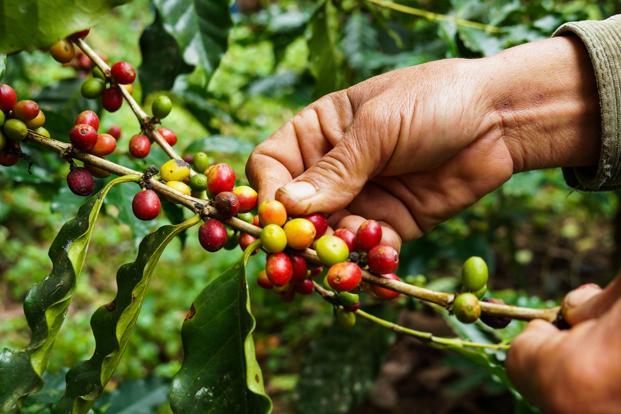
Coffee-picking at an estate in Coorg. Photo: iStock
René Redzepi, the foraging genius who stormed the culinary world with his New Nordic cuisine, would have a lot to smile about in Coorg. Here foraged ingredients don’t just put in an occasional appearance but are the main attraction, making Coorg an interesting region for true-blue wild-food pioneers. The eastern declivities of the Western Ghats that make up Coorg are extensively clothed in forests. Shade-grown coffee plantations offer the ideal habitat for rare flora and fauna to thrive as do sacred groves or devakads, designated as protected forests under the Indian Forest Act.
Against this backdrop is a staggering bounty of indigenous greens, weeds, flowers, fruits, berries, nuts, mushrooms and shoots, many of which play a starring role in the local cuisine.
Gazetteer Of Coorg, first published in 1870, devotes reams to Coorg’s jungle bounty: wild pepper, wild ginger, wild cloves, bitter local oranges known as kaipuli, rose apples, jungle mangoes, bastard sago—esteemed for its toddy—hog plums, several kinds of bamboo shoots, and an alphabetical list of over 60 ferns.
Locals keep their eyes open to what’s growing around them, constantly sizing up culinary possibilities. Freshly plucked cape gooseberries go into jams, a tangle of greens are added to stir-fries, and fronds of tender bracken ferns get pickled and ground into chutneys.
Kaveri Ponnapa, author of The Vanishing Kodavas, says in one of her earlier articles on Coorg: “Most women of my mother-in- law’s generation who lived on coffee plantations never set out on a stroll without the equivalent of the Russian avoska, the ‘maybe’ or ‘perhaps’ mesh bag—you never knew what surprise the season would throw your way.”
Several ingredients are unique to these parts. Like kachampuli, the dark vinegar made from the concentrated juice of the garcinia gummi-gutta fruit (called panapuli locally), which adds a sour kick to pork and fish dishes. And the famous Coorg honey, made from wild roses and forest blooms, which locals drizzle on akki ottis or rice rotis, and eat with ghee for breakfast.
Naveen Alvares, executive chef at Evolve Back Chikkana Halli estate, attributes this love of indigenous ingredients to Coorg’s unique geography and culture. “Kodavas, who make up most of the population, are ancestor worshippers and eat what is available off the land. Most have a plantation background or a sacred forest, so the connect with the land is very strong,” he says.
Walking through the resort’s lush plantations, among the oldest in Coorg, I see the coffee-forest symbiosis in full bloom. Coffee bushes sit beneath a canopy of silver oak trees that support festoons of black pepper. Ginger and turmeric, planted for intercropping, dot the forest floor. Jackfruits hang from trees. You can hear red-whiskered bulbuls chirruping.
Several exotic edibles are to be seen, many of them unconventional in the Indian context. As I stop to admire the bizarre artistry of a passionflower, Alvares smiles, “This is what makes Coorg special. It’s wildness.”
Dinner is a knockout pandi curry. The dark colour and complexity of this most iconic of Coorg pork dishes derives from dark roasted spices and kachampuli, a souring agent Alvares clearly loves.
I drive down from Siddapur to Madikeri the next day. The hour-long journey is jawdroppingly scenic. Acre after acre of coffee plantation presents itself, occasionally punctuated by the whoosh of a waterfall or the brilliant blue of a kingfisher.
A treasure trove of mushroom diversity, the Western Ghats are home to 750 species. Edible fungi known as kummu grow wild on Coorg’s hills and are highly prized for their exotic flavour. Vancouver-based blogger Shalini Nanda Nagappa mentions several varieties in her blog, A Cookery Year In Coorg—“feathery, delicate nucchi kummu and kokkalé kummu, succulent aal kummu, the giant nethalé kummu,..and the decidedly meaty pandi kummu.”
Only locals who carry with them an intimate knowledge of when, where and how to harvest the edible varieties can procure them, Nagappa points out. As a result, these treasures rarely make it to local markets and remain confined to the kitchens of plantation owners and local villagers.
‘Pandi curry’ at the Evovle Back resort.
The pleasures of kummu elude me during this visit, but I do feast on other Kodagu treats at Coorg Cuisine, a popular local restaurant in Madikeri. My lunch companion is M.B. Kumar, a Madikeri-based Kodava agriculturist and plantation owner. The wild mango curry, made with small jungle mangoes or kaad maange and black jaggery, is by turns sweet, sour and peppery. It’s unlike anything I’ve ever tasted. Chewing on a mango kernel, it is love at first bite.
The smoked pork, known as chillkana pandi, packs a meaty savouriness, while the freshness of the forest pervades a bowl of lightly fermented and sauteed baimbale or bamboo shoots. There’s pandi curry, of course, intensely flavoured and addictive as always. And akki ottis and kadumbuttus (rice balls) to mop it all up with.
To put pork’s near sacred place in Coorg’s cuisine in context, Kumar narrates a colourful legend. When Parvati expressed a desire to see Arjuna’s back (the great warrior never showed his back—a sign of weakness—during war), Shiva disguised himself as a hunter and shot a wild boar that Arjuna’s arrow had pierced. An altercation followed. As Arjuna fell over his opponent, his back was revealed, granting Parvati’s wish. A shower of flowers fell from the heavens and the pork was distributed as prasad to the hunting party.
The yarn illustrates the extent to which Coorg’s geographical seclusion has shaped its unique cuisine. “While we Coorgs (Kodavas) treat pork as prasad and offer it to our ancestors during rituals, it would be considered blasphemous to go anywhere near pork in neighbouring Mysuru,” Kumar laughs.
As we eat, Kumar draws my attention to the age-old tradition of foraging for monsoon greens, known as thoppus in Coorg’s interiors. The repertoire of seasonal weeds is dazzling. Thatte thoppu has a slightly bitter taste but tastes delicious with akki ottis and a little ghee; kakke thoppu with its purplish-black fruit is effective in deworming; therme thoppu or bracken ferns taste good simply sautéed with onions and pair divinely with eggs.
During mid-monsoon, on the 18th day of a period known as kakkada, Kodavas pick the leaves of a wild plant called madd thoppu and extract its juice to make a payasam.
The bustling Friday market in Madikeri is chock-full of these supergreens and more. Kembe (colocasia leaves) and kaipuli are up for grabs as are spices and meat. Walking around, it becomes abundantly clear that Kodavas are not just master harvesters, they’re also skilled at altering foodstuffs for preservation by yeast and bacteria. A huge assortment of jams and pickles made from the spoils of the land lines the local stores. Everything is home-made and unbranded.
On my last morning in Coorg, I drop in at Coorg’s Progressive Beekeepers Co-op Society store and pick up a bottle of wild honey to take back home. As I make my way to Bengaluru to catch my flight, the resinous, sour-sweet taste of kaad maange lingers on my tongue.
Wild foods, which grow in their natural habitat without fertilizers or pesticides, don’t deplete the earth’s resources. And they taste incredible. What if we, like Kodavas, thought of the forest as our pantry? Let’s tap into our vast underutilized permacultures and support the foragers who gather these ingredients. Let’s showcase our native treasures at the finest restaurants through dishes that startle with their newness and intensity.
Let’s go wild.
source: http://www.livemint.com / Live Mint / Home> Leisure / by Sona Bahadur / October 21st, 2018
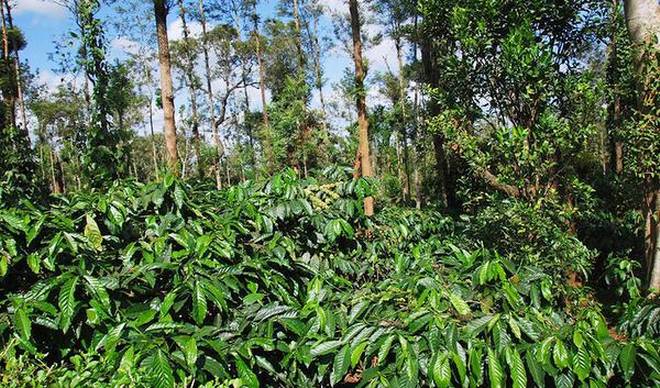
A coffee plantation in Kodagu, in the shade of silver oak trees. | Photo Credit: MAIL
Using silver oaks is detrimental for robusta
The exotic silver oak may be coffee growers’ preferred shade tree now, but research shows that it affects carbon sequestration and tree diversity in Kodagu’s agroforest systems.
Kodagu’s coffee farms were created when farmers cleared forest undergrowth and started growing coffee under the shade of giant evergreen trees. This ‘native shade’ coffee is still prevalent in the district, but evergreen trees are quickly losing out to the fast-growing silver oak. Farmers do not need permission from forest officials to lop or cut silver oak; this also contributes to its popularity. However, old forest trees make up a huge portion of carbon stocks here, and carbon stocks matter because the higher the carbon contained in vegetation, the more it helps with mitigating climate change.
Carbon stocks
To find out if carbon stocks change when silver oak takes over, a team including scientist Manjunatha Munishamappa from Bengaluru’s Environmental Management and Policy Research Institute studied a total of 49 native and exotic agroforestry systems – where either robusta (which needs more sunlight) or arabica coffee varieties are grown – near 18 forest patches that fall under both moderate and high rainfall zones. In each plot (all spread across 22 locations along the Cauvery river in Kodagu), the researchers quantified shade tree species diversity and the amount of organic carbon sequestered in the trees by measuring wood, root, litter and soil biomass. Across all plots, the researchers identified a total of 86 native tree species; and the total carbon stocks rose with increasing tree diversity.
Native trees in coffee estates and forests displayed high and comparable carbon stocks (approximately 193 and 222 megagrams (Mg) of carbon (C) per hectare respectively) as well as tree diversity (around 45 tree species). However, the introduction of silver oak negatively impacted both carbon stock and diversity. Predictably, robusta coffee estates with silver oaks had significantly lower tree diversity (nine species) and lower carbon stocks (up to an average of 65 MgC per hectare) than all other land-use systems in both precipitation zones.
Current trends
Hence, the current trend of replacing native shade trees in coffee estates with silver oaks is detrimental for carbon storage and tree diversity, especially in robusta farms. Current policies do play a role in this change, because the exotics can be cut for timber without prior permission.
“We have submitted two reports to the Karnataka government on these findings, we hope some policy changes will be incorporated,” he said.
source: http://www.thehindu.com / The Hindu / Home> Science / by Aathira Perinchery/ October 20th, 2018
The inauguration of Mysuru Dasara on Wednesday came with a special gift for the people of Kodagu, who were hit by floods and landslips recently. Infosys Foundation has announced a grant of Rs. 25 crore for construction of houses in the district.
Foundation chairperson Sudha Murty, who inaugurated the festivities, made the announcement in the presence of Chief Minister H.D. Kumaraswamy. In her address, Ms. Murty said her foundation would build houses for the distressed people of flood-ravaged Kodagu if the government came forward with land for it.
She also promised to contribute more for restoring the Hebbal lake in Mysuru, on whose rejuvenation the foundation is spending Rs. 35 crore. Ms. Murty is the first woman to inaugurate the Mysuru Dasara festivities in decades
source: http://www.thehindu.com / The Hindu / Home> National> Karnataka / by Special Correspondent / Mysuru – October 11th, 2018
A look at the variety of factors that go into brewing a truly green cup, from direct trade to responsible single-estate players.
Coffee is the most valuable legally-traded commodity in the world, second only to oil.
It is estimated that 2.25 billion cups of coffee are consumed each day, worldwide. Ironically, the poorest countries in the world (Guatemala, Ethiopia, Peru and Honduras are some of the top producers of coffee) are growing it, while it’s the richest who are drinking it (the top five coffee consumers are all European countries)… and at prices that get more absurd every day.
It is important to know that the coffee sold at retail is a different economic product from wholesale coffee, traded on the commodity exchange as green beans. And therein lies the rub. The money goes to those that process it. Coffee needs to be hulled, dried, roasted and ground before you can drink it. A big, shiny roaster inside your café means you can charge more than double what the farmer who grew the bean got for it. British charity Oxfam says the price of raw coffee exported from producer countries accounts for less than 7 % of the eventual cost of coffee to Western consumers.
The organic perspective
While certified organic coffee is sold at a premium, lower yields mean that farmers do not always profit in a meaningful way from obtaining certification, so most forgo it completely.
Fair Trade is a good option because the middlemen in coffee are so notorious. Coffee importers provide credit to certified farmers to help them stay out of debt with coffee buyers. But, the certification itself is expensive and there are several brands that practise fair trade without certification.
There are more than a few brands in India that make sustainable, fair trade, organic coffee nowadays. Black Baza is one of them. Founder Arshiya Bose, having done a PhD in the brew, believes a healthy ecosystem creates the best coffee. Black Baza supports their farmers with regular field research on healthy ecosystem indicators: spiders are the pest-control and butterflies, the pollinators. Not only is their coffee organic but the tree cover under which the coffee is grown also has to be 80% natural forest trees.
Organic coffee is mostly always shade-grown because of the large amounts of pesticide and fertilisers required to grow coffee under the sun. Indian coffee competes with large-scale, high-tech coffee estates in Central and South America, which were razed rainforests to begin with. They became so completely stripped of nutrients that in many areas of Brazil, the land could no longer be used for agriculture.
Little wonder that sun-grown coffee is the third most heavily sprayed crop in the world.
A constant struggle
I spoke to Kishore Cariappa of the famed Cariappa Coffee in Kodaikanal (with its own café). Their organic, single-estate, single-origin coffee, is easily one of the best in the country.
Kishore is a stickler for detail. Because the coffee is naturally rain-fed — with no artificial irrigation — the beans all ripen at different times. This means harvesting takes place several times to ensure only ripe berries are picked. It’s time-consuming and labour-intensive, but the only way you can compete with larger coffee companies.
His state-of-the-art roasting and processing machinery was bought to handle 200 acres of coffee. He had dreamt of starting a co-op of the farms in his village — tribal people that grew coffee organically under the shade of forest trees. He had even set up a system by which the farmers would get a monthly salary instead of the once-a-year bumper price that comes with the crop. But all the farmers in his village had already given their coffee out on five-10-year contracts to a clan of local coffee buyers.
“Educated farmers keep track of the prices in London and know what price to demand. But the average farmer doesn’t. They are not exposed to the Internet and their holdings are too small for export. Add to that the fact that they get an income only once a year, so they borrow money from this consortium of buyers and have their coffee locked on contract. This way, the international market prices don’t apply to them any more,” he says.
Kishore decided to go ahead with growing his own coffee and quickly realised that the only way to make money being a coffee farmer was to start his own café. It’s no dream job, though. “Growing sustainable coffee is hard. Organic coffee is so much more labour-intensive; which means expensive. To export, you need 20 tonnes per batch at least to fill a container. Coffee has to be fresh, even the green beans, so you have to send it in batches which is another added cost.”
Direct trade, where coffee roasters directly purchase from farmers, is also a socially sustainable choice. There’s no set standard, and there are no certifications. Roasters directly negotiate prices with the farmers, who typically earn a higher premium for their product. Blue Tokai coffee bags come with a detailed card on the farmer and the farm on which the coffee you ordered, was grown.
We are blessed to be growing some of the finest coffee in the world, and there are now plenty of brands that do it well. Keep it local, nourish our coffee traditions and support those that are making a difference.
source: http://www.thehindu.com / The Hindu / Home> Life & Style> Food / by Simrit Malhi / October 04th, 2018
“A forestdepleted Kodagu basin will have reduced capacity to capture and store rainwater.” It is a picture of destruction in Hattihole near Somwarpet, Kodagu, after the floods. | Photo Credit: Sampath Kumar G.P.
Protecting the Kodagu watershed is essential to ensure the water security of three States
We require water for everything: drinking, growing crops, producing electricity and industrial production. With the world population projected to grow to about 10 billion by 2050, according to the United Nations, and with climate change discernible, both the quantity and quality of freshwater will become critical, affecting health, food security, and economic well-being. A 2015 UN report, Water for a Sustainable World, pointed out that the gap between the availability of water and our need for water is only going to increase.
Projects in the river basin
The growing demand on freshwater resources demonstrates the need for sustainable management of water. In this context, projects that are being contemplated, such as the laying of multiple railway tracks in the critical Cauvery river basin in Kodagu district, Karnataka, are not only economically unviable but also ecologically damaging. Mega projects pose a clear threat to the long-term water security of the three States that depend on the Cauvery (Karnataka, Kerala and Tamil Nadu), and exacerbate the threat posed by seasonal droughts and floods.
The Cauvery basin drains an area of about 81,000 sq. km. Originating in Talakaveri, Kodagu, the river irrigates agricultural fields, generates electricity, and provides drinking water to downstream communities across south India. The Cauvery and its tributaries contribute the bulk of water to the Krishna Raja Sagara dam near Mysuru, the primary water source for Bengaluru. However, increasing development pressure from the transportation and construction sectors poses a severe threat to the forests, riverbeds, wildlife and agricultural lands. This March, for the first time in decades, towns such as Virajpet in Kodagu faced a severe shortage of drinking water. The continuing loss of forest cover and illegal sand mining from river beds endanger water and food security for all the downstream communities in the Cauvery basin.
The three proposed railway plans have major implications. One, all the tracks will cut through large swaths of agricultural farms and fields as well as Protected and Reserve Forests that are spread across Kodagu and Mangaluru districts of Karnataka, and Wayanad and Kannur districts of Kerala. Along this sparsely populated area, transportation needs can be met by simply improving existing roads at a fraction of the monetary and ecological cost of the proposed railways. In fact, in its feasibility report of the Mysuru-Thalassery line, the Delhi Metro Rail Corporation stated that the project would not be beneficial to the State. In response to protests by the people of Kodagu in February, the plan to build the Mysuru-Thalassery line was scrapped in March. However, if history is any guide, plans to build the tracks will reemerge in time.
Two, they will affect the Western Ghats, one of the most biodiverse regions on earth. Kodagu has about 45% forest cover and about 30% agroforestry systems (coffee plantations and paddy fields). Between 2013 and 2015, a high-tension power line linking Mysuru and Kozhikode resulted in the loss of about 50,000 trees in Kodagu alone. If the proposed railway lines are constructed, they would conservatively result in tree loss that is 10 times more than this. Forests help capture rainfall, reduce run-off and soil erosion, recharge groundwater aquifers, mitigate flooding, support local communities, and provide refuge for native flora and fauna. Raised railway tracks will also impede wildlife and could result in the deaths of endangered animals such as elephants. Most importantly, a forest-depleted Kodagu basin will have reduced capacity to capture and store rainwater. Even without the railway tracks, a satellite-based report titled India State of Forests 2017 noted that Kodagu lost 102 sq. km. of tree cover in just two years.
Variable monsoon
The Kodagu basin receives heavy rainfall, mainly during the southwest monsoon (June-September), that feeds the Cauvery. However, studies by the Indian Institute of Tropical Meteorology and others, published in the journal Nature, have found evidence for increasingly variable monsoon rainfall. Thus, we can expect to experience more extreme floods as well as droughts in the future. These are scenarios that make preserving forest cover more vital in order to mitigate the collateral effects of these extreme events.
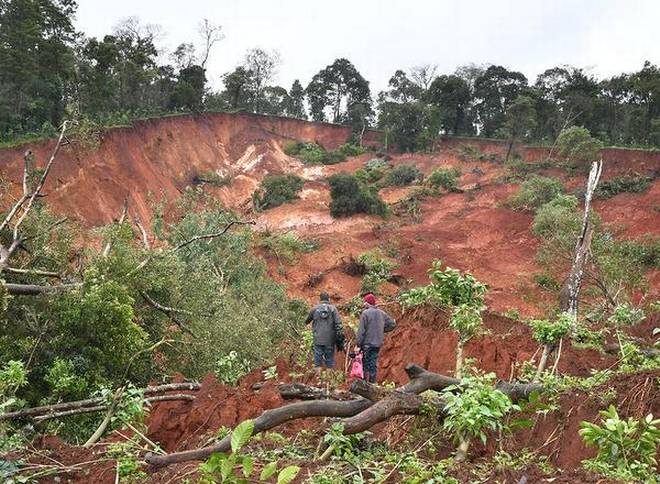
During this year’s southwest monsoon season, Kodagu received twice as much annual rainfall as usual and with greater intensity. This resulted in landslides and floods. A recent study of nearly 5,000 landslides around the world, published in Earth and Space Science News (Eos), has revealed that activities like construction, illegal mining and hill cutting are increasingly responsible for the uptick in fatal landslides, particularly in Asia. It will be hard to claim that the uncontrolled development and forest clearance in the steep slopes of the Western Ghats in recent years has not been a factor in the tragedy that just unfolded in Kodagu, and in the coastal districts of Kerala. With 100-year storms likely to become more frequent as the climate becomes warmer, business as usual is sure to increasingly endanger lives and property.
Erratic monsoon rains can cause flooding, droughts, water and food security. Preserving existing forests in the watershed provides an effective ‘insurance policy’ for reducing the effect of floods and droughts while recharging groundwater across the Cauvery river basin. Nature has reported that diminished access to water resources increases the risk of social unrest, political instability, intensified refugee flows and armed conflicts, even within borders. The variable nature of monsoons makes India one of the most vulnerable regions to water-related disasters associated with climate change and extreme weather events. According to a BBC report, Bengaluru is likely to run out of drinking water in the next decade. Economists should estimate the monetary and human cost of cities like Bengaluru becoming dry, and implement policies focused on achieving and maintaining sustainable water resources.
We are at the start of the UN Decade for Water, which emphasises water security for all. Everyone lives in a watershed, yet water remains a remote concept for those who consume it the most — people, industries and farmers. There are no substitutes for water as the very basis for life. Protecting the Cauvery’s source is essential for the sustained well-being of the entire basin and of the three States that the river nourishes. In fact, good water governance of the nation’s watersheds will be key to its sustainable future. We can begin by saving Cauvery’s cradle.
Bopaiah Biddanda is Professor of Water Resources at the Robert B. Annis Water Resources Institute, U.S.
source: http://www.thehindu.com / The Hindu / Home> Opinion> Comment / by Bopaiah Biddanda / September 24th, 2018
With donors from across the state contributing to CM’s Relief Fund, exclusively released to Kodagu district, over Rs 62 crore has been collected as on September 20.
Madikeri :
Following the natural disaster in Kodagu district, the numerous families that had lost houses and other properties were handed over Rs 3,800 – Rs 1,800 for clothing and Rs 2,000 for utensils and other household goods (per family)- under SDRF/NDRF guidelines.
Since the damage has been severe and the process of permanent rehabilitation will take some more time, the district administration including Deputy Commissioner Sreevidya P I and Kodagu District Minister Sa Ra Mahesh had proposed a request to the State government to increase the amount from meagre Rs 3,800/- per family to Rs 50,000, in a letter dated 28 August.
While the State and National Disaster Fund guidelines do not allow any changes to be made to the gratuitous funds, the state revenue department had stepped into people’s aid and had forwarded the proposal of releasing Rs 50,000/- each for the distressed families from the Karnataka Chief Minister Relief Fund-Natural Calamity 2018. The proposal, which was forwarded to CM H D Kumaraswamy was later forwarded to the Cabinet Committee for approval, which has now been sanctioned.
With donors from across the state contributing to CM’s Relief Fund, exclusively released to Kodagu district, over Rs 62 crore has been collected as on September 20. As many as 1,156 families have been directly affected by natural disaster and 186 houses have been damaged completely, 530 houses have been damaged severely and 404 houses have undergone partial damage.
While Rs 320 crore has been allotted to Karnataka under SDRF, an additional state fund of Rs 400 crore is provided to the state.
source: http://www.newindianexpress.com / The New Indian Express / Home> States> Karnataka / by Express News Service / September 22nd, 2018
Taking note of the geographical factors typical of hilly Kodagu also known for its origin of the river Cauvery, Sreevidya began vacating people the next day from danger-prone areas.
When the whole of Kerala reeled under floods last month amid rain-triggered landslides along its eastern mountains, just east of upstate Malabar, Kodagu too was hit by the calamity. Yet, if the people of southern Karnataka’s scenic district largely escaped the effects of the monsoon fury, a share of the credit goes to a Malayali bureaucrat’s prompt administrative initiatives.
A native of Kollam district in Kerala, P I Sreevidya was only eight months old with her capacity as the deputy commissioner of Kodagu when her office got information last month that the district along the Western Ghats was set to receive “very heavy and unusual rains.” Far from laughing off the alert received on August 12 through various agencies, the 2009-batch IAS officer swung into action.
Taking note of the geographical factors typical of hilly Kodagu also known for its origin of the river Cauvery, Sreevidya began vacating people the next day from danger-prone areas. Relief camps came up within hours.
As it rained cats and dogs on August 15 and 16, Kodagu lost 2,500 houses while crops perished in acres of farmlands. Roads developed cracks, some simply vanished.
Sreevidya, who had earlier served as Kodagu zilla panchayat chief executive officer for six months from mid-November 2013, opened a control room this time by her office, coordinating rescue and relief operations. She ensured that the district got aid from all the three arms of the service, besides the IAF’s special Garud commando service and the state police, fire force as well as the National Disaster Response Force under the Centre.
Joining her in the efforts were zilla panchayat CEO Prashanth Kumar Mishra, police chief Suman D Pennekar, MLAs Appachu Ranjan (Madikeri) and K G Bopaiah (Virajpet) along with other people’s representatives and social workers. The office of Chief Minister H D Kumaraswamy would enquire about the developments on an hourly basis. There were opportune interventions from state chief secretary T M Vijay Bhaskar.
“All these ensured that we could minimise the loss to property and the impact on public life,” says Sreevidya, who belongs to Chakkuvarakkal near Kottarakara and had secured 14th rank in her civil service exams. “I couldn’t even call home those two days.”
The bureaucrat’s four-year-old son Madhav, sensing the gravity of the situation, threw no tantrums and stayed quietly with his grandparents in the camp house.
As for Sreevidya’s husband, he is also a top officer. T Narayanan, who is Pathanamthitta district police chief, was that time busy in a similar rescue operation in his area. There, in south-central Kerala, the Pamba had swollen dangerously, invading places along both its banks, much to the trauma of their residents. “Believe me, I didn’t know his place was that badly affected. Neither did he know anything about the Kodagu floods,” says Sreevidya. “We were both cut off that time.”
Today, Kodagu people are all praise for their deputy commissioner. Social media posts, especially on Facebook, speak of Sreevidya’s administrative efforts that assuaged their misery.
source: http://www.english.manoramaonline.com / Home> Women / by Malayalam Manorama Correspondent / September 17th, 2018
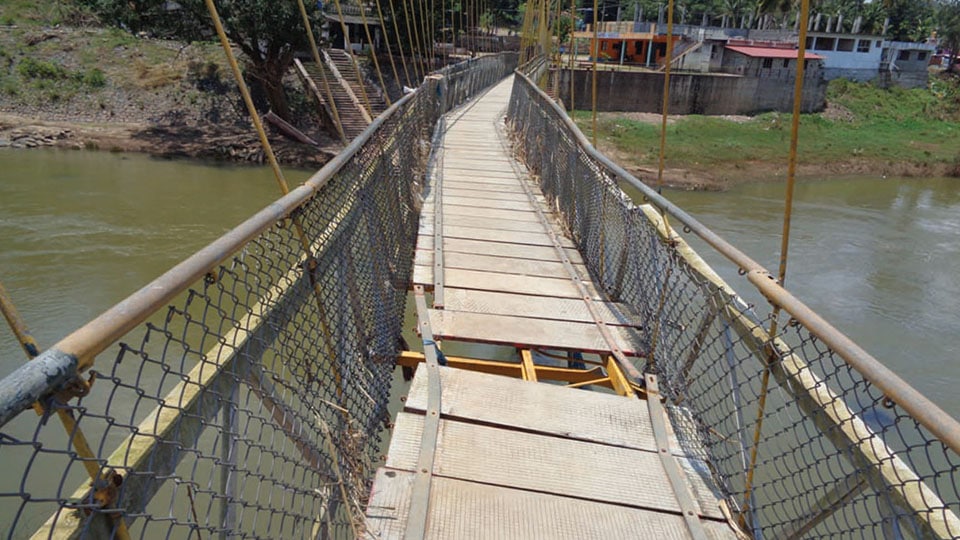
The hanging bride built across Cauvery River near Sri Ramalingeshwara Temple at Kanive close to Kushalnagar in Somwarpet taluk of Kodagu District has been severely damaged by recent floods that devastated Kodagu.
The hanging bridge connects villages along the border between Kodagu and Mysuru Districts. It also acted as a bond between villagers. The bridge with its unique nature, also attracted thousands of tourists. But heavy rains resulting in the flooding of Cauvery and Harangi Rivers, has caused huge damages to the bridge, which is on the verge of collapsing.
The Steel-Suspension Bridge supported by piers on both the banks of the river, has been so devastated by floods, that even pedestrians too are scared to walk on this bridge.
The steel rods that hold the bridge have broken and the wooden planks meant for pedestrian commute, have come apart. Thousands of people who depended on this bridge for their daily commute to work, are now scared about their future, with the bridge no longer safe for commuting.
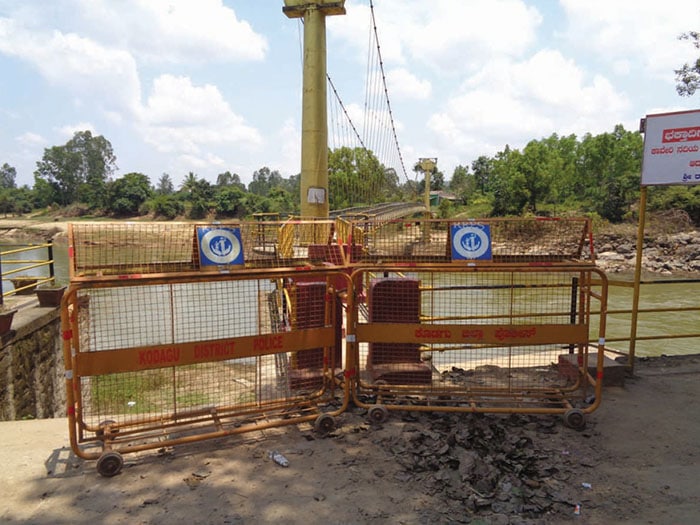
Entry to the bridge has been banned by the Police.
This hanging bridge was built eight years ago at a cost of Rs. 45 lakh, funded by Malnad Area Development Board (MADB), Shivamogga. Sullai’s renowned suspension bridge expert Girish and his team constructed the bridge using the latest technology. The bridge had been the dream of thousands of people living in villages along Kodagu’s border with Mysuru District. The bridge connects many villages of Periyapatna taluk in Mysuru District, including Dodda Kammanahalli, Shanubhoganahalli, Dindigadu, Muttina Mulluroge, Kanagalu, Hanumanthapura and Karadi Lakkanakere with Kodagu villages such as Kanive, Bhuvanagiri, Huluse, Hakke, Kudige, Mararu and Hebbale. Before the construction of this hanging bridges, the villagers had to cross the river on boats and on the dangerous bridge along the aqueduct built at a height of over 50ft. This dangerous and risky bridge was a bane to hundreds of students and labourers who used to commute daily. The authorities taking note of the daily hardship of the people, built this bridge at Kanive.
As flooding waters submerged this bridge and caused considerable damage to it, pedestrian movement on the bridge has been banned. The Police have erected barricades across the bridge. With the closure of his hanging bridge, villagers along the border are forced to take a detour of about 20kms via Avarti to reach Kushalnagar and other places.
With the recent floods weakening the bridge, the villagers have urged the Kodagu District Administration to repair this bridge at the earliest and throw it open once again for the benefit of villagers, who consider this bridge as a very important part of their life.
Unfortunately, for the people who depended on the bridge, the District Administration has not yet announced any funds to repair the bridge.
The bridge is crucial for the devotees to go to the historic Ramalingeshwara Temple and as the bridge is unsafe now, many people are robbed off the opportunity to go to the temple, said Bharadhwaj K. Anandatheertha, a writer from Kanive.
source: http://www.starofmysore.com / Star of Mysore / Home> News /
September 16th, 2018
WELCOME. If you like what you see "SUBSCRIBE via EMAIL" to receive FREE regular UPDATES.
Read More »