Category Archives: Green Initiatives / Environment

River Cauvery safe in Karnataka, say experts

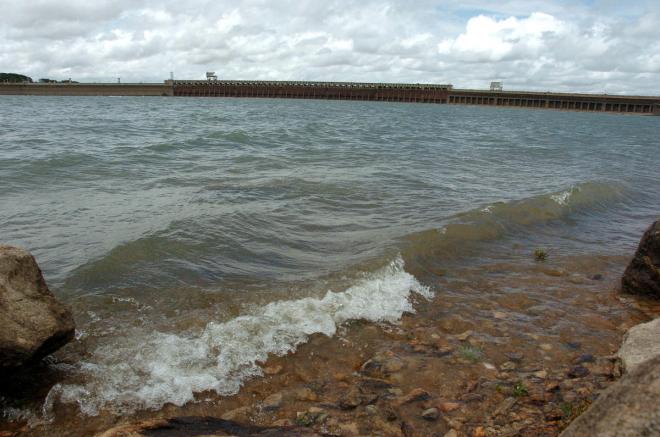
The backwater of the KRS dam. According to a KSPCB official, Cauvery river water in Karnataka falls under 'C' grade, which means it is safe for drinking after treatment. DH FILE PHOTO
The backwater of the KRS dam. According to a KSPCB official, Cauvery river water in Karnataka falls under ‘C’ grade, which means it is safe for drinking after treatment. DH FILE PHOTO

Environment experts claim that the report on River Cauvery published by Anna University, Tamil Nadu, may be partially true, but, the river water is safe for consumption in Karnataka.

S Srikantaswamy, professor in Environmental Science, University of Mysore (UoM), said, the pollution level at River Cauvery will be high during summer as water flow is less. The professor, who had conducted a study on River Cauvery two years back, said, “We cannot ignore the report, but, the pollution level in the river varies at different points in time.”

“It is true that the river, which has its origin at Talacauvery, in Kodagu district, receives wastewater from the starting point itself. The river flows amidst coffee plantations and the coffee pulped water is directly let into the river without any treatment. Similarly, the industries located along the river discharge wastewater (including toxic effluents) without treatment,” he said.

An official of the Karnataka State Pollution Control Board (KSPCB) said that he is unaware about the parameters of the study conducted by Anna University.

“The water in Karnataka comes under ‘C’ grade, which means it is safe for drinking after treatment. The report might be true as the river might be more polluted in TN,” he said.

In TN, a large number of small and medium textile dyeing industries, paper and sugar mills are located besides the river, and this could be the reason for high pollution levels. The pollution level during summer will be high as self-purification is low due to less volume of water flow, he said.

In Mysuru district, except sewage water in a few places, no industry releases wastewater into the river directly. The authorities monitor the quality of water every month at various places, commencing from Kodagu district up to the border of Karnataka, and the river water quality is good, he claimed.

Claiming that the River Cauvery in Karnataka is not polluted as much as River Ganga, he said, as per the physical appearance itself, the river is not much polluted.

source: http://www.deccanherald.com / Deccan Herald / Home> District / by Ranjith Kandya / Mysuru – DH News Service / December 25th, 2017

Coffee holidays: Unwind in nature’s lap with a hot cuppa

Karnataka, which accounts for over 70% of India’s total coffee production, is betting big on tourism around its coffee.

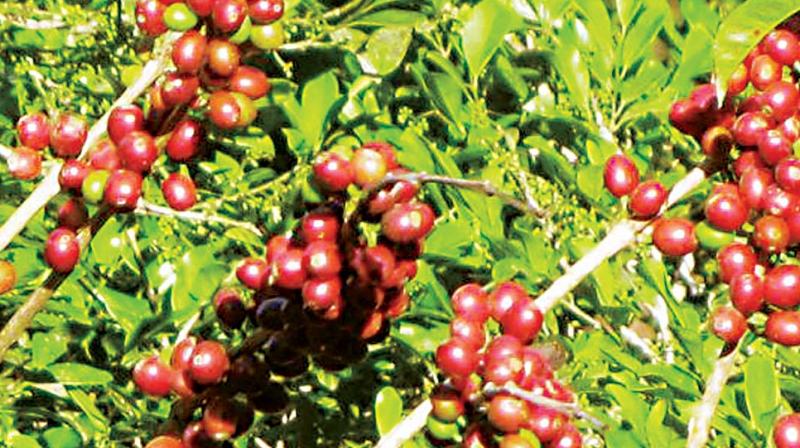
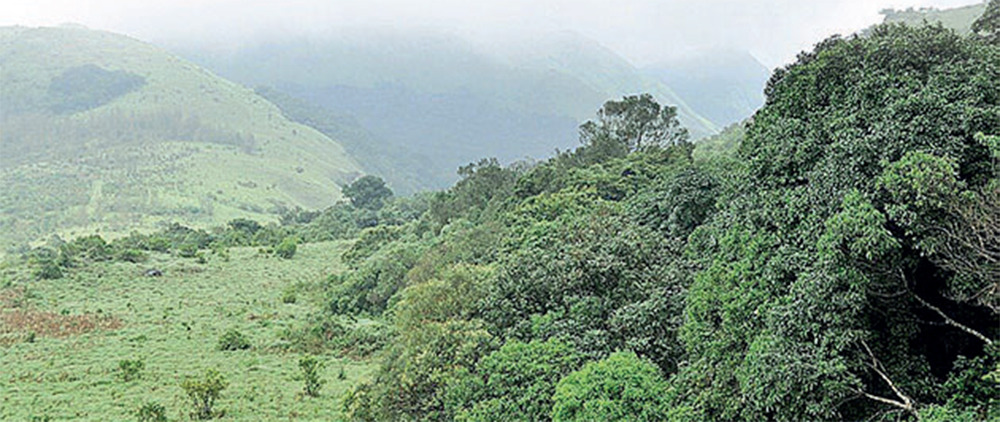
The last chunk of rainforest coffee on this planet is in India and grows along the Western Ghats covering Karnataka, Kerala and Tamil Nadu. (Photo: DC)

Bengaluru :

Karnataka, which accounts for over 70% of India’s total coffee production, is betting big on tourism around its coffee.

The last chunk of rainforest coffee on this planet is in India and grows along the Western Ghats covering Karnataka, Kerala and Tamil Nadu. Karnataka’s coffee gardens are a haven for wildlife, dozens of rare bird species, some 50 different types of tress apart from natural flora and fauna.
State Tourism Minister Priyank Kharge said a wide variety of farm and home stay options are available across coffee areas of Chikkamagaluru, Kodagu, Hassan, Sakleshpur and Baba Budan Giri (a mountain where first ever coffee in the country was grown in 1670), and Mullayanagiri (the highest coffee growing peek in Chikkamagaluru).

Kharge said, “We’ve recently eased a lot of restrictions around farm tourism and home stays, by decreasing the home stay registration fee to Rs 500 from Rs 10,000. We have also introduced additional incentives to encourage entrepreneurship in coffee tourism. We received home-stay registration requests from over 700 coffee farmers and estates in the last two months.”

Some of the activities promoted under coffee tourism include nature trails, trekking, pulping, bean plucking, drying, curing, roasting and grinding the coffee.

In addition, coffee lands offer amazing landscapes with unique culture and cuisines, he said.

Anil Kumar Bhandari president of Indian Coffee Trust said, “Corporates and real estate firms are eager to swallow huge chunks of coffee lands to build resorts, but coffee farmers with the help of the tourism department are trying to keep such elements out.”

Only individuals and families who are living in Karnataka for a minimum period of 15 years will be eligible for home stay licences.

source: http://www.deccanchronicle.com / Deccan Chronicle / Home> Nation> In Other News / by Mini Tejaswi / December 23rd, 2017

Karnataka : ‘ Tax tourists to preserve Kodagu’s green ’

CoorgGreenKF22dec2017

District wants to follow on Nilgiris’ footsteps, urges Payment for Ecological Services fund for the benefit of farmers and region’s ecology

Worried about the increasing tourism activity in Kodagu district, greens have urged the government to follow the Niligiris district administration and impose a green tax on tourist vehicles entering the district.

Recently, the Nilgiris district administration announced that tourist vehicles entering the district via the Burliar, Kakkanallah and Nambiar Kunnu checkposts will be charged a green tax of Rs. 20, which will be used for the maintenance of the district’s ecology. It is expected that the fee will be used by the administration to carry out restoration works and maintain the fragile Nilgiris landscape.

Sundar Muthanna, Bengaluru Co-ordinator for Coorg Wildlife Society, welcomed the move by the Nilgiris district administration and said this should be implemented at all entry points to Kodagu district too.

“Collecting a cess or tax from tourist vehicles is important at the entry points because tourism has a very negative foot print on the ecology. Some of the damage can be undone by the tourism industry itself. They cannot go on exploiting the land endlessly and they have to give back,” he said.

He said the money generated should be used for tree planting and rejuvenating the existing water sources. “The money thus collected must go to the Payment for Ecological Services (PES) fund. The idea for PES comes from the belief that a rich and diverse ecology is equal to economic capital for the state and the nation.

Through PES we can help the people of Malnad preserve the ecology they live in. A well-preserved ecology will encourage rainfall locally in the Malnad and in the neighbouring regions,” he said. The fund could be used to provide subsidies for Malnad’s planters and farmers, he said.

Paddy cultivation could be encouraged with this fund, as rice fields contribute richly to the streams and rivers, and help to make them perennial, or flow through the year. Cottage industries such as pepper processing, canning, coffee processing can be set up in each taluk of the districts of Malnad.

The entry point to Kodagu district is from Hassan, Mysuru, Dakshina Kannada and Kerala.

Dinesh Holla, convener Sahyadri Sanchaya, said uncontrollable damage has already taken place in the Western Ghats region of Kodagu and Chikkamagaluru. “Rainfall has reduced. The government talks about only development, but when environmentalists approach the minister requesting him to procure helicopters so that in case of forest fire, quick action can be initiated, we are told that we are not living in a foreign country. It is time that the youth come forward, raise their voice and protect whatever little is left behind in the fragile Western Ghats,” he said.

source: http://www.bangaloremirror.indiatimes.com / Bangalore Mirror / Home> News> State / by Deepthi Sanjiv, Bangalore Mirror Bureau / December 21st, 2017

CNC observes Huthari in traditional fervour

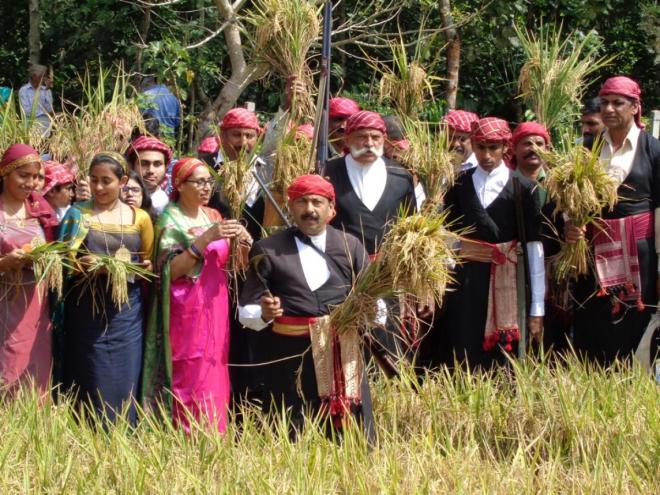
CNC President N U Nachappa and CNC members observed Huthari festival by cutting paddy sheaves in the filed of Uthappa at Chikkabettageri near Kushalnagar on Sunday.

The Codava National Council (CNC) led by its president N U Nachappa celebrated Huthari, the harvest festival of Kodagu, at a paddy field of Nandineravanda Uthappa, in Chikkabettageri village near Kushalnagar in Kodagu on Sunday.

By cutting paddy sheaves in the paddy field of Uthappa, the members celebrated the festival in a traditional manner.

The members offered prayers to the gods and began the Huthari celebrations with ‘Nere Kattuvo’ ritual. The leaves of mango, jackfruit, “Arali”, “Kumbali” and cashew nut trees were used in the ritual.

After the ritual, the participants walked in a procession to paddy fields accompanied by the ‘Dudikottpat’ (Dudi is a small drum of Kodavas).

After firing thrice in the air, the paddy sheaves were cut and brought home in a procession.

The CNC members performed traditional Kolata, Pareya Kali and Chowkata on the occasion. People relished Payasa, “Thambittu,” “Kadubu”, “Pandikari” and other delicacies on the occasion.

Speaking on the occasion, the CNC President urged the government to include Kodava language in the 8th Schedule of the Constitution.

He said that the government should accord tribal status to Kodavas.

The central government should declare a holiday for Huthari festival.

The CNC is continuing its struggle for an autonomous Kodava land and Kodava land should be declared a union territory. The culture and tradition of Kodavas should be included in the Intangible Cultural Heritage of Unesco, he said.

source: http://www.deccanherald.com / Deccan Herald / Home> District / by DH News Service, Kushalnagar / December 03rd, 2017

Karnataka : To save River Cauvery, Kodagu students send a scroll to Prime Minister Narendra Modi

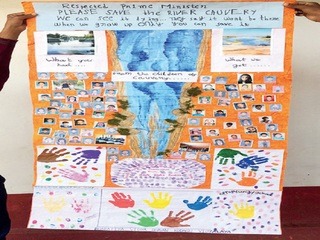
A group of children in Kodagu have written — rather drawn — to Prime Minister Narendra Modi, requesting him to protect river Cauvery which is under threat because of unplanned development activities. Instead of the usual way of writing a letter, the children opted for a scroll which has a series of paintings which depict the current state of the river.
ScrollKF25nov2017

Meena Cariappa, a social worker associated with the Opportunity School in Madikeri and wife of Air Marshal Cariappa (rtd), told Bangalore Mirror, “it is a scary situation the way river Cauvery is facing. While environment activists are working towards protecting the river, the children of Kodagu have joined hands in this mission and have attempted to draw the attention of the prime minister himself.”

She says if PM can look into the issue, the river can be a role model for the entire country itself.

She said, “Apart from a tweet to the Prime Minister’s Office, we have sent a six-ft–long scroll to the Prime Minister’s residence, hoping that he would look at it and there could be some change. There are many things happening in the name of development which is destroying the river, the lifeline of South India.”

The scroll reads: Respected Prime Minister, Please Save the Cauvery. We can see it dying and it won’t be there when we grow up. Only you can save it. There is a photograph of the Cauvery flowing in the centre. There are two photographs of the river on either side — one stating ‘what you had’ and another ‘what we get’. The entire text is handwritten on a recycled paper. It has pictures of about 100 students, though nearly 1,000 kids participated.”

“We have sent this scroll to the Prime Minister’s residence as part of Children’s Day celebration. We are hopeful that that he will respond to the students’ request. We are waiting,” Meena said.

source: http://www.bangaloremirror.indiatimes.com / Bangalore Mirror / Home> News> State / by Deepthi Sanjiv, Bangalore Mirror Bureau / November 23rd, 2017

Full of beans: Coffee grounds to help power London’s buses

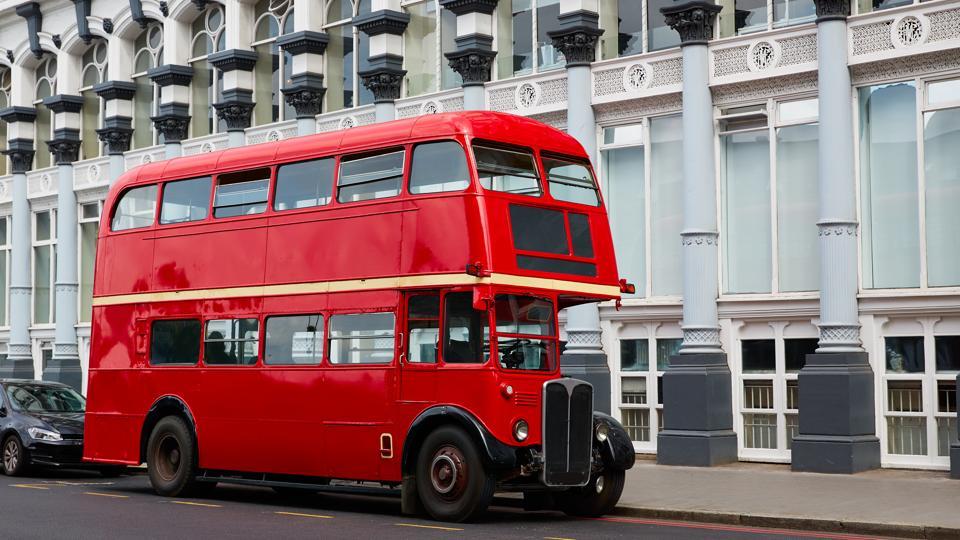
A new biofuel, which contains part coffee oil, is being added to the London bus fuel supply chain where it can be used without the need for modification.

Transport for London has been turning to biofuels to curb carbon emissions, trialling a fuel made with used cooking oil from the catering industry.(Shutterstock)

Waste coffee grounds will be used to help fuel some of London’s buses, Royal Dutch Shell and clean technology company bio-bean said on Monday.

A new biofuel, which contains part coffee oil, is being added to the London bus fuel supply chain where it can be used without the need for modification, the companies said in a statement.

Bio-bean and partner Argent Energy have so far produced enough coffee oil to power one bus for a year, if used as a pure-blend for the 20 percent bio component and mixed with mineral diesel to form a B20 fuel, they said.

Transport for London has been turning to biofuels to curb carbon emissions, trialling a fuel made with used cooking oil from the catering industry, the transport operator said on its website.

Bio-bean said the average Londoner drinks 2.3 cups of coffee a day, producing over 200,000 tonnes of waste a year. It collects waste grounds from high street chains and factories, which are dried and processed to extract coffee oil.

“It’s a great example of what can be done when we start to reimagine waste as an untapped resource,” bio-bean founder Arthur Kay said.

The coffee fuel technology has been supported by Shell.

source: http://www.hindustantimes.com / Hindustan Times / Home> World / by Reuters, London / November 20th, 2017

Need to protect Kannada stressed

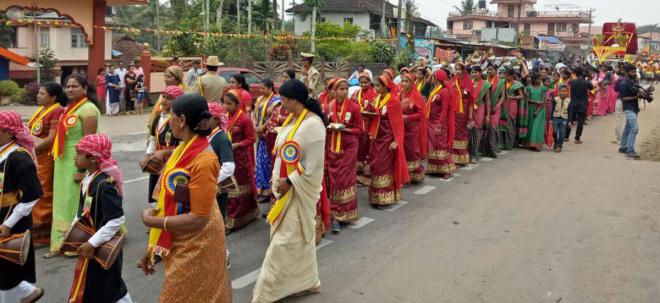
Sthree Shakthi members take out a procession.

There was a festive atmosphere at Ponnampete on the border of Kodagu district in Virajpet taluk, which is hosting a two-day district-level Kannada Sahitya Sammelan. A large number of students participated in the Kannada literary meet, which commenced on Saturday.

Inaugurating the meet, writer Dr Siddalingaiah said that there is a need to protect Kannada in Kodagu. “A few Malayalam name boards are found in the district. Kannadigas should be awake in the district.

There is no need for a Malayalam name board in Kannada land,” he said.

Stating that there are ample opportunities for promotion of tourism in the district, he said that the state government should chalk out programmes to safeguard the culture and uniqueness of the district along with the promotion of tourism.

Highlighting the importance of Kannada in the district, he said Kodagu Commissioner Cubbon had removed Lakshminarayanayya from the post of Diwan of Kodagu in 1838. He had written a letter to Governor General in Kolkatta highlighting the injustice met on him in pure Kannada.

Siddalingaiah said, “there is a need to restrict the purchase of land in the district by people from outside the district to protect the culture of the land.”

“Field Marshal Cariappa, General Thimmaiah not only brought fame to Kodagu but also the entire country. The people of the district not only guard the border but also protect the language.”

Kaveri nadi pradhikara
In her presidential address, Kechamada Subbamma Thimmaiah demanded the setting up of Kaveri nadi pradhikara.

She said “the test reports have confirmed that the water from river Cauvery at several places is not potable. The garbage and sewage from various places enter the river and pollute it. Cauvery is the lifeline of the state. There is a need to check dumping of garbage into the river. If left untreated, it could choke the river flow, ” she warned.

“The Kodagu district is the land of warriors and culture. There is a need to protect the culture of the land.”, she added.

Arameri Kalancheri Mutt seer Shantha Mallikarjuna Swami, Ponnampete Ramakrishna Sharadhashrama Swaroopanandaji Maharaj were present.

source: http://www.deccanherald.com / Deccan Herald / Home> District / Ponnampete – DH News Service / November 18th, 2017

City conservationists travel to Kodagu to protect ecology

Bengaluru :

A group of Bengalureans are out on a mission to restore the Kaveri catchment area in Kodagu to protect its biodiversity.Sheshadri, a conservationist and member of the Bengaluru-based group Forest First Samithi (FFS), believes that the word ‘conservation’ would not have existed in the English dictionary if people knew how to stay connected with nature. “It is because of our apathy that we have reached this pathetic state, where we fight with each other for even water,” he says.

Sheshadri along with IT professionals Meera Rajesh, Uma, Anil Panolil Chirikandoth and Dhandapany, formed this group in 2008 and they began their conservation work in Wayanad. They started working in Kodagu six months ago. The team works in association with Kodagu Model Forest Trust with an aim to conserve over 100 indigenous tree species of Western Ghats such as Saraca asoca, Mammea suriga, Garcinia talbotii, Dysoxylum malabaricum and Bridelia retusa. The team does rain water management to ensure maximum percolation to improve the ground water levels.

People from the community equally participate in the conservation of the biodiversity
People from the community equally
participate in the conservation
of the biodiversity

They encourage community participation as well. About eight people are working on this project. They are paid `8,000 per month from the funds that the team receives through online crowdfunding and friends. “A few IT professionals also contribute `5,000 from their monthly salary towards this cause,” he says.

Meera adds, “During the British Raj, the forest conservators were actually exploiting our forests for commercial benefits. We aim to make a headway in real time conservation of forest and ecology. It’s only then that our generation and posterity shall stand to gain and prosper.” The team is picking up some degraded patches of land across Kodagu with an attempt to protect them from cattle grazing and wild fires. Sheshadri says, “We clear dry grass and convert them to manure, hence, preventing wildfires from spreading.”

Funding is a major challenge for the project. The team is raising `7.30 lakh for this work through crowdfunding. If you wish to contribute for the cause, visit www.bitgiving.com. For further details about the team, log on to www.ffs.org.

source: http://www.newindianexpress.com / The New Indian Express / Home> Cities> Bengaluru / by Express News Service / November 14th, 2017

Forestry College wins overall championship

Students performed a peacock dance at Yuvajanotsava held at Forestry College, Ponnampet on Friday.

Forestry College, Ponnampet won the overall championship in the cultural programmes held as part of the two-day Yuvajanotsava at Forestry College in Ponnampet on Friday.

Students of Forestry College had won 106 points while students of Mudigere Horticulture College won the second place with 96 points. In the diploma category, the students of Brahamavar College won the overall championship while Kathalegere Diploma College won the second place.

Yuvajanotsava, under the title of Yuvaspandana, was organised by the University of Agricultural and Horticultural Sciences, Shivamogga.

Students of Ponnampet Forestry College and Mudigere Horticultural College presented a peacock dance, Pooja Kunitha, Nandikolu, Veeragasem Bhoothakunitha and others. Mudigere College students entertained the audience with Dollu Kunitha and Pooja Kunitha while students of the University of Agricultural and Horticultural Sciences, Shivamogga presented Lambani dance.

Rangayana Director Bhagirathi Bai said that youth have immense talent. Rangayana will organise College Natakotsava next month.

source: http://www.deccanherald.com / Deccan Herald / Home> District / DHNS, Madikeri / November 11th, 2017

Karnataka : Third edition of Barefoot Marathon to be held in December

Categories at the marathon include one-mile run, 10 km, 21 km and 42 km

The third edition of the world’s first barefoot marathon will be held at the Tata Coffee Sports Ground at Pollibeta in Kodagu on Dec 10.

Cheppudira Nikki Ponappa, professional golfer, coach and founder of Coorg Wellness Foundation, said the event is being organised with Milind Soman as part of the Coorg Reconnect Initiative by Coorg Wellness Foundation.

Ponappa said, “Barefoot marathon is an initiative through which we want the people of Kodagu as well as anyone who is a nature and wildlife lover to reconnect with mother earth and the best way to do this is by being barefoot. Through this event, we are trying to spread awareness about the rehabilitation of the elephant habitat and we want to replant the 54,000 trees that were chopped from Kodagu for a power grid. So, through the event, we hope to create awareness for planting native fruit trees in an eco-sensitive area like Kodagu. Our wildlife and elephants need to stay in the forest and enjoy their homeland.”

The organisers are expecting about 500 runners to participate from all over the country. “While for the natives of Kodagu, cash prize is awarded, outsiders who win prizes take home produce such as coffee and pepper. We want people to come and experience Kodagu and take back Kodagu with them. The entire event is an eco-friendly event with a ban on plastics. Even water is served in coconut shells. There are no loud speakers nor do we use electricity. The warm up begins with the folk music known as the ‘Vallaga’ and people will have to warm up by dancing the traditional Kodava dance,” Ponappa said.

Ponappa said the categories include one-mile run, 10 km, 21 km and 42 km.

source: http://www.bangaloremirror.indiatimes.com / Bangalore Mirror / Home> News> State / by Deepthi Sanjiv, Bangalore Mirror Bureau / November 10th, 2017