Protest planned against ‘ecologically destructive’ projects
Members of nearly 30 organisations have launched a “Save Kodagu, Save Cauvery” campaign to protest the ecologically destructive projects sanctioned in Kodagu on Saturday.
The activists will stage a protest in Kutta on the Karnataka-Kerala border to register their opposition to the 400 kV power line project passing through the district, the proposed railway line – one linking with Mysuru and the other with Thalassery in Kerala — besides linking of NHs cutting across the district.
“Most of these projects are not required for Kodagu which is an environmentally fragile and sensitive region and entails large scale felling of trees,” said Col. C.P. Muthanna of the Coorg Wildlife Society, which is also a part of the campaign. He estimated that lakhs of trees were at the risk of being felled to pave way for the projects based on the broad estimates of land acquisition.
“Each hectare of land in Kodagu supports nearly 350 fully grown and mature trees and one shudders to think of the extent of tree-felling that will take place given the vast tract of land that will be acquired,” he said.
The thrust of the campaign is to highlight the imperatives of conserving the catchment area of the Cauvery.
Rampant destruction of environment is evident in the depleting rainfall over the years and it is time to rethink such destructive development, according to activists. The railway line for Kodagu is being touted as an important link providing connectivity to the coffee market across India. But there is little value addition to coffee cultivated in Chikkamagaluru because of rail connectivity in Hassan, he said. The Mysuru-Kushalngar-Madikeri railway line has no real benefit to the district but could open up a can of new problems, including unbridled urbanisation of an environmentally sensitive region, he added.
The planned demonstration has received support from various quarters cutting across geographical region and the organisers have received endorsement from like-minded individuals and groups on social media groups as well.
The activists will congregate at Ponnampet and then go to Kutta where they will go in a procession at 11 a.m. and demonstrate near the check post on the border.
source: http://www.thehindu.com / The Hindu / Home> News> States> Karnataka / by Special Correspondent / Mysuru – August 24th, 2017
As Tamil Nadu gets set to mark rare event, devotees in the state seek a share
When it comes to Cauvery, nothing is simple between Karnataka and Tamil Nadu. This time, it’s about the puja being offered to the river on the occasion of Cauvery Pushkara, an event that is marked once in 12 years. The religious ceremony is a puja offered to the river aimed at plentiful rainfall and prosperity. While the Karnataka government has not made any plans to celebrate the occasion, Tamil Nadu, at the behest of Kanchi Mutt, has decided to hold elaborate rituals at three places.
The Pushkara tradition is associated with 12 major rivers of India, and this year it is the Cauvery’s turn.
According to Vidwan Ganesh Galapati, the Kanchi mutt has not only written to the Tamil Nadu government but also planned major functions at several places, including Hogenakkal, Nerur, Trichy, Thiruvaiyaru, Kumbakonam, and Mayiladuthurai. While the rituals will be held between September 12 and 23, the pundits in Karnataka are not happy with the fact that there has been no communication from the Religious Endowment department of Karnataka on the celebrations.
“The government did Parjanya japa in the first week of June and similarly it should also take up Pushkara ritual that has come after 12 years. Cauvery has been the backbone for both states. We all know what it would mean to not have any water in the river. As the purpose of the ritual is to pray for bounteous rains and prosperity of the state, the government must initiate a programme to take up the rituals either at Talacauvery or T Narasipur,” said Galapati. Bhagandeshwara Temple’s executive officer Jagadish Kumar confirmed that, so far, no such orders have been issued. “If the government issues any such order, we will arrange for such rituals.”
About the Puja
Vidwan Ganesh Galapati explains: “Each river is associated with a zodiac sign. Depending on where Jupiter is positioned during the cycle, the puja is done. This time, Jupiter will enter Libra (Tula) sign from Virgo (Kanya) by first week of September, which will be regarded as Pushkara Kala. The rituals will not only purify the river but also bring prosperity,” he explained.
source: http://www.bangaloremirror.indiatimes.com / Bangalore Mirror / Home> Bengaluru> Others / by Niranjan Kaggere, Bangalore Mirror Bureau / July 03rd, 2017
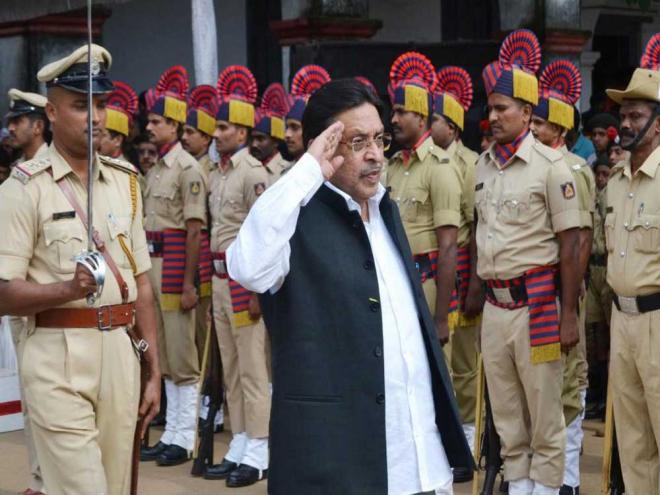
District In-charge Minister M R Seetharam receives guard of honour at the 71st Independence Day celebrations at Old Fort premises in Madikeri on Tuesday. Dh photo
District In-charge Minister M R Seetharam said that Kodagu district tops in the implementation of podi file clearance programme. Under the scheme, the officials have identified the exact boundary lines of land belonging to farmers and recorded them in relevant documents by awarding a new pahani in 115 villages of the district, for free of cost, he said.
Delivering the Independence Day address at the Old Fort premises in Madikeri on Tuesday, he said that 5,338 persons have benefited from the podi file-clearance programme of the government. This will be extended to all the villages in the district.
The minister said the concept of social justice and farsightedness is the guiding force behind the functioning of the State government. “We have to walk on the path laid down by our forefathers. By understanding the concept of freedom, we have to strive for the development of the country by shunning the differences,” he said.
Stating that the state government has taken up development works in the district in the last four-and-a-half years, Seetharam said that displaced Diddalli tribals have been rehabilitated near Kushalnagar. The title deeds will be distributed to them shortly. The department of Science and Technology will builtsub-regional science centre at the district headquarters at a cost of Rs 4 crore. It has been proposed to set up a mini planetarium, at a cost of Rs 5.75 crore in the district, he said.
Further, he said that Rs 50 crore has been released for repair of rural roads in the district. Under Kodagu package, 122 works will be taken up. A sum of Rs 38 crore has been released for the development of state highway and district roads.
He said the work on zilla panchayat administrative building is in progress and is likely to be completed by next June. In the backdrop of drought, the state government has waived Rs 151 crore loans borrowed by 34,000 farmers in the district.
SPC, Seva Dal, NCC, Scouts, Guides, students of General Thimmaiah School, Kodagu Vidyalaya, Rajeshwari Government PU College, GMP School, St Michael Convent, St Joseph Convent students took part in the march past. The students of St Joseph School, St Michael School, Rajeshwari School and Kendriya Vidyalaya presented cultural programmes.
P M Shailaja, Mohammed Rafeeq and M B Muneer, who have been selected for Jeevarakshaka Award were felicitated on the occasion.
Students collapse
Unable to bear the heat, two students collapsed during the march past. The students were given first-aid.
source: http://www.deccanherald.com / Deccan Herald / Home> District / DH News Service, Madikeri / August 16th, 2017
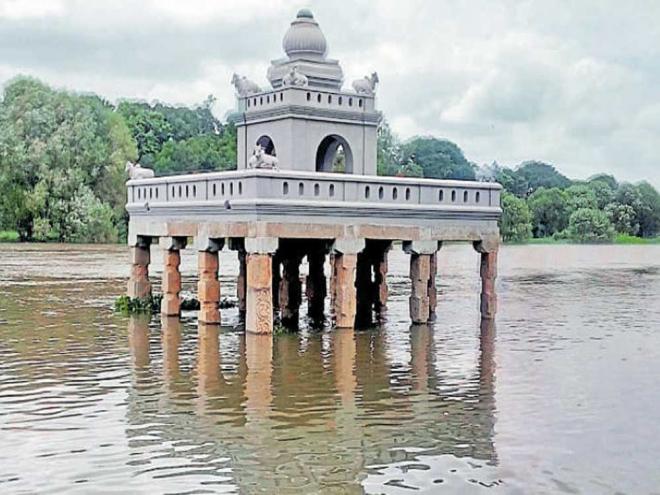
Hadinarukallu Mantap and the bathing ghat are partially submerged in swollen Kapila river following the release of water from Kabini reservoir in Nanjangud taluk on Sunday. dh photo
Reservoirs in the state continued to receive good volume of water despite a lull in monsoon showers. The inflow to Tungabhadra reservoir has increased following the release of water from Tunga dam in Shivamogga district.
The reservoir near Hosapete has received a staggering 8 tmcft of water since Friday. The storage level in the reservoir on Sunday stood at 26.211 tmcft. It was 18.305 tmcft on Friday. The inflow was 51,162 cusecs while the outflow was 2,359 cusec.
Harangi reservoir in Kodagu district is only 2 feet short of reaching the full reservoir level (FRL). The water level at Harangi on Sunday was 2,857.21 feet while the FRL is 2,859 feet.
About 1,200 cusecs water from the reservoir was released into the river.
Minor Irrigation, Superintending Engineer, M N Chandrakumar, said, “ Based on the volume of inflow to the reservoir, water would be released into the river in phases.
A meeting of the irrigation consultation committee will be held in Bengaluru on July 25. After the meeting, the decision will be taken to release water through canals for agricultural activities.”
Keeping in mind the safety of the reservoir, the water level would be maintained at 2,857 feet, said Executive Engineer S C Rangaswamy.
At present, the Harangi reservoir has a storage of 7.89 tmcft. The reservoir had reached FRL last year on July 10. The reservoir irrigates 1,34,895 acre farm land in Kodagu district and Periyapatna, Hunsur, KR Nagar in Mysuru district and Arkalgud in Hassan district.
Meanwhile, the six low-laying barrages-cum-bridges across Krishna and its tributaries in Chikkodi taluk in Belagavi district continued to remain under water despite a lull in showers in Maharashtra. Krishna river has recorded an inflow of 1.71 lakh cusecs on Sunday while its tributary Malaprabha received 20,113 cusecs. Doodhganga and Vedganga are flowing in full spate.
source: http://www.deccanherald.com / Deccan Herald / Home> State / DH News Service, Bengaluru / July 24th, 2017
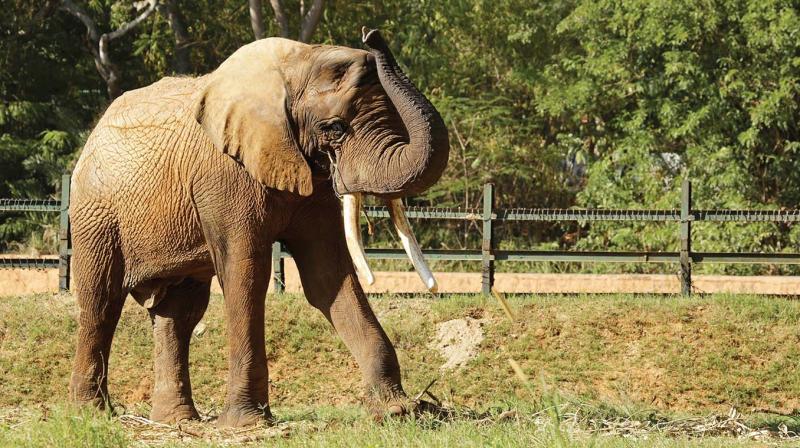
As many as four new animals have been added to the zoo which has also witnessed eight animal births. The animals will be available for public viewing after they finish the quarantine period. (Representational Image)
Mysuru:
Mysuru Zoo, celebrating its 125th anniversary, has new additions to its animal fraternity. As many as four new animals have been added to the zoo which has also witnessed eight animal births.
Zoo executive director Kamala said they have received two Lion tailed Macaques, Rama and Anitha, from Arignar Anna Zoological Park Chennai. The animals will be available for public viewing after they finish the quarantine period.
The quarantine period of a female and a male leopard, which the zoo got from Virajpet and Kushalnagar forests, on April 22 and May 14 respectively, has ended and they are now on display at the zoo.
Ms Kamala added that Mysuru Zoo has seen the birth of a Tufted Capuchin Monkey baby which is being nursed at the baby incubator in the zoo hospital. Also, two swamp deer fawns and three Gaur fawns were born at the zoo enclosure and two dusky lorry chicks have hatched in the zoo aviary.
source: http://www.deccanchronicle.com / Deccan Chronicle / Home> Lifestyle> Pets and Environoment / by Shilpa P , Deccan Chronicle / June 20th, 2017
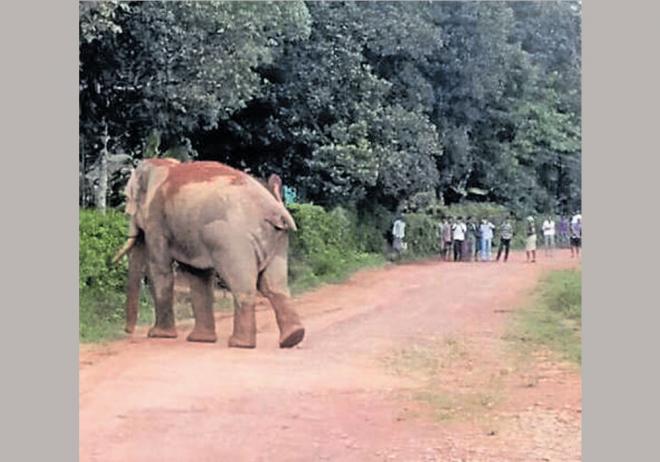
In 2017-18, three human and 11 elephant deaths have been reported till July 10. DH file photo.
The Forest Department is planning to set up a Coorg Foundation to address the increasing incidents of man-elephant conflict in Kodagu district which has a large pachyderm population.
This is the first time that the department is creating a foundation for a territorial area. It has already set up similar bodies in the tiger reserves of Kali, Bandipur and Nagarahole with a focus on man-tiger conflict to mobilise funds and to attend to the affected families.
The Coorg Foundation will focus on man-animal conflict in general and man-elephant conflict in particular. It will address the needs of the families affected by such conflicts.
“Our job does not end with giving a compensation of Rs 5 lakh to the family of a person who dies in conflict with elephants. We want to ensure that the education of the victim’s children is not affected and we will employ his wife, if needed. We will also provide for the affected family through the foundation,” P Anur Reddy, Principal Chief Conservator of Forests (Wildlife), told DH.
He continued: “We have chosen this district because many incidents of man-elephant conflict have happened in Kodagu. Setting up a foundation is in addition to the work already initiated by the department to reduce these conflicts. The foundation will do some hand-holding exercise for people and the affected families.”
In 2015-16, nine elephants and 13 people died in such conflicts in three divisions in Kodagu district (Madikeri, Madikeri territorial and Virajpet), Forest Department records show. In 2016-17, eight elephants and nine people were killed. In 2017-18, three human and 11 elephant deaths have been reported till July 10.
The proposal on the foundation has been sent to the state government for final approval. Work will start once the government approval comes, Reddy said.
The Forest Department, the wildlife division, village forest committees and eco-tourism units will contribute for the foundation, besides raising funds locally.
The foundation will be headed by the chief conservator of forests, Kodagu. The deputy conservators of forests of all three divisions, the heads of village forest committees and local administrators will also be a part of it.
source: http://www.deccanherald.com / Deccan Herald / Home> State / by Bosky Khanna / DH News Service / Bengaluru – July 11th, 2017
While liquor shops across the country are having to relocate in wake of the implementation of the Supreme Court order banning sale of liquor within 500 metres of national and state highways, a village in Kodagu on the Bengaluru -Mangaluru highway has decided not to allow relocation or reopening of vends.
A decision against reopening and relocation of liquor vends was taken unanimously at a recent gram sabha meeting in Sampaje village bordering Kodagu and Dakshina Kannada districts.
The village panchayat president, Balachandra Kalagi, raised the issue during the gram panchayat meeting and presented a written plea by villagers requesting the panchayat not to give `no objection certificate’ for shifting and reopening of closed bars and vends in Sampaje.
More than 25 letters signed by various organizations in cluding Dharmasthala Gramabrivrdhi Sangha, Shradha centres and self-help groups have been submitted to the panchayat administration urging it to stop liquor sale in Sampaje, to which Kalagi and other office bearers -BR Sundara, Kumara Chidkaru, BA Ganapathi, Tirumala, SN Pushpavathi -have agreed to.
The villagers have warned of an agitation if liquor shops are reopened.
“The panchayat has decided to reject applications seeking NOC for relocation or reopening of liquor shops,” said Kalagi.
He told TOI that the Sam paje village panchayat was among the four panchayats from Karnataka and 30,000 panchayats across the country to have received an award for its developmental efforts. The panchayat taps water flowing downhill and supplies it through a pipeline to its villages namely Pambechal, Chittegana, Kuntikana, Manyadka, Guddegadde, Arekalla and Kalyala.
source: http://www.timesofindia.indiatimes.com / The Times of India / News> City News> Bangalore News> Civic Issues / TNN / July 06th, 2017
The Travancore wolf snake sprawled near the bathroom mirror of the author’s room / Photo by Medha Saxena
Homestays in Coorg offer visitors a glimpse of a unique eco-system. Coorg or Kodagu is part of the Western Ghats that have been declared a world heritage site. It has many plantations that host hundreds of threatened species
It had beautiful dark coffee-brown scales with yellowish stripes and a sinuous slender body stretching no more than two feet.
The languid Tranvancore Wolf snake lay sprawled on the bathroom mirror. It had sneaked in to avoid the gentle night precipitation and was basking in the steam left behind by the hot water running earlier. It was hard to miss once the solar light was flicked on.
Gradually, it coiled back and slithered to a safer, darker corner behind the mirror. I was not sure at the time if it was venomous since it resembles the common Krait and is often targeted for the same reason. Suffice to say that I lay awake for most part of the night, wondering whether my nocturnal guest would like to take a peek at the room as well.
This was my penultimate night at the Rainforest Ecolodge on Mojo Plantation nestled at 1100-m altitude in Kodagu, Karnataka. The monsoon in a rainforest comes with its own delights and surprises. Leeches are a case in point. They crave to attach themselves to any warm body passing by to satisfy their desire for blood. But their presence also indicates a fertile soil and ecosystem. They are both the predator and the prey.
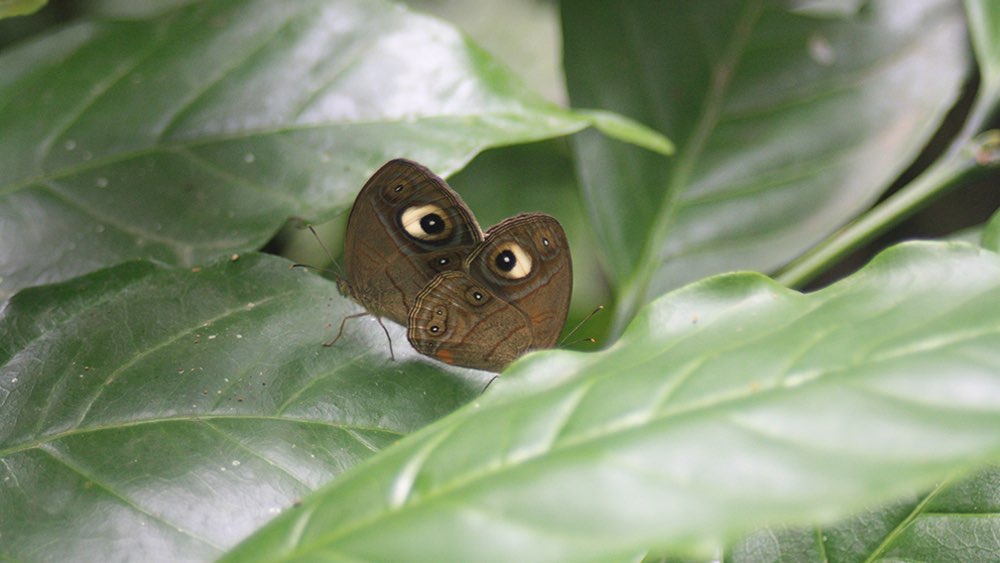
Beautiful butterflies found in plenty during monsoon in the rain forests of the Western Ghats / Photo by Medha Saxena
Then there are the frogs, toads, spiders, wasps, dragon flies, lizards, snakes and birds. Their tribe multiplies and diversifies with every shower of water it seems. And the heavens provide them plenty of those here. But they only proliferate in undisturbed habitats. Each one of the creatures that call the rainforest home have adapted themselves to it over the millennia.
Each adaptation and evolution is a fascinating revelation. Weaver ants are a marvellous example. Thousands of them coordinate with each other to stitch together nests out of leaves much bigger than themselves.
Trees themselves appear like curated art installations climbing vertically and horizontally. They are draped with vines, creepers, fungi, moss, lichen, orchids and a variety of other epiphytes that resemble emeralds and jewels on a bride. They glisten and shine best on bright wet mornings.
Twinkling fireflies circle the trunks during nightfall. The valley was covered with a million of these mating fireflies a month or so earlier in a perfect ‘symphony in light’ as the student-interns Meghna and Lily, working at the plantation recounted.
Being in a rainforest during monsoon is also a musical extravaganza. Its inhabitants are engaged in a synchronised performance at all hours of the day. Louder than revellers in a marriage procession the frogs and cicadas often accompany the sound of rain, streams and wind. The cacophony is coupled with serenity in equal measure. If you listen hard enough everything in the forest sings. But how many of us really listen?
Geography and Bio-Diversity
Kodagu is part of the wide-ranging Western Ghats, older than Himalayas, spanning from Gujarat to Kerala for 1600 kms. It directly intercepts the Indian monsoon winds. One of the eight ‘hottest hotspots’ of biodiversity, it has 325 globally threatened species (flora, fauna, bird, amphibian, reptile and fish) and many that are unique to this area.
The lush green forests also help with carbon sequestration and reduction of global warming / Photo by Medha Saxena
This mosaic of natural beauty was inscribed as a world heritage site in 2012 meant to be protected by the Western Ghats Natural Heritage Management Committee (WGNHMC) and receive international support.
The tag was achieved after much opposition by states that feared that development will be impeded. Critics said that an informed consent was not obtained from the gram sabhas and Forest Rights Act 2006 was not implemented properly during drafting of the proposal for grant of heritage status. It could also violate the historic customary rights of the adivasis.
The forests of Western Ghats, however, aid economy and transportation by keeping the ports and creeks along western coast silt-free. The forests and mangroves also help with carbon sequestration and reduction of global warming.
Other critics say that the declaration has no effect on damaging developmental activities. As recently as June 2, 2017, there were protests in Madikeri over destruction of wildlife habitat, Cauvery river catchment area and forest land for the construction of railways, highways and power lines. As more of the landscape is disturbed there is more human-elephant conflict. Illegal construction, mining and corruption have caused water scarcity during summer months in an area that is generally overfed by rains.
The ensuing struggles repeatedly point us back towards essential questions of what is development. Who is it meant for? Who do the forests belong to? And how are decisions to be taken in the interest of all parties concerned?
Organic Farming
In ancient times the exotic products of the Kodagu region were traded along the Silk Route and on oceanic routes via the Arabian Sea. Cardamom and black pepper were indigenous to this region. Rice was the main crop. Coffee was brought from Yemen to Chikmagalur in India by Baba Budanin in 1670.
Legend has it that the Coorg Rajas may have given land to Moplahs near Nalkanad who introduced coffee seeds to the area. In the mid-1850s many European coffee plantations sprung up followed by private Indian ones. When the British left, they sold their lands to the local population. There are strong remnants of British culture here, like the North Coorg Planters Club dating back to 1883.
A walk through the greens gives an idea of the rich biodiversity of the region / Photo by Medha Saxena
Now a good chunk of the land is covered in coffee, tea, rubber and palm oil plantations. Commercial chemical-based farming and unsustainable agriculture have eroded this landscape. Smaller landholders and farmers still find it difficult to turn a good crop and farmer suicides affect the Western Ghats as well. There has been an attempt to set up farmer-owned companies by Agriculture and Organic Farming Group India. Hundreds of homestays have also come up in Coorg in the past few years to complement agricultural income.
Sujata and Anurag Goel, owners of Mojo Plantation, have successfully experimented with organic farming doing multiple cropping with cardamom, black pepper, coffee and vanilla under the shade of the rainforest. Spice trees, fruits and vegetables are also grown in open areas.
A molecular biologist, Sujata Goel explained that fungi secrete enzymes to release nutrients from decaying wood and dead organisms. Shivani, the manager, described on a tour of the plantation that fungal mycelium act as telecommunication networks for the trees to convey threats. They are also used as biological pest control. Similarly, termites redistribute soil and recycle nitrogen. Even weeds have an important role to play as temporary hideouts for insects.
Plants themselves synthesise compounds (terpenes, tannins, phenolics) to repel insects and convey distress signals to other plants and predators. Chemical pesticides kill the natural defence mechanisms of plants..
The Wise, Old Relic
Meghna and Lily recount a magnolia tree that they variously describe as a ‘tree of life’, ‘tree mother’, ‘earth mother’, ‘magical beautiful wise old relic’ that has twists, turns and huge branches that one can climb and roots that open up into giant cave systems and tunnels underneath – in the middle of a coffee plantation.
It was ‘a metaphor for India’ for them, probably signifying layers of wisdom, age and continuity in a land of general mayhem. Neither trees nor our bodies survive in exclusion to their environment. The commune with nature is complete. If you listen carefully, everything in the forest sings.
The author teaches in Delhi University
source: http://www.nationalheraldindia.com / National Herald / Home / by Medha Saxena / June 10th, 2017
The JD(U) leaders offered baagina to river Cauvery at Triveni Sangama in Bhagamandala on Sunday.
JD(U) state president M P Nadagouda, women’s wing president Manjula Umesh, Kodagu district unit president Sunil Kumar, Mandya district unit president Basave Gowda also offered special prayers at Bhagandeshwara Temple.
Speaking to reporters, Nadagouda said the state government and opposition parties have failed to fulfill the demands of the people. There is a need for alternative forces in the state. In this background, efforts are being made to strengthen JD(U). With the both Centre and state governments mud-slinging against each other with regard to waiver of loans, the farmers are in distress.
Manjula Umesh said that farmers are backbone of the country. Having unable to repay the loans, the farmers are committing suicide.
source: http://www.deccanherald.com / Deccan Herald / Home> District / DHNS / Madikeri – June 12th, 2017
No new hotels or resorts can take shape in the Talacauvery sanctuary
The government has declared the Talacauvery Wild Life Sanctuary spread across 105.59 sq km as an eco-sensitive zone. This comes after the Environment Ministry notification on the proposed ecologically sensitive areas (ESAs) in the Western Ghats. The state has about five national parks and 27 sanctuaries, seven conservation reserve and one community reserve. The draft notification was issued on May 25 last year and the final notification was issued on May 15.
Kodagu Chief Conservator of Forest Manoj Kumar told BM this is an eco-sensitive zone under the Environment Protection Act. As per the Act, the area around the protected area could be heritage sites and others and there has been a provision to declare them as sensitive zones. But this was not being done and the National Wildlife Board based on the Supreme Court direction had stated that it is about 10 km, if not declared. Hence, so far it used to be 10 km. “But we started rationalising the area and had sent a proposal. Each proposal is now being approved and the rest of the sanctuaries in the area around will soon be declared as sensitive zones. It is not the Kasturirangan report. It is a statutory requirement and the state government after discussion with the district administration and representatives had sent a proposal,” he said.
As per the notification the region around the sanctuary from 1-16 km has been declared as the eco-sensitive zone. No commercial activity such as mining can be conducted and no new industries can be set up here. It also prohibits extension of industries that cause pollution, major hydel power plants, saw mills as well as rearing of animals. This declaration is also likely to hamper the union government highway project from Bhagamandala to Kerala’s Panathoor.
source: http://www.bangaloremirror.indiatimes.com / Bangalore Mirror / Home> News> State / Bangalore Mirror Bureau / June 06th, 2017
WELCOME. If you like what you see "SUBSCRIBE via EMAIL" to receive FREE regular UPDATES.
Read More »