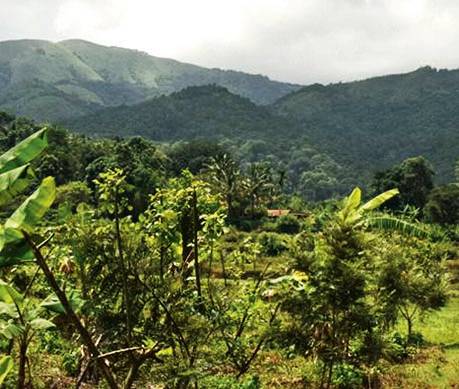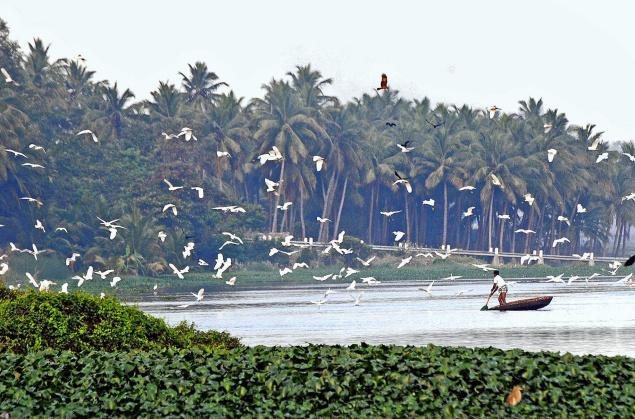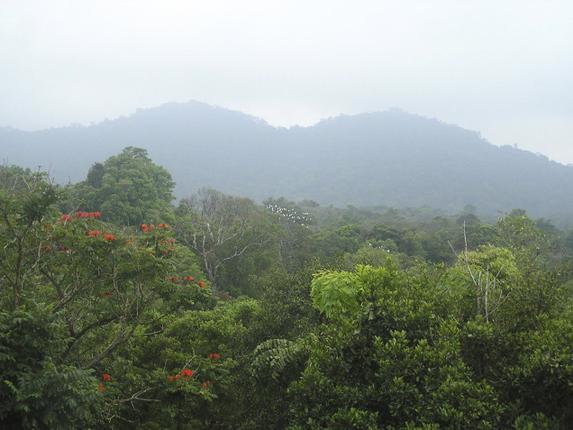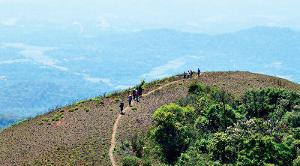
Railway minister Suresh Prabhu’s plans to get Kodagu on the rail map has run into trouble with Kodavas asking him not to extend the proposed Mysuru-Kushalnagar rail line.
The project was announced in this year’s budget. Following an RTI query by an environmentalist, railways officials have revealed that there are plans to extend the rail line to Madikeri and Makkanduru, a tiny village 3.5 km from Madikeri. Alarmed by the development, Kodavas living in Mysuru and Kodagu and environmentalists, too, have started tweeting urging him to stop the extension plan.
The online petition has got 11,976 signatures. Railway minister Suresh Prabhu has responded to the petitions and tweeted that he will go through the project in detail.
Aiyappa from Kodagu working in Vrindavan Hospital Mysuru told TOI that the railway project connecting Kushalnagar has not yet got the green signal. He fears that the line to Makkanduru village will affect Kodagu district’s natural resources.
Petitioners Sundar Muthanna, Shristi Kukreja and Fehmi Mohammad have started a campaign through www. Change.orglink. They fear that the estates and forests in Kodagu will be with the railway track. River Cauvery which is the lifeline of South India is under threat, claims the petition.
source: http://www.timesofindia.indiatimes.com / The Times of India / News Home> City> Mangalore / TNN / June 11th, 2016
On the eve of World Environment Day, Pamela Malhotra tells SRAVASTI DATTA about re-examining our obsession with technology and our lifestyles choices can have an impact on the environment
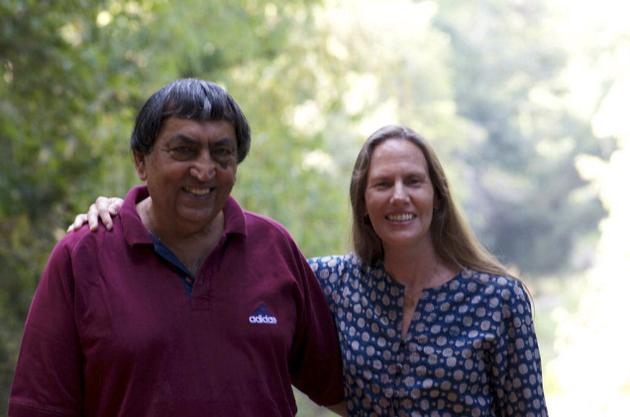
A.K.Malhotra and Pamela Malhotra
Her story is well-known. About two decades ago, Pamela Malhotra and her husband Dr. A.K. Malhotra bought 55-acres of land in the Western Ghats in Kodagu district, with the intention of reforesting the land that had fallen into various states of misuse. They Pamela and her husband were in the U.S. before they relocated to this land, in the Brahmagiri range, that is about 40 minutes away from Srimangala.
“K.M. Chinnappa of Wildlife First was the Warden at Nagarhole National Park when we first came to India in January of 1986. He It was he who encouraged us to buy land to protect in the Coorg/Kodagu district. We also met Ullas Karanth on that trip and also network with Ravi Chengappa of Cauvery Sene on environmental issues in the district,” says Pamela, who has dedicated her life toin protecting wildlife and the environment, and is a well-known speaker on climate change, watershed protection, bio-diversity and species extinction. Today that land has been converted into a 300-acres SAI (Save Animals Initiative) sanctuary of rich foliage and diverse species.
“The process took a long time. Did we ever expect to have the sanctuary we have today? No!” says Pamela, who was one of the speakers at the recently-concluded TedxBangalore.
“We took advice from the former owner of the 55 acres of land and the adivasis, because they have the knowledge of the native trees needed in that area. You need to understand which tree species belong where. The land was in various different conditions. The parts where cardamom was grown, there were a lot of shade trees, because cardamom requires a lot of shade, big native trees. But in the coffee plantations, big trees were taken out and there were smaller trees, because coffee requires sunlight. But coffee prices got de-regulated, so the cardamom plantations were pulled out, and they cut down the big trees. That was the first wave of deforestation. The second was when unregulated home stays were being built.”
Pamela says the Kodagu district is the source of fresh water for the Southern Indian peninsula. And so every drop of water that we take for granted in our cities is extremely precious. Bengaluru due to rapid, and often mindless, development is desperately holding on to the last vestiges of being a garden city. Even though forests do not lie within our immediate surroundings, we often take them for granted. Pamela says scientific studies have shown that 50 per cent of rainwater comes from forests, much more than oceans. So do we in our technology-obsessed cities have a responsibility towards Nature? Yes. Does the action of a single individual have an effect on climate change and conservation? Yes. Pamela says it is essential, therefore, to examine one’s lifestyle. “To save water, there is rainwater harvesting, recharging groundwater and conserving water. We also have to examine our obsession with technology. Do we need the latest iphone? Do we really need the latest tech toys? Rare earth minerals and materials are used in computers and mobile phones. And those materials, are just that, rare!”
Some of the measures we adopt to control diseases in cities is way off the mark. “Tanks are being poisoned to get rid of mosquitoes. But instead of poisoning tanks, see how we can breed frogs because they eat insects and mosquitoes. Swallows eat 2,000 mosquitoes! You could plant trees and small bushes in your backyard. It will also bring back small wildlife like butterflies and birds.”
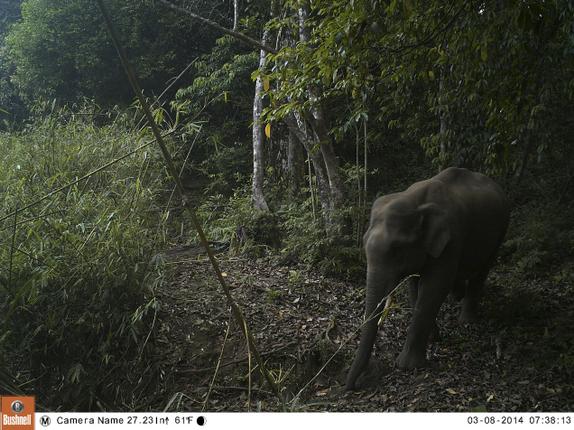
Elephant at SAI Sanctuary in Coorg
Pamela says conserving our rainforests is about survival. “It’s not a touchy-feely thing,” she emphasises. She reveals trivia about wildlife that is relatively unknown: “Elephants are the number one protectors of the forest. Recent studies by the Indian Institute of Science have shown the comparison between elephant impact on protection versus the roaming of domestic cattle. Elephants cover a 1000 square kilometre radius, while cattle cover a five km radius. Elephants also consume wholeseed, so they are scattered in their dung across a wide distance. It has also been proven that the seed in elephant dung sprouts much faster than those that even fall directly from trees.”
****
Brimming with wildlife, you can spot these at the SAI Sanctuary
Animals
Elephant, Gaur, Tiger, Bonnet Macaque, Jackal, Fox
Birds
Little cormorant, Little egret, Oriental honey buzzard, Butterflies, Malabar spotted flat, Pygmy scrub hopper
Snakes
King Cobra, Russell’s Viper, Common Sand Boar
***
Green up, clean up your city
Conserve water, resort to rainwater harvesting and charging underground water
Think about our obsession with technology. Do we really need the latest i-phone and tech toy? Rare earth material goes into the making of them. And as the name suggests, rare earth material is really, rare!
Plant trees or grow small bushes in your backyard. That will help attract small wildlife, like butterflies and small birds. Swallows, for example, can eat up to 2,000 mosquitoes, which can prevent diseases like malaria and dengue.
Instead of poisoning tanks to get rid of mosquitoes think of earth-friendly options such as frogs who eat mosquitoes
source: http://www.thehindu.com / The Hindu / Home> Features> MetroPlus / Sravasti Datta / Bengaluru – June 03rd, 2016
In an unusual act, the State Human Rights Commission (SHRC) has stepped in to save three tree species, especially in Coorg. It has asked the state government to withdraw its notification that included the three species, Hebbevu (Melia dubia), Belanji (Acrocarpous fraxnifolious) and mango, in the list of 23 trees exempted from the forest act which forbids tree felling.
The commission decided to act as the March 2015 notification was being misused to fell these trees rampantly in Coorg by the timber mafia. The commission, besides directing the authorities to check cases where the notification has been allegedly misused, sought a report by the state government. SHRC passed the order on May 21 after hearing a complaint filed by local activist K A Ravi Chengappa.
It’s an unusual action for the SHRC which deals with human rights violations, to take up the cause of maintaining green cover.
But this has been done considering it as one of key aspects supporting human existence. Chengappa is fighting an uphill battle to retain the greenery in Coorg. He has filed petitions with the High Court, Supreme Court and SHRC.
He had earlier filed complaints with the forest department and the Lokayukta too.
Chengappa said, “The order was being blatantly misused by those in illegal timber trade. Some forest officials were also handin- glove with them.” He said, “Only tree species grown by farmers in Coorg – like lemon, coffee and sapota (sapodilla) were exempted earlier (2002 and 2004). Now though including new species requires legislation, three species were included by the state government last year. Because of this exemption, Belanji which is a fine soft wood and which has grown naturally, is being felled rampantly. Wild mango, which is spread across forests and yields high value wood, is being rampantly cut and transported from forests. Even those in private lands are cut and transported. These species are spread across Coorg, Chikkamaga lur and Mangaluru which are part of Western Ghats. The government notification has proved detrimental and over 30-40 lakh trees face the threat of being cut.”
CG Hungund, SHRC member who has taken up the case, said, “The state government notification has many loopholes.
Prior to such orders, there should have been a mechanism of self-declaration by the land owners in place. This could have given figures on the number of trees. But now, there is no such thing. The trees are cut and transported haphazardly from the reserve forests. There is no proper mechanism to monitor the cutting and accountability is absent. Hence the government has been asked to withdraw the order as it may prove dangerous to state forests.”
Hungund has asked the chief secretary and principal chief conservator of forests to reconsider the notification and submit an action taken report within six weeks. Though the petitioner was successful in making government withdraw mango from notification, the other trees are being felled, SHRC brass said.
source: http://www.bangaloremirror.com / Bangalore Mirror / Home> Bangalore> Others / by Chetan R, Bangalore Mirror Bureau / May 28th, 2016
Verdant forests, picturesque mountains, lush coffee plantations — for many, Coorg is the perfect place to unwind. However, it was a different quest which took Arshiya Bose to the coffee land. A PhD holder in geography and environmental science from the University of Cambridge, she visited Coorg as part of a research project. Her mission — to make coffee production environment-friendly.
Realizing not all is well with the current production process — use of pesticides, exploitation of farmers, growth of coffee in the sun instead of shade — Arshiya, 32, started looking for ways to make it sustainable. She wanted to address these problems by adopting a holistic approach that ensures the well-being of both the environment and the coffee producers. The result — Black Baza Coffee, an entrepreneurial idea currently being incubated at the NS Raghavan Centre for Entrepreneurial Learning (NSRCEL), IIM Bangalore. The centre mentors innovators and supports their ventures.
During her research, Ashriya got the opportunity to work with forest dwellers and tribal communities in the Western Ghats, which helped her get closer to her goal. “I studied the social and environmental impacts of coffee production and found there were a number of problems no one was doing anything about. Traditionally, coffee in India has been grown under the shade of trees. But now, it is grown directly under the sun’s harsh rays, which adversely impacts biodiversity. Also, the trade market is extremely unfair to the producers, with the exploitation levels being very high. To fix the loopholes in the social and environmental ecosystem, I started Black Baza Coffee,” said Arshiya, who has tied up with many producers.
So far, the Kolkata resident has got 35 coffee producers on board, of whom 31 are marginal farmers from Biligiriranga Hills in Chamarajnagar. All of them are small growers —they own farms spanning less than 25 acres. “Under our partnership, we promise to buy coffee from farmers, support them through agronomic training and quality improvement and build safeguards for unforeseen price crashes. Many small growers are exploited and we hope to be the most fair buyer of their product ensuring they get their due,” said the young entrepreneur.
Explaining the potential of the idea, professor Suresh Bhagavatula, chairperson, Entrepreneurial Ecosystem Development, NSRCEL, IIMB said, “Coffee is among the top five most popular legally traded products in the world, including oil. It is a $90 billion industry and supports about 75 million people. While India is among the top 10 coffee-producing nations, it accounts for about 3.5% of the world exports. Unlike the rest of the world where sustainability and fair trade are becoming important for consumers, it is yet to catch on in India”.
“Black Baza Coffee would like to market the produce from farmers who practice sustainable methods for production. Consumption of coffee in India has started to increase, which will make it more feasible for ventures such as BBC to be established and serve the local markets as well,” Suresh added.
MUTUAL BENEFIT
We make conversational agreements with farmers and enter into a mutual understanding with them to grow coffee under certain kinds of trees, restrict the use of pesticides and protect their water resources. In return, Black Baza Coffee guarantees to buy coffee from these farmers at a higher premium
source: http://www.timesofindia.indiatimes.com / The Times of India / News Home> City> Bangalore / Shilpa Baburaj, TNN / May 25th, 2016
Minister questions absence of Spices Board in Kodagu
Assistance will be given for the setting up of environment-friendly industries in Kodagu district, said Satish Jarkiholi, Minister for Small Scale Industries.
Speaking at a review meeting here on Tuesday, the minister assured that financial assistance will be given for the setting up of small scale industries.
“There is an ample of opportunities for the setting up of food cluster, apiculture, fruit processing and juice units in the district. Land can be purchased at the market rate for the government projects,” he added.
The minister said that special emphasis will be given for the change in khata at industrial area in Kushalnagar. The MoU signed during the investors’ meet in the district will be implemented, he added.
“Black pepper is cultivated on a large scale in the district. The district should have had a Spices Board. Why has it not been set up so far?” he asked.
Deputy Commissioner Meer Anees Ahmmed said that 50-acre land has been identified in the district and all efforts are being made to set up a unit of the Spices Board.
Ketolira Fancy Ganapathy appealed to the minister to provide financial assistance for the setting up of food cluster, apiculture, piggery and fruit processing units in the district.
Textile park B N Prakash, District Commerce and Industries Association president, said that there is a need to set up an environment-friendly textile park in the district. A tiles factory at Madikebeedu has been closed down. There is a need to revive the tiles industry and promote pottery in the district.
The minister, who spoke to mediapersons later, said that government facilities have failed to reach all sections of the society. “Hence, there is a need to publish the report of the socio-economic survey conducted by the government last year,” he insisted.
source: http://www.deccanherald.com / Deccan Herald / Home> District / Madikeri – DHNS, May 25th, 2016
Task force formed for help during loss of houses, lives.
The City Municipal Council is all set to face eventualities from the heavy rain during monsoon in the next three months.
The Municipality has formed a task force to address the grievances of the people in case of house collapse and loss of life following heavy rain.
City Municipality Commissioner B B Pushvathi has directed the teams to visit the spots immediately in case of any mishap during monsoon. The task force members should not leave the headquarters from June to August, she added.
Problem places Areas like Tyagaraja Nagara, Rajarajeshwari Nagara, Ukkuda, Gaddige, Azad Nagara, Indira Nagara, Chamundeshwari Nagara, Jyothi Nagara, Ventakaramanna Layout, Rifle Range Nagara, Webs layout, Dairy Farm, Mangaladevi Nagara, Moornadu Road, Mangaluru state highway, Jayanagara, Sudarshan Layout, Ashokapura, Mallikarjuna Nagara, Thippegundi, Ranipete, Bhagavathi Nagara, FMC College, Putani Nagara, Dechur are likely to have rain-related mishaps in town. The artificial flood entering the houses and uprooting of trees on the road are common in these areas. The Municipality has deployed officials to such flood-prone areas to mitigate the damages.
Desilting drains She said that officials have been directed to remove the silt in the open drains for the easy flow of rainwater. Senior Programmer M N Sandhya and Second Division Assistant B R Harini have been given the responsibility of collecting information on the rain damage and submit it to the district administration daily. The revenue and health inspectors have been directed to shift the people in low lying areas to the safer places in case of necessity.
The City Municipality has appealed to the contractors to give utmost importance to the safety of the labourers working during the monsoon.
source: http://www.deccanherald.com / Deccan Herald / Home> District / by Aditya K A / Madikeri – DHNS, May 21st, 2016
Rakshana Vedike member opposes fire rituals for rains
Talacauvery Moolaswaroopa Rakshana Vedike Member Ulliyada M Poovaiah urged the government to retain the original glory of Bhagamandala and Talacauvery.
These two spots should not be converted into tourist destinations, he said.Addressing mediapersons here on Tuesday, Poovaiah said that in the official documents of the government, such as maps, Cauvery kshetra is mentioned as a tourist centre.
“The mistake should be rectified. Necessary measures should be taken to control the activities of tourists at the theerthakola (pond) of Talacauvery and Brahmagiri Hills. Security personnel should be appointed at the junction near Kailasa Ashrama and a gate should be erected,” he said.
Dress code
“Also, a dress code should be implemented at the Cauvery kshetra. The maintenance of theerthakola and Brahmakundike must be carried out as mentioned in the letter by Neeleshwara Padmanabha Tantri to the deputy commissioner. The water of the theerthakola has not been changed the last several months. The polluted water may cause harm to health. Hence, the theerthakola should be cleaned regularly. Measures should be taken to implement green police system in Talacauvery,” he demanded.
‘No rituals’
“There is an information saying some seers will perform sacred fire rituals at Talacauvery for rains. Singing the glory of God through bhajan and namasmarane is allowed, but sacred fire rituals are not entertained,” he said.
Ulliyada Poovaiah said that the plastic sheet above the brahmakundike is against religious beliefs. The cover should be removed immediately. The pooja timings should be displayed on a venue. The pooja should be conducted on specific timings.
Kodava Makkada Koota President Bollajira B Ayyappa, Talacauvery Moola Swaroopa Rakshana Vedike Convener Kokkalera A Cariappa, Secretary Karun Kalaiah, members Kodiyara Muttanna and Ratan Thammaiah were present.
source: http://www.deccanherald.com / Deccan Herald / Home> District / Madikeri – DHNS – May 12th, 2016
To restrict further crop damage caused by dry weather
Bengaluru :
The recent pre-monsoon rainfall in key coffee growing regions of Karnataka and Tamil Nadu is expected to help restrict damage to the 2016-17 crop, which has been impacted by the prolonged and higher than usual temperatures and delayed blossom showers.
The rainfall over the past few days has provided some relief to growers of arabicas, the premium and mild coffee variety, besides being seen as beneficial for the pepper crop, largely grown as a key intercrop in the coffee estates and arecanut plantations in the region.
“The plantation districts of Coorg, Chikmagalur and Hassan have received widespread rains over the past few days. The rainfall will help contain the damage caused by the delayed arrival of blossom showers,” said Baba PS Bedi, Chairman of the Karnataka Planters Association.
Blossom rain
Timely arrival of pre-monsoon showers is crucial for the blossoming of the coffee floral buds. Traditionally, the robusta and arabica variety growing areas should receive pre-monsoon showers for a good blossom by March 15 and April 15 respectively.
However, the blossom showers were delayed this year and were erratic in some areas, thereby hurting the prospects of the robusta variety. “It is too early to quantify the impact of delayed showers on robustas,” Bedi said.
Though some growers had taken up sprinkler irrigation for the robustas, the inadequate availability of water due to deficient rainfall in the last two years did pose a challenge to them. The coffee growing regions started receiving widespread rainfall from the first week of May, and some regions continue to receive rains. “It rained even today,” said N Bose Mandanna, a large grower in Suntikoppa near Madikeri in Coorg, on Thursday.
The rain has helped Arabica blossom and the crop should be good, provided there is no significant incidence of the pest – the white stem borer, Mandanna said. However, the delayed rainfall has already hurt the prospects of robustas in some areas, which cannot be reversed.
“It has been raining in most of the growing areas in Karnataka where coffee has blossomed,” said Y Raghuramulu, Director of the Balehonnur-based Central Coffee Research Institute. The rain should help in setting of the crop. Even the coffee growing areas of Tamil Nadu have received rain since last week, which is very good for the arabica crop, he said.
Crop estimate
“If only the rains had arrived two to three weeks earlier, there would not have been much impact,” Raghuramulu said, adding that the Coffee Board has started the estimating the crop size for 2016-17 based on the blossom, which is likely to be finalised by end-June.
After two years of good harvest, coffee is facing an off-year for the 2016-17 season starting October. The Coffee Board has estimated the 2015-16 crop at 3.5 lakh tonnes, a 7 per cent increase over the previous year’s 3.27 lakh tonnes.n
source: http://www.thehindubusinessline.com / Business Line / Home> Economy> Agri-Business / by Vishwanath Kulkarni / May 12th, 2016
Nagarahole first in the State to implement the project on experimental basis
PCCF B.J. Hosmath to inaugurate the project tomorrow
Mysuru :
With water bodies drying up due to lack of rains in almost all forests in the State and also because of scorching heat, the Forest Department has now turned towards solar energy to pump water to water bodies on an experimental basis at Nagarahole Reserve Forest, the first in the State to do so.
The project of pumping water to water bodies by utilising solar power will be inaugurated on Sunday (May 8) by Principal Chief Conservator of Forests (PCCF) B.J. Hosmath.
The Tiger Tank at Antharasanthe Zone in Nagarahole Reserve Forest, which used to cater to the needs of the wild animals, got dried up about three months ago and the animals were forced to go in search of water.
RFO Mahesh, who observed the animals moving in search of water, began to fill the water bodies using tankers, but it was not enough to cater to their needs. Hence, a borewell was sunk about 100 mts away from the Tiger Tank and a submersible pump was installed to pump water to the tank. Now, to supply power to the water pump, solar panels with 5100 watts capacity have been installed about 20 ft. above the ground and solar energy is being tapped to supply power to the pump.
A pipe is placed to pump water from the borewell to the tank, which is about 100 mts. away, and three litres of water is being pumped per second into the tank. The water pump will pump water for 6 to 8 hours a day with a total of 60,000 to 80,000 litres being pumped into the tank every day.
The solar panel is installed at a cost of Rs. 9 lakh and the cost was borne by wildlife enthusiast Tiger Ramesh, who had earlier donated CCTV Cameras to Bandipur and Nagarahole.
The Tiger Tank was drying up fast and we used to fill water to the tank using water tankers since three months. For the first time in the State, solar energy is being utilised in the forest to pump water to fulfill the water needs of wild animals. If this experiment succeeds, the same will be implemented in other places where there is scarcity of water.
— RFO Mahesh, Antharasanthe Zone
source: http://www.starofmysore.com / Star of Mysore / Home> General News / by M.T.Yogesh Kumar / May 07th, 2016
Local leader K J Bharat has urged the state government to develop Bhagamandala and Talacauvery in the taluk.
Addressing mediapersons, he said the government has neglected Talacauvery, the origin place of River Cauvery. Development works have been initiated here, he charged.
He claimed that soil has been dumped into paddy fields near Chamundi Bane of Bhagandeshwara Temple in Bhagamandala.
The soil, dumped on a large proportion and on a 100 metre wide and 10 foot tall area, will result in storm water flowing towards the temple and Bhagamandala, creating artificial floods. People cannot use the boats as the mud is dumped in front of the building where the boats are placed. Though a memorandum has been submitted to the local gram panchayat, no measures have been taken yet, Bharat charged.
He said Bhagandeshwara temple was renovated ten years ago. The kitchen and the room of the priest leak in rainy season. The tender process to carry out repair of the temple roof has stopped abruptly. There is no proper door for the temple. Though there is a fund of Rs 2 crore in the temple account, the officials are taking up repair work, he charged.
‘No safety measures’
Bharat said thousands of devotees and pilgrims visit Talacauvery and Bhagamandala every year. But their protection is not taken care of.
The bridge at Chedukaru in Tavoor village has collapsed. The bridge is only 10 years old and the narrow bridge constructed during the British period is still strong and vehicles move on that bridge.
The contractor who has constructed the Tavoor bridge should be blacklisted, he urged and warned of staging a rasta roko protest, if the demand is not fulfilled.
Local residents K S Prabhakar, K C Parashuram, Manoj Kumar, Yoganand and Poonaccha among those who were present in the press conference.
source: http://www.deccanherald.com / Deccan Herald / Home> District / DHNS – Madikeri, May 06th, 2016
WELCOME. If you like what you see "SUBSCRIBE via EMAIL" to receive FREE regular UPDATES.
Read More »